The Heavens; Interview with Michael Zeilik; Part 2
- Transcript
The more space you've got, the more space you've got. Your notions of time and space then, or have to be flexible. Yeah, you have to think of Ninestine's way of thinking about space and time. They're intimately coupled, and the simplest way I think about it is, as time goes by, space expands. Things move apart in the universe. Of course, don't ask me the question. Don't you dare ask me the question, especially when the camera's rolling out. What happened before the big bang? I love that one. Well, you saw the Pope, you know. They were talking about the satellite and the Pope and said, I think it's great everything you guys are doing, but don't ask anything about before the big bang. That's when God started all, and that's when it ends. My answer to my students is that, asking what happened before the big bang is like standing on the North Pole and asking what is North of a person standing on the North Pole.
And the answer is there is no answer. The question's wrong. Yeah, because you're linear thought process cannot accept a pre- That's right. If you think, if you ask the question, what happened before the big bang? You're assuming that time is still existing before the big bang, and that is the linear sense of time that we seem to perceive. And that's not it. Time ended. I mean, time started at the big bang, and if the universe collapses, time will end when the universe is in the big crunch. And we can't, I don't think we can see you easily of time beginning and ending. Therefore, we can't see you easily of the universe beginning or ending. We're going to go. Okay. We went to, uh, Sack Peak Solar Observatory in the very large array in the VLBG. Can you tell me about solar astronomy and its value to the rest of astronomy? It was interesting to me that we still really know relatively little about the Sun only studying it for four years.
Yeah, well, the Sun is our nearest star. We see it close up, warts and all. And because we see it close up, we have a heck of a lot more information about the Sun than we have understanding about the Sun. But the way to think about the Sun in doing research on the Sun from an astronomical standpoint is twofold. The Sun is a star. It's the nearest star. So the Sun forms the anchor of the solar stellar connection. The Sun, of course, is a single star at a certain time in its life of a certain mass and chemical composition. Other stars out there are different than that. But still, if we look at the physical processes that are occurring on the Sun and we can see those up close, we can apply the same physical processes to understand other stars. And that's really the Sun part of the solar stellar connection. The stellar part is more diffuse. Instead of being the anchor, it's sort of like the bait at the end of many, many rods. There's all those stars out there, all in different stages of their lives, different masses.
And we look at all those different stars and they give us a sense then of how stars change. We can't see any one star change in a human lifetime, not a lot. But we can imagine in our models how stars, when we look at groups of them, would be changing. Because when we look at groups of stars, some are at different ages, some are at different masses, and some of the different chemical compositions. So understanding the Sun helps us understand other stars in terms of the physical processes that goes on. It's our local laboratory. It's our local stellar laboratory. It's not far away. It's pretty big in the sky, and we can do a lot with it because we get a lot of life from the Sun. The other side of doing solar research is to help us here on the Earth understand long-term climate change. The Sun clearly is one of the main forces behind climate on the Earth. The climate is very complex. There's a lot of other things going on too. The Sun goes through Sunspot cycle, but most people know about. It's 11 years long. It goes through a magnetic cycle that's double the Sunspot cycle, 22 years long.
And there was a time back in the 17th century when apparently there were no Sunspots. And so maybe this whole idea of having Sunspots and having Sunspot cycles is something that only happens occasionally in the life of a star. And how that affects us here on the Earth, for example, in terms of climate, is unclear. We know the Sun has the height of its activity, has flares, and these flares can disrupt radio communications on the Earth. In fact, they knocked out in March of 1990. They knocked out a power grid in Canada because the flare emitted so much energy that disrupted the power network. So the Sun has those kinds of local direct effects. And of course, without the Sun, there wouldn't be life on the surface of the Earth. And it's really that simple and that profound. So if you can describe for me just simply if it's possible. It's pretty fascinating. The Sun is basically a couple of elements that are having a tremendous reaction with them. Well, the Sun, like us, the Universe and like us is mostly hydrogen and then helium.
There's not much helium in us, but there's a lot of hydrogen because a lot of water in our bodies. The Universe is mostly hydrogen. And it's the natural, I mean, here's the Sun. No federal regulations whatsoever. Nobody watching it, it puts out enormous amounts of energy over long periods of time, billions of years, by taking those hydrogen atoms and knocking them together at very high temperatures to fuse them into helium and releasing energy. That's the basics of stars. The fusion reactors, we're trying to make fusion reactors on the Earth but we're having a tough time doing that. A star does it quite naturally as part of its normal life and all the stars out there are basically fusion reactors too. Sometimes doing different elements besides hydrogen. But they're all up there glowing because hydrogen from the big bang is being fused into heavier elements. And then how did the planets then relate to this fusion reactor?
That's a good question. The planets are here because the Sun is here. Basically the planets were born and the Sun was born. We're kind of the leftovers from the formation of the Sun. It may very well be that planetary systems are fairly common. That you either get double star system or triple star system in no planets. By the way, double star systems are very common over half the stars in the Milky Way galaxy or double stars. If you don't get a multiple star system, you get a Sun with a planetary system. That's what I believe. The proof of that is yet to come. We're kind of the afterbirth of the formation of the Sun. However, there's this one particular planet that turned out to be just the right distance from the Sun. It wasn't too hot and it wasn't too cold. That planet is the perfect planet for us because we evolved on it and that's the planet Earth. And the Sun is important to us because we wouldn't be alive without it. Then we also visited the VLA and it's interesting to me we have one of the world's leading observation complexes for the closest star. We also have the world's largest radio telescope. Pretty remarkable observing distances. I think too great to really imagine how far away they're receiving things.
If you can explain what is radio astronomy and what is the very large array and how is it like optical astronomy and how is it different? Let's take radio astronomy first. You have radio in your car and you turn into your favorite station and maybe it's 104.1 on your FM dial. It turns out that out in space certain molecules, for example, emit at certain wavelengths. When you turn in a radio telescope to those wavelengths and detect that molecule, say carbon monoxide molecule, which is fairly common or water molecule, which is also fairly common in space, it's like tuning into your favorite radio station. You can observe that molecule in a gaseous form somewhere out in space and maybe millions of light years away. That helps us understand more about galaxies or more about stars. That's one way in which radio telescopes are different than optical telescopes because it's tuned into radio bands rather than into visible light bands.
The other difference is that the VLA works in a very special technique that involves spreading antennas around and acts like the zoom lens. When you spread the antennas out a lot, you zoom in to a small region of the sky to see a lot of detail. When you bring the antennas close together, you zoom out, you see a wider region of the sky, but you see less detail. You see this all at radio wavelengths, which are invisible to our eye. This gives us that additional information about galaxies that we can't see with regular telescopes. For example, in the great discoveries of the VLA, though there were hints of it before it was constructed, is that there are these enormous jets of electrons traveling close to the speed of light being channeled by magnetic fields over hundreds of thousands, sometimes millions of light years. You can't see this in visible light, but you can see with radio light coming out of the nuclei of active galaxies where there may be supermassive black holes, churning up the central parts of galaxies, eating up matter, and spewing out these streams of very, very high energy, very fast moving particles.
That was invisible to us before the VLA was constructed. If you could rephrase for me my kind of internet shell, what is radio astronomy? Radio astronomy is looking at the sky at radio wavelengths rather than visible wavelengths or x-ray wavelengths. For example, you have an AM or an FM radio in your car. An AM band is one band you can listen to. An FM band is another radio band that you can listen to. Actually, television is in a sense a radio band too. There are certain regions of the radio spectrum that astronomers have discovered can reveal more about the universe than others, so they tend to tune in on those bands. So it also then takes a tremendous amount of specialized computer technology to take all those signals and make some sense out of it? Only because of the particular way the VLA works. By spreading out antennas, we don't directly make images of objects in the radio with the VLA.
We make an image, but it's not an image that you would understand if you looked at it with your eye. Then you need a lot of computer processing to make an image that your eye can look at and then that your brain can understand and interpret and analyze. That's where the computer processing comes into play with radio astronomy. And then the VLA, what's significant to you about that? Well, the VLBA is probably going to be the next great tool of discovery and radio astronomy over the next 20, 25 years or so. What it is is the radio telescope almost as big as the Earth. And by making a radio telescope more spread out, the whole point of the VLA and spreading out the antennas is to see fine detail. Radio waves were long. And so in order to see fine detail of radio waves, you have to have a big radio telescope. But it's impossible to build a single radio telescope as big as the Earth. So what you do is you spread the antennas out instead and bring them together electronically and make images by computers.
And so we're going to be able to now have a radio telescope that's 100 times more spread out in the VLA. And that telescope will give us 100 finer times detail than the VLA can. And here comes our helicopter. Yeah, it's just going to stay. Do we need that? I don't know. I don't know. Let it fly over. There's a fly right over the observatory. Yeah, you'll take off your channel. If you could, boy, that was really great. It was just a lot of it was with... If you can just re-recover the point that you can focus so specifically by making it larger. The one thing you have to remember about radio waves, that radio waves are much longer than light waves. So in order to see fine detail with a radio telescope, you have to make a big radio telescope. But you can't make a big radio telescope. You can't make one that's 30 miles in diameter.
You can't make one that's 3,000 miles in diameter. What you can do instead is a special technique that the VLA and the VLA use is you spread out smaller antennas. And the more you spread them out, the finer the detail that you can see in the sky. And so with the VLA, we're getting the telescopes 100 times spread further apart than with the VLA. That means we'll be able to see 100 times more detail in the radio of the objects that we look at with the VLA. And one of the lessons you learn in astronomy is that when you can see astronomical objects in finer detail, you can start really seeing what's going on. They're far away. We can't see them very well, these objects that we look at that are millions and hundreds of millions of light years away. You have to see the detail to know what's going on. When you know what's going on, then you know the essential physics. And you can understand galaxies or clusters of galaxies or active stars, for example. So let's, as I was talking earlier with you, explore some other issues that I'll use just kind of as segues between the specific documentaries aspects of the program.
So these are very open-ended, pretty profound questions. 2000 years old probably. It's still comfortable about it. What is the heavens or the cosmos from an astronomer's from where you're coming from? From an astronomer's viewpoint, the cosmos is a fascinating, bewildering, mysterious, but understandable universe. It's important to understand that the word cosmos means order from an old Greek word. And astronomers see the universe as ordered, as pieces being linked and tied together.
You can't talk about the evolution of stars without talking about the evolution of galaxies. You can't talk about clusters of galaxies without talking about the evolution of the whole universe in the big bang. When you look out in space, an astronomer looks back in time, everything is revealed about the universe from the light that comes to us from all those distance times in the past. And we see page after page, time passed, after time passed. But it all links together. It all ties together. It's all part of the unity of the universe as we see it from a physical standpoint today. And it's that unity that then gives you beauty. And by looking at the universe as an astronomer, I see a beautiful cosmos. I see a cosmos in which humankind has a particular place.
Maybe simply to look out and see that the cosmos is beautiful. That may be enough. It may be more profound than that. We might know it now. We might know it five years from now. We might know it a century from now. But I think that's what astronomy is really all about. The beauty and the unity of the cosmos. I guess for me, I was quite surprised that it's also much more complicated. Can you just say something to the effect about with the discoveries how complex it's become? Neutron stars, quasars, black holes. Well, when you look at the universe, you look at everything. And everything means there's a lot of complex objects out there. During the last 20, 30 years, astronomers have discovered neutron stars, well, most likely black holes. We've discovered stars that have activity cycles that are much stronger than the suns. We've seen these jets coming out of the central regions of active galaxies. On the face of it, the universe looks very complex. But beneath that complexity is simplicity, simplicity of the natural order.
And that's what we have to do. We have to probe beneath what seems to be very complex objects in the universe and find the understanding of them by looking at the physical processes that unify them. And that's really what astronomy does. Physics and our physical understanding ties the universe together. It's the web that binds everything that we see. What is light? I'm finding the more I learn about light, the less I know what it is. Well, light fascinated Einstein. And you can actually attribute the special theory of relativity and Einstein's general theory of relativity starting off with Einstein being very puzzled about light. He said when he was young, he thought, what would light look like if you could run along with a beam of light at the same speed? Turns out you can't because that light would be moving away from you still at the speed of light.
No matter how fast you have to be running along. But that was a very profound question. Light is energy being carried by waves. And it's energy that has very special and sometimes very bizarre properties. For example, only light travels at the speed of light. And light can't travel slower, nor can it travel faster in the speed of light. And it's carrying a long energy. Is it moving along at the speed of light? Really without light there would be no astronomy. Without light there would be no life on earth. And so in many ways light is one of the fundamental pieces of the puzzle and of the unity of the universe that physics has come to understand more profoundly in this century. And in part because of Einstein's special theory of relativity. Is it like a substance? No, light is not a substance. And light in fact has an interesting property that itself propagates. It can travel through a vacuum. It makes itself go. Light consists of both electricity and magnetism sort of bound together.
And the magnetic field makes the electric field and the electric field makes the magnetic field. You may say that's on the strange, but how do you think we get electricity? We take magnets and we move them around. And so if you move them a magnetic field around, it makes electricity. But you can also think of light as being particles. It's sort of being a small little wad of energy that's moving along at the speed of light. And that's the other way to look at light. It can be a particle. It can be a wave. And how you see light, whether you see it as a particle or a wave, depends on the observer. And one of the profound discoveries of 20th century physics in quantum physics is that the nature of what you observe depends on how you observe it. And light is one of the best examples of that. It can be a particle. It can be a wave. It depends on how you look.
- Program
- The Heavens
- Raw Footage
- Interview with Michael Zeilik
- Segment
- Part 2
- Producing Organization
- KNME-TV (Television station : Albuquerque, N.M.)
- Contributing Organization
- New Mexico PBS (Albuquerque, New Mexico)
- AAPB ID
- cpb-aacip-191-35gb5r13
If you have more information about this item than what is given here, or if you have concerns about this record, we want to know! Contact us, indicating the AAPB ID (cpb-aacip-191-35gb5r13).
- Description
- Program Description
- Raw footage shot for "The Heavens." New Mexico is linked to the stars by the “observatories” of the ancient peoples at Chaco Canyon and Bandelier National Monument, and by the present day Very Large Array near Socorro, as well as the National Solar Observatory at Cloudcroft. This film explores the overwhelming sense of awe New Mexicans have about the wonders of the heavens from the earliest days to the present.
- Raw Footage Description
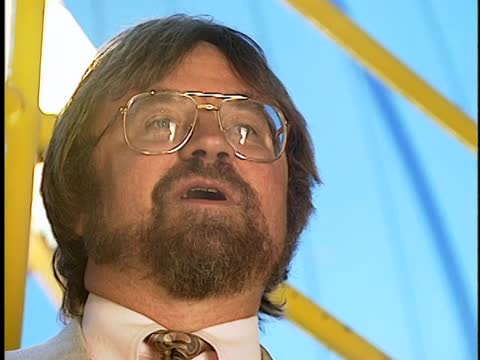
- This file contains raw footage of an interview with Dr. Michael Zeilik at the National Solar Observatory at Sacramento Peak in Sunspot, New Mexico. Dr. Zeilik discusses the importance of astronomy to Pueblo societies.
- Created Date
- 1993
- Asset type
- Raw Footage
- Genres
- Unedited
- Media type
- Moving Image
- Duration
- 00:20:16.537
- Credits
-
-
Interviewee: Zeilik, Michael
Producer: Sneddon, Matthew
Producing Organization: KNME-TV (Television station : Albuquerque, N.M.)
- AAPB Contributor Holdings
-
KNME
Identifier: cpb-aacip-941d015b86c (Filename)
Format: Betacam
Generation: Original
Duration: 00:30:00
If you have a copy of this asset and would like us to add it to our catalog, please contact us.
- Citations
- Chicago: “The Heavens; Interview with Michael Zeilik; Part 2,” 1993, New Mexico PBS, American Archive of Public Broadcasting (GBH and the Library of Congress), Boston, MA and Washington, DC, accessed April 2, 2026, http://americanarchive.org/catalog/cpb-aacip-191-35gb5r13.
- MLA: “The Heavens; Interview with Michael Zeilik; Part 2.” 1993. New Mexico PBS, American Archive of Public Broadcasting (GBH and the Library of Congress), Boston, MA and Washington, DC. Web. April 2, 2026. <http://americanarchive.org/catalog/cpb-aacip-191-35gb5r13>.
- APA: The Heavens; Interview with Michael Zeilik; Part 2. Boston, MA: New Mexico PBS, American Archive of Public Broadcasting (GBH and the Library of Congress), Boston, MA and Washington, DC. Retrieved from http://americanarchive.org/catalog/cpb-aacip-191-35gb5r13