The Heavens; Heavens; Part 3
- Transcript
We do, as we put CCD camera on the back end, and boom, all of a sudden you've got a whole new telescope, even though you have the same old telescope. Yeah, that's how it works. It's the detector at the back end that makes all the difference, yeah, and for the price of that TV camera, I bet that whole TV system probably costs about as much as our detector system costs, without the computer attached to it. Yeah, that's about 30,000. Yeah, that's about what it costs. That's remarkable. That's great. Alrighty. Okay, then as relating to time, yeah, what is life, what is space, what is time, so... Oh my god. What is, what is the space then, the sense of what space is? You can't talk about space without talking about time. That's what Einstein taught us.
The two are inseparable. You can't even think about space. And you can't even imagine yourself, say me, standing here, and talking. Without saying, well, he's at a place, talking at a certain time. And so space and time, those three dimensions of space in one of time, are totally linked together in the modern view of the physical universe. So you can't just talk about space and space. You have to add the time element in there too. If you look at the whole universe, what we see is the universe is expanding. Space is getting bigger as time goes by. It may be that our universe in the future, after it reaches a point in maximum expansion, will collapse. If the universe started in a big bang, it may end up in a big crunch. Then as time goes by, space gets smaller, and smaller, and smaller, until finally the universe becomes no space. And then there's no time. You can't even think about them anymore. In the Hawking film, they talked about imaginary physics.
That was really fascinating to me. Can you say something where they were saying, no, it's going to force us to rethink. Maybe there are two dimensions of time. Maybe there are different ways of looking at the physical world. Can you say something about some of those, I guess they're purely abstract, physics techniques? One thing you can say about scientific models and scientific theories in general is that they have to change. They always change. If they don't change, then it's not a scientific theory or not a scientific model. Right now our understanding of the universe is really based on Einstein's theory of general relativity. But the other big physical discovery of the 20th century was quantum physics. And physicists believe, people like Stephen Hawking believe, deepened their gut instinctively, that there is a unification of quantum physics in Einstein's general theory of relativity that must come about finally. And when that happens, we're going to look at the universe very differently because putting the two theories together isn't just going to make one plus one is a new theory.
It's going to multiply our depth of understanding and all of a sudden reveal new things or new understandings that we never anticipated before. That's what will happen. And that's really what Hawking was talking about when he talks about playing around in a realm of physics that's beyond the normal realm that most people deal with day to day. Can you, I don't know if it can, we explain simply then we don't have to bother, but could you give me what is the quantum physics and then what is the general relativity of time? Okay, very, very, very, very, very simply. And of course, this will make it slightly wrong. Very simply quantum mechanics, quantum physics says that as you get down to smaller and smaller and smaller levels, the universe is grainy. The universe comes in little chunks. For example, light comes in little chunks. The general theory of relativity says space and time are unified and that the universe consists of four dimensional space time.
And as you look at the four dimensional space time on smaller and smaller and smaller and smaller scales, it's still smooth. So space and time are considered to be fundamentally smooth in general relativity and not grainy. But quantum physics tells us that fundamentally at very small scales things are grainy. And so if the quantum physics and zero relativity ever get together, ever get married, we're going to find out that space time is grainy. And when space time becomes grainy, all of a sudden, maybe we'll find alternative universes, alternative dimensions, alternative flows of time or paths of time. Time isn't really linear. In fact, and the way physicists think about it, that's a human perception rather than the way physics understands the nature of space and time today. Okay, well then you just answered that next question, great.
One thing, what surprised I learned while doing this shows about the remarkable world scientific community. And could you explain to me what this world community of scientists is, how it interact, how people interact, and how do they benefit each other in the community? Science's world is really a worldwide enterprise that knows no national boundaries. And I say that as astronomer. There aren't too many astronomers in the entire world. There's maybe five, six, seven thousand astronomers. You can find almost more lawyers in Santa Fe, New Mexico than you can find astronomers in the world. Because of so few of us, but this is true of other scientific disciplines too. Because there are so few of us, though, in astronomy and so few telescopes, we tend to have work together. And in these days, we can work together electronically, very nicely, by using computer networks. We can use telescopes electronically that are remote sites, either on the earth or up in space.
I can communicate with my colleagues by electronic mail. We can send computer programs back and forth through each other. We can send images of objects of the universe back and forth over the computer networks. And because people are so curious about the universe, that automatically unifies us as scientists, as astronomers. And, you know, when I work with my colleagues in New Zealand, my colleagues in Spain, my colleagues in Hungary, my colleagues in the Norway or Sweden, I don't think of them first of all as being Norwegian or being Spanish or being from Mexico. I think of them first of all as being people with curious minds trying to understand the universe. And that's really what ties us together. And with the global network, the electronic global network that we now have, it's so much easier to do today than it was even ten years ago, that really, it's just like my colleague in New Zealand might live in another state next to ours. We can send electronic mail because they're the speed of light.
And so we really have the communications to make the connections to make this cooperative kind of science practical, possible, and powerful. Another big issue that came up was the pressure on scientists to justify our pure research. What to me just seems to be explorations into the nature of existence. How is this detrimental and give me some examples of how pure research is resulted in discoveries that would have been impossible to predict? Let me turn your question around. Let me take as the best example of pure research doing astronomy. Now, in a few ways, astronomy can benefit people directly. For example, if we understand how the sun effects climate, or if we understand and can predict solar flare, so we know when they're going to happen, so we can prepare for them on the earth. If we ever go out into space and have a space colony, those people have to know if flares are going to occur because they have to be shielded. Otherwise, the flare radiation will be lethal.
It will kill the people off on a lunar colony if they're on the surface of the moon, for example, during a flare star. There are these few areas where astronomy is practical. Astronomy actually sets your calendar too and keeps your time. But I really like to think of astronomy as being totally impractical, as being such a pure science that it really has no connections to what people do in their daily lives, except for one thing. Being fascinated about the universe curious about it and wanting to understand it. Now, if there's one thing that sets people apart from the other creatures of this world, it's that curiosity, that drive for understanding, and that drive towards understanding, which turns out to be a drive towards beauty. And there's really not a lot of difference between the impracticality of an artist and the impracticality of a pure scientist. But we both enrich, I think, the life of human beings on this planet. It was my next question when I was like, how I do mostly artists. I just come to see how great artists intensely research their subject matter and assiduously experiment as their theories before executing their work.
And that there's a particular beauty in the VLA or in-sense spot. Even that right there is exquisite, just because of what it looks like. So, what do you see as this connection, or this symbol? What do you see that is these similarities between artists and scientists and in-between great art and great science? The answer is really quite simple. Great art and great science finds beauty. Great art finds beauty, I think, mostly internally, and then it expresses it as a particular artist, might in whatever tools and crafts they use. A scientist is also a creative person. I think most people don't realize that. Scientists work in models. And those models are metaphors. And those metaphors like metaphors and poetry. Just as much as a poet tries to understand the world by writing a poem and having metaphors and analogies in it.
A scientist tries to understand and find beauty in the world by making up models that have metaphors and analogies in them to the physical world out there. Actually, what we're dealing with is the creativity of the human mind. So, I think that artists and scientists are similar in their drive for beauty, their drive for simplicity, their drive for understanding. The artist I think is trying to understand more human beings. The scientist is trying to understand more the nature of nature. But they complement each other exquisitely when you put the two together. I'd also like to say one thing about art today. In our Western cultural tradition, we've tend to have gotten fragmented. We tend to have gotten specialized. The universe is an overwhelming place. I specialize in a certain area of astronomy. All astronomers do, though that area of specialty may change as time goes by. And it will change. That's how I keep my creative juices going. What I see artists doing today, particularly artists who are influenced by astronomy and there are a number of them in New Mexico,
is I see the artist as the integrator, as taking that fragmentation that society has driven us to, has shatters us into by the way we live today and by the technology we have today and by our mindset that we have today. An artist takes that fragmented view of the world and integrates it and pulls it together in their creation. And I think that's where the artist play a role that's different from the scientist. The scientist sure is looking for the integration in the universe, but the artist is looking for the integration in the human being as the human being experiences the universe. So do you feel like we've lost contact with the heavens as lay people? And how do you feel about perhaps if re-taking it's perhaps the environmental problems of whatnot? How do you feel, you know, good about the future that maybe we're going to start getting a little more?
Like you said, like the photo of people's knowing that the equinox means something. I think that the average person in the United States today is very much removed from the stars. In fact, we're losing the heavens by light pollution quite dramatically. We're losing a natural resource. If you stand in Albuquerque, you cannot really see the sky very well. Try standing in Boston, Massachusetts and seeing the sky at all. You're lucky if you can see the moon when it's full. This is true in the LA area also. We've really lost our contact with the sky largely because of urban environments for their light pollution. And we're throwing away an element of beauty, a natural resource by doing so. And we have to preserve it. This is as much as we have to preserve wilderness areas so that people can understand what pristine areas of nature are like by being able to visit them. And we should be able to preserve dark skies. The world froze away, light to space, billions of dollars worth of energy per year. There's no reason to do that.
None whatsoever if we just think about it a little bit. And so, yes, I think people are disconnected from the heavens. I think the space program brought the heavens home to people, especially in the early part of the 70s. The problems of the space program is having now, though, I think has made people have a little more distance from it than they did maybe 10 years ago. But we have to remember that we're a planet, and we're a planet in the solar system. And we're bound to a star, and we're bound to many other stars in our Milky Way galaxy. And we're bound to an voyage in space and time that we have to understand and we have to live through. We're on a spaceship. We have to keep that spaceship operational. Otherwise, we're not going to make it. And finally, our technological world is brought about profound changes in the lives of people. And though, actually, physical time and space haven't really changed in our level of perception. And it seems that has happened what 350 years ago, or so, that as a culture, we may have to re-examine our notions of what space and time are as a result of physics.
And astronomy. Do you feel like we're coming? I mean, we're winding up the century, the millennia, et cetera. Do you feel like we're coming? And not because of that. But I mean, do you see something that there's something out there that we can learn that will help us have another view? Do you see that kind of shift in what I think they call paradigm, the paradigm of the times? There will be a shift in how we look at the universe and then in reflection how we look at ourselves in the Earth. I can't predict when that shift's going to occur. It's occurred a number of times, but you're right that has especially occurred about 300 years ago in Western European society. What kind of image we'll see? I don't know. I feel right now as an astronomer, and then it changes the technology that's made in astronomy, that we now see the universe through a very fuzzy telescope.
The new technology will give us sharper images of the universe. We'll bring into focus, and thereby into better perception in our minds, into better focus in our minds, what the universe is really like, and what space and time are really like, and whether or not quantum physics can really and must be unified with general relativity. But I would not want to be the person to make a specific prediction, except that it will change. It will probably change within a few human lifetimes, maybe not necessarily my lifetime, but maybe my son's lifetime, or maybe his children's lifetime. It won't be that long, and it will be profound. So ultimately, the questions you're asking is an astronomer are really not that different than those as a thousand, five thousand, ten thousand years ago. I think that people who are fascinated by the sky ask the same questions about the heavens. We just happen to ask them a little bit deeper out into space than people did a thousand years ago,
but I think people are asking the same question, what does the universe like? What's going on out there? He says the jet plane is fun, right? You heard that? I don't really hear it at the end, but on the telephone. Yeah. Somebody called our hotline. Let's hear it.
- Program
- The Heavens
- Raw Footage
- Heavens
- Segment
- Part 3
- Producing Organization
- KNME-TV (Television station : Albuquerque, N.M.)
- Contributing Organization
- New Mexico PBS (Albuquerque, New Mexico)
- AAPB ID
- cpb-aacip-191-278sfbfw
If you have more information about this item than what is given here, or if you have concerns about this record, we want to know! Contact us, indicating the AAPB ID (cpb-aacip-191-278sfbfw).
- Description
- Program Description
- Raw footage shot for "The Heavens." New Mexico is linked to the stars by the "observatories" of the ancient peoples at Chaco Canyon and Bandelier National Monument, and by the present day Very Large Array near Socorro, as well as the National Solar Observatory at Cloudcroft. This film explores the overwhelming sense of awe New Mexicans have about the wonders of the heavens from the earliest days to the present.
- Description
- Dr. Michael Zeilik interview
- Raw Footage Description
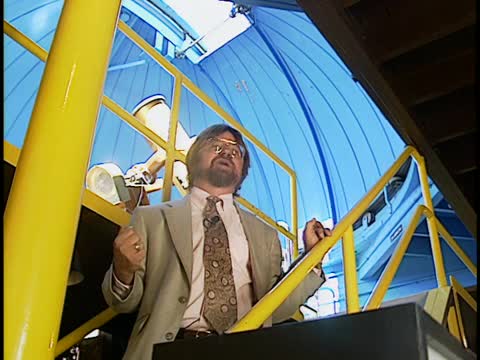
- This file contains raw footage of an interview with Dr. Michael Zeilik at the National Solar Observatory at Sacramento Peak in Sunspot, New Mexico.
- Created Date
- 1993
- Asset type
- Raw Footage
- Genres
- Unedited
- Media type
- Moving Image
- Duration
- 00:17:23.030
- Credits
-
-
Interviewee: Zeilik, Michael
Producer: Sneddon, Matthew
Producing Organization: KNME-TV (Television station : Albuquerque, N.M.)
- AAPB Contributor Holdings
-
KNME
Identifier: cpb-aacip-5df17c079e5 (Filename)
Format: Betacam
Generation: Original
Duration: 00:30:00
If you have a copy of this asset and would like us to add it to our catalog, please contact us.
- Citations
- Chicago: “The Heavens; Heavens; Part 3,” 1993, New Mexico PBS, American Archive of Public Broadcasting (GBH and the Library of Congress), Boston, MA and Washington, DC, accessed April 2, 2026, http://americanarchive.org/catalog/cpb-aacip-191-278sfbfw.
- MLA: “The Heavens; Heavens; Part 3.” 1993. New Mexico PBS, American Archive of Public Broadcasting (GBH and the Library of Congress), Boston, MA and Washington, DC. Web. April 2, 2026. <http://americanarchive.org/catalog/cpb-aacip-191-278sfbfw>.
- APA: The Heavens; Heavens; Part 3. Boston, MA: New Mexico PBS, American Archive of Public Broadcasting (GBH and the Library of Congress), Boston, MA and Washington, DC. Retrieved from http://americanarchive.org/catalog/cpb-aacip-191-278sfbfw