Report from Santa Fe; Gore Vidal, Part 2
- Transcript
... ... ... ... ... ... ... ... ... ...
... ... ... ... ... ... ... ... ...
... ... ... ... ... ... ... ... states. You have a context to observe what's happening in contemporary America. Well, it's sort of a family affair. My grandfather spent 30 years in the Senate, and he was a great friend of Robert Lincoln, son of the president. And he was also a friend of Mark Twain. They used to lecture together on the Shadalkwood circuit under the tents.
So it was all around me. I was marinated in American history. And obviously very interested. I suppose you start to see things going wrong, depending upon his Heisenberg's law, kind of where you're standing. But it can vary with our position in life, observing. And Jefferson was the first to have to bite the bullets on Empire with a Louisiana purchase, which was totally illegal. And he knew what he thought he was going to be impeached, but he did it anyways. He had three ministers over in France, and Bonaparte was trying to raise money to conquer Europe. And he was sick of this Western hemisphere. Now he was trouble for
him, and so he made a bargain with Thomas Jefferson. And now the great political philosopher of the period was Monty's skill, Frenchman that Jefferson had read very carefully, and so the other founders. And Monty's skill had made the point that you cannot maintain a republic and gain an empire too. But one cancels the other. Please, for our viewers, Mr. Vidal, could you give us the definition of empire in republic so that our viewers can understand the dynamic between them? Well, republic comes from the word, the Latin race, publica. It means public things, things to do with the folks. And when we were designing the Constitution, the founders wanted a republic. A few wanted to monarchy. There were still lovers of England. But the other one was sick
because the English was sick of the monarchy. Then it was discussed sort of an aristocracy. They couldn't agree on that one. So they had had a republic like the Roman one. Well, the problem was it was too much like the Roman one. They did not want an army, a standing army, most of the founders. They just knew it was mischief. You have a big army you're going to use it to conquer your neighbors. They all had read history, you know, and like this gang now, it has, you know, barely read the comic strips. But they really, proud no nothings. By the way, I noticed that Cheney has gone over to give his good advice to Iraq. Do you know what he's going over to do? Dennis Kucinich, and I need to speak about this. They're telling their rackets, you know,
you've got to get going, you've got to start up your country and we'll be leaving one of these days. But before we go, we want you to privatize the oil fields of Iraq. And there is Mr. Corruption himself from Halliburton, the first to give them the news. That's what they have to do. So we're getting strange silences are coming across the water. They don't know quite how to react to this. Well, now a few people like Cheney and you can get into an empire no time at all to send the troops, send the fleet. Well we did notice under this administration that the National Guard, which belonged under the control of the individual governors, should do helpful things like clean up after hurricanes or massive tornadoes, will protect the United States from attack. Yes, yes, that they're suddenly under the military and these people who probably join
the National Guard to do something else are actually fighting Iraq. Well, the credit of the governors, they've been fighting back. Yes. They've been, it's their constitutional duty to hold on to the reserve. That hasn't worked, but in any way to get back to the definition, a republic is a form of representative government with frequent elections and oversight, suspicious oversight of people like Catalan who was put down so brilliantly by Cicero. And you have checks and balances and we got a very good republic at the beginning. Benjamin Franklin was there. He didn't participate. He was pretty old and sick. But as he was leaving Constitution Hall in Philadelphia, no lady that he knew said, well, Ben, what have you given us? He said, we've given you a republic
if you can keep it. Then later some young Turks got after him and said, well, why didn't it be so depressing like that? Well, he said, history demonstrates, which meant he was a good reader of Aristotle who's written the final word on republics. He said, history shows that republics, sooner or later, particularly if there's ambitious people governing them, they tend toward empire, toward the acquisition of other countries which dilutes their republicanism and perhaps ends them as working republics in which everybody sort of has to say. And he said, finally, in the end, republics are lost historically due to the corruption of the people and he met every last one of us. Well, one more definition. Where does
the famous democracy fit in here? They didn't like it, the founders. They never used the word. Well, if they did, it was always pejorative. Anytime they mention the Greeks, the Athenians, you know, you can feel they're getting sick headaches. It's a mess to them. So we were founded as a republic and how long has the purity of that republic, how long did that last and when did, when did empire building road to begin? It was Louisiana Purchase, early 19th century, but we've maintained a pretty decent republic until the recent adventures in which we did everything that a crass, grasping European nation would have done. I'd say 1846 is when we really got going and that was the war with Mexico, which we stole a great chunk of Mexico in order to get California and Mexicans
are now sensibly filling it back up. Yes, they do complain that actually the border moved, they didn't move and we are in New Mexico. So we were a chunk of that. Yes, yes. Did you mention checks and balances? That is probably the aspect of the republic that I am missing the most. Well, it's pretty much over. The most dangerous move that this gang has done was getting rid of Magna Carta, which is a few good gifts that England left us with, and after six or seven hundred years, Magna Carta has gone, habeas corpus is out, and that is the basis of our legal system. But how, how did they, how did, was everyone asleep? Well, nobody reads the legislation. Well, but, but I mean, there were, there
were websites and there were many, many political commentators who said, but this is the basis of our legal system, habeas corpus. And now I think the Democrats in the House are trying to put a, well, there's, well, there are two or three very good members like Lay and Consignations on who are trying to restore, but it'll take two or three generations to undo the mess that has been made of the Constitution. And what amazed me was the speed of which we lost everything? Yes, but I still, I mean, due process of law is gone. Yes. You cannot be put in jail or executed or your money taken by the state without due process of law. You have to go before your peers, a jury. That's gone too. The invent jury is made of admirals sitting in the Caribbean somewhere, military courts, they say, totally illegal. Well, and and and in its most blatant form, the whole argument about torture, there,
there must be a cellular visceral reaction, torture, and we just are against torture as a nation. I think it's a nation you'll find that we are totally without imagination individually. It's been erased from our brains by the public school system, by the most poisonous media of the world has ever seen. So how can you expect people to be intelligent or to possess any empathy at all toward anyone else? Everything to me, me, me. One of your famous quotes about the media is that 50% of Americans don't vote and 50% don't read newspapers. Let's hope it's the same 50%. Then as a member of the media, I want to know what, who was asleep with the switch? From all the major newspapers and all the television networks, is it because they're owned by the major, yes, is it merely that matter? It's that matter. And two
few entities own far too many outlets of media. And that's been a problem for years, and it's going to be worse and worse. What can the consumer of media do to support media like Bill Moyers, like even John Stewart of the Daily Show, Stephen Colbert? I mean, there is an alternative media that is not quite... I think people turn to it. I do. I also read a lot of foreign press. I want to know what was going on American politics. I'll find out in the courtyard of Delacere before I will in New York Times. And we're lucky we get the BBC news. So that's one of my sources of news. That and the economist. Yes. The natural times of the very good. But for the average citizen who, with the war, it's called the war on the middle class, who is working so hard, who, you know, so many people do not even have health insurance.
And so the natural impulse to check up on some of the things you're being told, they don't have the time or the energy. Or the money. But the Republicans did something never done before was to put together a lot of money and to put together a kind of juggernaut, which is in place. It's a lie machine. If a hero is running against a coward, carry against Bush. Say that the hero or hero is a coward. Who's going to correct him? By the time the correction comes out from the carrier's camp, it's too late. The lies just told. Then they come back next week and they do it again. Carried and wasn't wounded. He's lying. This is the way we lie all the time. The thing that's really debasing is the corrupt, bad people that are now in control of the country. I think everybody's
like them. I remember with Albert Gore, they said in 2000, and there was known that they were falsifying elections and playing around with the electronic machinery of debolds and so on. He said, well, we had to. Gore was stealing the election. Because of the damn dislike, he couldn't steal a pencil. Well, Frank Rich has book the greatest story ever sold about the lies that led up to the Iraq war. We interviewed Joe Wilson on the show whose wife Elri Plain was outed. Do you think that's finally all going to come out? People are going to understand what that meant. I think it will. It's no help that Miss Pelosi has taken impeachment off the board. I mean, impeachment was a tool meant
to be used. The founding fathers were putting articles in the Constitution just to have them sit there. And what you got to government is bad as this one. I mean, I've been even proposing that we have a kind of recall of this government, that they can't govern. No, it doesn't seem to do anything. And the weather has gone wrong and they don't know what to do about the levees. They don't know what to do about anything, nor do they want to. They want to grab as much money as they can. They get that through attacking other countries and making munitions. And they're going to be grabbing the oil fields again. But it comes out of the basic question, how much is enough? How many hundreds of millions of dollars? Well, we don't have it anymore. It's gone. Yes. They have it. But no, it's we've gone broke in this curious adventure. You, in your autobiography, the point-to-point navigation, you mentioned that there could be an element of willful destruction, that
could someone have inadvertently reached this much havoc, or could there be some intention there? Well, I think there's intention. Remember, the first thing a Joker like the little president, first he ever heard was how terrible Franklin Roosevelt and Eleanor were. Babs, his mother, is known for her arias on the horrors of Mrs. Roosevelt, possibly because Mrs. Roosevelt was a lady. So there's business. It's the first thing you've ever heard. Anybody who's done something for the people, the New Deal and so on. Once we get in power, we're going to destroy the whole thing. It's wrecking the country. We can't sell pet food without this saying, you know, it's contaminated or something. We've got all this oversight. We don't want oversight. We want free enterprise. We just go out and sell it if they've done enough to buy it, they'll buy it. But this issue of oversight, by appointing cronies,
we have found lobbyists for industries now regulating the consumer fear. Well, no, there's someone art to it. He picks the worst person to get, like Bolton, who hates the U.N., so he sends him to the U.N. Wolfowitz, who is no banker. I mean, he's nothing but a war martyr. And they've given the world bank to knock out. I would say that there's genuine Mr. Forfoot. The little fellow is very hip on the idea of evil. There is natural evil in the world. He goes on and on and on about it. And anyone who does that really believes in it. And then it makes only a step from there before he is evil himself. They're all evil. Roosevelt was evil. Mr. Roosevelt was worse. So I'll be evil too. Where are we going? What do you see happening? And did you, when you started writing these
essays about American history 50, 40 years ago, would you ever have imagined that we ended up like this? Yes, I predicted it. I have my Benjamin Franklin side. I thought it's going to happen. I don't think it's happened as fast as it did with so little protests from interested parties. I couldn't, I couldn't foresee that. Some of you wrote me to say how right I'd been about certain things along the years. How did you do it? I said I did it because I didn't believe me. What can we do to take America back, to try to make some steps back to a republic from the beaches of empire? Well, going broke will help. There isn't any money really for anything now. For at least no more military ventures. You'll save a lot of lives and a lot of money. I think nature is showing us the way by
knocking our cities down and we're going to have to start rebuilding. I noticed in Shanghai they were rebuilding much of the city, a beautiful city. The old part of it, the 1930s is quite beautiful. They're putting up beautiful skyscrapers. ours are always ugly. There are different colors and a bit of fantasy. A man-date of heaven has returned to China. They've got it again. So I think that's going to be the great nation as a near future. So westward the course of empire turns is over the Pacific to Asia to China. And how will America adapt to not hate and fury? That's how it responds to almost everything as far as we've taught to judge the world. Now I can see what I always start to do.
It's our terrible religions, monotheism specifically. It's just the source of all evil. And I much prefer Confucius. I wrote a book to that effect called Creation. And how with Confucius you had a great teacher, great logic, great morality, and good governance. It's all these incidents making society work well. So if we had got a few more Chinese earlier in our history it might have served as well. Perhaps employed them for other things in railroad building. Yes, yes. Well, what gives you hope? Do you have hope? Are there movements of foot like the environmental movement or the upcoming election? What do you see that gives you some modicum of hope?
Well, not a great deal. We, or Bismarck, always said that if there is a God, God looks after drunks little children in the United States of America. That's hope that Bismarck looks right. Well, yes, indeed. And I know a lot of our viewers will really respond to your words, but what can you tell them that they can do, be involved in politics? You had run twice for the Senate in California against Jerry Brown. I think you came in second, right? Was that in the 80s? And then early in New York you had run for office in New York State for House of Representatives. So would you encourage people to get more involved? Involved, yes, in elections. I wouldn't tell them to run unless they have
a lot of money they want to burn up. No, I think the moment I just would propose no way to do a lot of poll-watching because you're going to catch them at it again and again they've got the templates or stealing yet another election. In the last election it was 04. Ohio is well and truly stolen as was Florida in 2000. And John Conier's noble figure in the House of Representatives is fact he's a majority leader now. As a judiciary committee he went up with a crew of lawyers and so on to Ohio to investigate the election and it was polling district by polling district and he came out as a hair-raising tale of how it was stolen and by whom and what. There was a secretary of state out there who was
busy stealing. Well, he was head of the Bush for President campaign. He never got to separate. As was the same situation back in Florida. So he wrote a book about it. I wrote a preface for him and we waited for something to happen. New York Times never mentioned the book. He said, look on now the second presidential election had been stolen. New York Times didn't care. They were very happy with the Bush people and with Haliburton and he's old. You know, good guys. Wall Street Journal didn't wear Washington Post. Well, if the major media ignores the Republic, the Republic is gone. And it shows they don't like it. They don't want it. Well, I am grateful for your work as some call you an agent provocateur and I just want to go through these collection of essays because people who want to have another look
and see the historic patterns here. I've got to do them in order. A perpetual war for a perpetual peace, how we got to be so hated. And you call these pamphlets, but they're very short compelling reading. A dreaming war, led for oil with the Cheney Bush-Hunta and finally, most recent Imperial America. So I recommend these and I thank you for writing them, but I have to go to my favorite book. This, called Point to Point Navigation, is Gervi Dolls, the second part of his autobiography. It is beautifully, passionately written and I recommend it to everyone. Thank you. So I want to thank you, Gervi Doll, for being our guest today on report from Santa Fe. Thank you so much and welcome back to a more pleasant and new Mexico experience. Indeed. And I'm Lorraine Mills. I'd like to thank you our viewers for being with us today on report from Santa Fe. We'll see you next week. Report from Santa Fe is made possible in part by a grant from the members of the National
Education Association of New Mexico, an organization of professionals who believe that investing in public education is an investment in our state's economic future. All right.
Thank you. Thank you. Thank you. Thank you. Congratulations, sweetie. ... ... ... ...
- Series
- Report from Santa Fe
- Episode
- Gore Vidal, Part 2
- Producing Organization
- KENW-TV, Eastern New Mexico University, Portales, New Mexico
- Contributing Organization
- KENW-TV (Portales, New Mexico)
- AAPB ID
- cpb-aacip-c97fe2d2acc
If you have more information about this item than what is given here, or if you have concerns about this record, we want to know! Contact us, indicating the AAPB ID (cpb-aacip-c97fe2d2acc).
- Description
- Episode Description
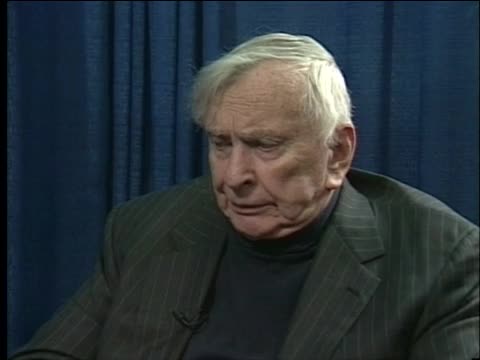
- Part 2 of 2. Prolific author Gore Vidal talks about his background and family, the latest chapter in his new autobiography “Point to Point Navigation,” several of his past works and experiences, his role as a writer, and the relationship between movies and writing. He also talks about history, politics, and what’s happening in contemporary America.
- Series Description
- Hosted by veteran journalist and interviewer, Lorene Mills, Report from Santa Fe brings the very best of the esteemed, beloved, controversial, famous, and emergent minds and voices of the day to a weekly audience that spans the state of New Mexico. During nearly 40 years on the air, Lorene Mills and Report from Santa Fe have given viewers a unique opportunity to become part of a series of remarkable conversations – always thoughtful and engaging, often surprising – held in a warm and civil atmosphere. Gifted with a quiet intelligence and genuine grace, Lorene Mills draws guests as diverse as Valerie Plame, Alan Arkin, and Stewart Udall into easy and open exchange, with plenty of room and welcome for wit, authenticity, and candor.
- Broadcast Date
- 2007-05-26
- Asset type
- Episode
- Genres
- Interview
- Media type
- Moving Image
- Duration
- 00:29:02.208
- Credits
-
-
Guest: Vidal, Gore, 1925-2012
Host: Mills, Lorene
Producer: Ryan, Duane W.
Producing Organization: KENW-TV, Eastern New Mexico University, Portales, New Mexico
- AAPB Contributor Holdings
-
KENW-TV
Identifier: cpb-aacip-02b04735c8b (Filename)
Format: Betacam: SP
Generation: Master
Duration: 00:27:12
If you have a copy of this asset and would like us to add it to our catalog, please contact us.
- Citations
- Chicago: “Report from Santa Fe; Gore Vidal, Part 2,” 2007-05-26, KENW-TV, American Archive of Public Broadcasting (GBH and the Library of Congress), Boston, MA and Washington, DC, accessed December 15, 2025, http://americanarchive.org/catalog/cpb-aacip-c97fe2d2acc.
- MLA: “Report from Santa Fe; Gore Vidal, Part 2.” 2007-05-26. KENW-TV, American Archive of Public Broadcasting (GBH and the Library of Congress), Boston, MA and Washington, DC. Web. December 15, 2025. <http://americanarchive.org/catalog/cpb-aacip-c97fe2d2acc>.
- APA: Report from Santa Fe; Gore Vidal, Part 2. Boston, MA: KENW-TV, American Archive of Public Broadcasting (GBH and the Library of Congress), Boston, MA and Washington, DC. Retrieved from http://americanarchive.org/catalog/cpb-aacip-c97fe2d2acc