Report from Santa Fe; Gore Vidal, Part 1
- Transcript
You You Report from Santa Fe is made possible in part by a grant from New Mexico Tech on the frontier of science and engineering education for bachelor's
master's and PhD degrees. New Mexico Tech is the college you've been looking for 1-800-428-T-E-C-H. I'm Lorraine Mills and welcome to report from Santa Fe. Our guest today is Gore Vidal, Man of Letters, author extraordinaire, and really an icon for this century. Thank you for joining us. Well, very happy to be here. I had an aunt called Lorraine. Oh, well, I'm family. Yes, Grand Rapids, Michigan. Well, I'd like to talk a little about your your extraordinary family. If we can start with your background, your father worked for the President Roosevelt as his director of air, air commerce, and was very interested in in in didn't he set up some early. He founded three airlines. One, they all morphed into something else. Airlines never made any money. But what happened to two unsuccessful airlines emerged together. So his first one was called TAT, which
merged into TWA. And his next one was the Luddington line. And that became Eastern airline. And he ended up in Amelia Earhart, started a little airline in New England called Northeast. And it never made a penny. Never, never made a penny. And he owned that till the end. Well, but he wasn't doing it to make money. He was passionate about planes. He really didn't like money, you know. But I was thinking that as I was driving into town because my mother had condemned me to the Los Alamos Ranch School where every boy had his own horse. And I loved it. I must say. But my poor father, they were divorced by then. He was stuck with. She was married to a Mr. Oakenklaus, who was a member of the standard oil family. So my poor father
was paying standard oil bills from me being at the school, which none of us liked. But how did you even hear about the school? This is before it became the Los Alamos project. Oh, yeah. So it was supposed to be. It was a well-known boy school. It was for rich disturbed boys. I was not rich. I was more disturbing, perhaps, the disturbed. And my mother was a lunatic. And she just decided I had to go there. And it was a very bad idea. But I did do a lot of excavating. Part of the school was on the site of an old Pueblo. And within two weeks I was excavating the Pueblo. And really threatening to hit anybody who tried to get me to play baseball. So by the time I finished I'd excavated the ground floor of the Pueblo. Wonderful. This will be a more happy visit
to the area for you. Speaking of your mother, her father was Senator Thomas Gore of Oklahoma. That's right. Tell me a little about your relationship to him. I know you read to him a lot. He was blind. He was blind at the age of ten to two separate accidents. And then he just, that wasn't going to stop him. So he practiced law with his two brothers. They had eyes. And then the word came that something was going happening in the Oklahoma territories. And he was very, very political. And he went out there to become a senator. And went to a town called Lawton, Oklahoma. He and my grandmother settled there. And in 1907, exactly a century ago, he brought Oklahoma into the Union and was elected there for a senator. And served until 1937. I think it was. And he was a stabilizing force for the Republic, I think. He did not like foreign wars. He would be in a rage
today if he saw what was going on. They were all pretty much isolationists, the old boys of that period. His father had been in the civil war. Although the goers were never successionists. They were against the South's proceeding. But you went where your family and friends went. And they, they went off to war. And my great grandfather was wounded at Shiloh. And went on to become counties, county clerk of Webster County, Mississippi. So you are additionally related to Al Gore? I don't think it's all that distant. We never knew. I knew Albert Sr.'s father, a nice fellow. But T.P. Gore was the senator of Gore. And Albert was just a minor player in Washington. The big gourd then was a great e-gore who owned the Fairfax Hotel where Albert Sr. and Albert Jr. lived for many, many years and had the
only good restaurant in Washington, the jockey club. And Grady Gore had two daughters. They each kept running for a governor of Maryland. I can't remember whether one of them ever made it or not. Well, I'd like to talk a little about your life. You were born at the hospital at West Point. Yes. And of course, going to the Los Helimos boys camp. But you did at an early age join the U.S. Army. Seventeen, yeah. And that is where I'd like to mention your latest chapter of your autobiography because it's called Point to Point Navigation. And explain, this is a wonderful, wonderful book. It just came out and explained, because this title comes from your early army days, tell us a little what point to point navigation means. I was with army ships. And we had a larger fleet than the Navy in number of boats, not in Tunnage. And I was
first made it of an army freight supply ship in the Aleutian Islands where you never could chart a course. We never got to see the sun. Stars are moon. So we went point to point navigation. You had to memorize the landscapes, the seascapes, the mountains, the islands. Very dangerous. I still have nightmares about it. I've taken a wrong turning and up ahead is a volcano. But somehow I survived. I gave my knee for my country. That was about it. Hyperthermia. So as a structure for this autobiographical piece, then you kind of go from highlight to highlight without having to have a cause and effect linear template. That's why it's such a pleasure to read. Well, it keeps you going anyway. It certainly does. It certainly does. So you were in,
you were recently in New York to receive Penn International's Literary Service Award, their first time for your courage and your honesty is quite a fabulous, fabulous award. That's one of those. Is he still breathing prizes? Everybody says it's a pride. After 80, you've got a lot of these things. Yes, but they did wait with baited breath to hear what you had to say about literature today. Well, I hope they're not baiting their breath now. So I just want to give our viewers a little, it's so hard you have had such an incredible life and career, but I'll just try to summarize it. You've written over 25 novels. Short stories, screenplays, plays. You're a wonderful period after 1950s who've been writing these incredible books of essays, one of which I'd like to point out. You've got the National Book Award for this collection of essays called United States and their essays from when to when? What does it say? 52 to 92. 52 to 92. 40 years of essays. 40 years of essays.
And the book weighs three pounds. Yes. Just don't rush and buy it. Go slowly with a wagon. And another book I'd like to point out, it's called, this is one, another collection of essays called America, or it's just called the last empire. And I sensed when I wrote it that our empire days were over. Well, we'll be talking a lot about that in the second half of the show. So you started at your first novel you wrote when you were in that army and then you wrote in what eight years you wrote eight historical novels. No, I had eight novels as regular novels, but because of the city and the pillar, which the New York Times did not like, it's a very poisonous paper, it refused to review eight of my novels in a row which drove me into television, movies, and the theater. Kind of enjoyable now that I look back on it, but at the time
it was pretty shocking. And they do nothing but grind acts as they're always trying to get somebody's for something. It's a lousy paper. And always miss coach. Yes. Yes. Well, was it a sort of literary McCarthyism then that you were really right. Very much so. Yeah. Very much so. Many other people were too. No, they were trying to, they had their own little cozy group, which now now we call them neo-cons, but we didn't know what they were then. Most of them were communist. They were trotskites. And I was sort of a fellow traveler along with them at the time because most liberals were until office slicing her, decided to give us the Americans for a democratic. What was the action? ADA to make sure that we were not confused with terribly radical people. And that's sort of about Senator Gore. My grandfather was founding the populist party that was about his
radicals you can get in those days. And for the end, he had a rather stormy last term in the Senate because he was approaching. He was defeated in his final election, but it was, and he couldn't figure out who was more powerful, the socialist party in Oklahoma of all places. Socialists in Oklahoma, they were very strong there. Or the Ku Klux Klan. Oh my gosh. He said, you know, it's pretty desperate to sit here between these two groups that I don't like. And we told I've got to make up my mind, which one I like. So he, as usual, said nothing very tactfully. He did observe if there was any race other than the human race, I'd go join it. Got him off the hook. Now speaking of fellow travelers, I know that that has a literal meaning in terms of affiliates with the communist party, but you were acquainted with and had long, long friendships with some of the literary beacons of our times. I mean,
I'm thinking of certainly Tennessee Williams and Norman Mailer and Paul Bowles. I love what you wrote about him and that. So who are the people that you look back most fondly in the literary realm? Well, you know, we were not very, what they call the war generation in the 1940s and we were not terribly convivial. In other words, we were mostly solitary people and we just didn't hang out together unlike the Brits who just, you know, from the school days to the graveyard. They were taking in each other's laundry. We weren't really like that. We had alliances, you know, Tennessee was a great friend and I learned how to be a playwright just hanging around here when he was producing a play and that was very interesting. His genius was a short story and better than check-off and I think toward the end he was beginning to realize it because he would take them and
use them as a foundation for a play and sometimes a play was not as good as the story but he changed the generation anyway. He certainly did and your plays were so well received, there was visit to his small planet and then the best man and then the Richard Nixon piece in 72. That's right. Yes, somebody sent me a note about that the other day. Unfortunately, I had called it and evening with Richard Nixon not realizing no one on earth wanted to spend evening. Even the most depraved Republican didn't want to do that. Well, yeah, he still is down on the bottom of the bottom ring of the Republican ladder. You did a lot of screenwriting too. You wrote suddenly last summer and the catered affair with the Betty Davis. Yes, I've got my French godson is staying
with me now, leaving me around and being raised in France. He never saw many Betty Davis moments. So we were having a Betty Davis festival at the house. Oh, amazing how good she was. Oh, absolutely, absolutely. You yourself were persuaded to do some acting too. Was that fun? Yeah, I was saving money on a production, you know. I wouldn't have to play another actor to do it. But you know, acting's very nice. It's, you get you out of yourself and I always found that things go wrong. You better take an acting job or anything not to be you for a while. And when my friend died, I was, I went straight to New York, straight to Broadway where I played in a play about his name, the Black Lister writer. Oh, I remember. Oh, just ring me up out there,
somebody in the dark. Tell me who it was. And he was a very wonderful letter writer. These were his letters. We were acting. Well, I know that movies were a great influence on you. And so you, you, Mickey Rooney was one of your early heroes. I just saw him on television kissing the Queen's hand. The Queen's hand. You're not supposed to touch the Queen. Actually, who, who Mickey Rooney could probably do anything. So, and how do you feel now with movies being such an important part of our culture? And what is the relationship between books as well? Can an author influence the world anywhere near as much as a filmmaker or an actor? Well, I don't think films influence anybody. They like to, they've become very proud. These film directors and
by and large, their work is not, not serious in the way they would like it to be. No, they, well, everybody, it talks about, oh God, the ninth muse, they call them in Italy. It's a new art form and they only vital one and the literature is dead. Well, the literature, our readers may well be dead. I get that feeling sometimes. But the work is still being done and I think the most interesting form of writing is the essay. It's the last place where a writer a thousand years later is addressing a reader. Just head on. Montagne is talking to us across 500 years. Now that is communication. Yes. And it's very, but I find it electrifying and much favor that is the form of writing. I was also for reading. Then there's, I was always being troubled by people and I said,
you know, how much I liked Mitzmann Night's Dream, Max Reinhardt's version in the foot films. They said, oh no, I don't, but movie people get off with Shakespeare. I said, well, how wonderful. I read it up in Los Alamos, Mitzmann Night's Dream and then I read my way straight through Shakespeare at the time I was 17 and I'd read all the plays, you know. What kind of happened? Yes, what a, what a school and language for young writers, yeah. And not understanding half the words that made it all the better. And I think that when Mickey Rooney played Puck from Mitzmann Night's Dream, that was one of your favorites. That's what I wanted to be Puck, yes. Yes. Well, in some way, I think you have, I think you've enchanted us and you have worked magic on us. You describe in your writing that
mountains used to the word essay is, would you give us the literal translation from the French? What is an essayist trying to use? Well, an essayist. The essay comes from the word the verb essay, which means to try. So you try to explain something in an essay. So what you're writing is an attempt to, and you attempt generally, you should cover the waterfront. I mean, if you're going to talk about, I don't know, Yago or Othello, you're trying, you're going to try Shakespeare's plays and then you're going to try Venetian history, you'll try this, you'll try Shakespeare. It's just an attempt to, you see, until you write something, you're not able to think at all. Renard was a great aphorist in France once wrote, I find that when I do not think of myself, I do not think at all. But I think 99.9% of the world is like that.
But if you think about yourself and go into the first person, I think that. Now you've started to, you are thinking now. And what you come up with will be thought, which otherwise it doesn't sit there on a camp stool waiting in your head. It's got to be some written tribe. But in the evolution of your writing career to, to, to done these magnificent novels, historical novels like Lincoln and Burr and Julian. I mean, these are the amount of scholarship that went into these. Were you finally liberated to go to the essay where you could really just say what you feel instead of have to, you know, because I do just in much research with an essay as I do with writing a book about Julian, Ober or Lincoln. They all involve study and making notes and making choices or what to believe. So much of what you read is not going to be true.
And you have to have a pretty good detector to try and figure that out. And you don't always do it either. You were asked at a conference about writer's block and tell our viewers what you said. A young writer, well, what about writer's block? I said, be so grateful you have it. It means you don't have to do it. It also means you're not a writer anyway. So just stay blocked. Probably a very liberating answer for them. Yes. And what other advice would you have for young writers or for any writers? To read. The problem today is people are too proud to read. They think they know everything anyway. And there's very little curiosity which the schools have done a great job of eliminating. And I used to say when I was, I remember losing my voice, when I was an active politician, I used to go to PTA things.
And if I could see there are a lot of parents there and so on, disturbed parents, I would say, what happens with our educational system? You all have had children at school. I said, I've never met a boring six-year-old. And I've never met an interesting 16-year-old. What has done to them in that 10 years? How do you kill curiosity? Well, boy, I don't have to speak after that. The entire audience is telling me what's wrong. And so how would you change that? Well, make them read and get to kids read real books. I mean, when I first went to Russia, I was really deeply impressed by their educational system that lived seven, eight, nine years old. They were reading stories by check-off. It doesn't get any better than that. No, it never does. They were reading great literature and they
respected it. I remember I went to a restaurant with Yachto Shinkoff at that time, the greatest poet and so-called Soviet Union. And there was a marriage party going on in this restaurant. And one of the boys and girls looked out from the party and rushed down the shop to Shinkoff. He's here. And they all rushed in and they forced him up on a chair, stand on chair, and he decided for an hour. That's his gift to the wedding party. I thought, dear God, but not have happened with Robert Lowe. No, and maybe with Robert Frost. No, Robert Frost would have got up there before you could have held his back. You end this wonderful, I just want to mention this to our viewers again. Gervi Dahl's point-to-point navigation, which is the second part of his autobiography. His first autobiography was called Palm Says, and that takes you up to 1940.
And then this is from 1940 and it ends on January 1st, 2006. And you end with a little recitation of which I'm sure has been burned into your memory for many years. Do you want to give us those lines from Pope? I'm springing this on you. It's probably not fair. We don't have. I'm trying to clear my, I don't know what's happened with it. You have a lot of pollen around it. Yes, we do. That's what it is. I've got it all to do. Yes. No public flame, no private desks to shine, no human spark, no gift to divine, low the dread empire chaos is restored, light dies before the uncreating word and the hand-great anarch lets the curtain fall. Boom. And the curtain, yes.
It's the end of the dunce yet. And you were compared to Pope, among many, many comparisons. And this is something that you had learned from. I taught myself and I wouldn't have mind learning it in school, but we never got around to Pope. Oh, it's a shame. Well, we had to learn things like the Raven, not quite, not quite Edgar Allen Poe, not quite as intellectually dense and compelling. I want to thank you for joining us today. Our guest is Mr. Gervi Dahl, one of America's greatest, greatest men of letters. And I want to mention again point to point navigation, his new book, his autobiography, a few of his others books. Gervi Dahl, the last empire, book of essays, and our three-pound magnificent Magnus Opus, the National Book Award winner, a collection of essays called the United States, really, really incredible, incredible reading. So we've come to the end of our first half. Thank you so much for joining us,
Mr. Gervi Dahl. Thank you. And I'm Lorraine Mills. I'd like to thank you our viewers for joining us today and report from Santa Fe. We'll see you next week. Report from Santa Fe is made possible in part by a grant from New Mexico Tech on the frontier of science and engineering education for bachelor's masters and PhD degrees. New Mexico Tech is the college you've been looking for, 1-800-428-T-E-C-H.
- Series
- Report from Santa Fe
- Episode
- Gore Vidal, Part 1
- Producing Organization
- KENW-TV, Eastern New Mexico University, Portales, New Mexico
- Contributing Organization
- KENW-TV (Portales, New Mexico)
- AAPB ID
- cpb-aacip-b9b75c893ee
If you have more information about this item than what is given here, or if you have concerns about this record, we want to know! Contact us, indicating the AAPB ID (cpb-aacip-b9b75c893ee).
- Description
- Episode Description
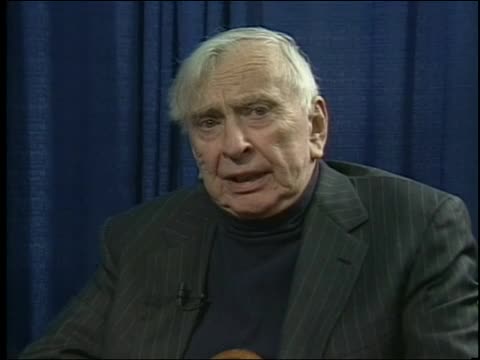
- Part 1 of 2. Prolific author Gore Vidal talks about his background and family, the latest chapter in his new autobiography “Point to Point Navigation,” several of his past works and experiences, his role as a writer, and the relationship between movies and writing. He also talks about history, politics, and what’s happening in contemporary America.
- Series Description
- Hosted by veteran journalist and interviewer, Lorene Mills, Report from Santa Fe brings the very best of the esteemed, beloved, controversial, famous, and emergent minds and voices of the day to a weekly audience that spans the state of New Mexico. During nearly 40 years on the air, Lorene Mills and Report from Santa Fe have given viewers a unique opportunity to become part of a series of remarkable conversations – always thoughtful and engaging, often surprising – held in a warm and civil atmosphere. Gifted with a quiet intelligence and genuine grace, Lorene Mills draws guests as diverse as Valerie Plame, Alan Arkin, and Stewart Udall into easy and open exchange, with plenty of room and welcome for wit, authenticity, and candor.
- Broadcast Date
- 2007-05-19
- Asset type
- Episode
- Genres
- Interview
- Media type
- Moving Image
- Duration
- 00:28:50.362
- Credits
-
-
Guest: Vidal, Gore, 1925-2012
Host: Mills, Lorene
Producer: Ryan, Duane W.
Producing Organization: KENW-TV, Eastern New Mexico University, Portales, New Mexico
- AAPB Contributor Holdings
-
KENW-TV
Identifier: cpb-aacip-775d3619b60 (Filename)
Format: Betacam: SP
Generation: Master
Duration: 00:27:11
If you have a copy of this asset and would like us to add it to our catalog, please contact us.
- Citations
- Chicago: “Report from Santa Fe; Gore Vidal, Part 1,” 2007-05-19, KENW-TV, American Archive of Public Broadcasting (GBH and the Library of Congress), Boston, MA and Washington, DC, accessed December 16, 2025, http://americanarchive.org/catalog/cpb-aacip-b9b75c893ee.
- MLA: “Report from Santa Fe; Gore Vidal, Part 1.” 2007-05-19. KENW-TV, American Archive of Public Broadcasting (GBH and the Library of Congress), Boston, MA and Washington, DC. Web. December 16, 2025. <http://americanarchive.org/catalog/cpb-aacip-b9b75c893ee>.
- APA: Report from Santa Fe; Gore Vidal, Part 1. Boston, MA: KENW-TV, American Archive of Public Broadcasting (GBH and the Library of Congress), Boston, MA and Washington, DC. Retrieved from http://americanarchive.org/catalog/cpb-aacip-b9b75c893ee