NAACP convention 1980; Part 4
- Transcript
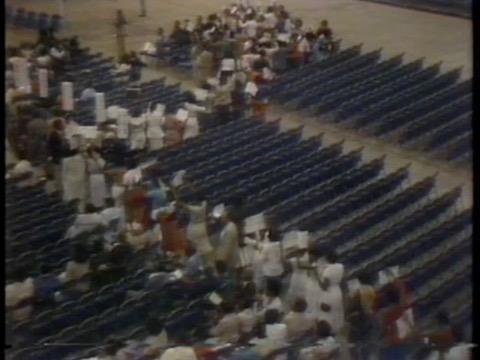
<v Narrator>Major funding for this program was provided by this station and other public <v Narrator>television stations. Additional funding was provided by the Quaker <v Narrator>Oats company. [Intro music] <v Carl Rowan>They came from the centers of America's great and seething cities from <v Carl Rowan>the farmlands of Alabama and Mississippi and from the West Coast, make believe <v Carl Rowan>havens to which so many blacks have gone. <v Carl Rowan>[Song: Lift Every Voice and Sing] They all came talking about the importance of this <v Carl Rowan>seventy first convention of the National Association for the Advancement <v Carl Rowan>of Colored People. They came in a time of crisis, a crisis
<v Carl Rowan>of the pocketbook for millions of Americans who were both jobless and hopeless, <v Carl Rowan>a crisis of despair for some cause by the realization <v Carl Rowan>that the mood of this nation seems to be drifting to the right with America's <v Carl Rowan>majority turn its back against most of those things for which <v Carl Rowan>minorities cried out. <v Carl Rowan>They came remembering that gruesome riots had taken place recently, <v Carl Rowan>not far from their convention site riots, which were the product <v Carl Rowan>of black anger and frustration. <v Carl Rowan>They came knowing that a ghost would hang over their convention. <v Carl Rowan>The ghost of Arthur McDuffie, the black insurance man whose <v Carl Rowan>slaying, while in the hands of policemen, gave new fervor to <v Carl Rowan>their outcries against police brutality. <v Carl Rowan>They came like moths lured by the fire this time. <v Carl Rowan>T he flames of nearby Liberty City dancing in their heads, raising <v Carl Rowan>questions about a repeat of 1967, that long,
<v Carl Rowan>hot summer when hundreds died and billions of dollars worth of property <v Carl Rowan>was destroyed in Newark, Detroit and a hundred other cities. <v Carl Rowan>They came frustrated and angry. <v Carl Rowan>Yes, even executive director Benjamin Hooks, who opened up the convention with <v Carl Rowan>a blast at the press and an assault on blacks who fight other blacks, <v Carl Rowan>a point surely well-taken. But the 68 members of his board of directors <v Carl Rowan>who have made a sport of fighting each other. <v Benjamin Hooks>I'm pleased to be able to report that the NAACP, your <v Benjamin Hooks>NAACP is stronger today than it had ever been in its <v Benjamin Hooks>history. And let the New York Times and let all of these line people all <v Benjamin Hooks>over this nation talk about us all they want. <v Benjamin Hooks>They'll wake up to find us sitting on their front door. <v Benjamin Hooks>[Applause] I'm tired. Sick and <v Benjamin Hooks>tired of newspaper reporter running to wake up people
<v Benjamin Hooks>from a dead drunk and asking them, do you know what the NAACP is? <v Benjamin Hooks>Why don't you go to the black churches where 10 million people assemble every <v Benjamin Hooks>Sunday morning? Why don't you go where black folk are working and trying to make decent <v Benjamin Hooks>life for themselves? Why don't you go where black folk are trying to remove the yoke <v Benjamin Hooks>of bondage and lift those who are down and ask them about the NAACP? <v Benjamin Hooks>And they know who we are and where we are. <v Benjamin Hooks>[Applause] We gonna tell that story. <v Benjamin Hooks>I know what it is when you a branch president and you're doing your best, you're <v Benjamin Hooks>criticized by your family, by your friends, by <v Benjamin Hooks>the folks who voted for you. Harrassed by the white power structure, ignored <v Benjamin Hooks>by many blacks, talked about by others. <v Benjamin Hooks>But I want you to stay on the case. <v Benjamin Hooks>There have been a lot of rumors circulating about the fact <v Benjamin Hooks>that I plan to resign, that I plan to retire. <v Benjamin Hooks>There've been a lot of lies told about problems that I'm supposed to be having
<v Benjamin Hooks>with the board. But let me tell you now, I'm not a quitter <v Benjamin Hooks>because quitters never win and winners never quit i <v Carl Rowan>NAACP members came in rejection of violence as they always have done, looking <v Carl Rowan>first for relief within the political system. <v Carl Rowan>Many politicians also came, they, too, sensing that this is a season <v Carl Rowan>of urban crisis and most decidedly, their season of political <v Carl Rowan>survival. The politician who first got the convention's complete attention <v Carl Rowan>was Ronald Reagan, the man who wasn't here. <v Carl Rowan>Reagan, the certain presidential nominee of the Republican Party, declined <v Carl Rowan>an invitation to speak when NAACP director Hooke's suggested <v Carl Rowan>that Reagan was writing off the black vote. <v Carl Rowan>Reagan sent Hookes a telegram pleading ignorance of any invitation to speak <v Carl Rowan>and declaring that he would never write off the black vote. <v Carl Rowan>The hostile reaction here may have had something to do with Reagan's acceptance of
<v Carl Rowan>an invitation to speak at a National Urban League meeting in New York on August <v Carl Rowan>5. A few days before the Democratic convention in Madison Square <v Carl Rowan>Garden, how much damage was done to Reagan's hopes of winning <v Carl Rowan>black votes by the faux pas regarding this convention? <v Carl Rowan>I can report exclusively that the NAACP board has discussed <v Carl Rowan>doing with regard to Reagan what it has done only once before <v Carl Rowan>in 1964. <v Carl Rowan>NAACP leaders were so frightened by the prospect of a Barry Goldwater <v Carl Rowan>presidency that they appealed publicly to blacks not to vote for <v Carl Rowan>the Arizona senator. My information is that the <v Carl Rowan>NAACP probably will do the same for Reagan. <v Carl Rowan>Suspecting this, perhaps three of the nation's leading politicians did show <v Carl Rowan>up. John Anderson came in the beguiling posture of a white <v Carl Rowan>boy deprived because he never had black friends.
<v Carl Rowan>Ted Kennedy came as the rich white boy who now feels a special blackness. <v Carl Rowan>And Jimmy Carter came draped in the halo of the Oval Office, singing We <v Carl Rowan>Shall Overcome. <v Ted Kennedy>And in the sum total of all that we say, <v Ted Kennedy>we shall be raising our voices to sound once again more the deeper, ideal <v Ted Kennedy>and the abiding dream of the Negro national anthem <v Ted Kennedy>in 1980. We shall stand again with James Weldon Johnson <v Ted Kennedy>from across all the generations of struggle. <v Ted Kennedy>We shall sing a song full of the faith <v Ted Kennedy>that the dark past has taught us. <v Ted Kennedy>Sing a song full of the hope that the President has brought <v Ted Kennedy>us. Facing the rising sun of our new <v Ted Kennedy>day begun. [Cheering] Let us march on till victory until <v Ted Kennedy>it is won.
<v John Anderson>Let me be very direct. <v John Anderson>I come from an essentially white community in Rockford, Illinois. <v John Anderson>I have grown up in white America. <v John Anderson>I have not had that many really close black <v John Anderson>friends and that has not been entirely my own choice. <v John Anderson>Indeed, I believe it has been my loss and it may well <v John Anderson>be a measure of our common situation. <v John Anderson>I cannot pretend to know how it feels. <v John Anderson>Day in and day out to be black in America. <v John Anderson>I do not know how it feels to be black and poor. <v John Anderson>And I do not even know how it means to be black and successful. <v John Anderson>But I will speak to you tonight from what I do know. <v John Anderson>I will speak to you as one who has spent nearly 20 years in the Congress <v John Anderson>as a legislator.
<v Jimmy Carter>You've got a friend in the Oval Office who will join that fight with you. <v Jimmy Carter>Thank you very much. And God bless you all. [Applause and Song: We Shall Overcome] <v Carl Rowan>If America's cities remain powder kegs and if blacks and other minorities remain <v Carl Rowan>second class citizens, it will not be because the nation's presidential contenders <v Carl Rowan>don't know what the problems are. <v Carl Rowan>The candidates hammered on the same issues and themes. <v Carl Rowan>Let's take a look at the rhetoric used by President Carter, John Anderson and Ted <v Carl Rowan>Kennedy. <v Ted Kennedy>This morning, I walked the bleak streets of Liberty City and I saw <v Ted Kennedy>a community that has become a bombed out ghetto filled with frustration <v Ted Kennedy>and fear. And Liberty City reveals more starkly than any <v Ted Kennedy>words that our nation still provides liberty and
<v Ted Kennedy>justice only for some. <v Ted Kennedy>[Applause] <v Ted Kennedy>The first fire last time here in Miami was <v Ted Kennedy>lit by a sense of unequal justice, but a sense of unequal opportunity <v Ted Kennedy>smolders all the time in other slums and barrios of this land <v Ted Kennedy>across America as Ben Hooks has worn, there are a dozen <v Ted Kennedy>Liberty Cities waiting to happen. <v John Anderson>It is appropriate that we meet here this evening just a <v John Anderson>short distance, as we have heard over and over again during this convention, <v John Anderson>a short distance from Liberty City. <v John Anderson>It is a tragic but gripping reminder, as the governor has told <v John Anderson>us and others this evening of the unfinished work which the next <v John Anderson>president of the United States must carry on. <v John Anderson>And it is he the only one who is elected by all
<v John Anderson>Americans who must seek to translate America's age <v John Anderson>old promise of equality for all of our citizens into a new <v John Anderson>and meaningful reality. [Applause] <v Carl Rowan>President Carter never mentioned Liberty City or the riots. <v Carl Rowan>The delegates got a shock on Monday the convention's opening day when the United <v Carl Rowan>States Supreme Court voted 5 to 4 to validate the Hyde Amendment, <v Carl Rowan>in which Congress denied Medicaid money for abortions for the vast majority <v Carl Rowan>of the nation's poor women. <v Carl Rowan>This convention already anguishing over the fact that 2 black families <v Carl Rowan>out of every 5 are now headed by a woman with no husband present <v Carl Rowan>was outraged. <v Margaret Bush Wilson>And just today, word has come to me that <v Margaret Bush Wilson>the Supreme Court of the United States has made a ruling in the <v Margaret Bush Wilson>Hyde case. <v Margaret Bush Wilson>The effect of which is to say that our government cannot longer
<v Margaret Bush Wilson>finance to support women who wish to exercise the choice <v Margaret Bush Wilson>of abortion. And so we have the spectacle of poor people <v Margaret Bush Wilson>being denied what rich people can do by virtue of their resources. <v Carl Rowan>Two days later, the high tribunal gave minorities a victory and an <v Carl Rowan>affirmative action case involving public works funds. <v Carl Rowan>But the NAACP general counsel, Thomas Atkins, put the two decisions <v Carl Rowan>in special perspective. <v Thomas Atkins>Glad that the Supreme Court affirmed the the uh <v Thomas Atkins>set aside the Congress pass at the same time <v Thomas Atkins>we see this as a uh an opportunity for us <v Thomas Atkins>through our branches to help minority business men across <v Thomas Atkins>the country who they set aside program guarantees the <v Thomas Atkins>opportunity to participate.
<v Thomas Atkins>We see this as a chance for us to help them get involved. <v Thomas Atkins>The hundreds of millions of dollars made available through this set aside programs, <v Thomas Atkins>public money. <v Thomas Atkins>We want to see used in our communities. <v Thomas Atkins>And we think that the Supreme Court was right in saying that the Congress did <v Thomas Atkins>have the power and the authority and we believe the responsibility <v Thomas Atkins>and obligation to assess the problems, which in part they created <v Thomas Atkins>and to come up with legislation that would help to remedy that. <v Thomas Atkins>We do not consider the good decision and full of love today to offset <v Thomas Atkins>the terrible decision and the uh a day or <v Thomas Atkins>so ago when the Supreme Court validated the Hyde Amendment, which prohibits <v Thomas Atkins>poor people, poor women, to be precise, from <v Thomas Atkins>using public funds with which to have an abortion. <v Carl Rowan>This convention dealt with a lot of politics and pain, but it's early days <v Carl Rowan>offered much more than that.
<v Carl Rowan>Ben Hooks made the point shortly after succeeding the longtime great leader, Roy <v Carl Rowan>Wilkins, that lifting the level of life of 27 million black people <v Carl Rowan>involves a lot more than filing lawsuits, pressuring presidents <v Carl Rowan>and cursing Congress. He said the NAACP had to inspire <v Carl Rowan>and honor young people who study, perform, achieve, so <v Carl Rowan>act so. That means Afro-American, academic, cultural, technological, <v Carl Rowan>scientific olympics, Act-So came into being. <v Carl Rowan>We saw some marvelous talent compete for the Act-So award. <v Carl Rowan>[Actress performing monologue] [Techno dance music] [Pop music] [Piano music] <v Carl Rowan>And the NAACP honored one of the civil rights organizations, oldest
<v Carl Rowan>and most distinguished members, when it gave the highly coveted Spingarn Medal <v Carl Rowan>to Dr. Rayford Logan of Washington, D.C., whose teaching has prepared <v Carl Rowan>and inspired many thousands of blacks across the land, <v Speaker 1>Lives of great men all remind us we can make our lives sublime <v Speaker 1>and departing leave behind us footprints in the sands <v Speaker 1>of time. Footprints that perhaps another ?saving <v Speaker 1>or life solemn name?, a forlorn and shipwrecked brother <v Speaker 1>seen may take heart again. <v Speaker 1>[Organ music and applause] <v Rayford Logan>Mrs. Wilkins, Dr. Cobb, ?Dr.
<v Rayford Logan>Oaks?, other guests at the head table, <v Rayford Logan>members of the oldest Negro civic organization <v Rayford Logan>in the unremitting quest for equal rights. <v Rayford Logan>You who could be and should be and I hope <v Rayford Logan>will the members of the NAACP <v Rayford Logan>I proudly and gratefully accept this medal, the most <v Rayford Logan>prestigious award that can be conferred upon an American citizen <v Rayford Logan>of African descent. <v Carl Rowan>But in the plenary sessions, the workshops and on the streets, these delegates <v Carl Rowan>focused on a half dozen or so critical issues that go to the heart of the <v Carl Rowan>well-being of 27 million black Americans. <v Carl Rowan>They were ever mindful of the dangers that violence of the sort which erupted in <v Carl Rowan>1967 could push this country further toward a police state. <v Carl Rowan>So they talked about how to mute the effects of black frustration,
<v Carl Rowan>as chronicled in this piece by reporter Rodney Ward of Miami's WPBT. <v Carl Rowan>[Song: Ain't Gonna Let Nobody Turn Me Around] [Song: Lift Every Voice and Sing] <v Speaker 2>I like to see America go a long ways with black folks. <v Speaker 2>But now the way I see they're going to be very hard, very difficult. <v Speaker 3>I feel like the problem is, you know, that <v Speaker 3>they just don't understand us, you know.
<v Speaker 3>Like we all created equal and like hey, if we can get some justice, <v Speaker 3>man, you know, some equal rights, we can get it. <v Speaker 4>You're white, you're right. You're black, you're out- you know? <v Speaker 4>That's how I go down here, man, you're in a justice system. <v Marzell Smith>The masses of black people who have not been cut in to <v Marzell Smith>the systemic rewards have suggested very strongly to our leadership in <v Marzell Smith>this county and in this city and in this nation that <v Marzell Smith>they are not satisfied and they will not just <v Marzell Smith>sit back and rest at ease when they have nothing to rest <v Marzell Smith>at ease on and rest at ease about. <v Marzell Smith>[Song: Lift Every Voice and Sing] <v Protestor 1>We <v Protestor 1>are going to demand equal justice under the law.
<v Protestor 1>We are going to declare poor people's independence in this country. Thank <v Protestor 1>you, Jesus. [Song: Lift Every Voice and Sing] <v Eula Bell McDuffie>That's alright, let them walk free. But they'll be sorry. <v Rodney Ward>Do you find that you're taking advantage of a situation, just why are you selling this <v Rodney Ward>T-shirt? <v Speaker 5>I think that this is why we why we're doing this is because we want to make <v Speaker 5>sure that this stays in the people's face. <v Speaker 5>Not all people we already know what happened, I'm talking about the people that did it. <v Speaker 5>We want them to know. We want em to keep seeing it. <v Speaker 5>If they keep seeing that, they might do some about it so it don't happen again. <v Rodney Ward>But you're putting a 5 dollar price tag on an incident that happened? <v Speaker 5>No we're not putting a $5 price tag. All we're doing is selling a piece of black history. <v Speaker 5>[Song: Lift Every Voice and Sing] <v Rodney Ward>What do you think about your future?
<v Speaker 6>Well, if I stay around here, there won't be too much <v Speaker 6>of it. Because you know, ain't too much out here you know to have a good future about it, <v Speaker 6>so that's what I think, you know. <v Speaker 6>I might have a better chance, you know, if the community lived more decently <v Speaker 6>and everything. [Song: Lift Every Voice and Sing] <v Marvin Dunn>America's always been a very racist country and it still is.
<v Marvin Dunn>But I also suggest that <v Marvin Dunn>black people have to confront that reality, have also <v Marvin Dunn>the responsibility for owning some charge to <v Marvin Dunn>ourselves to move ahead in spite of that racism and not to have all of our <v Marvin Dunn>defeats attributed to the fact that the white racists out there give a darn about black <v Marvin Dunn>people. <v Carl Rowan>The delegates talked a lot about jobs. <v Carl Rowan>There's a saying that the only thing wrong with poor people is that they don't have any <v Carl Rowan>money. The mores of America is such that the only honorable way to get money <v Carl Rowan>are to work or inherit it, and not many of the people being discussed <v Carl Rowan>here have any rich uncles dying soon. <v Carl Rowan>So, speakers here said again and again that black America doesn't <v Carl Rowan>want that dishonorable means of getting money, welfare; that <v Carl Rowan>what they want is jobs. <v Carl Rowan>Sharon Stevens has this report on disadvantaged youth. <v Sharon Stevens>What NAACP delegates heard today was an ambitious and many say long
<v Sharon Stevens>overdue assistance program for black youth, whose unemployment at 35 percent <v Sharon Stevens>is the highest in the country. The Labor Department will also oversee a jobs creation <v Sharon Stevens>program that will have joint input from both the public and private sector through <v Sharon Stevens>the Community Economic Development Corporation. <v Sharon Stevens>There are also plans for a new Job Corps center, which will serve black and Hispanic <v Sharon Stevens>areas. And the NAACP is working on its own jobs program with the <v Sharon Stevens>National Alliance of Businessmen. <v Sharon Stevens>Earlier, Assistant Labor Department Secretary Ernest Green said the new employment <v Sharon Stevens>program will cover a wide range of jobs. <v Ernest Green>For some young people, it's the business of having adequate labor market information. <v Ernest Green>For some, it's having work experience, getting prepared for jobs, for others, things <v Ernest Green>like Job Corps, where you need more intensive training and educational assistance. <v Ernest Green>For some, it's full time on the job training activity beginning immediately. <v Ernest Green>And what we need to do and what we if you look at <v Ernest Green>the youth bill, I think it moves a long way and connecting the education
<v Ernest Green>side and the employment side to make that assessment that different young people need <v Ernest Green>different things. And some young people are simply not ready to go immediately into a <v Ernest Green>job. Others are and need less preparation. <v Ernest Green>It's the range of those job and training opportunities that will provide <v Ernest Green>over a million and a half employment opportunities. <v Sharon Stevens>Secretary Green said the type of job each individual receives is related to education. <v Sharon Stevens>A major factor that has worked against minority youth. <v Ernest Green>It's obvious that two things have got to happen. <v Ernest Green>The general economy has got to improve, but we've got to make a better connection between <v Ernest Green>education. I mean the bulk of the young people who are long term unemployed <v Ernest Green>are unemployable. <v Ernest Green>They come with limited skills, education, skills and <v Ernest Green>and work experience. And it's there that we've got to try to make the mix. <v Ernest Green>I mean, we can improve the job market all we ?have.? <v Sharon Stevens>Part of the jobs program goes into effect within the next couple of days if everything
<v Sharon Stevens>goes according to plan. Green predicts there could well be a 10 percent decrease <v Sharon Stevens>in the jobless rate among black youth in 1981. <v Carl Rowan>John Anderson promised jobs and more. <v Carl Rowan>Kennedy blamed black unemployment on a Carter administration that he said <v Carl Rowan>has abandoned democratic principles. <v Carl Rowan>President Carter boasted about how many jobs his administration has created, <v Carl Rowan>especially for blacks. <v Ted Kennedy>At the Democratic convention, we must fight for a platform <v Ted Kennedy>which reaffirms the basic civil right to a job. <v Ted Kennedy>We must give a specific and effective response to this recession. <v Ted Kennedy>And the only true Democratic response can be summed up in three short <v Ted Kennedy>words jobs, jobs, jobs. <v John Anderson>But, you know, it isn't enough simply to create jobs. <v John Anderson>We must also create opportunities for human fulfillment
<v John Anderson>and career advancement, because for too many young Americans, <v John Anderson>unemployment isn't just a temporary inconvenience. <v John Anderson>It is a way of life, not a way of life that they have chosen. <v John Anderson>But our way of life to which they have been condemned by a lack of education <v John Anderson>and opportunity, or because they have met with outright discrimination. <v John Anderson>And it is for reasons like that that I have supported the proposed <v John Anderson>$2 billion youth employment initiative. <v Jimmy Carter>Unemployment and particularly black unemployment in particular, black young unemployment <v Jimmy Carter>is far, far too high. <v Jimmy Carter>But we've created more new jobs in the last three and a half years than in any other time <v Jimmy Carter>in history, even including. ?For? <v Jimmy Carter>years of war, 1 million more black Americans hold jobs <v Jimmy Carter>today than it did in January 1977. <v Jimmy Carter>Employment, even among black teenagers, has risen dramatically.
<v Jimmy Carter>And in the spring of this year, for the first time in 7 years, black teenage <v Jimmy Carter>unemployment even went down. <v Carl Rowan>It is doubtful that any of these speeches satisfied the youngsters who interrupted <v Carl Rowan>the convention business to demonstrate for jobs. <v Carl Rowan>[Song: Battle Hymn of the Republic] <v Carl Rowan>With all the talking over there, still, we're more than a million seven hundred thousand <v Carl Rowan>blacks out of work. Twenty five percent more than when President Carter took
<v Carl Rowan>office. And black unemployment was still double the rate for whites. <v Carl Rowan>Perhaps the most acceptable comment about jobs came from an official who isn't <v Carl Rowan>running for anything. Assistant Secretary of Labor Ernest Green. <v Ernest Green>The delegates are very concerned about what happened to those jobs... <v Ernest Green>[continues talking] <v Interviewer>Well, what have things? <v Ernest Green>Well, one thing for certain, that about 60 percent of all the increase <v Ernest Green>in unemployment is about three industries automobiles, steel and rubber. <v Ernest Green>The state of the industrial world, this country, automobile particularly, <v Ernest Green>has had a devastating effect on black workers, many of them right now covered <v Ernest Green>certainly by unemployment insurance, supplementary benefits, trade adjustment assistance. <v Ernest Green>But in terms of long range employment opportunities, it's likely that many <v Ernest Green>of those jobs will be gone forever. <v Ernest Green>And what we've got to have is a serious reindustrialization program for this country. <v Carl Rowan>If any subject dominated this convention more than jobs, it was the issue <v Carl Rowan>of police brutality and the question of whether it will provoke riots
<v Carl Rowan>in other cities. Sociologist Marvin Dunn talked to Rodney Ward <v Carl Rowan>about the role of police brutality in provoking the Miami riots. <v Marvin Dunn>The McDuffie killing, you must understand it was a thing taken <v Marvin Dunn>quite personally about a great many black people in this town, including myself. <v Marvin Dunn>Because the killing of McDuffie merely reaffirmed our individual <v Marvin Dunn>and collective vulnerability. <v Marvin Dunn>It said to us, this could have happened to you. <v Marvin Dunn>And I think that that in part explains the particular viciousness <v Marvin Dunn>of this riot. It was an act of revenge. <v Marvin Dunn>The white people who were killed were not killed because they got in the way, they were <v Marvin Dunn>not kill because they provoked a confrontation, they were killed because they were there. <v Marvin Dunn>And because they were white. <v Carl Rowan>Police brutality is such an emotional subject that few delegates need it
<v Carl Rowan>to be stirred up. But Ben Hooks around the convention with this comment. <v Benjamin Hooks>It makes good print and I think it's a good idea to talk about human <v Benjamin Hooks>rights in South Africa and Yugoslavia and friends, but I am told a charity <v Benjamin Hooks>begins at home. <v Benjamin Hooks>We cannot tell the leaders of South Africa about shooting down <v Benjamin Hooks>innocent blacks over there if we slaughter them in Los Angeles and in Wrightsville, <v Benjamin Hooks>Georgia. We cannot admonish the Ayatollah Khomeini <v Benjamin Hooks>about safeguard human rights if we continue to disregard human rights at home. <v Benjamin Hooks>We cannot talk about correcting conditions in France until we correct <v Benjamin Hooks>conditions right here in Florida. <v Carl Rowan>The presidential candidates knew that blacks were really stirred up over this issue. <v Carl Rowan>So each of them dealt with the subject. <v Jimmy Carter>I wish I could come here to you tonight as president <v Jimmy Carter>of a greatest country of all to say that this battle for moral justice
<v Jimmy Carter>was over. But it's not. <v Jimmy Carter>Not while gr- groups such as the Ku Klux Klan and the self-proclaimed Nazis <v Jimmy Carter>and others still encourage racial hatred and religious <v Jimmy Carter>hatred, not when minorities still fear police harassment. <v Ted Kennedy>And the Kennedy forces secured a pledge to play civil rights units <v Ted Kennedy>in U.S. attorney's office. In every state where there were a need <v Ted Kennedy>it, we insisted that the full power of the federal government must be deployed <v Ted Kennedy>in local areas to prevent and punish any repetition <v Ted Kennedy>of the Arthur McDuffie case. <v Ted Kennedy>And last week, <v Ted Kennedy>[Applause] I wrote the attorney general asking for the swift action in that <v Ted Kennedy>case. <v John Anderson>We ought to have sensible uniform standards <v John Anderson>nationwide for the use of deadly force by
<v John Anderson>law enforcement officers. <v John Anderson>And I understand, Dr. Hooks, that the NAACP will soon <v John Anderson>conduct a full review of the deadly force issue. <v John Anderson>As your president, I pledge you to review those findings <v John Anderson>and to work toward the swift acceptance of appropriate <v John Anderson>standards. <v Carl Rowan>One voice that cried out to these delegates about the criminal justice system <v Carl Rowan>came from the ghost of Arthur McDuffie, the black insurance man who was beaten <v Carl Rowan>to death while in the hands of Miami policemen. <v Carl Rowan>The delegates heard McDuffie saying, "There is no justice for black people." <v Carl Rowan>One of the most moving moments of the convention came when Ella Washington sang <v Carl Rowan>The Ballad of Arthur McDuffie. <v Carl Rowan>[Song: The Ballad of Arthur McDuffie] <v Carl Rowan>President Carter scored his best points politically when he played to black concerns
<v Carl Rowan>about the criminal justice system by reminding delegates that when they vote for <v Carl Rowan>the next president, they also will be voting for control of the Supreme Court and <v Carl Rowan>for voices on other federal benches. <v Jimmy Carter>As you know, for your long struggles on civil rights, one of the most important <v Jimmy Carter>powers of any president is a power of appointment. <v Jimmy Carter>Presidents come and go, but those appointments quite often <v Jimmy Carter>stay on and they determine the policies of our nation that affect the lives of everyone, <v Jimmy Carter>not just Cabinet administrative officials, as crucial as they might be, but U.S. <v Jimmy Carter>attorneys, members of regulatory boards and <v Jimmy Carter>federal judges. [Applause] I've <v Jimmy Carter>appointed people like Drew Days and Eleanor Holmes Norton to administer the laws <v Jimmy Carter>that enforce civil rights.
<v Jimmy Carter>I put black people on regulatory boards of all kinds. <v Jimmy Carter>And I've also always insisted on affirmative action. <v Jimmy Carter>The results speak for themselves. I won't quote the statistics in order to save time. <v Jimmy Carter>I've only served three and a half years as president, but I have already <v Jimmy Carter>appointed more blacks, more women <v Jimmy Carter>and more Hispanics to the federal bench as judges than all <v Jimmy Carter>other presidents in a 200 year history of this country. <v Jimmy Carter>[Applause] <v Carl Rowan>Delegates spent many hours talking about the housing needs of America's minorities. <v Carl Rowan>Benjamin Hooks set the theme in his keynote address. <v Benjamin Hooks>Urban housing is a national disaster. <v Benjamin Hooks>In 1980, many of our cities are torn up as <v Benjamin Hooks>the war torn cities of Europe. <v Carl Rowan>All three presidential candidates talked about housing in ways designed <v Carl Rowan>to make black America believe that they offer the best answer to this problem.
<v Ted Kennedy>In this session of Congress, we must continue to strive for <v Ted Kennedy>a fair housing law that will unlock the doors of discrimination <v Ted Kennedy>once and for all. <v Ted Kennedy>That bill is my first priority in this session <v Ted Kennedy>and I intend to see it pass. <v Ted Kennedy>[Applause] <v Ted Kennedy>I will find a quorum to act on fair housing no matter <v Ted Kennedy>what it takes. And no matter what the Republicans do. <v Ted Kennedy>[Laughter and applause] <v John Anderson>But just as I found discrimination intolerable in 1968 <v John Anderson>in housing, I find it intolerable in 1980 <v John Anderson>and we need fair housing laws that work. <v John Anderson>We need teeth put into the enforcement of that law. <v John Anderson>We need to give the Department of Housing and Urban Development the authority <v John Anderson>that they now lack to take administrative action against those who
<v John Anderson>would discriminate. Even now, twelve years later, in the <v John Anderson>leasing and sale of housing. [Applause] But <v John Anderson>just as I found discrimination intolerable in 1968 <v John Anderson>in housing, I find it intolerable in 1980 <v John Anderson>and we need fair housing laws that work. <v John Anderson>We need teeth put into the enforcement of that law. <v John Anderson>We need to give the Department of Housing and Urban Development the authority <v John Anderson>that they now lack to take administrative action against those who would <v John Anderson>discriminate. Even now, twelve years later, in the leasing <v John Anderson>and sale of a housing. [Applause] <v Jimmy Carter>We are waging important battles right now, today in the Congress that affect your <v Jimmy Carter>lives for the confirmation of federal judges that I have sent to <v Jimmy Carter>the Hill that have not yet been approved for welfare reform, <v Jimmy Carter>for fair housing legislation, to make sure that we take the 68 act, which was
<v Jimmy Carter>good and which has never been enforced and have enforcement powers. <v Jimmy Carter>We got that bill to the legislature, to the Congress and the House with <v Jimmy Carter>your help. <v Carl Rowan>Here, as in all the other areas of discussion, a mood of skepticism prevailed. <v Carl Rowan>Many delegates said they doubted that the powerful people who could change things <v Carl Rowan>were really listening. President Carter twice said that blacks have a friend <v Carl Rowan>in the Oval Office, but there were people here who insisted that his budget <v Carl Rowan>doesn't show it. Delegates wondered if the nation's home builders <v Carl Rowan>and bankers were listening enough to put an end to redlining and naked <v Carl Rowan>discrimination in the sale and rental of housing. <v Carl Rowan>There was doubt that the mayors and police chiefs were listening to the extent <v Carl Rowan>that they will take the steps necessary to reduce hostility between the police <v Carl Rowan>and the residents of America's cities. <v Carl Rowan>There seemed general agreement here that it is essential to hire
<v Carl Rowan>and promote more minority policemen so as to make police forces <v Carl Rowan>more representative of the communities they serve. <v Carl Rowan>There was general agreement here also on another crucial point. <v Carl Rowan>Not many politicians are going to listen unless black Americans <v Carl Rowan>use the power of the ballot. <v Carl Rowan>I talked to two prominent figures about the black vote and what it can mean <v Carl Rowan>in this election year. <v Ernest Green>It is indeed a fact that the black vote made the crucial margin of difference for Jimmy <v Ernest Green>Carter, certainly in the state of Mississippi. <v Ernest Green>Throughout the south and indeed, many of the states that he carried. <v Ernest Green>Carl, the Census Bureau tells us that on Nov. <v Ernest Green>4, 1980, there will be 17 million blacks eligible to vote <v Ernest Green>in America. That is between 11 and 12 percent of the national electorate. <v Ernest Green>Now, what is significant about that is that those voters are located in crucial <v Ernest Green>cities, in major states with large blocks of electoral votes, and therefore <v Ernest Green>they have the potential to exert enormous influence.
<v Ernest Green>All of the pundits so far believe that this election is coming down to the wire and will <v Ernest Green>be very close. Blacks can make the difference. <v Ernest Green>What has been so exciting to me at this convention is that is all of the issues have been <v Ernest Green>analyzed, whether the question was jobs or the question <v Ernest Green>was healthcare or education, what not all of the roads led to, we must get <v Ernest Green>some power. We must increase our political influence. <v Ernest Green>And if we get that kind of trust and enthusiasm coming out of every national <v Ernest Green>black organization in America, we can stem the tide of apathy, which is running <v Ernest Green>heavily in our communities. And I'm optimistic that we're going to be able to do that. <v Ernest Green>We're going to be able to to get a substantial number of those 17 <v Ernest Green>million eligible to vote, not just for the presidential election. <v Ernest Green>Too much emphasis has been placed on that. <v Ernest Green>We've got to vote to get out some of those congresspersons <v Ernest Green>who are not being responsive. We've got to vote to get positive state legislators who can <v Ernest Green>impact not only on our agenda, but also on reapportionment in 1981.
<v Ernest Green>And of course, we've got to impact at the local level. <v Carl Rowan>I gave some figures earlier from a survey of delegates to this convention <v Carl Rowan>done by the Miami News. <v Carl Rowan>That survey showed that 53 percent of the delegates said that if the <v Carl Rowan>election were held tomorrow, they'd vote for Jimmy Carter. <v Carl Rowan>This despite all I've heard here and around the country about how Jimmy Carter <v Carl Rowan>didn't keep his promises and so forth. <v Carl Rowan>Does that 53 percent figure surprise you? <v Carl Rowan>Or is it in keeping with what happened in the primaries? <v Ernest Green>No, it does not surprise me at all, Carl. <v Ernest Green>And it certainly is in keeping with what we found in the primary in <v Ernest Green>Florida and Alabama, in New York and in several other states. <v Ernest Green>Nor does it surprise me in terms of what I hear around the country if indeed the election <v Ernest Green>were held tomorrow. And it seems to me that that does indeed reflect a rather pragmatic <v Ernest Green>judgment on the part of blacks. And the question has to be raised, Jimmy Jimmy Carter, <v Ernest Green>compared to whom? <v Carl Rowan>There are an awful lot of people out there who say that with the candidates <v Carl Rowan>available now, none of the above could win the election if it were held tomorrow.
<v Carl Rowan>Are we going to get a lot of blacks who will say, I don't want <v Carl Rowan>Reagan? I'm not happy with Carter. <v Carl Rowan>I don't believe John Anderson's got a chance. <v Carl Rowan>So to hell with it, I'm just going fishing. <v Aaron Henry>I think when it becomes clear as to whether Rich Kennedy or Carter <v Aaron Henry>that there will be a genuine effort <v Aaron Henry>not only made but demonstrated in terms of a political <v Aaron Henry>institution that has delivered. <v Carl Rowan>A group of young members of the NAACP board have been arguing that <v Carl Rowan>the NAACP won't be relevant to the great mass of black people <v Carl Rowan>until some of the old school blacks are removed from the board and replaced <v Carl Rowan>by young people with modern, even militant ideas. <v Carl Rowan>Rodney Ward and Sharon Stephens talked to executive director Hooke's about <v Carl Rowan>some of the strains within the organization. <v Benjamin Hooks>? I have the support of the board.? I don't know if I've been anything long term in
<v Benjamin Hooks>support of everybody, but I don't think I have the active opposition of anybody on the <v Benjamin Hooks>board. And obviously the large organization like ours with hundreds <v Benjamin Hooks>of thousands of members, 18 other chapters. <v Benjamin Hooks>I don't think everybody out there supports me or [Annoucer speaking over PA] would <v Benjamin Hooks>support anybody else. But I think the overwhelming majority of the people in the NAACP <v Benjamin Hooks>have been very supportive of the ?job inaudible this organization? <v Carl Rowan>A few days later, the young people took their fight to the convention floor with <v Carl Rowan>the support of some old timers and got this result. <v Speaker 7>I firmly believe that we have not become the largest and oldest civil rights <v Speaker 7>organization in the world by placing limitations on the amount of service our <v Speaker 7>members can give. [Applause] But white people recognize and <v Speaker 7>believe in the strength of our leaders in the democratic process by which they are <v Speaker 7>elected. I believe that young people, all people, your region, my <v Speaker 7>region should be represented on the board. <v Speaker 7>But I also believe in my right to vote and decide if I want to send someone
<v Speaker 7>to represent me for 12 years or 24 years. <v Speaker 7>We have got to stop being emotional. <v Speaker 7>We've got to be realistic. I urge support of the minority report. <v Speaker 7>Thank you. <v Annoucer>All right. <v Speaker 8>The survival, of the NAACP or any other organization is <v Speaker 8>dependent upon new ideas, new people and new <v Speaker 8>projects and new strategies. <v Speaker 8>What we have today is basically a new deal board, a board that past <v Speaker 8>his times in many ways. <v Speaker 8>We need another generation. <v Speaker 8>When I said throw the present board members out, we are saying integrate the board <v Speaker 8>members and give everybody a chance to serve. <v Speaker 8>Mr. Chairman, we ought to remember what happened to Iran. <v Speaker 8>We ought to remember would have in Nicaragua. <v Speaker 8>We ought to remember what happened to Korea today when repressive and non <v Speaker 8>democratic regimes fall and many cases the organization to fall. <v Speaker 8>For many of us, we've struggled too long to see a democratic organization fall
<v Speaker 8>because the repressive board of governance. <v Annoucer>All those in favor please signify by showing your cards fine, in <v Annoucer>favors, all thank you. <v Annoucer>All those opposed, please show your cards. <v Annoucer>[Crowd booing] OK. <v Carl Rowan>Then I ask two top NAACP officials what they thought the <v Carl Rowan>board would do. <v Thomas Atkins>Well, most of the board members were present today during the session. <v Thomas Atkins>So it's not a message that is going to have to be delivered in a sealed envelope to them. <v Thomas Atkins>They were there, they heard they felt the conviction that was being expressed. <v Thomas Atkins>And I think that convention dealt with a number of other issues, which <v Thomas Atkins>is which of crucial, crucial importance to the NAACP and the work <v Thomas Atkins>we're doing across the country. <v Rev. Charles Smith>Well, I basically concur having served on that board for 9 years. <v Carl Rowan>Sharon Stephens and Rodney Ward have done a marvelous job of covering this convention all
<v Carl Rowan>week. I asked them to join me for a chat about what some of these <v Carl Rowan>things mean. Sharon, what's all this ruckus in this plenary <v Carl Rowan>session? Do we have a Young Turks rebellion going on in the NAACP? <v Sharon Stevens>I think there's no question about it. And not only is it a Young Turks movement, but it <v Sharon Stevens>involves of older people too. <v Sharon Stevens>The resolution that was so important to the body yesterday, which was passed, is <v Sharon Stevens>going to require tenure for national board members. <v Sharon Stevens>It's going to mean that they can only serve if it is approved, of course. <v Sharon Stevens>12 consecutive years at a time or 4 terms. <v Sharon Stevens>And they can run again. But they've got to take a break there. <v Sharon Stevens>And this is a resolution that's been debated and it's been voted on and defeated in <v Sharon Stevens>past years. <v Carl Rowan>A so-called purge of the tarried blood, huh? <v Sharon Stevens>Could be <v Carl Rowan>Rodney, is this going to make any difference? <v Carl Rowan>Do you see the NAACP becoming more militant because <v Carl Rowan>of these changes? <v Rodney Ward>I think it will make a difference because as you said, the people in the organization,
<v Rodney Ward>the delegates who voted for this change are saying that there are a lot of people who've <v Rodney Ward>made their impact on the organization. It's time for some new blood. <v Rodney Ward>Time for some leadership. I think the NAACP is headed toward a <v Rodney Ward>new era, an era where it will become a more vocal <v Rodney Ward>group. I think there's going to be a new approach taken by the NAACP. <v Rodney Ward>I think there will be a new militancy by the organization. <v Carl Rowan>Do you think that this convention lived up to its billing share? <v Carl Rowan>And I know that at the beginning I and others were seeing it might be the most important <v Carl Rowan>convention in the organization's history. <v Carl Rowan>Was it? <v Sharon Stevens>I'd say the next few years will tell this story. <v Sharon Stevens>It's too soon to say that. Yes. They're clearly going to make some changes here, some <v Sharon Stevens>changes there. That's why this particular resolution is so important within the next few <v Sharon Stevens>years. We'll see what the complexion of the board is. <v Carl Rowan>Well, Rodney, do you think there's any question that the board would <v Carl Rowan>refuse to heed that voice off the plenary session floor?
<v Rodney Ward>That was a question that delegates raised immediately after the resolution was passed, <v Rodney Ward>a couple of delegates went to the microphones and said ask the question, is the board <v Rodney Ward>required to do this? Well, the board is not required under the constitution to do it. <v Rodney Ward>But as Ben Hooks said, and as Thomas Atkin's, the general counsel, said, there <v Rodney Ward>were board members that were present there. <v Rodney Ward>And perhaps they will heed this call, because I think <v Rodney Ward>if the board did not go along with what the majority of the delegates voted <v Rodney Ward>for, decided upon, that we would see a very serious split in the organization. <v Carl Rowan>Well, one of the things I heard, Rodney, was a lot of people saying, <v Carl Rowan>I'm not sure that anybody is listening. <v Carl Rowan>Do you think the delegates went home believing that the country heard what they had to <v Carl Rowan>say on these crucial issues? <v Carl Rowan>That's a very difficult question to answer, because I think that <v Carl Rowan>the delegates themselves were there to learn <v Carl Rowan>themselves about what was going on.
<v Carl Rowan>I don't think there were so much concerned about what the country was listening to, as <v Carl Rowan>was what they were hearing and what they could gain out of this convention. <v Carl Rowan>And I think what they got out of this convention was acknowledge <v Carl Rowan>that racism runs rampant in this country, a new awareness of some of the <v Carl Rowan>problems that exists within this country. <v Carl Rowan>Some new information about the economic problems that are faced by blacks in this <v Carl Rowan>country. I think this was a convention more for the delegates for than to say something <v Carl Rowan>to those outsiders who were watching what was going on in the NAACP. <v Carl Rowan>You know, during the convention, I made a little crack about the fact that we sent 800 <v Carl Rowan>questionnaires out to delegates, got 116 back. <v Carl Rowan>And I said, I hope they vote better than they return questionnaires. <v Carl Rowan>We talk a lot about black apathy, as you saw what was going on in this convention. <v Carl Rowan>Were they participating in such a way that would lead you to believe that <v Carl Rowan>the apathy is gone, that they're fired up and they're going to transmit this back to
<v Carl Rowan>their community, Sharon? <v Sharon Stevens>I don't know that the apathy is is gone. <v Sharon Stevens>Some of the NAACP chapters have gone through a very rough time. <v Sharon Stevens>Some of them have closed down for a while and then become active again. <v Sharon Stevens>I think what we saw was a lot of people, particularly young people who said, "I want to <v Sharon Stevens>be involved and I want to help this organization be the viable voice that <v Sharon Stevens>it had been in years past." So there may still be some apathy. <v Sharon Stevens>But they seemed like they were working towards it. <v Sharon Stevens>I think the vote on the resolution and the resolutions, period, all of the resolutions <v Sharon Stevens>showed that they were out there and that they want to see some changes. <v Carl Rowan>Sharon, Rodney, I thank you for that analysis. <v Carl Rowan>It's been great working with you. <v Carl Rowan>After a tennis session with a longtime white friend who lives in Miami, I <v Carl Rowan>ask him if racial tension is as high as I'd been led to believe. <v Carl Rowan>"Yes," he said. "And the worst thing about this chasm that separates blacks <v Carl Rowan>and whites is that you can't even talk about it." We've tried
<v Carl Rowan>with these broadcasts to bridge that chasm to be a channel of communications <v Carl Rowan>between Americans who don't talk to each other and thus lose sight of <v Carl Rowan>their common destiny. <v Carl Rowan>I'm Carl Rowan saying thanks for watching. <v Carl Rowan>And I hope you were really listening. <v Carl Rowan>Good evening. [Song: Lift Every Voice and Sing] <v Narrator>Major funding for this program was provided by this station and other public
<v Narrator>television stations. Additional funding was provided by the Quaker <v Narrator>Oats company. [Outro music]
- Program
- NAACP convention 1980
- Segment
- Part 4
- Producing Organization
- Public Broadcasting Service (U.S.)
- WPBT-TV (Television station : Miami, Fla.)
- Contributing Organization
- The Walter J. Brown Media Archives & Peabody Awards Collection at the University of Georgia (Athens, Georgia)
- AAPB ID
- cpb-aacip-526-6m3319t54m
If you have more information about this item than what is given here, or if you have concerns about this record, we want to know! Contact us, indicating the AAPB ID (cpb-aacip-526-6m3319t54m).
- Description
- Program Description
- "Live and videotape coverage for PBS of the 1980 Convention of the National Association for the Advancement of Colored People, held in Miami Beach, Florida, June 30th to July 4th, 1980. The coverage included live broadcasts from the convention floor as well as videotape reports from locations throughout Miami. Analysis and interpretation of the convention was provided by award-winning nationally syndicated Chicago Sun-Times correspondent, Carl Rowan. The series included a live hour each afternoon, a half-hour of highlights each evening, and a one-hour summary of the week's events. "The 1980 NAACP Convention occurred shortly after the devastating racially oriented riots in the Liberty City area of Miami and during the developing Presidential campaign. Issues ranging from inflation and unemployment to equal opportunity in education and employment predominated on the national scene. It was the intent of the broadcasts to report and interpret the convention events within a broad context to give viewers perspective on how the issues dealt with by the delegates affected the concerns, not only of black Americans but all Americans. In short, convention coverage was designed to reach as diverse an audience as possible, relating the events to their own interests and concerns, with an emphasis on interpretation and analysis. The specific audience was a wide group who might not ordinarily have been interested in the specific activities of the NAACP but who would watch if those activities were related to important national issues and the developing presidential campaign. Measured in terms of letters and phone calls, the response to the broadcast, especially the one-hour final report and overview, was exceptionally positive and definitely seemed to reach beyond those who had a special interest in the NAACP to those who found the programs enlightening for their general content."--1980 Peabody Awards entry form. The coverage of this convention, reported by Carl Rowan, includes exclusive interviews with Congressman John Anderson, educator Marzell Smith, sociologist Marvin Dunn, Police Foundation President Patrick Murphy, and US Department of Labor secretary Ernest Green. Reports from Sharon Stevens and Rodney Ward give audiences an inside look at the convention including interviews with NAACP executive directors Gloster Current and Benjamin Hooks as well as with some of the protestors in the 1980 Miami riots. At the studio, Rowan himself hosts a few guests such as activist Ruth Bates Harris, NAACP council member Thomas Atkins, and Reverend Charles Smith. The program also includes footage of speeches from NAACP board members such as Dr. Michael Meyers, attorney Althea Semmons, Margaret Bush Wilson, Rayford Logan as well as other leaders in other important organizations such as the director of the Defense Communications Agency Samuel Gravely, Donald Shelton of the National Black Veterans Organization, Colonel D. R. Butler of the Army Discharge Review Board, and Ernest Green of the US Department of Labor. Because it is an election year, the convention importantly hosts speeches from presidential candidates including former President Jimmy Carter, Ted Kennedy, and John Anderson that concern their policies and ideas on black issues in America.
- Broadcast Date
- 1980
- Asset type
- Program
- Media type
- Moving Image
- Duration
- 00:59:10.719
- Credits
-
-
Stevens, Sharon
Ward, Rodney
Rowan, Carl
Director: Carpenter, Richard
Executive Producer: Morgan, Shep
Producer: McIntosh, Clarence
Producing Organization: Public Broadcasting Service (U.S.)
Producing Organization: WPBT-TV (Television station : Miami, Fla.)
Writer: Rowan, Carl
- AAPB Contributor Holdings
-
The Walter J. Brown Media Archives & Peabody Awards Collection at the
University of Georgia
Identifier: cpb-aacip-3e076f906a6 (Filename)
Format: U-matic
Duration: 4:00:00
If you have a copy of this asset and would like us to add it to our catalog, please contact us.
- Citations
- Chicago: “NAACP convention 1980; Part 4,” 1980, The Walter J. Brown Media Archives & Peabody Awards Collection at the University of Georgia, American Archive of Public Broadcasting (GBH and the Library of Congress), Boston, MA and Washington, DC, accessed May 30, 2026, http://americanarchive.org/catalog/cpb-aacip-526-6m3319t54m.
- MLA: “NAACP convention 1980; Part 4.” 1980. The Walter J. Brown Media Archives & Peabody Awards Collection at the University of Georgia, American Archive of Public Broadcasting (GBH and the Library of Congress), Boston, MA and Washington, DC. Web. May 30, 2026. <http://americanarchive.org/catalog/cpb-aacip-526-6m3319t54m>.
- APA: NAACP convention 1980; Part 4. Boston, MA: The Walter J. Brown Media Archives & Peabody Awards Collection at the University of Georgia, American Archive of Public Broadcasting (GBH and the Library of Congress), Boston, MA and Washington, DC. Retrieved from http://americanarchive.org/catalog/cpb-aacip-526-6m3319t54m