¡Colores!; 804; A:shiwi A:wan/Belonging to the Zuni; Interview with Ronnie Cachini; Part 3
- Transcript
Can you get out of your Bolo like you're in it? I'm working on a shallacle scene, it's going to the races, it comes out at our house. So it has all the alternates and medicine men in the background. It's coming out really nice, I'm almost finished with it. I've been working on it for about four days, four or five days now, but I haven't been... What? Yes.
Well, you weren't thinking about the time I think you were actually. My style, it's really hard to say, you know, I use all kinds of different techniques sometimes, you know, but just the dry brush technique is probably one of the main techniques that I use. And, you know, it's up to the individual that what they want to do. But, once I make my background, if I'm doing a sky, a sky, I like to do wet on wet, you know, make the sky blue and then just create the clouds, you know, mixing the blue with the white and put in a little brown, black or brown, sometimes put a little red in it and just mix it and shape it like clouds and have like a depth to it, have contrast, you know, some parts
would be like really real light and some parts would be like dark or have clouds on the top, you know, overhaining, you know, like that and that's pretty difficult doing that, you know, having clouds, you know, sometimes when a thunderstorm comes in and weighing the back would be a nice, white, cumulus cloud and on top would be a dark cloud, sainting like that, you know, it's pretty interesting, you know, once you have the Finnish product, you know, sometimes I don't want to put anything on because the background is so nice and everything, you know, if you put a figure around there or cover it up or especially sunsets, I like doing sunsets, you know, and they come out really nice, if you're using the right color, the right consistency of certain colors,
you know, it come out really nice, you know, have a New Mexico sunset, really kind of orange on the bottom and then have a blue purple on the top, you know, sometimes, you know, it just like be amazed at what you can do with the with the paint and brush, you know, there's no limitations, you know, to all the young artists, you know, sometimes they're like don't want to show their work, you know, stuff like that, you know, I encourage everybody, you know, even my cousins, they like to draw and my cousins' boyfriend, he likes to draw but he's in stages, you know, just beginning and last time she showed me some of his work and he was embarrassed, you know, he didn't want to
show up to me, but you know, I told him, you know, I was there before, you know, and don't give up, you know, it's, you get the hate of it, you know, you just need to have like patience and self-esteem, you know, that's probably the main ingredients being artists, you know, don't have self-esteem, have pride in your work and not don't let the critics get you down, you know, it's, it's something that, that, you know, once one day you start criticizing your work, you know, your self-esteem goes down and then you don't want to create any more paintings, but, no, don't let, don't let it get you down, it's just something that, that's inside of you,
that they can't take it away from you, you know, if you have to give, you know, use it. Yeah, I think, I think it is, I think there's a lot of a good market for me, but as far as art shows, I've, I've only entered just a few, the Northern Arizona show, the inter-tribal ceremony, and there's just one show, the Zuni Expo that's coming up next month, I hope to be in that one. So, you know, it's, it's pretty, pretty hard to, to build up an inventory, you know, if it's, you know, like, like, for me, you know, it's my main source of income,
so, so I, we don't have that much inventory, you know, to build up with, you know, once, once I make a painting, finish a product, you know, I like sell it right away, you know, sometimes I won't have a painting more than two days, but sometimes, you know, things get tough, you know, nobody's buying up, I'll probably have it for three or four days. It's just rarely that I have a painting for more than a week. So, it's pretty good, the market's pretty good out here, you know, but elsewhere, I don't know about the other places, you know, I really don't go out of the village to sell my work, I usually sell it right here, you know. Thank you very much for telling me, yes. You know, I sometimes get my price, sometimes they'll cut it
off for me, but, you know, I need to sell it, so I just go ahead and sell it to them for a low price, if they cut it down, you know, if I can sell it anywhere, you know, sometimes it gets a lot difficult, you know, it's frustrating too, when you, when you can sell your work, you know, it just gets you down sometimes, you know, but, you know, it'll pass and then they'll start buying your stuff again and it's like a roller coaster, I think it's like that in every business. What would your reaction, what would your reaction if you walked in here and come up with a bridge?
Oh, I was, I was moved, you know, it's not every day that you'd be asked to, you know, be a part of a, an exhibition show like this, you know, with the top artists, you know, especially Alex and Duane, you know, and that's very happy, you know, it's very moved, you know, I got my foot in the door. What does this show mean to you? I mean, when you look around it, it's not to something itself, yeah. When I, when I look at the show, it's, I think it's like opening the door to a whole new, I'd say opening the door to my career, you know, it's exposing our work more, you know, because making paintings or being artists, you know, it's probably like not the least thing you
want to do, you know, in Zuni, you know, there's a lot of people that do fetish history and all that, you know, there's not a lot of people that do art, you know, and you know, it has to do something with, I don't know, or, you know, really touched, you know, this, because I've never been asked to be a part of a show like this, you know, and it's a great opportunity for me, you know, very proud, yeah, very much, you know, I'm proud of what I do, you know, I've been doing this for past, past, probably 15, 17 years now, you know, it's, there's not a day go by, you know, that I, I don't
pick up a paintbrush, you know, I like, I like working, I like creating, you know, it's, it's a whole wide, you know, variety of art styles that you could do, you know, it doesn't have to be kachinas, you know, it can be still live or nature scenes, you know, you know, it's just something that, that you have to be born with, I think, you know, it's, you know, we have an artistic talent, you know, yeah, there's quite a bit to it, you know, but mainly it's probably for my recognition, I think, that I really need notes, I don't know,
I can't really explain it, you know, it's very important to me, you know, it's, when I walked in here, you know, it's, it's just like moving, you know, it's something, something that I can't, I can't really explain, but, you know, I'm very proud of, to be a part of this show. What do you think, when you see some of the paintings, there are really high quality paintings, you know, there's no doubt about that, you know, every, every piece has its own characteristics,
and, and I think these are wonderful artists. How do you rate this show on the quality? I give it a four. Is that one to five? One, from one to five, I give it a five, you know, and, you know, even, you know, it's here in Zuni, you know, it's, you know, it's not out somewhere else, you know, it belongs to us, you know, you know, it should stay here, I think. But, I think it was alright, it was alright, you know, they had their own showroom, you know, instead of having them mixed with those other paintings, you know, it was pretty nice, it was alright.
I didn't ask, I was talking to Peter Walsh most of the time, you know, but I didn't ask any, the visitors or nothing, you know, I didn't ask them how they felt about the show, you know, it's. I would have known that you knew them, but they didn't do it. Oh, that's a big issue, you know, it's really concerns me too, you know, because we create paintings to where we show a lot of in-depth, you know, how they actually are, you know, that, and, you know, I don't, I don't,
I don't really think we're exposing our religion, you know, the sensitive areas, you know, we're not, we're not showing how they dress or, or how they prepare before they go out and dance, you know, we don't, we don't create that, we create the, the, the dances, you know, the kachinas, but we don't expose what, what goes on. It's all behind closed doors, you know, and, um, I know it's, there's a lot of people that don't, I think they don't like it, you know, because we're revealing too much, but it's not the way I look at it, I don't think we're revealing too much. Yeah, I think, I think, so, you know, you can't, you can't really change, change our religion, you know, you know, it's, we've been practicing this for thousands of years, since we're still doing it.
And nobody can take that away from us, you know, as far as exposing, I don't think we're exposing a lot, we're exposing the kachinas, but not, not the stuff that goes on behind closed doors, you know, because that's ours, you know, it's nobody else is, that's, nobody can take that away from me, because it's mine, you know, it's, that's what I believe, it's my, my religion. You know, it's the source of, source of strength, you know, I asked, I asked them for, for strength and helped me through a difficult time, or something like that, and, and I asked them, I asked them for, um, for a prosperous life, you know, and, I don't think we're revealing, too much, and that's a really, you know, concerning issue too, you know, some people don't like it.
What are even these, are you really kind of passed on with the tradition? Um, more or less, yeah. Can you put that in a whole set of questions, by asking that tradition? Yeah, I'm passing on the tradition, you know, and, at the rate of what's going on right now, and, in the village and the whole world, you know, it's chaos, you know, and now the younger, younger kids, you know, they don't really, like, kind of believe in the Cachina society, I think, you know, they don't have respect for it no more. And what I'm, what I'm doing is I'm trying to teach, teach the young, young, young people, you know, to respect the Cachinas, you know, and, and, um,
respect, respect your religion and what you believe in, you know, because I, now, nowadays, they're too much into their own world, I think, and, um, and, we'll have certain doings, religious doings, such as night dances, and you see all kinds of teenagers, young people, you know, going around, you know, being this respect for and all that. And I think that that should stop, you know, because that's not a time, you know, for, for parties or such, you know, it's, it's time for prayer, you know, they should have respect in that instead of, instead of, you know, being disrespectful towards their elders and the Cachina society. You know, and that's what I'm trying to teach the young, young, young people about, you know, telling, telling them that it's not, it's not, they're just, it's not, not a game that, that, that, that we put on, you know, the dances are highly, um, we lead.
- Series
- ¡Colores!
- Episode Number
- 804
- Raw Footage
- Interview with Ronnie Cachini
- Segment
- Part 3
- Producing Organization
- KNME-TV (Television station : Albuquerque, N.M.)
- Contributing Organization
- New Mexico PBS (Albuquerque, New Mexico)
- AAPB ID
- cpb-aacip-191-93ttf78m
If you have more information about this item than what is given here, or if you have concerns about this record, we want to know! Contact us, indicating the AAPB ID (cpb-aacip-191-93ttf78m).
- Description
- Episode Description
- This is raw footage for ¡Colores! #804 “A:shiwi A:wan/Belonging to the Zuni.” This is raw footage for ¡Colores! #804. Traditionally Zuni Pueblo has been known for its fine pottery and silver work. This ¡Colores! documents the landmark A:shiwi A:wan/Belonging to the Zuni painting exhibition that showed for the first time the excellence and beauty of Zuni Painting. Featured are the Zuni painters exhibited in this exhibition, discussing their inspirations and their devotion to their culture.
- Raw Footage Description
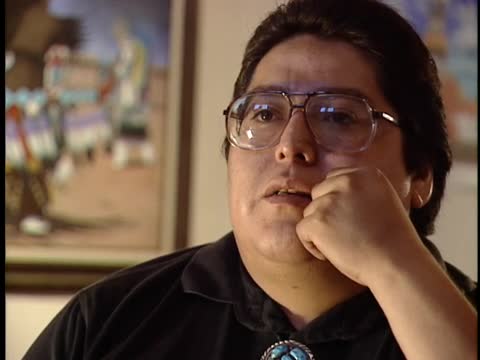
- This file contains raw footage of an interview with Ronnie Cachini, a Zuni painter.
- Asset type
- Raw Footage
- Genres
- Unedited
- Media type
- Moving Image
- Duration
- 00:21:12.472
- Credits
-
-
Interviewee: Cachini, Ronnie
Producing Organization: KNME-TV (Television station : Albuquerque, N.M.)
- AAPB Contributor Holdings
-
KNME
Identifier: cpb-aacip-be093c4879a (Filename)
Format: Betacam
Generation: Original
Duration: 00:20:00
If you have a copy of this asset and would like us to add it to our catalog, please contact us.
- Citations
- Chicago: “¡Colores!; 804; A:shiwi A:wan/Belonging to the Zuni; Interview with Ronnie Cachini; Part 3,” New Mexico PBS, American Archive of Public Broadcasting (GBH and the Library of Congress), Boston, MA and Washington, DC, accessed December 18, 2025, http://americanarchive.org/catalog/cpb-aacip-191-93ttf78m.
- MLA: “¡Colores!; 804; A:shiwi A:wan/Belonging to the Zuni; Interview with Ronnie Cachini; Part 3.” New Mexico PBS, American Archive of Public Broadcasting (GBH and the Library of Congress), Boston, MA and Washington, DC. Web. December 18, 2025. <http://americanarchive.org/catalog/cpb-aacip-191-93ttf78m>.
- APA: ¡Colores!; 804; A:shiwi A:wan/Belonging to the Zuni; Interview with Ronnie Cachini; Part 3. Boston, MA: New Mexico PBS, American Archive of Public Broadcasting (GBH and the Library of Congress), Boston, MA and Washington, DC. Retrieved from http://americanarchive.org/catalog/cpb-aacip-191-93ttf78m