¡Colores!; 804; A:shiwi A:wan/Belonging to the Zuni; Interview with Ronnie Cachini; Part 2
- Transcript
You You're talking about sometimes you don't even paintings you know they have like spiritual beings I think you know sometimes if you're making a kachina you know and it doesn't want to come out you
just have a hard time trying to make the right position pose or something like that you know and sometimes you know when they're called cooperative you know it's just like just comes out right there you know even paintings I think have a spiritual kind of beings too because they're kachinas and to create something like realistic and all that you know I think they you know become kachinas like in real life I think but what happens if you're painting and you can't get it right you don't give up no I don't give up I just if I if it doesn't come out and if I should probably mess up my canvas or something like that I just match the color and redo it all over again and try to get it as perfect
as possible no it's it's just the the brush brush and paint you know you need to control it a lot more instead of the paint controlling you sit down and just calm yourself down I think and just start painting again you know when you're in the mood you know it's it's there's no stopping me you know when I get in the mood there's no stopping me it's just keep on painting but sometimes I have to get up and walk around you know I get frustrated or something you know just get up and go outside take a walk or or do something you know just instead of getting more frustrated because because that figure won't won't come out or something you need to
mess up your painting you know just set it aside you know go outside and go for a walk or something yeah and I I try to work every day but I don't have a sketch I just work sometimes I don't feel like working I won't you know there's days that I have to work you know even though I don't want to but no it's just that's my source of income so so I have to create in order to get money so you know if I don't make a painting I don't eat you know I don't keep a schedule I just I work when I feel like working you know sometimes you know or youngest one you know she'll be like you
know she'll come up to me and one she'll want me to take her outside or something so I have to quit you know and I'm on a roll and she comes in and does that to me come on I got to work you know there's something like that you know sometimes I I really like to paint on large canvas but those take a lot of time you know at the end you know you'll be all frustrated because it doesn't seem like it's getting done or something that the one with the shot the lawn horns on the other side of the wall right here and I almost punched it out one time I was so frustrated you know it's making the necklaces a turquoise making the right color and probably pull the texture on them and stuff like that
and it seemed like it was just taking forever and ever and just I thought I wasn't finishing it and I was all frustrated then but but once I finished it and I felt happy about it and I came out really nice and all that and sometimes I do smaller ones like that you know just to pass the time or something yeah sometimes I use watercolors water color paper I like water colors but but that's not for me I prefer acrylics weeks time if I sit down and work all through the week I'll probably have about
two two or three depends on what size you're working on the bigger canvas you know take quite a while the smaller ones don't take that much time sometimes if I sit down and work out I'll finish 9 by 12 in about probably six hours or so you know have a couple of figures on there or if not just a head part and having them probably gazing down from the sky or something like that you know it's up to you what you want to create you know nobody can tell you what or what not to make you know it's up to you you know what what feels right or if you like something that you've seen you know not capture it on canvas
that's that's how I work and most of the time most of the time I just gather information from dances or especially during night dances you know you'll be in there and all kinds of kachinas would be coming in and you'll be studying them and all that how they walk and how they dance you know sometimes flipping a tape of the night dances and have get visions you know just by hearing the songs and hearing the bells you know and you know just have a sense that that that it's going on right now you know
and just capture it on canvas you know I like I like I like corn dancers and making corn dancers they have a lot of you know they dress elaborately with all kinds of like ribbons yarn and the necklaces and all those feathers on their heads and you know those are the ones that take take a lot of time but but once you finish it I think you know this when you have get you know you feel very proud of yourself you know and you look at it wow did I create that you know I just have a warm feelings you know knowing that you that you created it yeah yeah sometimes I really like what I
do if I make a shalako and it comes out really nice you know I sometimes sometimes want to excuse me sell it but no but I have to and no I really don't have that much paintings at my house we only have two of mine you know at my at our house but my grandma has all kinds of paintings you know that I did even my first ones in I think was in 80 and the other one is in 78 that's when I started painting on canvas was in 79 that's when I did my first painting which my auntie has at her house it's
just a red kind of orange background with with a positive on the side like that and I think it has a pottery and rainbow I think it was like that the rainbow going across like that you know that was my first ever painting you know and back then you know they were first couple years when I started making paintings you know they were telling me to enter in art shows but I was I felt that my work wasn't good enough you know back then and I think that's that's the trouble with with the young artists today too that they don't have any self esteem in their work they think they were getting good enough you
know but that's that's you know if you if you create something that you feel that is that you feel that it's good you know it feels right don't let it stop you in showing it off or something you know no there's a lot of critics out there but don't you know that's something you know that you have just you know oversee you know not really get to you because once once they get to you you know your self esteem will drop in your your performance in your work with you know decline you know so I just don't let it let it get to me there's some people out there you know that they'll criticize your work or something like that and I just well you know I like it you know don't really
have to care about you you know you think you know but all that input you know will help you out to in the long run you know just get you should stop you know That's a good way underneath the basket. And cool. And we could be talking about building what they would since we had performs. So, in preparation for the work of Ой Fosa, is that we tell us more about the band owns here.
Yeah, what I do is more or less traditional, you know, in the old days instead of doing modern type settings, you know, I like to go back probably 100 years, you know, to old houses where they used to have what five or five stories. I have probably have some kids probably running around or something like that or old folks, you know, just have, you know, whatever, you know, comes to your mind, you know, just like, for instance, if I should do a public scene, you know, put some kachines on the bottom, you know, and then people like looking
out a window or have an old man standing on top of the roof watching down, you know, something like that, something, you know, like have like a kind of humor in it, you know, or something like that, you know, just put a little kid looking out the window, just the head part or the eyes, you know, just have them looking out or, you know, it's up to the individual, you know, what they want to do, you know, and my backgrounds, what I like to do is, I like to do skies and have a thunderstorm or something like that, you know, when, when you just make
a plain blue sky, you know, a clear sky, you know, it's, it's not right, you know, to me, I don't, I don't feel right, you know, just having a plain blue sky, you know, I like to put clouds in it, you know, and, yeah, well, that's what we all pray for, all catching us, pray for rain, you know, and it ties in with, I think, our religion, our, that's what we pray for, it's rain, so that's what I like to create in my paintings, you know, have clouds, you know, a cloud burst or, or just, even though just a few clouds here or there, you know, that's what, that's what we all pray for, so that's how I like to interpret,
you know, make it to where, that there are prayers have been answered by the gift, you know, you know, our spirits, our ancestors, our forefathers, you know, they form in shape of clouds, you know, that's how we ask for, pray for rain, and then when it rains, you know, we say that our grandfathers come in or something like that, you know, and they, when they answer our prayers, you know, it makes us feel good, you know, and rain is this life, you know, gift of life, so that's what I like to put in my work, like, put clouds or have it snowing or something like that, you know, if I do winter scenes, you know, I like to have put some clouds in there, have it snow, you know, just something to make
it like we're interested in, and like I said before, you know, clouds are probably the hardest thing that you could do with the brush and paint, because having, like, the actual, actual colors, it's probably difficult, you know, it's just not white and black, you mix it together and get gray, you know, it doesn't work that way, sometimes it has a blue tone in it, you know, so you've got to really know what you're doing, you know, as far as clouds are concerned, you know, it's, you know, have, have, you know, like just picturing your mind first at first and then just lay it out, you know, and that's what I really like to do is I like to make clouds and sometimes, sometimes I just make abstract
background and probably just put a lawn horn, you know, just a head part or a shoulder length or something like that, you know, and on the bottom have like a nature scene, probably put a toy on the bottom like that, have abstract background on top and then the colds down and have nature scenes, you know, that's what I like to do, those come are pretty nice, you know, I like doing that, you know, there's no limit to what you could do with the canvas, you know, I'm paying, you know, there's all kinds of styles out there that you could go with or you could create your own style, but I think, I like to do dry
brush, it's a dry brush technique, you know, don't really water your paint down too much, you know, it's just like using just a little bit of water and just stroking it on, you know, that's what I like to do, dry brush technique and sometimes I have to wet on wet, you know, but I like to have my backgrounds dry first.
- Series
- ¡Colores!
- Episode Number
- 804
- Raw Footage
- Interview with Ronnie Cachini
- Segment
- Part 2
- Producing Organization
- KNME-TV (Television station : Albuquerque, N.M.)
- Contributing Organization
- New Mexico PBS (Albuquerque, New Mexico)
- AAPB ID
- cpb-aacip-191-8380gkqs
If you have more information about this item than what is given here, or if you have concerns about this record, we want to know! Contact us, indicating the AAPB ID (cpb-aacip-191-8380gkqs).
- Description
- Episode Description
- This is raw footage for ¡Colores! #804 “A:shiwi A:wan/Belonging to the Zuni.” This is raw footage for ¡Colores! #804. Traditionally Zuni Pueblo has been known for its fine pottery and silver work. This ¡Colores! documents the landmark A:shiwi A:wan/Belonging to the Zuni painting exhibition that showed for the first time the excellence and beauty of Zuni Painting. Featured are the Zuni painters exhibited in this exhibition, discussing their inspirations and their devotion to their culture.
- Raw Footage Description
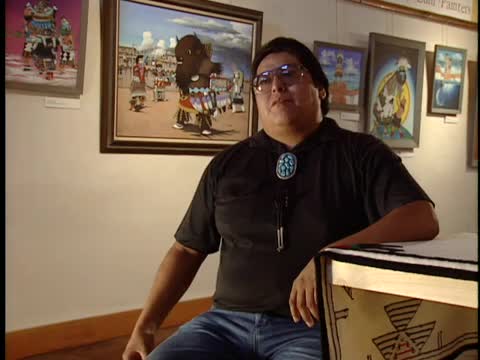
- This file contains raw footage of an interview with Ronnie Cachini, a Zuni painter.
- Asset type
- Raw Footage
- Genres
- Unedited
- Media type
- Moving Image
- Duration
- 00:21:09.090
- Credits
-
-
Interviewee: Cachini, Ronnie
Producing Organization: KNME-TV (Television station : Albuquerque, N.M.)
- AAPB Contributor Holdings
-
KNME
Identifier: cpb-aacip-c79fc6424e9 (Filename)
Format: Betacam
Generation: Original
Duration: 00:20:00
If you have a copy of this asset and would like us to add it to our catalog, please contact us.
- Citations
- Chicago: “¡Colores!; 804; A:shiwi A:wan/Belonging to the Zuni; Interview with Ronnie Cachini; Part 2,” New Mexico PBS, American Archive of Public Broadcasting (GBH and the Library of Congress), Boston, MA and Washington, DC, accessed December 15, 2025, http://americanarchive.org/catalog/cpb-aacip-191-8380gkqs.
- MLA: “¡Colores!; 804; A:shiwi A:wan/Belonging to the Zuni; Interview with Ronnie Cachini; Part 2.” New Mexico PBS, American Archive of Public Broadcasting (GBH and the Library of Congress), Boston, MA and Washington, DC. Web. December 15, 2025. <http://americanarchive.org/catalog/cpb-aacip-191-8380gkqs>.
- APA: ¡Colores!; 804; A:shiwi A:wan/Belonging to the Zuni; Interview with Ronnie Cachini; Part 2. Boston, MA: New Mexico PBS, American Archive of Public Broadcasting (GBH and the Library of Congress), Boston, MA and Washington, DC. Retrieved from http://americanarchive.org/catalog/cpb-aacip-191-8380gkqs