Conversation With
- Transcript
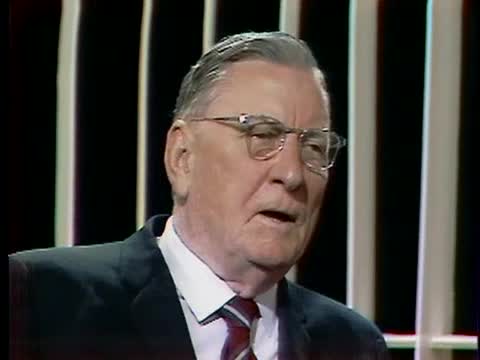
Conversation with Ross Barnett talking today with Ross Barnett former governor of the state of Mississippi is William peered. During his political career Ross Barnett sought only one office. Mississippi's highest that of governor. He made two unsuccessful bid for the office before he won the state's highest prize in 1959. Mr. Barnett served as governor from 1960 until 1964 a period marked by industrial expansion lowered taxes and racial transition. He was born on a small farm in the tightly Catholic communities of standing pine. And Rose But on January 22nd 1898. He attended public schools in Lee County and was a graduate of Millsaps College and the University of Mississippi. He also attended Vanderbilt University in Nashville. Mr. Barnett is one of the South's most successful trial lawyers. Governor when you were growing up in these tiny communities in Lee County did. Did you have any time. Desire to do this into
the governorship in your state. Yes I had it is to serve the people of my native state and the time I was 10 years old. Got that ambition One day when I heard a county superintendent of education make a speech. In a small public school. I had an ambition also. To become a good basketball player. A barbel operate a little barber shop. I ask you and in college. I had an ambition to become a good school teacher told her to two years. I didn't think I don't teach that one year but they raised my salary to two dollars a day for a month and so I stayed on a second year. Part of talk Mississippian. Been ambitious all of my life and I really and truly had a burning desire to serve as governor of this great state. Did you make the basketball team as you planned. Yes
I'm a governor. I played on the basketball team in public school two years two years and Agricultural High School at Lena Mississippi. And for years that Mississippi College at Clinton Mississippi. Smoking cigarettes back in those days I know you don't smoke. Well I was one of the worst cigarette smokers I guess ever raged to miss it because of it. And cooch red Anderson asked me one day if you smoke cigarettes don't you also I said yes. He said well if you quit smoking cigarettes put you on the varsity basketball team. And I told him that I would quit smoking and I did and I haven't smoked sense that when you win standing pat and did not understand a lot of Indians back. In the area in those days and you want to mention to me when we've done some interview on this book that that I'm doing on your life that you had a you had an ambition also to where as I recall
an alum and shirt you did just what wasn't already there were quite a number of Indians in our community. They would make baskets and I would bottom seal had good sized clean break and I'd sit around listen to them. Home and all of mine became one of my best friends and gave me two red shirts. And I'd have a big fuss. With who I'd start to screw. If I couldn't wear one of all of the shirts. I always want to wear all in one red shirt. We had an Indian over there by the name of Scott York. And we didn't know he was a preacher. One Friday afternoon he passed our old home. Between Carthage and union riding a great big old yellow horse with corn tied on the back of it and a couple of bone I would have thought of. And my dad are sitting out on the front porch he hollered said Scott. Says
to her you go every fourth Friday he said I'll go to Coney I had to preach my datasource York I didn't know you're a preacher. Yes I'm a preacher. They got you but thirty five miles to preach don't he said yes he said I'm sure you get good pay. God says Mr. Barnet I get $40 a year. My dad says Scott that's mighty mighty poor pay. Scott York says Mr. Barnet it's a poor preach too. I enjoy living around the Indians over that community. Or good citizens really and truly gov that you left Miss at the college you went to Vanderbilt and Tex and some lower pre-law as I recall. And you told me one time that you that you sold insurance. And you had you had a pretty pretty neat way of selling this insurance when you reminisce about that a moment please. Well Vanderbilt started Law two summer
sessions. Right across the street from George Peabody college where there were a lot of good looking school teachers. Attending school. So I would have a date say tonight with a schoolteacher and a life insurance policy. Tomorrow. I sold a lot of insurance that course most of the policies were small. But I would date a schoolteacher at night and sell or a policy the next day. So I like having your cake and eating it to live having cake and eating it too was right. When you were standing. I believe that this is where you initially got the feeling of unity exact what unity meant because you had a very close knit family you came from a large family. And every every Saturday night since as you put it one time there were no Hawkie talked to frequent that that you would have spelling bees and debates among the family and neighboring people. And that your Uncle Egbert I think you name wasn't Uncle Arden I would get up
and told you something about unity that that has stuck with you all through the years. That's right I recall very well Martin he was a just a preacher and a physician. He lived in standing pine for a long time and it Walla grove and in Bergen and probably other places or a family where you need some boys he said I'm going to be will own your side and with you and backing you at all times when I know you're in the right leg but also a physician and he got up he said Boys he said I'm going to be with you right or wrong. He says We believe in unity here this could be. I won't even ask you which which uncle's advice you took the most at heart because I think it's the latter. When you were governor of course you you immediately ran to a whole multitude of problems. But at that time before
you became governor that is after you or after you won the election in November. Did you think that your thorniest your most knotty problems would be in what area. Well I soon realize that the. Thorniest problem probably would be giving jobs soon and I was elected people begin to form lines to my office and some time theyd be a hundred fifty two hundred per day coming to see me and wanting a job. I hadn't been in the governor's mansion more than about three weeks. Phone rang about 1:30 one morning I had been asleep. Couple from way down south this is it was it Hello Mr Ross he said Oh I mean Governor rolls. He said I want to tell you that I worked my hard during the campaign and he said I tell you now I want I want a job Jackson I said Would you work with my campaign manager you down in Jones County Oh no he says he and I
had to get along where we wanted I didn't pay any attention to him and I did work by myself you know I said I worked my heart spent a lot of money on you know I said what kind of job you won't bad he says Governor I'll just leave that up to you I'm not selfish she said I'll just whatever you he said about $375 a month would be all right he said. Where have I said you have to be a little bit more specific. Really what do you want released his Mr. Rolls his eye would take three hundred fifty dollars a month and just let you pick out whatever you want me to do it I'm. Just mad at one of the main problems that I had. This was at 1:30 in the morning. Good thing I didn't call you at 3:30 and he might have dropped that he said he said I didn't want to bother you and you also said I didn't want to call you when you're not doing anything you know one third of the morning that I didn't think you'd be doing anything about 1:30. Why there'd be people coming in the 20 and 25 want to game wardens for this one and that one and then they'd come in 20 and 30 will
employee takes commission and park commission. And I'll tell you Bill people back in 19 and 62 64 were really and truly interested in jobs. They wanted a least a position you know and it was a pleasure dealing with them I'd stay in that always on time out of 10 o'clock at night. I'd stay in NY and talk with them. I couldn't give them all the jobs of on it but I would see them and talk with them and try to give them some logical answers not think Mississippi will remember you. Most of the efforts that you made you're successful have a highly successful Levison industrial expansion. You really worked at this almost around the clock as I recall I didn't move here until 1962 when you were in the last two years of of your. Term. But many of the contact that you made during the first two years had done to jail by that time. Just how did you go about.
Wooing industry into acetate. Well after my election in August 1959 I planned several trips before the end of the year. I made one trip to New York and I made one to Houston Texas and I. Made two or three other trips before I was inaugurated and the first question that an industrial prospect would ask me Mr. Barnet. What is your tax structure in Mississippi. What are your income tax program in Mississippi. Well. I'd have to say income tax is 6 percent. But he said what he did an Alabama I'd have to say 3 percent or didn't Lousiana I'd have to ask asked tell him that it's 2 percent Lousiana. When he said a lot of difference and 6 percent and 2 percent he said I understand I don't have any income tax in Florida I'd say that's great and all in Texas. Well he
says I think we should just go to either Florida or Texas. So I came back in the first session of the legislature joint session. I begged a legislator was to go along with me. And reducing state income tax from 6 percent down to 3 percent. Because I own you I found out that if we are not competitive with our neighboring states we are not. We were not going to get the capital you capital invested in histories and new jobs that we were entitled to get and legislate toward most of them said well are also. Reducing that income tax will add all the for the big dollars and not for the little fellers. I say you've got to get the big boys in here so the little fellas can have jobs. But I said Well since you mentioned that let's give everyone an extra $1000 state income tax exemption
and they went down the line with that suggestion. And that is what the did they reduce the state income tax from 6 percent down to 3 percent over a period of six years. It was a reduction of one half of 1 percent each year and giving everyone an extra $1000 state income tax exemption. That meant saying no people as well as married people. And after we enacted that law and a lot of other laws. Creating industrial parks throughout Mississippi and taking over the poor didn't go forward. We knew that those port city of Gulfport could not compete with the states of Alabama Louisiana and Florida and the feel of world commerce. So I asked a legislator was to go along with me in taking that state take over the port and they did then build a banana terminal and that helped bring in
some industry. No one company from New Orleans left I believe it's a standard food company and went to go to court later with a thousand employees. Then we realize that the bonnes would not be so hadn't been so in Pascagoula put up the grain elevator proposal. And so I suggested to the legislature that we. You extend the full faith and credit of the state of Mississippi for that project provided Jackson County Mississippi would extend its food faith and created first and they did that and that grain elevator today is a huge project that has helped a great deal.
Governor Brennan's anew all and it is a it's a new all in tradition. The breakfast is at the mansion that you had to the industrialists were conditioned during your your four year term and you inaugurated a. Serving trick that that not only let you get your calories fast but also that you get away from the breakfast table and they harvested your business just so how do you go about that. Well I told the waiters to instead of starting at one in ham and saving it all the way down and then coming back to start at one end with a platter of ham. Start at your the end at the same time with a platter of hot biscuits and in the middle with gravy and in a few minutes a plate should be filled you know and I'll never forget when we got started or people in the morning for breakfast we had 18 from California and Kentucky. And they played the field in two minutes and Mr Debbie S. Smith
president of standard or do it my system. Mississippi has been feeding people. That was Lee County Hamlet and that was some of it leaked out. Ham red eyed gravy hot biscuits and good ole Rankin and Lee County molasses and industrial is really and truly enjoyed it. We'd call 1 or five you know every morning I mean industrial prospect job or look what a great hip to me he'd come in and deal Hackett who is now director of the industrial development in Louisiana they would come in there say about 7:30 in the morning look here governor here is here's a prospect in Ohio let's call him right now. Getting on the phone we tell him about the tax reduction we tell him about the extra exemption. Taking him about a lot of little or creating industrial parks throughout Mississippi and tell him we were inviting him to the oldest governor's mansion in the United States of America
where we serve ham biscuits and weekend in Malaysia and in a television only go to his mansion in the United States that had a $10000 gold bathroom and you know they had except about two out of three would accept and they'd go. And then our individual boys would gather them all around the community. First thing you know they'd be putting a plant in Mississippi and I think the $10000 that the legislature appropriated to redo the bathroom in gold plate or gold leaf or whatever you know I think we got perhaps a million dollars were published out of it. Again I don't want to belabor the point but can you give me a brief post-mortem you might say of. The enrollment of James Meredith the first member of his race knowingly admitted to the University of Mississippi back in the fall of 1966. In other words would if. If you planned the play in the hand again with what would you do what would you do now. What what you did
back then. Well it's true that I did all that I could to keep him out of the University of Mississippi. And the reason I did it was because I had taken an oath. When I was inaugurated as governor to the whole lot of the state of Mississippi the Mississippi constitution as well as any other constitutional law. And I didn't think that the federal government had in their legal right. And I don't think so today to control and direct the activities of a public school. I think that's a matter that belongs entirely to the states and I believe that someday the United States Supreme Court will hold that way. I think the 10th Amendment which says that the powers not delegated by the Constitution to the federal government and we are not prohibited by their contribution to the states belong to the States or the people they're off.
The word school is not mentioned in the Constitution. They were a education is not mentioned in the Constitution. So I don't know where the federal government gets power and authority legally to control and direct the activities of Public to. Now when James Meredith attempted to register at the University of Mississippi judge sitting in mine as rendered the first opinion and he said that it is was nothing but a troublemaker. Well let naturally. Prompted me in trying to keep games up because we didn't want trouble in Mississippi. It's my hell that on two different occasions after having the hearings and about I think it was three members of the Circuit Court of Appeals said the same thing. But anyway finally federal court said Let him enter. You know western Mississippi. And so the president of United States called me about 48 hours before we did enter and said Mr.
Governor you have brought me here it is your last time. We had blocked him three times because we didn't think that under the law the Mississippi constitution of the United States that the federal government had a right to control and direct the activities of our public schools. And I don't think so yet really in truth. I mean the way the president said he's going in Ole Miss and he said all we want to know you two are you going to cooperate in keeping order. I said Mr. President I'll do what I can for people and I did. We use the highway patrol as long as we could. I knew that it would be foolish to go up there again and try to tempt or block him. When several hundred troops had already come in in front of him and the president said he'd send the whole army of the United States the ox would if we didn't permit him to come in. So he did get in and graduated at all the
government back in 1968 the Democratic National Convention. You led the delegation to the convention of course. This was in Los Angeles. And before the convention was over you were you were nominated as a favorite son candidate for the presidency. Prior to that however you had a meeting with Lyndon Johnson who was then Senate majority leader who was seeking the presidency but who of course ended up John Kennedy's take at that as vice president you had a meeting with him in his hotel room would you recount. That experience for us please. Yes I remember very well. Senator and Stannis. And Walter Hester of Natchez Mississippi and I. Went to see. Mr. Johnson he was a United States senator of course at that time. And he was eating tomato soup.
Then. I told him I said Mr. Johnson I'm sorry but we can't support you. He said hon I said because you are a liberal. And a conservative and the people of Mississippi are conservative. Like I said I'm not a liberal I'm a conservative. Well I had a magazine in my pocket United States News and World Report. And I put it I said I here's an article by you in which you state that you are a Texan. Your rank you your senator and you are a liberal. He said well what I meant or being a liberal. Man that be liberal in granting jury trials because he like to tried your lawsuits and with that he wiped the vegetable soup off his mouth and leave and you and your group left the room.
That's right governor all during your political career. Your part as a Reader's Digest Readers Digest instead of the United States and World Report. All the articles all do in your political career your family has participated quite extensively. And in your campaigns I. Just sort of have the idea that even though you had campaign managers that you considered. Mrs. Pearl your number one campaign manager there she was a great help. She was great. One thing that you had to handle people and she was courteous and calm and everyone wanted to get into the mansion and they were royally entertained. Pearl. One of my grandchildren said the name rid of or wrote of on it so that's why I say there's a name Pearl River for grandma told her about it
she was there if you'd care Panola County for me every time you asked for it she would return and you yourself carefully count ass and let her. Relatives care that friends you know friend all over Lee County going to four years ago. You made another campaign for governor when you left the governor's office in 1964 you were probably at the peak of your popularity and reading Missippi history from what I have written so I've lived here you were probably as popular as any governor who went out of office. Yet the people decided that that they wanted someone else reasons of their own. And you made a statement that impressed me very very deep at the time. You said after the votes were counted Jenner's apparent that you had not won your bid for another term. You said well I guess the people just wanted me to continue practicing. LOL And since then you have done
that and have done it very successfully. Now that you've been out of the governor's office for seven years and. And recollect was as much fun as it was the. From the statement you made the day that you get the term expired you said you enjoyed every minute. Well I did enjoy every minute of it and I enjoy practicing law and we are practicing law away from you all into Springfield Missouri. Try to case not long ago in Springfield and. I lost it. You know lawyers don't usually tell about keys you lose. Lost it in their circuit court in Springfield. But then we appealed it to the Supreme Court of Missouri and we won it in the Supreme Court of Missouri. And when I got back I said when we last came back saying that St. Louis Blues and when we won in the supreme go to Missouri I came back saying them Rewald. Yes. I'm back in the law practice and some man said that when I left
the governor's mansion I called up a claim agent before I got them all the builder to meet me at the office because I wanted to settle a lawsuit with it would you have been a most successful trial lawyer. Well I thank you for the compliment that back to to unity again. You have long ex-boss the theory of Southern unity to get together the southern states a stronger voice in national affairs. Did you state that holds as true today as it did when you were actively campaigning that direction you have the political arena when you don't make these statements that you once made a cool. Or I say I think so I think that is one of the answers to our. Problems today is so than unity honestly and sincerely believe deep down in my heart that all the governors senators and congressmen of 12 or 13 states of the
South would unite work together work together and let the world know that we organize. I believe that our voices would be heard throughout the nation and that we would have a much better nation in which to live. And I also believe that we ought to elect a United States Supreme Court judge. Let the people vote on. Well right here an audience I'd like to hear. Former Supreme Court Justice Warren try to defend some of his decision before. Audience in Birmingham Alabama. Or better roads Louisiana or even a look at Mississippi do you think there's any possibility that this may come about in the future. I mean even 50 years later probably come about this has been a conversation with former Mississippi Governor Ross Barnett here in the United States Supreme Court
rules that govern atol New York by the way he was a good friend of mine. He helped me get industry in Mississippi and he had advocated to the man he asked to legislate tours of New York State to pass a law giving the trustees of all published power and started to fire a skoot each year if the trustees reached the conclusion that this.
- Series
- Conversation With
- Contributing Organization
- Mississippi Public Broadcasting (Jackson, Mississippi)
- AAPB ID
- cpb-aacip/60-49g4f92x
If you have more information about this item than what is given here, or if you have concerns about this record, we want to know! Contact us, indicating the AAPB ID (cpb-aacip/60-49g4f92x).
- Description
- Description
- Series: Conversation With Time: 28:40 No. 14 PGM: Ross Barnett Date: 10/27/1971 VTR No. QBTF Ross Robert Barnett 1898 _) was the governor of Mississippi from 1960 to 1964.
- Genres
- Talk Show
- Topics
- Politics and Government
- Media type
- Moving Image
- Duration
- 00:29:27
- Credits
-
- AAPB Contributor Holdings
-
Mississippi Public Broadcasting
Identifier: MPB 710 (MPB)
Format: Digital Betacam
Generation: Dub
Duration: 0:28:40
If you have a copy of this asset and would like us to add it to our catalog, please contact us.
- Citations
- Chicago: “Conversation With,” Mississippi Public Broadcasting, American Archive of Public Broadcasting (GBH and the Library of Congress), Boston, MA and Washington, DC, accessed April 3, 2026, http://americanarchive.org/catalog/cpb-aacip-60-49g4f92x.
- MLA: “Conversation With.” Mississippi Public Broadcasting, American Archive of Public Broadcasting (GBH and the Library of Congress), Boston, MA and Washington, DC. Web. April 3, 2026. <http://americanarchive.org/catalog/cpb-aacip-60-49g4f92x>.
- APA: Conversation With. Boston, MA: Mississippi Public Broadcasting, American Archive of Public Broadcasting (GBH and the Library of Congress), Boston, MA and Washington, DC. Retrieved from http://americanarchive.org/catalog/cpb-aacip-60-49g4f92x