December 1, 2015 6:00pm-7:01pm PST
- Transcript
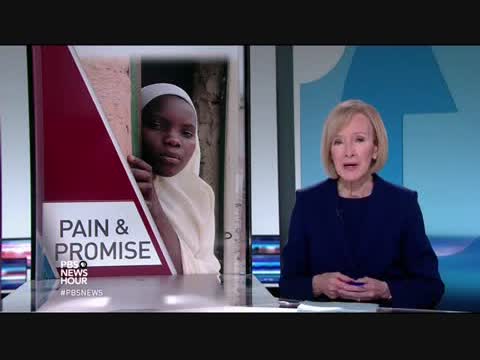
that can be armed and disarmed remotely and live video monitoring from anywhere. Good evening, I'm Judy Woodruff. And I'm Gwen Eiffel. On the news hour tonight, Chicago's mayor fires the city's police superintendent, amidst protests and calls for change after video of an officer killing a black team. Also ahead this Tuesday, ramping up the fight. The U.S. expands use of special forces in Iraq and Syria to combat ISIS. And our special look at Nigeria's pain and promise continues. How an economic boom leaves much of the country in poverty. It's no political water. There's no access to how to get the primary health care. The schools are completely private. There's no official presence in my group. All that and more on tonight's PBS NewsHour. The U.S. has been provided by VNSF Railway. The ongoing support of these institutions.
This program was made possible by the Corporation for Public Broadcasting and by contributions to your PBS station from viewers like you. Thank you. World leaders left Paris today and negotiators got down to the hard work of finishing a landmark climate change accord. President Obama was among those departing after a final call to action. I'm convinced that we're going to get big things done here. At an afternoon news conference, the president sounded optimistic about the summit's chances. If you had said to people as recently as two years ago that we'd have 180 countries showing up in Paris with pretty ambitious targets for carbon reduction. Most people would have said you're crazy. That's a pipe drink.
And yet here we are, that's already happened. Even so, climate scientists warned it will take much larger reductions to stop the Earth's warming trend. Another sticky point is finding the money to help foreign nations adapts. Today, Mr. Obama, a native of Hawaii who lived for a time in Indonesia met with leaders of Pacific island nations whose very existence is threatened by rising sea levels. And as weather patterns change, we might deal with tens of millions of climate refugees from the Asia Pacific region. And as I mentioned to my friends around the table, I'm an island boy. I grew up on an island. And understand both the beauty but also the fragility of island ecosystems. Meanwhile, African leaders talk to French president Francois Hollande about threats their countries face, ranging from the spreading Sahara desert to dwindling water supplies.
Africa, the least emitter of greenhouse gases in the world, now suffers the most from climate change. Others pollute Africa pace and pace dearly. Lake Chad is almost gone. And the sand dunes are encroaching the Sahel. Hollande announced today that France will send more than $8 billion to Africa for development of renewable energy and electrical access. But the Paris meeting success will ultimately be judged by how far a final deal goes and how effective it can be without mandatory enforcement. President Obama acknowledged as much as his new conference. What we seek is an agreement where progress paves the way for countries to update their emissions targets on a regular basis. And each nation has the confidence that other nations are meeting their commitments. Still, as the president flew back to Washington, House Republicans called for action to reject his clean power plan.
House Speaker Paul Ryan. I don't think we're on a step with public opinion warning jobs, warning economic growth, weighing the costs and the benefits. And I think when you weigh the costs and the benefits against these so-called legally binding obligations, they don't add up. The House votes on a Republican energy bill later this week, the White House has already threatened the veto. And this evening, House Republicans did push through resolutions opposing EPA limits on carbon dioxide emissions from power plants. In the day's other news, Chicago may a Rahm Emanuel fired police superintendent Gary McCarthy today over the killing of a black teenager. Video released last week showed Laquan McDonald being shot 16 times by a white officer in October of 2014. Today, the mayor said the police department needs, quote, fresh, eyes and new leadership. Any case of excessive force or abuse authority undermines the entire force and the trust we must build with every community in the city.
Police officers are only as effective as if they are trusted by all Chicagoans, whoever they are and wherever they live in the city. Meanwhile, Jason Van Dyke, the officer involved in the shooting, has been charged with first-degree murder. And late today, the Illinois State Attorney General called for a federal civil rights investigation of the Chicago Police. We'll examine what led to today's firing later in the program. A federal trial has been delayed again for a Dylan Roof accused of killing nine black church members in Charleston, South Carolina. A judge postponed it for the third time today, giving the defense more time to review thousands of pages of evidence. Roof faces federal charges of hate crimes and firearms violations. A trial on murder charges in state court is set for next July. More bloodshed in the Middle East today, the Israeli military says troops shot and killed two more Palestinians in attempted stabbings. Both attacks happened in the West Bank,
but ours apart. The army did not say how close the attackers, a man and a woman got to their targets. Since mid-September, 19 Israelis and at least 100 Palestinians have died in the ongoing violence. The number of refugees fleeing to Europe by sea fell last month for the first time this year. The UN refugee agency says the number was roughly 140,000 down from 220,000 in October. It cited turbulence season, Turkish action against smugglers. But thousands have arrived on Greek islands this week alone, many of them among the most vulnerable. The numbers of children and women continue to climb, which is for us, quite honestly, something of a surprise. And we can only assume that this is a sense of the desperation that families are going through. When you take your whole family with you, it means you don't have schools for your children. You don't have proper shelter. You have no sense of what lies ahead.
The UN estimates more than 1 million migrants in refugees will enter Europe this year. Investigators in Indonesia say they have determined why an air Asia passion passenger jetliner crashed last December, killing all 162 on board. They said today that a recurring problem with the rudder control system and miscommunication among the crew brought the plane down. Search teams had to recover the wreckage from the Java sea after the crash. They also found the black box flight recorders that helped explain what happened. Back in this country, there's worth the number of Americans with newly diagnosed diabetes is falling after decades of rising. The Centers for Disease Control and Prevention reports cases fell by about one fifth from 2008 to 2014 to 1.4 million. Experts say they're not sure what's causing the drop, but better eating habits could be a factor. Ceremonies in Montgomery, Alabama today
marked a seminal moment in the civil rights movement. It was 60 years ago that Rosa Parks refused to give up her seat on a segregated bus and triggered a boycott. The commemorations focused on the Baptist Church where Dr. Martin Luther King Jr. led the boycott. Democratic presidential candidate Hillary Clinton was among the speakers, along with Alabama Congresswoman Terry Sewell. We're here down only to celebrate 60 years, but to know that in order for us to get 60 years further down away, we must do our part. We must do our part. The price of freedom is never free. It has been paid for by the blood and tears of so many. And all of us know that we get to stand because Rosa refused to sit. Rosa Parks died in 2005 at the age of 92. Facebook chief executive Mark Zuckerberg announced the birth of a daughter today
and a huge new charity. Zuckerberg said he and his wife, Priscilla Chan, will give away nearly all of their Facebook stock, valued at $45 billion. They'll focus on fighting disease, improving education, and reducing poverty. In economic news, US auto sales had a 14 year high last month thanks to major holiday discounts. That data plus better economic indicators from Europe and Japan went down well on Wall Street. The Dow Jones industrial average gained 168 points to close at 17,888. The Nasdaq rose 47 points in the S&P 500 added 22. And starting today, menus at chain restaurants in New York City will carry a warning about salt. A salt shaker emblem will note menu items that have more than 2,300 milligrams of sodium. That's the daily limit. Many nutritionists recommend about one teaspoon of salt. It's the first such rule in the country.
Still to come in the news hour, boosting special forces in Iraq and Syria. The birth of Africa's largest economy, Chicago's police chief fired, and much more. The US strategy against the Islamic State, also known as ISIS or ISIL, came in for some direct questions in Washington today before the House Armed Services Committee. As the US military announced that more forces will be heading to Iraq to fight the extremist group. Pentagon leaders came to the hearing with a response to calls to do more against the Islamic State. In full coordination with the government of Iraq, we're deploying a specialized expeditionary targeting force to assist Iraqi and Kurdish Peshmerga forces. Defense Secretary Ash Carter said the force will be larger than 50, and be authorized to take direct action,
including combat. These special operators will, over time, be able to conduct raids, free hostages, gather intelligence, and capture ISIL leaders. This force will also be in a position to conduct unilateral operations in Syria. The US already has 3,500 troops in Iraq, supporting that country's military, and a few dozen special operations troops are assigned to support local fighters in Syria against ISIL. Carter said today, the US is, quote, at war, and the force he announced is a new way of achieving the objective. We're actually eager to do more, because that will accelerate the defeat of ISIL, but it hinges upon us finding the low-capable local forces that we can enable in this way. A number of Republicans have called for sending in far more troops, but in Paris today, President Obama again rejected that idea.
For some reason, too often in Washington, American leadership is defined by whether or not we're sending troops somewhere, where we strengthen our relationships and influence the most is when we are helping to organize the world around a particular problem. Back at the hearing, the country's top military officer, Marine General Joseph Dunford, acknowledged ISIL has not been contained, but he said stepped up airstrikes are cutting into the militant's oil revenues, even so Ohio Republican Michael Turner challenged Secretary Carter on claims of progress. Are we winning, Mr. Secretary? We will win. Are we winning now? We're going to win. Well, Mr. Secretary, most of us, on both sides of the aisle, do not have confidence that you have a strategy and that you do not have a strategy based on an accurate assessment.
I think your presentation here today shows a disconnect between what all the information that we're receiving and really what's being placed into the United States effort. Meanwhile, in Iraq, Shiite Muslim militias warned they will attack any new American force that deploys there. For more, we turn to the Chairman of the House Armed Services Committee, Republican Mac Thornberry of Texas. I spoke with him just a short time ago. Welcome, Chairman Mac Thornberry. Let me begin by just asking, what is your understanding now of these additional steps the Obama administration is going to be taking in the fight against ISIS? Well, obviously, the Obama administration is trying to respond to Paris and other terrorist attacks. So they label these eight adaptations because they don't want to admit that what they've been doing so far is not working. So these are adaptations, slight changes to what they have been doing and they hope it's more successful.
You know, my fear is that it is too much of a gradual approach that is not really going to change the conditions on the ground or the ideological battle in which ISIS is excelling. Well, Secretary Carter called it, I believe, a quote, specialized expeditionary targeting force and we're hearing reporting that it could be as many as 200 troops or more. Why do you think that could be inadequate? Well, I do think they're taking just step by step sort of approach. So people have been calling for some time about putting some of our folks on the ground to help make airstrikes more effective. And that sounds like what the Secretary talked about today, although he did say that they could carry out raids and so forth. But if it is 200 people, then it is a small fraction of what we once had, for example, in just Iraq. So that's the reason I think a number of us are concerned that the President is responding to events rather than trying to figure out
how to actually degrade and destroy ISIS and then putting the resources behind that. Well, you have talked about the need for the President to put a four-star general in charge of this somewhere in the region. Are you saying that there's a number of troops who should be on the ground that the administration hasn't agreed to yet? No, I don't get caught up in numbers. What I get caught up in is a strategy to actually succeed. And my biggest fear is that what we've seen so far is that there's been micro-management from the White House. You heard that testimony today. There are 3,500 U.S. troops in Iraq. If they want to add 100, they've got to go all the way to the President to get his approval to add 25 or 100. So it's that micro-management from the White House that is one of the constraints on our efforts. And so that's the reason I say there needs to be a four-star
in the region in charge and he needs to have the authority to be successful rather than run and ask Mother Mayah for every additional 25 troops that he thinks he needs. Well, speaking of Iraq, Prime Minister Abadi said late today that he doesn't believe there should be any more foreign troops in his country. So how do you reconcile that? You're saying if the U.S. believes it should send more troops it should. What about the will of these sovereign countries and their own leaders? Well, unfortunately, Iraq has become more and more a proxy for Iran. And so the country that is putting lots of troops on the ground as well as directing the Shiite militias is their neighbor Iran. And that certainly makes things more complicated. So that's the reason, for example, the bill the Congress passed and now the President has signed would allow the President to provide arms directly to the Kurds
directly to the Sunni tribes rather than gill through the Baghdad government because Iran is increasingly calling the shots there. As you know, the administration, Chairman Mac Thornberry, you know the administration is saying that this needs to be done in coordination with the countries in the region. Are you saying that the U.S. should be calling the shots no matter what the countries in the region want? Oh, of course not. But I also think it is absolutely true as the former Obama under Secretary of Defense for Intelligence wrote about a week ago that the countries in the region are not going to step forward unless the U.S. takes a decisive leadership role. So it's a chicken in the egg. We can't do it without them and they're not going to do it unless they know we're committed. And they know that we're going to stay with the mission. See, part of the problem is the countries in the region remember that we abandoned Iraq in 2011 and that has been, that has contributed to this mess. So they need, we have to earn their trust back
and that's going to take some time and effort. But in the end, who's calling the shots? Well, there is no substitute for U.S. leadership. Now, we need to do it with the coalition. There needs to be Muslims on the ground to help carry this out but nobody can take the place of the United States. And that's the reason that I believe a four star on the ground in charge empowered to call the shots is really needed to help focus these efforts. And do you have any sense the administration is prepared to do that? I don't know. They make good noises about the authority of the guy that they have currently in Kuwait and he's a good guy. I don't take anything away from him. What I worry about, again, is the White House age micromanaging everything that goes on there. We cannot have a successful military operation run from the basement of the White House.
The chairman of the House Armed Services Committee, Congressman McThorneberry, we thank you. Thanks for having me. And, no, we expect to hear the Obama administration's perspective later this week. We return now to our continuing series this week, Nigeria, pain and promise. Tonight, special correspondent Nick Schifrin looks at the country's massive economic surge, new millionaires, growing inequality, and those fighting to provide new opportunities for all Nigerians. In Africa today for the young, the hip, the rich. There's no better place than Lagos. Nigeria is just the place to be right now in the developing world. Tola Dobko designs handbags for Florian London. Increasingly, her market is in Lagos. This is the world's fastest growing megacity. Any international business, don't be shy of life.
It is no buperer, anyway, especially not illegal. This is a nation of superlatives, Africa's largest population, richest country, and fastest growing economy. They show that this will be the main hub in Africa and it comes to the luxury goods in near future. Straight from Germany. Straight from Germany. Onerog Shah sells portions that cost 600 times the average Nigerian's annual salary. The ultra rich are growing at a higher percentage here than in the US. We have luxury yards, you have luxury aircraft, you have luxurious watches. Every luxury business in Nigeria currently is booming. It's not only the rich, between now and 2030. The middle class will grow by a factor of eight. Their spending power has made Nigeria the world's largest consumer of Guinness beer. Half the country is under 30.
Smart young Nigerians have more money and they're starting their own businesses. Tony O'Lou is one of Africa's richest men. He's trying to build the middle class by investing 100 million, of his $700 million net worth in 10,000 young entrepreneurs. The right sustainable way to intervene in Africa for economic development, for inclusive development, is to invest. When I started in Italy, I did a free watch. So people were actually attracted to the police. It's to do what Agbonani is one of Loomalo's first entrepreneurs. She calls herself Nainé as in the founder and lead mechanic of Nainé's AutoCare. Nainé's invested $50,000 of her own money. Tony O'Loumalo's money button engine lift and will convert this hole into a proper mechanics
pit. It will make her team faster and allow her to hire more people. My name is Titus. My name is Tobias. We are David. Titus and Tobius Igway are also a Loomalo entrepreneurs. Five years ago, the twins were mopping floors when their father died suddenly. They taught themselves how to cook. It was a miso survival. We're doing it because we want to survive, because that was hungry and hungry. Today, they run Speed Meals Mobile Kitchen. Within a year, they hope to cook and cater for a thousand people a day. On this day, they give away packaged lunches to prospective clients, and they feed about a hundred churchgoers. They are always smiling and always dreaming. A Loomalo's $10,000 rented this new office space.
The twins used their rags to riches story to motivate and mentor younger entrepreneurs. We tend to use this story to encourage and inspire the nearest generation. If the twins can actually make it in this house economy, in this same bar conditioner, I find myself, who am I? What is Nainé's excuse? And that's when the mentees sound like the mentor. Because your success is not a disaster for you and your family. It's a disaster for Africa. And that is the only way Africa can grow. Many young businesses and entrepreneurs begin to support other entrepreneurs. They de-grews be a chain reaction. If you succeed in employing a hundred people with a thousand people you're playing on, but if you are the level of poverty, if they're poverty, we have the better for everyone. But that poverty is still everywhere, and the wealth gap here is among the world's largest. In elite neighborhoods, tuk tuk taxis weave between mansions and share the road with luxury Mercedes SUVs.
The rich build houses that literally look down on the poor who are getting poor. In 1980, the poverty rate was 27%. By 2010, it was 69%. Even though the country's wealth is increased dramatically. Nigeria may be Africa's richest country, but here in Lagos alone, there are more than a hundred slums, including this one, Zona's Makoko, where the houses are literally built on stilts on the water. Across the country, more than a hundred million people don't have toilets, and only two percent have running water. So the people live below the poverty line, because they are less citizens of this country, not because they're less deserving. But because the government is funding to provide those services. If you guys see Felix Morca is a community organizer from Makoko's 200,000 residents. The water here is filthy and smells of sewage, and yet young residents learn to swim before they can walk. When the government that's supposed to provide those services,
it's not providing those services. They're obviously what you have is, you know, a lot of the privateions. Just look whatever water, there's no access to the health gap. The schools are completely private, there's no official presence in Makoko. Morca accuses the government of rallying around the rich and penalizing the poor. Three years ago, government-paid thugs tried to drown Makoko, so it could be replaced with a fancy boat club. You see a lot of wood stumps sticking out of water. This used to be the foundation of the house, one of the houses that was sliced down by the demolition squad. It was simply an omission of violence on the community. While the government targeted Makoko, it endorsed what developers hope becomes legosis, an Africa's premier address. Nigeria and specifically Lagos today is where China was three to four decades ago. David Frame has lived in Nigeria for 30 years.
He hopes Echo Atlantic City is his legacy. Echo Atlantic could be that catalyst to establish legos as that financial hub for the entire continent of Africa. In the heart of this iconic city, rise as the new financial hub of Legos. To lick promotional videos envision a city of the future, four square miles, nearly the same size as Midtown Manhattan, all built on land reclaimed from the Atlantic Ocean with 140 million tons of sand. Echo Atlantic is Africa's largest construction project. In 10 years, what is all this going to be? All the water that you see from here to the shore will be reclaimed and sand. So this will be problematic. This is building for the rich on the world's poorest continent. 400,000 people will live and work here. They've already sold nearly every plot without any government money. And our model is live in Echo Atlantic, working Echo Atlantic and enjoy the facilities
of Echo Atlantic. The most important part of Echo Atlantic, in fact, the only reason it can exist, are these rocks. They're called the Great Wall of Legos. And that is what prevents the Atlantic Ocean from coming in and reclaiming the land. The wall will be five and a half miles long and weigh four and a half million tons. It will keep Echo Atlantic dry and keep Legos safe from erosion. Whatever the ocean can throw at us and including the projected rises in sea level. To the end of the century, this wall will protect Echo Atlantic. Echo Atlantic's chief developer is Gilbert Chagari. He and his family are the embodiment of Nigeria's well-healed and well-connected. He holds an honorary ambassadorship and he donated more than a million dollars to the Clinton Foundation. Two years ago, Clinton and Nigeria's most senior politicians christened the new city. They have reclaimed five million square meters of land from the sea. This is something I'm telling you.
There will be countless numbers of people coming here to study. The construction is not without controversy. Before Echo Atlantic could be built, the government evicted residents who used to live on the beach. Frame says the neighborhood is better for it. The police were the tribute to a lot of the crime that was going on in the area to people living in those camps. So it was a very necessary to move them out. But Morca and those who advocate for the poor believe Nigeria's priority should be building equity, not new cities. You need effective balance. You must ensure that whatever policy that drives a corner in the city drives even farther for the millions of people who are left behind. Unless that is done, then it becomes a very skewed development policy, but advances the interest of a few to the detriment of majority. In 35 years, it will be more Nigerians than Americans. For so many here, there's so much promise and so much pain.
Building the economy and bridging the wealth gap could change the city, the country, and the continent. Nicks your friend, PBS NewsHour, Lagos, Nigeria. And tune in tomorrow night for the next story in our Nigeria pain and promise series about the nation's crippling corruption. Stay with us, coming up on the news hour, how an author and marine explains war to those he loves. And what is a cow's carbon footprint? How cattle are affecting climate change? Now we've returned to Chicago, where Mayor Rom and Manuel fired his long-time police superintendent, Gary McCarthy, earlier today. The move comes exactly one week after the city released this dashcam video showing Officer Jason Van Dyke
fatally shooting 17-year-old Laquan McDonald. He fired at the teen 16 times. Only now, more than one year after the shooting, has Van Dyke been charged with first-degree murder. The video sparked outrage and protests across the city and calls for a shake-up within the police department. Before the mayor's announcement this morning, the Chicago sometimes called on its front page from McCarthy's ouster. Parrishuts at WTTW Chicago has been covering the fallout, and he attended today's press conference. Welcome, Parrish. So I have to ask you the first obvious question, what did Gary McCarthy know, and when did he know it? Well, Gary McCarthy had seen the video before the rest of the public had seen the video. It's questionable what he knows overall about the case. The reason for his firing was because public outcry had gotten so heated, not only from protesters,
but as you said this on times, and from African-American, an aldermen who were about to take a vote of no confidence in McCarthy, and McCarthy says his hands were tied, that he had removed Van Dyke once he had seen this video, but because of union contracts with the return order of police, he couldn't actually fire McCarthy from his job, but today McCarthy is the fall person and he's out of his job. So as far as we know, there wasn't necessarily wrong doing, but it was the optics of the situation. I mean, just this morning, Gary McCarthy was on morning television in Chicago, he seemed to be secure in his job. He was, and even last night, I'd asked the mayor's office whether they were going to announce the firing of McCarthy, and they said, no, they're going to announce the creation of a new task force, but there were so many questions about not just the shooting, but the aftermath. Why the initial narrative from that crime scene said that McDonald had been lunging at police officers and threatening him while they clearly weren't doing that if you look at the video, and why overall,
there seems to be this culture of protecting cops and not disciplining them. McCarthy had also protected the job of another cop, Dante Servin, who while he was off duty had shot an innocent woman, and the state's attorney Anita Alvarez, the Cook County State's attorney, had brought manslaughter charges against that cop. The judge acquitted that cop and said, you should have brought murder charges. McCarthy defended that job and kept that cop on the job for several years. So this has been fomenting for a long time, and the McDonald case was sort of the final straw for many people in the community. Well, there are also questions about the mayor's political life livelihood at this point. Are those questions so alive tonight? I think he's done an effective job tampering down the calls for his resignation, but clearly this isn't going to be enough. Now, there is a lot of anger at the mayor because the city was aware that this video existed months and months and months ago.
They settled with the McDonald family in February for $5 million, because they saw how bad the video was. But the mayor's administration fought back dozens of freedom of information requests from reporters and the public to get that video out. They said it was because there was an ongoing federal investigation, state investigation into this officer, and releasing that video would compromise those investigations. But a lot of protesters and onlookers believe that the mayor was trying to save his political future. He was in the midst of a very heated runoff election. So there's a lot of anger at him still, too. And briefly, also, Paris, this task force that was formed, they're bringing in the former Massachusetts governor, Chicago native, Deval Patrick, to run it. Does anybody have any confidence in this task force? I think the initial reaction to this task force was, in credulity, that this was all the mayor was going to do to respond to this. Remember, the mayor hasn't said anything public about this case since the video surfaced a week ago.
I think what most people want lawyers, editorial boards, is an independent federal investigation into the police department. Why is it that so few officers are disciplined? Only 3% of officers that have complaints against them end up getting disciplined. And I don't think at this point, the public really trusts the independence of oversight until it comes from someone like the feds. Paris shuts up WTTW in Chicago. Thank you very much. Thank you. Now, another installment in our series of NewsHour essays. Essays are part of a long tradition at the NewsHour. And in the coming weeks and months, we hope to bring you a range of voices as varied as the ideas they will share with you. Tonight, as the U.S. steps up its military role in Iraq and Syria, we hear from Phil Kly, who served as a Marine in Iraq,
and is the author of re-deployment, a collection of short stories and won the National Book Award for Fiction in 2014. In January 2007, I arrived at a base on the banks of Lake Habanea in Iraq's Ambar Province. At the time, Ambar was the lost province, the heart of the Sunni insurgency, as a tremendously violent place. In one of those early months, I set up a video teleconference call between some soldiers and their families back home. These soldiers were at the end of a 16-month deployment. It was only supposed to have been 12 months, but they'd been extended. So a year to the day after they arrived, they were still patrolling the banks of Lake Habanea, and it was on one of those patrols that they lost two soldiers to an IED. They recovered the bodies, mourn their dead, and kept patrolling through a desert that seemed full of violence and devoid of hope. Before they got on air, a discussion broke out about what exactly they should tell their families. They couldn't tell the truth about how they felt their families were worried enough. Instead, they'd tell them
proud of lifting things. We can tell them the truth when we get home, one of the soldiers said. It was quite a moment and then another asked, will we even tell them the truth then? Not long after that unit returned home and another took their place, doing the same mission, patrolling the same banks of the same Lake Habanea, except they didn't come into Anvar, the lost province. They came into the Anvar Awakening, right in the middle of the surge. Instead of 16 months of a seemingly endless grind of pointless violence, they spent seven months watching insurgent attacks plummet, markets open up, and local police forces swell. When they came home, they probably knew exactly what to tell their families. We're winning. Well, I didn't last. We Americans tried to wash our hands of Iraq, pulling out, not interfering after the 2010 elections, only to watch the unraveling of the fragile stability that had been achieved. Operation Iraqi freedom may have ended, but Operation inherent resolve, our current military effort overseas, continues on.
I wonder what the situation looks like to troops in Iraq right now. I wonder what they're telling their families. And I wonder, what do I say to my family now? What when my son is old enough? Do I tell him about my war? I volunteered, after all. All of us did. That's how we wage war now. A fraction serves and a majority decides in hindsight, which politician to blame it on. Most of us joined with the hope of making a positive difference in the world. Few of us, I think, got exactly what we asked for. Whatever we were thinking, part of joining the military is about risking yourself for a higher purpose. You don't get to decide the broad course of history, only your role within it. I wish I could evade responsibility for all that's gone wrong in Iraq. And only think about the sacrifices of those I serve with, their heroic efforts, the courage of the Iraqis I met, the lives of both Iraqis and Americans saved by the medical staff at my base. I wish I could only think about my deployment and how it ended,
full of hope. But I can't. I'm an American citizen, responsible just like every other citizen for every part of the war, not just how I felt about the end of my part. In a democracy, everyone shares responsibility. Troops don't issue themselves, orders. War is paid for by our tax dollars, in order by politicians we as a people need to hold accountable. So I guess this is what I'll tell my son. I'll tell him it's my job now and until I die to be an informed citizen. I'll tell him about joining institutions government or otherwise that are working for about a world. I'll tell him about failure and I'll tell him about the necessity of attempting to change the world and the necessity of facing the consequences when you try. We'll be back with a look at cows and climate change.
But first, take this moment to hear from your local PBS station. It's a chance to offer your support which help keep programs like ours on the air. Good evening. I'm John Ballend here with Michael Esop. Every edition of the PBS NewsHour leaves you with more than just the news of the day. It brings you a depth of understanding and a breadth of perspective that you just can't expect from commercial news broadcasts. That's because the news hour team devotes the time and effort to cover stories thoroughly and put them in context with unbiased analysis. It's all possible because the program is supported by its viewers and right now we're asking you to do your part by making a donation to KQED. So please call us now at 1-800-568-9999 or make your contribution online at KQED.org-donate. Your support will help us bring you the kind of journalism that doesn't resort to confrontation to report the news. And thanks to an anonymous member of KQED's producer circle, every donation we received during this break will be doubled
up to a grand total of $1,000. It's a dollar for dollar challenge grants and that means we have to match this donor's gift with viewer contributions in the next few minutes or else we must offer to return the grant. And if you join us as a monthly sustaining member, the entire first year of your membership will count towards that $1,000 challenge. So please take advantage of this offer from an anonymous member of KQED's producer circle. Producer circle members make a commitment to help ensure KQED's continued vitality as a Bay Area Community Resource and Cultural Institution. For more information on the producer circle, you can visit KQED.org slash producer circle. Dollar for dollar challenges like this one make a big difference to us during these fund razors. So please call now and make a smart investment in news and information. Just how much of an investment is up to you because we're grateful for anything you can spare. You choose the amount that works for you because we aren't offering thank you gifts. Instead we're asking you to support the news hour on its own merits
and help us keep our fundraising costs to the absolute minimum. Every contribution will go straight to work for KQED, whether it's a few dollars a month or a few hundred or somewhere in between. And when you consider everything you get and return, you'll realize that your donation is money well spent. So please let us hear from you right now. Especially if you count on KQED for news and information, your donation will help support KQED Newsroom each Friday evening at 8 p.m. hosted by Tuivu. Along with roundtable discussions newsroom brings you interviews, field reports and features about the stories that are important to Northern Californians. It's the kind of in-depth local journalism that's difficult to find these days and it's one more way we're transforming our service to meet your needs. Your support helps make that possible. And consider setting up your contribution as a sustaining membership. Just choose the monthly donation level on your credit or debit card and your membership will continue uninterrupted. You won't have to worry if your membership is current and it helps us manage our budget more effectively. You can sign up as a sustaining member
at KQED.org slash donate or we can handle all the details when you give us a call. It costs us more than $50,000 a day to operate our entire television service. And there's no way we could be here for you without viewer support. So please make your contribution right now and take advantage of the dollar for dollar challenge from that anonymous member of KQED's producer's circle. Go to KQED.org slash donate or call 1-800-568-99-99. And the story goes... Oh... Oh...
And then... Oh... Overgrandi... When this fundraising break ends, so does our chance to collect $1,000 from that anonymous member of KQED's producer's circle. So please make your donation before the PBS NewsHour continues. When Robert McNeil and Jim Larra teamed up to cover the Watergate hearings in 1973, they couldn't have imagined that they'd become trailblazers in broadcast journalism. Ten years later, the McNeil Larra report became the nation's first one-hour nightly newscast, and it set a standard rarely achieved by commercial news broadcasters.
As a program of all to become the PBS NewsHour, that commitment to accurate, in-depth coverage never changed, and in today's media landscape it's more valuable than ever before. With so much information available from so many sources on so many platforms, it's easy for tabloid noise and partisan pandering to replace real reporting and analysis. But every addition of the PBS NewsHour brings you information and insight that tools you need to form your own opinions. If you value everything it has to offer, this is the time to let us know with any amount you can spare. We're not offering any thank you gifts because we know that supporting a valuable service like the NewsHour is more important than getting a mug or a tote bag in return. And your donation now will help make sure we have the resources we need to pay for the program in the year ahead. One after another viewer contributions add up to more than half of our operating budget. And during dollar for dollar challenge grants like this one, even a small contribution is twice as valuable to us. And if you'd like your money to work even harder for KQED, use
your donation tonight to start a sustaining membership. You just decide on an amount you'd like to contribute each month and set up an ongoing donation with a debit or credit card. Your support will continue month after month, and you'll save us the time and cost of reminding you when it's time to renew. Get all the details at KQED.org slash donate, or let us help you when you make that call to 1-800-568-9999. If you've already made a contribution, we want to say thank you for your support. And we also want to thank that anonymous member of KQED's producer's circle for issuing tonight's dollar for dollar challenge. It's time to go back to this Tuesday edition of the PBS NewsHour. But if we haven't heard from you yet, please donate before the end of this fundraiser and do your part for community-supported KQED. Special thanks to Rusty Bakery and Larkspur, Novato and Marin Country Mart. The Republic
of T's Downton Abbey T's and Strauss Family Creamery, proudly supporting organic family farming for over 20 years, for all of their donations to our fundraiser. While world leaders meet in Paris to try to agree on a plan to reduce greenhouse gas emissions, it turns out one culprit can be found in our food supply. The United Nations says 14 percent of man-made greenhouse gas emissions come from raising livestock, including the fuel and fertilizer it takes to grow feed and the waste animals create themselves. But not all carbon footprints are created equal. Eight percent of all livestock emissions come from poultry. Nine percent come from pork. Forty percent come from beef cattle. As Grand Girlock at Harvest Public Media Reports, ranchers and the farmers are looking at ways to reduce the beef and cattle industries impact on the climate. It's breakfast time at the J&S feedlot where they're serving up hay and corn to 4,000
hungry cattle. There's an exact amount of pounds that each pan will receive. Younger cattle that are growing have more hay and less corn. Cattle that are finishing and putting on more muscle are getting more corn and less hay. In only six months time, they can pile on around a thousand pounds of meat. Joan Ruscamp says the secret is their stomach. So they're eating all these things I don't want to eat and they're giving me a great burger, a great steak, a great roast to eat in the end. But the same cow stomach that turns corn into meat also has a troubling side effect. As they eat corn or grass, cattle regurgitate methane, a greenhouse gas many times more powerful than carbon dioxide. In fact, when it comes to global greenhouse gas emissions, cattle are one of the worst offenders. If you look globally and you just can't compare every sector, I'm talking electric utilities, steel, automobiles, beef, globally, beef is at the top. Okay, the highest emissions per dollar of output, higher than electric
utilities globally. The cattle industry is trying to get a grip on how to reduce that footprint. Kim Stackhouse Lawson is the Sustainability Director for the National Cattlemen's Beef Association. 70% of beef's carbon footprint actually happens on the ranch at the cow calf level. Stackhouse Lawson says in a way the US actually has a head start over the rest of the world when it comes to controlling the carbon footprint of cattle. And that's because US feedlots are the most efficient at turning pounds of feed into pounds of beef. Cattle have gotten bigger. That's from genetic improvements, so we've been very focused on maximizing resource use. Go back 50 years to 1965. At that time, a steer went to slaughter weighing right around 1,000 pounds. Today, with better beef genetics and nutrition, that same animal weighs over 1,300 pounds. With fewer cattle, the US produces 30% more beef. If the rest of the world was as efficient as the United States, it would go a long way in cutting global greenhouse emissions from cattle.
But not every country can grow feed like the Midwest, and some believe the current system relies too much on fields of corn and soybeans that add to the environmental cost. They want to move beef away from feedlots and row crops. We're rewriting history. We want to change the way things are done, and we want to deal with a group of cattle that fit with our nature situation and for a lot of other people. So, sucky-ass, sucky-ass. Come on, let's go girls, sucky-ass. Delphi grazes cattle in southeastern Nebraska. They never go to a feedlot. Instead, they start and finish their lives feeding on pasture, designed to grow on grass, not grain. They're engineered to do everything on forage, like cows were intended. The switch to grass-fed beef was a huge change for fike. Until a couple years ago, he farmed 7,000 acres of corn and soybeans and fed cattle in a conventional feedlot. Now, he's down to around 500 acres, nearly all grass.
You can have more cows, more pounds, and do it in a way that is better for the environment. If you use the right genetics, fike says keeping cattle on grass takes crops like corn and soybeans out of the picture, along with the fuel and fertilizer needed to grow them. That cuts carbon emissions. Also, planting prairie where crops used to be pulls excess carbon out of the air and stores it in the soil. This was all cropland, and this would be a highly erodible land. It's true, grass-fed cattle do a lot to save carbon, but strictly in terms of greenhouse emissions, they're still at a disadvantage. Kim Stackhouse Lawson says it's because of efficiency. At the feedlot, she says a calf is ready for slaughter by the time it's 18 months old. If we were grass-finishing an animal, they might be anywhere from two to two and a half years old before they reach the same finished endpoint. Since grass-fed cattle have more time before slaughter,
they typically have a larger footprint. But Stackhouse Lawson says at the same time, keeping cattle on pasture provides benefits for wildlife habitat and water. A grass-finish system might have a smaller water footprint, because oftentimes irrigation is used to water crops. So it's a trade-off, and it's about balancing those trade-offs. There are different ways to meet the growing appetite for beef in the US and abroad, and that each have something to offer. Feedlots are efficient. The whole reason I'm here doing this is to feed people. Well, grass is green. Just let the cow be a cow. But that's the challenge for the beef industry in a climate-conscious world, finding a way to meet that demand while keeping the carbon footprint of cattle in check. For the PBS NewsHour, I'm Grant Gerlock in Lincoln, Nebraska. On the NewsHour online, the company known for affordable household wares and ready-to-assemble furniture is using its design chops for a philanthropic mission, building shelters for refugees.
The Swedish Superstore IKEA is now making refugee housing with doors that actually lock and solar panels. See what they look like and how they're being implemented at refugee camps. That's on our homepage, pbs.org slash NewsHour. And tune in later tonight. Charlie Rose sits down with Hillary Clinton for an hour-long conversation. And that's the NewsHour for tonight. On Wednesday, I talk with the head of the World Bank just back from Paris on the economic challenges of climate change. I'm Gwen Eiffel. And I'm Judy Woodruff. Join us online. Again, right here tomorrow evening for all of us at the PBS NewsHour. Thank you, and good night. Moving our economy for 160 years, BNSF, the engine that connects us.
The Ford Foundation, working with visionaries on the front lines of social change worldwide. Carnegie Corporation of New York, supporting innovations in education, democratic engagement, and the advancement of international peace and security at Carnegie.org. And with the ongoing support of these individuals and institutions, this program was made possible by the Corporation for Public Broadcasting and by contributions to your PBS station from viewers like you. Thank you. You're watching PBS.
Thank you, Ed. Thanks, our members and community partners for their support. Nationalist Harry Huang offers on-the-spot auction values in the current market. Weekly Wednesday appraisal events or private appointments are available. Learn more at mashans.com. Script them actively buying and selling Japanese prints.
Lights dim, hush falls, experience San Francisco Ballet's Nutcracker, as magic blooms, snow falls, and the holidays come alive. Nutcracker, tickets at sfballet.org. You're watching community supported KQED. Get away from it all and escape with a journey to Rick Steve's Europe. Discover Madrid with its stunning policies and museums. Experience the charms and traditions of Sevilla. Visit Milan and Lake Como in Northern Italy. Explore the fast-changing city of Berlin, and travel to Prague,
the golden city of a hundred spires. Rick joins us live on the KQED Studio for Marathon of shows, tonight at 7.30. Times change, technology improves, even security systems. Xfinity Home offers 24-7 professional monitoring that can be armed and disarmed remotely, and live video monitoring from anywhere. Briturian, a San Francisco-based provider of artificial intelligence and machine learning, providing real-time intelligence from all data sources, regardless of type, complexity, and volume. Learn more at Briturian.com. Hitting the gas, with the U.S. auto industry, did today that it's never done before. And out of reach, why some patients have a difficult time getting access to certain drugs just
when they need them most. All that and more tonight on Nightly Business Report for Tuesday, December 1st. Good evening, everyone, and welcome. December is here, and the calendar is on your side. The month that's historically good to stock investors got off to a strong start, shaking off weak manufacturing data and focusing instead on strong sales in the auto industry, as investors hope to stretch the market's win streak to three straight months. Today, the major average-
- Producing Organization
- NewsHour Productions
- Contributing Organization
- Internet Archive (San Francisco, California)
- AAPB ID
- cpb-aacip/525-3n20c4th5t
If you have more information about this item than what is given here, or if you have concerns about this record, we want to know! Contact us, indicating the AAPB ID (cpb-aacip/525-3n20c4th5t).
- Description
- Description
- Covering national and international issues, originating from Washington, D.C.
- Date
- 2015-12-02
- Media type
- Moving Image
- Duration
- 01:01:00
- Credits
-
-
Producing Organization:
NewsHour Productions
- AAPB Contributor Holdings
-
Internet Archive
Identifier: KQED_20151202_020000_PBS_NewsHour (Internet Archive)
Duration: 01:01:00
If you have a copy of this asset and would like us to add it to our catalog, please contact us.
- Citations
- Chicago: “December 1, 2015 6:00pm-7:01pm PST,” 2015-12-02, Internet Archive, American Archive of Public Broadcasting (GBH and the Library of Congress), Boston, MA and Washington, DC, accessed June 13, 2026, http://americanarchive.org/catalog/cpb-aacip-525-3n20c4th5t.
- MLA: “December 1, 2015 6:00pm-7:01pm PST.” 2015-12-02. Internet Archive, American Archive of Public Broadcasting (GBH and the Library of Congress), Boston, MA and Washington, DC. Web. June 13, 2026. <http://americanarchive.org/catalog/cpb-aacip-525-3n20c4th5t>.
- APA: December 1, 2015 6:00pm-7:01pm PST. Boston, MA: Internet Archive, American Archive of Public Broadcasting (GBH and the Library of Congress), Boston, MA and Washington, DC. Retrieved from http://americanarchive.org/catalog/cpb-aacip-525-3n20c4th5t