The NewsHour with Jim Lehrer
- Transcript
MARGARET WARNER: Good evening. I'm Margaret Warner. Jim Lehrer is off. On the NewsHour tonight: Our summary of the news; today's new indictment in the Enron scandal against former CEO Jeffrey Skilling; a Newsmaker interview withDemocratic presidential candidate John Kerry; a Paul sol man report on why deficits matter; and the latest news from the red planet.
NEWS SUMMARY
MARGARET WARNER: The former chief executive of Enron was charged today with fraud, insider- trading, and conspiracy. Jeffrey Skilling pleaded "not guilty" to all 35 counts, in a federal court in Houston. He resigned four months before Enron collapsed in late 2001. Skilling has insisted he had no role in rigging the books and misleading regulators and investors. We'll have more on this story right after the News Summary. U.N. Secretary-General Annan said today he doesn't think elections can be held in Iraq before the U.S. surrenders sovereignty on June 30. Annan spoke after meeting with his special envoy, Lakhdar Brahimi, who's just returned from a week-long mission to Iraq. They briefed several dozen U.N. Ambassadors, and then addressed reporters.
KOFI ANNAN: We shared with them our sense and the consensus or understanding that elections cannot be held before the end of June, that the June 30 date for handing over sovereignty must be respected and that we need to find a mechanism to create the government and then help prepare the elections some time later in the future.
MARGARET WARNER: The U.S. initially wanted regional caucuses to elect an interim government, but Iraqi Shiites balked, demanding quick elections. Today, the U.S. Administrator in Iraq, Paul Bremer, said again the U.S. Is open to other proposals, but the June 30 handover date won't change. U.N. officials said it could be a week before Secretary-General Annan comes up with his recommendations on constructing a caretaker government. In Iraq today an explosion killed two U.S. Soldiers near Khaldiyah, west of Baghdad. In Washington, the chairmen of the Joint Chiefs refused again to predict how long U.S. troops might stay in Iraq. General Richard Myers said he did not want to give an estimate because, in his words, "The things we've sat around and talked about before have been wrong on every count." The State Department urged Americans to leave Haiti today. This cited growing concerns about security amid an armed uprising. The Defense Department said it was sending a small military team to assess any threats to the U.S. Embassy and its staff. The rebellion has spread across parts of northern and central Haiti and now threatens a vital port city in the north. Haiti's president, Jean Bertrand Aristide insisted today he will not be driven from office before his term expires in two years. In the ceremony in the capital, Port-au-Prince to honor police killed in the uprising, Aristide said he was ready to give his own life if need be.
JEAN-BERTRAND ARISTIDE: We will continue to face terrorism, to fight in a legal way all those who come here as terrorists willing to destroy our democratic process. Please tell the world this is what we have as a message today.
MARGARET WARNER: The U.S. has opposed any forced removal of Aristide, but Secretary of State Powell said today Washington would not object if he leaves on his own. In Iran, Islamic hard-liners shut down the last two major reformist newspapers today, on the eve of national elections. The ruling conservative clerics have also barred more than 2,400 reformist candidates from tomorrow's ballot. Pro-reform liberals are urging all Iranians to boycott the vote. Also in Iran, U.N. inspectors have reportedly discovered equipment capable of enriching uranium for use in nuclear weapons. U.S.A. Today and others reported that an advanced centrifuge system was found at an air forcebase outside Tehran, equipment more advanced than anything Tehran has previously acknowledged. Just a week ago, the inspectors found drawings for a centrifuge. Iran dismissed the allegations today. In the Democratic presidential race today, front-runner John Kerry won another big endorsement in his bid for the nomination. It came from the AFL-CIO, the 64-union federation that represents 13 million workers. And Senator John Edwards sharpened his attack on U.S. trade policies. In New York City, he called the loss of jobs overseas "a moral issue" that sets him apart from President Bush and Senator Kerry. We'll have more on the campaign, and an interview with John Kerry, later in the program. New claims for jobless benefits fell last week by 24,000. The Labor Department reported today that was the largest decline in three months. And a key economic gauge was up sharply in January. According to the Conference Board research group, the index of leading economic indicators 0.5 percent. On Wall Street today, the Dow Jones Industrial Average lost seven points to close at 10,664. The NASDAQ fell 30 points to close below 2046. And in the latest twist in the gay marriage story, the city of San Francisco said it was filing suit today against the state of California. The suit challenges a state law banning same-sex marriage. Over the past week, the city has sanctioned more than 2,700 marriages of gay and lesbian couples. That's it for the News Summary tonight. Now it's on to: The big Enron indictment; Democratic front- runner John Kerry; red ink in Washington; and the news from Mars.
UPDATE - CALLED TO ACCOUNT
MARGARET WARNER: The latest, most prominent Enron figure to be charged. Spencer Michels begins our report.
SPENCER MICHELS: After turning himself into the FBI, 50- year-old former Enron CEO Jeffrey Skilling was escorted in handcuffs to a Houston federal courthouse. Today's indictment of Skilling on 35 counts of fraud, insider trading, and lying about Enron's finances also had new charges against Richard Causey, Enron's former chief accounting officer. Justice Department officials said Skilling and others wove a web of lies.
JAMES COMEY, Deputy Attorney General: The indictment charges that Mr. Skilling, Mr. Causey, and other Enron executives oversaw a massive conspiracy to cook the books of that company, and to create the illusion-- the illusion-- that it was a robust, growing company with limitless potential, when in truth and in fact, as we all know, and as Skilling and Causey and their co-conspirators knew then, Enron was an increasingly troubled business kept afloat only by a lifeline of gimmicks and maneuvers, gimmicks and maneuvers that amounted to an out-and-out fraud.
SPENCER MICHELS: Skilling and Causey were also charged with enriching themselves by selling millions of dollars of Enron stock before the company's troubles became public. After serving as Enron's longtime number two, in February 2001, Skilling replaced Kenneth Lay as CEO of the Houston-based energy trading giant. He resigned just four months before Enron filed for bankruptcy, in December 2001. On Wall Street, the billion- dollar company's stock plummeted. Tens of thousands of workers lost their jobs and their pensions, too. The Enron scandal led to a congressional investigation into corruption in corporate America. Testifying two years ago before congress, Skilling insisted he had no knowledge of, or involvement in, Enron's financial troubles at the time.
JEFFREY SKILLING: I was not aware of any financing arrangements designed to conceal liabilities or inflate profitability.
SPENCER MICHELS: After Skilling pleaded "not guilty" today, and was released on $5 million bail, his attorney Dan Petrocelli told reporters his client had passed a lie detector test.
DAN PETROCELLI: He was asked a number of controlled questions, including -- including whether he was aware of any improper financial transactions that were presented to or approved by the board of directors, passed with flying colors, no hesitation ,and the government knows it. They know they don't have a case against this man. And he is a victim.
SPENCER MICHELS: Skilling is the latest and highest ranking of dozens of Enron executives to face criminal charges. Last month, Andrew Fastow, Enron's former chief financial officer, pleaded guilty and agreed to cooperate with prosecutors. So far, former CEO Kenneth Lay has not been charged.
MARGARET WARNER: For the significance and prospects of the government's case against Skilling, we turn to: Kurt Eichenwald of the New York Times-- he was in the Houston courtroom this morning; and John Coffee, a professor specializing in corporate law and white collar crime at Columbia Law School.
Welcome back to you both, gentlemen.
Kurt Eichenwald, that was quite a scene today, the former high-flying Jeff Skilling taken to a courthouse in handcuffs. What was it like inside the courtroom?
KURT EICHENWALD: Well, pretty much business as usual. I mean other than the fact that the place was packed with reporters, it was standing room only, and that Mr. Skilling was, in terms of his legal team, was really loaded for bear, it was fairly calm. I mean he went in, they had a prearrangement on bail, he was released on $5 million bond. He pleaded not guilty. But it wasn't emotional, there wasn't... you know, there weren't any strong scenes. It was a very just simple procedure.
MARGARET WARNER: Garden variety indictment. This is a complicated case. This is a huge indictment. I'm sure you've looked at it and I have, too. What's the nub of this case, what's the gist of this case against him?
KURT EICHENWALD: Well, the basic point is that... what the government is saying is that Enron was a company that was in truth falling apart, that it was unable to meet the financial expectations of Wall Street and continued to do so through accounting gimmicks, through games through one-shot sales, through one-shot markups of the values of assets, by creating reserves and then bleeding them off. One of the things that's most interesting about these charges is that there are some that are undeniably charges of criminal activity that anybody would be faced. Others of them are, in and of themselves, individually, the kinds of things that a lot of companies do, the kinds of games-playing that a lot of companies do, the earnings management they do at the end of the quarter to meet Wall Street's estimates. What's interesting about that, though, is it is the compilation it's the magnitude, the quarter after quarter appearance of what the government is charging that, you know, they are truly trying to create what appears to be, here is the big picture of Enron. And so the defense is going to be arguing it on the details. They're going to be saying, you know, no, Andersen, Arthur Andersen approved the accounting here, there's a business judgment reason for this, and that's really going to be the battle in the courtroom.
MARGARET WARNER: Professor Coffee, the other big element is that at the same time, Skilling is actually selling his own stock.
JOHN COFFEE: I think you're quite right. I think that the jury may be confused, their eyes may glaze over when it comes to a battle of accounting principles with rival experts on both sides. But I think any jury can understand the difference between the defendant's actions and the defendant's words. It's very important that Mr. Skilling sold something like $62 million worth of stock in just a 15-month period, as the company was falling apart and after he resigned. At the same time, he was doing that, he was telling the world and securities analysts in particular, that the company had a bright future, everything was better, and that there was a very rosy picture. So his behavior and his words to the world are glaringly inconsistent, and I think juries pick that up fairly quickly.
MARGARET WARNER: Do you share Kurt Eichenwald's assessment or expectation of what the defense will consist of?
JOHN COFFEE: Oh, I think the defense has to fight this piece of hay by piece of hay because there's a huge haystack that's been thrown on the defendant. As Kurt properly said, the charges here cover the waterfront, there's a lot of mud thrown at the wall in the hopes that is some of it may stick, and he's particularly correct in saying the charges run from the extremely culpable to the fairly pedestrian kind of earnings management that most companies during the 1990s were engaged in to some degree.
MARGARET WARNER: Kurt, the deputy attorney general who had a press conference today said these kind of cases, he acknowledged are very hard to prove in white collar case because you not only have to prove that the fact occurred, but that you have to prove to the jury that the person who did it, what was in their mind, as he put it. Does that definitely apply here, and if so, how can they do that?
KURT EICHENWALD: That is without doubt the critical issue in every Enron case. I mean now this one in particular, Jeff Skilling, there are no secret bank accounts, there are no transactions where money is funneling out of the company and into his pocket in any way, as there were with the criminal case against Andy Fastow, the former chief financial officer, who pled guilty earlier this year. What you have to establish, what the government has to establish is that the actions that were being undertaken, the transactions being entered into, were done with the knowledge that they were in violation of the accounting rules. There are ways that that can be done. There can be... if the evidence is suggested in the indictment, the evidence is they decide we need this much money and then they back in to it by changing the accounting treatment of certain things, that's going to be evidence of intent. On the defense side of the ledger, they're going to be able to keep turning and believe me, they're going to do it a lot, they're going to be able to keep turning and saying Arthur Andersen said this was appropriate. That is known as a reliance defense. I relied on the professional advisors. I mean truly one of the things, having finished reading the Skilling indictment, one of the things that I walked away with was just an amazement at how much Arthur Andersen approved that clearly just went far too far off the track in terms of what was appropriate.
MARGARET WARNER: And of course Arthur Andersen, having been prosecuted and is now defunct. Professor Coffee, then how important is, say, this Andrew Fastow who did cut a plea deal and he only got two charges against him and the rest were set aside? Is he key to the prosecution's case?
JOHN COFFEE: I think you're exactly right. The government waited two years before indicting Mr. Skilling, and they waited only about three or four weeks after Mr. Fastow's guilty plea because they have to prove intent that he knew the financial statements were cooked. They're going to rely on Mr. Fastow for that because he can get on the witness stand and say, yes, there was a conspiracy I was part of it, Mr. Skilling was part of it, Mr. Causey was part of it and I told Mr. Skilling that we were way over the line in terms of our use of these special representatives special-purpose entities. So the jury won't be particularly convinced by broad propositions about what accounting principles may require. They may, however, be very convinced when someone else says he knew it because I was told him, we were all in it together and we cooked the books. That's the simple way the government can try to attribute knowledge to Mr. Skilling.
MARGARET WARNER: And then also, what do you make, Professor, of the fact that Richard Causey, the former chief accountant, he's named in a lot of these counts in the indictment? I mean are the prosecutors trying to turn him against Skilling, or are these two guys up there facing it together?
JOHN COFFEE: He's under an extraordinary amount of pressure. It took about a year for Mr. Fastow to flip, twisting slowly in the wind the entire time. Mr. Causey may also. And if Mr. Causey flips because the government will offer him very significant concessions and probably none to Mr. Skilling, then it becomes two co-conspirators saying we were guilty and both pointing their fingers at Mr. Skilling. At that point, it's going to be very, very difficult for Mr. Skilling to mount a credible defense.
MARGARET WARNER: Kurt Eichenwald, the government said today it's seeking, in addition to jail time-- by the way, how much jail time could he get if convicted on all of these counts?
KURT EICHENWALD: One of the fallacies of all this is when they say how much they can get. Technically, he could get 335 years. Under the sentencing guidelines, that's just sort of off the charts. The reality is what we're talking about is, if he were convicted on everything, if he were to go through the guidelines, I haven't done the calculation, I wouldn't be able to without a pre-sentencing report, but you'd probably be talking about fifteen to twenty years.
MARGARET WARNER: And then briefly, they are also seeking that $60 million in insider trading profits that they say Skilling made. Do prosecutors know where that money is?
KURT EICHENWALD: Well, it wasn't -- it's not just insider trading profits; it's profits that are they say are derived from the fraud. Yes, they know where all of it is. There's no hidden money here. These are... they're sitting in brokerage accounts, they're sitting in bank accounts, they're sitting in real estate that he owns,. And there are no offshore accounts, there's... it's just, you know, a wealthy man's portfolio.
MARGARET WARNER: And one brief final question to you, also, Kurt: Is Ken Lay still in the prosecutor's sights, or is he in the prosecutor's sights? What can you tell us about that?
KURT EICHENWALD: I have never been... even though the public perception has always been that this case is about Ken Lay, I have never really subscribed to that. His fingerprints have not been on the types of transactions that are at the center of this case. He's never been held up as a hands-on manager. Mr. Skilling has always been portrayed as one of the people who was the ultimate target of the investigation. His was a name you heard a lot. This doesn't mean that Ken Lay might not face criminal charges. If somebody comes forward and says, you know, I told Ken Lay in July of 2001 all of these things were true and Ken Lay had obvious reason to believe that it was true, say, if it was coming from Andy Fastow, then he might have trouble. But there's no indication that that happened, there's no indication that that's true. And I would not be surprised if this case ended without any charges against ken lay.
MARGARET WARNER: Okay, Kurt Eichenwald and Professor John Coffee, thank you both.
FOCUS - CAMPAIGN 2004
MARGARET WARNER: Still to come on the NewsHour tonight: Today's campaign news; Democratic front-runner John Kerry; why deficits matter; and the news from Mars.
Kwame Holman wraps up today's campaign events.
MUSIC: Born in the U.S.A.
KWAME HOLMAN: The two leading democratic candidates focused heavily on jobs today. Massachusetts senator John Kerry was in Washington, D.C., Where he picked up a major endorsement from the AFL-CIO. John Sweeney, president of the 13 million-member labor organization, introduced Kerry.
JOHN SWEENEY: He has stood with working families throughout all of his years in public office, he has shown this country the kind of leadership we need through his powerful and positive campaign that has won the trust and confidence of millions of Americans. Brothers and sisters, please welcome the next president of this country, John Kerry. (Applause)
KWAME HOLMAN: Kerry used the opportunity to repeat his attack on President Bush's record on the economy, noting the president has declined to endorse an optimistic jobs forecast released by the white house last week.
SEN. JOHN KERRY: Every single year George Bush has promised to create jobs, and every year he's ended up losing them. Just last week, the White House promised to create 2.6 million jobs this year. But yesterday, George Bush said he couldn't be held responsible for knowing the number of new jobs because he's not in charge of numbers. Well, ladies and gentlemen, it just doesn't take a lot of fuzzy math to count to zero. ( Cheers and applause )
KWAME HOLMAN: While Kerry was getting a boost from organized labor, North Carolina Senator John Edwards was blaming some of the job losses on the 1993 North American Free Trade Agreement, which Kerry supported. Speaking in New York City, Edwards said NAFTA and other U.S. trade deals are not just about economics.
SEN. JOHN EDWARDS: This is a moral issue, and it's about what's right and wrong. The United States of America should never enter into a trade agreement that allows an American corporation to pick up, leave America, go to another country and hire children to make their product. It's wrong, and you and I need to be willing to say so.
KWAME HOLMAN: Edwards finished a strong second in Tuesday's Wisconsin primary, where he focused on the state's loss of manufacturing jobs. He said voters will benefit by his staying in the race.
SEN. JOHN EDWARDS: This country is so hungry for real change, for new leadership. And I think the truth is, it would be a loss if Senator Kerry and I did not debate these issues, did not give the people of New York, the people of America, these choices.
KWAME HOLMAN: Edwards and Kerry plan to crisscross the country in the run-up to the 12 contests on Super Tuesday, March 2.
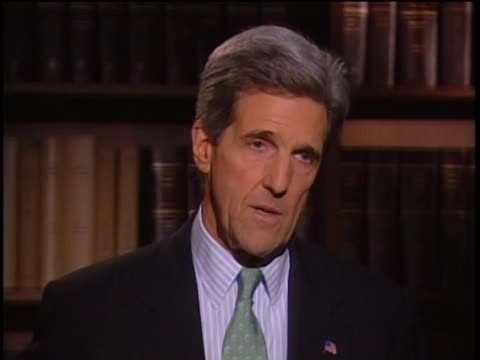
MARGARET WARNER: Gwen Ifill talked with Senator Kerry this afternoon at the AFL-CIO Building in Washington.
GWEN IFILL: Senator Kerry, welcome.
SEN. JOHN KERRY: Glad to be with you. Thank you.
GWEN IFILL: How does an endorsement like today's help you?
SEN. JOHN KERRY: Well, you have to build momentum. You have to build energy in a campaign. You have to translate any endorsement into grassroots support and votes. I've never taken endorsements as a free-standing means to election. I take it as a building block to the grassroots effort. And when I've had endorsements, I translate them into grassroots. When I haven't had them, I go around it and do the grassroots anyway.
GWEN IFILL: You know, early in this campaign, Howard Dean was the one who got all of the union endorsements, and it didn't seem to help him. How would it make a difference?
SEN. JOHN KERRY: Well, he had a couple of them. He didn't have all of them at all. Dick Gephardt had most of them, actually, and there are a lot of workers. But look, I've never relied exclusively on endorsements, and that's what I... you know, when I ran for the United States Senate in 1984, I don't think I was endorsed by anybody, which is why I've always known the lesson, and that is to go out and talk to real people and to fight for every single vote. But a campaign is a process of building support, and I am building that support around the real choices Americans face about their lives. Health care needs are driving people crazy. I mean, people can't afford it; employers can't afford it. Businesses are feeling the pressure. I think we can do a better job of reducing the burden of health care costs in America. That's what I'm building this campaign on. Schools... kids are being left behind every single day. Teachers are paying out of their own pocket to put materials in front of children in America's schools, while Washington is busy giving tax cuts to the wealthiest people in our country. It doesn't make sense. That's the campaign that I'm building, a campaign that's based on common sense, decency, fairness, and what I think are mainstream American values.
GWEN IFILL: Since New Hampshire, just in the past couple of months, you have won 15 of the 17 primaries you've entered. So where do you go now?
SEN. JOHN KERRY: Well, I still have to win the nomination. I mean, this is an ongoing fight and I take nothing for granted. Every single day, I'm campaigning hard. I'M... just came from Ohio yesterday. I went straight there from Wisconsin. I'll be in Georgia on the weekend. And there are 11 states, and three of them actually up next Tuesday. So I'm continuing to campaign as hard as I can everywhere, and that's what I will do from now through hopefully winning the nomination and then on towards November election.
GWEN IFILL: Have you been at all surprised by the force of the momentum involved in your campaign?
SEN. JOHN KERRY: I think, Gwen, the honest answer is that I'm pleasantly, you know, surprised and pleased by it. But I can't tell you that the strategy didn't say, "you've got to go into Iowa, you've got to do well in Iowa, come out in New Hampshire and build momentum." And that's why I worked hard at Iowa: Because I understood that out of that kind of effort comes the building block, and so I think we had a good strategy.
GWEN IFILL: You've never done this before. As you continue on this campaign, do you find that your message... that your honing your message as you go along and it's striking different chords with different audiences?
SEN. JOHN KERRY: You know, that's up to people to decide. I'm really talking about the same thing that I started talking about the day I announced on Tim Russert that I was going to run for presid... that I was going to open an exploratory committee. And I said then, the issue for America is security: Job security, wage security, income security, retirement security, health security, education, and of course physical, national security. That's exactly what it is today. We can do a better job of putting America to work. We can do a better job of being fiscally responsible and balancing our budget. We can do a better job of helping our kids to really open the doors of opportunity. I know we can have health care in America that reduces costs and becomes affordable and accessible to Americans. This administration has no real plans to deal with any of America's real issues, and so I'm just going to talk the truth. I'm talking common sense, mainstream American values. I think I won in Tennessee and Virginia because the people in the South care about the same things as people in the rest of the country: Their kids, their jobs, their health care, drinking clean water, breathing clean air, and being safer in the world. And we can do a better job on everything.
GWEN IFILL: Among the candidates in this race, including the president, there has been much discussion about special interests. Who is most beholden to special interests? You obviously have a career in the Senate. The "Los Angeles Times" has a story today detailing letters that you wrote on behalf of a constituent. How do you, knowing the history that you have in the Senate, the letters you've written, the lobbying maybe-- to use the word a little "l" sense-- that you've done, how do you begin to brush off those accusations, if you can?
SEN. JOHN KERRY: Because my record is really so clear, and it will be as we go forward here. Where George Bush embraces the oil industry and does whatever they want, I stood up and led the fight to stop the drilling of the Arctic Wildlife Refuge. Where George Bush has given the oil industry enormous tax breaks for drilling, I would be pushing harder for renewable and alternative energy, and I've stood up to them. I've stood up and fought for better auto emissions control. I stood up against the effort of Newt Gingrich to undo the Clean Air and Clean Water Act. I've fought for children. I've fought for education funding. I fight for veterans. So you measure the fights. I've helped people create jobs. You bet I have. That's my job as a senator from Massachusetts. And some of them support me. You bet they do. But I've also been one of the most outspoken, strongest advocates of campaign finance reform in the United States Congress. I'm the only United States Senator who has been elected four times, voluntarily refusing in any of my races to ever take one dime of Political Action Committee money. So in the total of my life, Gwen, of all my races, perhaps about 1 percent of the money that I have raised has come from anybody who's ever lobbied for anything. I'm proud of that record. Paul Wellstone and I wrote the most far-reaching campaign finance reform bill in the Senate. And when I'm president, we're going to get the big money out of American politics.
GWEN IFILL: The other night in a debate in Wisconsin, your major remaining competitor, John Edwards, said, "Not so fast, Senator Kerry. I just heard you talking about all of the ways you're going to take on President Bush." Do you feel after the results in Wisconsin that you have to in some way take on Senator Edwards?
SEN. JOHN KERRY: No, not at all. In fact, in the next breath after he said that, Senator Edwards said, "and when I'm president," and then the audience laughed. You know, we're all going to talk about what we want to do as president. I have great respect for John Edwards. He's done a superb job. He's a great competitor, and he's still competing. And I take nothing for granted, as I've said. You know, one of the reasons I think I've won 15 out of 17 primaries and caucuses is I've been fighting everywhere in this country. Unlike some candidates, I'm not cherry-picking a state here or there.
GWEN IFILL: You think Senator Edwards did?
SEN. JOHN KERRY: No, I've just said "unlike some in the race," and you can figure out who they are. I'm running all over the country, and that's what I intend to continue to do.
GWEN IFILL: Do you think that you could use the endorsement of Howard Dean to get to some of those independent voters that Senator Edwards was able to attract in Wisconsin?
SEN. JOHN KERRY: Well, yeah, but I've also attracted those independent voters in Tennessee, in Virginia, in Iowa, in New Hampshire-- and Republican voters, may I add. So I'm reaching across the lines in every state. And I think that, yes, with respect to Howard Dean, I think anybody would be... would welcome his involvement and endorsement. And would I love to sit down with Howard somewhere in the next days, but I think he deserves a little space. I think he deserves not to have people sort of just beating down his door. I respect incredibly what he achieved in this race.
GWEN IFILL: When you sit down with him, will you ask for his personal endorsement?
SEN. JOHN KERRY: Absolutely. I'll ask for it before I sit down with him. I'll ask for it now. Howard, I hope you'll endorse me. But I think that he accomplished a lot, and he energized our party. He energized people who aren't part of our party. He gave a sort of focus to this race that I think all of us are grateful for, and I think Democrats owe him a great deal. And he's obviously extremely creative in the kind of campaign that he ran. I have great admiration for it, and I've told him that.
GWEN IFILL: The New York Times editorial page today said "the one thing that Democratic voters know for sure is they will have to choose between two Johns who are members of the United States Senate for the nomination." How do you tell those Democratic voters in these remaining states that you should be the John they choose?
SEN. JOHN KERRY: Number one: I can beat George Bush, and every evidence shows that. Number two: I am the most experienced candidate in this field ready to be president. I have 35 years of proven experience and accomplishment in fighting for the progressive agenda of our country and of the Democratic Party. I have fought standing up against Richard Nixon and his war in Vietnam, fought against Ronald Reagan's illegal war in Central America, helped to lead the fight to hold General Noriega accountable for putting drugs in the veins of our children and involving himself with the CIA. I've led environmental fights in the United States Senate. I have led the fight to put 100,000 cops on the streets of America. I've led the fight in 1985 with Fritz Hollings and others to reduce the deficit. I think I've shown a record of what I'm prepared to fight for, and I've also shown that I'll walk a different path in trying to distance myself from the money in American politics, and I have 35 years experience in foreign policy, national security, and military affairs. We're at war. This is a dangerous time, and the world is looking to us for leadership. I think George Bush has proven it's not a time for on-the-job training in the White House, and I think we want somebody who has a proven steady hand at the helm of state, who's prepared to make America safer and live up to our values and our goals and aspirations in the world. I've done that in many different ways: 20 years on the Foreign Relations Committee, as a former chairman of the Narcotics Terrorism Committee. I think I've been a leader on those issues, and I think America wants real leadership.
GWEN IFILL: Senator Kerry, thank you very much.
SEN. JOHN KERRY: Thank you. I appreciate it.
FOCUS - RED INK
MARGARET WARNER: Now everybody talks about budget deficits, but do they really matter? Our economics correspondent Paul Sol man of WGBH-Boston looks at that.
SPOKESMAN: Thank you.
PAUL SOLMAN: The new budget is out, and somewhere in those phonebook-thick volumes is a number that's struck a chord. The country is running more than half a trillion dollars a year in the red, and shortly after the announcement, Federal Reserve Chairman Alan Greenspan included deficit concerns in a sobering report to Congress.
ALAN GREENSPAN: Budget projections from the Congressional Budget Office and the Office of Management and Budget indicate that very sizable deficits are in prospect in the years to come. But federal budget deficits could cause difficulties even in the relatively near term.
PAUL SOLMAN: Democrats, meanwhile, have been quick to seize the moment.
SEN. KENT CONRAD: This means that the country, under president bush's budget, is spending $900,000 a minute more than we're taking in-- $900,000 a minute.
PAUL SOLMAN: A group formed to oppose President Bush, moveon.Org, has made a TV ad blaming the president for deficits that will supposedly saddle the next generation with debilitating debts. That's a trillion dollars if you count both this year and last; more if you project ahead. But no matter how you slice it, it's money that has to be borrowed and paid back. That has again brought the deficit problem to the fore-- a problem we're going to try to explain. While critics blame tax cuts for the deficit, the administration says it's due to lower government revenues, and Iraq, and promises that future deficits will be lower.
JOSHUA BOLTON, Director, OMB: Today's deficit is certainly understandable, but that deficit is also undesirable and unwelcome. And with Congress's help, we will bring it down. ( Applause )
PAUL SOLMAN: Or as the president put it in his recent state of the union speech:
PRESIDENT GEORGE W. BUSH: We can cut the deficit in half over the next five years. ( Applause )
PAUL SOLMAN: Short-term, the administration and many economists argue, the economy was in recession, so it needed a boost. Borrowing money to engage in deficit spending, they say-- for the military, for the president's tax cuts-- has gotten America off the ground. Now that the economy's moving again, deficits should come down. But before asking if they really will, why do both the administration and its critics say deficit reduction is such a big deal? Well, in the long run, says economist Ben Friedman, economic growth is hurt by government borrowing, which is competing for money against the private sector.
BEN FRIEDMAN: It's competing against the General Motorses and the General Electrics of the world that might like to borrow money to put up a new factory or to modernize an old factory. It's borrowing against anybody who's running a small business or a plumbing shop that would like to modernize and expand. And guess who wins when the treasury competes with either people like you or me or even with the General Motorses? The Treasury always wins.
PAUL SOLMAN: The Treasury wins because it can pay a higher interest rate, and thus divert money from private so-called capital investments for future growth. The president's economic advisor, Greg Mankiw:
GREGORY MANKIW: I think the mainstream economics profession says that yes, budget deficits do have an adverse impact on economic growth, because budgets deficits tend to crowd out private capital accumulation. And that's one of the reasons why a budget deficit is a concern and why the president wants to... wants to get the budget deficit down.
PAUL SOLMAN: Now there's skepticism about such reduction, even among Republicans in the congress. The president wants to make his tax cuts permanent, and his numbers assume holding government spending far below its historical growth rate. Wyoming Senator Michael Enzi thinks that would be uncharacteristic of Congress.
SEN. MICHAEL ENZI: We're not very good at cutting anything. We're not even... not even good at slightly reducing things. What we go into, particularly in an election year, is we go into a phase of trying to outbid each other on every program that comes along.
PAUL SOLMAN: But let's assume, for the moment, that the president and Congress do manage to somehow cut the deficit in half. Deficit hawks warn that there's still a problem in the wings. And here it is. The one obvious source of money to invest in America's future is what American individuals and companies save. But Americans now save far less than we used to. Back in the 1980s, of every dollar Americans and U.S. firms earned, we saved about 8 cents. That savings was money to invest-- in new companies, for example. Today, though, we save less than 5 cents on the dollar. But at the same time, deficits are now up to almost 5 cents on the dollar. Uncle Sam is this borrowing exactly as much as we save. And even if the deficit, and thus the borrowing, were cut in half, he'd still be soaking up the equivalent of half our private national savings-- money that, says Ben Friedman, would otherwise be invested to grow the economy.
BEN FRIEDMAN: This is about undermining the economy's ability to do the kind of investing that we need, that any economy needs in order to become more productive over time. This is about how much can we do in the way of modernizing our factories? How much can we do in the way of providing high-quality and therefore high-paying jobs for more people? And I think cumulating over time, it makes a difference for the kind of economy and therefore for the kind of society that we have.
PAUL SOLMAN: Okay, so if Uncle Sam borrowed all of U.S. savings, we'd be in trouble. But there's another source of savings: Foreigners like the Japanese, who've been investing their savings in us for decades-- buying U.S. Stocks, real estate; lending to Uncle Sam. Just last year, the Japanese loaned us about 40 percent of the money Uncle Sam borrowed-- roughly 2 of those 5 cents you saw earlier. But there's a catch. Foreigners can easily lend elsewhere. And there's now talk that Japan and China may cut back on their investing in and lending to the United States. So, bottom line: U.S. saving is down, U.S. Government borrowing is rising, and foreigners could stop making up the difference. All of which sets the stage for what may be the biggest reason deficits matter: The baby boom. Having been an economic force since it came of age, it's now reaching retirement. Boomers, after paying Social Security and Medicare taxes for decades, will finally start collecting when they hang up their rock 'n' roll shoes. Or, as Alan Greenspan put it to Congress:
ALAN GREENSPAN: My real concern is that when the time comes to start to pay these benefits, we're going to find that we are in very serious fiscal difficulty.
PAUL SOLMAN: Greg Mankiw says the administration is also concerned, but that the fix will come from a combination of economic growth, spending restraint, and the reform of social security.
GREGORY MANKIW: I hope what happens is we get a national consensus around rethinking Social Security, that people look hard at the president's proposals for personal accounts, look hard at the Social Security Commission's report, and move toward a political consensus that we need to move towards a system that is sustainable for future generations.
PAUL SOLMAN: In the end, though, almost every analysis assumes that "sustainable" must mean, at least in part, "lower total benefits." Reforms may be perfectly reasonable. If we're living longer and retiring later, why shouldn't our benefits be delayed? But will the baby boom stand for that? Recall the image of Dan Rostenkowski back in 1989, when the Democratic chairman of the House Ways and Means Committee seemed to support entitlement cutbacks for the elderly. As the baby boom reaches such maturity, its power at the polls may make car-rattling unnecessary. But untrimmed boomer benefits will have to come from those still working. That implies a richer economy, which can afford more taxes and borrowing. But the road to a richer economy tomorrow is more investment today. And that's what big deficits and a growing debt threaten.
SPOKESMAN: But no one is willing to make the sacrifices.
PAUL SOLMAN: Back in 1986, the Grace Commission, appointed by President Reagan to improve American competitiveness, also made a TV ad. It imagined America if deficits just kept growing, just kept adding up to a bigger and bigger cumulative national debt.
SPOKESPERSON: $2 trillion. Didn't that frighten you?
PAUL SOLMAN: Today, the debt is actually closer to $4 trillion, and more than $7 trillion if you add the government IOU's held by trust funds like Social Security and Medicare.
SPOKESPERSON: I have a question.
PAUL SOLMAN: The question is, will continued borrowing starve the U.S. Economy of the money it needs to build for the future? And by 2017, presumably, we'll find out.
FOCUS - RED ROVERS
MARGARET WARNER: Finally tonight, the latest from mars. Ray Suarez has that.
RAY SUAREZ: Twin rovers named "Spirit" and "Opportunity" continue to explore opposite locations on mars. To update us on their travels, and what we've learned so far about the red planet, I'm joined by Steven Squyres. He's a professor of astronomy at Cornell University, and the principal investigator for the Mars Exploration Rover Project. Professor Squyres, you've got two vehicles that are ranging now pretty widely away from their landing area. What have you been able to find out so far?
STEVEN SQUYRES: Well, there's been a lot going on at both landing sites. At the Gusev Crater landing site, where "Spirit" landed, we're in the process of doing our first really long drive. We landed about 250 yards from a big impact crater, something that's about 200 yards in diameter. And so we're in the process now of making our way towards it, typically going twenty, thirty yards a day. And over the next couple of weeks, we're going to climb up to the crater rim and peer in and see what we see. The other landing site, which is at a place called Meridiani Planum, and that's where "Opportunity" touched down, we actually landed inside an impact crater. And exposed within the wall of that impact crater is a fantastic outcrop of finely layered rock that we think may have a very interesting story to tell about what happened long ago on mars. So we're focused verymuch on trying to understand that outcrop, but also some of the soil around it.
RAY SUAREZ: Well, now that you have a chance to have the tools on the landers dig into the Martian soil and get, you know, beyond just the outer layer that you can see with your cameras, what are you turning up?
STEVEN SQUYRES: Well, we just did that yesterday, so we're sort of still in the process of getting the data off of the spacecraft. What we did, we did what we call a trenching activity. And it's similar to what might happen to you if you take your four-wheel-drive vehicle to the beach and you kind of spin your wheels a little bit. You can dig your way into the sand a little bit. And so what we did with our six- wheel-drive vehicle is position one our wheels so that we could spin it and sort of move sand and soil out of the way and dig a trench that's, oh, four-, five-, six-inches deep, back out of it, and then use our instruments to look into the hole. And what it does is it provides us with a way to see below the surface of Mars. And what we've gotten down from the spacecraft so far are the first pictures from deep down inside the hole. We have a microscope on the end of an arm, and we can reach the arm down below the surface into the hole that we dug, and look at the things that we see in the soil there. When we look at the soil at the surface at Meridiani Planum, what we see is sand grains, and then sprinkles on top of that lots and lots of sort of gravel- sized objects-- we call them granules. They come in all different shapes-- some of them are very angular, some of them are perfect spheres, which is very strange. And what we wanted to know is, are there any of these things down below the surface? Is it just a surface coating, or are there any down below? So we dug a trench with the wheels, stuck the microscope in there, looked at the wall of the trench, and what we found were lots of very, very fine grain soil, much finer than what we had seen at the surface, plus some granules that are stuck into the wall of the trench, and they're perfectly circular and they're also shiny, much shinier than anything we've seen at the surface. And we don't understand that yet.
RAY SUAREZ: Well, what are some of the forces on mars that could have created that distribution of fine and less-fine granules, the natural sources that could have created something like a spherical piece of rock?
STEVEN SQUYRES: Well, there's a couple of different questions here. Regarding the spherical objects-- we call them "spherals," which is short for spherical granuals-- we've sort of got three theories for how those formed. One possibility is that there... it's something called le pili, I think it's an Italian word meaning "little rocks," or something like that. But anyway, when you have a volcanic eruption and you toss a lot of volcanic ash up into the air, as it settles out, what can happen is pieces of this very fine ash will kind of glom together and make little round balls-- Pompeii is actually buried in a lot of this stuff. And then these little round balls will sort of fall out. So, that's one possibility -- that we're seeing the results of a volcanic eruption. Another thing that we've looked at is the possibility that if you have a different kind of volcanism, where you spray lava into the air, or you have an impact in which a meteorite from space hits the surface with an enormous amount of energy, and again sprays molten rock into the air because it melts rock when it hits, those little droplets of molten rock can then fall down to the surface and make effectively make little glass beads that we would then be seeing in the soil. A third possibility, which we're sort of intrigued by, is that these might be what we're called concretions. And in fact, when we look in that outcrop that I mentioned, we see these things embedded in the rock. And what can happen is if you have an outcrop of rock that has water percolating through it, and the water has materials dissolved in it, those materials can solidify or precipitate around little nucleation sites and then grow little spherical objects. If they're actually concretions, then that would be an indicator that water was involved in their formation. So when we drive up to this rock outcrop where we know there are some of these spherical objects, we're going to be studying them in intense detail to try to find out which one of those three ideas is correct.
RAY SUAREZ: What tools have you got onboard to take a look at those rock outcroppings and get a better idea of how they were formed and how they make up the bedrock of Mars?
STEVEN SQUYRES: Well, we've got... we got a lot of tools. This rover is sort of like a Swiss-Army knife, it's got a lot of things on it. The rover has a mast that sticks up in front and that mast supports two instruments, one is some a very high-resolution color cameras. The other is an infrared spectrometer that we can use to look off in the distance, and from a distance tell us something about what the rocks are made of. Once we then decide where we're going to go, we can drive over to the target. And then the rover has an arm. The arm is almost exactly the same dimensions as my arm with a shoulder and an elbow and a wrist and a hand. And on the hand there are four fingers: There's a microscope for looking at the rocks up close; there are two spectrometers to tell us a lot more detail about what the rocks are made of; and then we have this device called the RAT, R-A-T, that's short for Rock Abrasion Tool. And that's a tool for grinding away the outer layer of a rock that's sort of opening a window in the interior of the rock that the other instruments can then look in.
RAY SUAREZ: Now, I've heard you refer to the warranty expiring dates on these two rovers. The way things are going, and now that you've been able to clear up some of the earlier glitches, could "Spirit" and "Opportunity" be rolling around and telling you new things for a lot longer than the 90-day window?
STEVEN SQUYRES: I think they really could. We always said that this was intended from the outset as a 90-day mission, but what that means is, as you said, it's 90 sols, 90 Martian days, which are called sols, is when the warranty expires. It doesn't mean that when the sun comes up on the 91st sol that the wheels are going to fall off, it just means that that's what we designed them for. But vehicles like this are designed with a lot of conservatism, a lot of margin. You build them to be tougher than you think they need to be. And the good side of that is that once the warranty expires, you've still got a pretty healthy vehicle on your hands. And what we're finding is that the vehicles are performing extremely well. They're in excellent health. And they're showing every sign of lasting considerably beyond that 90 Martian Day target that we had initially set. So I think they're going to be tooling around Gusev and Meridiani for a good long time.
RAY SUAREZ: Well, that means we'll get another chance to talk to you. Steven Squyres, thanks a lot.
STEVEN SQUYRES: Nice to talk to you.
RECAP
MARGARET WARNER: Again, the major developments of the day. Enron's former chief executive Jeffrey Skilling was charged with fraud, insider-trading and conspiracy. He pleaded "not guilty" to all counts. U.N. Secretary-General Annan said he doesn't think elections can be held in Iraq before the U.S. surrenders sovereignty, on June 30. The State Department urged Americans to leave Haiti. It cited growing concerns about security amid an armed uprising. A program note: Tonight's edition of "Frontline" looks at the use and abuse of illegitimate tax shelters. Please check your local listings for the time.
MARGARET WARNER: And now, to our honor roll of American service personnel killed in Iraq. We add them as their deaths are made official and photographs become available.
MARGARET WARNER: We'll see you online and again here tomorrow evening with Shields and Brooks among others. I'm Margaret Warner. Thanks for being with us; good night.
- Series
- The NewsHour with Jim Lehrer
- Producing Organization
- NewsHour Productions
- Contributing Organization
- NewsHour Productions (Washington, District of Columbia)
- AAPB ID
- cpb-aacip/507-wh2d79668f
If you have more information about this item than what is given here, or if you have concerns about this record, we want to know! Contact us, indicating the AAPB ID (cpb-aacip/507-wh2d79668f).
- Description
- Episode Description
- This episode's headline: Called to Account; Campaign 2004; Newsmaker; Red Ink; Red Rovers. ANCHOR: JIM LEHRER; GUESTS: KURT EICHENWALD; JOHN COFFEE; SEN. JOHN KERRY; STEVEN SQUYRES; CORRESPONDENTS: KWAME HOLMAN; RAY SUAREZ; SPENCER MICHELS; MARGARET WARNER; GWEN IFILL; TERENCE SMITH; KWAME HOLMAN
- Date
- 2004-02-19
- Asset type
- Episode
- Topics
- Global Affairs
- Business
- War and Conflict
- Religion
- Military Forces and Armaments
- Politics and Government
- Rights
- Copyright NewsHour Productions, LLC. Licensed under a Creative Commons Attribution-NonCommercial-NoDerivatives 4.0 International Public License (https://creativecommons.org/licenses/by-nc-nd/4.0/legalcode)
- Media type
- Moving Image
- Duration
- 01:05:09
- Credits
-
-
Producing Organization:
NewsHour Productions
- AAPB Contributor Holdings
-
NewsHour Productions
Identifier: NH-7868 (NH Show Code)
Format: Betacam: SP
Generation: Preservation
Duration: 01:00:00;00
If you have a copy of this asset and would like us to add it to our catalog, please contact us.
- Citations
- Chicago: “The NewsHour with Jim Lehrer,” 2004-02-19, NewsHour Productions, American Archive of Public Broadcasting (GBH and the Library of Congress), Boston, MA and Washington, DC, accessed July 3, 2026, http://americanarchive.org/catalog/cpb-aacip-507-wh2d79668f.
- MLA: “The NewsHour with Jim Lehrer.” 2004-02-19. NewsHour Productions, American Archive of Public Broadcasting (GBH and the Library of Congress), Boston, MA and Washington, DC. Web. July 3, 2026. <http://americanarchive.org/catalog/cpb-aacip-507-wh2d79668f>.
- APA: The NewsHour with Jim Lehrer. Boston, MA: NewsHour Productions, American Archive of Public Broadcasting (GBH and the Library of Congress), Boston, MA and Washington, DC. Retrieved from http://americanarchive.org/catalog/cpb-aacip-507-wh2d79668f