The NewsHour with Jim Lehrer
- Transcript
JIM LEHRER: Good evening. I'm Jim Lehrer. On the NewsHour tonight some perspective on why the Dow Jones Industrial Average fell more than 500 points today; a preview report plus analysis of the Russian summit and President Clinton overseas; and a conversation with Scott Ritter, the Arms Inspector who resigned in protest against U.S. and U.N. policies toward Iraq. It all follows our summary of the news this Monday.% ? NEWS SUMMARY
JIM LEHRER: The U.S. stock market had a bad fall today. The Dow Jones Industrial Average lost more than 6 percent of its value, closing down 513 points at 7539.07. It was the second largest point loss ever. The Dow has gone down 19 percent from the July peak of 9337 and has lost nearly 1000 points in the last six days alone. All the market's gains this year have been erased. The NASDAQ had its sharpest ever decline today, closing down 140 points or 8.6 percent of its value. Major exchanges throughout Europe and Asia also had big losses. We'll have more on the markets right after this News Summary. Economic and political turmoil continued in Russia today. The central bank announced another drop in the exchange rate of the ruble and the lower house of the parliament, the duma, overwhelmingly rejected Victor Chernomyrdin, President Yeltsin's choice for prime minister. Chernomyrdin pleaded with the communist opposition to approve him and to launch economic reforms. They, in turn, blamed him for the country's current financial crisis. Yeltsin immediately re-nominated him. The duma has seven days to reconsider and vote again. President Clinton left this afternoon for a two-day summit in Moscow. He and Yeltsin are expected to discuss an array of matters from the economic crisis to regional security. Before leaving, Mr. Clinton called on Russia not to return to communism. He spoke at an education event in Northern Virginia.
PRESIDENT CLINTON: What I want to do is to go there and tell them that the easy thing to do is not the right thing to do. The easy thing to do would be to try to go back the way they did it before, and it's not possible, but that if they will stay on the path of reform to stabilize their society and to strengthen their economy and to get growth back, then I believe America and the rest of the western nations with strong economies should help them and, indeed, have an obligation to help them, and that it's in our interest to help them.
JIM LEHRER: We'll have more on Russia and the President's trip later in the program. Senate Majority Leader Trent Lott today criticized President Clinton's relationship with Monica Lewinsky. He said he was offended by Mr. Clinton's behavior and the tragic example it set for young people. Lott was back in Washington, following the Senate's August recess. He was asked at a news conference if the President's personal problems would affect his ability to deal with Congress.
SEN. TRENT LOTT, Majority Leader: His credibility is in question-more than what he should do now or the credibility in our relationship is the question, you know, can he lead? Can he provide, you know, leadership without the necessary respect and with the problems that he has? That's what really matters. Will he--can he provide leadership at a very critical time internationally and domestically? And I guess only time will answer that question.
JIM LEHRER: Lott said the Senate had about five weeks to get things done before breaking for the fall election campaign. The House reconvenes next week. Northwest Airlines continued to cancel flights on this third day of a pilot's strike. All of its 1700 domestic flights were shut down through tomorrow and its European flights through Wednesday. The pilots union and the company are at odds over job security and compensation, among other things. No talks are underway or scheduled. Northwest is the country's sixth largest airline carrying nearly 150,000 passengers daily. Another labor dispute was settled. Some 34,000 US West telephone employees went back to work today after 15 days on strike. The new contract includes employee pay hikes and limits forced overtime. Overseas today North Korea test-fired a two-stage ballistic missile for the first time today. Japanese defense officials said the first stage splashed down near Vladivostok, Russia. The second passed over Japan and dropped into the Pacific Ocean. It was North Korea's first launch of a missile in five years, its fourth since 1984. Secretary of State Albright said the United States would protest the action in talks with North Korean officials in New York. And that's it for the News Summary tonight. Now it's on to the falling stock market, President Clinton goes overseas, and former UN Inspector Ritter.% ? UPDATE - TAKING THE PLUNGE
JIM LEHRER: The stock market story and to Phil Ponce.
PHIL PONCE: Today's 513-point drop means the Dow Jones Industrial Average has now lost all the gains it's made this year. It's now down to where it was last November. Some insights now from three market watchers: Joe Battipaglia is chief investment strategist for Gruntal & Company. Michael Metz is managing director for CIBC Oppenheimer. James Glassman is a financial columnist for the Washington Post and a fellow at the American Enterprise Institute. Mr. Battipaglia, what happened today?
JOE BATTIPAGLIA, Gruntal & Company: Well, what happened today was a follow-on of the events of the last few weeks, and that is there's great concern about what comes out of Russia; we're worried about Asia; and of course the President's own issues in the U.S.. But when the Russians cannot rally around the nominated prime minister, that put the market into a negative mood all day. It was then exacerbated by what I call program traders, and that is investors who want to play trends. And once that kicks in, then falling leads to more falling, and the market fell mostly in that last hour.
PHIL PONCE: Mr. Metz, how do you assess what happened? How do you describe it?
MICHAEL METZ, CIBC Oppenheimer: Well, the market has been declining, I think, because of a deteriorating background for the last few weeks. Today I think it was largely motivated by internal considerations. I think most investors come into this decline with relatively limited amounts of cash, maybe over-leveraged, and now they're getting very anxious to increase their cash and reduce their exposure, and it takes a very strong emotional tone.
PHIL PONCE: So are you saying that investors basically, what, finally got scared by a confluence of circumstances?
MICHAEL METZ: Yes. And this is shown by the action of some of your stocks in NASDAQ, like Dell and Intel, and Microsoft, which had been holding up very well. But I think those holders decided they wanted to raise cash and to their dismay, they found out there were no aggressive buyers when they tried to unload. And then it fed on itself. Also, during the day, the market acted like it was ready to make some sort of rally. I think traders bought in expectation of a rally. When it didn't happen, they disgorged what they had bought.
PHIL PONCE: So, Mr. Battipaglia, do you see this as a correction to the bull market, or do you see it as the beginning of a bear market?
JOE BATTAPAGLIA: I see it as a deep correction of a bull market in a bull market, and the reasons are simply that the largest economies, the industrialized world, will continue to expand going forward. And they'll enjoy the benefits of low inflation, lower interest rates, and globalization. Now, globalization thematically has been misconstrued as a positive year in and year out forever. And the Asian miracle, where we had extraordinary returns there were just symptomatic of that expectation. Now we're getting into the hard work, where these economies do go to busts from booms, then they return back to booms, and also Russia has to be dealt with in terms of how we deal with the Eastern bloc entirely. So this is a process where the positives still greatly outweigh the negatives. The fear factor is that a recession is around the corner. If we avoid a recession, then the market will start to rally very strongly in the face of these events because there will be meaningful progress on one and all of these fronts, and I might add that the policy weapons at the Federal Reserve and the U.S. Treasury are quite significant, and they've yet to be deployed. The bond market is telling us that a rate cut is in order. I believe that that is the case, that we will see a lowering of interest rates, perhaps fifty to seventy-five basis points, in the next six to eight weeks. That would set up a framework, I believe, to provide global liquidity, stabilize currency relationships, allow the U.S. economy and the European economies to sail through this particular period, then, as the emerging markets return, start to talk about the expansion that exists in '99 and beyond, a very bullish scenario.
PHIL PONCE: Mr. Metz, clear sailing?
MICHAEL METZ: I don't like to be frivolous. But I think Mr. Greenspan is absolutely irrelevant to prospects for Latin America, Southeast Asia, Russia, and so forth. The real problem here is that the American market has been fed by the illusion, I would call it, of a so-called new paradigm, that is, we live in a new world, and there's no political instability; there's global economies. There are free markets operating effectively. There's never-ending expansion and poor profit margins, never-ending momentum and profits, and a never-ending flow of money by individuals into the soft money. I think all of these assumptions now are highly questionable, if not inaccurate. Even more importantly, you've had over $2 1/2 trillion in wealth destroyed over the last few months by the American stock market. In my judgment this will have an impact on the real economy. Remember, in the second quarter of this year the American consumer spent much more money than he was earning in the sense that the growth in spending exceeded the growth in earnings. What happened is savings rates fell to the lowest level in a generation, admittedly, a new way of determining them. But the net result is that the American consumer, in my judgment, has been spending his unrealized capital gains. I believe that we're going to have a disappointing growth in personal spending. We're going to have some slowdown in growth in capital spending and a rather difficult environment for exports. This is not consistent, in my opinion, with a strong economy.
PHIL PONCE: James Glassman, what does the average investor, the average consumer to make of this?
JAMES GLASSMAN, Financial Writer: Well, I think the average investor should, first of all, only be in the stock market if he or she is in for the long haul, which I would define as seven years and ten years and beyond. And in that case what happens today or what happens on any individual day or week or month really doesn't mean very much. I mean, it certainly scares you, there's no doubt about that, but that impulse to sell at a time like this is one that ought to be resisted. There are two things that you ought to do. First, you ought to look at companies that you own, and I say the companies that you own, not the stocks, but the underlying companies, and see whether something's happened to those companies in the last few weeks or few months that justifies this kind of decline. And if there is, maybe you should consider selling. In most cases there won't be. Second, you should be looking for bargains. There may well be some very good bargains out there. And I say this not as somebody who's making a prediction about whether we're in a bull market or a bear market or what's going to happen this week or the week after-I'm not smart enough to figure that out-but as somebody who believes that Americans should participate in the growth of good companies by owning stocks.
PHIL PONCE: Mr. Battipaglia, time for bargains tomorrow, perhaps?
JOE BATTAPAGLIA: Yes. As early as probably 10:30 to allow the first hour to take on the more panicked element of investment, but then we start a process of recovery. I like to frame this in the context of post World War II, where we came out of a war victorious, but most of the economies were flat on their back, and, even worse, there was a specter of Communism enwrapping and engulfing the globe. We are at a point now where, indeed, economic growth has great vitality in the industrialized world. The United States is being looked for leadership in the emerging markets. And we don't have the threat of a Cold War. It's not an ideological issue. Freedom is reigning supreme. There will be bumps along the way, but therein lies the opportunity. That's why Europe has moved to a Euro to come up with a common currency to help that marketplace. You've seen Argentina use the dollar as a substitute currency. You're going to see a lot more of that. And the United States has come to this point, now running surpluses, having a strong currency, and the ideological leadership to get this done over the course of years. The opportunity looks greater now over the next 30 years than they did after World War II.
PHIL PONCE: Mr. Metz, how about the opportunity tomorrow, in the short term?
MICHAEL METZ: I don't know about tomorrow, but as an old curmudgeon, I would say the world is more dangerous now than it was before. I think the whole financial environment is given to more instability. I think the idea that free markets are going to be adopted by people who for generations never heard of democracy or free markets, and that they're going to function efficiently, that the hundreds of billions of dollars floating around, hot money looking for amusement by destroying currencies or economies, is going to result in efficiency. I think this is an illusion basically, in my judgment; the market is still assuming that everything is going very well for the next five years, and I think the investor should be rather cautious here.
PHIL PONCE: James Glassman, do you have a sense of what the public is feeling? I mean, is there-is it fear? Is it anxiety? How would you describe it?
JAMES GLASSMAN: I think there's a lot of fear and a lot of anxiety. When you say the public, you mean people who own shares.
PHIL PONCE: Sure.
JAMES GLASSMAN: And about half of Americans now own stocks, and I think that the majority of them have not gone through anything like this. And they're certainly frightened, although they've been taught year after year by the mutual fund companies and by commentators on television and in newspapers, people like me, to hang on, maybe to buy on dips. And we'll see what they do. Certainly up to this point they have held on. Whether they're going to continue to do that or not, I just don't know. And really a lot depends on what happens in the real economy. You know, the stock market is often a harbinger, very frequently a harbinger of what's gong to happen in the real economy. When the market goes down 19 percent, that is sometimes a pretty strong indicator that we could be headed toward a slowdown or a recession. We also have an inverted yield curve. In other words, interest rates are higher on the short-term than they are on the long-term. That's also a bad sign. So we could be headed for bad economic times--
PHIL PONCE: So James Glassman, what do you say to-
JAMES GLASSMAN: That would disturb a lot of people.
PHIL PONCE: What do you say to those then who look at the local interest rates, look at the low inflation, and say, things on Main Street are fine, therefore, things on Wall Street should be as healthy as Mr. Battipaglia is talking about?
JAMES GLASSMAN: Things are fine, and I think that the debate between Mr. Battipaglia and Mr. Metz is a very good one. The question is: Have things changed fundamentally because of globalization, because of new free flow of capital, because there are so many capitalist countries in the world, or, you know, are we going to have the same kind of cyclical downturns that we've had in the past? And I don't know the answer to that question but certainly the market is beginning to tell us, yes, things could easily slow down.
PHIL PONCE: Mr. Battipaglia, one of the old rules of thumb is that when the market drops 20 percent, as it has in the past month or so, that's often an indicator of a bear market. As somebody who's been bullish, what would it take to convince you that maybe things have changed?
JOE BATTIPAGLIA: We would have to have a recession in the United States or a significant credit crisis. And I don't see the conditions evolving for that. Indeed, if you go back over the history of this particular bull market, each and every correction, including the big one in '87, was sharp, deep, and very short-lived, and we came out of the '87 crash, for example, saying that the real economy would be adversely affected. And, of course, it wasn't, and the market went on to sail to higher highs. We were making fun just a few weeks ago about the "Wag the Dog" scenario in the political realm. Now we're saying the same thing about world economies. Let's not forget that the United States and Europe are the dominant economies by far, by any way you want to measure it. Their strength is what will stabilize world economies. And it's not the weakness in Southeast Asia or Russia that will determine the economic health of those environments. So this short, deep correction is consistent with the ones we've experienced in '87, '89, even in '94, and even last year in October, when we had the first scare about Asia.
PHIL PONCE: Mr. Metz, a short, deep correction?
MICHAEL METZ: I really don't agree. I don't know, of course, but I really think the world is much different now in the sense that not for a generation or more have you had such a high exposure to the equity market by the American individual. You know, there's a myth about the baby boomer saving more money. Actually he hasn't. He's depended on the stock market to do it for him. Never before have people been so exposed, their wealth, to this variable. Moreover, never before has the market been so overvalued. Never before has it assumed a perfect scenario ad infinitum. I'm not giving you an Armageddon thesis, but to me the market is still not on a bargain counter. And, frankly I find what's going on in the merging nations, which is the marginal buyer/seller that determines prices, I find this has rather ominous implications for economic growth for Europe and the U.S..
PHIL PONCE: James Glassman, very quickly.
JAMES GLASSMAN: I was going to say, I mean, the small investor, in fact, could be the savior of this market. I mean, Michael Metz is right. There has been a change in who owns stocks. But it could well be that small investors may be willing--because they have their money in for retirement, most of them, because they're not checking where their funds are every day--may be willing to be patient, as they have been taught, and what we've seen so far has been that they are. And they could really actually hold up the market. But I think the most important thing is the real economy. And we just don't know about that, but there are a lot of signs that the real economy is headed for a slowdown, including some numbers today from purchasing managers.
PHIL PONCE: Gentlemen, that's all the time we have. I thank you very much.
JIM LEHRER: Still to come on the NewsHour tonight, President Clinton goes overseas and former U.N. Inspector Scott Ritter.% ? FOCUS - TIME OF TURMOIL
JIM LEHRER: President Clinton left Washington this afternoon for his summit meeting in Moscow with Russian President Yeltsin. But among ordinary Russians facing their own political and economic problems there's little hope the summit will produce many results. We have a report from Special Correspondent Simon Marks.
SIMON MARKS: In the shadows of the White House the Russian government's headquarters in the center of Moscow lies a protest now entering its third month. The coal miners of Vorkuta in the Arctic Circle say they won't budge until Boris Yeltsin resigns, and now they think they don't have long to wait.
ALEXANDER SEMINOV, Striking Coal Miner: (speaking through interpreter) We think he'll be gone by the end of September. When we decided to come here, we said we'd get rid of him by September, us, the miners who used to support him. That was our task. He's incapable; he's old material; he can't think; he can't talk; he can't do anything concrete anymore.
SIMON MARKS: Boris Yeltsin used to count on the miners of Vorkuta for support. In his 1996 re-election campaign he visited their coal field, promised them new cars, better wages, and improved working conditions. Now, Alexander Seminov says he and his colleagues were duped. They haven't been paid in 10 months because the government is out of cash. They dismiss Yeltsin's vow to remain in office and have no confidence in any government formed by Prime Minister Victor Chernomyrdin.
ALEXANDER SEMINOV: (speaking through interpreter) You know, people think that workers are stupid; they won't figure things out. But we saw through all of this a long time ago. If the president or the government won't take responsibility for the fate of the people, then somebody has to step forward and lead the fight against them. There's no way around it.
SIMON MARKS: The last time fighting talk was heard from ordinary people ringing the White House it was 1991. Then a generation of Russians streamed to the building to defend Yeltsin and rise up against the coup plotters trying to overthrow Gorbachev. Now it's Yeltsin's future at stake. As the miners camped out all weekend, the president's negotiators were discussing power-sharing with the country's Communist-dominated parliament. Whatever happens next here politically, whether Yeltsin stays or goes, whether Chernomyrdin proves capable of dealing with the current crisis, many here believe the events of the past few weeks have taken a deeper toll. As the country's financial crisis has worsened and the ruble has continued to tumble, millions of people have had their faith in economic reform shattered and restoring that faith could prove to be a lengthy, complex task. This morning, nervous lines once again formed outside the city's banks as people here attempted to get their hands on their own money. Dollar withdrawals are a thing of the past. ATM's are closed, and a number of rubles account holders can withdraw are restricted in a bid to prevent a run on the banks. Waiting patiently to see whether he could get his money, Gary Vadimov, who was due to close on an apartment today--without the cash, he'll lose his new home.
GARY VADIMOV, Retiree: (speaking through interpreter) We didn't want to come here, but everyone is panicking because the banks stopped paying money out to people whose investments have matured. Word started to spread that no money was being paid out at all, so crowds were gathering. We didn't want to come here at all, but when we found out that they weren't giving out any money, we've been waiting a week now.
SIMON MARKS: There's no outward sign of panic in Moscow. More a sense of fatalism about Russia's destiny and a sense that whatever message President Clinton is bringing cannot help resolve the nation's problems.
TATANIA LUKANINA, Unemployed Economist: (speaking through interpreter) I doubt it will change a thing because we need to sort out our own problems. I doubt that President Clinton or any other powerful foreign leaders can change anything here. It's our business.
SIMON MARKS: The city's electronic stores were all closed this weekend for technical reasons, read the signs. People were also turned away from stores selling sporting goods and the other fruits of economic reform. The store owners don't want to sell their inventory until the economic picture stabilizes and they know how much to charge, meaning Larissa Trefilova can't buy a pair of hockey skates for her four-year-old son, Constantine. Her thoughts on President Clinton's arrival-
LARISSA TREFILOVA, Housewife: (speaking through interpreter) I think there will be very few results from this meeting. They held high level meetings like this before, and they haven't resulted in any changes. We're just ordinary people. We don't feel any results. I don't have any faith in this meeting.
SIMON MARKS: Someone else with limited faith is Natasha Smokova, twenty-six years old, a waitress in a trendy Tex-Mex restaurant just around the corner from the Kremlin. She and her colleagues are Russia's next generation. This weekend, as they started their shifts, the waiters were learning the caf 's prices have doubled. About the only people eating here, a group of German tourists. So ask Natasha Smokova now about capitalism and this Russian Gen X'er gives an old style reply.
NATASHA SMOKOVA, Waitress: (speaking through interpreter) I don't think this is the right system for us. Maybe we should take some things from it and combine them with something new to get good results. But full capitalism, I don't buy it. Russia doesn't need it.
SIMON MARKS: And that may be the most troubling impact of recent events here, the fact that even those few Russians who have experienced the benefits of the country's experiment with democracy now feel so badly let down.
LARISSA TREFILOVA: (speaking through interpreter) I've got to say that, in all honesty, I lived better under communism. Things were calmer. We were confident. We had faith in the future for us and our children. So I hold that time dear.
SIMON MARKS: Despite the crisis, some new businesses are going ahead with their scheduled debuts. In Moscow's Pushkin Square last Friday a new teen-age magazine was holding a launch party, complete with rock music, models, readers who can barely remember communism. The question for Russia now, whether anything can be salvaged, or whether the free market experiment here is a bubble that's been burst.% ? FOCUS - WORLD LEADER
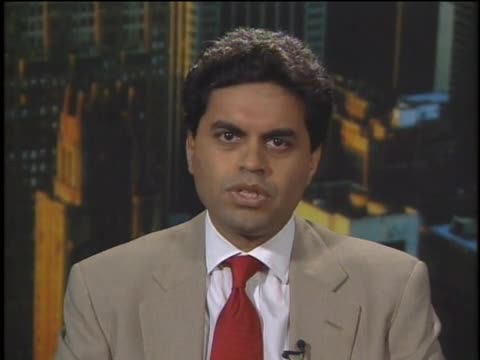
JIM LEHRER: Now how three American foreign affairs columnists view the summit and President Clinton's ability to conduct foreign policy right now: Jim Hoagland of the Washington Post; Fareed Zakaria, managing editor of Foreign Affairs Magazine, contributing editor of Newsweek; and Trudy Rubin of the Philadelphia Inquirer. Jim Hoagland, what expectations should there be about this summit?
JIM HOAGLAND, Washington Post: Well, fear. It's a survival summit. Bill Clinton is endangered in his presidency, Boris Yeltsin even more so. I think the high stakes here are simply getting through the summit with a credible performance by both men. Clinton calls himself the comeback kid. He's going to be tested, I think, over the next two days, because he goes without any real resources to put into the Russian situation. There's no new money going to be coming from Congress or even from the IMF until there is a Russian government in place, until Boris Yeltsin makes it clear that he has the ability to survive over the next month or two, or the rest of his term, up to the year 2000. So I think it's going to be an occasion for Clinton to tell the Russian people that they have to pull themselves back from the brink, that they have to do it largely on their own, and if they do, they will find the West willing to help them in the future. But they've got to make those steps first. And I think Clinton can deliver that message fairly effectively.
JIM LEHRER: Trudy Rubin, what do you think would constitute success? Would you agree with Jim, that it's mostly a summit of words, rather than of deeds?
TRUDY RUBIN, Philadelphia Inquirer: Yes, I would. First of all, I do agree that the President was right to go. I think not to go would sort of be delivering an obituary for Russia. And I think that Russia is still too important for us to basically say hands off, we're not even going to try. I do think this is a summit of words. I think that it's very important, is that the President, who is going to be meeting with different heads of factions in the duma, who control whether Russia is going to have a prime minister, convey to them that there is not going to be any more western money coming in unless a new responsible government is constituted that can be ensured that that money goes where it is supposed to go. That's a message that has to be made clear, I think, because even though the Communists may say they want to roll things back, the whole Russian economy has become dependent on aid from outside. It was right to give it when there was a reformist government but now no more. And one last thing, I think that Mr. Clinton has to talk about the importance of Russia continuing to hold elections if they're going to change leaders.
JIM LEHRER: Do you think it matters to the people who run Russia, as well as the folks down the street, like the ones that Simon Marks just interviewed about what President Clinton says? Does it matter what President Clinton says?
TRUDY RUBIN: I don't think it does matter to the people on the street. I think it may matter to some of the leaders, and I think that in a sense this is almost an intelligence mission for President Clinton to find out for himself whether Boris Yeltsin has much life left in him, whether Victor Chernomyrdin is able to rise to the occasion, assuming he gets appointed, and whether anyone in the duma has a clue about what to do to get the economy back on the road.
JIM LEHRER: Mr. Zakaria, do you see it as an intelligence mission?
FAREED ZAKARIA, Foreign Affairs: Not exactly. I think that the President can do one or two very important things. The first is to talk to the Russian people and to talk to them about the importance of the reforms they're conducting, to talk to them about the nature of capitalism, about how it does have a cyclical nature, how it does have these kinds of swings, and how incomplete the reforms have been. I think the second mission is to convey to the Russian government how important it is to keep on track. So I think that this is actually a perfect time for the President to be going, because this is when they need, if you will, the stiffening of their spine. President Clinton should say to Boris Yeltsin what Margaret Thatcher is reported to have said to George Bush. This is no time to go wobbly, Boris.
JIM LEHRER: But let's say he says that. Is Boris in a position not to go wobbly?
FAREED ZAKARIA: Sure. The Russian president actually has enormous powers on paper. Now, obviously they are being contested by the duma and by the Communists in the duma. But Yeltsin is still somebody not to be ruled out. He has enormous powers on paper. He can dissolve the parliament, which parliament is not going to want it done. No member of parliament wants to run for re-election. And so he has at least that threat which he can use against them. And finally I think the Russians know or many Russian leaders know there isn't really salvation in nationalizing industries, in re-imposing capital controls on their currencies in toto. So while there is a great temptation to do some of these things, there is an annoying realization that this cannot be the path to salvation.
JIM LEHRER: So, Jim Hoagland, no matter what President Clinton's problems are back home-and they are very real-he still speaks with some power when he goes to Russia and he talks to the people and he talks to Boris Yeltsin and the duma?
JIM HOAGLAND: I think he does. One should never underestimate the power of the American presidency. One should never underestimate the particular abilities of this President. He is a man who can give quite a commanding speech on these kinds of topics, on the topics of globalization, on the world economy. I think he does have both the ability and the need to emphasize that, in fact, what the Russians did was not to adopt the American style of capitalism. This is not a failure of the capitalist model. They never really chose to push all the way with their reforms to the point where you had a functioning self-sustaining capitalist model. And I think that Clinton will be able to deliver that message with some effect.
JIM LEHRER: But the folks on the street maybe, and, of course, some folks on the duma believe it is the failure of capitalism.
JIM HOAGLAND: There's going to be that argument made, and that's precisely why it's important that Bill Clinton go and make the counter argument and make it with some force. What we see here going on right now over the next couple of days, Jim, is a political negotiation inside Russia. Political negotiations have very short history in the Russia. They tend to-in their politics either rule or be ruled and not to negotiate with their adversaries. Communists have rejected Chernomyrdin today. Yeltsin still does have the power of disillusion that I think he will use if they continue to reject Chernomyrdin. I think it's in everybody's interest in that political system to come up now with a viable compromise that points towards some immediate political stability. The final act of this is political instability that reflects the economic problems they've gone through over the past year.
JIM LEHRER: And President Clinton could in some way influence that?
JIM HOAGLAND: I think he can. I think he can point toward the way out of this particular crisis. I think he can lend support to Yeltsin. He's in desperate need of it, and I think he should do that.
JIM LEHRER: Trudy Rubin, the general thing about President Clinton, Senator Lott, we reported in the News Summary awhile ago, questioned-raised the same question today that others have raised since the President's August 17th speech where he admitted he had this affair with Monica Lewinsky, and this, will President Clinton's problems in that area make it difficult for him to have strong leadership in international relations, as well as domestic? What do you think about that?
TRUDY RUBIN: I think that people have to recognize that this is an extremely different view of this from overseas. From overseas in most countries people just cannot understand what America is doing. I've been on the phone with Russian colleagues and experts to Moscow all week, and everybody says the same thing to me. First, are you nuts when the world is in such economic difficulties? And then they say and how can you have all those details about sex on television? So basically, people overseas are looking for the United States President to be able to act as a leader. In times of economic crisis the U.S. is the oasis of stability. I think that what undercuts Clinton's ability is the cacophony back home, and especially if there is another investigation into the vice president and then there's no certainty about the presidency up till the year 2000 whatsoever, so that I think there's a self-fulfilling prophecy here. If you say that President Clinton can't be a leader abroad, in effect, it is being made so here, and it can be unmade so, if the investigation comes to a speedier end.
JIM LEHRER: Now, Mr. Zakaria, the President not only has the Lewinsky problem in his suitcase. He now carries a Dow Jones Industrial Average drop today of 513 points and a 1000 point drop just in the last six days. What does that do to his ability to say to the Russians, hey, do it our way, and let's get squared away?
FAREED ZAKARIA: Well, the power of the American president fundamentally derives from America. So I do think that the Lewinsky business will not have as big an impact. The Dow Jones probably has some impact, but still, America towers above the rest of the world on so many dimensions of power, military, economic, political, cultural, that I don't think that'll be the problem. There is one problem, though, that the President has, which is self-inflicted, which is in my opinion an absence of policy. The President is very good about talking about globalization. He's very good about extolling the virtues of reform, but these economic reforms and free markets do not flourish in the absence of political stability, in the absence of political structures. And that's where we have not been very good in integrating Russia into the western world. We cannot expect that somehow Russia would be able to find their way entirely on their own. The principle policy the Clinton administration has had toward Russia for the last two years, after all, Jim, has been NATO expansion, a policy specifically designed to exclude Russia from the western world. And so when you don't give it the kind of political structures upon which globalization, free markets, free trade rest. Naturally, when the downturns hit, they are much more vicious.
JIM LEHRER: A real policy problem, that's the main problem, Jim?
JIM HOAGLAND: I think that's a very important point, that Bill Clinton certainly can lead, but the problem is that Bill Clinton tends to lead in bursts. He tends to concentrate on a problem, and then move on and not really follow up on it, particularly in foreign policy. We've seen that again and again. We've seen it in Iraq. We've seen it in the Middle East; we've seen it in Russia. And that's what's going to happen. There's also the temptation here, in fact, to lead too much, that Clinton will try to distract attention from his problems. He'll have to show that he's not paralyzed and will undertake too many initiatives overseas, will undertake too many trips abroad. We get into the irony of this President, who was elected to be laser-like, concentrating on the economy, and not to be a foreign policy President, will look to foreign policy as salvation. And I think he's smart enough to realize it won't work. It didn't work for Richard Nixon in 1974, when he went off to the Middle East. He went off to Moscow. Watergate's still got him. The American public is wise enough to distinguish between domestic foolishness and law-breaking and wrongdoing, and the real needs of the country overseas, and that will happen again. But I think Mr. Clinton has to avoid that temptation and, indeed, should be thinking seriously about delegating to his national security aides, defense secretary, secretary of state, a little more of the initiative, a little more of the power.
JIM LEHRER: How do you see that, Trudy Rubin?
TRUDY RUBIN: I think that there's a different kind of leadership necessary at this moment, an international economic leadership. It's very hard for the American public to understand what this crisis is all about, but I think President Clinton would be both capable of explaining it and also of providing some leadership on the international scene. The world economy is changing in ways that financial leaders are unable to cope with. The question of currency flows, which is undercutting developing economies, there has been a conventional wisdom that there can be nothing done to regulate those, but clearly the system that was developed after World War II to deal with international financial matters is out of date, and I think that what President Clinton has to do is to provide some leadership in the G-7 to confront these issues head on, because I believe that if developing countries, which have done things right, and Russia, of course, has done a lot of things wrong, but there are countries that have done things right, and their economies are in the tank. Currencies, huge amounts, can be moved at the flick of a button by a 27-year-old investment manager. I think the question of how to develop a new international economic architecture must be developed, and that is an area where President Clinton, if he can find the focus, I think must provide the leadership for the industrial nations of their leaders.
JIM LEHRER: Mr. Zakaria, would you say amen to that?
FAREED ZAKARIA: I would, indeed. I think that what we've been doing for the last seven or eight years is living off the capital of the Cold War. There has been stability for the last seven or eight years, and it has been some kind of shadow or follow-on effect of the Cold War. We now have to construct a post Cold War world that is stable in its own right and that uses new institutions and new policies to stabilize it. Right now what we do is take NATO and we expand it. We take the IMF and we give it a little more money. We change its mission entirely, we tell the World Bank stop funding dams, start funding something else. It's all entirely ad hoc. And there has been a hope I think both on the right and the left oddly that somehow globalization and free market economics will stabilize matters and democracy will bring us to a kind of a high, a nirvana. And, in fact, all this rests on power. It rested on British power in the late 19th century. It has rested on a weird kind of bipolar power for the last forty or fifty years, and we now have to come up with a truly stable system for the 21st century.
JIM LEHRER: All right. Well, we'll leave it there. Thank you all three very much.% ? NEWSMAKER
JIM LEHRER: And finally tonight former UN Inspector Scott Rigger. Margaret Warner begins with some background.
MARGARET WARNER: For the past seven years, Scott Ritter has been a central figure in the United Nations inspection effort in Iraq. He has headed the team in charge of uncovering and countering Iraq's efforts to conceal its weapons programs. But last Wednesday, in a blunt letter of resignation, Ritter charged that the Special Commission in charge of the inspections, known as UNSCOM, has become "hobbled by unfettered Iraqi obstruction and non-existent Security Council enforcement of its own resolutions." Ritter went on to charge that the UN Security Council has become "a witting partner to an overall Iraqi strategy of weakening the Special Commission." UNSCOM chairman Richard Butler accepted Ritter's resignation.
RICHARD BUTLER: I read it. I talked with him about it. It was clear to me that the best course of action was for me to accept it. In doing so I expressed to him my deep regret that his departure from UNSCOM will take away from us skills, knowledge, and dedication that we needed and him being very valuable.
MARGARET WARNER: Butler would not comment on whether he agreed that UNSCOM inspectors are being hampered in their work, as Ritter charged.
RICHARD BUTLER: Whether or not I share those views is something that I won't go into here. What I will say is this: Scott and I agree that there is still work of disarmament to be done.
MARGARET WARNER: But Butler strongly denied news reports that Secretary of State Madeleine Albright had pressured him to hold off on additional surprise inspections of Iraqi facilities.
RICHARD BUTLER: I have never felt that that pressure will represent-that the representation of those views would be described as undue pressure or persuasion but, above all, I have never found that they cross the line between their legitimate interest in policy and my unique responsibility for operational decisions never.
MARGARET WARNER: Secretary of State Madeleine Albright also responded to Ritter's charges.
MADELEINE ALBRIGHT, Secretary of State: We are the foremost supporters of UNSCOM and have been working very hard to assure that UNSCOM can continue to do its work. In fact, we have been the ones that have been covering its back to a great extent in the Security Council. And we believe that it is absolutely essential for Saddam Hussein to come clean in terms of the weapons of mass destruction and to follow-to follow through on all the Security Council obligations that he has. The United States has been the country in the lead keeping Saddam Hussein in his box.
MARGARET WARNER: Ritter, a former U.S. Marine Corps captain and a long-time disarmament specialist, has been at the center of controversy before. In January, the Iraqi government accused him of being a U.S. spy, and tried to prevent him from conducting inspections. The resulting showdown almost led to U.S. military strikes against Iraq. That crisis was defused in February with an accord that UN Secretary General Kofi Annan negotiated with the Iraqis, establishing new ground rules for inspectors. Ritter conducted his last inspection in March. Earlier this month, Iraq announced it was suspending cooperation with most UNSCOM inspections.
JIM LEHRER: And to Elizabeth Farnsworth in San Francisco.
ELIZABETH FARNSWORTH: In the latest development in the Scott Ritter story today Iraq's Deputy Prime Minister Tariq Aziz again charged that Ritter was a spy working for the United States and Israel. He's called on UN Secretary-General Kofi Annan to launch an investigation. Scott Ritter joins us now.Thanks for being with us, Mr. Ritter.
WILLIAM SCOTT RITTER, JR., Former U.N. Arms Inspector: Thank you.
ELIZABETH FARNSWORTH: What was happening in your investigations that made you feel you had to resign?
WILLIAM SCOTT RITTER, JR.: Well, basically, is the investigations had come to a standstill were making no effective progress, and in order to make effective progress, we really needed the Security Council to step in in a meaningful fashion and seek to enforce its resolutions that we're not complying with.
ELIZABETH FARNSWORTH: Could you describe the most recent investigation that you wanted to undertake. Give us a little detail about it and what happened to derail it.
WILLIAM SCOTT RITTER, JR.: Well, basically, the investigations that I was tasked with carrying out by the executive chairman involved looking at exposing the means by which Iraq hides their prohibited weapons and weapons capabilities from the special commission. We needed to expose this methodology so that they used so we could get at the weapons, themselves. And the investigation has been going on for several years now, and this summer we were in the process of resuming these inspections, you know, in accordance with the agreement reached by Kofi Annan and Saddam Hussein in accordance with the Security Council resolutions that said Iraq had to comply or face severe consequences, so we're trying to get back on task. We had some very specific information, which led us to believe we could go to locations where we would find aspects of this hidden weaponry, of these hidden components, and also uncover how Iraq actually went about hiding these weapons from the commission. We had very specific information, and we believe that if we'd been allowed toaccomplish this inspection, we could have achieved meaningful disarmament results.
ELIZABETH FARNSWORTH: And why weren't you allowed to accomplish it?
WILLIAM SCOTT RITTER, JR.: Well, again, we have a problem with this-with the United States. On April 6th, the President of the United States submitted a report to Congress in which he clearly states that a diplomatic solution had been tried. We have a memorandum of understanding, and the marker's on the table now. Iraq must be held accountable for the agreement that they have signed with the Secretary-General and which was endorsed by the Security Council in its Resolution 1154. If Iraq didn't, there would be the severest consequences. You had this statement on the one hand, but on the other hand, this administration's saying, wait a minute, we can't go forward with aggressive inspections because they will lead to a confrontation with Iraq, but let's understand the confrontation is because Iraq will not comply with the law passed by the Security Council. So we weren't allowed to do our job out of fear of a confrontation in which the United States would not be able to muster the required support of the Security Council to respond effectively or to respond in a manner which they had said they would respond in Resolution 1154.
ELIZABETH FARNSWORTH: Who specifically blocked the investigation?
WILLIAM SCOTT RITTER, JR.: Well, I mean, now we're getting down to who made the phone calls. The bottom line is the people held accountable are the national security policy team of the United States. Policy is made in policy coordination meetings, where the principal people meet. This would be Sandy Berger, the national security adviser; Madeleine Albright, the secretary of state; and other principal personnel from the State Department, from the Department of Defense, from the intelligence community. They will meet and they will decide on policy issues. And it's this body that makes a determination that they needed to basically put pressure on the special commission to slow down, to postpone, to cancel certain operations because they would lead to confrontation, which the United States was not willing to step up to.
ELIZABETH FARNSWORTH: And how many inspections were blocked in this way?
WILLIAM SCOTT RITTER, JR.: Well, I mean, the list is actually quite long over the years. But since November there-since November of 1997, I would say that there have been a half dozen or so inspections, which have been either delayed or postponed or canceled outright, due to pressure exerted on the executive chairman by the United States.
ELIZABETH FARNSWORTH: Now, we just heard the UNSCOM chairman, Richard Butler, saying that there had been conversations with the secretary of state and others, but that he was never pressured, that it never crossed the line. Is that untrue?
WILLIAM SCOTT RITTER, JR.: Look, Richard Butler is the one that has to make that decision. He's the executive chairman. He makes the call. You know, that's his determination. What I will say is that, you know, Madeleine Albright, you just showed a clip of her saying that they've been the strongest supporter of UNSCOM. In fact, they're the ones who stand at the back of UNSCOM. That's absolutely correct. And you have your friend who's supposed to be backing you up as you carry out implementation of the law that they're encouraging you to execute and that friend calls you up and says excuse me, if you try and do this job, we're not going to be able to back you up, we don't agree with this. I believe Richard Butler would be under an awful lot of pressure, whether he wants to state that that was the case or not, but you just don't go forward with an inspection when the friend that you're requiring to back you up says they won't support it.
ELIZABETH FARNSWORTH: Mr. Ritter, as you know, this change has been described by some people as tactical, that the secretary of state and others wanted to wait until they had support in the Security Council to move forward with these more confrontational investigations. What's your response to that?
WILLIAM SCOTT RITTER, JR.: This is lunacy. The bottom line is we haven't had-the United States hasn't had this kind of Security Council support for many years now, and Security Council support is eroding, eroding in large part because of a lack of American leadership. I don't know what they're waiting for. The Security Council is on a gradual, even a steep slide downhill in terms of its ability to support, or willingness to support the special commission. And there's no indication that anything the United States has been doing would turn the Security Council around. So I don't know-it sounds an awful lot like an excuse. It seems like it's a strategic pause, because it's been taking place for many years now.
ELIZABETH FARNSWORTH: And, Mr. Ritter, there were-were there requests to specifically withdraw you?
WILLIAM SCOTT RITTER, JR.: Again, I'm not going to avoid the issue. The bottom line is that because of Iraq's choosing, they have painted me as a troublemaker in an effort to distract the world's attention away from its failure-Iraq's failure to abide by its disarmament obligations. In doing so they made me a lightning rod for attention, and there many in the U.S. administration of Madeleine Albright included, who felt that my inclusion on certain inspections would attract attention and would become the cause for conflict, and they felt that it should be the inspections, not the inspector, that are at issue, but they just don't get it. The executive chairman is the one who dictates who will be chief inspector, not Iraq. The executive chairman picks the personnel who are best qualified to do the job, not Iraq. And when the executive chairman says that Scott Ritter will be the one who heads his team and Iraq doesn't agree, I think that's an issue worth fighting for, not because of Scott Ritter, but because it's the executive chairman and his appointed leader that's being affected.
ELIZABETH FARNSWORTH: And the Washington Post reported that you're the subject of an FBI investigation into some exchange of information about Iraq with foreign governments, is that true, is there such an investigation?
WILLIAM SCOTT RITTER, JR.: My understanding is that is, indeed, true. There is an ongoing FBI investigation against me concerning the work that I did on behalf of the executive chairman to carry out the tasks given the special commission by the Security Council.
ELIZABETH FARNSWORTH: And that investigation goes back several years, right?
WILLIAM SCOTT RITTER, JR.: My understanding is that investigation began on or about January 1997.
ELIZABETH FARNSWORTH: Any truth to the fact that-to the charge that you-
WILLIAM SCOTT RITTER, JR.: Absolutely-the charge of?
ELIZABETH FARNSWORTH: Exchanging information with a foreign government?
WILLIAM SCOTT RITTER, JR.: Absolutely-truth. I was tasked to carry out liaisons with any number of governments by the executive chairman, and in the conduct of these liaisons there was an exchange of data. But the exchange of data was explicitly approved by the executive chairman. It was done to support the goals andefforts of the special commission and fully in accordance with the mandate set forth by the Security Council.
ELIZABETH FARNSWORTH: Mr. Ritter, does Iraq still have prescribed weapons?
WILLIAM SCOTT RITTER, JR.: Iraq still has prescribed weapons capability. There needs to be a careful distinction here. Iraq today is challenging the special commission to come up with a weapon and say where is the weapon in Iraq, and yet part of their efforts to conceal their capabilities, I believe, have been to disassemble weapons into various components and to hide these components throughout Iraq. I think the danger right now is that without effective inspections, without effective monitoring, Iraq can in a very short period of time measure the months, reconstitute chemical biological weapons, long-range ballistic missiles to deliver these weapons, and even certain aspects of their nuclear weaponization program.
ELIZABETH FARNSWORTH: And is it your contention that without a significant and realistic threat of military action, Iraq will not allow the investigations to begin again, beyond just the monitoring that's already going on?
WILLIAM SCOTT RITTER, JR.: Well, in this I would only echo the words made by the Secretary-General and other personnel back in February, who said that you couldn't have had the February MOU without the real and credible threat of military force. That's an obvious statement. You can't expect to enforce the law unless you have the means to carry out the enforcement.
ELIZABETH FARNSWORTH: Mr. Ritter, you've become a subject of debate in Congress already. People are calling for investigations, and this has been a very public resignation on your part. What do you hope to accomplish with this? What do you wish would happen right away?
WILLIAM SCOTT RITTER, JR.: What I want to accomplish from this resignation is to highlight the fact that it's incumbent upon the United States to exercise the leadership to turn this problem around. If the world wants to rid Iraq of weapons of mass destruction, as the world has said they want to do in accordance with the Security Council's resolution, then we're headed down the wrong path. We're not going to succeed if we continue to move in this direction. And by resigning in such a public fashion, I hope to expose the fallacies of this administration's policies and encourage a debate in which this administration might recognize that they are, in fact, heading in the wrong path, and seek to find ways to get us out of this mess, to turn the policy around, and get Iraq moving towards effective disarmament in accordance with the resolutions passed by the Security Council.
ELIZABETH FARNSWORTH: Well, Scott Ritter, thanks very much for being with us.
WILLIAM SCOTT RITTER, JR.: Thank you.% ? RECAP
JIM LEHRER: Again, the major stories of this Monday, the Dow Jones Industrial Average lost 513 points or 6 percent of its value. The NASDAQ had its sharpest ever decline, 8.6 percent of its value. In Russia the lower house of parliament rejected President Yeltsin's choice for prime minister, Victor Chernomyrdin, and President Clinton was en route to Moscow for a two-day summit. We'll see you on-line and again here tomorrow evening. I'm Jim Lehrer. Thank you and good night.
- Series
- The NewsHour with Jim Lehrer
- Producing Organization
- NewsHour Productions
- Contributing Organization
- NewsHour Productions (Washington, District of Columbia)
- AAPB ID
- cpb-aacip/507-v69862c766
If you have more information about this item than what is given here, or if you have concerns about this record, we want to know! Contact us, indicating the AAPB ID (cpb-aacip/507-v69862c766).
- Description
- Episode Description
- This episode's headline: Taking the Plunge; Time of Turmoil; World Leader; Newsmaker. ANCHOR: JIM LEHRER; GUESTS: JAMES GLASSMAN, Financial Writer; MICHAEL METZ, CIBC Oppenheimer; JOE BATTIPAGLIA, Gruntal & Co.; JIM HOAGLAND, Washington Post; TRUDY RUBIN, Philadelphia Inquirer; WILLIAM SCOTT RITTER, JR., Former U.N. Arms Inspector; CORRESPONDENTS: SPENCER MICHELS; PHIL PONCE; ELIZABETH FARNSWORTH; SIMON MARKS
- Date
- 1998-08-31
- Asset type
- Episode
- Rights
- Copyright NewsHour Productions, LLC. Licensed under a Creative Commons Attribution-NonCommercial-NoDerivatives 4.0 International Public License (https://creativecommons.org/licenses/by-nc-nd/4.0/legalcode)
- Media type
- Moving Image
- Duration
- 01:02:00
- Credits
-
-
Producing Organization: NewsHour Productions
- AAPB Contributor Holdings
-
NewsHour Productions
Identifier: NH-6244 (NH Show Code)
Format: Betacam
Generation: Preservation
Duration: 01:00:00;00
If you have a copy of this asset and would like us to add it to our catalog, please contact us.
- Citations
- Chicago: “The NewsHour with Jim Lehrer,” 1998-08-31, NewsHour Productions, American Archive of Public Broadcasting (GBH and the Library of Congress), Boston, MA and Washington, DC, accessed April 4, 2026, http://americanarchive.org/catalog/cpb-aacip-507-v69862c766.
- MLA: “The NewsHour with Jim Lehrer.” 1998-08-31. NewsHour Productions, American Archive of Public Broadcasting (GBH and the Library of Congress), Boston, MA and Washington, DC. Web. April 4, 2026. <http://americanarchive.org/catalog/cpb-aacip-507-v69862c766>.
- APA: The NewsHour with Jim Lehrer. Boston, MA: NewsHour Productions, American Archive of Public Broadcasting (GBH and the Library of Congress), Boston, MA and Washington, DC. Retrieved from http://americanarchive.org/catalog/cpb-aacip-507-v69862c766