The NewsHour with Jim Lehrer
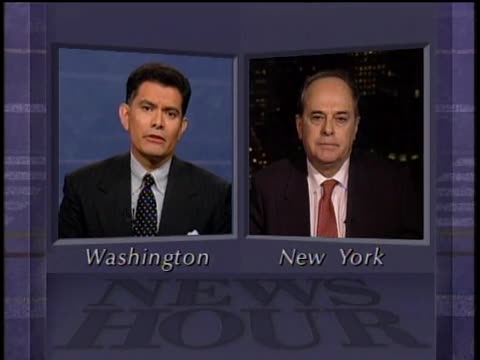
- Transcript
JIM LEHRER: Good evening. I'm Jim Lehrer. On the NewsHour tonight, full coverage of the capture of three US soldiers and other events of the continuing war over Kosovo. We have interviews with Defense Secretary Cohen and Joint Chiefs Chairman General Shelton, plus the Yugoslav UN ambassador, updates on the worsening refugee situation, and opinions of the four American newspaper editorial page editors. Once again, we'll have the rest of the news of this Thursday at the end of the program tonight.
FOCUS - CAPTURED SOLDIERS
JIM LEHRER: NATO leaders reacted angrily today to the capture of three US soldiers. They were seized near the Kosovo-Macedonia border. Tom Bearden again narrates our opening summary report on the events of this day, the ninth day of the NATO bombing.
TOM BEARDEN: Americans awakened to Serbian television images of the three American GI's: Staff Sergeant Andrew Ramirez of Los Angeles, Staff Sergeant Christopher Stone of Smith's Creek, Michigan, and Specialist Steven Gonzales of Huntsville, Texas. American army units searched throughout the night at the twisting roads that parallel the border between Yugoslavia and Macedonia. There have been reports that the Americans might have been seized by Serbian residents of this village on the Macedonian side and delivered to Serb troops. The Pentagon said it was investigating their capture as an abduction.
SPOKESMAN: They were reported missing yesterday by their command, and the last transmission was that they were surrounded, involved in a fire fight, and felt that they were surrounded at the time. Whether or not they later had escaped from that and had driven in the wrong direction, or whether they were fleeing on foot, we did not know. We knew they were missing. They were reported as missing, and it was confirmed when we saw them on television.
TOM BEARDEN: Serbian authorities claimed the soldiers had been captured inside Yugoslavia, and this afternoon a Yugoslav news agency said they would be subject to a military trial. In a speech to military families in Norfolk, Virginia, President Clinton said he would hold Yugoslav President Slobodan Milosevic responsible for their treatment.
PRESIDENT CLINTON: Three army infantrymen were seized as they were carrying out a peaceful mission in Macedonia, protecting that country from the violence in neighboring Kosovo. There was absolutely no basis for them to be taken. There was no basis for them to be held. There is certainly no basis for them to be tried. All Americans are concerned about their welfare. President Milosevic should make no mistake: The United States takes care of its own. [cheers and applause] And President Milosevic should make no mistake: We will hold him and his government responsible for their safety and for their well being.
TOM BEARDEN: State Department Spokesman James Rubin reacted sharply to the prospect of a military trial for the Americans.
JAMES RUBIN: Well, such a trial was obviously ridiculous. For the Serbs to try to court martial American soldiers, it was -- you know, the fact is, it was illegal for them to be abducted, and they were performing a mission in a neutral country. There is no basis for their detention, and under the Geneva Convention, to subject them to some phony trial about - called a court-martial -- ridiculous.
TOM BEARDEN: In Brussels, NATO Commander General Wesley Clark noted that the soldiers appeared injured in the television pictures, and demanded the Serbs abide by the Geneva Convention.
GEN. WESLEY CLARK: We've all seen their pictures -- treated, and we have a long memory about these kinds of things. So I have not called any Yugoslav military authorities. They know very well what the right way to treat people is. They know what the law is.
TOM BEARDEN: Meanwhile, the exodus of ethnic Albanians out of Kosovo continues. The United Nations High Commission on refugees now estimates that 180,000 people have fled the province. The Serbs have begun using trains to transport refugees to the border. The German Foreign Minister compared it to Germany's systematic destruction of Jews during World War II. General Clark said the Serbian army is directly attacking unarmed civilians.
GEN. WESLEY CLARK: What we've seen on the ground yesterday and this morning is a continuation of the general pattern of ethnic cleansing and the attacks by heavy forces, tanks, and artilleryand armored fighting vehicles -- against essentially unarmed refugees, particularly in the Pagarusa Valley area.
TOM BEARDEN: Despite bad weather, NATO's air campaign continued in Yugoslavia. Missiles destroyed a major bridge over the Danube River in Serbia's second largest city, Novisad. NATO officials said cloud cover had slowed the pace of operations, but vowed to continue. Late this afternoon, the Pentagon announced that 12 additional F-117 Stealth Fighters are being sent to participate in the aerial campaign. But critics say the continuing flood of refugees calls into question the viability of NATO's basic strategy. President Clinton called for patience and perseverance.
PRESIDENT CLINTON: We've been doing this for seven days now, just seven days. Our pilots have performed bravely and well -- in the face of dangerous conditions and often abysmal weather. But we must be determined and patient. We cannot do everything in the world, but we must do what we can. We can never forget the Holocaust, the genocide, the carnage of the 20th century. We don't want the new century to bring us the same nightmares in a different guise.
TOM BEARDEN: On the diplomatic front, Russian President Boris Yeltsin appealed for the foreign ministers of the Group of Eight Industrial Countries to convene an emergency meeting on the Yugoslav crisis. In Belgrade, Milosevic met with the de facto leader of Kosovo's ethnic majority, Ibrahim Ragova. Serbian news agencies reported that Ragova had called for an end to the bombing campaign, but NATO and US officials questioned whether he was acting under duress. Several religious groups have called on NATO and Yugoslavia to cease fire and return to the bargaining table. The Vatican dispatched a delegation to Belgrade, and eight US Roman Catholic bishops called on both sides to make peace in the Balkans.
NEWSMAKERS
JIM LEHRER: And now to the Secretary of Defense, William Cohen, and the Chairman of the Joint Chiefs of Staff, General Henry Shelton, who are with us now for a NewsMaker interview.
First and foremost, Mr. Secretary, what's the latest news you have on the three American soldiers?
WILLIAM COHEN, Secretary of Defense: Well, the latest news is that they're still being held, we believe, illegally detained, and that there have been reports that the Serbs intend to put them on trial tomorrow in a military court, something of a kangaroo court. We believe that they have been illegally detained but at a minimum they are, nonetheless, subject to protection of the Geneva Convention, and there should be no trial; they should be entitled to have the Red Cross or some other agency visit them, a right to humane treatment, and not to be beaten, as is quite evident from the photographs we've seen.
JIM LEHRER: You think they have been beaten?
WILLIAM COHEN: I think it's very clear from the photograph at least one of the individuals involved, that he has suffered some beating around the face.
JIM LEHRER: General, do you know where they are, these three men?
GEN. HENRY SHELTON, Chairman, Joint Chiefs of Staff: At this time, Jim, we do not know where they are, other than being detained by the Serbs, as the Secretary has indicated.
JIM LEHRER: There was a report I read earlier, just a while ago, that they were in the Pristina area, because that's where these TV pictures came from, that that's, of course, the capital of Kosovo. You cannot confirm that.
GEN. HENRY SHELTON: I cannot confirm it. There have been -- we've had several different reports today, and none of them confirmed at this time.
JIM LEHRER: Do youknow now the circumstances under which they were captured, the exact circumstances?
GEN. HENRY SHELTON: That is currently an ongoing investigation by the operational command there in the former Republic of Yugoslavia, Macedonia. We do not have the results of that investigation yet, and there have been conflicting circumstances reported both by the immediate report from the individuals who last reported that they were under fire, that they were surrounded, which was the last report we received, and then later we got reports from the villagers, as well as the police in Macedonia.
JIM LEHRER: Where were they when they were under fire, in Macedonia, or were they over the border in Yugoslavia?
GEN. HENRY SHELTON: Well, that's part of what will be determined as a part of the investigation.
JIM LEHRER: Yes. Now, Mr. Secretary, does it matter whether they were in Macedonia or near the border with Yugoslavia, or technically in Yugoslavia, as to whether or what their legal status is?
WILLIAM COHEN: Under any consideration they are, nonetheless, entitled to protection under the Geneva Convention; whether they are being illegally detained or whether they occupy another status as prisoners, they, nonetheless, are entitled to protection under the Geneva Convention.
JIM LEHRER: But the United States does not quarrel with the Yugoslav government's right to hold them, is that correct? It's the circumstances under which they're held that you object to?
WILLIAM COHEN: Well, it's a question of how they were apprehended, where they were apprehended. If they were, in fact, in Macedonia and were taken illegally across the border, that certainly would make a difference. That would be clearly illegal detention. If they were in to -- over the border, and then subject to apprehension at that point, that might make a difference, but it would not make any difference in terms of the treatment that they are accorded under the Geneva Convention; they still would be entitled to humane treatment, right to have access to the Red Cross, and other international agencies and no trial. Those are all violations of the Geneva Convention, what's apparently and purportedly about to take place.
JIM LEHRER: Now, the trial, is it your information on the trial based solely on the information that's been announced publicly to everybody else?
WILLIAM COHEN: Yes.
JIM LEHRER: So, you don't have any inside, direct information on that.
WILLIAM COHEN: No.
JIM LEHRER: Now, General Shelton, General Clark said that he had made no effort to contact Yugoslav military authorities and say watch it with these three guys. Why have you all not done that?
GEN. HENRY SHELTON: I think the way we normally approach these things is through the various diplomatic channels and not from military to military in circumstances like this for sure.
JIM LEHRER: Has a message been delivered directly to President Milosevic, Secretary Cohen, about all this?
WILLIAM COHEN: Well, I think President Clinton delivered a message today very publicly, and I think very passionately, that Mr. Milosevic, himself, would be held accountable for the security and safety of these individuals, and so I think Mr. Milosevic has the message.
JIM LEHRER: Now, what does that mean, he will be held accountable personally?
WILLIAM COHEN: These individuals are entitled to the full protection accorded under the Geneva Convention. In the event that Mr. Milosevic violates that Convention, then we would hold him accountable for it, and we would take appropriate action at some future time. And we'd also send a message that this would not be a behavior that's likely to go unresponded to by the United States. I think it means that we will hold him accountable; we'll hold him responsible; and as General Clark said, this is a very serious matter; we will treat it as such, and I think that Mr. Milosevic would be very unwise for him to handle these individuals in any way other than under the Geneva Convention.
JIM LEHRER: And you mean militarily here. I mean, if something happens to these three soldiers, NATO is prepared to do -- Yugoslavia -- targets in Yugoslavia are already being bombed. Yugoslav targets in Kosovo are already being bombed. But we're talking about even an escalation of that if something happens to these three Americans?
GEN. HENRY SHELTON: Well, Jim, I think that's a decision to be made by the commander in chief, by the President, and with the consultation of the Congress and depending on the support of the American people, but, sure, I think he made it clear today that America takes care of its own -- that we are very concerned about the detention of these three solders. We expect them to be treated humanely, and in accordance with the Geneva Convention, as the Secretary has said, and so where we go from here, I think, depends on the way that our soldiers are treated and what the outcome of that is.
JIM LEHRER: Just to put it in simple language, Mr. Secretary, is what you want Milosevic -- the message you want Milosevic to get, you and the President and General Shelton, what Milosevic to get is you think it's bad now, you haven't seen anything yet, if you harm those three men?
WILLIAM COHEN: We're sending a message that there will be a substantial penalty involved in the event that he should treat them less than they're accorded and should be accorded under the Geneva Convention.
JIM LEHRER: But you're not expecting them to be released? You are not demanding that, are you?
WILLIAM COHEN: Well, we are demanding that. We expect them to be released. At a minimum, I've indicated that they're entitled to Geneva Convention protection, and if they have been in fact kidnapped or apprehended illegally, that we are entitled to have them immediately returned now.
JIM LEHRER: All right, let's say they go ahead with this trial tomorrow. What happens? What are we going to do about it?
WILLIAM COHEN: Well, I wouldn't want to telegraph in advance other than to say and repeat what the President said: There will be a substantial consequence for that.
JIM LEHRER: General, have you or any other military commanders changed the nature of the mission in Macedonia as a result of the capture of these three soldiers to make sure this doesn't happen again tomorrow or the next day?
GEN. HENRY SHELTON: Jim, I think every time you have an incident of this time, the first thing, the local commander, the operational commander, will do is go back and review the circumstances under which the incident occurred, take a look at the various measures that were in effect and see whether or not any of these need to be adjusted. That, in fact, has been done, is in the process of being done even as we speak, and appropriate measures will be taken. Because they're operational in nature, I wouldn't wanted to discuss exactly what changes have taken place, but that has occurred.
JIM LEHRER: Refresh all of our memories, General, on what those three soldiers were doing in Macedonia in the first place, out three soldiers.
GEN. HENRY SHELTON: Well, those three soldiers were originally deployed to Macedonia under Task Force April Century, which is the United Nations peacekeeping mission that was observing, making sure there were no violations, intrusions of the border that separate Kosovo from Macedonia. A few -- about a few days ago, they were pulled off of those borders, replaced by the Macedonian troops at that time because the UN did not extend the task force April Sentry, and so they were pulled back closer to where the NATO force is right now, and they were in the process -- they would were just occupying defensive positions there outside of the Skopji with the NATO force that is currently there.
JIM LEHRER: And they were on a scouting mission or reconnaissance mission, is that right?
GEN. HENRY SHELTON: They were occupying observation posts around the -- around their own defensive positions -- and as I understand it, were checking the routes to and from those at the time. All of this will come out in the investigation. There are still some things that are not -- not quite clear and that'll come out in the investigation.
JIM LEHRER: But they've had -- what were their rules of engagement? If somebody shot at them, they had the permission to shoot back?
GEN. HENRY SHELTON: Under peacetime rules of engagement even, they would have had the rules of engagement to be able to defend themselves and that when they reported they were being fired at, then certainly they have the right to use deadly force to protect themselves.
JIM LEHRER: Do you know now who might have been firing at them?
GEN. HENRY SHELTON: We do not at this time know who was firing at them. That's part of what the Macedonian police and the operational commander are trying to determine at this time, whether it was a unit or -
JIM LEHRER: A unit of the Serb army or one of the paramilitary units or even some civilians, right?
GEN. HENRY SHELTON: We're still trying to fix responsibility.
JIM LEHRER: Mr. Secretary, moving to the other part of this, as we just reported, the exodus of ethnic Albanians continues and it continues to raise all kinds of concerns here in the United States. Is there any sign at all that that is lessening?
WILLIAM COHEN: There is though sign that there has been any reduction or diminution of activity. I couldn't help but as I was watching the lead-in, of seeing that scene repeated out of "Schindler's List," the kind of horrific ethnic cleansing being conducted by the Serbs. It certainly stirs the ashes of what took place during World War II. And for all that reason, the international community should be condemning what Mr. Milosevic is doing. With respect to the action that has been taken, we understood from the very beginning that Mr. Milosevic had organized his forces almost some 40,000 strong on the edge of Kosovo, prepared to go in and do this kind of damage. We have seen him engage in ethnic cleansing in the past, and we have to look at past behavior and present capabilities. And judging from his past behavior, he's done this before. It's a continuation of what he had done last fall. And so that was a catastrophe that he was prepared to engage in. NATO decided we should try to take some action to deter that, but failing to deter him from doing that, then we were going to systematically start to diminish and damage his military capability, and we are in the process of doing that and we're going to continue to do that.
JIM LEHRER: As you know, Mr. Secretary, both the "Washington Post" and the "New York Times" and other newspapers, as well, had stories today suggesting that the President was told before ordering -- or before going and okaying the air strikes, that this very thing might happen, andthat the CIA, among others, predicted this very outcome, that if you want to accelerate ethnic cleansing, launch a bombing campaign. And the President went ahead anyhow, is that correct?
WILLIAM COHEN: The stories that have appeared in today's papers are false, that there was absolutely no division on the part of any of the President's advisors and no misunderstanding on the part of the President. All of us knew from the very beginning that this was about to take place, we knew that Mr. Milosevic was prepared to go in, we understood that if we did nothing and sat on the sidelines, you would see this kind of ethnic cleansing take place. We knew there was a risk that if we went in, that he could go forward in any event. We had hoped that we might send him a message that NATO was determined to prevent this from taking place, if at all possible. But if not, that we were prepared to carry this battle to Mr. Milosevic, and that's precisely what was presented to the President. He understood it, we all understood it. There's no division on this. And to the extent that there's any speculation or rumors in the press to the contrary, they are in error.
JIM LEHRER: General, what do you say to the other group of critics - not critics, I guess, commentators, or whatever, some of them former army officers, high-level army officers of the United States military, have suggested that the idea of saying at the very beginning, before the first bomb was dropped, "we're not going to put in ground troops," told Milosevic, all he had to do was hunker down, continue what he was doing and he could ride this thing out and that was a basic mistake in judgment. Do you agree with that?
GEN. HENRY SHELTON: Though, I don't, Jim. I think that first you look back at NATO itself, where there was no political decision to employ ground troops. The will to do that was not there. I think that right up front we recognized that we were faced with two choices: We could stand by and do nothing and allow the atrocities that had already begun. Remember, the OSCE had already been forced out. The Kosovo observer mission had been forced to leave because they couldn't do their job. Basically the Serbs had already started. And so NATO was forced with a couple of options: One is do nothing; the other one was try to use air power, as the Secretary has outlined. Or the third one, if there had been political will would be to try to move some massive force in and there were some assessments done early on that said, unless you had a peaceful settlement, that it would take a tremendous number of troops, and as I said, there wasn't -
JIM LEHRER: A couple of hundred now, is that right?
GEN. HENRY SHELTON: A couple of hundred thousand was one estimate, under the conditions that exist now. And the political decision to do that was not there. And so we had the decision then, do nothing or use air power. And start to reduce the capabilities that he's got and send a very clear signal to him, that if this continued, that he would continue to have his capabilities reduced. And that's exactly what we've been doing.
JIM LEHRER: Mr. Secretary, a lot of people mistakenly - I'm loading the question -- okay, bombing may not be accomplishing everything, so we'll snap our fingers and we'll send in a couple of hundred thousand troops. That's not practical, is it?
WILLIAM COHEN: It doesn't happen that way. As a matter of fact, before you could ever send any troops in, you would still have to carry out the air campaign to eliminate the air defense systems, so you could start moving the aircraft in, to move the troops in, all in a hostile environment in which you have hundreds, if not thousands, of air defense systems that could attack these transport planes and helicopters coming in. So it sounds very easy, you could snap your fingers, but the same kind of process of really doing some damage by an air operation would be a preliminary and a predicate for introducing any kind of a substantial ground force. So it's not practical. We are proceeding along a path that not only the United States, this is a 19-country operation where 19 countries have signed on saying this is the correct process and policy, and we would have to now do what President Clinton said, we've got to stay the course. It's been a week. We intend for this to go on much longer and Mr. Milosevic is going to find that his military is going to be diminished as a result of this.
JIM LEHRER: But staying the course does not involve even planning on a contingency way for the introduction of troops in a hostile environment?
WILLIAM COHEN: Our plans today are to continue the air operation. We believe that we can carry that out successfully.
JIM LEHRER: How do the two of you feel about this new wave of I guess questioning whether or not this was the right thing to do, the people are being -- we've seen these pictures, we talked about them. My goodness, the very thing that this thing was intended to stop, it's gotten worse instead of better.
WILLIAM COHEN: Well, I don't think we should suffer from any accommodating amnesia. We go back to October, for example. We can see the same pictures back in October when there were almost 400,000 of these refugees and displaced persons up in the hills. They had been forced out of their homes and out of their villages with only the clothes on their backs. They were in danger of starving and freezing to death. And at that time, it was NATO that had to force Mr. Milosevic saying, "Unless you let them down and be resettled, you're going to face an air campaign against you." And at that time Mr. Holbrooke was successful in negotiating an agreement to allow them to come down. But this kind of ethnic cleansing has been really been a hallmark of Mr. Milosevic. He has tried it before, he has conducted it before, and we are seeing the fruits of that right now. There should be no mistake about it, he was planning this, he was continuing it, and we are doing our best to make sure that he is not able to continue this at the level he has been in the past.
JIM LEHRER: General Shelton, your level of confidence remains what it was when this began eight days ago?
GEN. HENRY SHELTON: For sure, Jim. We knew going in that this would be a very tough mission, a very robust, integrated air defense system. We knew that we'd have to deal with that. The weather we knew at this time of the year was going to make it extremely difficult. And the terrain there favors -- makes it more difficult to operate. We went in with a plan. We have worked that particular plan, it has been very effective to this point. It becomes even more effective as the weather gives us breaks. And we will continue to go after him. The intensity of it will be increasing in the next several days, and I think that the results of that are already starting to show. And I think that, as long as we stay the course, he is losing a significant amount of capability. He's losing military capability, economically it is starting to hurt him. And infrastructure, long-term he's paying a severe price right now.
JIM LEHRER: All right. Well, gentlemen, thank you both very much.
NEWSMAKER
JIMLEHRER: Now the view from the other side of this and to Phil Ponce.
PHIL PONCE: For that view, we're joined now by Yugoslavia's Ambassador to the United Nations, Vadislav Jovanovic.
Mr. Ambassador, thank you for joining us. Sir, what is the latest information you have of the condition of the three American soldiers?
VLADISLAV JOVANOVIC: I don't have much information, as a matter of fact, but I know that the three soldiers were captured on Yugoslav territory and that they are taken according to the standards and the tradition of Yugoslav army, which are very bright and we don't treat the soldiers of our enemies in any bad way. So that outcry, the dramatization of the issue by the American press and some American politicians is not in proportion with reality.
PHIL PONCE: So Mr. Ambassador, you're saying that even though you may not have very much information, you can assure people that the three soldiers are in good condition now?
VLADISLAV JOVANOVIC: Well, they are in good condition in the sense that they are not badly treated. This is not our intention or our tradition. But the bruises, traces on their faces you can see can be the result of many things. And I don't know anything about the circumstances under which they have been captured. But they could -- they have probably put resistance and maybe some fight preceded to their apprehension or maybe some car accident preceded it. I don't know anything. So it is much better to be more prudent and avoid jumping to any conclusions before knowing more about the circumstances - more about the details of their capture.
PHIL PONCE: So, we just heard the Secretary of Defense say that he believed that they had been beaten. Your reaction to that would then be -
VLADISLAV JOVANOVIC: Believing is not any evidence. I really can't believe authorities about -- I don't believe I can follow his drive of thoughts that that thing could happen. It is simply out of our tradition to treat our enemies badly. But my assumption is that one fight preceded their captures and usually that fight that maybe even our soldiers were harmed or have some bruises.
PHIL PONCE: Mr. Ambassador, where are they being held?
VLADISLAV JOVANOVIC: I don't know. This is military secret.
PHIL PONCE: Do you have any information on the circumstances under which they were captured?
VLADISLAV JOVANOVIC: Not yet.
PHIL PONCE: So, for example, do you know where they were? Were they in Yugoslavia, or were they in Macedonia?
VLADISLAV JOVANOVIC: No. They were captured in Yugoslavia, in Yugoslav territory, but where I don't know. I expect to get some more clarification in that respect. But this is a military matter more than political, and in that case, the access to the information is quite difficult, not easy one.
PHIL PONCE: And Mr. Ambassador, even though you don't have much information, do you have any idea who captured the three soldiers? Was it -- were they members of the Serb army, the paramilitary, were they civilians?
VLADISLAV JOVANOVIC: My understanding is that they were captured by soldiers.
PHIL PONCE: Mr. Ambassador, what grounds are they being held? What do you consider their status to be, prisoners of war?
VLADISLAV JOVANOVIC: They were captured in our territory. It depends on the mission they had, they got from their superiors when they were sent to Yugoslavia, whether the mission was to get in touch with the disrupted KLA organizations in order to serve as a liaison officer and to coordinate with the terrorists with the bombing of NATO. Or they had specific tasks to do any subvergence or doanything. I don't know. This is just open to everybody's speculation. But unless we know more about that, we cannot answer to your question in any reliable way.
PHIL PONCE: So for people in this country who believe that they were serving as part of a peacekeeping force, you're suggesting that, what, perhaps they were operating in a different capacity than that?
VLADISLAV JOVANOVIC: You know, the peacekeeping mission terminated with the end of the UN mission mandate approximately a month ago. Since that time, the American and other soldiers who have served under UN flag had become something else. They cannot pretend to be peacekeepers anymore. They are all members of the so-called extraction force, which was unilateral decision by NATO countries to position them in Macedonia or a part of NATO troops which - who have been piled up, or concentrated in Northern Macedonia as a part of the policy of threatening Yugoslavia with the use of force in the case it refused to accept the ultimatum dealing with the so-called peace agreement in Paris.
PHIL PONCE: Mr. Ambassador, will these three soldiers be given the protection of the Geneva Conventions?
VLADISLAV JOVANOVIC: There is no question that we are a country respecting all our international commitments, Geneva Convention of course. But we still don't know in what capacity the American soldiers were sent to Yugoslavia, what was their mission; if they were sent with some task which was not in line with the task of soldiers, it is another thing. But I don't know anything to say in advance. I don't have any clarification if that military court is going to seize that matter and put it into procedure, it certainly means that the matter is quite serious.
PHIL PONCE: Mr. Ambassador, so will there be in fact some kind of a military proceeding against the three Americans?
VLADISLAV JOVANOVIC: I don't know. I know what you know, that the military court is in charge to do with that matter. What will be the decision of the court, I don't know. It will depend on many of facts and circumstances.
PHIL PONCE: Mr. Ambassador, how do you respond to legal experts who -- and we also heard the Secretary of Defense say that, under the Geneva Conventions, a trial or a military proceeding against prisoners of war, that that is illegal, that's not an appropriate procedure?
VLADISLAV JOVANOVIC: As a matter of fact, I am not very much familiar with Geneva Conventions. I have studied them once upon a time, but I have to refresh my own knowledge. But first of all, we have to know what is necessary to be fulfilled in order to get the status of the war prisoners. They are war prisoners, and people, individuals engaging in committing some crimes. I don't say anything that American soldiers could be associated with that. But without knowing more about the case, one cannot go further and establish any judgment on the basis of the Geneva Convention.
PHIL PONCE: Mr. Ambassador, I thank you for joining us.
VLADISLAV JOVANOVIC: You're welcome, sir.
UPDATE - EXODUS OF AGONY
JIM LEHRER: More on the continuing refugee crisis. We have two reports from Independent Television News. The first is by Tom Bradby in Albania.
TOM BRADBY: Today it was clearer than ever that what is happening in Kosovo is the exodus of a whole people. Thousands upon thousands were crossing the Albanian border, most from Pristina. They brought a consistent story of the organized and determined way in which the Serbs appear to be clearing the city. They said men with guns came to every house yesterday and forced each family into the streets to join thousands of others marching in silence.
WOMAN: Those people are from prison, are out from prison now, criminals and gypsies with big weapons, with black masks.
TOM BRADBY: They were forced to march to the train station, where they were joined, they said, by tens of thousands of others. They waited all night. Several babies were born by the track.
ANOTHER WOMAN: We were forced by guns behind us, no speaking, a silence, a silence. I never seen such kind of silence and such kind of fear in my life.
TOM BRADBY: In the morning, they were forced onto buses and trucks, taken towards the border, and then told to walk. Drita, whose name means "light," is nine months pregnant. She and her husband walked all night with their daughter, called Yette, or "Life."
DRITA: She has all these nightmares. She's afraid. I'm afraid. I don't know poor my mother, poor my two brothers, poor sister.
TOM BRADBY: What's happening here doesn't compare with previous days. This queue stretches for miles and mile, and each family crossing the border has a story that's terrible in its own right. Some have left elderly relatives behind who didn't want to leave their homes. They had a few minutes to say good-bye. They don't expect to see them again. As the refugees crossed the border, they were handed food. Many had not eaten for days -- children who have nothing given something to comfort them. The aid agencies are acknowledging now that if the exodus continues at this rate, it may be difficult to feed everyone.
WILLEM SMIT, Red Cross: Coping with it, I don't think anybody can cope with it at the moment. The only good thing that they can do at the moment is transporting the people more to the coastal area, to the cities and get an enormous international aid program to assist the people at the moment.
TOM BRADBY: The Albanian authorities are moving people out quickly, but food is running short. And as to the eventual numbers, who now can guess? The people of Kosovo, in their own words, are leaving behind a wasteland.
JIM LEHRER: Our second report is from ITN's Mark Austin on the border between Kosovo and Montenegro. Terence Smith talked with him this afternoon.
TERENCE SMITH: Mark, what is the situation there today? Is the flow of refugees continuing?
MARK AUSTIN: Yes, the flow of refugees is continuing for the fifth day now. We've been up on the border, the mountain border, it's snowing, it's very cold. And while we were up there, several thousand refugees crossed the border from Kosovo in cars, in tractors, in trailers and some on foot. And this is, as I say, has been going on for five days now. And it doesn't seem to be stopping. There's slightly less today. That's largely because the weather in the mountains is bad. It's difficult to cross the mountains. But the very fact that they are crossing the mountains, trying to cross them, means -- shows how desperate that they are to get to the safety or relative safety of Montenegro, which although it's inside Yugoslavia, is a part of Yugoslavia that is pro western and a part of Yugoslavia where they feel safe for the time being before they then move on to Albania.
TERENCE SMITH: And do these refugees report that they are still being forced out at gun point?
MARK AUSTIN: Yes. The stories that we're hearing are very harrowing stories. And they're all the same stories so you have in many ways to believe them. I mean there's no way of verifying the stories. We can't get into Kosovo. We can't get in with our cameras so all we can do is listen to these accounts. And the accounts are that masked gunmen, paramilitaries, came to their homes in the middle of the night and told them that they had to leave Kosovo, they had to leave what they call the Serb nation, and they have to go to NATO they say, "Go and join NATO. That's what you want to do." And they force them out. And of course hundreds start leaving, and then others see those leaving, so thousands start leaving. There have been killings, we've been told, in the streets, executions. Men have been rounded up and taken to sports stadiums. So these are the stories we're hearing. Houses are being burned. I spoke to a teacher today, a primary school teacher from Kosovo who taught English, and he said that a gunman came to his door in the middle of the night, he told him that he and his family had to leave. He gave them 30 minutes to leave. They stole all their money. They looted their flat. And of course they left. And they started a long walk towards the border. Now, this is one story out of hundreds, thousands of stories pretty much exactly the same. As I say, they're uncorroborated but the very fact that they're -- all say pretty much the same thing does lend credibility to the stories.
TERENCE SMITH: Are they -- are the refugees aware of the wider war around them? Are they aware of the NATO air strikes on their behalf?
MARK AUSTIN: Well, this is an interesting point. Of course they're aware that a war has broken out. They are being bombed. Kosovo is being hit by NATO bombers. And the Serbs, of course, are saying that this is the reason why they're fleeing. Now, this is denied by the refugees themselves. They say they are not fleeing because of the bombing, they welcome the bombing. The reason they are fleeing, they say, is they're being forced out, they're being persecuted and they're being threatened and that they have no alternative but to seek sanctuary in Montenegro, in neighboring Albania, where most of the refugees seem now to be going and in Macedonia. But, as I say, they're coming across this mountain, they're in a terrible state. They have very few belongings. It's very cold. They don't have food, they don't have water, and once they get here, Montenegro is a small country, it's not a particularly rich country and they're having great difficulty in finding aid for the refugees who come across.
TERENCE SMITH: Mark, let me ask you on a personal note, you've covered the Bosnia crisis, you've been in the gulf during the Gulf War. How does this compare to what you've seen in those circumstances? What is it like to cover it?
MARK AUSTIN: I think in terms of a sort of exodus, a forced exodus from a country, I haven't seen anything like it in Europe clearly. I covered the Rwanda situation, where up to a million people fled from Rwanda and the scenes there were horrifying. These people were arriving without any food and water, and the aid couldn't reach them. And as we know, hundreds were dying a day of cholera and other illnesses, and I think in the end 30,000 of them died. Now, here we're not seeing illness and sickness break out yet. The aid is able to get in to Albania. The European Union, the United Nations will be able to get aid into Albania. So they hope that they can avoid that kind of humanitarian catastrophe. But certainly, in terms of people being forced out of their villages, out of their towns, I haven't seen anything like that in Europe, and I don't think anybody has since the Second World War.
TERENCE SMITH: Well, it's obviously a very wrenching and dramatic situation, Mark, and we appreciate this chance to get a first-hand account from you. Thankyou very much.
MARK AUSTIN: Okay. Thank you.
FOCUS - EDITORIAL OPINIONS
JIM LEHRER: Now a sampling of American editorial page opinion and to Elizabeth Farnsworth in San Francisco.
ELIZABETH FARNSWORTH: For that opinion, we turn to four editorial page writers: Beth Barber of the "Cleveland Plain Dealer"; Robert Friedman of the "St. Petersburg Times"; Rob Elder of the "San Jose Mercury News"; and Don Wycliff of the "Chicago Tribune." Robert Friedman in St. Petersburg, I want to go back to Jim's interview with Secretary Cohen and General Shelton. Your editorials have opposed the air strikes and been quite critical, calling the administration or criticizing the administration and NATO for not being, "farsighted enough about the consequences of their actions." Did you hear anything today that might change what you'll write tomorrow?
ROBERT FRIEDMAN: No. I feel as though the -- what we've seen is a continuation of the past week of an escalated attack on the Albanians in Kosovo. I'd like to think that they were putting as much effort into back-channel diplomatic solution to this as they are to what appears an incremental escalation of the bombing without any end strategy in sight.
ELIZABETH FARNSWORTH: And you remain critical of the administration for not foreseeing that there would be these terrible expulsions?
ROBERT FRIEDMAN: Well, I don't think I or the members of our staff claim to be foreign policy experts, but these are just the kinds of counterproductive results, the tragedy that we were afraid we would see. Now, certainly Mr. Milosevic bears the primary responsibility for this tragedy, but I think you used the term short-sighted that we had said, and I think nothing has happened to change that view.
ELIZABETH FARNSWORTH: Don Wycliff, anything change in your view? Your paper's been supportive of the administration?
DON WYCLIFF: Actually, our paper has been reluctantly supportive of bombing. We supported the peace effort at Rambouillet. We are not prepared to sign on at this point to any kind of ground invasion. We feel the bombing ought to be intensified to try to bring Milosevic to his senses.
ELIZABETH FARNSWORTH: And nothing that you've heard in anything that we just went through in the program today, the refugee stories, the interviews, has made you change anything you might write tomorrow?
DON WYCLIFF: Not at this point, no.
ELIZABETH FARNSWORTH: All right. Beth Barber, your paper's also been quite critical of the bombing. Did you hear anything from the Secretary or from General Shelton that would change your mind?
BETH BARBER: None at all. None at all. There was nothing reassuring about any of this.
ELIZABETH FARNSWORTH: And what is your view now of what's happening?
BETH BARBER: Well, our view now is that we have had a policy that has brought about exactly what it was supposed to prevent. And the solution, we're told, is more of the same. So if we do more of this policy, do we get more of the same results? The ends and the means have gotten so fuzzy on this, we're losing sight of the justification.
ELIZABETH FARNSWORTH: Rob Elder, losing sight of the justification? Your paper also, it seemed to me reluctantly supported the bombing.
ROB ELDER: We did, and the one thing I've seen today that changes what I've written for tomorrow is that the President, in his speech this morning, was a pretty good pep rally leader. He was long on emotion and patriotism, but he utterly failed to give us a clear statement of what the purpose is now. He told us the other day that the purpose was three things that clearly we have not accomplished here, and the burden we think now lies on him to spell out what are we trying to do with this war? Where are we trying to get, and what is a reasonable way to get there?
ELIZABETH FARNSWORTH: So what's changed?
ROB ELDER: Well, what's changed is we have the stated purpose being to get Milosevic to agree to the Rambouillet framework, which was to establish a self-governing Kosovo within Yugoslavia. What's changed is a third of the people in Yugoslavia are trudging out of there as refugees, there are papers showing that they owned any land have been destroyed. Their identity papers are taken. Even if they wanted to go back, and many have made it clear that they're afraid to go back, it would be sheer chaos to try to put that country back together.
ELIZABETH FARNSWORTH: What do you think, then, and what will you argue should happen next?
ROB ELDER: Well, we will argue that it is the President's job, he has the information far more than we do, to clarify which of a number of goals he is really trying to achieve here. Is he trying to partition Kosovo between the Serbs and the Albanian people? Is he trying to let them get out safely? Is he trying to destroy Milosevic's army, and, if so, for what purpose? What we think should happen next is some leadership from the President of the United States in terms of defining what it is this war is all about.
ELIZABETH FARNSWORTH: Robert Friedman, what are you editorializing should happen next? You mentioned a diplomatic solution.
ROBERT FRIEDMAN: Well, I think it's tragic that we're more than a week into the bombing and we're now still waiting for the President to justify both his policy and the goals of it. We think he did much too little much too late prior to the bombing to win the support of both the public and Congress with these actions. We'd like to see some changes made in the Rambouillet agreement that we tried to force on both parties that might lead to an honorable diplomatic solution. Failing that, and it may be that Mr. Milosevic makes that impossible, I tend to agree with Senator McCain that, once you're in it, you have to win it. The worst alternative is the one I'm afraid I see, which is we muddle into this almost mindless escalation incrementally over time.
ELIZABETH FARNSWORTH: Don Wycliff, once you're in it, you have to win it? And does that mean ground troops?
DON WYCLIFF: I hope it doesn't mean American ground troops. I kind of doubt it'll mean NATO ground troops. I think if that were to be done, it should have been threatened along with the bombing right at the start. Actually, I think a year ago, maybe more than a year ago, we should have begun arming the KLA so that there would be a ground force which could carry the war to Milosevic's army while this bombing, if it were to happen, provided air cover. But that has not happened. I do not want to see American ground troops in there, from my perspective mainly because I don't think this administration can do it well.
ELIZABETH FARNSWORTH: Beth barber, ground troops?
BETH BARBER: No ground troops. There has got to be an alternative other than that, at least not American ground troops. If the Europeans want to do it, it's their backyard. But there must would be some alternative. Someone mentioned earlier that they might be able -- some way to revisit the Rambouillet agreement. Surely, surely somebody is pursuing that through back channels or some which way. It's shame, though, that, as Secretary Cohen said and General Shelton said, that there was no division in the administration on this policy. Maybe there should have been.
ELIZABETH FARNSWORTH: Beth Barber, you heard what General Shelton and Secretary Cohen said about what the US response would be to what Secretary Cohen called a kangaroo court of the three soldiers who have been taken. They said if they go ahead, if the Serbs go ahead with the trial, there would be substantial consequences. Did what you hear satisfy you?
BETH BARBER: I don't know that it has to satisfy me, but it certainly should have to satisfy Mr. Milosevic and the people who are going to do this.
ELIZABETH FARNSWORTH: But I mean in your writing, an editorial, do you think that was enough, what you heard?
BETH BARBER: I didn't hear anything specific. I heard another vague threat. I don't know if that means they're going to try to find out where they are and rescue them or bomb them or what. I think it's disturbing that the Yugoslav ambassador has not yet refreshed his memory about what the Geneva Convention requires. Surely somebody back in Belgrade has already done that. This is one time when we have to hope that the -- no matter how vague the threat, that it suffices. Americans now see a very human, very American face to the risk to this. And as one of the generals said earlier, "We don't like it."
ELIZABETH FARNSWORTH: Don Wycliff, what did you think of what the secretary and the general said about the response to the three soldiers being taken?
DON WYCLIFF: I don't think there was much to react to. I mean they said what you would expect them to say. We expect them to be treated under the Geneva Conventions as it prescribes. They made the response you would expect. And one of our recommendations tomorrow is going to be that our forces in Bosnia and Macedonia be reinforced so that we have some protection against the taking of people in this way. But they didn't say anything that surprised me at all.
ELIZABETH FARNSWORTH: Rob Elder, what are you hearing in your letters to the editor? Are people paying attention to this? Are you hearing from people?
ROB ELDER: Yes, we are. We have a number of people from the Balkans in our readership. One -- well, actually several have cautioned us, have cautioned our other readers not to make easy generalizations about who are the good guys and who are the bad guys in the Balkans. They've pointed out that today's aggressor may have been yesterday's victim. In addition to those letters, we have gotten a number that say, "You can't win this as an air war." And we've gotten others that say, "You can't win this, period, that it's just not the sort of thing we ought to be in, in the first place." We've gotten virtually nothing supporting the President's getting in.
ELIZABETH FARNSWORTH: Robert Friedman, are you getting the some kinds of letters?
ROBERT FRIEDMAN: Almost exactly the same. I don't know that we've had any wholehearted support for what our government has gotten into. We have not had a huge volume, but I would say that that's not reflective of the interest in the issue. I think a lot of people have a hard time deciding what their views are on an issue this complex and this far away and are scrambling to make a decision. And, again, I would place a lot of that on the President's failure to have enunciated it well.
ELIZABETH FARNSWORTH: And Beth Barber, you think that, with the three soldiers' faces in the television, there will be more interest?
BETH BARBER: I think there'll be a lot more interest. That's something that people can identify with. It's something that actually brings it home.
ELIZABETH FARNSWORTH: What are you hearing in your letters?
BETH BARBER: Our letters have been mostly opposed to what's going on. Cleveland does have a sizable Serb population. And -- but I don't think that's the main reason that we're getting the letters we are. Most people do seem to have grounds, but in this area of the world, today's good guys are tomorrow's bad guys or yesterday's good guys. And it's not with a simple matter and it's not a matter that's going to be solved by bombing.
ELIZABETH FARNSWORTH: Don Wycliff, what about your letters?
DON WYCLIFF: We have gotten surprisingly few letters on this issue. There have been -- and of those we have gotten, there's been a lot of tongue glucking, regret expressed over the plight of the refugees, very little - very little -- no support really for any kind of ground invasion or any more aggressive military force.
ELIZABETH FARNSWORTH: Well, thank you all four very much for being with us.
NEWS SUMMARY
JIM LEHRER: In the other news of this day, there were more big mergers. As expected, BP AMOCO agreed to buy Atlantic Richfield, ARCO, for $26.6 billion in stock. The new company will be the second largest in the oil industry. And in the television business, CBS bought King World Productions for $2.5 billion in stock. King World produces "Jeopardy" and the "Oprah Winfrey Show," among other things. Federal grants to combat violence and drugs in schools were announced. Schools in 50 communities will get up to $180 million next school year. The competitive grants will be administered by the Departments of Education, Justice, and Health and Human Services. The plan was created in reaction to several school shootings last year. In Northern Ireland, the peace talks adjourned with no agreement. British Prime Minister Tony Blair and Irish Prime Minister Bertie Ahern announced "a short pause" in the marathon negotiations to salvage last year's Good Friday Peace Accord. At the center of the impasse is the disarmament of the Irish Republican Army. Talks are scheduled to resume April 13th.
RECAP
JIM LEHRER: And to update our major story before we go, the war over Kosovo, NATO reacted with anger to the capture last night of three US enlisted men by Serb forces. Allied leaders demanded the soldiers be treated in accordance with international law, or Yugoslavia would face the consequences. And on the NewsHour tonight, Defense Secretary Cohen said, if they were apprehended on Macedonian soil, the three should be released immediately. We'll see you online and again here tomorrow evening. I'm Jim Lehrer. Thank you and good night.
- Series
- The NewsHour with Jim Lehrer
- Producing Organization
- NewsHour Productions
- Contributing Organization
- NewsHour Productions (Washington, District of Columbia)
- AAPB ID
- cpb-aacip/507-qr4nk36x4z
If you have more information about this item than what is given here, or if you have concerns about this record, we want to know! Contact us, indicating the AAPB ID (cpb-aacip/507-qr4nk36x4z).
- Description
- Episode Description
- This episode's headline: Captured Soldiers; Newsmakers; Newsmaker; Exodus of Agony; Editorial Opinions. ANCHOR: JIM LEHRER; GUESTS: WILLIAM COHEN, Secretary of Defense; GEN. HENRY SHELTON, Chairman, Joint Chiefs; VLADISLAV JOVANOVIC, UN Ambassador, Yugoslavia; MARK AUSTIN; ROBERT FRIEDMAN, St. Petersburg Times; DON WYCLIFF, Chicago Tribune; BETH BARBER, Cleveland Plain Dealer; ROB ELDER, San Jose Mercury News; CORRESPONDENTS: TOM BEARDEN; TOM BRADBY; TERENCE SMITH; CHARLES KRAUSE; PHIL PONCE; MARGARET WARNER; KWAME HOLMAN; ELIZABETH FARNSWORTH
- Date
- 1999-04-01
- Asset type
- Episode
- Topics
- Global Affairs
- War and Conflict
- Journalism
- Military Forces and Armaments
- Politics and Government
- Rights
- Copyright NewsHour Productions, LLC. Licensed under a Creative Commons Attribution-NonCommercial-NoDerivatives 4.0 International Public License (https://creativecommons.org/licenses/by-nc-nd/4.0/legalcode)
- Media type
- Moving Image
- Duration
- 01:01:54
- Credits
-
-
Producing Organization:
NewsHour Productions
- AAPB Contributor Holdings
-
NewsHour Productions
Identifier: NH-6397 (NH Show Code)
Format: Betacam
Generation: Preservation
Duration: 01:00:00;00
If you have a copy of this asset and would like us to add it to our catalog, please contact us.
- Citations
- Chicago: “The NewsHour with Jim Lehrer,” 1999-04-01, NewsHour Productions, American Archive of Public Broadcasting (GBH and the Library of Congress), Boston, MA and Washington, DC, accessed June 4, 2026, http://americanarchive.org/catalog/cpb-aacip-507-qr4nk36x4z.
- MLA: “The NewsHour with Jim Lehrer.” 1999-04-01. NewsHour Productions, American Archive of Public Broadcasting (GBH and the Library of Congress), Boston, MA and Washington, DC. Web. June 4, 2026. <http://americanarchive.org/catalog/cpb-aacip-507-qr4nk36x4z>.
- APA: The NewsHour with Jim Lehrer. Boston, MA: NewsHour Productions, American Archive of Public Broadcasting (GBH and the Library of Congress), Boston, MA and Washington, DC. Retrieved from http://americanarchive.org/catalog/cpb-aacip-507-qr4nk36x4z