The NewsHour with Jim Lehrer
- Transcript
JIM LEHRER: Good evening. I'm Jim Lehrer. On the NewsHour tonight, Kwame Holman updates the Elian Gonzalez stalemate, Margaret Warner interviews World Bank President Jim Wolfensohn and IMF Acting Director Stanley Fischer, Ray Suarez looks at the presidential election in Peru, and Elizabeth Farnsworth talks with the Pulitzer Prize Winner for Drama. It all follows our summary of the news this Thursday.
NEWS SUMMARY
JIM LEHRER: A federal appeals court today ordered that Elian Gonzalez remain in the United States at least for another day. It granted an emergency request by the boy's Miami relatives. The Justice Department also agreed to delay transfer of the boy to his father. A Department spokeswoman said the end result is to put off the custody showdown for three or four days. Earlier, the relatives defied a deadline to hand over the boy today. But Attorney General Reno said she wasn't ready to force the issue.
JANET RENO: If we are compelled to enforce our order, we intend to do so in a reasonable measured way -- the approach that we have always taken in this matter. We have the authority to take action. But responsible authority means not only being able to take action but knowing when and how to take that action.
JIM LEHRER: We'll have more on this story right after the News Summary. The presidential election in Peru will go to a runoff. Officials made that announcement late last night. They said President Alberto Fujimori fell just short of winning a majority in Sunday's first voting round. He'll face Alejandro Toledo in a runoff set for late May or early June. We'll have more on this story later in the program tonight. The head of the IMF Today rejected claims his agency has done more harm than good in poor countries. Stanley Fischer spoke in advance of the IMF-World Bank's spring meeting, which begins Sunday in Washington. Demonstrators have vowed to shut it down. We'll talk with Fischer and World Bank President James Wolfensohn later in the program tonight. President Clinton said today he would not ask for a pardon from his successor. The issue relates to Independent Counsel Robert Ray's recent statements. He confirmed he was considering whether to indict Mr. Clinton in the Monica Lewinsky matter after he leaves office. The President was asked about the pardon issue at a meeting of newspaper editors in Washington.
PRESIDENT CLINTON: I don't have any interest in that. I don't want one. And I am prepared to stand before any bar of justice I have to stand before. But I would like just once to see someone acknowledge the fact that this Whitewater thing was a lie and a fraud from the beginning and that most people with any responsibility over it have known it for years.
JIM LEHRER: The President also said he was proud of how he fought impeachment. He said he was defending the Constitution. The South Carolina Senate voted today to remove the confederate flag from the state capitol. Instead, it would fly at a monument to confederate soldiers on the capitol grounds. But the NAACP Said the flag would still be too visible. It said it would not end a tourism boycott of South Carolina. The bill must still pass the South Carolina House of Representatives. On Wall Street today, stocks fell because of new concerns about inflation. The Labor Department reported wholesale prices rose 1% in March, twice what analysts expected. The Dow Jones Industrial Average dropped 201 points to close at 10,923, a loss of nearly 2%. The NASDAQ Index was down 92 points at 3676, or about 2.5%. And that's it for the news summary tonight. Now it's on to the standoff in Miami, the heads of the World Bank and the IMF, the Peru elections, and the Pulitzer winner for drama.
UPDATE - TUG OF WAR
JIM LEHRER: Kwame Holman has our Elian Gonzalez coverage.
KWAME HOLMAN: Elian Gonzalez left his great-uncle's house in Miami's Little Havana yesterday, but did not fly to Washington to be with his father, as federal authorities had hoped. Instead he was taken to the home of sister Jeanne O'Laughlin, who has helped mediate Elian's fate. There, he and family members awaited the next step in the five month tug-o-war over whether he stays in the United States or returns to Cuba. Attorney General Janet Reno flew to her home town of Miami to participate in that meeting. But after two hours, there was no resolution. After the meeting, Reno said she gave the Miami family two options, both of which would reunite Elian with his father, Juan Miguel.
JANET RENO: We have provided the relatives and Elian the opportunity to travel to Washington to meet with Juan Miguel and to participate in an orderly transfer. If not, we have provided them alternative instructions that call for them to bring Elian to Opalocka airport tomorrow afternoon, where his care will be transferred and he will be flown to Washington to be reunited with his father.
KWAME HOLMAN: Facing a deadline of 2:00 P.M. Today, Elian's Great-Uncle Lazaro Gonzalez was defiant, as he's been throughout the odyssey.
LAZARO GONZALEZ, Elian's Great Uncle (Translated): We have done everything possible to see that the family is reunited and this problem resolved in the same way it started, within the family. We are not going to negotiate with Miss Janet Reno, and her crazy idea that the child should obey the wishes of the father, not the father obey the wishes of the child.
KWAME HOLMAN: Elian and his Miami relatives returned to little Havana late last night. Shortly afterward, family members released a home video of Elian. It is unknown whether the boy was prompted in what he said.
ELIAN GONZALEZ (Translated): I don't want to go to Cuba. If you to want to stay here , but I don't want to go back to Cuba. I'm telling you now, you say I want to go back to Cuba. I tell you now that I don't want to go back to Cuba. I want you, if you want, to stay here. But I don't want to come back to Cuba.
KWAME HOLMAN: Today, as the early afternoon ultimatum approached, the first- grader peered out the window of his great-uncle's home to see a crowd of more than 200 people. Meanwhile, his father left the home of the Cuban diplomat near Washington, D.C., where he's been staying, and met with human rights activist Randall Robinson. Juan Miguel Gonzalez was heard to say, "please return my son to me." The attorney general spoke to reportersfrom Miami midday and reiterated her hope that the two sides of the family would meet.
JANET RENO: This meeting would take place before Elian is transferred to his father's care. It would take place at a private retreat site where this family can finally sit down face to face and try to work things out amongst themselves. If they could work things out amongst themselves, the government would step aside. But if at the end of the day they could not reach agreement, the relatives would abide by the rule of law. We stand by this offer, and Juan Miguel Gonzalez has agreed to participate. Unfortunately, Lazaro Gonzalez and his family have refused these arrangements. Secondly, another rumor that exists is that the government is federalizing the streets around Lazaro Gonzalez's home and ejecting the media. These rumors are wrong, flat-out wrong. We have not taken any such steps and have no plans to do so. Despite all the tension, it was wonderful to look out the window this morning and to see this beautiful city lying out beyond the bay, to look to the West, towards the Everglades, to look to the Spanish tiles on the roof of the federal building, to realize that this community represents America and all that it is about. It represents America and the people who have come to this land for freedom, for opportunity, for the right to speak their mind, free of violence. It is a great community, and a community that, if we come together in this time of tension where people obviously disagree with tremendous emotion; but if we come together, if we respect each other, if we respect the rule of law, we can work through it.
KWAME HOLMAN: In Washington, President Clinton said he had confidence in Attorney General Reno's handling of the situation, and reiterated Elian's case is a matter for American law to decide.
PRESIDENT CLINTON: We have a legal system, and it has been followed. And the decision that was made, that Elian Gonzalez's father was a devoted and fit father and could properly speak for his son, and therefore, to make decisions for his minor son, was ratified in a district court and is now on appeal to a court of appeals. But none of the courts have granted any kind of interim relief, which would justify opposition to the plain rule of law. So to me, this case is about the rule of law.
KWAME HOLMAN: In Little Havana, the Miami relatives once again called on Elian's father to come to Florida. Their attorney, Manny Diaz.
MANNY DIAZ: We want very much for the families to get together with no preconditions. Let the families speak to each other. Who knows what will come out of the family meeting? Perhaps they will leave that room and come out and tell the world they have worked this out.
KWAME HOLMAN: As 2:00 approached and the crowds swelled, the two mayors who represent greater Miami urged them to remain calm.
MAYOR ALEX PENELAS, Dade County: Federal marshals are not coming to this home at 2:00 today. They are not coming to this home this afternoon. We need to tell the community that, because that is what has them with as much tension, so we want to urge each of you to cooperate with us as we try to ease tension in this very, very tense moment in the history of our community.
MAYOR JOE CAROLLO, Miami: The eyes of the world-- all of you representing media from coast to coast, worldwide-- are upon Miami now, and we want you to let world know what Miamians are really like. This is a peaceful community, a nonviolent community, and we are going to keep it that way.
KWAME HOLMAN: But today's 2:00 deadline passed and federal officialsdid not act to remove Elian. Also today, a state court judge denied a request by the Miami relatives to intervene in the case, saying she lacked jurisdiction. In Washington, the attorney for Elian's father had this to say:
GREGORY CRAIG, Lawyer for Elian's Father: Today, a Florida state court dismissed the case that Lazaro brought against Juan Miguel and eliminated any and all claims under state law that Lazaor had any legal right to keep the boy. Today, Lazaro broke the law. Let the record be absolutely clear on this point: Lazaro Gonzalez and those who assist him now are in violation not only of federal and state law. Elian Gonzalez is being held unlawfully in Miami against his father's wishes.
KWAME HOLMAN: Late this afternoon, the Little Havana crowd cheered at news that another court, a federal appeals court, had granted the Miami relatives' request for a temporary stay in the case, which keeps Elian in the United States for now.
FOCUS - GLOBAL VIEWS
JIM LEHRER: The meetings of the IMF And World Bank, and accompanying protests, are about to begin in Washington. We will have full coverage over the next few days. Margaret Warner begins that coverage.
MARGARET WARNER: Last year, it was the battle in Seattle, a violent showdown between police and protesters at the World Trade Organization meeting. This week, anti-globalization demonstrators are again taking to the streets, but this time they are here in Washington. Their target: The annual spring meetings of two major players in international finance and development, the World Bank and the International Monetary Fund. The 182-member IMF monitors the world's economy, and provides short-term economic aid to needy countries, usually demanding free-market reforms in return. The World Bank focuses on longer-term lending and development projects.
Joining us now are the heads of both organizations: James Wolfensohn, president of the World Bank; and Stanley Fischer, the IMF's acting managing director. Welcome, gentlemen.
Mr. Wolfensohn, you said yesterday you found these protests a bit demoralizing. Do you understand or sympathize with what these protesters are upset about?
JAMES WOLFENSOHN, President, The World Bank: Well, of course I understand they're concerned about globalization and that they're concerned about issues of equity and poverty. But the thing that I find demoralizing is that I -- together with 10,000 of my colleagues -- spend all our time really trying to address the issues of poverty, dealing with the country's concern and trying to make the world a better place much as they would like. So I think there's a lot of misunderstanding about what we're doing, although I understand that many people are concerned about the future.
MARGARET WARNER: Mr. Fischer, I want to read you a quote from the "New York Times", they described the protesters attitude - thinking that you are part of the problem. It said that many of the protesters view the World Bank and the IMF as global loan sharks, hooking low-income nations on cheap debt and then insisting on policies such as opening their markets that actually often drive them further into poverty. What do you say to that?
STANLEY FISCHER, Acting Managing Director, IMF; Well, the IMF does mostly emergency crisis lending, and we're lending mostly to help stabilize economies. And that has worked around the world, it's been successful in the Asian countries in Brazil, in Latin America. So it works, and it helps the citizens of those countries. Typically also, if there are conditions related to the structure of the economy, they'll be included in some of our loans. And all the evidence is that opening to the global economy actually helps countries grow, helps the poor people in those countries.
MARGARET WARNER: But let me give you an example that they point to. The Asian economic crisis, in a way these countries were encouraged by the I M F to completely liberalize their financial markets, all this international investment money came in. Then when things got at all shaky, it all left and they were left prostrate, really, and then with huge loans. Do you think the IMF bears some responsibility for that kind of a situation, that some of these economies aren't ready for perhaps full capitalism on a global scale?
STANLEY FISCHER: The IFM hasn't encouraged immediate opening of capital accounts, and what was wrong in the Asian cases was that they had opened first to short term capital, the most dangerous form of capital, and Korea for instance had opened to long term investment, which is much more stable, much more successful. We were not involved in those countries when they opened their accounts, and I don't think we were pushing for that particularly. We would certainly advise that that be done cautiously in any case, starting at the long end of the spectrum.
MARGARET WARNER: Mr. Wolfensohn, on a related matter, there is also a perception at least a monk these protesters that quite often your two organizations insist on these poor countries opening their markets, for instance there was a piece in the "Washington Post" today about Haiti being forced to open its market to say rice imports, all the subsidized American rice flows in, and their own market collapsed, or their own production collapses and there are no compensating, either industries there, nor do they have the ability to export many of their products, because many developed countries don't accept them. I mean, do they have a point?
JAMES WOLFENSOHN: Well, I don't think they do, Margaret. I mean, I understand what happened in Haiti, but we spend all our time in the bank trying to deal with the questions of dislocation caused by changes in the market and openings in markets. Our objective is to make sure that there's a social underpinning, if there is a change in the market, we try and help countries to become competitive. We think that globalization, quite apart from the bank, is here to stay, and we spend all our time trying to deal with the questions of poverty and deal with these dislocations. So to suggest that we cause it is, I think, very extreme description of what we do.
MARGARET WARNER: Give us an example of something that you do that tries to deal with these dislocations.
JAMES WOLFENSOHN: Well, for example, in countries in North Africa that are concerned about opening their markets, we will put in social safety nets for people that are put out of jobs. We will go into training programs so that people can be retrained. We will start programs to finance small and medium sized enterprise, so that people that are dislocated can start their own businesses. We try and introduce private sector to come into the countries to bring in new technology and people. And many of these countries we're bringing in modern technology. The objective is to try and help countries advance in the world, and not to stay back in the dark ages. And so our objective is to try and ensure that there's the training, education, the finance, the opportunity, so that these countries can compete.
MARGARET WARNER: So you're saying that the image of the World Bank is only funding these huge development projects, that that's no longer true, that you've made a change there?
JAMES WOLFENSOHN: That's simply not true. The focus of our place is to fight, as we put it, poverty with passion. And in our meetings that we're going to have now, the first item on the agenda is AIDS, and the second item is poverty and development and trade. And what the demonstrators are trying to do is essentially stop us talking about those issues, which I think is very sad.
MARGARET WARNER: Mr. Fischer, the one concrete thing that the demonstrators seem to agree that they actually want you to do, as opposed to stop you from doing, is to grant really not just some dealt relief but full dealt forgiveness for all these poor countries. They point out a lot of these countries now spend more on interest payments, lots more, than they do say on addressing the problem of AIDS or on health care. Can you do that?
STANLEY FISCHER: It takes financing to pay for debt relief, and at the moment we're still trying to get payment for the debt relief new under way, which altogether will reduce the debts of the heavily indebted 41 of them, countries, by about two thirds. When, if those payments are made, and there are severe difficulties for some of the other development banks, then we can proceed to give a lot of debt relief. If the creditors would want to do more, then we could move ahead on that basis. But at some point one has to ask what is the best way of distributing aid if it available, is it on the basis of how indebted countries are? And do you at some point want to say that countries, which borrowed have an obligation to repay something? So there are complicated issues. But the debt relief is now well under way, and considerable amounts of debt relief will be given. We're working extremely closely together on those issues. And a number of countries have already passed the first stage of this process. I hope that in a day or two we'll get the next country into the second stage, final stage of the process.
MARGARET WARNER: Jim Wolfensohn, where are you on this issue of debt, first expanding the dealt relief so it's debt forgiveness and expanding the number of countries?
JAMES WOLFENSOHN: Well, after all, we in the fund three years ago started this whole idea of debt forgiveness because we basically felt that a number of countries had borrowed so much that they could never get out of debt, much like individuals sometimes do or companies that are going into bankruptcy. Our objective is to try and restore these countries to a certain balance so that they can retain their momentum and move forward. And so our objective is very clear. We want to try to remove the debt to a point where the countries can invest their funds in social programs, in education, in health, and we will arrange for the debt forgiveness when those countries demonstrate that that is what they want to do. And we are now working with all these countries, along with our friends in the Fund, to try and have them develop their programs. So I have no pace at which I want to do this, other than to say that let them have their programs first, let's be satisfied, and then let's try and bring about the debt reduction.
MARGARET WARNER: Mr. Fischer, one other major point -- it seems agreement among the protesters has to do with environmental policies. What they say is that the IFM and World Bank tend to fund things that contribute, help large corporations come in and perhaps develop these countries in a way that's not conducive environmentally. What do you say to that?
STANLEY FISCHER: Well, it's a difficult issuefor the I M F. We typically lend for general government expenditures and not for particular projects. But typically we're lending in cooperation with our colleagues in the Bank. And they do have environmental protection programs, they've been very active in that regard. And we're very supportive of what they do. In a few exceptional cases where environmental problems become very large scale and would affect the macro economic variables on which we focus, we have had agreements on improvements in environmental policy in countries, but that is basically something that the World Bank does and has been pursuing pretty vigorously, I may say.
MARGARET WARNER: And, Mr. Wolfensohn, do you see the World Bank as having a responsibility to steer these countries into -I don't know -- renewable resources, rather than fossil fuels, is that part of what you try to do or not?
JAMES WOLFENSOHN: Well, yes. We'd have a major program if we could have everybody working on solar energy, and it would be wonderful. But of course that's not possible in many countries. And where it's possible to have natural gas, we move towards it. But where the countries have fossil fuels, then our major objective is to make sure that those fuels are used in the most environmentally sound way. We are in fact a major force in saving the environment where people are forced to use fossil fuels. We're also very active in trying to get trading going to enhance the Kyoto initiative. So to say that we're not involved in the environment would be a gross misstatement.
MARGARET WARNER: Mr. Fischer, finally, I want to ask you both, why do you think we're seeing this sort of generalized revolt against globalization? We see it aimed at the WTO, trade with China, genetically modified foods, what you two do. What do you think explains it?
STANLEY FISCHER: It's interesting that it's happening now. We've just come through a very major crisis during which there was a fear of a worldwide recession. Fortunately, that didn't happen. The Asian crisis is largely over. There's stability in much of the rest of the world -- the world economy is growing. And it is a point at which we've had an opportunity to take our breath. I think what's happening is that there are two things going on out there. There are some who are pushing for debt relief, they've had many good ideas and they've been very constructive. There are others who have a natural or a simple reaction against globalization, I think without understanding that globalization per se is as Jim says something we can't stop -- that countries have grown best by integrating into the world economy. But they see some of the down side, they see workers losing their jobs in the short run. They see some aspects they don't like, the environmental problems that you talk about, some object on labor grounds. So they're looking at negative as respects of globalization and instead of saying let's deal with these negative as respects, which we are trying to do, they're objecting to the whole thing. But it can't be stopped, and it shouldn't be stopped.
MARGARET WARNER: Go ahead. I just wanted to get Mr. Wolfensohn on that point also.
JAMES WOLFENSOHN: Well, I think that people are worried about the future, I think they don't understand a lot of the big international institutions, I don't think that they know that we're reaching out to civil society to try and build the relationships that we have to open the doors to discussion and dialogue, and hopefully as a result of these meetings, maybe people will recognize that we are ready to talk, and we have been ready to talk, we're very anxious to do it, and some of the mystery will go. But we are entering a new age of globalization, and I think there's a lot of fear.
MARGARET WARNER: All right. Well, thank you Jim Wolfensohn, Stanley Fischer, thank you both very much.
JIM LEHRER: We'll have a report on the World Bank-IMF protesters tomorrow night. Still to come on the NewsHour tonight, elections in Peru, and the Pulitzer Prize winner for drama.
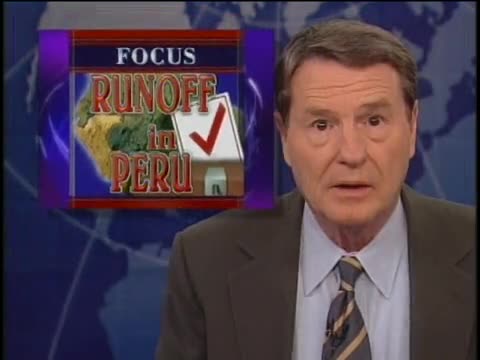
FOCUS - RUNOFF IN PERU
JIM LEHRER: The Peru story, and to Ray Suarez.
RAY SUAREZ: As Peru's cliffhanger vote count drew to a close, President Alberto Fujimori missed the 50% he needed for a first-round win. Challenger Alejandro Toledo's presidential ambitions are still alive.
ALEJANDRO TOLEDO, Presidential Candidate (Translated): I come here tonight to announce to you that collective democratic stubbornness has just triumphed.
RAY SUAREZ: All week, demonstrators have been on the streets of Peru's capital, Lima, alleging fraud in the presidential balloting. Much of the press and the majority of political leaders backed accusations of interference with computer systems and falsified ballot papers, all meant to assure the president's reelection in the first round. As the vote count stretched into days, pressure continued to mount on the Fujimori government from inside and outside Peru.
JAMES RUBIN: We would have some serious questions if that official count was inconsistent with these respected non-governmental organizations and international observers. If that were to happen, and thus there would be convincing proof of fraud, in our view this would pose a substantial challenge to restoring the credibility of the government in Peru with the United States and the rest of the international community.
RAY SUAREZ: Peru's president faced eight opponents, but only one, Toledo, was considered a serious threat to him by the time the polls opened. Before the Election Commission announced Fujimori would be forced into a runoff, Toledo led more than 4,000 protesters in a march on Fujimori's presidential palace. Protesters lobbed rocks and tear gas at the building.
DEMONSTRATOR (Translated): The people are sick to death of Fujimori. Today we have said that it's about time we got rid of this dictatorship.
RAY SUAREZ: First elected in 1990, Fujimori was an unknown university rector. He appealed to poor citizens who saw him as a genuine outsider, and helped him defeat the internationally known author Mario Vargas Llosa, in a runoff. Fujimori took over a country terrorized by guerrillas and plagued by inflation, which ran at 7,500% annually. Within two years, arrests had crippled rebel organizations in Peru, and a free-market economic program was in place. After forcing changes in Peruvian law to clear the way, Fujimori was reelected overwhelmingly to a second term in 1995. President Fujimori walked onto the global stage amid a hail of bullets three years ago. The no-nonsense, tough-guy image he had been projecting at home in a fight against a guerrilla army, the Shining Path, was displayed on international television when he sent Peruvian troops to storm the Japanese embassy that had been held by terrorists. It was a high point of controversy for an often controversial president, a politician of Japanese descent in a nation whose politics are dominated by descendants of Spanish conquerors and native Indians. Then Fujimori ran for a third five- year term. Peru's 1993 constitution permitted sitting presidents to stand for reelection just once. In 1997, three judges who wanted to uphold the constitutional ban were quickly fired by Peru's congress under pressure from the president. As he cast his own ballot on Sunday, flanked by his daughters, Fujimori urged the people of Peru to vote.
PRESIDENT ALBERTO FUJIMORI (Translated): As president of the nation, I ask that the people turn out in force and vote responsibly.
RAY SUAREZ: As tempers have risen in the days after the balloting, Fujimori has continued to urge calm and promised to respect the voters' decision, while Alejandro Toledo has threatened disorder and brought the opposition onto the streets. The runoff is now set for June.
RAY SUAREZ: And for more, we get three views. Dennis Jett served in the U.S. Foreign Service for 27 years, and was U.S. Ambassador to Peru from 1996 to 1999. Vladimir Kocerha is a correspondent for "El Gestion," a Peruvian financial newspaper, and for CPN, Peru's second largest radio network. He just returned from the country two days ago. And Carol Graham is a senior fellow at the Brookings Institution, and has written extensively about Peru and Latin America.
Well, Dennis Jett, it was a cliffhanger. Are you surprised by how all this has turned out?
DENNIS JETT, Former U.S. Ambassador to Peru: There are a couple things that surprise me, the strength of Toledo who emerged late and was able to win 40% of the vote and force a runoff; that surprised me. And the way the ballots came in, there was very little variation once the counting got under way. And the president came within a razor's edge of getting a majority, but in the end he'll have to face a runoff too. I think it's a victory for all, I think it's a victory for democracy and those people that care about democracy. I think it's a victory for Toledo for making a good showing, and I think it's a victory for Fujimori, who has a unique opportunity to salvage his place in history by running in a runoff that -- a campaign that's clean and a process that's above reproach, and either winning a clear mandate, and a legitimate one, or not. The irony and tragedy of Fujimori is that he in some respects, he has been a very good president, historic accomplishments, as outlined in your introductory film of controlling inflation, controlling terrorism, controlling narcotics trafficking, signing a peace with Ecuador. But all that will be undone if he wins a discredited victory and has a great difficulty governing the nation.
RAY SUAREZ: Carol Graham, do you think that this really was a legit number at the end, 49.85%, just short of the 50 needed to avoid that runoff?
CAROL GRAHAM, Brookings Institution: It's very difficult to say. I think there were a tremendous amount of irregularities in the process, which began with the initial attempt by Fujimori to overturn the supreme court ruling that ruled it was unconstitutional for him to run to begin with -- then to a very nasty campaign, in which there were very credible accusations that the opposition was harassed, did not have access to the media, all kinds of other inequities in the campaign. And finally in the process, there were several complaints about observers not being allowed to watch, or being excluded from the vote count. There was a tremendous delay in tabulating the results, and a lot of very credible accusations of fraudulent tactics. So I certainly can say if this election had swayed a couple points in the other direction and Fujimori had declared a victory, with this process, there would have been a tremendous amount of unrest, and the results would not have been by any means credible. Given that these results only take us to a second round, what we need to look for and hope for is that this next round is much more of a clean campaign in which the winner has a legitimate mandate to govern, whether that be Fujimori or Toledo, and which is sanctioned as free and fair by international observers.
RAY SUAREZ: Vladimir Kocerha, it's inching closer to 50%, then large crowds came onto the street and the United States made it very clear it wouldn't look well in a first round win. Is that what stopped it?
VLADIMIR KOCERHA, Gestion Newspaper, Peru: I guess, yes. There were two things that stopped it. Both international pressure, as you have mentioned and we have seen in the report, yes, international pressure, the U.S. government, other governments calling in, other governments from the region, and also the domestic, the people going out on the streets. And what we have seen our images from Lima, but many of the cities to the South part of the country - namely Kusko -- and also in the North close to Lima have also showed very, the reaction in a very strong way by hundreds and thousands of people going onto the streets. So yes, both international and domestically you have seen -- Fujimori has seen himself forced to cope with his second round.
RAY SUAREZ: Is there much difference politically between these two men who are going into the runoff? Or is this really now a personality driven campaign?
VLADIMIR KOCERHA: Well, the political difference are I guess in the matter of styles. Fujimori, we know him for the past ten years, I would say that Fujimori has had two different, has shown two different faces, the first five years, the first period, the first term he had between 1990 and1995, yes, he did a lot of good things for the country, specifically defeating the terrorist groups, also bringing the inflation under control. But then after 1995, we started seeing a different Fujimori, a more autocratic Fujimori who was already thinking about his possible third term. Okay. So then is when we really learned how Fujimori is like. Now, in the case of Toledo we have to say that he's a U.S. educated economist, he came at an early age to the U.S. after being part of a very low class family in the North and coastal city of Peru. Now when he was here in the U.S., he apparently learned what the U.S. was all about. So he has a different style, a different personality, I would say more democratic. He's showing that at least in his speeches.
RAY SUAREZ: Carol Graham, Toledo also mobilized the opposition on the street and was unyielding during these weekdays of the count. Does that bother you, does that set the stage for a very rough and tempestuous election season?
CAROL GRAHAM: I don't think so. I think it was something he had to do to pressure the government, given the tactics that had occurred up until that point. I think it actually looks most interesting about Toledo is that you have almost a mirror image of what Fujimori did in the 1990 elections, which is an unknown university professor that people have hunches could be an okay leader, we don't know very much about any of his platforms -- becomes a symbol of change, and gets a tremendous amount of popularity, and overcomes the sort of favored winner. The one thing we do know about Toledo is that he has taken a very centrist, very orthodox stance on economics, he wouldn't change the current very successful economic strategy. And in fact, Fujimori's promises in the campaign on the economic front were much more populist than Toledo's.
RAY SUAREZ: And Dennis Jett, during this campaign season, Fujimori is said to have used the national broadcasting system to, as a tool of his political campaign, put a lot of pressure on the printing press when it didn't write what he was looking for. Is he going to have to cool that now that the world may be paying attention to this runoff election?
DENNIS JETT: Well, I think that's a key element of any free and fair election -- is access to the media and a media that's not used as a baseball bat against your opponents. I think there are a lot of questions raised about the role of the media, how it was used, and if those continue in the run-up to the runoff, then there will be continued questions about the fairness of the runoff elections.
RAY SUAREZ: Is there going to be more attention for the runoff, Dennis Jett, than there was for the first round? Does this kind of event bring in observers, that sort of thing?
DENNIS JETT: Well, I would think that a minimum all those organizations that have sent observers will stay the course, will maintain their interest and see this through to the end. I think it's important for Peru, important for Latin America and all the Americas that this be a successful exercise in democracy.
RAY SUAREZ: So, Vladimir, what should we understand now about the state of democracy in Peru, still a fragile flower?
VLADIMIR KOCERHA: Definitely. It's very fragile. And as a matter of fact, before we go into the election itself -- a second round of the election -- things have to change. And one of the things that has to change in Peru is definitely the electoral board. Who is going to tally the votes? Ompe has show that they are not prepared -
RAY SUAREZ: And Ompe -that's the commission that did the count?
VLADIMIR KOCERHA: That's right; they have dragged this tallying for the past four days and they are the ones who have been motivating, kind of creating this chaos, this uncertainty in the country, by many standards. And now the other thing of course, you mentioned, is the media. Just to give your viewers an idea what it is like, in Peru you have open-air channels, which are seen by most Peruvians, and cable is only seen by 6 to 7% of Peruvians. During the election day after the decision was announced at 4:00, most open air channels gave Toledo the majority over Fujimori.
RAY SUAREZ: In the polling.
VLADIMIR KOCERHA: In the polling, yes. And then they went off the air for 3 1/2 hours. I mean, they were showing cartoons and films. Only one cable station managed to continue with the balloting and showing the regional and provincial results. And three and a half hours later they come back in with different results, and that's what the Peruvian people see. Here in the U.S. you have seen more than down there. So that's basically another thing that has to change.
RAY SUAREZ: Guests, thank you very much. The runoff is in June.
CONVERSATION
JIM LEHRER: Finally tonight, another in our conversations with winners of this year's Pulitzer prizes in the arts, and once again to Elizabeth Farnsworth.
ELIZABETH FARNSWORTH: The Pulitzer for drama this year went to Donald Margulies for his play "Dinner with Friends." It's a rueful comedy about love, commitment, and friendship in the age of divorce. The play is currently running at the Variety Arts theater in New York. Here's an excerpt with the original cast. Beth has just told her best friends that her husband, Tom, is leaving her.
BETH: He confessed because we had an argument about the dog. (Sobbing) He hates the dog, and the dog chews on the rug, and it's all my fault. He said he was miserable, that he's always been miserable...
FRIEND: What?
BETH: ...That he's been miserable for so long, he doesn't know what it's like to be happy.
FRIEND: Tom said that?
BETH: Then he said this wasn't the life he had in mind for himself, and if he were to stay married to me it would kill him. He would die young. (Laughter) Did you know about this? Did he say anything to you?
FRIEND: No, this is totally... I didn't have a clue.
FRIEND TWO: We all just went out to eat together.
BETH: I know.
FRIEND TWO: Right before we left, that Indian place in Branford. We love their chicken tikka masala. (Laughter)
BETH: It's not about John.
FRIEND TWO: I mean, he seemed fine. You both didn't seem miserable at all.
BETH: I know!
FRIEND TWO: Wait, you mean to tell me we were sitting there having a wonderful time and he was not only miserable, but in love with someone else?
BETH: I know. Isn't that...
FRIEND TWO: Oh, God, sweetie! I am so sorry. This can't be happening. How could he do this to you? Oh. Feel free to jump in anytime.
FRIEND: What? (Laughter) I'm listening.
ELIZABETH FARNSWORTH: Playwright Donald Margulies joins us now. He also wrote the Obie award- winning plays, "Sight Unseen" and "The Model Apartment." He's in Seattle this week for the world premiere of his adaptation of Sholom Asch's 1906 play, "God of Vengeance." Thank you for being with us and congratulations.
DONALD MARGULIES: Thank you very much. I'm glad to talk to you.
ELIZABETH FARNSWORTH: Tell us more about the play. What happens next?
DONALD MARGULIES: Oh, dear. Well, the play really takes the phenomenon of divorce and skews it somewhat. The play essentially is about two couples who are longtime friends, both in their 40's and essentially dissects the various permutations of what happens when a breakup unsettles the equilibrium of four long-term friends. So it's really... It really analyzes the effects on the foursome more than it does on any individual.
ELIZABETH FARNSWORTH: And it really seems to... the divorce seems to upset the other couple almost more than it does the people going through the divorce.
DONALD MARGULIES: That's right. You know, I think it's really about the aftershocks that we all experience when certain constants in our lives, things that we perceive to be constant, suddenly shatter and are no longer dependable.
ELIZABETH FARNSWORTH: It's very funny. It's not preachy at all, not judgmental.
DONALD MARGULIES: I hope not.
ELIZABETH FARNSWORTH: No, not at all. But am I wrong to say that there is an affirmation of long-term marriage in it?
DONALD MARGULIES: Well, I think it's a hopeful play. I don't think that it's by any means is a sentimental or a simplistic view of marriage. I think that what I strive to do in any of my plays is to look at a problem, look at a phenomenon from all different angles, and through objectivity, try to show that dilemma in all various colorations. So there aren't simple solutions to any of the issues that arise in the play, as there are not in life.
ELIZABETH FARNSWORTH: Did this play reflect concerns that you were having at the time that you wrote it? I mean, you've been in a fairly long-term marriage.
DONALD MARGULIES: That's right. My wife and I have been together for 21 years. We have seen this phenomenon take place repeatedly in our circle of friends, and I think that sometimes we feel as if we're clutching one another through the maelstrom. And I think with so many of my plays, they tend to reflect things that trouble me, or interest me, or confound me in some way at the time in which I create the play, and I think this play definitely falls along those lines.
ELIZABETH FARNSWORTH: Are you surprised at the reception it's gotten? It's been very popular here in the United States, and I understand it's quite a hit in Paris, too.
DONALD MARGULIES: That's right, which turned out to be complete luck. I never would have thought that the French would have embraced it to the extent that they have, but they have. I think it's the most successful American play in Paris in quite some time.
ELIZABETH FARNSWORTH: Well, how do you explain it-- the success there and here?
DONALD MARGULIES: Well, you know, unwittingly, I think that the play taps into the zeitgeist in a way that I certainly couldn't have predicted and I'm grateful that I couldn't have predicted it, because I think had I written it with a certain result in mind, it may not have had the favorable result that it has had. But I do think that, you know, I'm 45, I've been in a long-term relationship. I think that so many of my contemporaries are taking stock, and I think that the play somehow speaks to that. It gives voice to certain issues that people are living with or grappling with, sometimes, that have not been articulated, and it gives voice to these issues. Watching the audience's reaction to the play has been very gratifying and interesting. It touches people, it upsets people, it discomforts people. I mean, obviously there's humor in it as well, but I think that it also touches a nerve, and I think that's one of the reasons why it has had the success that it has had.
ELIZABETH FARNSWORTH: I wanted to ask you about that. It's very funny, and yet it is touching and sad in some places. How do you-- I'm not sure this is explicable-- but how do you put together those two things, something so serious and yet make it so funny?
DONALD MARGULIES: You know, I don't really know. All I know is that in writing truthfully, there is humor, even in a terribly sad or nearly tragic situation. And I think that as long as I am faithful to the situation and faithful to the voices of the characters, and if these are people who possess intellect and wit and a certain ironic viewpoint, humor will find its way through almost any situation.
ELIZABETH FARNSWORTH: When did you know that you wanted to be a playwright?
DONALD MARGULIES: Oh, gosh, you know, I think from the first time I was taken to the theater at the age of nine. I think the first play that I ever saw, not the first musical, but the first play was Herb Gardner's play, "1,000 Clowns," and I must have been about nine or ten when my parents took me and my brother to see it on Broadway with Jason Robards, and Barry Gordon was the kid I so identified with. And I think that the excitement of sitting in a theater with... and the communal experience of sitting in a theater had a tremendous impact on me. It took me years to return to playwrighting as something to pursue, but because I was a visual art student most of my young life and most of my life as a student, writing became a kind of guilty pleasure for me. And then it wasn't until I was a college student at Suny-Purchase where I was studying visual art that I began to seriously write plays.
ELIZABETH FARNSWORTH: Do you think, though... You did go to a lot of plays as a child, didn't you? Do you think that made a big difference?
DONALD MARGULIES: I do. You know what? I wonder if generations today are exposing their children to theater in the same way that I was exposed to theater. But I grew up in a middle class, Jewish background in Brooklyn where we weren't religious people. For us, the religion was show business. We went to Broadway. We didn't go to synagogue, but we went to see "Hello, Dolly." So it was something that was instilled in me from a very early time, the power of the theater, that I think is possibly a dying form of entertainment. I don't know that young people are being exposed to it quite in the way that my generation was.
ELIZABETH FARNSWORTH: And you're a very hardworking playwright. You write for the screen.
DONALD MARGULIES: That's right.
ELIZABETH FARNSWORTH: You've written quite a lot of screenplays, as I understand it, and you're doing an adaptation of Tom Wolfe's book, "A Man in Full," for an NBC mini-series.
DONALD MARGULIES: That's right. That's right. I'm in the midst of that right now. During all of this Pulitzer mayhem, I'm also carving out the second half of a two-part mini- series, based on "A Man in Full," which is a considerable challenge.
ELIZABETH FARNSWORTH: And there's screenplay writing both for television and for the film.
DONALD MARGULIES: That's right.
ELIZABETH FARNSWORTH: Is that very, very different from writing for stage?
DONALD MARGULIES: Well, it's very different because in theater my voice is still the purest that it can be as a writer. I think that film and television has become such a corporate endeavor, that it doesn't really allow the purity of the artist's voice to come through. I think that's why I continually return to the theater where it really is a writer's medium completely. The experience that I'm having right now with the premiere of my newest play, which is an adaptation of a 94-year-old play by Sholom Asch called "God of Vengeance," has been a wonderful, joyful experience in the theater for me in terms of my professional life. It's been extremely gratifying working on the largest canvas I've ever worked in as a playwright. There are 22 characters in this play, which is a complete departure from the chamber-like pieces that I've been writing in recent years. So it's been feeling like a wonderful expansion, so I'm enjoying it quite a bit.
ELIZABETH FARNSWORTH: What does the prize, the Pulitzer Prize, mean to you at this stage in your career? As I understand it, you were nominated twice before?
DONALD MARGULIES: I was a finalist twice before, yeah. You know, I don't think that I ever truly aspired to winning a Pulitzer Prize, but when I was a finalist in 1992, I think it was, for my play "Sight Unseen," it suddenly became something that was accessible to me in ways that I never really gave it much thought about before. I think that at this stage in my career, at a point at which I've been working fairly prolifically in the theater to growing reputation-- I have a large body of work, I don't know exactly how many, but at least a dozen plays that have been produced on stages all across the country-- I think that this kind of national recognition happening at this particular time feels very sweet to me. It seems to acknowledge not only - "dinner with friends," but the body of work that you see today, and a sense of validation for all of those years of work. So I'm very delighted with it, I truly am.
ELIZABETH FARNSWORTH: Well, Donald Margulies, thank you so much for being with us, and congratulations again.
DONALD MARGULIES: Thank you very much.
RECAP
JIM LEHRER: Again, the major stories of this Thursday: A federal appeals court ordered that Elian Gonzalez remain in the United States, at least for another day. And President Clinton said he would not ask for a pardon from his successor. Independent Counsel Robert Ray is considering whether to indict the President in the Monica Lewinsky matter after he leaves office. We'll see you online and again here tomorrow evening with Shields and Gigot, among others. I'm Jim Lehrer. Thank you and good night.
- Series
- The NewsHour with Jim Lehrer
- Producing Organization
- NewsHour Productions
- Contributing Organization
- NewsHour Productions (Washington, District of Columbia)
- AAPB ID
- cpb-aacip/507-pg1hh6d00j
If you have more information about this item than what is given here, or if you have concerns about this record, we want to know! Contact us, indicating the AAPB ID (cpb-aacip/507-pg1hh6d00j).
- Description
- Episode Description
- This episode's headline: Tug of War; Global Views; Runoff in Peru; Conversation. ANCHOR: JIM LEHRER; GUESTS: JAMES WOLFENSOHN, World Bank; STANLEY FISCHER, IMF; DENNIS JETT, Former U.S. Ambassador to Peru; CAROL GRAHAM, Brookings Institution; VLADIMIR KOCERHA, Gestion Newspaper, Peru; DONALD MARGULIES, Pulitzer Prize, Drama; CORRESPONDENTS: MIKE JAMES; TERENCE SMITH; BETTY ANN BOWSER; SUSAN DENTZER; RAY SUAREZ; SPENCER MICHELS; MARGARET WARNER; FRED DE SAM LAZARO; GWEN IFILL; TERENCE SMITH; RICHARD RODRIGUEZ; KWAME HOLMAN
- Date
- 2000-04-13
- Asset type
- Episode
- Rights
- Copyright NewsHour Productions, LLC. Licensed under a Creative Commons Attribution-NonCommercial-NoDerivatives 4.0 International Public License (https://creativecommons.org/licenses/by-nc-nd/4.0/legalcode)
- Media type
- Moving Image
- Duration
- 00:58:53
- Credits
-
-
Producing Organization:
NewsHour Productions
- AAPB Contributor Holdings
-
NewsHour Productions
Identifier: NH-6706 (NH Show Code)
Format: Betacam
Generation: Preservation
Duration: 01:00:00;00
If you have a copy of this asset and would like us to add it to our catalog, please contact us.
- Citations
- Chicago: “The NewsHour with Jim Lehrer,” 2000-04-13, NewsHour Productions, American Archive of Public Broadcasting (GBH and the Library of Congress), Boston, MA and Washington, DC, accessed September 10, 2026, http://americanarchive.org/catalog/cpb-aacip-507-pg1hh6d00j.
- MLA: “The NewsHour with Jim Lehrer.” 2000-04-13. NewsHour Productions, American Archive of Public Broadcasting (GBH and the Library of Congress), Boston, MA and Washington, DC. Web. September 10, 2026. <http://americanarchive.org/catalog/cpb-aacip-507-pg1hh6d00j>.
- APA: The NewsHour with Jim Lehrer. Boston, MA: NewsHour Productions, American Archive of Public Broadcasting (GBH and the Library of Congress), Boston, MA and Washington, DC. Retrieved from http://americanarchive.org/catalog/cpb-aacip-507-pg1hh6d00j