The NewsHour with Jim Lehrer
- Transcript
JIM LEHRER: Good evening from the First Union Center in Philadelphia. I'm Jim Lehrer. The NewsHour tonight launches our coverage of the Republican National Convention with a look at the party platform; a discussion of who and what is the Republican Party of this year 2000; a behind-the-scenes tour of the media coverage; a report on the protests outside the convention hall; plus perspective on it all from Michael Beschloss, Haynes Johnson, Doris Kearns Goodwin, and Kay James, and analysis by Mark Shields and Paul Gigot. We'll have the non-convention news of this Monday at the end of the program tonight.
CONVENTION OPENS
JIM LEHRER: The Republican National Convention opened today in Philadelphia. More than 2,000 delegates gathered to nominate George W. Bush for president, Dick Cheney for vice president. Some 15,000 journalists were on hand to cover the four-day event. Governor Bush's name was placed in nomination this afternoon. The roll call of the states begins tonight, and proceeds in phases over the next three days. In the past, the formal nomination process took place on the convention's third night. Bush will address the convention tonight via satellite from Columbus, Ohio. Today he continued his campaign trip across key states, heading for Philadelphia later this week.At a stop in Dayton, he spoke of his tax cut plans.
GOV. GEORGE W. BUSH: We're going to knock down the tollbooth on the road to the middle class, this tax code we have in America today, penalizes people at the bottom end of the economic ladder. It makes it harder for people to get ahead and to save. It's conservative to cut tax. It's compassionate to hear the voices of the people at the bottom end of the economic ladder. It's compassionate to give people their own money back so you can save and you can dream and you can build and that's exactly what we're going to do should I become your President.
JIM LEHRER: And back at the convention today, the delegates ratified the party platform. It said Republicans have a clear message, especially for immigrants and minorities; that the party believes in a society that welcomes all. The platform maintains opposition to abortion, and opposes special legal protections for gays. But it drops a call for making English the official language and for abolishing the Education Department.
JIM LEHRER: Gwen Ifill spoke this afternoon with the platform committee chairman, Wisconsin Governor Tommy Thompson.
GWEN IFILL: Governor Tommy Thompson of Wisconsin, welcome.
GOV. TOMMY THOMPSON, Wisconsin: It's a privilege to be with you, and thank you so very much for having me on your program.
GWEN IFILL: You have just finished -- concluded successfully the GOP Party platform _-
GOV. TOMMY THOMPSON: That is correct.
GWEN IFILL: -- which will tell us exactly what the party platform, what the party is supposed to be about. Tell us what that means.
GOV. TOMMY THOMPSON: Well, the platform really is the structure of the political party. And what we tried to do in this document, to be very uplifting, very visionary, very progressive, and one that really tries to solve societal problems and one which really puts the flesh on the bones of compassionate conservatism, which George Bush talks about. We want to bring structure, and we wanted to bring in some of the details of what compassionate conservatism is all about, and this document tries to do that in many instances.
GWEN IFILL: There have been many differences in this platform from the platform four years ago, and a lot of the things, which are the same. Let's try to walk through them one by one: of course, abortion, very much the same.
GOV. TOMMY THOMPSON: Abortion was one of those documents, one of those items, you know, that's very difficult, very controversial. And the Republican Party, the majority of the delegates are pro life, including myself. And Governor Bush wanted to leave the plank just the way it was in '96, even though he has indicated he has some exceptions to what that platform is all about - namely rape, incest, and the life of the mother. He also does not believe - and agree with the fact that this document says that there should be litmus tests for judges and for other federal appointment, because he has strongly articulated a position other than that. But, overall, in the areas of education, which is the centerpiece of what George Bush is all about - a brand new tone. Tone is very uplifting, very positive and exciting, and of course George Bush has done a tremendous job in Texas, and especially with minority students - African-Americans and Hispanics - improving their grades. In fact, there was just a recent study put out by the RAND Corporation that said that Texas was number one in improving scores for minority children. Wisconsin was number two.
GWEN IFILL: It wasn't that long ago when your party was talking about abolishing the Department of Education, abolishing the National Endowment for the Arts, and none -- all of that sort of language is missing from your party document this time.
GOV. TOMMY THOMPSON: I made a concerted effort, as did the co-chairman, Senator Frist and Congresswoman Myricht, to go along with really changing the direction of the party. I wanted to have a document that was uplifting, exciting, and not confrontational, not pessimistic, and not tearing down government but building government, making government more of a partner with businesses and with individuals across America. And that's what we try to do. We try to change the tone, just as George Bush is trying to change the tone in American politics - we try to change the tone for the Republican Party of being confrontational to being one of optimistic.
GWEN IFILL: Another issue - immigration - it was very tough language in previous party platforms about illegal immigration, which is entirely missing this time.
GOV. TOMMY THOMPSON: Absolutely. We want to make sure that people that come to our country - you know - from other countries and from other walks of life feel very good about the Republican Party. We want to build a big tent. We want everybody to join the Republican Party and feel comfortable there. And that's why we took that kind of language out that was really sort of negative and sort of saying to immigrants, you know, we don't really welcome you. This document says we really do welcome you; we want you; and we want to be part of this dynamic new team under George Bush's leadership and under our Republican Party.
GWEN IFILL: As you're building this big tent, is there any concern that the most conservative members of the party - aside from abortion, where they won that battle - are going to feel left out - that the Reagan revolution for them might be considered over?
GOV. TOMMY THOMPSON: Well, you know, we had two days of hearings, but I want to tell you that the hearings went very nicely, that the discussion was courteous, not confrontational, and on some things the real conservative members lost; in some areas they won. They won on the area of abortion, but in regards to their education they lost. And so, you know, when you build a platform, not everybody is going to agree with every line in the platform because 107 people from different walks of life with different philosophical underpinnings have different ideas. And so you have to take the best that you possibly can, put it together, and I think we did a very good job. In fact, most people love the new tenor, love the new excitement about this new direction of the Republican Party, and feel good about it. But not everybody's going to agree with every line. And George Bush can't; Dick Cheney can't; and Tommy Thompson can't. But, overall, it's a very uplifting document.
GWEN IFILL: In your speech to the delegates on the floor today one of the things you said was no matter what is in a platform, it doesn't matter if we can't win. Is the whole point of this platform the way it's written this year a way to make sure that George W. Bush can win?
GOV. TOMMY THOMPSON: You can't improve the quality of life in America without - without winning. You can't do the job that you need to do to make Wisconsin - make America - not Wisconsin but Texas and every state better - stronger and better tomorrow than it is today - without winning. And George Bush knows that; I know that. And so I think that's one of the reasons George Bush wanted me to draft this document and get it passed through the committee because he wants - he wants something that is going to help him build this tent, build a framework, going out and getting minorities, getting individuals from different walks of life to join the Republican team, and make sure that we win in November so that we can govern and go a different direction in America, a better direction.
GWEN IFILL: Is the Republican Party platform really a blueprint for how he will behave, or how he will govern it? Or is it just a bunch of words really?
GOV. TOMMY THOMPSON: Oh, I think it's a blueprint, but in all instances you're never going to receive consensus on all items, you know, because a lot of different people had different inputs. But, overall, it's a document that you can feel good about, you know. In '96, you know, some of us felt, you know, do we really want to run on that document? This document is much more positive, much more, you know, uplifting, much more exciting for candidates that run as Republicans that say, you know, this is our party platform: we're for education; we're for the environment; we're for women's rights; we're for women's health; we're for improving the quality of life of all of our citizens. That makes me feel good because that's how I govern in the state of Wisconsin, and that's how George Bush governs in Texas. And this is a document that's going to allow us to run and articulate those things and say this is the new Republican Party for the future.
GWEN IFILL: Are you trying to tell us folks - this is the last question - that this is not your father's Republican Party?
GOV. TOMMY THOMPSON: It never was my father's Republican Party. I'm a new convert, but what it's saying is that the Republican Party of yesteryear is taking a page from the new decade, the new millennium, and we're moving in a new direction, a direction of togetherness, a direction of restoring our prosperity, our ability to make America stronger and better tomorrow, and we're doing it together.
GWEN IFILL: Governor Tommy Thompson of Wisconsin, thank you very much.
GOV. TOMMY THOMPSON: Thank you. My privilege.
FOCUS - PARTY PROFILE
JIM LEHRER: Now Margaret Warner looks at who and what is the Republican Party of this convention and of George W. Bush.
MARGARET WARNER: Is there a new Republican party? For perspective, we turn to three party activists. Gary Bauer, former head of the Family Research Council, ran for President this year. He's now head of the Campaign for Working Families. Olympia Snowe is a senator from Maine. Former Congressman Vin Weber was a supporter of john McCain, and is now an adviser to governor Bush's campaign. He's also a lobbyist in Washington. Welcome all.
Senator Snowe, it's not only a more centrist platform, we're going to a see a much more centrist party on display at this convention tonight. Is it for real? Is the party moving to the center?
SEN. OLYMPIA SNOWE, (R) Maine: I happen to think it is. I mean, I think that what Governor Bush has done during the course of this campaign is to reflect what he has done as the governor of Texas, and I think it's right for a presidential campaign. It is right for the Republican Party, and I think it's right for America, because that's where the majority of Americans are. They don't want scorched earth policies and eviscerating government programs, but what they want is a much for efficient, effective government that reflects their concerns and problems.
MARGARET WARNER: Do you see this party moving to the center?
GARY BAUER, Former Presidential Candidate: I don't, Margaret. But if Olympia feels it is and that makes her feel better, that's okay with me. Look, the polling data shows that the majority of the American people are conservative or slightly right of center. And this platform is profoundly conservative. It's unambiguously pro-life. It's pro family. It's in favor of educational choice, in favor of a missile defense system. I'm a little disappointed, quite frankly, that it wasn't as strong on the Department of Education issue. But this is a conservative platform, and I don't anybody's going to have any confusion on election day who the liberal candidate. Is his name's Al Gore. And who the conservative candidate, is that's George Bush.
MARGARET WARNER: So when people look at this convention tonight and they see this more centrist face, I mean, is it all just about image, or is there something deeper going on? Do you agree with Senator Snowe?
FORMER REP. WIN WEBER, (R) Minnesota: I think there is something deeper going on. Let me differentiate what it is. Republicans for a long time, when I was a kid and before, said that lots of things were simply not the province of government. That was our response, no. What George W. Bush is doing, and what this Republican convention is doing is saying, all right. We concede to issues like education, poverty and housing, a whole lot of things are the proper province of some kind of public response. But it's not the same kind response you're going to get out of the Democrats. We're not going to talk about creating big new centralized bureaucracy, but this candidate really for the first time as a Republican is coming forward and saying, yes. We're ready to compete with the Democrats on which party can best provide policies that educate America, house America, provide for America's health. That is a difference, but where I agree with Gary is we're not embracing liberal solutions to those problems. We're putting forward new solutions based on decentralization, individual empowerment, and market mechanisms.
SEN. OLYMPIA SNOWE: You know, what's interesting about all that, Governor Bush has been governor, and you don't put ideological labels on solutions to problems. Rather, you look towards what practical solutions can be developed for the problems facing the people of a particular state, in this case, Texas. It's what works, so it could be a conservative idea, it could be a liberal idea, it could be an independent idea. The question is whether or not it works, because governors have to make it work, and the same is true for President. And I think Governor Bush recognizes that.
MARGARET WARNER: And Governor Thompson even said this document is meant to reflect governor Bush's view that government can with a partner. Now, the party used to be very critical of federal government's role in anything. Are you comfortable with this?
GARY BAUER: Well, look, there were a lot of things we thought the federal government could do and should do. But we certainly have opposed for 30 years massive expansion of the federal bureaucracy in Washington, and we continue to oppose that. I think education's a good area. I think Al Gore's solution will be, well, I'll double the size of the Education Department budget. Republicans are much more likely to say, we'll give parents a voucher or a tuition tax credit so they've got more authority in the kind of schools they're sending their children to. Those are diametrically opposed solutions to education reform.
FORMER REP. WIN WEBER: Or the governor talking about poverty that brings in faith-based institutions and other nongovernmental organizations. Government has a role to play there in coordinating andmaybe even in providing resources, but it's utilizing mechanisms that are nongovernmental, which is something Democrats are allergic to. For them it has to be a big government solution in Washington.
MARGARET WARNER: Now, one issue on which the conservatives won in the platform had to do with abortion. We just heard Governor Thompson say very clearly, Governor Bush doesn't agree with some of those positions. What is your expectation about President Bush if he were elected and he got his first Supreme Court appointment to make?
SEN. OLYMPIA SNOWE: I think he will do as he has said during the course of the campaign and not impose a litmus test on a judicial appointment, which I think that's a major departure from the party platform. He has said that he will depart from the platform. His positions and his views are not entirely consistent with the platform. And in the case of abortion. So I think that is true.
MARGARET WARNER: But I mean, is your expectation that hi will... He has said Scalia and Rehnquist or Scalia and Thomas are his two most admired Supreme Court justices. So in terms of... In terms of whether it's a litmus test or no, what is really your expectation about... You're pro-choice, I know -- what is your expectation?
SEN. OLYMPIA SNOWE: My expectation is that he will obviously select the best qualified candidate that does not necessarily comport with his views on the issue of abortion. I feel that he will not drive this issue ideologically, and secondly, I think that obviously, I think he's going to be well aware of the fact that a supreme court appointment in this instance could undercut the Roe V. Wade decision, and I frankly can't visualize America, with all due respect to the positions reflected here, throw out the Roe V. Wade decision
MARGARET WARNER: All right. Now, what's your expectation?.
GARY BAUER: I dream at night about an America which n which 1.5 million children are part of an American family. My expectation is that Governor Bush is man of his word. During the campaign in the debates I took place in, he repeatedly said that he wanted all of our children welcomed into the world and protected by the law. I can remember the words because I used them first. And I believe if you want children protected under the Constitution, and Declaration of Independence, you've got put pro-life judges on the court.
MARGARET WARNER: So it sounds as if people at this stable and in the hall have some very different expectations about the governor.
FORMER REP. WIN WEBER: I agree with Gary on the issue of abortion, but I am also aware of the fact that presidents Reagan and Bush appoint Justices Thomas, Rehnquist and Scalia, but also Justices Souter, O'Connor and Kennedy. Be there litmus tests or not, it's very hard for a President to actually enforce views on a Supreme Court Justice, and the Republican appointees of the past administrations have shown that. I think Governor Bush is going to try to appoint conservative justices. I hope they are pro-life justices, but I think we aren't going to be able to predict that anymore than we could with Ronald Reagan or George Bush.
GARY BAUER: > Every judge, every judge that Bill Clinton has put on the federal court from the top level to the bottom is pro abortion and pro gay rights. They're serious about their judicial appointments. I'm going to be very disappointed if my party and our next Republican President isn't just as serious about his appointments.
SEN. OLYMPIA SNOWE: But it's interesting to note that the judicial appointments in the past, as Vin has mentioned, wedid not know their positions on specific issues, including...
GARY BAUER: And shame on us. We should make sure...
SEN. OLYMPIA SNOWE: I think that's the right approach. I think that's the one the American people would embrace.
GARY BAUER: I want no bigots on the courts. We should always ask the judge, do you believe in equal protection of the laws for all Americans because of race? That's an important issue. And we ought to ask them whether or not we believe our children are part of the American family.
SEN. OLYMPIA SNOWE: Obviously, Governor Bush doesn't agree with you.
MARGARET WARNER: Let me ask one final thing. At Governor Bush's direction he talked about this in his interview with the "New York Times" yesterday, there are no what you might called hard-edged conservatives speaking in prime time throughout the entire tension, no pro-life spokesmen, no spokesmen for sort of cultural values, family values. Does that bother you?
GARY BAUER: This party is a conservative party. You walk among the delegates and talk to them, I wouldn't describe them as hard-edged. I would criminal them as principled. And on election day...
MARGARET WARNER: Does it bother you that the viewing public isn't going to see that?
GARY BAUER: It's not my convention. It's his convention. He'll make a judgment about what's best to bring more people to his banner -- but he can't win on election day unless the conservative base of this party is on fire. Right now it is on fire, and I trust that his campaign will keep them on fire.
FORMER REP. WIN WEBER: The conservative base has one huge motivating factor, and that's Al Gore. But Governor...
MARGARET WARNER: So in other words, it's about winning.
FORMER REP. WIN WEBER: Well, Governor Bush has reassured those folks through... Remember, he's been leading Al Gore for almost two years in the polls. He has had a lot of time to go in and talk to those folks and for them to come to a negative or positive conclusion, and they're really formed: They think they know where he stands. They understand what his agenda is. And they understand that it's a much broader agenda even than we've been talking about around this table. They're going to stick with them.
MARGARET WARNER: You don't think they're going to feel let down?
FORMER REP. WIN WEBER: I don't think so. Part of it, Margaret, I must say is the media stereotype that's been created over who these so-called Christian right voters are. They're actually people a lot like you and me.
MARGARET WARNER: All right. Thank you all three very much.
GARY BAUER: Thank you, Margaret.
FOCUS - UNCONVENTIONAL COVERAGE
JIM LEHRER: News organizations are here in force to cover this convention. And Media correspondent Terence Smith looks behind their scenes.
TERENCE SMITH: There's a different look to this year's convention. Among the skyboxes that used to be the private preserve of the broadcast networks, there are some new names. Upstarts like pseudo.Com and established Internet providers like America online: They represent the future, the links to a virtual convention that more and more Americans are expected to log onto this week.
KATHLEEN DeLASKI, America Online: The Internet, I think, is going to soar as the medium for this and other kinds of political events, because it can allow people to determine for themselves... allow voters to determine for themselves what their experience is going to be.
TERENCE SMITH: Kathleen DeLaski is director of political and government programming for AOL, which attracts some 16 million visitors a month to its news websites. That number is greater than the combined daily circulation of the top 20 American newspapers but still smaller than the 25 million who watch the three evening news broadcasts on any given night. Close to a thousand news organizations here are reporting on their own websites. And some 35 others exist solely on the web and occupy the workspace known as Internet alley. They are stepping into the void created, in part, by the decision of the big three television networks to cut back staff and coverage of this year's conventions.
SPOKESMAN: My cable is long enough.
TERENCE SMITH: These quadrennial political festivals used to be considered great television. The first televised convention was here in Philadelphia in 1948, when the Republicans nominated Thomas Dewey.
SPOKESMAN: I am honored by your nomination and I accept it.
TERENCE SMITH: As recently as 1976, the three major networks provided more than 50 hours of convention coverage. But by 1996, that had dropped to 12 hours. This year it is likely to shrink to a third of that.
ANDREW HEYWARD, President, CBS News: We all walked away from the '96 convention saying, it's really never going to be this way again. I think what's happened, terry, is that the conventions themselves have changed. There's less at stake. It's no longer a nomination process; it's really a coronation.
TERENCE SMITH: Andrew Heyward, president of CBS News, argues that the reduced network coverage is the result of the lack of anything approximating real news.
ANDREW HEYWARD: From the journalistic point of view, we simply can't justify this amount of coverage of something that-- without using the pejorative word infomercial-- really is a political pep rally. Ironically, the coverage that we will give on Thursday of a purely political speech by the candidates is something that they'll be hard pressed to match when they become President.
TERENCE SMITH: The exception to this trend is the Public Broadcasting System and this broadcast, which are providing full coverage of the proceedings here and in Los Angeles. Also, while the commercial broadcast networks have reduced their commitment, the all-news cable channels have increased theirs. CNN has close to 400 staffers here-- out of a total of 15,000 journalists overall-- and is planning to provide wall-to-wall coverage. The other two all-news cable channels, MSNBC and Fox, are here in force as well.
JUDY WOODRUFF: Just to say, well, because we already know who the vice presidential running mate is, we're not going to cover it, it just, you know, boggles my mind.
TERENCE SMITH: CNN's anchor Judy Woodruff says the networks are giving an important story short shrift.
JUDY WOODRUFF: We haven't had that many close elections-- something like four or five in the last century. This is an election where the candidates are talking about the issues. It's an election where the Supreme Court... it could result in a shift in the Supreme Court. You know, you've got all sorts of things at stake in this election, so to say "less, not more" doesn't make sense.
TERENCE SMITH: While the networks have dialed back, Internet services like AOL have quadrupled their staff from four years ago, and are offering an enriched diet of options for those who log on.
KATHLEEN DeLASKI: If you are interested in just dropping in on the convention floor, we'll have an ongoing 24- hour convention cam from our skybox. We'll do a pre-game show every night, which is mostly an Internet chat show-- which you participate in by typing-- but we'll have a video and audio line going so you can watch the guests.
TERENCE SMITH: Other Internet organizations have their own innovations. Pseudo.com, for instance, aiming for what it calls a "video experience on the computer," will have a 360-degree camera in its own skybox taking in events all around the arena. Users can control the camera angles they are viewing. Msnbc.com, in association with Hotline, the online political digest, will produce a live, hourly webcast from the convention throughout the day.
MERRILL BROWN, Editor-in-chief, MSNBC on the Internet: The Internet is an extraordinarily valuable medium for covering politics. It allows you to do live television. It allows people to interact with one another, in many ways like the medium of talk radio. It allows people to get news headlines based again, on their schedules, as opposed to when somebody decides to air a broadcast or publish a newspaper.
TERENCE SMITH: Eight-month-old voter.com bills itself as the only non- partisan site dedicated solely to politics. Former newspaper reporter Carl Bernstein, of Watergate fame, now directs the site and its 40 staffers at the convention.
CARL BERNSTEIN: We are the beneficiaries of the cutting back by the networks in their political coverage, because-- and in fact-- we have more coverage about politics than newspapers do, again, because we don't have that limitation of space. We have infinite space.
TERENCE SMITH: And there are infinite web offerings. Some appeal to huge audiences of political junkies, while others, AOL and MSNBC.com, hope to build a mass following, with their streaming audio and video, live polls and chats. Meanwhile, the Republican Party, which has taken six weeks to build this temporary media village and wire it with miles of cable for news outlets, is also taking its message directly to the voters. The so-called virtual convention enables people to become dot-com delegates at home, communicating with real delegates on the floor. Many television viewers are tuning in to discover that the broadcast networks are tuning out. They're devoting between three and five hours of coverage to the conventions this week, and many viewers say they now believe what they see on their computer more than what they see on their television. A recent study by the Pew Research Center for the People and the Press found that Internet users find news websites more credible than their parent organizations. Abcnews.Com-- now staffed by veteran broadcasters such as Sam Donaldson-- is, for example, more believable than ABC Television News, according to the study. At a panel discussion here in Philadelphia yesterday, network representatives and political figures debated the role and responsibilities of the broadcast operations.
EDWARD RENDELL, General Chair, DNC: The networks ought to cover four hours a night, four times a week for both conventions, and if they lose money, they ought to take their lumps.
TOM BROKAW, Anchor, NBC News: There's a suggestion here that the American people are out there wandering in an intellectual wasteland unable to make a decision about what's of interest to them and how they're going to find their way to where they're going to see coverage of what is going on in the convention and the whole public service question that we put before them, it becomes like state television: You can only get one thing, which would be wall-to-wall convention coverage for the week on all the networks.
TERENCE SMITH: NBC Anchor Tom Brokaw maintained that his network's cable arm, MSNBC, is providing comprehensive coverage. But media critic Alex Jones, director of the Shorenstein Center at Harvard University, argued that the networks are still the most widely available source of news.
ALEX JONES, Shorenstein Center, Harvard University: I think for the three networks to abandon this as an important event-- now call it a news event or not-- I don't think that's really the issue. It seems to me that the major networks have an obligation, notwithstanding the news value alone, to get involved, to put it on the air, to take the time.
TERENCE SMITH: But networks executives are unapologetic. Four years from now, they say, their coverage may be reduced to the acceptance speech alone.
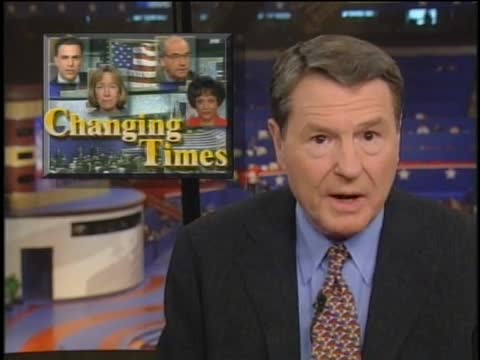
FOCUS - CHANGING TIMES
JIM LEHRER: Moving now to some overview perspective on this and other political conventions, and to Ray Suarez.
RAY SUAREZ: We get that overview from NewsHour regulars: Presidential historians Doris Kearns Goodwin and Michael Beschloss, and author and journalist Haynes Johnson. Joining them tonight and throughout our convention coverage is Kay James, a senior fellow at the Heritage Foundation and director of its citizenship project. She's a Bush delegate from Virginia, where she was dean of the Robertson school of government at Regent University. Well, we're all here. Around this table. And...
HAYNES JOHNSON: It's wonderful to be here, but you know, it was wonderful to hear terry use the that little lead in about 52 years ago in this city. And you saw Tom Dewey through a little black box. This is where it all began. That was the last convention that had more than one ballot to nominate anybody. Since then, Republicans have been all these years since, and the television, what we just heard, is played out on that. It's a very different party now. That was an eastern party. Tom Dewey, the Midwestern party. And this is now a much more culturally conservative party, that is, as Tommy Thompson said earlier, it's got a new tone and a new direction. And that's the message of the convention.
RAY SUAREZ: Agree, Doris?
DORIS KEARNS GOODWIN: No question that I think the Republican Party is trying to give a new tone to its whole face right now, if you give a tone to a face. Without a question, I think that the Houston convention in 1992 served to frighten Republicans just as the Chicago convention in 1968 frightened the democrats. So there's no Pat Buchanan speaking here today about a cultural war. I mean, I look back at that speech, and it's astounding that he was allowed to give such a speech like that when a party's hope in a convention is to have a big tent. And he's talking about mobs in Los Angeles, made up of Blacks and Hispanics. It's our country and we're going to take it back from then in a certain sense. Marilyn Quayle giving an angry speech about women who were careerists rather than just raising children. Now, you're not going to see that here. There's a real attempt to make the Republican Party seem more inclusive, and I think George Bush, having been a governor, knows that real problems take public resources to solve. So he's more pragmatic.
RAY SUAREZ: But aren't we talking more about tone and appearance than the actual party? Kay James?
KAY JAMES: I don't think you are at all. You know, it's interesting to me that as people talk about this great shift in the Republican party and what we're attributing that to, George Bush and one of the reasons I think you're seeing the level of excitement and anticipation around the country surrounding his candidacy, is that he is articulating what many Republicans have felt for a long time, and this is that being conservative and being compassionate is not in fact an oxymoron. And what he's doing is putting a face on and a voice to thousands, millions of Republicans and thousands of delegates who are here who want to bring those two together. And I thought it was quite interesting in listening to some of the commentary coming up to this saying there are no real cultural conservatives speaking at this convention. Where are they? And as far as I'm concerned, the most eloquent and outspoken spokesperson for that point of view in our party today is George Bush, and he will have prime time.
MICHAEL BESCHLOSS: Yes, he will have prime time, but in a way he's swimming against the tide of history, because this is a guy who is saying, I want this party to be a more centrist party that than it sure seemed in 1992, that convention that Doris was talking about in Houston. But think of the recent efforts by Republican nominees to make this party a moderate one, Dwight Eisenhower wanted moderate Republicanism in the 1950's. He wanted to accept the new deal and basically say, we'll accept things like Social Security, but we Republicans can administer those things better. Richard Nixon in 1968 said, let's take the party back from Barry Goldwater and the conservatives. Let's make this is a centrist majority. George Bush the elder in 1988 would have absolutely loved to make this a Bush Republican Party, not a Pat Buchanan party, but someone... a party that, yes, was in favor of free enterprise, but also concerned about the education, about education and the environment. And what happened? If you look at every single one of those events, they all met with a very bad end? Goldwater reversed the tide of Eisenhower in 1976 and 1980. Ronald Reagan basically said that Nixon had taken the party much too much to the center and then of course George Bush in 1992 had to deal with Pat Buchanan, which cost him the election. If George W. Bush succeeds in doing this, he'll have been able to do what no Republican nominee has done for a half century.
DORIS KEARNS GOODWIN: You know, an interesting thing is part of the reason why it's been so hard to make the party seem more moderate and be more moderate is that the primary system rewards the purists, the ideologues, the single-issue activists.
HAYNES JOHNSON: On both sides.
DORIS KEARNS GOODWIN: On both sides, so that the people who have gotten the nomination so far have tended to have to prove their conservative credentials. We saw that with George Bush during this primary system when he went to Bob Jones. So even as now he tries to project a more moderate image, people will remember he did something earlier that was counter to all of that.
HAYNES JOHNSON: No question if you look at the Republican Party that we're seeing right here in this hall that this is a conservative party, as everybody has said. It is a party that does not reflect the population of the United States. It's largely white, male. 83% of this is white. African are 4% I believe.
KAY JAMES: Well, it depends on which poll you look at.
HAYNES JOHNSON: Well, I mean, these are the delegates who have been polled themselves.
KAY JAMES: Well, I am a delegate. I was not polled.
HAYNES JOHNSON: Well...
KAY JAMES: I'm an African American female.
HAYNES JOHNSON: Well, what do you think the margin is...
KAY JAMES: I really don't know. There are four African Americans in the Virginia delegation. I polled them today. Somehow we keep missing those polls.
RAY SUAREZ: Well, Haynes started us off with Tom Dewey in a little box, that is primitive television -- in 1948. You mentioned that theparty was eastern. But the country was eastern. And hasn't the Republican Party had to mirror the shifts in the United States, the rise of the west, the joining of the new south to the Republican party?
HAYNES JOHNSON: Ray, the shift between them, 1948 and now. Think about it then. Franklin Roosevelt, the Democratic Party had been this office since 19 32. Without fail, they won all those presidential election year after year. They had the solid South. Now the Republican Party has had the solid South. You've had an enormous shift in the way... away from the old base of what was the Republican Party to this new party that is now we're seeing gathered before. They want to win. That's what this is all about. Hungry to win...
DORIS KEARNS GOODWIN: You know, the interesting thing is that shift toward the solid South becoming Republican instead of democratic occurred with the passage of the Civil Rights Act. When Lyndon Johnson signed the Civil Rights Act of 1964, ending segregation legally in the south, he predicted that the Democratic Party would lose for a generation in t e south. It opened the door to the Republicans. Then demographics meant more people were in the South, more money was in the South. So what used to be the liberal establishment in the East was overwhelmed by the South and it became the new base of the party.
RAY SUAREZ: So what are we looking at now, a suburban party, a party that represents a non-urban, non-farm new America?
KAY JAMES: I don't think that's what you're looking at at all, and I know that the convention planners have worked very hard, as well they should, to display what's happening in the Republican Party at the grassroots level all over this country. I remember the days when we used to hold meetings of black Republicans and the four of us would get together. Well, now we need a stadium, and I'm sure by the time we get together for the next convention it will be impossible for the media to overlook us, because we'll be everywhere and so I really don't blame the convention planners for trying to highlight those individuals and to showcase them, as well they should. African Americans, women, Hispanics, it's long overdue -- they have long been attracted to the Republican Party, and they're making their way through the party hierarchy and taking leadership roles and positions, as well they should.
HAYNES JOHNSON: -- doing books on Abraham Lincoln - and this was the party of Lincoln. I mean, this was the party that African Americans, citizen, they voted for Republicans and then shifted to the New Deal. Now maybe they're up for grabs again.
KAY JAMES: I think so. You remember, I'm a southern African American. So for me, to have the Republican Party vilified void as racist or anti-women is absolutely hysterical, because I remember the Democrats that stood in the schoolhouse doors, and I remember that they were in fact racist. They were in both parties. I don't think either party has a corner on that. It's time we move far beyond that and judge people on the basis of their ideas and vilifying parties as being parties... It just doesn't serve any real purpose or contribute to the dialogue.
MICHAEL BESCHLOSS: But I think the real question that we'll know a lot more about the answer to by the end of this week is, is this just an effort to put on a superficial happy face, a moderate face on a party that really is conservative, or are these people who are saying, yes, we tried the way of Newt Gingrich, it didn't work? We really have begun to look at, to use a term that these people on the floor would loathe because it's a Bill Clinton term, a third way -- a conservatism that does make a bow toward issues that are interesting to Democrats, like health, education and the environment.
DORIS KEARNS GOODWIN: And when you look at the platform, it still is predominantly a conservative platform, although George Bush is broken on education. No longer do they talk about abolishing the Department of Education because he wants to use public resources to make education better. It's gotten softer on immigration. They were really tough in those previous platforms against immigrants and people coming into the country, and hopefully it reflects a substantive change, as well.
RAY SUAREZ: Well, we'll be hearing from you all for the rest of the week. We've made a good start. Thank you.
FOCUS - TAKING TO THE STREETS
JIM LEHRER: This Republican convention, like all political conventions, is also generating protests and other events outside the convention hall. Kwame Holman has our report on what happened on that front today.
PROTESTORS: Hey, hey, ho, ho, it's got to go.
KWAME HOLMAN: This morning protesters began to protest for the first of the week's major demonstrations. Marchers from across the country chose economic equality and an end to homelessness as the theme for day one. Negotiations between protesters and the City of Philadelphia had failed to produce an agreement that would allow a march down the city's main north-south thoroughfare, Broad Street. As things stood, police were prepared to arrest anyone who stepped off the sidewalk. As they said they would, marchers attempted to enter Broad Street and walk the three and a half miles to the First Union Center, site of the Republican National Convention. In a surprising response, Philadelphia police retreated.
PROTESTER: I thought that maybe they would let us go a few blocks and then try to block it, but they really assisted all the way along with traffic and everything else.
KWAME HOLMAN: But in fact, police let the march continue for more than two miles, assisting with traffic control along the way. Activists like Mary Ann Baker stayed focused on the message as she walked.
MARY ANN BAKER: We want to get the message across that there should be universal health care for all. There should not be people living on the streets, this is the richest country in the world. Why should we have poor?
KWAME HOLMAN: Today's crowd was small compared to yesterday, when more than 5,000 marched from downtown, along Benjamin Franklin Parkway, in a city-approved demonstration. The theme was unity 2000, as demonstrators voiced opposition to a nuclear missile defense system, the death penalty, and the Republican conventioneers' recently adopted anti-abortion platform. No arrests have been made so far this week, and Philadelphia Police Commissioner John Timoney says there's no reason that has to change.
JOHN TIMONEY: Arrest for us is a last resort. We're looking to bend over backwards to see if we can't facilitate some kind of a compromise. However, some people don't compromise. They don't want to... Some actually don't even want to meet with us. We'll kind of deal with them when we meet them. You know, it's... We have been quite clear in our message to demonstrators, everybody's welcome. Please don't engage in violence or serious property damage. We can live with almost everything else.
KWAME HOLMAN: As for today's unapproved march, Timoney's officers diverted it to a park well away from where Republican delegates were meeting, and marchers complied. Police officials said they decided to allow the partial demonstration after discussions with leaders among the activists, but protesters say there are more unsanctioned events as the week goes on.
FOCUS - POLITICAL WRAP
JIM LEHRER: Now, summary words from shields and gigot: Syndicated columnist mark shields and "wall street journal" columnist Paul gigot. The bottom line, Paul, is that what would constitute a successful convention for the Republican party and George W. Bush?
PAUL GIGOT: If George W. Bush can make majority of the American people comfortable with the idea of him as President of the United States. If you read the polls, the voters, giving him a lead, 5% to 6% in almost every poll, sometimes more, but roughly that, they're saying they're prepared to make a change from the party in the White House. Al Gore, they know him somewhat. They don't much like him. He can't seem to pop above the low 40's in the polls, but they haven't quite... George W. Bush hasn't quite sealed the deal yet as the man who could replace him. He has to make them comfortable with him as a man, with his character and leadership ability, and then substantively show them that this is not just all cosmetic. There's also some ideas here and things he would do as president.
JIM LEHRER: Mark?
MARK SHIELDS: I would agree with Paul. I would say that in addition there can be no strident pessimism. There can be no negative message coming out of this. It has to be a smirk-free zone for George W. Bush. He cannot... There can't be in body language or appearance, there can't be that sense of sort of self-congratulatory or self-satisfaction. I would add to that, Jim, the statement made by Carl Rove, Bush's campaign strategist this morning at the breakfast with reporters, in which he pointed out that the Republicans, this has been the easy part up until now. George W. Bush as this point has consolidated the Republican base, and that this convention is about talking to the American people. The top record in the history of American politics of any person nominated with was Ronald Reagan getting 94% of the Republicans, who voted for him on election day, which is unprecedented. George Bush now is at 89% of Republicans in the Bush zone. It's just really unprecedented, especially for this stage. And now they've got to understand, they're not going to get the bounce from Republicans. They've got to reach out to other voters.
JIM LEHRER: So they're going with... Go ahead. Sorry.
PAUL GIGOT: What Mark talks about is correct, and it's a huge strategic advantage because it means they he can use this convention, use his speech to reach out to that broad middle. He doesn't have to do with Bob Dole did in 1996 and his father had to do in 1992, which is use the convention to mobilize the base. They're mobilized.
JIM LEHRER: It will be a great show. So the Bush people have bought into the conventional, historical wisdom that this is the time that the great majority of the electorate starts paying attention. These conventions, right?
PAUL GIGOT: I wouldn't say starts paying attention, but really takes a big focus. The campaign thing has three big challenges, and people will tune in, in a more than cursory way. One was the vice presidential choice. George W. Bush passed. The third will be the debates. Those are the come in the fall -- the second is this week, and in particular... the overall message that's sent by the convention, in particular, the acceptance speech on Thursday.
JIM LEHRER: Do you agree that Bush has passed the vice presidential thing? There's been an awful lot of stuff about Cheney's record. How do you read that now?
MARK SHIELDS: I don't think they've passed it. I have one thing based upon what Paul said. Margaret's - Margaret Warner's interview with Olympia Snowe and Gary Bauer and Vin Weber. Gary Bauer said you can't build lasting political movement on opposition to government. And boy, I think that was... that turned out to be prophetic.
JIM LEHRER: Who said that?
MARK SHIELDS: Gary Bauer said that ten years ago in 1990. This is not an anti-government Republican Party. I think that's an posh thing to understand. I think that's been George Bush's...
JIM LEHRER: Do you think that's real? Do you think it's tone?
MARK SHIELDS: I think more in the tone. I think it's more than tone. Let's abolish the Department of Education, that's gone. I think it's there in substance. When they say... George Bush's spokesman said to me at the platform committee hearings, we believe that government... Federal government can play an effective role in education. That's a difference, Jim.
JIM LEHRER: Come back to Cheney in a minute. Let's stay on this for a second, Paul. The discussions we've heard beginning with the interview with Tommy Thompson and everything that's come up until now, where do you come down on this? Is the party really changed in your opinion?
PAUL GIGOT: I do think so.
JIM LEHRER: You do?
PAUL GIGOT: Yeah, I do. I think... It's... For 30 years in this country, conservatism defined itself by what it was against. It was against the evil empire, against the New Deal, it was against the great society. It was rolling those things back. I think what happened... The shock of winning the Congress finally in 1994 and then coming up so short in 1996 and having Bill Clinton define the party, fairly or unfairly in many ways in my view - but define the party as extreme was a shock to the Republican Party. And it said that we can no longer succeed, I think it taught a lot of Republicans, particularly the governors, we can no longer succeed as an insurgent conservatism. We have to show what we're for, and we have to address problems on issues we haven't been effectively addressing in the past, Social Security, health care, education. That is what Bush has done. This is not a, the tax cut, crime and welfare platform.
JIM LEHRER: So it's real?
PAUL GIGOT: I think it's real.
MARK SHIELDS: I'm not sure it's real. I think Paul's right. They are addressing them. I'm not sure the solutions or the programs are real. But that's right. That's exactly right. Where there's a dominant emotion in this city among these 4,000 delegates and alternates is the great maximum Chicago City politics, which is don't make waves and don't back losers. They're not making waves, and they think they're backing a winner.
JIM LEHRER: Cheney -- let's pick up on Cheney. You were about to answer.
MARK SHIELDS: I think it was the first false start from the Bush folks. What really had to upset them is the democrats were quicker off the mark on Dick Cheney than they were. The democrats were there with the charges and specifics on his record. It took them two, three days, prying out answers and back peddling, tweak the record, backing off that. Yes, different times I would vote differently now. Yes, Governor Bush does make a case. I'd were for child locks for guns. I don't think Dick Cheney has been sure footed. Now, what works for Dick Cheney is that the persona, the public persona is not that of Newt Gingrich. Give them Newt Gingrich's voting record, but you can't give them Newt Gingrich's personality.
PAUL GIGOT: I think Mark is making tacticalpoints. He's right, Cheney hasn't been as sure-footed. But in the end, it doesn't matter. I don't think... The LA Times poll showed that 20% of the public said they were more likely to vote for Bush because of Cheney, only so 10% said they were less likely to vote for him. 53/15, people have a favorable view of Cheney. I think that's one of the reasons that the Democrats came out so hard to try to define him because they see that that was a choice that was actually helping Bush.
MARK SHIELDS: I don't think -- I'll tell you what... why the Democrats did what they did. This is a race for the middle. We're seeing two parties rushing for the middle. The George W. Bush campaign is the Bill Clinton campaign of 1992. He's following the same route to the convention -
JIM LEHRER: They're just coming from a different direction.
MARK SHIELDS: -- all the same thing. And what the Democrats are saying to say was look -- this guy says he's a middle fellow, but look, his first choice, the first guy he chose has a voting record the right of Dick Armey and Newt Gingrich. Do you really think he is this new Republican?
PAUL GIGOT: It's not going to work because he's not - it's not true. Dick Cheney is a moderate man -
JIM LEHRER: A moderate personality.
PAUL GIGOT: A moderate personality. And his voting record of 1985 is not relevant to running in 2000.
JIM LEHRER: Before we leave this, you both mentioned Newt Gingrich. I read a wire story this afternoon that pointed out the dramatic fall of this man. He's around in one of these sky booths as an analyst for Fox Television News, and, remember, just four years ago, he was almost as popular - in fact, more powerful than the presidential nominee, Bob Dole. And that's - isn't that why they're trying to put Newt Gingrich around Dick Cheney?
PAUL GIGOT: I think that's one reason. The First Lady today attacked her opponent, Rick Lazio, saying, he sounds like a moderate but he was really Newt Gingrich's deputy whip. You know, any attachment they can make. The Democrats ran against Herbert Hoover for 20 years. They're going to try to run against Newt Gingrich for another 20.
JIM LEHRER: It's amazing how quickly things change.
MARK SHIELDS: It is. It's interesting that Dick Cheney's voting record in 1985 isn't important but Al Gore's from 1975 is -- having said that, Newt Gingrich will not be on the platform. Tom DeLay will not be on the platform. Pat Robertson will not be on the platform. They've just kept everybody. They've muted all the controversial figures. They're not getting anywhere near a microphone.
JIM LEHRER: Does that bother you, Paul?
PAUL GIGOT: No. Those figures, no. I'll tell you what bothers me is that Henry Hyde is not going to be on the platform.
JIM LEHRER: That would have brought up the Clinton impeachment...
PAUL GIGOT: Jim Rogan, the impeachment managers. They didn't have to get up and talk about impeachment at all. I'm talking primetime. All they had to do was walk up there, and this place would have gone crazy. I think that would have been something that...
JIM LEHRER: Why would they decide they... They don't want to have that image? They don't want to be the impeachment party?
PAUL GIGOT: Their view of Washington is that we're trying to transcend the fights here. We're not trying to pick sides. They want to come in over the top of everybody, and they don't want to be on either side.
MARK SHIELDS: George W. Bush, this is George Bush's convention, this is not a Republican convention. This is not to rehabilitate and redeem the Republican Congress.
JIM LEHRER: Okay. We have to go. Thank you. See you later.
NEWS SUMMARY
JIM LEHRER: In non-convention news, passengers on a British airways Concorde had a scare Sunday. Their jet lost speed and began to reek of fuel on a flight from London to New York. It made an emergency landing in Canada, and was grounded for safety checks. And on Saturday, a Concorde flying from New York to London had an engine problem. It landed in London without a problem. The incidents came just days after an Air France Concorde crashed outside Paris. Investigators today focused on the possibility that the jet had a major fuel leak. We have a report from Lawrence McGinty of Independent Television News.
LAWRENCE McGINTY: British airways Concorde flight to New York from Heathrow attracted more than the usual attention. Unlike Air France, the Concorde fleet hasn't been grounded -- despite last Tuesday's crash and the catalog of minor glitches since. Investigators sifting through wreckage and r now saying the port side engines were not the source of the dramatic fire seen by eyewitnesses. The fire, which started even before the Air France Concorde took off, originated in the fuel tanks to the left of the two port engine parts. It is still not clear what ruptured the tanks, spilling fuel that fed the spectacular fire. Publicly investigators have not ruled out an engine failure, hurling parts through the tanks. But attention seems to be focus focusing on the possibility of a burst tire. Debris the blowout could have pierced the fuel tanks. French and British investigators are today meeting engineers from the airlines and Rolls Royce, the engine makers. The technical cause of the disaster might then be clearer.
JIM LEHRER: And the death toll from the crash was lowered today by one, to 113. French officials blamed a mix-up in registering the bodies. Israeli Prime Minister Barak survived a no-confidence vote in parliament today. It was the second time in a month that he faced such a vote. Opponents accused him of making too many concessions to Palestinians at the failed Camp David summit. Barak lost his majority in parliament when some of his coalition partners quit the government just before the summit. Venezuelans celebrated in the streets today after President Hugo Chavez won reelection. Partial results showed he took nearly 60% of the vote on Sunday. He's governed on a program of social revolution aimed at dismantling the country's old political order, but wealthy Venezuelans charge he's hurt the country's economy. We'll be back on most PBS stations at 8:00 PM Eastern Time with our complete coverage of the opening night of the Republican National Convention, and we'll return at our regular NewsHour time tomorrow, as well as being with you throughout the convention online. For now, I'm Jim Lehrer. Thank you, and good night.
- Series
- The NewsHour with Jim Lehrer
- Producing Organization
- NewsHour Productions
- Contributing Organization
- NewsHour Productions (Washington, District of Columbia)
- AAPB ID
- cpb-aacip/507-g73707xd24
If you have more information about this item than what is given here, or if you have concerns about this record, we want to know! Contact us, indicating the AAPB ID (cpb-aacip/507-g73707xd24).
- Description
- Episode Description
- This episode's headline: Party Profile; Party Profile; Unconventional Coverage; Taking to the Streets; Political Wrap. ANCHOR: JIM LEHRER; GUESTS: GOV. TOMMY THOMPSON; GARY BAUER; SEN. OLYMPIA SNOWE; FORMER REP. VIN WEBER; KAY JAMES; HAYNES JOHNSON; MICHAEL BESCHLOSS; DORIS KEARNS GOODWIN; MARK SHIELDS; PAUL GIGOT; CORRESPONDENTS: FRED DE SAM LAZARO; BETTY ANN BOWSER; SUSAN DENTZER; RAY SUAREZ; SPENCER MICHELS; MARGARET WARNER; GWEN IFILL; TERENCE SMITH; KWAME HOLMAN
- Date
- 2000-07-31
- Asset type
- Episode
- Rights
- Copyright NewsHour Productions, LLC. Licensed under a Creative Commons Attribution-NonCommercial-NoDerivatives 4.0 International Public License (https://creativecommons.org/licenses/by-nc-nd/4.0/legalcode)
- Media type
- Moving Image
- Duration
- 01:04:07
- Credits
-
-
Producing Organization:
NewsHour Productions
- AAPB Contributor Holdings
-
NewsHour Productions
Identifier: NH-6821 (NH Show Code)
Format: Betacam
Generation: Preservation
Duration: 01:00:00;00
If you have a copy of this asset and would like us to add it to our catalog, please contact us.
- Citations
- Chicago: “The NewsHour with Jim Lehrer,” 2000-07-31, NewsHour Productions, American Archive of Public Broadcasting (GBH and the Library of Congress), Boston, MA and Washington, DC, accessed May 9, 2026, http://americanarchive.org/catalog/cpb-aacip-507-g73707xd24.
- MLA: “The NewsHour with Jim Lehrer.” 2000-07-31. NewsHour Productions, American Archive of Public Broadcasting (GBH and the Library of Congress), Boston, MA and Washington, DC. Web. May 9, 2026. <http://americanarchive.org/catalog/cpb-aacip-507-g73707xd24>.
- APA: The NewsHour with Jim Lehrer. Boston, MA: NewsHour Productions, American Archive of Public Broadcasting (GBH and the Library of Congress), Boston, MA and Washington, DC. Retrieved from http://americanarchive.org/catalog/cpb-aacip-507-g73707xd24