The MacNeil/Lehrer NewsHour
- Transcript
MS. HUNTER-GAULT: Good evening. I'm Charlayne Hunter-Gault in New York.
MR. LEHRER: And I'm Jim Lehrer in Washington. After our summary of the news this Thursday, we look at the coming of the Michelangelo computer virus, the impact of Pentagon budget cuts on people in uniform, the end of the latest round of Middle East peace talks, and the going of Presidential candidate Bob Kerrey. NEWS SUMMARY
MR. LEHRER: Bob Kerrey dropped out of the 1992 race for President today. The Democratic Senator from Nebraska had won only one primary in South Dakota. He won none of last Tuesday's primaries and caucuses. He made his withdrawal statement in Washington this morning.
SEN. BOB KERREY, [D] Nebraska: While we have plenty of potential and plenty of enthusiasm, unfortunately we do not have plenty of money. So it is with regret, but with great pride for all that we have done together that I am here this morning to end my candidacy for President of the United States of America. But make no mistake, this is no retreat, in Bruce Springsteen's words. This is no retreat and this is no surrender. For me, the fight simply is going to move on to new arenas. [applause]
MR. LEHRER: We'll have a fuller excerpt from the Kerrey news conference later in the program. His departure leaves a field of four major Democratic candidates, Bill Clinton, Paul Tsongas, Jerry Brown, and Tom Harkin. They will debate in Dallas tonight on ABC Television. It's their last joint appearance before next Tuesday's primaries in 11 states. President Bush campaigned in two of those primary states today. In Columbia, South Carolina, he attacked his challenger, Pat Buchanan. Though not by name, he said Buchanan's "America first" philosophy was protectionist, isolationist, and amounted to surrender. In Oklahoma City, Buchanan kept up his criticism of Mr. Bush on foreign aid and trade. He called for U.S. officials to stop being trade wimps. Charlayne.
MS. HUNTER-GAULT: Nineteen members of Congress who repeatedly wrote bad checks will be publicly identified under a plan proposed today by the House Ethics Committee. The Committee has been investigating charges that members routinely bounce checks on accounts at a bank run by the House of Representatives. The bank charged no fees for the over drafts. The full House must now vote on the proposal to disclose the 19 most flagrant violators. Four members of the Ethics Committee dissented in today's action. They said they would offer a counter proposal to identify as many as 355 current and former House members who had bounced checks.
REP. JON KYL, [R] Arizona: One of the members of the committee said simply this does not pass the smell test. And I suggest that the American people will not believe that the majority report is a sufficient response to a problem of a House of Representatives that has had scandal after scandal after scandal in the last several years. We've got to come clean. And that's why I believe that it's important for this body to release the names and an amount of information that is sufficient to convey the magnitude of the problem.
MS. HUNTER-GAULT: Wall Street took a tumble today. Analysts said traders unloaded stocks in anticipation of tomorrow's government report on unemployment. At the final bell, the Dow Jones Average was down 27 points on heavy volume. In the broader market, losing stocks outnumbered gainers by a 3 to 1 margin.
MR. LEHRER: Britain sent a warning to Iraq today: Destroy weapons of mass destruction or face a military strike. Foreign Secretary Douglas Hurd issued that warning. He said Britain and its Gulf War allies had stepped up pressure on Iraq to force it to comply with the terms of the United Nations cease-fire. The U.N. Human Rights Commission also had harsh words for Iraq today. It voted overwhelmingly to condemn what it called massive and great human rights abuses by Iraq. Those abuses included torture and mass executions.
MS. HUNTER-GAULT: The South African government has agreed for the first time to support the appointment of blacks to cabinet posts. The breakthrough came at power sharing talks between black and white political groups. The talks are a part of a historic three- month-old forum called CODESA, or Convention for a Democratic South Africa. Jeremy Thompson of Independent Television News reports from Johannesburg.
MR. THOMPSON: The idea of President F.W. DeKlerk sharing power with black leaders like Nelson Mandela of the ANC and Inkatha's Mangu Suthu Buthelezi is now one step nearer reality. CODESA, the multiparty forum negotiating constitutional change, has reached broad agreement on the appointment of an interim council, including blacks and whites. The government's plan is for its existing cabinet to coopt black members as part of a transitional authority, clearly allowing white leaders to retain control.
BAREND DU PLESSIS, Finance Minister, South Africa: The thrust of the document is that it be suggested to the principals that they also agree that this new executive be appointed and not elected.
MR. THOMPSON: But there is still disagreement. The ANC, who want a new independent executive body, are accusing the government of misinterpreting the deal.
CYRIL RAMAPHOSA, ANC Spokesman: Are now putting out to the world that people are going to be brought into the present cabinet to form a super cabinet that'll take responsibility for the running of the country. That is simply not the approach of the ANC.
MR. THOMPSON: The right wing conservative party is sure to exploit the CODESA resolution as a sign of the government's willingness to sell out whites and surrender power to black rule. The CODESA agreement is an important breakthrough, though there will be plenty of tough bargaining in the weeks ahead before the government and its black opponents finally settle their differences on precisely how and when to end white minority rule.
MS. HUNTER-GAULT: Ethnic fighting continued today in the former Soviet Republic of Azerbaijan. Twelve people were reported killed overnight in the disputed enclave of Nagorno-Karabakh. Its mostly Armenian population is fighting Muslim Azerbaijan for control of the territory. A prosecutor investigating the mass killing there today said 200 Azerbaijani bodies had been recovered. He also said Armenian militants are holding hundreds of women and children hostage. The U.S. today announced an increase in aid to the Baltic states. Agriculture Secretary Edward Madigan said Lithuania, Latvia, and Estonia would each get $5 million in new food aid. Last month, the U.S. airlifted humanitarian aid to 11 former Soviet republics to help them avoid winter food shortages.
MR. LEHRER: Two suspected Irish Republican Army bombs exploded in Northern Ireland today. One outside Belfast injured seven people, including five policemen. The second went off in Central Belfast. It damaged buildings, but caused no casualties. A coal mine in Turkey was sealed today. Officials said there was no hope for nearly 150 miners trapped inside by an explosion. Officials said fires were still burning inside the mine and it had to be sealed to prevent another blast. One hundred and twenty-two bodies were recovered after the Tuesday methane gas explosion.
MS. HUNTER-GAULT: The United States has agreed to give at least $3 million in humanitarian aid to Vietnam. The assistance was announced today by Assistant Secretary of State Richard Solomon after meeting with Vietnam's foreign minister in Hanoi. Solomon said the U.S. had approved the aid after the Vietnamese offered new ideas on resolving the issue of Americans still missing from the Vietnam War. A Vietnam official said his country appreciated the U.S. aid but called on the U.S. to lift its trade embargo against Vietnam. That's it for the News Summary. Still ahead, the Michelangelo computer virus, hard times for the troops, the latest round of Arab-Israeli peace talks and Bob Kerrey bows out. FOCUS - TERMINAL CONDITION
MR. LEHRER: Tomorrow is the 517th birthday of Michelangelo, one of the greatest artists of all time. That obscure fact is a key element to our strange lead story tonight, because when the clock strikes midnight a few hours from now, computers around the country, no one knows for sure how many, will be struck by a virus named for Michelangelo. The result could be some serious havoc for a nation grown fully dependent on the computer. What's it all about? We begin with a backgrounder by Kwame Holman.
MR. HOLMAN: Personal computers have revolutionized the office, the home, the factory, and even retail selling. This successful bookstore in Washington, D.C., increasingly has relied on its computers. Barbara Meade is co-owner.
BARBARA MEADE, Bookstore Owner: We have seven computers here that we're totally dependent upon for our inventory and it's amazing the number of times that a customer will say at the register I wanted you just to know that this was the last copy on the shelf. What that customer doesn't know is that I can see the whole sales history of the book and at that point I make a decision of whether to reorder the book, of where to reorder the book, but I had never heard of a Michelangelo virus until two days ago when I saw it on a television news show. And at that time I thought, well, thank heavens that couldn't happen to me.
MR. HOLMAN: But as Meade later learned, it could happen to her. That's because the personal computers in her store, like an estimated 60 million others worldwide, are of a type known as "IBM compatible." That means they are all susceptible to having the data in them destroyed by the so-called "Michelangelo computer virus." It lies dormant in an unknown number of PCs, waiting to be triggered by the arrival of March 6th, the birth date of the 14th century artist.
DENNIS STEINAUER, National Institute of Standards: It's very similar to the process of a biological virus, which attaches itself to a cell or some other part of a living organism and goes along with it.
MR. HOLMAN: Dennis Steinauer is a computer security specialist for the federal government.
DENNIS STENAUER: It's one of now several hundred varieties of viruses that specifically not only makes copies of itself, it makes copies of itself on diskettes that may be put into an infected machine and then it has what we call a trigger. It's designed so that on March 6th it will do something in addition to making copies of itself. And in this case what it does is it writes over the hard disk of the machine that it is on. And so it will go through and trash the disk. You know, it doesn't physically destroy it, but it for all practical purposes, the data on that disk will be lost. It's next to impossible to recover, from what we can tell.
MR. HOLMAN: Meade says she made extra copies or back-ups of her computer files three times a week, but losing even a couple of days' worth of data would be a major inconvenience.
MS. MEADE: It would mean that our bookkeeper would have to spend a number of days of reconstructing the financial information, but then all the rest of the 12 people who work here would have to spend a lot of time working with all the invoices that had come in, packing slips that had come in since then, and manually entering these into the system. It would be a nightmare.
MARIANNE SWANSON, Computer Scientist: We have a whole area on alerts, computer security alerts. The Michelangelo and that fact sheet is listed in there under Alert 25. We have another file, I believe we're calling it, let's get to it again, let's see, here we go, Heads Up. There is the virus warning. We have it discovered in this system. We have another one here. So we have quite a bit of places where it's been discovered and we post those as well.
MR. HOLMAN: The Michelangelo virus, first discovered a year ago, has been a preoccupation this week for the computer security specialists at the federal government's Institute of Standards & Technology. Steinauer, head of the computer security division, says Michelangelo is similar to hundreds of other known computer viruses, but with some alarming differences.
DENNIS STEINAUER, National Institute of Standards: Viruses are usually spread by taking an infected disk from one machine and using it in another machine. And that doesn't normally occur on a widespread basis very quickly. It appears that the Michelangelo Virus has been inadvertently distributed by a number of vendors of both hardware and software in their products, either in the software of the products or in one case a computer manufacturer had distributed a number of copies or issues of his hardware, their hardware, that had the virus already "preinstalled," if you will. In the past, we tended to worry about stuff that we got off bulletin boards and people sharing disks. Now we have to think a little bit more about, well, maybe even right out of the box that thing isn't safe.
MR. HOLMAN: The highly publicized Michelangelo Virus is one of only a few computer viruses to be found already in brand new machines. The furor has made computer store owner Sam Zarafshar change the way he does business.
SAM ZARAFSHAR, Computer Store Owner: In the past two days we've had a couple of people doing nothing except checking every computer we have in our offices for Michelangelo Virus. So we lose time and we lose money.
MR. HOLMAN: On the other hand, Zarafshar and other computer dealers are experiencing record sales, even selling out of computer programs that detect Michelangelo and other viruses. Michelangelo has been detected and removed from thousands of PCs throughout business and industry. Steinauer and other experts say PC users should make back-up copies of the information in their files and scan their computers for the presence of the virus. Book seller Meade said she planned to have all her computers scanned today. But without such precautions, experts advise IBM PC users to consider celebrating Michelangelo's birthday tomorrow by taking a day off from the computer.
MR. LEHRER: Now a further look at Michelangelo and computer viruses. Charles Rutstein is a staff researcher with the National Computer Security Association which tracks computer viruses and anti-virus products. He wrote a book called "The Executive Guide to Computer Viruses." He's a sophomore at Hobart College. He joins us from Syracuse. Mark Rasch is a former Justice Department lawyer who prosecuted the case of Robert Morris, who was convicted in 1990 of using a computer virus to cripple a national computer network. Mr. Rasch is now an associate at the Washington law firm of Arent Fox. He joins us tonight from Denver. Mr. John McAfee is president of McAfee & Associates, a supplier of anti-virus products. He's also chairman of the Computer Virus Industry Association which represents software manufacturers. He joins us tonight from Cupertino, California. First, to you, Mr. McAfee, what is the potential for havoc from this thing? I mean, everybody said it could do this, it could do that. How do you read what it could do?
MR. McAFEE: Well, we know that on the 6th of March if you are infected with this virus it will destroy all of the data in your hard disk. The question is how many systems are infected. Estimates range anywhere from 50,000 to 5 million. Depending upon the number and depending upon the number that is still infected by tomorrow, the havoc could be substantial.
MR. LEHRER: But you don't have, there's no way to know how many have been infected?
MR. McAFEE: Well, it depends on who you talk to. We've done surveys of customers and we estimate about 1 percent of all PC's have this virus. Dataquest, a division of Dunn & Brad street did a study in January and they said 15 percent. I think the NCSA says one in a thousand. So it's --
MR. LEHRER: What's the NCSA?
MR. McAFEE: The National Computer Security Association.
MR. LEHRER: I see.
MR. McAFEE: So it depends on who you believe and who you listen to. But even the smallest estimates -- let's assume that only one in one thousand computers were infected -- that's sixty thousand computers worldwide, and at an estimate of five hundred to a thousand dollars for each one to recover, we're still talking sixty million dollars at the very low end in terms of what it will cost.
MR. LEHRER: Mr. Rutstein, anything you want to add or subtract to that as far as the impact of this?
MR. RUTSTEIN: Yes. I think our estimates are actually significantly lower than that. Current estimates for virus infections by Michelangelo in the U.S. are currently from our group around ten to twenty thousand. And we also say that it probably won't be as expensive as Mr. McAfee says. Under certain circumstances when they are infected, it may not cost a million dollars to clean up. So we think there will be fewer infections costing less.
MR. LEHRER: Well, now when you say system, what do you mean? Are you talking about individual personal computers?
MR. RUTSTEIN: Yes.
MR. LEHRER: IBM compatible computers?
MR. RUTSTEIN: That's correct.
MR. LEHRER: So if it's a business that has, like say Mrs. Meade's bookstore that we just saw, where she has one computer system but several computers. You count that as one, right?
MR. RUTSTEIN: No, actually that would be counted as seven. Just because one computer out of sight is infected, a site being for example her bookstore. It doesn't mean that all the computers at that site will be infected. Some of the reports that we've gotten back today indicate that a very small percentage of the computers at various sites that were infected actually got the virus.
MR. LEHRER: Mr. Rutstein, why do you say it isn't cost, it's not going to be as expensive as Mr. McAfee says?
MR. RUTSTEIN: That's just based on our data from past infections of different viruses, viruses that are equally as destructive. We simply don't feel that it costs as much. Obviously, there's no way to quantify it exactly. It depends just who gets hit. If a doctor's office gets hit versus a bank or versus a small business, the costs will vary dramatically.
MR. LEHRER: Mr. McAfee, how, if somebody's listening to this now and just got the word say a few moments ago that there was a such thing as a Michelangelo Virus, and on the tape somebody said, well, you need to check your computer to find out whether or not you have it, how in the world do you do that?
MR. McAFEE: Well, in order to check your computer you need a specialized piece of software, a program that's specifically designed to scan the system looking for this virus. If it does find it, there are other specialized programs that can remove it and repair the damage. That's assuming you catch it before it activates. These programs are available free of charge on Compu Serve and many of the on-line networks. The problem at this late date is getting access to them. Compu Serve is completely overloaded from people trying to get these programs. You can't buy them in computer stores. So at this late date I would say the only advice we can give people is to either turn the computer off and don't use it on the 6th, or today, set the date to the 7th. What that will do is buy you time until you can scan the system to see if you're infected.
MR. LEHRER: Buy you time until next year at this time, is that right?
MR. McAFEE: Yes. You're still infected and every day you will still be infecting diskettes which may be passed to friends, relatives, your family, co-workers and so on. So you have to deal with the problem. But it will at least buy you time and will save you loss of all of your data.
MR. LEHRER: Mr. Rutstein, I don't want to get too technical on this, but how do, how does a computer, whether anybody's computer, know it's March 6th?
MR. McAFEE: The computer has an internal clock, Jim. Actually, it's got two internal clocks. And that's done so that you're able to track the changes in your files. For example, you know when certain documents were created using the computer, just a convenience feature really.
MR. LEHRER: And all computers have these things, there's nothing you can do -- but Mr. McAfee, you said you could move it ahead a day if you wanted to, right?
MR. McAFEE: That's correct. It's like a wristwatch. You can set it to any day or time that you wish and there's a very simple command in IBM computers that allow you to say date. Then it asks you what date you want it to be. You can then set it to the 7th. The virus then does not know that the 6th is really happening.
MR. LEHRER: I see. Mr. Rasch in Denver, is there some awful criminal out there who did this, who did this Michelangelo Virus, and should that person be found and prosecuted to the limits of the law, and, if so, what are the laws? That's eight questions all in one, Mr. Rash, sorry.
MR. RASCH: That's okay. It's tough to tell whether it's just one person or a group of individuals who did this. The odds are probably good that it's just one individual. Whether that person's a criminal is dictated by what the virus actually does. In this case, the virus destroys information and keeps people from using their computers. So to that extent, it's a crime. It's a violation of the federal computer fraud statute. And I think that that type of individual who's motivated by desire to destroy information should be caught and should be prosecuted.
MR. LEHRER: Have you, based on your experience prosecuting these kinds of cases, Mr. Rasch, what motivates somebody to do this? I mean, if it's a random thing that somebody planted this, one or more people planted this virus, what are they going to get out of it?
MR. RASCH: Well, there are a lot of motives that are potentially there for virus writers. The first is just pranksterism. People just want to see if it can be done. That's one of the problems is that the more security and the more attempts you make to prevent viruses from coming in, the more these virus writers see that as an opportunity to try to get around it.
MR. LEHRER: In other words, a challenge, you're putting a red flag up in front of them?
MR. RASCH: Absolutely. And they see that red flag and they try to get around it. Michelangelo is one example that went around the traditional ways of detecting viruses. And new virus detecting software had to be written to find Michelangelo. But viruses can be written for a lot of different reasons by a lot of different people. For example, one motive would be to sell anti-viral software. You could write a virus and get people worried about it so you could sell anti-viral software. Now, I want to emphasize that there isn't any indication that that's why this virus was written or that any virus has been written for that reason. But that's one motive. Another potential motive is to destroy a particular system. For example, there were news reports during the Persian Gulf War that indicated that the U.S. government had allowed computers to go to Iraq which had viruses in them and that the software that they allowed to go to Iraq had viruses which were intended to destroy the ability of the Iraqi government and the military specifically to have command and control over military operations. So there could be a lot of motives.
MR. LEHRER: For the record, that story has not been confirmed. U.S. News & World Report ran that story and then it's still a subject of debate as to whether or not the U.S. government actually did that. Mr. Rutstein, what would motivate somebody to do this? What do you think?
MR. RUTSTEIN: It's very difficult to say. We feel that it's the same as many of the traditional hacker ideas, the idea that proving one's self, I can write a better program than you can and I'll prove it, this sort of an idea.
MR. LEHRER: You, just based on your knowledge and experience, do you personally suspect that there's somebody sitting out there tonight just laughing their head off at what they've done?
MR. RUTSTEIN: I think it's entirely possible. The problem is that there's no way to say with any certainty whatsoever where that person is. That person could be anywhere in the world.
MR. LEHRER: But what's your guess? What's your gut tell you? Give me a profile. If you had, as they say in the FBI, the profile of the potential killer, give us a profile of a potential person who did this.
MR. RUTSTEIN: A potential virus author is probably somewhere between 17 and 28 years old, is probably a white male, generally is very, very bright, very often an underachiever, someone with something to prove.
MR. LEHRER: Underachiever meaning he's very bright, he's got all this knowledge, but somehow it hasn't worked for him?
MR. RUTSTEIN: Yeah. Perhaps he hasn't succeeded in the traditional methods, in school or other methods, and for some reason he isn't satisfied.
MR. LEHRER: Yeah. Mr. Rasch, does that agree with your experience?
MR. RASCH: That's true. That's pretty much the profile. In fact, the FBI has been working up a profile of the average computer hacker and virus writer and that pretty much comports with it. But let me emphasize that that, just like with any profile, that just captures the average. And it could be virtually anybody and anywhere in the world.
MR. LEHRER: Mr. McAfee, do you have a guess you would like to share with us as to who did this?
MR. McAFEE: Well, the problem with writing viruses, virus writers are different from other computer criminals. They do not have to have physical access to your system so they can write a virus, drop it off anonymously on any computer in the world and know that that virus will spread of its own accord to other systems. So in reality, with just two exceptions, we really don't know who these people are. We've never traced it back with, again, two exceptions to the specific individual. So they could be teenagers. They could be senior software engineers. We really don't know. And I think what we're doing is speculating at this point.
MR. LEHRER: What do you think of Mr. Rasch's, the possibility, and he said there's no evidence to this effect, but it could be even somebody in the business, in the anti-virus business, trying to create a little business?
MR. McAFEE: I think that would be redundant. I mean, there are 1,200 computer viruses and to have someone in the business write the virus would be meaningless. We have enough trouble trying to write anti-virus programs to keep up with the virus designers.
MR. LEHRER: Mr. Rutstein, this thing just got publicity here the last few days. That's when everybody focused on it. Why is it that the federal government and the computer industry hasn't figured out a way -- if they can make computers -- you all can do all of that, why can't you make a computer that is immune to these kinds of viruses?
MR. RUTSTEIN: Well, very simply, Jim, a virus is simply a program much like any other program you might run on your system. An example is a word processor or something. And so unless we're going to not run any programs on our system and not add anything to them once they've left the factory, we really can't protect against all viruses. They're merely a fact of life and they go along with the age of technology.
MR. LEHRER: But couldn't you put in every computer a virus detective, detection system of some kind?
MR. RUTSTEIN: Yes. The problem with a lot of current methods though is that they only detect viruses that we know about. There are some products coming onto the market now that also detect new viruses, they claim to, but they have not yet been proven. Currently, the best products only detect known viruses.
MR. LEHRER: So --
MR. McAFEE: It's like developing the perfect safe. If you design the perfect safe, I can bring in the perfect safecracker to get into it. And that's the problem we have. No matter how sophisticated we make the anti-virus software, the virus designers are going to get around that.
MR. LEHRER: But Mr. McAfee, the safecrackers wanted money out of it. That's the reason they went in, for jewels and money.
MR. McAFEE: That's correct.
MR. LEHRER: That's an entirely different ball game here, is it not? People are going in here for kicks.
MR. McAFEE: That's fine, but motivation seems to be equally as strong. I mean, look, we have 1,200 new viruses that are out there in the world. The viruses are getting more complex, more sophisticated. They're being written by extremely bright people. They're getting a kick out of this, perhaps as much of a kick as getting $1/2 million by breaking into a safe. I don't know. Nevertheless --
MR. RASCH: But let me point out --
MR. McAFEE: -- we still have that challenge.
MR. LEHRER: Yes, Mr. Rasch.
MR. RASCH: Yeah. Let me point out that getting kicks is only one of the motives. There are examples of people who've written computer viruses for the purposes of extortion so that they will say I will clean up the virus that I've given you if you pay me a certain amount of money. In fact, there's a physician in England, Dr. Popp, who had written such a virus and had distributed it to a number of hospitals and doctors in the United States and elsewhere.
MR. LEHRER: There's also great material for some, many plots for novels that can come out of all this as well. All right, gentlemen, thank you very much for being with us.
MS. HUNTER-GAULT: Still to come, hard times for the troops, the Arab-Israeli peace talks and Bob Kerrey's farewell. FOCUS - THINNING RANKS
MS. HUNTER-GAULT: Next, we look at the cost of going out of the cold war business. Yesterday Defense Secretary Dick Cheney said he would be forced to fire 300,000 military personnel next year if Congress goes ahead with a plan to cut an additional $15 billion form the defense budget. That's in addition to the 236,000 already being dropped. As Time Magazine National Security Correspondent Bruce Van Voorst reports, these are hard times for America's servicemen and women.
MR. VAN VOORST: The 82nd Airborne is always ready for the next jump. Riggers untangle lifelines and pack parachutes at their home base, Fort Bragg, North Carolina. More than 32,000 of the soldiers here were among the first frontline forces deployed in the Gulf War. Now, reunited with their families, the troops are back to a normal peacetime mix of readiness and family life. Fort Bragg's Airborne forces were ferried to and from Saudi Arabia by an armada of transport planes based at nearby Pope Air Force Base. The pilots and the flight crews have returned to their normal training missions as well But no amount of readiness prepared them for what may be their toughest mission yet, returning unexpectedly to civilian life. Many at Fort Bragg and Pope Air Force Base face being RIFED, fired from the military as part of a reduction in force. The fears and uncertainties of war have been replaced by the anxieties of peace. The personnel cuts will include lifers and would-be-lifers, those midway through military careers and those in the early stages of what they expected would be a military career. For most who leave there will be a parachute, but hardly a golden one.
MALE SOLDIER: I love the army and I don't want to get out.
MALE SOLDIER: I think to be an army officer you have to have a calling. This is my calling.
FEMALE SOLDIER: There's a lot of camaraderie in the air force. I have a lot of good friends. I'm getting upset, yeah.
MR. VAN VOORST: The Pentagon's top brass says today's military is unquestionably the best in the nation's history. There are no draftees. Since 1973, every man and woman in the service is a volunteer. 97 percent of them have a high school diploma, a substantially higher percentage than for the nation as a whole. Tens of thousands have college degrees. Most of all, more than half expected to make a career in the military. At recent congressional hearings Army General Colin Powell, Chairman of the Joint Chiefs of Staff, worried out loud about troops cuts.
GEN. COLIN POWELL, Chairman, Joint Chiefs of Staff: Every one of them has a career on the line. Every one of them has a job on the line. Every one of them hopes that their national leadership is looking at this as something more than just let's wack 'em a little bit more because we don't see a threat or we don't see a particular danger. This is the greatest group of young men and women who have ever volunteered to serve their nation. They are the best and the brightest.
MR. VAN VOORST: Making separation painless is especially difficult during a recession when jobs are few in the civilian economy. In an effort to ease the pain, Congress has already passed legislation offering payments for those willing to leave voluntarily. The lump sum payment is 15 percent of their annual basic pay times their years of service. For an E-6, a senior non- commissioned officer, with 10 years' service, for instance, the lump payment is about $28,000.
SPOKESMAN: What's your separation date?
SOLDIER: 28 February.
SPOKESMAN: We've got to rush with you, don't we?
SOLDIER: Yeah.
MR. VAN VOORST: Since this is the army, there is a catch-22 for soldiers who are now visiting outplacement centers. If they don't take the separation payment and leave voluntarily, they may be forced out later and lose 1/3 of the bonus. Servicemen in overstaffed categories face a choice, gamble and stay in, or take the money and run. To help soldiers assess the career risks they now face, military personnel officers are conducting briefings at posts around the world. They explain how the drawdown is based on job description and the length of service and that more will be expected of soldiers who want to stay in.
OFFICER: The army can no longer reenlist most soldiers as it has in the past. Retention will become much more competitive.
MR. VAN VOORST: Enlisted personnel in their first and second tours are being discouraged from reenlisting. Early retirement boards will evaluate which officers to discharge and when. At Fort Bragg, Master Sgt. Walter Mack, a senior non- commissioned officer at a Hawk Missile battery, frets about the younger troops facing discharge. Mack, at age 46, is retiring after a 25 year army career.
MASTER SGT. WALTER MACK, U.S. Army: They don't want decision to make. They don't know -- they're good soldiers. They're the ones that have the real problem, because they wanted to make the army a career and now they find out they're not going to be able to do that maybe. And so that maybe is what's really getting them upset because they don't know if they tried to stay whether or not they're going to be in that few to get cut.
MR. VAN VOORST: What do you think of the impact of the overall military cut on U.S. defense?
MASTER SGT. WALTER MACK, U.S. Army: Well, I'm going to tell you personally, okay, while I accept that the military can be smaller and downsized and I think it goes along with the army strategy of what they've been saying anyway and I believe it can be cut, but I think that's a lot of pressure to cut the military quickly for financial reasons and I think they're going to cut their heart right out of the military if they're not careful. I think we're going to get a position where we're not going to have the personnel, the quality of personnel, or equipment to do the job.
MR. VAN VOORST: One soldier Sgt. Mack worries about is Sgt. David Corbett, who works for him on the Hawk Missile battery. Sgt. Corbett is in an overstaffed MOS, Military Occupation Specialty, and has decided to gamble that they won't throw him out.
SGT. DAVID CORBETT, U.S. Army: I might make it through and I might not make it through. Who knows, you know? It's kind of scary, you know, but still I'm going to take that chance. In my case I have no bad credit in my record whatsoever so I'm going to fight it. I'm going to stay in.
SPOKESMAN: So we're going to 2010 now?
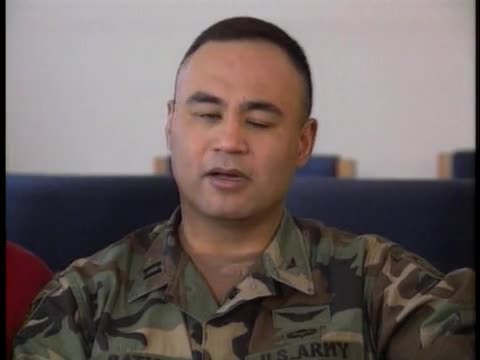
MR. VAN VOORST: Captain Bernie Ratio, age 33, is also gambling he can survive the cut. Though as a helicopter pilot with Desert Storm experience, his risk is not great. An 11 year army veteran, Captain Ratio loves the army too much to leave.
CAPTAIN BERNIE RATIO, U.S. Army: Where else can you go to jump out of airplanes and fly 'em and enjoy it? You know, I mean, sure I'm not a football player or professional athlete that makes a million dollars a year for what I do, although some people say for what we do we should get paid that amount of money. But you're not in it for the money. If you're in it for the money, you're in the wrong business. You're in it because what's in your heart, for me anyway. You're in it because you're a soldier.
MR. VAN VOORST: Captain Ratio also believes the army is providing troops with adequate information on the separation of packages.
CAPTAIN RATIO: I think they take care of the soldiers by, one, informing them, by No. 2, allowing them the time to make that transition, giving them some time to make the decision and they're giving them a fair amount, you know, to start off a different life with. You know, you could be, you could be working in a factory somewhere and get fired with or without severance pay. Whereas, here they're giving you some money to leave and start a life with, but that wasn't my decision. My decision is not the money. My decision is not a decision where I have to say, well, let's see, do I want to go make a civilian career, or do I want to stay in the military. I don't have that decision. I've taken the risk and I've made the decision stay until the end.
MR. VAN VOORST: And even with that dedication, you can accept the notion that that's it, you're out?
CAPTAIN RATIO: If I get cut and it's my time to leave, well, then, you know, I'll hurt, I'll pick up, will move on, and will go do what we have to do, but -- and I won't have any heartaches. That's one thing about an officer or a soldier, any kind of soldier. You can barter with your boss, you can make, he can tell you to do something and you can make decisions and you can make recommendations, but when he makes the final decision, you stand up, you salute the flag and you say, yes, sir. That's what I do.
MR. VAN VOORST: Todd and Cindy Gunter are both sergeants in the Air Force. His job is not threatened by the cuts, but Cindy's was. A carpenter, Sgt. Cindy Gunter, planned on spending 20 years in the service. Now 33 years old, she's put in 11 years. Just days before we talked to her, Sgt. Gunter said she'd been forced to resign.
SGT. CINDY GUNTER, U.S. Air Force: I was pissed off! I was pissed. I don't deserve to be thrown out.
MR. VAN VOORST: Why?
SGT. CINDY GUNTER: I have been, served my country well. I have never done anything wrong, nothing wrong on my records, never been any kind of trouble, showed up for every formation, followed every rule and regulation, and I'm getting thrown out.
MR. VAN VOORST: Will you be able to survive? What's your budget going to look like?
SGT. CINDY GUNTER: Terrible, bad. $1500 a month cut in pay is gosh, I'm going to feel that. Who wouldn't? That's a lot of money. We were living very comfortably. I had just anything I wanted to have. And now we're going to go from, gosh, a little over $3,000 to $1600 a month.
MR. VAN VOORST: And in practical terms, what will that mean for your living?
SGT. CINDY GUNTER: Macaroni and cheese. It's going to be tough. We've worked it all on paper work and everything and we can squeeze by. We can squeeze by.
MR. VAN VOORST: Sgt. Gunter believes she's deserved some consideration for serving a year away from her family at a remote Aleutian Island. She had to leave her husband to care for their two boys, then aged four and six.
SGT. CINDY GUNTER: I got on that plane and that was the hardest thing I ever did was get on that plane knowing I wouldn't be back for eight months until I came back from leave. So the first three months I was there all I did was cry. We had $400 a month phone bills and I cried. It was terrible. But I did it because I had to do it and once I got there, I made the best of the situation.
MR. VAN VOORST: Are you going to salute that flag as you go off?
SGT. CINDY GUNTER: Yes, yes.
MR. VAN VOORST: Why?
SGT. CINDY GUNTER: Because I still have that.
MR. VAN VOORST: And your experience isn't going to nullify that?
SGT. CINDY GUNTER: At first I was bitter, you know. I don't know who I was bitter at, the Air Force, the country, but I can't turn my back. It's my country. And I thought, well, if they call me back to war, I'm not going to go, you know, I'm going to be bad. But I will go. I will go.
MR. VAN VOORST: A little resentful?
SGT. CINDY GUNTER: I don't think so. I will just go, maybe not as gung ho as I would have been, but I would think about well, I would want someone to do that for me, and I would go.
MR. VAN VOORST: On balance, the military services are probably handling the drawdown as effectively as possible, but no amount of counseling and exit bonuses can compensate for the deep shock to those who love the military and are now being forced to leave. UPDATE - ELUSIVE PEACE
MS. HUNTER-GAULT: Next tonight an update on the Middle East peace talks. The fourth round of negotiations between Arabs and Israelis ended in Washington last night after Palestinian and Israeli delegates exchanged and rejected each other's detailed plans for an interim self-governing arrangement in the West Bank and Gaza. To discuss the state of the talks now we turn to two journalists covering them. Oded Ben-Ami is Washington's bureau chief for Israeli Radio and Hisham Melhem is a reporter for the Lebanese paper As-Safir. And starting with you, Hisham, the New York Times today characterized the progress in the talks as meager. Do you agree?
MR. MELHEM: Absolutely. I mean, there is no progress in the sense that agreements are being reached. The parties are exchanging views. The fundamental differences are, in fact, deepening.
MS. HUNTER-GAULT: What do you mean by that?
MR. MELHEM: Well, this round is characterized by more venomous exchanges, threats at times, very, very --
MS. HUNTER-GAULT: On both --
MR. MELHEM: -- undiplomatic exchanges. Well, the Arabs would say the Israelis began it and I'm sure you read what the Israelis have been saying publicly. But the problem is we have the kind of differences and disagreements on fundamentals and principles, the kind of impasse that cannot be broken by both sides if they're left to their own devices. And on the Palestinian-Israeli conflict, it seems to me that the core of the problem is the following. Stripped down to its essence, the relationship between the Palestinians and Israelis today is a variation on the old master-slave dichotomy. It's the dichotomy of the occupied and occupier.
MS. HUNTER-GAULT: Okay.
MR. MELHEM: The Israelis would like to maintain the status quo. The Palestinians would like to change the status quo. The Palestinians came up with a vision for the future which in essence wanted during the interim arrangement to neutralize this dichotomy of the occupied-occupier and to prepare the ground for eventual right of self-determination. The Israelis came up with a vision that in essence smoothes the rough edges of the occupation but they would like to maintain the dichotomy, basic dichotomy of the occupied-occupier.
MS. HUNTER-GAULT: Okay. I want to get into the specifics of that briefly in just a moment, but let me ask you just briefly, Mr. Oded Ben-Ami, do you agree that the progress was meager?
MR. BEN-AMI: Not at all. I think, Charlayne, that this is a very unique process and for the first time in 43 years of a very bitter and tough debate or conflict between the Israelis and Palestinians, the Israelis and Syrians and Jordanians and Lebanese, for the first time you can see here in Washington Israelis and Arabs sitting around the same table. And for the first time on these talks, this round, they exchanged papers. If there is anyone who expected that it would be just like that, this is not the right thing to think of it. For the first time, both parties, both sides expressed their fundamental views and this is part of the bargaining, of the negotiation.
MS. HUNTER-GAULT: But what about what Hisham just said, that the tone of the talks has seemingly degenerated into harsher, sharper, I forget what exact words you used, but it sounded like it was worse than it has been?
MR. BEN-AMI: Well, if there was one side who choose not to talk to the substance but to talk to the media and to blame the prime minister of Israel that he has no one cell of peace in his brain, it wasn't the Israelis. This was the Palestinians, the Palestinians, and this is what a senior U.S. official criticized today. He said that the Palestinians choose to talk to the media rather than talk to the substance, to talk peace.
MS. HUNTER-GAULT: So your position is that with this exchange of papers, there was a definitive move into substance in these talks?
MR. BEN-AMI: For sure. They didn't waste the time. They are starting. Now that both sides know very well what is the fundamental point of view of the other, now they have to try to bridge the gap and to negotiate.
MS. HUNTER-GAULT: And the fundamental position, as Hisham started to talk about, is that the Palestinians have presented a plan for self-government and the Israelis have presented a plan for interim rule, is that it?
MR. BEN-AMI: Well, Charlayne, this process has a term of reference that the U.S. administration with the Soviet created and the term of reference in the Israeli-Palestinian track says that the Israelis and the Palestinians will negotiate an interim self- government arrangement. And this exactly what the Israelis brought here to Washington, not only the ideas but experts, experts in the economy, commerce, in health, in legal areas. So they have to negotiate and to reach an interim self-government agreement and not a final status as of a Palestinian state. This is not the, within this process, term of reference.
MS. HUNTER-GAULT: Hisham, how do you see that based on what he just said and the fact that the State Department did today criticize the, actually blasted the Palestinians for posturing, talking to the media, not bringing in experts, what does that tell about from your perspective?
MR. MELHEM: I don't think it's warranted. I think the United States did not say anything when the Israelis really came up with an arrangement, not a vision, a plan to maintain the status quo in perpetuity. I think the Palestinians are living up to the terms of reference. They are talking about an interim self-government authority. The Israelis talk about an interim arrangement that is premised on the fact that the Israelis will maintain in perpetuity the occupation and the Palestinians are clear what they presented was a letter of intent, if you will. They want to go through an interim period in which we would build up the structures, social, economic and otherwise, that willallow us as a people, distinct population, to have the right of self- determination at a given process, after three, five years. The point is that there are fundamental, philosophical differences here, because we say the territories are occupied. The Israelis says, no, they are not occupied. We say 242 is based on the premise, on the principle land for peace. The Israelis say no. How can you negotiate if you don't even have a gray area where you can bridge the gap?
MS. HUNTER-GAULT: So you just reject Mr. Ben-Ami's characterization of having moved into substance at this point.
MR. MELHEM: Well, if substance is exchanging fundamental positions, I, I mean, each party came and tabled its own position, explained it, justified it, and waited for the other side the following day to do the same thing. There were no surprises there because we knew, everybody knew where the other side is coming from. The point is whether we agree on the terms of reference, and I still maintain that there is no agreement on the terms of reference because we have completely contradictory definitions.
MS. HUNTER-GAULT: Okay. Let me ask you, Mr. Ben-Ami, what about the other delegations, the Syrians, the Lebanese, the Jordanians, did they in your view get beyond meager progress?
MR. BEN-AMI: Well, my understanding is that, and this is another point of view on this, on this process, that in the Israeli- Jordanian track, the progress is an -- even coming to a conclusion is very very immediate, but the problem with the Jordanians is that among the Arab side of this negotiation, nobody would like to be the front man. What would the other say?
MS. HUNTER-GAULT: Right. Nobody wants to conclude a deal.
MR. BEN-AMI: Exactly.
MS. HUNTER-GAULT: Is that how you see it, Hisham?
MR. MELHEM: Well, yeah. I think the Arabs would argue publicly, they will admit that, look, even if we coordinate all of us, the four Arab parties, we will never be in a symmetrical position in terms of power vis-a-vis the Israelis. So they are trying to compensate for that asymmetry of relationship by trying to coordinate a position. We know that a separate deal can be only at the expense of the Arab Party. The Lebanese, for instance, tried it in 1983. It led to disastrous results. The point is every Arab Party today coming to Washington, they're talking explicitly about the need to have peace, but not any kind of peace and not peace at any price. And I think the Syrians, for instance, have been very explicit, challenging the Israelis, if you give us an intent, tell us that you are willing to withdraw, then from our side, we are willing to deliver on the requirements of peace. But you cannot enjoy the fruits of peace unless you withdraw. So it's a quid pro quo in that sense.
MR. BEN-AMI: Again, you can see how the point of views matter. But the Israelis are saying, are telling the Syrians and this is what, like 50 hours of actually trying to convince the other side, first, you, Syrians, you have to recognize the basic right of existence of the State of Israel, and then we'll negotiate everything, including, including withdrawal from the Golan Heights. But first you have to recognize the existence of Israel. It's a basic fact.
MS. HUNTER-GAULT: Okay. If this is a window on the talks, I think it's very interesting. Let me ask you this. What does it mean, and just very briefly, that the meeting ended today without any reference or agreement on when and where the next meeting is going to be? Mr. Ben-Ami, just briefly.
MR. BEN-AMI: Well, this is the Israeli demand that making peace in the Middle East, it is very important to make peace, to talk peace in the Middle East so the peoples in the Middle East, Syrians, Jordanians, Israelis will see the Israeli diplomats and the Arab diplomats making peace. The Arab side is insisting that Washington is the right place.
MS. HUNTER-GAULT: Okay. Excuse me, just briefly, is this a bad sign, Hisham, that there's been no agreement on the future when or where?
MR. MELHEM: Not necessarily. I would expect the United States and the co-sponsors and Russia to invite both sides to Washington sometime before June, before the next Israeli election.
MS. HUNTER-GAULT: Okay. I'm sure we'll see you again on this one, Hisham Melhem, and Mr. Obed Ben-Ami, thank you for being with us. FINALLY - '92 ELECTION - CALLING IT QUITS
MR. LEHRER: Finally tonight, the going of Bob Kerrey. The Nebraska Senator pulled out of the 1992 race for the Democratic Presidential nomination. He did so at a morning news conference on Capitol Hill. Here's an extended excerpt from what he said. The cheers and applause are from supporters who came to the news conference with him.
SEN. BOB KERREY, [D] Nebraska: After New Hampshire, I was delighted, or at least I appeared delighted, to say that I'd won a bronze, then went on to South Dakota and was happy to be able to say that I won a gold, but after Tuesday I feel a little like the Jamaican Bob Sled Team. We had a lot of spirit but unfortunately we didn't get a lot of medals. About the only good news for me came on Tuesday in the state of Colorado. I'd like to have done better in Colorado, but when you're a corn husker from Nebraska, any time you get 12 points on the road in the state of Colorado, you've done pretty well. [applause] At the end of the campaign we were ready to go full throttle, but unfortunately we ran out of gas. While we have plenty of potential and plenty of enthusiasm, unfortunately, we do not have plenty of money. So it is with regret but with great pride for all that we have done together that I am here this morning to end my candidacy for President of the United States of America. But make no mistake, this is no retreat, in Bruce Springsteen's words, this is no retreat and this is no surrender. For me, the fight simply is going to move on to new arenas. [applause] I thought last night for a moment that I might go on in the race simply by changing my name to "Bob Uncommitted" [laughter] but I thought better of it. I want to first of all congratulate all the other candidates, the four remaining Democratic candidates who did win. And I want to wish them well. I know there's a long road ahead. And there's a lot of work for all of them. I have exercised political hyperbole on a number of occasions and called them "unelectable," but with each passing day it's clear to me that the only unelectable politician running for President of the United States is George Bush. [applause] As to my own campaign, while my candidacy for Presidency of the United States is over, the cause of the campaign, the urgent need for fundamental change, is not over. I will continue the struggle to describe the course I believe America should set in the unchartered waters of the post cold war era. And I will continue to fight to make changes needed to move in this new direction. Paraphrasing the late Lou Gehrig, you may have heard, I've got some bad breaks, most of them self-inflicted. But today I consider myself the luckiest man on the face of the earth. I'm lucky for having a state like Nebraska that would give me its faith and encouragement. I'm luckyfor the opportunity I've had these past five months to lay out my views before the wisdom of the American people, and I'm lucky for the thousands who supported me with their confidence, idealism, money, time, and effort. I'm also very grateful and, indeed, very moved by the support and friendship and the love, in fact, given to me by my fellow comrades in arms in the Vietnam era. I hope that as much as the war was slightly open during this campaign that America understands that Vietnam is no longer the issue. The issue, instead, is the eagerness and sense of purpose with which Vietnam veterans return to political life. I take as a sign of hope that my campaign has awakened in thousands of Vietnam veterans the realization that their government is no longer an enemy, that government can be an instrument of power which can, after all, be used wisely, if only one gets involved in defining the mission. Perhaps the strongest message of this campaign is that job security in Washington, D.C., must be reduced if we ever hope to reverse the uncertainty everywhere else in this country. Americans are full of doubt about the future, anger about the present, and longing for the past. It is time for Americans to rise up with the full spirit of our indomitable nature to seize this moment and build the nation and world of our dreams. Thank you all very much. [applause] RECAP
MS. HUNTER-GAULT: Again, the main stories of this Thursday, Britain warned Iraq to destroy its weapons of mass destruction or face a military strike and this evening the Federal Deposit Insurance Corporation rejected a $1.3 billion offer from junk bond king Michael Milken to settle government civil suits. Good night, Jim.
MR. LEHRER: Good night, Charlayne. We'll see you tomorrow night with an interview with Bill Clinton, among other things. I'm Jim Lehrer. Thank you and good night.
- Series
- The MacNeil/Lehrer NewsHour
- Producing Organization
- NewsHour Productions
- Contributing Organization
- NewsHour Productions (Washington, District of Columbia)
- AAPB ID
- cpb-aacip/507-d795718g11
If you have more information about this item than what is given here, or if you have concerns about this record, we want to know! Contact us, indicating the AAPB ID (cpb-aacip/507-d795718g11).
- Description
- Episode Description
- This episode's headline: Terminal Condition; Thinning Ranks; Elusive Peace; '92 Election - Calling It Quits. The guests include JOHN McAFEE, Anti-Virus Supplier; CHARLES RUTSTEIN, Computer Security Researcher; MARK RASCH, Attorney; CORRESPONDENTS: KWAME HOLMAN; BRUCE VAN VOORST. Byline: In New York: CHARLAYNE HUNTER-GAULT; In Washington: JAMES LEHRER
- Date
- 1992-03-05
- Asset type
- Episode
- Rights
- Copyright NewsHour Productions, LLC. Licensed under a Creative Commons Attribution-NonCommercial-NoDerivatives 4.0 International Public License (https://creativecommons.org/licenses/by-nc-nd/4.0/legalcode)
- Media type
- Moving Image
- Duration
- 01:04:09
- Credits
-
-
Producing Organization:
NewsHour Productions
- AAPB Contributor Holdings
-
NewsHour Productions
Identifier: 4284 (Show Code)
Format: Betacam
Generation: Master
Duration: 1:00:00;00
If you have a copy of this asset and would like us to add it to our catalog, please contact us.
- Citations
- Chicago: “The MacNeil/Lehrer NewsHour,” 1992-03-05, NewsHour Productions, American Archive of Public Broadcasting (GBH and the Library of Congress), Boston, MA and Washington, DC, accessed June 12, 2026, http://americanarchive.org/catalog/cpb-aacip-507-d795718g11.
- MLA: “The MacNeil/Lehrer NewsHour.” 1992-03-05. NewsHour Productions, American Archive of Public Broadcasting (GBH and the Library of Congress), Boston, MA and Washington, DC. Web. June 12, 2026. <http://americanarchive.org/catalog/cpb-aacip-507-d795718g11>.
- APA: The MacNeil/Lehrer NewsHour. Boston, MA: NewsHour Productions, American Archive of Public Broadcasting (GBH and the Library of Congress), Boston, MA and Washington, DC. Retrieved from http://americanarchive.org/catalog/cpb-aacip-507-d795718g11