The MacNeil/Lehrer Report; Interview with Edward Rowney
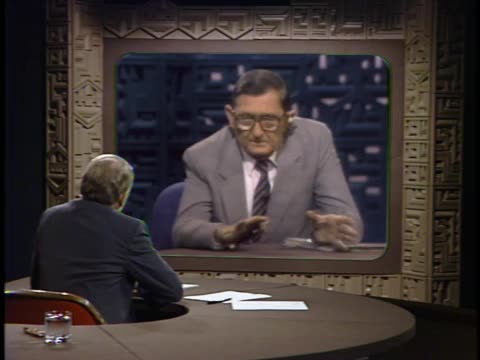
- Transcript
ROBERT MacNEIL: Good evening. Soviet leader Yuri Andropov today offered to scrap a considerable number of Soviet medium-range missiles in Europe if U.S. missiles were not deployed there. Andropov made the offer in an interview with the Communist Party newspaper Pravda. The missiles he mentioned included the SS-20s, the triple-warhead weapons that are the object of current negotiations in Geneva. If agreement is not reached, the U.S. will deploy its own medium-range missiles in Europe this fall. Until now, Andropov has agreed only to move some of his missiles to the east. The talks on these missiles, called INF, for intermediate nuclear force, may hold up the simultaneous Geneva talks on strategic nuclear weapons, the START talks. When they recessed earlier this month, the U.S. negotiator, Edward Rowney, said he expected no breakthrough until there was agreement on the INF talks because that was the Soviet priority. Tonight, to discuss the Reagan administration's proposals and hopes for nuclear arms control, we have a conversation with Ambassador Edward Rowney. Jim?
JIM LEHRER: Robin, Edward Rowney has been there before as a member of the U.S. team which negotiated SALT II with the Russians from 1973 to 1979. But he didn't like the final shape of that treaty. He was an army general at the time, a combat veteran of World War II and the Korean War. Resigning his army commission, he went public with his discontent in testimony before Congress, charging the treaty contained more negatives than positives.
EDWARD ROWNEY, [July 12, 1979]: Most of these positive features are, regrettably, more theoretical than actual. Additional other useful features, which a second arms control treaty could and should have treated, were not dealt with because of Soviet intransigence, which could, in my opinion, have been overcome. We must make it clear to them we will not for long accept strategic inferiority. The less expensive solution for the United States and the Soviet Union as well, indeed, a more sensible solution, is for the Soviets to scrap those systems which give them strategic superiority. Should they not elect to do so, then we have no choice but to enter into a vigorous program to restore parity. Having done that in a vigorous way, and simultaneously I would go back to the Soviets and say, "Look, you pick any point on this curve you want. I would prefer, and I've always preferred, a lower point on the curve. It's to your interest to get on the lower point of the curve; it's to our interest." I believe with that kind of talk they'd say, "All right, we'll buy this treaty."
LEHRER: And with that kind of talk it came as no real surprise that President Reagan chose General Rowney, who speaks fluent Russian, to be the chief U.S. negotiator at the strategic arms reduction talks in Geneva. He's been on the job more than two years, including eight months sitting directly across the table from the Soviet negotiators. Mr. Ambassador, welcome. First, how big a deal is Andropov's offer today on scrapping those missiles?
EDWARD ROWNEY: Well, of course, as you know, this is not in my area. This is my colleague's area, Paul Nitze's area, but it's a worthwhile clarification. As Robin said, previously we weren't sure what they were going to do with these missiles when they were reduced, and now he's said they would scrap them. It doesn't change his basic position, but it's a worthwhile clarification.
LEHRER: A "worthwhile clarification" rather than a major change in position?
Amb. ROWNEY: There's no change in position, really. The basic position, you know, is the same, as I understand it. Now, of course, I'll have to study the thing and other people want to study it carefully before we make any definitive reply.
LEHRER: Is it a clarfication that's so worthwhile that it might lead to an agreement?
Amb. ROWNEY: No, no.
LEHRER: It's not that kind of breakthrough?
Amb. ROWNEY: No, no. They'll have to -- there will have to be some really meaningful changes in the basic proposal that the Soviets have made before it will be acceptable to us, in my opinion.
LEHRER: Do you still feel that your talks, the START talks, are more or less being held hostage to these intermediate missile talks?
Amb. ROWNEY: Well, let me put it this way. You know, INF started well before ours did, and they've been into the process for more than a year longer than ours have, and so they're ready; they're at a point where they need a real breakthrough and can come to an agreement. We're not at that point yet. We are narrowing our differences; we're on the verge of getting a framework. And that has been going along satisfactorily.
LEHRER: Satisfactorily. Why do you use the word satisfactorily?
Amb. ROWNEY: Well, let me give you just a minute or so of background. This is now the end of the fourth round of negotiations. The first three rounds of negotiations, we explained our positions and clarified and probed and asked the other side. Then, between the two rounds, between round three and four, there were a series of intensive meetings with the President and his Cabinet looking at what the Soviets had said and what is really important to us. As a result, the first part of June, the President instructed me to go back with a much more flexible position. We asked ourselves, what are the major concerns of the Soviets? and they had two. One, they say we were telling them to restructure their forces in detail, and they didn't like that. The second, they said --
LEHRER: You mean tell them specifically --
Amb. ROWNEY: Specifically --
LEHRER: -- what to do with the particular weapons systems?
Amb. ROWNEY: Yes, our original position, you know, had a number of collateral constraints in it, and still does have a number of collateral constraints. But now we say to the Soviets, "If you don't like these collateral constraints, we'll substitute a blank number for the effect of those collateral constraints in destructive capability. Collateral --
LEHRER: I'm not sure what you mean by a collateral constraint.
Amb.ROWNEY: All right. Our original position --
LEHRER: No, just give me a hypothetical example of what a collateral constraint --
Amb. ROWNEY: Collateral constraint is at the end of the reductions, you the Soviets shall have no more than 210 of your medium and heavies and no more than 110 of your heavy missiles.
LEHRER: But you don't care what missiles they are as long as they're --
Amb. ROWNEY: Now we've said, "If you don't like those, and you've said you don't, we will accept and we'll negotiate a number which represents the destructive capability potential of what remains. So long as there is a substantial reduction, we don't -- we're not going to tell you how to do your restructuring." And then we gave them a third alternative, saying, "If you don't like those two, you give us a proposition and we'll look at it." So we took away the Soviet complaint that we were telling them in detail how to restructure their forces.
LEHRER: All right. Robin?
Amb. ROWNEY: Yeah. I was going to tell you the second concern, but maybe Robin will ask me.
LEHRER: I'm sure he will.
MacNEIL: At the risk of embarrassing ourselves in front of the Ambassador, we'd just like to give you a little background on what they are talking about as strategic arms. Basically there are three things -- launchers, warheads and throw weight. The Soviets have focused their attention on launchers. The U.S. has some 1,600 land- and sea-based missiles; the Soviets have 2,400. When the talks began in 1981 the U.S. proposed cutting both sides back to 850. The Soviets countered with a proposal of 1,800 launchers per side; the U.S. recently agreed to raise its figure, but has kept the figure secret. The American negotiating focus has shifted to warheads and throw weight. The U.S. has about 10,000 nuclear warheads, the Soviets about 8,000. The U.S. has proposed a ceiling of 5,000 for each side, with no more than half based on land. The issue of throw weight addresses the much larger size of current Soviet missiles, enabling their arsenal to carry almost three times as much destructive power as the U.S. The U.S. has proposed that the Soviets reduce, and the U.S. increase, throw weight until the two sides were near parity. Now, Mr. Ambassador, was that reasonably accurate?
Amb. ROWNEY: Yes, that's reasonably accurate. Let me give you just a few points of clarification on that. You're correct, the Soviets wanted to reduce launchers and still do, and as you know, launchers don't do the damage. They don't kill. It's like the rifle tube. It's the bullets and the size of the bullets and the number of bullets that come out that do the damage. Now, your numbers are reasonably accurate in rough, rounded-off numbers. And what I would point out is that under the current Soviet proposal their current number of warheads could be increased by another 50%. Now, we say let's reduce the current number of warheads by a third; let's reduce to 5,000 on both sides. So --
MacNEIL: What could happen to our number of warheads under their proposal -- our 10,000? What would happen to that?
Amb. ROWNEY: Well, under the 10,000 -- let's break that down. Three thousand are not warheads, strictly speaking. They're weapons on bombers. So you shouldn't put them in that equation. We're talking about ballistic missile warheads, and those are the things that really count. Those have the throw weight, those have the power; those are the ones that can do the damage and are not, by being able to reach a target in 30 minutes rather than the bomber weapons which take seven or eight hours, those are the weapons which are unconstrained at the far end by defenses. You see, we have an ABM treaty where ballistic missiles virtually run free. So let's break it down into bomber weapons and missiles. Now, under the warheads on missiles, we have about 7,200 and the Soviets have about 7,900. The rest are the bomber weapons, which we should exclude from this conversation. We say let's reduce those on both sides; in other words, the Soviets reduce to 5,000, we will reduce to 5,000. In other words, both will reduce by approximately one third the number of our ballistic missile warheads.
MacNEIL: Okay. You said a moment ago the President instructed you to go back and be a bit more flexible. Now, is that flexibility reflected in the draft treaty that you put on the table in the last session in Geneva?
Amb. ROWNEY: Yes, Robin. You mentioned one of the items.
MacNEIL: Yeah, that's on the launchers, right?
Amb. ROWNEY: That's the 850. Right. We have said, "You, the Soviets, didn't like the 850; let's put a blank there and let's negotiate that." We have stayed firm on the 5,000 warheads because the President said that's central to our position, and that's correct. Now, the other collateral constraints that I was mentioning to Jim here, we have said, "-- are on the table, but you don't like those, so let's substitute a number for the power," or as you said, "the throw weight for whatever we agree to reduce to. And if you don't like that, you tell us some number." So we would reduce -- have the Soviets reduce this huge advantage in throw weight -- they have about a three-to-one advantage. And another very important part that I want to clarify is that we no longer say that the Soviets must come down to our level during this particular agreement. It's still our goal, but we say as long as there is a substantial reduction -- significant reduction, during this reduction period that we're going into, then we will be satisfied. And we haven't said, of course, what that is.
MacNEIL: On the question of throw weight, Mr. Ambassador, what is your answer to those critics of the administration who say the whole emphasis on throw weight is really a sign that this administration doesn't really expect or want agreement because it's a bit of a red herring because the enormous size of the Soviet missiles is counterbalanced by the much greater accuracy of American missiles?
Amb. ROWNEY: Well, that used to be a credible argument, but since about the beginning of 1979 or late '78 the Soviets caught up to us in accuracy, so that argument no longer holds. The Soviets are now as accurate as we are with our missiles. Therefore, the power of those missiles makes a great deal of difference, and since they have three times as much, we want them to reduce to a lower level. We don't necessarily want to build up to that level. We would have the right to do so, although I doubt we would do it, but we would have the right to build up to some lower number than the Soviets now have.
MacNEIL: Thank you. Jim?
LEHRER: Mr Ambassador, I'm curious about the use of this word flexibility. Is it -- does that mean that you went back over there with a new proposal that was flexible, or that you sat down as the negotiator in a more flexible posture, that you were able to negotiate from a much wider range than you had been otherwise?
Amb. ROWNEY: I would say some of both. In other words, the President said, "Look, where we're going is important; how we get there is less important. You explore a number of ways, and you ask the Soviets to give you proposals and you examine seriously any proposal that they give you." Now, we have done so and, as a result, we have shown some flexibility in this first element of their concern, and then we also showed some flexibility on the second element. Originally we had said that we should negotiate in two phases, if you will recall. And the Soviets said, "No, you want us to do things which you are concerned about, but not -- you're not responding to what we are concerned about." Now, after a year, we know what they are concerned about; we've collapsed the phases, and we've said everything is on the table; it's all there. And we've recorded this in a draft treaty so that it's in writing. They can see that we're serious about it and it is a firm proposal.
LEHRER: Well, as you know, Mr. Reagan made a deal with some members of Congress: in an exchange for their support of the MX missile, there would be flexibility at the negotiating table in Geneva. I've got a hunch I know what your answer is, but I'm going to ask it anyhow. Do you feel that through you the President has held up his end of the bargain?
Amb. ROWNEY: Yes, I do. I guess that's the answer you expected --
LEHRER: Yeah.
Amb. ROWNEY: -- and that's the correct answer.
LEHRER: Is it changing any? Now, you're going back probably in October to sit down again. Are you still flexible? Do you have a new flexible -- I mean, what does being flexible mean to you now when you go back?
Amb. ROWNEY: Well, what it means is that at the moment we have shown a great deal of flexibility in our position. Let me say that when we did so the Soviets said, "Well, you're not the only ones that can be flexible; we'll be flexible, too." So they relaxed their position on two counts. Not on the central issues that we've been talking about, but still very important items. So, in a way, it's accomplished its purpose or part of its purpose.
LEHRER: What do you think caused them to be flexible?
Amb. ROWNEY: I think that they didn't want to take the public criticism that we're the only ones showing flexibility. So I think they were looking at the public view, and also I think they recognized that their positions were unrealistic and therefore they could relax them without losing anything because we weren't going to accept them in the first place.
LEHRER: A housekeeping question: back in the spring, during the confirmation process that Kenneth Adelman went through to become the head of the arms control agency, a memo surfaced, you remember, with your name on it criticizing your staff. Have you cleaned house or made adjustments, or how's that working out?
Amb. ROWNEY: No, that whole memo thing was quite a misunderstanding. As you know, this was a memo prepared for me which I didn't read. When I read it -- I'd gone to Geneva. I called Adelman and said, "These are not my views." The memo just died right there.
LEHRER: But I mean, there has -- what is the status --
Amb. ROWNEY: The status is that one member of the team who had previously asked for transfer even before this memo was given the transfer.
LEHRER: What kind of working relationship do you have with Mr. Adelman?
Amb. ROWNEY: Excellent, splendid.
LEHRER: I mean, do you report through him to the President, or how does that work?
Amb. ROWNEY: I report to the President through the Secretary of State. Adelman reports to the President through the Secretary of State. I stay in close contact with Mr. Adelman. He and his team take care of my backup and the minor problems. So, on these day-to-day issues,yes, he is my channel. On the bigger issues, I go directly to the President and I work for the President and my channel then is through the Secretary of State. It's a rather complicated --
LEHRER: Sounds that way.
Amb. ROWNEY: -- spaghetti, but it works; that's the important thing.
LEHRER: Okay. Robin?
MacNEIL: Mr. Ambassador, is the changing of the U.S. position complete now?
Amb. ROWNEY: No, I wouldn't say that it's complete because at some point there has to be a breakthrough on the final terms of the agreement. We are not at the point where we are ready to sit down and have this breakthrough. There is -- the framework still needs to be changed. However, as I've tried to suggest, we have made the most flexible positions and taken the lead. We now expect the Soviets, and we look to the Soviets, to make comparable moves of flexibility on their side.
MacNEIL: Is the so-called build-down proposal that senators Nunn and Cohen put forward during all these negotiatios with the Congress over the MX, whereby two of our warheads would be destroyed for every new one deployed, is that now on the table with the Russians?
Amb. ROWNEY: No, no. It's not on the table. It's still being studied in Washington -- intensively studied -- and the President has said, and all of us, I think, agree, that in principle this proposal makes sense. As you can see from our own proposals, we would deploy 1,000 MX warheads on 100 MX, and we would tear down over 2,000 warheads during that period of reduction. So in principle, we agree. It's only when you get into the details that you have to be sure that those details fit.
MacNEIL: Have you seen any sign from the Russians yet that the initial approval of the MX by Congress is making it work as a bargaining chip?
Amb. ROWNEY: Well, let me first have a clarification about the bargaining chip. I don't work with bargaining chips, as you may know, Robin. It's bargaining leverage. A chip suggests that it's there to be thrown away. It's not there to be thrown away. After 15 years of having the same missiles in our inventory while the Soviets have gone on with three more generations, if we're going to have a land-based leg of the triad which is a viable one, we have to modernize it, and we are. So my viewpoint is that I can't guarantee you an agreement if we have the MX missile. I can guarantee you we will not have an agreement if we don't have it. And the Soviets have generally responded to that.
MacNEIL: Finally, there's a different kind of political pressure in Washington, and that comes from conservatives who claim that the Russians are even now violating existing agreements, and that makes any further agreement with them pointless. Is that pressure a curb on your efforts, and are they wrong, or are there violations going on which would make a new agreement pointless?
Amb. ROWNEY: Well, Robin, there are three alleged violations, and the President has instructed Secretary Shultz to take up through diplomatic channels those alleged violations. There are three serious questions. Now, from my point of view, I am glad that these are being raised because if we shove them under the rug and I tried to bring home a treaty which covered up some alleged violations or show that we weren't looking at these, I wouldn't have any success with the treaty. Furthermore, it helps to emphasize to the Soviets that we have to close the loopholes in this treaty. And, you see, the -- at least two of the violations or alleged violations were loopholes in these preceding agreements.
MacNEIL: Thank you. Jim?
LEHRER: Now, Mr. Ambassador, I'm curious as to how it actually works there in the room in Geneva. Is it a civil tone among people who respect one another? Do you argue? What's it like?
Amb. ROWNEY: Oh, it's quite civil. It's entirely civil and serious.
LEHRER: Is it done from people -- from prepared papers or do you -- is it spontaneous?
Amb. ROWNEY: No. Let me explain this a bit. We meet at least twice a week in formal sessions, generally twice a week. At those formal sessions we carefully prepare statements on each side which are binding on our governments. So every word and every comma and every nuance is examined carefully. We place these on the table. That usually takes an hour. Then, for two, three or four hours, we go off into respective rooms, one on one -- I go with Victor Pavlovich Karpov, and my deputy goes with the deputy on the other side, and our other delegates go. And then we talk about what was put on the table, what might have been put on the table before, or what might be put on the table in the future. So it's a free for all where we --
LEHRER: But that's not binding, if you're --
Amb. ROWNEY: It's not binding, no. He goes home and writes a memorandum for record on what he says -- and I never look bad in my memorandum for record, you know. And he tells me he doesn't either.
LEHRER: Well, do you ever -- have you ever gotten into a philosophical discussion with him about the way they do it over there and the way we do it here?
Amb. ROWNEY: Oh, yes. Oh, yes. You know, I've been dealing with this man now, except for the two-year break, between the administrations, for 10 years. In other words, it was 6 1/2 years before and now a year and a half. So we're at a point where we have the old corporation-type jokes, you know. He says something and I say, "Now, Victor Pavlovich, that's number 39 and my answer's 34, you know. Let's get on with something more serious." But we do cover a large range of subjects. He's a highly intelligent, dedicated servant of the Soviet Union. He's been here four years. He reads our press. He's disappointed that Doomesbury is no longer in the papers.
LEHRER: You just made a slip; you said "Doomesbury."
Amb. ROWNEY: That's what I meant.
LEHRER: Well, it's "Doonesbury."
Amb. ROWNEY: Doonesbury! I'm sorry. Oh, what a psychosomatic question.
LEHRER: We've got to leave it there.
Amb. ROWNEY: That's an awful thing for an arms negotiator to say!
LEHRER: We have to go. Robin?
MacNEIL: Mr. Ambassador, thank you very much for joining us. Good night, Jim.
LEHRER: Good night, Robin.
MacNEIL: That's all for tonight. We will be back on Monday. I'm Robert MacNeil. Good night.
- Series
- The MacNeil/Lehrer Report
- Episode
- Interview with Edward Rowney
- Producing Organization
- NewsHour Productions
- Contributing Organization
- National Records and Archives Administration (Washington, District of Columbia)
- AAPB ID
- cpb-aacip/507-8s4jm2435b
If you have more information about this item than what is given here, or if you have concerns about this record, we want to know! Contact us, indicating the AAPB ID (cpb-aacip/507-8s4jm2435b).
- Description
- Episode Description
- This episode's headline: Edward Rowney Interview. The guests include EDWARD ROWNEY, Special Ambassador, START Talks. Byline: In New York: ROBERT MacNEIL, Executive Editor; In Washington: JIM LEHRER, Associate Editor; GREGG RAMSHAW, Producer; DAVID T. SHAPIRO, Reporter
- Created Date
- 1983-08-26
- Rights
- Copyright NewsHour Productions, LLC. Licensed under a Creative Commons Attribution-NonCommercial-NoDerivatives 4.0 International Public License (https://creativecommons.org/licenses/by-nc-nd/4.0/legalcode)
- Media type
- Moving Image
- Duration
- 00:27:41
- Credits
-
-
Producing Organization: NewsHour Productions
- AAPB Contributor Holdings
-
National Records and Archives Administration
Identifier: 97264 (NARA catalog identifier)
Format: 1 inch videotape
If you have a copy of this asset and would like us to add it to our catalog, please contact us.
- Citations
- Chicago: “The MacNeil/Lehrer Report; Interview with Edward Rowney,” 1983-08-26, National Records and Archives Administration, American Archive of Public Broadcasting (GBH and the Library of Congress), Boston, MA and Washington, DC, accessed April 3, 2026, http://americanarchive.org/catalog/cpb-aacip-507-8s4jm2435b.
- MLA: “The MacNeil/Lehrer Report; Interview with Edward Rowney.” 1983-08-26. National Records and Archives Administration, American Archive of Public Broadcasting (GBH and the Library of Congress), Boston, MA and Washington, DC. Web. April 3, 2026. <http://americanarchive.org/catalog/cpb-aacip-507-8s4jm2435b>.
- APA: The MacNeil/Lehrer Report; Interview with Edward Rowney. Boston, MA: National Records and Archives Administration, American Archive of Public Broadcasting (GBH and the Library of Congress), Boston, MA and Washington, DC. Retrieved from http://americanarchive.org/catalog/cpb-aacip-507-8s4jm2435b