The NewsHour with Jim Lehrer
- Transcript
JIM LEHRER: Good evening. I'm Jim Lehrer. On the NewsHour tonight, Betty Ann Bowser and Margaret Warner cover the aftermath of the EgyptAir crash off the coast of Nantucket; Gwen Ifill leads a discussion about the proposed federal rules on medical privacy; Ray Suarez examines the agreement on salvation between Catholics and Lutherans; and essayist Roger Rosenblatt considers the work of artist Jane Freeman. It all follows our summary of the news this Monday.
NEWS SUMMARY
JIM LEHRER: The Coast Guard gave up the search for survivors today in the crash of EgyptAir Flight 990. The 217 people onboard are now presumed dead, 106 Americans and 62 Egyptians among them. The airliner crashed early Sunday in the Atlantic Ocean, about 60 miles south of Nantucket Island, Massachusetts. It had taken off from New York's Kennedy International Airport en route to Cairo. Investigators said there was no evidence of foul play. President Clinton responded today to a question about the crash.
PRESIDENT CLINTON: Nothing has been ruled in. Nothing has been ruled out. And I hope no one will draw any conclusions one way or the other until we finish the work.
JIM LEHRER: We'll have more on this story right after the News Summary. Mr. Clinton was in Oslo, Norway, today for the opening of a two-day summit with Israeli and Palestinian leaders. He said he hoped to instill renewed energy into the peace process, but he didn't expect a major breakthrough. The Israelis and the Palestinians have set a September 2000 deadline for a final agreement on issues left unresolved in their 1993 accord. White House negotiators were back at the capitol today working on a budget deal. There was no word on progress. The Senate was poised to pass a Republican plan for a 1 percent across-the-board federal spending cut. The House did so last week. President Clinton has promised to veto it. The government has been running on temporary spending bills. And the latest expires on Friday. Texas Governor George W. Bush was injured today diving out of the way of a truck. The Republican presidential candidate was jogging in Austin. He was treated at the scene for minor bruises to his leg and hip. He returned home and then went ahead with a trip to New Hampshire later in the day. A Texas public safety agent with Bush was hospitalized. Bush's spokespeople said there was no evidence it was other than an accident. Russian troops briefly opened several border crossings today with Chechnya. They allowed a small group of Chechen refugees to leave. Russian forces sealed all the borders ten days A. We have this report from Louise Bates of Associated Press Television News.
LOUISE BATES: Hundreds of people waited on the Ingosetia side of this border crossing for it to be opened. Most were waiting for relatives to come through from Chechnya. Others were refugees who wanted to return. But when the gate was finally pulled back, border guards only allowed a trickle of refugees to pass through, despite the huge numbers waiting. (Shouting) This woman said there was a line 15 kilometers long of cars and trucks crammed with refugees waiting to get out of Chechnya. There were also those trying to return so they could start searching for loved ones left behind in the breakaway republic. This woman, Tatiana, wanted to find her children, who were still trapped in Grozny. A large contingent of police tried to maintain order at the frontier in freezing rain. Russia shut the Chechen frontier ten days ago, saying it wanted to stop guerrillas from escaping.
JIM LEHRER: Catholics and Lutherans have healed their problems over salvation. The two faiths announced that yesterday at a meeting in Germany. The reconciliation on the salvation issue came nearly 500 years after German monk Martin Luther's disagreements led to the Protestant Reformation. Church officials are still discussing other areas of disagreement. We'll have more on this story at the end of the program tonight. Former football star Walter Payton died today at his home outside Chicago. The former Chicago Bear running back had a rare liver disease. He was the National Football League's all-time leading rusher, running for more than 16,700 yards in his 13-year career. Walter Payton was 45 years old. And that's it for the News Summary tonight. Now it's on to the EgyptAir crash; medical privacy; Catholics and Lutherans; and a Roger Rosenblatt essay.
FOCUS - EGYPTAIR CRASH
JIM LEHRER: Betty Ann Bowser begins our air crash coverage.
BETTY ANN BOWSER: The final journey of Egyptian Air Flight 990 began uneventfully. It left Los Angeles on Saturday, flew across country, and stopped at John F. Kennedy Airport in New York, where the 767-300 wide body took on 167 new passengers. Then shortly after 1:15 Sunday morning, the plane headed for Cairo, its destination, with 217 people onboard. Just 33 minutes after takeoff, near the island of Nantucket off the Coast of Massachusetts, the plane began to fall from the sky. Radar tapes showed the 767 dropped from 33,000 feet to 19,000 feet in 36 seconds. As Flight 990 continued its dive toward the Atlantic Ocean, its image remained on radar for nearly another minute and a half. However, in the final moments, the plane descended at a rate two to three times its normal emergency descent rate, something that could have caused it to break apart. Coast Guard helicopters, planes and cutters searched the ocean in hopes of finding survivors, but only small pieces of debris and one body were recovered.
On long island, members of the Islamic Center came together to pray for passengers on the plane. More than 100 were Americans. This pediatrician drove his parents to JFK for the flight to Cairo.
PEDIATRICIAN: They just filled the house with happiness and love. They were very loving parents. I will miss them so much, so much.
BETTY ANN BOWSER: In Cairo, friends and relatives of passengers on Flight 990 came to the airport and were told to fear the worst, and by midday today, the Coast Guard confirmed those fears.
REAR ADMIRAL RICHARD LARRABEE: We know that the water temperature in the area we're searching is about 58 degrees. Our hypothermic tables tell us that the average life expectancy in water temperatures at 58 degrees is about five to six hours. We know at this point that we have reached about as much of the saturation of that area as we possibly can with the probability of detection of about 100 percent. We also have assessed the debris that we've been recovering and we know the extent of the damage to the aircraft. And based on these three factors and what we believe to be our best effort, we believe at this point, that it is in everyone's best interest to no longer expect that we will find survivors in this case. It is now a search and recovery operation. It's an operation that will primarily focus in the next day or two on recovering everything we possibly can from the surface. And we'll tell you that we found a significant piece of the aircraft this morning, a new piece of evidence. It is large enough that it requires the crane on our buoy tender to recover it and that operation is going on as we speak.
BETTY ANN BOWSER: Admiral Larabee said Coast Guard ships have also picked up a ping signal which could indicate the location of the plane's flight data and cockpit voice recorders. Those so-called "black boxes" could tell investigators more about what happened in the final moments of the flight, but Larabee said pinpointing the site could be difficult in the 250 feet of water. In 1996, when the Navy mounted recovery efforts for the plane and 230 passengers aboard TWA Flight 800, it was summertime. The water was warm, and the 747's pieces were in a little over 100 feet of water. What's left of EgyptAir 990 is much deeper than that. This time of the year the water is cold, and the depth could hinder the efforts of the Navy divers expected on the scene later today. Late this afternoon, the National Transportation Safety Board held a news conference, to introduce the team of government agencies that will be working on the recovery and investigation. NTSB Chairman Jim Hall indicated finding answers to the causes of the crash could take a long time.
JIM HALL: You might have heard earlier today that a pinger had been detected, which we believe may be associated with one of the flight recorders. The Navy is bringing resources, as you have learned, from Commander Pulse, but it will be 36-48 hours before that equipment will be in position to see if we can locate the source of that ping. Remember, please, we are dealing with water 250 feet deep. And recovering and locating small objects like recorders is a daunting effort. We estimate that counting the state authorities, we have between 500-1,000 people dedicated to this investigation right now. This will be a long investigation. We will continue to cooperate closely with the Government of Egypt and with all of the appropriate authorities as the investigation develops. Factual information may not be developed as quickly as the press may like. But when we learn something, we will present it to you and the American people.
BETTY ANN BOWSER: And the FBI said so far, there is no evidence of criminal wrongdoing.
BARRY MAWN, Special Agent, FBI: I would like to, at the very first strongly emphasize that at this particular point in time, there is no indication of criminal activity the FBI will be in support of the National Transportation Safety Board. In that support we will follow appropriate protocols that are familiar to both the NTSB as well as the FBI, so that if, in the event there was some criminal activity or incident that did take place, that we would be following the proper procedures so that it would not hamper or be counterproductive to any criminal prosecution.
BETTY ANN BOWSER: Meanwhile, hundreds of relatives of passengers are coming to the staging area in Rhode Island from all over the world to await recovery efforts.
JIM LEHRER: And to Margaret Warner.
MARGARET WARNER: For more, we're joined by Michael Goldfarb, a former chief of staff of the Federal Aviation Administration. He now runs an aviation consulting and lobbying firm. John Hansman, a professor of aeronautics and astronautics at MIT and Jack McGeorge, formerly with the Secret Service, who now runs a firm that advises government and industry clients on security matters. Michael Goldfarb, let's start with what we do know. What are the most telling clues already in hand that will help investigators decide what happened here?
MICHAEL GOLDFARB: Well, Margaret, obviously early speculation tends to prove wrong but this is one of the most baffling aviation accidents. The enormity of this tragedy, not just for the family but from the aviation standpoint, planes don't fall out of the sky at 33,000 feet, and yet we've had two or three, you know, incidents, serious accidents over the last three years. We went 50 years without having a plane fall into the North Atlantic. The last several seconds -- what happened in the cockpit for a rapid descent, lots of theories, very few answers. And that's why the rapid recovery from the ocean floor of the flight data recorder and the cockpit voice recorder and other things will help us here. So, clearly the pilots for some reason had a sudden loss of control. And even the electrical systems were working at lower altitudes. It's truly a baffling, at this stage, you know, an unanswered event.
MARGARET WARNER: John Hansman, what would you answer to that in terms of what we know based on, for instance, the very rapid descent, or the fact that the radar was picking up signals during the descent; there was no mayday from the pilots?
JOHN HANSMAN: Yes. The fact that it was... there was no mayday or indication from the pilots indicated that they were not aware of any problem up until the beginning of the descent. The fact that the descent was so fast, faster than you would do in any normal maneuver, indicates that this airplane was essentially in an uncontrolled descent. Now we don't know at this point what the cause of the uncontrolled descent is. But we do know that they wouldn't have been doing it on purpose. It also indicates from the radar track that the descent slowed at lower altitudes, so we'll be trying to understand why that was.
MARGARET WARNER: And what about the fact that, as Michael Goldfarb just referred to, and Betty Ann's piece did, too, explain the radar and the fact... what that tells us, the fact that there was still a certain kind of a signal even midway through the descent or nearly midway?
MICHAEL GOLDFARB: Yes. The radars that we use to look at air traffic or we use for air traffic don't actually measure altitude. On board the aircraft, there's an instrument which we called a transponder which actually takes the measured altitude from the aircraft and sends it down as a digital code. So the last 30 seconds or the 30 seconds after the airplane began to descend, the transponder was still working and was still sending out signals, which means there was at least electrical power to the transponder and there was sufficient structural integrity that the antenna for the transponder, which is on the surface of the airplane, was still connected to the cockpit.
MARGARET WARNER: Now, Jack McGovern (McGeorge), we also heard NTSB Chairman Hall and others there say that really there's almost - there's very little debris on the surface. There's only one body recovered. Does that tell us anything?
JACK McGEORGE: In the context of whether it was an explosion or not, it might suggest that whatever it was wasn't very big...
MARGARET WARNER: Excuse me. Mr. McGeorge.
JACK McGEORGE: That's quite okay. I understand. I think it's over because the plane came down largely intact and did not break up obviously at higher altitude. I don't think it tells us anything terribly significant yet in the context of might it have been some deliberate act and, if so, what kind.
MARGARET WARNER: And, was it sabotage or was it mechanical failure? It doesn't really tell you?
JACK McGEORGE: Not from my perspective, no.
MARGARET WARNER: All right. So, Michael Goldfarb, talk about the two things that...you mention the flight data recorder that they think they heard this ping. They think they may be able to recover that, and then also this big piece.
MICHAEL GOLDFARB: Yes.
MARGARET WARNER: That they won't describe to us or haven't described to us. But what could that yield?
MICHAEL GOLDFARB: Well, let's start with the flight data recorder. This plane is relatively new, it is fairly young. Ten years is young. Most planes in the last ten years have what's called modern flight data recorders. That simply means there's a lot of sensors. And those sensors tell you everything you need to know about that aircraft. And if they can recover it intact, it's going to give the NTSB a head start here. The size of the piece of the air frame, the fact that it was a larger piece, also is significant. Engines are critical, engines are very important here, given the past history of the 767. So those components if they can get them fairly rapidly given that the ocean is not cooperating like it did in the TWA crash, those components are going to give the NTSB a jumpstart. They'll still have a long way to go, but I think it will be revealing if they're intact to have that flight data recorder and also that cockpit voice recorder.
MARGARET WARNER: Professor Hansman, tell us a little bit more about what's on both of those kind of recorders.
JOHN HANSMAN: Well, the flight data recorder has the parameters, the flight parameters of the airplane. So, it will tell you the altitude, air speed, altitude of the airplane. So if there was some loss of control event where the airplane went into a bizarre maneuver, that would show up in the flight data recorder. The cockpit voice recorder will tell you what the crew was saying but it also pick up any warning signals that were in the cockpit or if there were an explosion on board, it would pick up the acoustic signature of the explosion.
MARGARET WARNER: What would you add to that?
JACK McGEORGE: Look at the bodies and what happened to them, the shrapnel wounds, burns on the bodies. The recorders, you're looking for sound, sound of the explosion, you're looking for pressure change in the flight data recorder. Was there a big pressure spike? Looking at the...what happened to the metal of the plane, the skin of the plane. Does it petal outward or was it merely sheered? Rivets, were the rivet heads sheered?
MARGARET WARNER: Go back to that because I assume what you're talking about now is trying to determine whether it's sabotage or mechanical.
JACK McGEORGE: Right. An explosion produces a lot of gas inside the plane, very high pressure. That gas has to go someplace. It will blow the skin of the plane out. When it does that, it looks like you peel a banana and it will have that petaling effect that would indicate pressure moving outward. So you would look at that, that would be a pretty good indication, something built up a lot of pressure, like in TWA Flight 800, the rapid expansion of the deflagrating gasoline fumes or in prior unfortunate incidents, the gas produced by an explosive itself - both would produce this petaling. Looking at the metal itself, there are different metals in an airplane, different materials that melt at different temperatures. And one of the things they're going to look at is what melted and what didn't. And this will indicate approximate heat of what was going on inside and outside the plane at that moment. Whether the way the plane broke apart, were the rivet heads sheared off? There's all sorts of things, pitting, for example. The forces of an explosion will propel either hot gases certainly and maybe projectiles, pieces of the plane into other pieces of the plane and you would look for that. Many things we'll look at in that debris field.
JOHN HANSMAN: It's important to note that at this point we still don't know that there was an explosion. They will be looking for evidence like that but it may very well be that there wasn't.
MARGARET WARNER: So what would it... take some of the evidence that Mr. McGeorge described and what would it look like, Professor Hansman, if it wasn't an explosion?
JOHN HANSMAN: Well, if you do find that kind of evidence, that would indicate an explosion, if you don't find that evidence, they'll look for other causes. So, for example, if there was a problem in the flight control system that caused the airplane to just go into a descent, that might be a cause. Again that would show up on the flight data recorder. If there was, for example, an uncontained engine failure where shrapnel from the engine went into the fuselage, that could also cause this kind of event.
MARGARET WARNER: Michael Goldfarb, tell us about the safety record of these 767s?
MICHAEL GOLDFARB: It's exemplary and what is confusing here and what is so perplexing is we're speculating and the board over time will come to the cause.
MARGARET WARNER: I hope we're not speculating - I hope we're just telling people what to look for, but go ahead.
MICHAEL GOLDFARB: Right, but invariably it's usually a series of things, a series of things that come together. But the accidents are troubling because the plane itself has a wonderful safety record. We don't have planes --
MARGARET WARNER: Just one fatal air crash due to mechanical problems.
MICHAEL GOLDFARB: Right. Exactly. We don't have planes fall out of the sky. I mean, most accidents, 80 or 90 percent are either controlled flight into terrain, which simply means into the land, or landing and takeoff kinds of situations. So a lot of the safety things we've taken care of. Terminal Doppler radar, wind shears. We've solved the problems and yet we have the problems of catastrophic failure perhaps at high altitudes. That is going to require the aviation community redoubling its efforts to find that last piece here on this and the TWA crash quite frankly.
MARGARET WARNER: Professor Hansman, does it ever happen there's a class of aircraft that has an exemplary flying record with very little problems, very few problems and that then a mechanical problem nonetheless causes a fatal crash? I'm not saying that very well but how much does it mean that it's got a great safety record up to now?
JOHN HANSMAN: Well, you have to understand that all our airplanes right now have very good safety records. A 767 is actually one of the best. It was the first airplane to be certified to fly across oceans on only two engines. But our system is so safe now that it takes an extremely unusual event to cause a fatal accident of this type. So the accidents that show up are ones that we don't know about. Okay, the causes that we know about we fix. And that's why we're trying to understand this one.
MARGARET WARNER: And then ,Michael Goldfarb, what about the sort of safety performance of EgyptAir?
MICHAEL GOLDFARB: I think we have aviations global now, and unfortunately the nation states haven't kept pace with one set of standards for safety. So people get on a plane that may have a co-chairing agreement get on an American Airlines flight. Then it becomes another airline that carries them further. EgyptAir has had some problems -- in the last ten years no crashes -- but the oversight is the responsibility of the Egyptian government and they have a different set of standards. Hopefully they comply with the United States FAA set of standards but we don't police the world in that regard and there needs to be one set of international standards for safety and I believe the world have will have move towards that.
MARGARET WARNER: But you're saying there is a set of standards but the policing function...
MICHAEL GOLDFARB: You can't land in the United States ... a foreign carrier cannot land in a U.S. airport without complying with F.A.A. worthiness directives and safety directives. That does not mean that carriers around the world, you know, keep their planes necessarily up to the same levels of safety that you might find in the United States. And the public has to be aware as they travel is that those are choices they make as the professor said, it's an exceedingly safe system, but, you know, we have to watch as air travel grows that we can keep pace.
MARGARET WARNER: Mr. McGeorge, an interesting theme of the last 48 hours, or 24, 36, whatever it's been -- from President Clinton on down, outwardly and publicly and saying don't jump to any conclusions about terrorism. This is quite different from the immediate postmortems after the TWA crash.
JACK McGEORGE: Yes it is and I think it's a very good policy. We jumped way too soon, some people did, and that was a mistake. We tend to... We made policy, perhaps as a result of that crash, that was not warranted. To take and let the evidence as it unfolds show us what really happened and then make our policy decisions and our procedural decisions based on that -- that's the appropriate thing. Right now we don't know that this was deliberate. We don't know anything really. Plane fell down with tragic loss of life. That's all we know. Let us let the evidence tell us where to go from here.
MARGARET WARNER: And yet, Professor Hansman, at the same time the FBI has to conduct a parallel criminal investigation in case it turns out to be?
JOHN HANSMAN: Well, yeah. If there was some sort of cause that was driven by terrorism or something like that, their ability to collect the data will go away. So they need to be collecting it right now.
MARGARET WARNER: Thank you all three very much.
JIM LEHRER: Still to come on the NewsHour tonight, medical privacy; an agreement between Catholics and Lutherans; and a Roger Rosenblatt essay.
FOCUS - RX FOR PRIVACY
JIM LEHRER: Susan Dentzer of our health unit begins our look at the new medical privacy regulations. The unit is a partnership with the Henry J. Kaiser Family Foundation.
HEALTH CARE WORKER: 1128/78. Excellent.
SUSAN DENTZER: Whether it's information about your latest doctor's visit... the drug you just picked up at the pharmacy...or anything at all that might appear on a medical bill, millions of pieces of medical information about you are on record somewhere. In the past, that data has mainly been available on paper. Now it's increasingly likely to be recorded on computer disks, or even floating in cyberspace. And as a result, some experts think an individual's ability to keep that information private is in greater peril than ever.
HEALTH CARE WORKER: Does the other knee bother you at all?
SUSAN DENTZER: Medical information is routinely shared among a number of parties, including health care providers, insurance companies, and employers. Sometimes that's for benign reasons, such as comparing records among hundreds of patients to make sure they're all getting the best care. But patient advocates worry that some uses of medical information are too invasive of individual privacy, and President Clinton agrees.
PRESIDENT CLINTON: Today, with the click of a mouse, personal health information can easily and now legally be passed around without patients' consent to people who aren't doctors, for reasons that have nothing to do with health care.
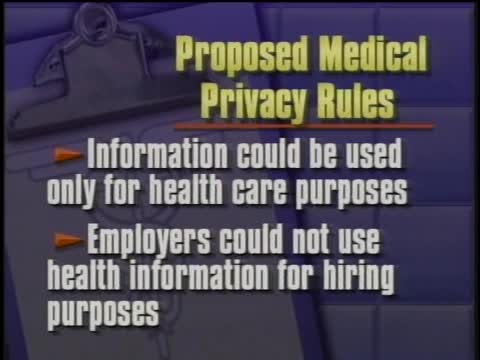
SUSAN DENTZER: In fact, one recent survey showed that more than a third of all Fortune 500 companies check someone's medical records before a hiring or promotion. And privacy experts worry that in the future, information about individuals' genetic makeup and likelihood of incurring major diseases could hurt their ability to get jobs or insurance. Congress failed to meet a self- imposed deadline last summer to pass federal legislation to protect individual medical privacy. So last week President Clinton proposed new regulations designed to provide consumers with some important new protections. Patients would for the first time have a federally guaranteed right to view and obtain copies of their medical records. They could also ask that mistakes be corrected. Health care providers and health plans would have to tell consumers how their information was being used, and to whom it was being disclosed. And in general, President Clinton said, health information could be used only for health care purposes. That means employers couldn't screen individuals' health information to avoid hiring people who'd been sick, or for snooping on them later.
PRESIDENT CLINTON: Americans should never have to worry that their employers are looking at the medications they take or the ailments they've had.
SUSAN DENTZER: But under the new regulations, providers and payers would still have broad leeway to use medical records without patients' consent. That worries some privacy advocates, who fear that patients would lose some more stringent protections they've already won through state laws and various court decisions. For their part, health plans are worried about the costs of complying with the regulations. They say these could total $40 billion over five years, or ten times what the administration predicts. Even President Clinton last week seemed painfully aware of the proposal's limits. Because of a quirk in federal law, it would only apply to records that are on or printed out from a computer, not to records that are maintained on paper.
PRESIDENT CLINTON: I think it is important to point out there are still protections-- some of them-- we can give our families only if there is an act of Congress passed. For example, only through legislation can we cover all paper records and all employers.
SUSAN DENTZER: The Department of Health and Human Services will now get public comment now for two months before final regulations are to be issued next February. They are scheduled to take effect in 2002.
JIM LEHRER: Gwen Ifill takes it from there.
GWEN IFILL: Joining me now to discuss the privacy of medical records are Janlori Goldman, director of the Health Privacy Project at Georgetown university, an organization promoting health access and quality; and Chip Kahn, president of the Health Insurance Association of America, which represents the nation's leading health insurance companies.
Miss Goldman, most Americans thought their medical records were private. They thought that when they went to the doctor and everything wasput in the cabinet, that nobody else had had access to them. What is it that the President has announced now that will change that?
JANLORI GOLDMAN: Well, I think the President has lifted this illusion of confidentiality that many Americans still have to say that we don't have a federal law to protect people's medical records. And the President took a bold step and said we're going to put enforcible rules in place so people will have the protections some believe they currently have.
GWEN IFILL: What do you mean by enforcible rules?
JANLORI GOLDMAN: Well, right now there since there's no federal law that creates rules about who can use medical information under what circumstances, it is an open atmosphere out there. People can use medical information for sale, they can use it for marketing to turn a second and third profit and people have no real control over who gets to see their medical records and what they do with the information.
GWEN IFILL: Mr. Kahn, the health insurance industry has been of two minds about the proposals in the past. But you generally think this is on the right track?
CHIP KAHN: Well, the industry has a good record in keeping records confidential. And we believe that we need some rules now with electronic availability. It will make easier access to records. And we want to make sure there are clear rules of the road. So these regulations are good. Obviously, there are some details we may have concerns about, but overall this is a needed change.
GWEN IFILL: Now, how does this work? Does the patient have to ask for their records to be kept secret, or is this something which the doctor has to offer?
CHIP KAHN: Well, no, the records are required to be kept secret. There are certain circumstances under which in these rules would you have to ask permission of the patient to use their records. And they would have to be informed as to whether or not their records were being used and for what purpose.
GWEN IFILL: Ms. Goldman, some privacy advocates have said in the past that people have been hesitating to go to the doctor. They haven't had taboo illnesses treated because they were afraid that their records might be released. How would this change that?
JANLORI GOLDMAN: Well, people really are afraid that their records are going to be misused. In fact we know that one out of every six people either lies to their doctor, or gives them inaccurate information or pays out of pocket for care, or in some cases they don't seek care at all because they are so worried the information will be misused; they might lose a job or lose benefits. And so for the first time people will know that their information is going to be handled confidentially, that they will have some control, that only for treating them and paying for their care will the information flow freely. All other uses, they will get to give their consent.
GWEN IFILL: What if that doesn't happen? What redress does a patient have?
JANLORI GOLDMAN: Well, it's one of the limits of the regulations and one of the legal constraints put on the Secretary by the Congress. They cannot sue to enforce the regulations but there are civil and criminal penalties built into the rules.
GWEN IFILL: Mr. ... I'm sorry, Mr. Kahn. Tell me again what would happen if exactly, if this fell through on the part of the provider? Say if an HMO decided to give information to a pharmacy and the pharmacy misused the information, would the HMO or other health care provider be held liable?
CHIP KAHN: Well, that's one of the issues here is that the HMO or the health plan would be responsible for the information used by downstream providers, whether it's the pharmacy or an auditor or lawyer. Now, we're concerned about exactly how that would apply. But clearly through contracts we have the ability to apply rules to people who use information down the line. So we're hoping that we will be able to provide those protections. The penalties though are fairly stiff and our companies are used to being regulated, so in this case, they obviously will want to serve the consumer and avoid any kind of penalties from non-compliance.
GWEN IFILL: What about the cost to patients, I've heard estimates of $43 billion over five years and higher health care bills?
CHIP KAHN: Any of these kinds of changes are going to cost money. They're going to affect the cost of premiums. But I also think that the issue of protection of your rights and your medical records are at a premium. And so people are going to have to pay the cost. But I think most Americans will want to do that.
GWEN IFILL: At one point, Ms. Goldman, the administration was going to allow law enforcement to have access to the records. That went away somehow in this set of proposals. Why is that? How is that?
JANLORI GOLDMAN: Well, a couple of years ago when the administration made its recommendations to Congress as to what it thought should be in the law, they said that law enforcement should have unfettered easy access to medical records without having to get a warrant or court order. And there was absolute opposition to the proposal. And I they learned, so they reversed themselves in this proposal and they now say that law enforcement does have to get a court order or warrant. However we're also concerned that this initial proposal doesn't go far enough and we'll be submitting that to them.
GWEN IFILL: Congress had a role in this or was supposed to have a role in this and it went nowhere. Why? What happened?
CHIP KAHN: Well, there are a lot of side issues. This issue of liability is one, issues related to parental notification concerning abortion. Our concern is that if Congress had acted, there would be the opportunity to have what's called preemption, where if there would be a federal rule and not the potential of 51 rules. We are concerned that there may be confusion in terms of care, in terms of application because there are different rules across the states. This regulation doesn't overdue the rules, it is in addition to the rules.
GWEN IFILL: So state rules, if they were stronger than the federal rules would still...
CHIP KAHN: Right, in terms of whether it's mental health or any other kind of rules that have been passed by states, those rules are in effect. This regulation does not affect them if those rules are more stringent than the federal rule.
JANLORI GOLDMAN: Let me add to that for a minute. There has been some concern, some of the provider groups' doctors have said, well, we are concerned that these regulations aren't going to be as strong as what we currently do. Nothing prevents doctors from doing more. Nothing prevents health plans from doing more and taking extra measures to protect the privacy of their patients. What this does is set a base line of practice, some minimum requirements that have to be put in place. And so in fact people will lose nothing under these regulations. They will only gain.
GWEN IFILL: And is there room for Congress to still step in and do more itself?
JANLORI GOLDMAN: There is a very important role for Congress. In fact, there are a number of constraints that the administration has that it cannot act. It cannotcover paper records, they can't put in a private right of action. There's a big role of for Congress to play and we hope they'll play it.
GWEN IFILL: It sounds like a gigantic loophole that she just mentioned that was in Susan Dentzer's piece that paper records are not covered by this...
CHIP KAHN: I think that's an issue ...
GWEN IFILL: ... or are the only ones that aren't covered by this.
CHIP KAHN: In terms of health plans and insurers, I think every record ultimately gets into a computer. I think over time that will remain an issue but will probably go away because the computers are the future. And paper records will soon become an anachronism.
GWEN IFILL: There was another argument against the idea of imposing the regulations and that's that it would restrict - hamstring in some way researchers' availability to find out about cures for disease by not giving them access to all the kinds of information they could have.
JANLORI GOLDMAN: Well, one of the critical pieces of this proposal is that it will create uniform rules that the same rules that NIH follows, the same rules that the Mayo Clinic follows, the same rules that all researchers follow in this country will now have to be followed by health plans and drug companies that are doing research. And so I think it will only improve the quality of research in the country. It will make people more willing to give information, to participate in research projects, if they know protections are in place.
GWEN IFILL: We talked earlier about the cost to patients. How about the cost to industry?
CHIP KAHN: Well, insurance companies provide coverage, but we have to have that coverage paid for. So all of the costs will ultimately be included in premiums.
GWEN IFILL: What's the solution? Is there a solution to that or do we just have to suck it in and assume it is going to cost more?
CHIP KAHN: If people want the extra protection and it takes more grease, it will cost more and they'll have to pay the bill.
JANLORI GOLDMAN: I think we should look at the cost savings. I mean, if people are participating more in their health care, if they're open with the doctors, if they're more honest, if they're willing to seek care right away and not be afraid of stigma and discrimination, then I think that will lower the cost of health care. People will get treated earlier, they'll get diagnosed earlier and I think there will be an ultimate cost savings there and having more reliable information.
GWEN IFILL: Briefly we know the difference between regulations in place and law passed. Where are we with this now?
CHIP KAHN: Well, this regulation hopefully will be finalized next year and will go into effect in 2002, and then it will be the law of the land as a regulation - it will be the law of the land.
GWEN IFILL: And Congress's role -- you think something can happen between now and 2002?
JANLORI GOLDMAN: I think what Congress should do is fill the gaps. They shouldn't take away the authority they've given President to issue rules but they should absolutely step in and fill the gaps.
GWEN IFILL: Ms. Goldman, Mr. Kahn, thank you both very much.
FOCUS - COMING TOGETHER
JIM LEHRER: Ray Suarez has the Catholics and the Lutherans story.
RAY SUAREZ: On October 31, 1517, the German monk, Martin Luther unleashed centuries of disputes with the Roman Catholic Church. One of the chief arguments had to do with how a believing Christian earned salvation -- through belief called justification by faith or living a good life called justification by works. Yesterday, the Catholic Church and Lutheran Churches worldwide ended the argument begun with Martin Luther. Throughout his years as Pope, John Paul II has embraced other Christian bodies while never compromising on historic Catholic teaching. This agreement may reflect that. After 482 years, the two churches declare that justification is achieved by faith, but good works matter, too. Christians are reminded to embrace an ethic of earthly duty to humanity.
RAY SUAREZ: For more, we are joined by Ulrike Strasser, Assistant Professor of History at the University of California-Irvine and a visiting lecturer at the Harvard Divinity School. And Randall Balmer, Professor of religion at Columbia University and the author of "Blessed Assurance: A History of Evangelicalism in America." Professor Strasser, let me start with you. It's interesting because any argument that lasts 500 years is bounding to interesting which it finally ends. But is this a really significant departure for these two churches?
ULRIKE STRASSER: Well, speaking of the significance, I think the way we need to look at this is more in terms of the symbolic significance rather than the sort of practical or political significance. This is, after all, an agreement between church leaders. And frankly speaking, I doubt that it will have an immediate tangible impact on the average layperson and his or her parish community. However, having said that, I nonetheless think that any kind of agreement on an issue that has kept people apart for close to 500 years, represents a major stepping stone towards further healing of a very, very deep of long lasting rift in European society.
RAY SUAREZ: Professor Balmer, did they really agree or did they just stress what they agree upon and leave aside those things that they still can't?
RANDALL BALMER: This strikes me as a significant document. I haven't had time to read it thoroughly but it seems to me the Roman Catholic Church is indeed agreeing with Martin Luther 500 years or almost 500 years after the fact, saying that we are justified by grace through faith, and that was certainly one of the touchstones of the Protestant reformation.
RAY SUAREZ: But, significantly the document also says that neither church disavows its past. They don't want to go back on anything they've said before. And they've gone at it pretty hot and heavy. It's been a couple hundred years now, but there have been some very, very strong denunciations in the past.
RANDALL BALMER: There's no question about that, particularly in the 16th century when Martin Luther feared for his life from Catholic authorities and so forth, and the wars of religion in Europe, there was a lot of hostility and has been over the centuries. I think for the Roman Catholic Church now with this document, they seem to be capitulating, it seems to me, to Luther's view of justification by grace through faith.
RAY SUAREZ: Professor Strasser, you mentioned that you didn't think that this was going to show up very much in the pews. Five million American Lutherans, sixty million American Catholics, many of them will head to church next Sunday and not know anything much is different. But many American churches and worldwide churches are in these kind of talks. Does this help open the door a little bit more?
ULRIKE STRASSER: Oh, I think it does help open the door and it is a kind of marker of progress of the ecumenical dialogue we've had for 30 years now that we actually can or Protestants and Catholics actually can see eye to eye on one of the major bones of contention of the 16th century.
RAY SUAREZ: But where does this all end? This is a long way short of a merger between these two churches.
ULRIKE STRASSER: Yes, the question would be whether a merger is desirable in the first place. I guess my perspective is more the perspective of the historians. So I look less at how this impacts the future than to my mind how it reflects how far we've come in the past 482 years.
RAY SUAREZ: Professor Balmer, what do you think about the state of relations between other churches now that big argument could be settled?
RANDALL BALMER: Well, I think there's... there are two levels. One is theological or doctrinal, and the other is institutional. I read this document as primarily theological or a doctrinal agreement, rather than any sort of organizational coalescence. But I think that the ecumenical movement certainly has been an important movement within Protestantism, not so much between Protestants and Catholics but within Protestantism within the last 30 or 40 years. There's no question about that. I question whether or not it has really significantly advanced the kingdom of God. But that's perhaps another matter.
RAY SUAREZ: Well, there are many conversations going on now between churches that aim not to bring them under a similar umbrella, but to bring them into communion with each other, to make it less difficult for couples where one is from each denomination, to marry, so that they might share the sacraments; that people who are ordained clergy in these denominations could also preach in each other's pulpits. Does this help bring that a day closer?
RANDALL BALMER: It probably does. I think that sort of unity is probably a good thing. But I do worry somewhat... I worry a great deal, in fact, about Protestant ecumenism, that is, the blending of differences theologically in particular. It seems to me that main line Protestantism in America in particular suffers appallingly from a lack of theological definition. And the ecumenical movement, this drive for theological unity, has, I think, even further diminished those differences...I think tragically so.
RAY SUAREZ: Professor Strasser, most of the world's Lutherans and Catholics are outside the United States, and we sometimes tend to look at developments like this through a very American lens. In Germany, for instance, the sort of seed bed of this 500 years of argument, a place that has fought wars over this -- are we at a point where Germany is going to pay much attention to this document?
ULRIKE STRASSER: I think Germany will. And I think that just the last perspective we had on the sense that there is a sense of a loss of plurality among Protestantism in this country strikes me as a very valid point but also as a particular American perspective, because I do think that kind of ecumenical dialogue just has a fundamentally different place in European life. If I can just for a moment also bring in my persona as someone who has grown up in one of the strongholds of Catholicism in Germany, I certainly feel very attuned to the long lasting social and political legacies of these doctrinal conflicts that were in Europe not just doctrinal but resulted in so many massive changes, so that, for example, in my hometown, in fact one could not be a resident if one were a Protestant, until the 19th century, and could not hold office until the early 20th century. So, in light of the fact that doctrines were also instruments of political exclusion, of social discrimination, to me these doctrinal changes, this coming together is a very welcome move.
RAY SUAREZ: So, when we sometimes talk in America about people not remembering their history, there are also places in the world where people remember it maybe a little too much?
ULRIKE STRASSER: Or experience it tangibly. I'm not sure whether we can remember history too much. I don't think you can expect a historian to concede that but I will say that we experience it in a very tangible way and I think that sort of unity between doctrine and political life that once existed in Europe and shaped it for centuries is just not as tangible in this late 20th century American society anymore.
RAY SUAREZ: So Professor Balmer, are you calling for more rigor? You want these differences still to matter, to hold the line against a post-denominational America?
RANDALL BALMER: Well, I don't have any particular vested interest in denominations per se, but it seems to me that since roughly 1965, America is for the first time truly a pluralistic society. We've had this rhetoric for a couple hundred years but we are truly a pluralistic society. And it seems to me as I survey the American religious landscape, in particular, and I would concede the point about other places being different, but in America, every other group, every other religious or ethnic group, has a voice, it seems to me, in the arena of public discourse. The only voice that seems to be missing as far, as I can tell, is that of main line or mainstream Protestantism. And I think it's because we main line Protestants are...or mainstream Protestants have lost our voice. We have kind of allowed ourselves to get sucked into a kind of theological amalgam that really doesn't say very much.
RAY SUAREZ: Randall Balmer, Ulrike Strasser, thank you very much, both.
ESSAY - UNOCCUPIED ROOMS
JIM LEHRER: Finally tonight, essayist Roger Rosenblatt on the work of artist Jane Freeman.
ROGER ROSENBLATT: This is the working thesis of Jane Freeman, an artist of small worlds, who for the past 13 years has been creating a way to understand one's place in one's life. Freeman creates miniature rooms that contain everything but people. Yet they are not dollhouses minus the dolls. Rather, they are undersized structures that demand oversize imaginations. We are the people inside them. And at the same time, we are outside, too. We are in and out of the vacant lot in "Night Prowl"; in and out of Matisse's studio; players and audience in her scenes from "The Magic Flute;" lingerers and observers in "Van Gogh's Bedroom." We live and do not live in the "Lower East Side Tenement;" ride and do not ride the subway in "Below the City." In all her created universe, she creates a proposition: People are outside the world they live in. This paradox seems modernist, but it goes back and forward forever. There is a great deal more than cleverness in her work, but her work is exceptionally clever. She sees small, and has a near- magical ability to discover in the larger world objects that become other things in hers: Tea bags, napkin rings, toys, scraps of wire and wood, nails. In her small studio, which she does occupy in New York's Tribeca, I asked her to detail what went into her "Subway Platform."
JANE FREEMAN: The girders are made out of shelf brackets. Heater filter backs are the fences. Bic lighters for the subway turnstiles. Orthodontia molds for the subway tunnel. There's a swatch watch up here that's the clock. There's a sink aerator here, which is perfect for the P.A. System-- looks just like it.
ROGER ROSENBLATT: That eye of hers allows her to make visual jokes-- puns-- in her work. But more important is the cosmic joke she deals with: That we never really know where we are, even when we are responsible for where we are. In any room one occupies, one is aware of part of the room, but never the whole. The room is one's life. The room is the graveyard in "Don Giovanni," or a television studio, or Rousseau's dream. Or it is the room you are in right now. You know something of what it says about you-- the biography is implied. But it is also incomplete. You don't know where you fit in, exactly. You are not sure of your place in the world, in spite of the fact that you have made or chosen that place. In a sense, then, one creates all the evidence of a life, except oneself. One goes on a lifelong hunt to find small, substantial things, like one's soul.
ROGER ROSENBLATT: Is there a spiritual element in your work?
JANE FREEMAN: Well, I think so. It's like if you go into a vast, beautiful cathedral, you become overwhelmed. I think cathedrals were designed so that we could be experiencing the dazzlement of the whole cosmos, which is really too much for anybody to take. So you go into this great big, huge cathedral, and you find something small. You find a little altar; you find a sculpture, a statue; you find a candle. And you can center yourself on that, and in so doing, without losing any of the awe, but all of the overwhelmed feeling, you find yourself. And you discover that you are not so small after all. You're quite large.
ROGER ROSENBLATT: What do you think when you get into a work of art?
JANE FREEMAN: I think I have to get out of the way. It's very much like writing poetry. I think Dylan Thomas said that they way he writes poetry was that he throws all the letters of the alphabet up in the air, and they fall down on the page in perfect order. And it's really...that's the creative process for me, too. I don't have anything in mind. I don't make sketches, I don't have plans. I want to rediscover and discover, and search and research as I go along. It's all very spontaneous.
ROGER ROSENBLATT: What Freeman does with this special form of art is to make one suddenly aware of the place of place in a life, of the effort to locate oneself on a number of levels, and we try to learn how to live. We all begin as unoccupied rooms. Freeman is openly driven by the fact that she finds the world beautiful, even when the world's rooms are spare, cold or menacing, and she discloses a beauty in every scrap she uses. Yet the unfathomable, imponderable beauty of the world lies in the people she does not create, who struggle to know where they are. Like Freeman, they too construct rooms out of everything they come upon, and then yearn to enter the lives they make. I'm Roger Rosenblatt.
RECAP
JIM LEHRER: Again, the major stories of this Monday: The coast guard gave up the search for survivors in the crash of EgyptAir Flight 990. The 217 people onboard are now presumed dead. And President Clinton met with Israeli and Palestinian leaders in Oslo, but he said he did not expect a major breakthrough in the Middle East peace process. We'll see you online, and again here tomorrow evening. I'm Jim Lehrer. Thank you, and good night.
- Series
- The NewsHour with Jim Lehrer
- Producing Organization
- NewsHour Productions
- Contributing Organization
- NewsHour Productions (Washington, District of Columbia)
- AAPB ID
- cpb-aacip/507-4x54f1n39q
If you have more information about this item than what is given here, or if you have concerns about this record, we want to know! Contact us, indicating the AAPB ID (cpb-aacip/507-4x54f1n39q).
- Description
- Episode Description
- This episode's headline: EgyptAir Crash; RX For Privacy; Coming Together; Unoccupied Rooms. ANCHOR: JIM LEHRER; GUESTS: MICHAEL GOLDFARB, Former Chief of Staff, FAA; JOHN HANSMAN, Massachusetts Institute of Technology; JACK McGEORGE, Security Specialist; JANLORI GOLDMAN, Georgetown University; CHIP KAHN, Health Insurance Association of America; ULRIKE STRASSER, Harvard Divinity School; RANDALL BALMER, Columbia University; CORRESPONDENTS: SUSAN DENTZER; RAY SUAREZ; TERENCE SMITH; GWEN IFILL; KWAME HOLMAN; BETTY ANN BOWSER; ELIZABETH FARNSWORTH; MARGARET WARNER; ROGER ROSENBLATT
- Date
- 1999-11-01
- Asset type
- Episode
- Topics
- Economics
- Social Issues
- Literature
- Global Affairs
- Sports
- Religion
- Transportation
- Politics and Government
- Rights
- Copyright NewsHour Productions, LLC. Licensed under a Creative Commons Attribution-NonCommercial-NoDerivatives 4.0 International Public License (https://creativecommons.org/licenses/by-nc-nd/4.0/legalcode)
- Media type
- Moving Image
- Duration
- 00:59:10
- Credits
-
-
Producing Organization: NewsHour Productions
- AAPB Contributor Holdings
-
NewsHour Productions
Identifier: NH-6589 (NH Show Code)
Format: Betacam
Generation: Preservation
Duration: 01:00:00;00
If you have a copy of this asset and would like us to add it to our catalog, please contact us.
- Citations
- Chicago: “The NewsHour with Jim Lehrer,” 1999-11-01, NewsHour Productions, American Archive of Public Broadcasting (GBH and the Library of Congress), Boston, MA and Washington, DC, accessed January 3, 2026, http://americanarchive.org/catalog/cpb-aacip-507-4x54f1n39q.
- MLA: “The NewsHour with Jim Lehrer.” 1999-11-01. NewsHour Productions, American Archive of Public Broadcasting (GBH and the Library of Congress), Boston, MA and Washington, DC. Web. January 3, 2026. <http://americanarchive.org/catalog/cpb-aacip-507-4x54f1n39q>.
- APA: The NewsHour with Jim Lehrer. Boston, MA: NewsHour Productions, American Archive of Public Broadcasting (GBH and the Library of Congress), Boston, MA and Washington, DC. Retrieved from http://americanarchive.org/catalog/cpb-aacip-507-4x54f1n39q