The MacNeil/Lehrer NewsHour
- Transcript
INTRO
JIM LERHER: Good evening. In the news today, President Reagan announced he will meet with Soviet Foreign Minister Andrei Gromyko September 28th. Walter Mondale said he was happy for such a meeting, but said it was pathetic it took so long to arrange. Also today, hurricane Diana continued its dangerous pass at parts of the southeastern Atlantic Coast. Robert MacNeil is away tonight. Charlayne Hunter-Gault is in New York. Charlayne?
CHARLAYNE HUNTER-GAULT: In our NewsHour tonight our major topics include a conversation with former British Foreign Secretary Lord Carrington, now head of NATO. We'll get his reaction to the proposed Reagan-Gromyko meeting and his assessment of the state of East-West relations generally. The major issue we focus on for extended debate is abortion. A Catholic bishop and a Catholic senator face off on opposite sides. And we look at the kind of political fallout the issue generates among activists on both sides. And, finally, in our essay department, Tom Pew, the editor of American West magazine, goes looking for America and finds, in his words, "not only a country but a dream."
Saying that he wants to convince the Soviet Union that the United States means no harm, President Reagan announced today that he will meet with Soviet Foreign Minister Andrei Gromyko. The meeting will take place at the White House on September 28th. It will follow talks between Secretary of State George Shultz and Gromyko in New York during the United Nations General Assembly session. The President said he issued the invitation to Gromyko because the Soviet minister's presence at the General Assembly session was too good an opportunity to let pass. The last time any Soviet foreign minister visited Washington was in 1978, when Jimmy Carter was president and when such visits were routine. Despite his previous position that such high-level talks should be preceeded by extensive and careful preparations, the President said today he had changed his mind somewhat. He said he hoped the meeting would break the impasse on nuclear arms reduction talks that have been stalled since the Soviet walkout late last year.
Pres. RONALD REAGAN: I believe it's important to use the opportunity provided by Mr. Gromyko's presence in the United States to confer on a range of issues of international importance. One of my highest priorities is finding ways to reduce the level of arms and to improve our working relationship with the Soviet Union. I hope that my meeting with him will contribute to this goal as our administration continues to work for a safer world. And -- end of statement.
REPORTER: Mr. President, first, after 3 1/2 years of very little progress in U.S.-Soviet relations, some people might consider this a political ploy on your part to answer Mr. Mondale's charges that you've been lax in this area. How would you respond to that?
Pres. REAGAN: Well, I would answer that the facts would belie any such supposition. The fact is we have proposed meetings with the Soviet Union on a number of occasions and for a number of reasons. We have not retreated from any meetings with them.
REPORTER: Mr. President, you've said yourself in the past that you think some people think you're trigger-happy, and in polls we can see this is one of the main concerns of people in this election campaign. Do you think this meeting will help people come to your way of thinking that you're not the trigger-happy cowboy you say people like to portray you as?
Pres. REAGAN: Well, the most important thing is, is to -- what understanding we can -- I can reach with Foreign Minister Gromyko to maybe convince him that the United States means no harm.
HUNTER-GAULT: Despite the President's denial that politics had anything to do with the hastily-arranged meeting, his Democratic rival. Walter Mondale, said in Chicago today that he thought it was pretty pathetic that this is taking place in the middle of an election campaign and pathetic that it took 3 1/2 years. Nevertheless, Mondale said he hopes the meeting makes progress towards peace. In another aspect of relations with the Soviet Union, President Reagan announced today that Moscow will be permitted to buy an additional 10 million metric tons of American wheat in the yar beginning October 1st. That will make a total of 22 million tons in the second year of the current five-year grain deal. An agriculture analyst said the announcement means the United States could provide as much as 8% of its grain over the next 12 months. The analyst remarked, "If there is a cold war going on, the people who sell grain to the Soviets don't know about it." Jim? Lord Carrington: Surveying the Scene
LEHRER: President Reagan was able to immediately share the joy of his Gromyko meeting announcement with a key leader from Western Europe, Peter Lord Carrington. The new secretary-general of NATO was at the White House this afternoon for a meeting os his own us. Lord Carrington became head man at NATO in June after a long career in British politics. He was Britain's defense minister in the early '70s, and was foreign minister the Thatcher government from '79 to '82, when he resigned following the Argentine invasion of the Falkland Islands.
Lord Carrington, welcome.
PETER Lord CARRINGTON: Think you very much.
LEHRER: How important is this Reagan-Gromyko meeting?
Lord CARRINGTON: Well, I think the fact it's taking place is important because there have been such discouraging signs from the Soviet Union over really quite a long period that the acceptance of this invitation in itself, I think, is important. I don't think one wants to read too much into it. I don't know that anybody would expect a great deal to come out of it, but the very fact it's taken place is encouraging.
LEHRER: You mean it's a no-lose deal, then, you think? There's nothing harmful that could come out of the fact that they are getting together?
Lord CARRINGTON: No, I don't think so at all. I think that when you come to think of what the Soviet Union has been -- the policy they've been pursuing over these last few months and the corner that they've painted themselves into, I think this is really almost the first sign we've seen of some change of policy. I think it's much too soon to say whether it really is significant or not. But I think it's encouraging.
LEHRER: You think it is a sign of a change of policy, to use your term?
Lord CARRINGTON: Well, it could be. I mean, I don't think that six months ago, if President Reagan had issued an invitation to Mr. Gromyko, Mr. Gromyko would have accepted, even though it is a customary thing, I think, until quite recently for Mr. Gromyko to see the President when he comes over for the U.N. General Assembly.
LEHRER: You heard what Charlyane said that Walter Mondale said, that it was pathetic that it took 3 1/2 years for this meeting to come off. Do you agree?
Lord CARRINGTON: You wouldn't expect me at this particular juncture in American politics to make a comment about that kind of thing. But I think in common with everybody, and Mr. Mondale said so himself, But I think it's welcome news.
LEHRER: Well, one more question about American politics. One, several political observers here suggested today that this means that the Soviets at least believe that Ronald Reagan is going to be re-elected. Is that a fair analysis?
Lord CARRINGTON: Well, you have to be a Kremlin-watcher, I think, to make a judgment about why Mr. Molotov -- Mr. Molotov!? -- why Mr. Gromyko has accepted this invitation. I think three are a number of reasons. I mean, another possibility is that after what happened last year he felt personally very wounded and is taking this opportunity to redress the balance. There are a number of possible factors.
LEHRER: Last year when they wouldn't --.
Lord CARRINGTON: Yes, when he wasn't allowed to land in New York, and I think he was very sore about that, and maybe this is one of the reasons why he wants to come and see the President. But for whatever reason it is, I think it's welcome news.
LEHRER: Do you think that -- and I realize this is all speculation, but we're not going to let that stand in our way, Lord Carrington. Do you think it's the kind of decision that Chernenko and everybody, all the big fellows in Moscow made, or the kind of thing that Gromyko under the current situation in Moscow could have made himself?
Lord CARRINGTON: Well, as you say, it's speculation. I would judge at the moment that Mr. Gromyko is really quite firmly in charge of Soviet foreign policy. But I doubt whether he would have made the decision of this kind without it being a Politburo decision. So I think it must be a Soviet decision as such.
LEHRER: What's the latest on Chernenko and whether or not he's really running things?
Lord CARRINGTON: I only know what you know, which is what I read in the newspapers and what I get from out friends who visit Moscow. I think Mr. Chernenko is obviously a sick man, but one knows so little. One of the things I find in a way rather depressing about the West generally is how little we do know about what's going on in the Kremlin. It's such a secretive society. One of the reasons why contact of any kind, even though you may not expect much to come from them, are really rather a good thing, that at least we can see what they look like and they can see what we look like, and that's helpful.
LEHRER: Well, the unwashed like us in the press have always assumed that when you were foreign secretary of Great Britain and in your position now in NATO that there is intelligence information that you all are getting all the time about what's going on in the Kremlin. Are we wrong to assume that kind of thing?
Lord CARRINGTON: People have always assumed that we're always very much better informed than the ordinary person. On those sort of matters, I mean, you get a little more information, but perhpas not so much as one would like, certainly not about that kind of thing.And that's why I would hope very much that we do have more contact with the Soviet Union, because, not to give things away, not necessarily even to negotiate, but to get contacts that mean we understand a bit more about the people there and what sort of people they are and they about us.
LEHRER: Were you as struck as everyone else will be, I'm sure, by the other announcement that Charlayne reported of the new grain deal with the Soviet Union, that things do go on?
Lord CARRINGTON: Yes. I mean, they have been going on, after all, for some considerable time. I don't think that trade -- trade is rather a good thing. I think that the administration is quite right to worry about technological transfers. I think that anything that we do to make it easier for the Soviet Union to build up their defense forces or offensive weapons, that, that must be a bad thing, and that we must look at very carefully. But I'm afraid I don't really see very much problem about giving them grain. Somebody once said a criticism about the United States giving grain and a criticism about Europe giving butter. Well, it doesn't seem much between us in that respect.
LEHRER: Before we goon to other things, in summary, though, the Gromyko thing really could be a major breakthrough, you believe?
Lord CARRINGTON: No. I think that's putting it too high. I think that our relations and your relations with the Soviet Union, and East-West relations generally are very long-haul. I think we make a great mistake in supposing that Soviet policy changes from day to day very quickly. They have a long record of consistency. And it's much easier for them and the Warsaw Pact because they run it. It's a monopoly, so to speak. We, on the other hand, in the Atlantic alliance are 16 sovereign nations.Our governments change their political complexions from left-wing socialist to right-wing. We find it more difficult, I think, as an alliance to keep and maintain a steady policy.I think as an alliance we ought to pay more attention to that, and we ought not to expect things to change in the Soviet Union quite so quickly as they change in our own countries, because I don't think that's going to happen. It's going to be a long haul, East-West relations, and we mustn't get discouraged. What we ought to do is to try.
LEHRER: But do you agree with those who say that East-West relations are at the lowest they have been in years right now?
Lord CARRINGTON: Well, I think they've been pretty low. I mean, partly as a result of Afghanistan and Poland and then the consequences of that. I think they have been pretty low. I still think that there is very much a realization on the part of the Soviet Union that nobody really can survive a war, and I think that there's been no indication that the Soviet Union because of those bad relations are going to do anything aggressive. But the fact that we have these bad relations means that we are keeping up a level of armaments which neither side really wouls wish to do, and therefore it must be in the interests of both of us to seek to get a more stable relationship if we possibly can. But it's going to take a long time, and I don't think people must get discouraged.
LEHRER: Why? Why?
Lord CARRINGTON: Well, there's no trust between East and West. It's going to take a very long time to get arms limitations talks which are verifiable and which mean something, which are acceptable. And then we've got to see whether the Soviet Union stick to their bargain and gradually over a period of time we may be able to build up a situation in which we can take much bigger steps, but we mustn't get impatient. People who talk about disarmament overnight are really whistling in the dark.
LEHRER: You've been at NATO now since June. What is your impression -- I realize this is over a short period, but what is your impression of the ability of the West, of NATO, militarily to perform the mission in Europe?
Lord CARRINGTON: Oh, I have no doubt about that. I mean, if I were in the Kremlin and were contemplating some sort of adventure against Central Europe or Europe, I would look very carefully at the capacity of NATO and decide that it really was not worthwhile. But, having said that, there are imbalances in the situation. We certainly are inferior in terms of conventional weapons to the Soviet Union in Europe, and that in itself has consequences for decisions about what to do in the event of war. And I think that we must do more to redress the balance.
LEHRER: We're too dependent on nuclear, you believe?
Lord CARRINGTON: Well, that's right. I mean, the less powerful your conventional forces, the sooner you have to make up your mind about whether or not to use conventional weapons. And obviously deterrent forces -- it's better to have conventional weapons than to rely on nuclear weapons too soon. Therefore, it's all a part of the deterrent, and I think we've got to more in Europe in redressing that balance and getting more conventional weapons.
LEHRER: Finally, a person question. When you resigned as foreign minister over the Falklands thing, you became a folk hero of the United States because --
Lord CARRINGTON: Really?
LEHRER: Yeah. You didn't know that? Well, because --
Lord CARRINGTON: Quite a lot of places I wasn't a hero.
LEHRER: The reason was that we say we have a no-fault government here, and here you took responsibility for a policy decision and you stepped aside because of that. Well, looking back on that decision, any regrets about it? Any thoughts now, some many months, years later?
Lord CARRINGTON: Oh, I have a regret that I had to do it because in my -- you know, I've always wanted to be the foreign secretary of my country and enjoyed it very much. And I regret the need for doing it. But I don't regret having done it. I think in the circumstances, when your country is in considerable difficulty, when you really are going to go to war 8,000 miles away from your home base, it's a great mistake for somebody to stay in a position where he is criticized and people are asking why it happened and blaming him before they know whether it's true or not. I think people have to go united into a situation of that kind, and I think I was right to resign, but I can't pretend I enjoyed it very much.
LEHRER: Lord Carrington, thank you very much. Charlayne?
HUNTER-GAULT: Hurricane Diana was hovering off the coasts of North and South Carolina late today carrying winds of up to 130 miles an hour and pushing heavy rain as far as 80 miles inland. The course of the storm was wavering and it was not certain whether it would strike the shoreline. The land area most immediately threatened was the coastline between Myrtle Beach, South Carolina, and Wilmington, North Carolina. Hurricane warnings were in effect all along the coast and people were urged to move out of the barrier islands and beach resorts. The National Weather Service has designated Diana as a dangerous storm.
A storm off the coast of Belgium split the hull of a French ship that sank last month with a cargo of 30 containers of radioactive material called uranium hexafluoride.New divers and salvage crews are trying to determine whether the containers with radioactive material have drifted away from the wreck. One container did wash ashore, but it turned out to be one that never contained any of the material. Here is a report from Peter Gould of the BBC.
PETER GOULD, BBC [voice-over]: By daylight it was clear that the Mont Louis is now being ripped apart by the sea. After being battered by Channel storms, the ship appears to have broken in two. It's the last thing the salvage team wanted.The danger now is that the barrels of radioactive material will spill out of the wreck and be scattered on the seabed.The French manufacturers insist that the barrels are so strong they will not break open. But even if they're right, it will be much more difficult to recover the barrels if they are washed out of the hold as the ship breaks up. The fears of antinuclear protestors were heightened during the night when one barrel was washed ashore on a beach near Ostend.The label on the barrel left no doubt that it was a uranium hexafluoride container from the Mont Louis. It was found by a local defense unit and the recovery operation was filmed by Greenpeace. But it seems this was one of a number of empty barrels being carried by the vessel, which would explain why it floated ashore.
HUNTER-GAULT: And, in the Persian Gulf, two more ships were reported to have been damaged.Iraq said its warplanes hit two oil tankers near the Iranian oil terminal at Kharg Island. Lloyds of London said one of the ships was a 250,000-ton supertanker loaded with crude oil. Jim?
LEHRER: Up to 10,000 Vietnamese political prisoners may be headed toward the United States. Secretary of State Shultz said today that was a Reagan administration immigration goal. He told a House subcommittee the administration also wants to admit Asian children who have U.S. servicemen fathers and their family members now in Vietnam. Shultz said the refugees are of particular humanitarian concern to the United States because of their undisputed ties to this country. The resettlement will be discussed next month when U.S. and Vietnamese diplomats meet in Geneva. Charlayne?
HUNTER-GAULT: Still ahead in the NewsHour is our major issue topic tonight, abortion, with a Catholic bishop and a Catholic senator at odds, along with two activists on each side of the issue giving us a sample of the heavy political fallout. And we'll hear from a man who found his dream roaming around the American West.
[Video postcard -- New York, New York]
HUNTER-GAULT: Little has changed since yesterday in President Reagan's low-key response to Walter Mondale's deficit-cutting plan. During a brief news conference at the White House, where the President clearly had other things on his mind, he dismissed Mondale's plan as a tax-increase plan.
Pres. REAGAN: I don't think he's really submitted a budget, or a deficit-reduction plan. I think he's submitted a tax plan, a tax-increase plan. In fact, the only real specifics, three specifics there, have to do with taxes. We believe that the deficit will be reduced by continued growth of the economy and by getting control of spending to where it does not increase faster than the increase in revenues from the growth in economy.
HUNTER-GAULT: But Mondale, campaigning before a group of toolmakers in Chicago, continued to press his demand that President Reagan produce a more specific budget deficit-reduction plan of his own. While he also told the audience that Reagan deficits are destroying America's ability to compete overseas, he hit hardest on his challenge to Reagan to be specific about what he would do about taxes and the deficit.
WALTER MONDALE, Democratic presidential candidate: Now, yesterday Mr. Reagan said, "No problem, no plan, let's wait until after the election." Well, that's not going to wash. Americans know it is a problem, a deep and profound problem, one that can destroy and is destroying your business and the thousands of jobs and the nation's security. The American people want leadership, not salesmanship.The American people know that this is a problem and they want to be trusted. Joe Louis once said something I'd like to quote to the President, if I might, and that is, "You can run but you can't hide." Thank you very much. Thank you. Issue and Debate: Abortion
LEHRER: Vice President Bush today became the latest candidate officeholder to get snarled by the abortion issue. At a news conference in Charleston, South Carolina, Mr. Bush was asked if he favored abortions for victims of rape. "Do I personally? Yes," he replied, an answer which puts him at variance with President Reagan, who opposes abortions for any reason. The Bush question grew out of his professed desire to remain silent on the flap between his opponent Geraldine Ferraro and Archbishop O'Connor of New York.The archbishop accused Ms. Ferraro of misstating the Catholic position on abortion, a charge denied by Ms. Ferraro. The two talked on the phone yesterday and agreed to disagree.Senator Edward Kennedy weighed in on the Ferraro side of the argument in a New York speech last night. He spoke specifically to another O'Connor point, that Catholic politicians cannot separate personal views on abortions from their public life. Ms. Ferraro and Governor Mario Cuomo, among other Catholic politicians, disagree. Here's what Kennedy said about it.
Sen. EDWARD KENNEDY, (D) Massachusetts: Religious leaders may say anything they feel bound in conscience to say, but they may not ask government to do something which it cannot do under the Constitution or the social contract of a pluralistic society. Where decisions are inherently individuals ones or in cases where we are deeply divided about whether they are, people of faith should not invoke the power of the state to decide what everyone can believe or think or read or do. In such cases, cases like abortion or prayer or prohibition or sexual identity, the proper role of religion is to appeal to the free conscience of each individual, not the coercive rule of secular law. Archbishop O'Connor surely has every constitutional right and, according to his faith, a religious duty, to speak about abortion.And just as surely Geraldine Ferraro and Mario Cuomo are equally right that faithful Catholics serving in public office can agree with his morality without seeking to impose it across the board and imposing it in such a way that seeks to deny the freedom of others to control the uniquely personal parts of their own lives.
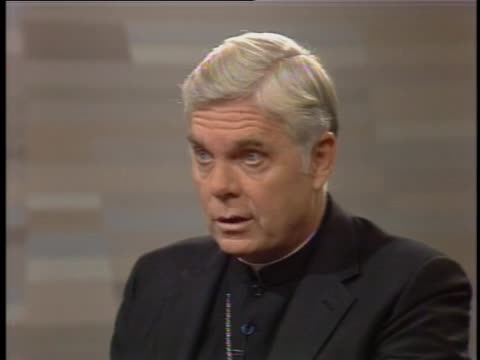
LEHRER: All of this is by way of introducing one of our major issue and debate segments on the question of abortion. There is no issue where politics and religion mix and clash more head-on, where emotions and opinions run hotter and stronger. The Kennedy-Ferraro-O'Connor argument over personal views and public politics is where we begin, first with Archbishop Bernard Law of Boston.
Archbishop, is it permissible for a Catholic politician to support abortion rights for others?
Archbishop BERNARD LAW: Well, I would say that it is not logically permissible for any responsible public official to support abortion. I would phrase the problem differently, perhaps, than either Senator Kennedy or others who have spoken to it recently. I don't see this as a religious issue. I would quite agree that it would be totally inappropriate for religious persons to try to impose positions of faith by law. But I don't see abortion that way, nor do many other citizens see abortion that way. It's a matter of an inalienable right to life. And the attempt to isolate this issue in a religious ghetto and then say that it is off limits for public policy seems to us to be logically inconsistent. Obviously I would not urge, as a citizen who happens to be a Catholic, that Catholic points of faith be legislated by the federal government or by the state government. But that isn't what is at issue. To be sure,the Catholic position on abortion is quite clear, quite consistent, quite unmistakeable. But at the same time, I would argue, as a citizen of this nation, that that faith position happens to coincide with a far longer tradition of jurisprudence in our nation. It happens to coincide with the medical evidence. It happens to reflect most adequately that basictriad of the inalienable rights of life, liberty and the pursuit of happiness. And if you take the right to life, then where are you?
LEHRER: All right, but what do you say then to the Catholic politician, the Cuomo, Ferraro, Kennedy, Mitchell -- go down the list -- who say, "Yes, I am a Catholic and I believe in the Catholic view on abortion; however, I am unwilling to vote for legislation in my public life that would further that"?
Archbishop LAW: I would say the same thing to a Catholic politician who would say that as I would say to a Protestant or to a Jewish or to a politician of no religious persuasion. I would say, "That's fine, what your personal belief happens to be, but what we're talking about is a fact, a fact of life. We're talking about the fact that 1.5 million human beings are deprived of the right to life, with the sanction of a very bad Supreme Court decision, each year." That is a fact which affronts the conscience of humankind. It isn't a fact that particularly confronts only a Catholic conscience or a certain Jewish conscience or a certain Protestant conscience. And I think that the importance of this moment is that at last, please God, we can get abortion off the back burner of those off-limits issues that are particularly religious, which it is not, and get it into the forefront of public discussion, where it belongs.
LEHRER: From your own personal perspective, is this the single most important issue on public agenda?
Archbishop LAW: Well, as you well know, the bishops of the United States, in an issue on public responsibility, have isolated 14 issues which we see as critical, and of those 14 we have focused in on nuclear arms control and abortion as the critical issues for us at this moment. The Conference of Bishops, the Catholic Church, as indeed other church bodies and religious bodies in this country, are known in their long history of advocacy for human rights -- from civil rights legislation, certainly the Pastoral on war and peace. Personally -- personally -- it seems to me, and I speak now not for the Conference of Biships but as one member of that body, personally it seems to me that logic would dictate that the issue of abortion is a key issue for the simple fact that it deals with the right to life. Nuclear holocaust is a future horrible possibility; the killing of 1.5 million unborn each year is a present reality. And it seems to me that logic demands that we attend to that. And if not now, when?
LEHRER: Archbishop Law, thank you. Charlayne?
HUNTER-GAULT: We get some insight now into how Catholic politicians deal with the dilemma of having their religious beliefs in conflict with their interprestation of the Constitution. Senator George Mitchell is a Democrat from Maine and a Catholic opposed to abortion.He resolves the dilemma, and that's one of the things we find out about from him now.
Senator, how did you resolve that dilemma?
Sen. GEORGE MITCHELL: Well, I have voted against an amendment to the Constitution to prohibit abortion.I alo oppose the government funding of abortions. That's a position that enables me to antagonize both sides in the debate. But I believe, as the bishop has said, that this is a legitimate area of public discussion. I think that he quite rightly identifies it not only as a Catholic issue but as an issue that affects all of us. I simply don't believe that the proposals to amend the Constitution would in any way achieve the objective sought, and in fact would probably cause more problems than they solve.
HUNTER-GAULT: The bishop says thisis not a religious issue. How do you see it?
Sen. MITCHELL: Well, I'm a Catholic. I'm a practicing Catholic. And I believe very deeply in my faith. I'm also a public official. I am very much aware of and concerned about the views expressed by the Catholic Church, but when I act in a public capacity ti Must take those into account. I must also take into account my own conscience, and I must also take into account the views of the people I represent and, indeed, the people of the entire country. There is no single standard. I don't think it is exclusively a religious isue. I think it is an issue that involves and should be he subject of public debate and discussion in this country.
HUNTER-GAULT: When you discuss this issue and confront your constituents and other voters, does that present problems for you?
Sen. MITCHELL: Well, it certainly does. There is no issue on which there is greater intensity and emotion on both sides, and I might also say unfortunately there is no issue on which minds are more closed and less receptive to even hearing a contrary point of view. But I raise it in meetings all over the state.I have held dozens and dozens of public forums. I've met with groups on both sides. I've met with religious leaders on both sides, and I engage in a pretty frank discussion. I've also read several books on the subject that presented to me by both sides. I'm aware that it's been an issue for as long as there has been civilized society, and will continue to be one for years to come.
HUNTER-GAULT: So you agree with the Bishop that this is really going to be a cutting-edge issue in this election?
Sen. MITCHELL: I don't know if it will be a cutting-edge issue. It is an important and tense issue to some people, but I don't think that the majority of Americans would agree with the Bishop's order of priorities in terms of importance. I think an overwhelming majority of Americans feel that the nuclear arms race and the possibility of a nuclear conflagration is a much more important issue for public debate and discussion than is the question of abortion.
HUNTER-GAULT: How do you respond to what the Bishop just said about the legislation? He says that what you're dealing with is -- I mean, it is the law, but he says that you're dealing with a bad Supreme Court decision that in effect affronts all humankind. I mean, you have to deal with this with your constituents. How do you react to that kind of statement?
Sen. MITCHELL: I am a former federal judge, and I am the first to acknowledge that judicial decisions can be wrong. I don't happen to agree with the Bishop's characterization of the Supreme Court decision, but I respect his right to hold and articulate his point of view. And I would never take the position that just because something has been stated by the Supreme Court, therefore it is somehow engraved in stone and not to be the subject of debate, challenge and possible future change.
HUNTER-GAULT: Well, why do you think the bishops have taken such an aggressive public position on this now?
Sen. MITCHELL: I think they believe very deeply in the issue. I think they are properly expressing their point of view and, of course, prior to an election is the appropriate time to attempt to influence the views of those who are seeking and holding public office. I think that's very much in the American tradition, and he's an American citizen, just like you and I, and he's got a right to press his point of view on the electorate and on candidates for office.
HUNTER-GAULT: And you have a right to disagree?
Sen. MITCHELL: Absolutely.
HUNTER-GAULT: Thank you. Jim?
LEHRER: And would you, Archbishop Law, urge the voters of Maine not to vote for Senator Mitchell because of the position he just stated on abortion?
Archbishop LAW: Well, first of all, I wouldn't urge the voters of Maine or of Massachusetts to vote or not to vote for any individual.
LEHRER: Why not?
Archbishop LAW: Because I think it inappropriate for me as a bishop to do that in this free society. I think it is more appropriate for me to do what I've been attempting to do and what the Conference of Bishops has been attempting to do for years and years, and that is to address the issues. It happens to be a very teachable moment for this precise issue, and I thank God for that. But may I say that, with rguard to the Senator's position, as I understand it, Senator, you agree that abortion is a matter of a right issue, it's a human rights issue. You say that it is appropriately an issue for public policy. You do not see it as exclusively a religious issue. Therefore, you do not buy the -- I presume, from what you're telling me -- that you do not buy the position that this is a matter of only personal morality, but it does impact public policy. You say that you're not for a constitutional amendment. Now, that's a matter of how do you implement it, prudential judgment. And I think that people -- the important thing, from my perspective, is in the debate is that it be established that this is an issue of human rights and it is an issue that public policy is competent to act upon.
LEHRER: Let me ask the Senator.
Archbishop LAW: I wouldn't have a basic difficulty with him -- I think he's wrong, but he has a right to be wrong on that.
Sen. MITCHELL: May I just say in response to that that it is a matter of public debate. That of course leaves open the possibility of acting or not acting on something if one perceives that the consequences of action provide greater risk than the consequences of inaction.
LEHRER: Let me ask you this, Senator. Is Archbishop Law and Archbishop O'Connor of New York and others who have spoken out on this, are they copping out when they say they're really not, as the Archbishop just said, I'm not trying to tell the people how to vote. He's telling the people how to vote, isn't he?
Sen. MITCHELL: I don't think he is.
LEHRER: Or suggesting it very strongly?
Sen. MITCHELL: Well, it may be, and there may be some people who are greatly influenced by his position. I am one. He is an archbishop in the church to which I belong, and I have great respect for him and his views, and my own bishop in Maine. I would make this point, though.They stressed 14 issues, and I think if the voters of Maine looked at the 14 issues and looked at all of my views on those, they would find that my position is in agreement with those of the bishops in an overwhelming majority of them. What happens is the abortion issue always tends to rise to the top and everything else is subodinated.
Archbishop LAW: Could I get into it?
LEHRER: Sure.
Archbishop LAW: I also think it's important to point out that this is not a partisan issue. In the great state of Missouri, from whence I have just come, the two excellent senators of that state, one a distinguished Democrat and one a distinguished Republican --
LEHRER: That's Senator Danforth, the Republican; Senator Eagleton, the Democrat.
Archbishop LAW: Right, yes, one a Catholic, one an Episcopalian. Both are strongly pro-life. And you know, my profession believes in the possibility of change, so I would hope that in addressing the issue we would be addressing not only voters but also candidates, and that they would see that this need not be a partisan issue.
Sen. MITCHELL: Well, I just -- my one comment to the Bishop would be that it is not only important how a candidate stands on a particular issue because no one can now foresee what issues will arise in the next two, four or six years. It is also important to evaluate, and especially people involved in religion and faith, should recognize morality, judgment, character, integrity and other matters. There are many public officials in this country who I would score way down on those issues who happen to take a pro-life position. And I think the Bishop would agree that a Catholic voter ought not just to say, "Well, if this fellow is against abortion, I ought to vote for him, and this fellow is for it, I ought to vote against him." You've got to look at a lot more than just the position on one issue.
Archbishop LAW: And I would agree that you have to look at a lot more. I would also say that realistically in our system that it would be a straw man or a straw woman that one would be constructing that would be right on one of those 14 issues and wrong on 13; right on 13 and wrong on one. But that the margin of difference on many of these issues is not in terms of principle and orientation, but it's more terms of the matter of prudential judgment as to how to best accomplish a desired end that both would agree to. I think in the question of abortion, however, it's much less easy to introduce a distinction.
LEHRER: But Senator Mitchell, would you agree with the position that we heard Senator Kennedy give on the tape and the position of Governor Cuomo and Congresswoman Ferraro, that it is possible to even go further than you have as a Catholic and still remain a good Catholic and still be a good public official?
Sen. MITCHELL: Oh, absolutely. I believe that very deeply. I think I am a good Catholic, and I think I'm a good public official, even though I don't agree with the Bishop or others on this particular issue. I think you have to go, as I said, beyond that, and I think you have to remember one other thing, that there are profound problems in this country and the world involving people who are today alive, and if Christ's message can be summed up in two words, it is love and charity. And while we must be concerned about the issue that the bishop raises, because it is a serious profound issue, we must also be concerned about the fact that there are 35 million Americans in poverty and people starving all over the world.
Archbishop LAW: The point is that we are involved with an issue of people who are alive when we're involved with the abortion issue. Don't consider them otherwise.
LEHRER: Archbishop Law, Senator Mitchell, thank you both very much. Charlayne?
HUNTER-GAULT: The abortion argument is not only going on at the national level, as we'll see now when we talk with two long-time abortion activists at the state level. They are Laura Cohen, Missouri coordinator for the National Abortion Rights League, the nation's leading advocacy group on that side, and she joins us tonight from St. Louis. In addition, for an opposing view, we have Marianne Rea-Luthin, past president of the Massachusetts Citizens for Life and an 11-year veteran of the so-called "pro-life" movement. She joins us from the public television studios of WGBH in Boston. Starting with you in Boston, do you think that the voters are going to see abortion as the overriding issue in the campaign this year?
MARIANNE REA-LUTHIN: I think certainly in the Commonwealth of Massachusetts voters will be looking at abortion very seriously. We're a very overwhelmingly Democratic state which in 1980 was won by President Reagan. We have many long-time Democrats who are very concerned that their party has apparently left them on this most crucial issue to them.
HUNTER-GAULT: Ms. Rea-Luthin [sic], what do you see?
LAURA COHEN: I don't think it is single-issue campaign. I think what we're going to see is people considering the issue of abortion and also the issue of the Supreme Court, but I think there is a lot of issues around peace and justice that are going to be taken into consideration in voters' minds.
HUNTER-GAULT: But how imortant is this issue going to be, do you think? I mean, is it going to be enough to change somebody's minds to affect the way they regard a candidate and so on?
Ms. COHEN: I don't think it will be. I think what we have here in Missouri is several pro-choice candidates who have run on a statewide level and have been very successful in that. So I think that that issue in and of itself will not be the determining factor in this election in Missouri.
HUNTER-GAULT: And you agree with that also in Boston, Ms. Cohen?
Ms. REA-LUTHIN: I think we have our names confused a little bit.
HUNTER-GAULT: I'm sorry, right. Ms. Rea-Luthin?
Ms. REA-LUTHIN: Boston is pro-life, yeah. We feel very strongly that the people of the Commonwealth are deeply concerned about abortion as an overriding issue. As the Archbishop mentioned earlier, this really isn't a religious issue. It's a human rights issue. And if one really believes that abortion involves the taking of an innocent human life in a very painful way, then of course it has to be an overriding issue. And I think that's our concern with many political leaders who say that they're personally opposed, yet every time they vote in Congress or in the state legislature they consistently vote pro-abortion. That is the record of Mrs. Ferraro and Mrs. Kennedy [sic], and there's a deep, deep concern that these politicians are not being logical and consistent in their position.
HUNTER-GAULT: How do you see it in St. Louis?
Ms. COHEN: Well, we feel that they are being consistent with their personal views, which says that they don't believe in abortion personally, but they don't feel that they have the right to impose their personal beliefs on public policy, and we support that position as our organization.
HUNTER-GAULT: Do you think that the Ferraro position is going to hurt Mondale at all in this?
Ms. COHEN: I think it's going to help him and help the Democractic ticket. The majority of people in this country are pro-choice, and I think that having a pro-choice candidate run with a woman as well on the ticket will help him.
HUNTER-GAULT: What do you say to that, Ms. Rea-Luthin?
Ms. REA-LUTHIN: I would of course have the opposite opinion. We have consistently seen long-time Democrats who are deeply, deeply concerned about Mrs. Ferraro's strong proabortion position. I think if you punched into a computer and tried to find the representative in Congress who had the strongest pro-abortion record, it would be Mrs. Ferraro. And, again, for a congresswoman who claims that she personally opposes abortion because ostensibly it destroys an innocent human life, but then to go and say that she can't impose her morality on the public seems somewhat inconsistent. You know, I've never heard that argument used on any other issue. I've never heard a candidate for public office say, "Well, I'm personally opposed to war," but then when that person was elected and going to Congress vote for every armaments measure that came through the legislature. It just doesn't happen on any other issue except abortion.
HUNTER-GAULT: Well, you are involved with voters, I gather, in your state. When you deal with them on this issue, is that how you lay it out? I mean, do you lay out the candidates who have taken what you assume are pro-life positions and say that they have to be dealt with at the polls?
Ms. REA-LUTHIN: Well, most of our political effort is really an educational effort. I'd say probably 80% of our time and effort goes into educating the voter to exactly what the voting records of congression are on the issue. Again, it's very easy for a politican to say I'm personally opposed to abortion, but what the voters want to know is not what you say but how you vote, and that's why I think we have been so successful here in Massachusetts for the past 10 years, where we've been able to educate the voter on the records, not on the public statements.
HUNTER-GAULT: Ms. Cohen, how do you deal with that issue?
Ms. COHEN: Well, we too provide information to voters on candidates' positions on the right to choose, which is how we see the issue, as an issue of choice, not of being proabortion. And we feel that the climate does support pro-choice candidates here in Missouri and nationwide so we're not afraid and we encourage politicians to take pro-choice positions, that they don't have to be afraid of that issue.
HUNTER-GAULT: What makes you feel that the climate supports that?
Ms. COHEN: Because we have had pro-choice candidates run statewide in Missouri and win.
HUNTER-GAULT: Do you feel the climate is that way, Ms. Rea-Luthin?
Ms. REA-LUTHIN: Certainly not in Massachusetts at the local level. Our state legislature, which is known across the country for taking very liberal and progressive stands on many social issues, has consistently voted pro-life. Abortion did not come into being in this country through national referendum or through the votes of state legislatures.It was imposed by seven [sic] men on the Supreme Court.
HUNTER-GAULT: Well, how do you deal with that? I mean, you head what the Bishop said. Is that how you deal with voters, saying that you're dealing with a bad Supreme Court decision and that hs to be factored in? I mean, how do you --
Ms. REA-LUTHIN: Of course. See, many people even 11 years after the decision don't realize that the Supreme Court legalized abortion on demand up until the day of birth. Many people are still under the assumption that the Court just said in certain circumstances, perhaps during the first trimester of pregnancy, that abortion was allowed. But the Court has swung the door open so that there are a million and a half abortions performed every year, many of them, at least in this Commonwealth, at the taxpayers' expense.
HUNTER-GAULT: Ms. Cohen, do you feel the voters just don't understand what's happening here?
Ms. COHEN: No. I feel like the voters understand it perfectly, and that what the issue is, is preserving a woman's right to choose abortion, that what we don't currently have abortion on demand in this country, we never have. From the beginning of the 1973 Supreme Court decision abortion has been regulated and it continues to be so.And what the issue is here is whether or not it is going to remain legal. We're not really talking here about stopping abortion. Abortion has existed probably since the beginning of time. What we're talking about here is keeping abortion legal and safe.
HUNTER-GAULT: Well, how do you feel about the role of the Bishops in all of this?You heard what Bishop Law had to say about this. I mean, do you think this is an appropriate position for the Bishop as well as the Church to be taking now?
Ms. COHEN: Well, I feel that every religious community has its principles and that they have every right to preach those principles to their members. And I feel that if that's what the Catholic Church does, that's certainly within the boundaries of what is acceptable, I feel, in our society, but I don't feel, and I don't think a majority of Catholics or any religious group feel that they have to accept and vote by what their religious leaders say. I think that it's been shown that most people make up their own minds.
HUNTER-GAULT: Ms. Rea-Luthin, there is a national poll that says that 65%of Catholics favor some form of abortion rights. Are the polls just wrong?
Ms. REA-LUTHIN: Well, I could show you polls giving you any answer you want to any question depending on the wording. I think the only valid poll that we have is the poll at the voting booth, and consistently throughout the country we've voted pro-life state representatives, pro-life federal legislators, and that is really the challenge before us.
HUNTER-GAULT: And I would assume from what both of you have said that you both agree that this is a healthy discussion that's going on now. In a word, Ms. Rea-Luthin?
Ms. REA-LUTHIN: Most certainly.
HUNTER-GAULT: And Ms. Cohen?
Ms. COHEN: Yes, although I hope that we settle the issue and begin to remove it from the political arena.
HUNTER-GAULT: All right.Well, thank you both for being with us. Jim?
LEHRER: There was a gathering of Democrats at the Republican White House today. Senator Edward kennedy, former party chairman Robert Strauss and Joan Mondale, wife of presidential candidate Walter Mondale, among others, were there. They watched Republican President Ronald Reagan present a gold congressional medal to the widow of former Senator, Vice President and presidential candidate Hubert Humphrey. Mr. Reagan said Humphrey, who died of cancer in 1978, was one of the great happy warriors of American politics.
Pres. REAGAN: He loved justice. He believed our Constitution is a living document that is rebom every day. He was a passionate democrat -- small d and big D -- who tried to make the world better according to his lights.And no one was better than he at infusing his followers with a fighting spirit.
MURIEL HUMPHREY BROWN: Today, with this great tribute this is a continuation of that celebration of that man's life. He was one man who changed -- made a great change in the life of our country.
LEHRER: Again, the major stories of the day. Soviet Foreign Minister Andrei Gromyko will come to Washington September 28th for a meeting with President Reagan. The meeting, just five weeks before the November 6th Presidential election, will be the first between Mr. Reagan and a high Soviet official. Walter Mondale said the meeting was great but said it was pathetic it took 3 1/2 years to arrange.
Also, hurricane Diana, with its 125-mile-an-hour winds, continued to move slowly up the East Coast of the United States, still not coming ashore, but remaining a dangerous threat to do so along the coast of North Carolina.
Charlayne? Following a Dream
HUNTER-GAULT: Even as the summer is ending, there are no doubt many Americans looking back wistfully on how they spent their summer vacations. Prominent among them it Tom Pew, the editor and publisher of American West magazine. Back in his home town of Tucson, Arizona, without prompting from a teacher who always seems to want such an essay when school starts, Pew wrote one which he calls "Not Only a County, but a Dream."
TOM PEW [essay]: There are moments in the West when the place, the rise of some mountains, the curve of an evening road, a little town with side-trotting dogs crossing the dusty main street, can jolt us with a certainty that we'd rather be alieve right here and now than anywhere else on earth at any time whatever. So far as I know, we Americans lack an entirely adequate word to describe the feeling I'm trying to touch here. The Welsh have a word for it, though. It's something called hiraeth, and it's described as a kind of never-to-be-satisifed yearning, something between having been there before and a revelation, something with which Welsh folk contemplate their own landscape and their presence within it.
I could recite one of those "Roots" essays here saying that my sense of rightness at being alive here and now in this place derives in some mysterious way from my own Americanized, transplanted, mostly forgotten Welsh origins. But I prefer to believe that this application of hiraeth is more a native American brand of yearning and wanting to belong to a strictly American landscape.
It certainly was a yearning for an American place I discovered last summer when, for a month and 5,000 miles that began and ended in my hometown of Tucson, Arizona, my family and I drove north and west nd then followed the Pacific Coast of the United States south, taking in the back roads of a part of the country we'd barely touched before.
Although there is precious little land, even in the American West, that can be truly described as untouched, the deeper one follows the byways into the heartland of the Southwest, the northern plains states and the Pacific Northwest, the more of the Walter Lippman sense of this nation we still find ourselves in, the place he meant when he said, "America has always been not only a country but a dream."
As for the strictly native flavor of the place, there is even a kind of instant place-name poetry in the towns and villages where we stayed the night or more along our way: Flagstaff, Zion, Salt Lake, Boise, Yakima, Seattle, Port Townsend, Quinault, Brush Prairie, Yahats, Gold Beach, Ashland, Little River, Monterey, Santa Barbara, San Diego, Tucson. The native or the traveler to these same places will recognize in the solid road lines that connect the towns on our map of words and pictures stretches of desert and long valleys, glacier-cut mountains and seascapes out of reach of adjectives to flesh out the memories.
There will be places along the way where one feels ashamed for what we have done to our land. There are others where one imagines it's possible for just an instant to sense the presence and share the rush of promise and renewed hope the American land has given generations who knew and know America is the dram as well as the country.We'd rather be alive right here and now than anywhere else on earth at any time whatever.
HUNTER-GAULT: Good night, Jim.
LEHRER: Good night, Charlayne. And we'll see you tomorrow night. I'm Jim Lehrer. Thank you and good night.
- Series
- The MacNeil/Lehrer NewsHour
- Producing Organization
- NewsHour Productions
- Contributing Organization
- NewsHour Productions (Washington, District of Columbia)
- AAPB ID
- cpb-aacip/507-319s17t83t
If you have more information about this item than what is given here, or if you have concerns about this record, we want to know! Contact us, indicating the AAPB ID (cpb-aacip/507-319s17t83t).
- Description
- Episode Description
- This episode's headline: Lord Carrington: Surveying the Scene; Issue and Debate: Abortion; Following a Dream. The guests include In Washington: PETER Lord CARRINGTON, NATO Secretary-General; Archibiship BERNARD LAW, Diocese of Boston; In New York: Sen. GEORGE J. MITCHELL, Democrat, Maine; In Boston: MARIANNE REA-LUTHIN, Past President, Massachusetts, Citizens for Life; In St. Louis: LAURA COHEN, National Abortion Rights Action League Missouri Charter. Byline: In New York: CHARLAYNE HUNTER-GAULT, Correspondent; In Washington: JIM LEHRER, Associate Editor; Reports from NewsHour Correspondents: PETER GOULD (BBC), over the English Channel; TOM PEW, on the road
- Date
- 1984-09-11
- Asset type
- Episode
- Rights
- Copyright NewsHour Productions, LLC. Licensed under a Creative Commons Attribution-NonCommercial-NoDerivatives 4.0 International Public License (https://creativecommons.org/licenses/by-nc-nd/4.0/legalcode)
- Media type
- Moving Image
- Duration
- 00:59:59
- Credits
-
-
Producing Organization: NewsHour Productions
- AAPB Contributor Holdings
-
NewsHour Productions
Identifier: NH-19840911 (NH Air Date)
Format: U-matic
Generation: Preservation
Duration: 01:00:00;00
-
NewsHour Productions
Identifier: NH-19840911-A (NH Show Code)
Format: 1 inch videotape
Generation: Master
Duration: 01:00:00;00
If you have a copy of this asset and would like us to add it to our catalog, please contact us.
- Citations
- Chicago: “The MacNeil/Lehrer NewsHour,” 1984-09-11, NewsHour Productions, American Archive of Public Broadcasting (GBH and the Library of Congress), Boston, MA and Washington, DC, accessed April 1, 2026, http://americanarchive.org/catalog/cpb-aacip-507-319s17t83t.
- MLA: “The MacNeil/Lehrer NewsHour.” 1984-09-11. NewsHour Productions, American Archive of Public Broadcasting (GBH and the Library of Congress), Boston, MA and Washington, DC. Web. April 1, 2026. <http://americanarchive.org/catalog/cpb-aacip-507-319s17t83t>.
- APA: The MacNeil/Lehrer NewsHour. Boston, MA: NewsHour Productions, American Archive of Public Broadcasting (GBH and the Library of Congress), Boston, MA and Washington, DC. Retrieved from http://americanarchive.org/catalog/cpb-aacip-507-319s17t83t