The MacNeil/Lehrer NewsHour
- Transcript
MR. LEHRER: Good evening. I'm Jim Lehrer in Washington.
MR. MacNeil: And I'm Robert MacNeil in New York. After the News Summary our lead story comes from the world AIDS conference in Amsterdam. The head of U.S. AIDS research and a critic debate U.S. policy. Correspondent Tom Bearden reports on the administration's new anti-drug program called "Weed and Seed." Finally, a conversation with Czechoslovakia's ambassador on her country's short life as one nation after Communism. NEWS SUMMARY
MR. MacNeil: After a week of being bashed by the Democrats, President Bush today struck a few blows of his own. He accused Bill Clinton of stealing one of his campaign lines when Clinton said, "We have changed the world; now it's time to change America." Clinton used the line in his acceptance speech to the Democratic Convention. Mr. Bush saved his harshest criticism for the candidate's economic plan. He spoke in the White House Rose Garden.
PRES. BUSH: What I see is a program that does not address itself to the deficit. And I'll have a lot more to say about that later on. I think we've got to get the deficit down. I don't think you need to go raise taxes on people right now. I think that's a big mistake. I think it's counterproductive. And when you analyze the program, you have this expression right here, "smoke and mirrors," going to save it all by eliminating overhead, eliminating waste, and there's billions of dollars that is earmarked to do that and I just don't think that's practical. So it's going to -- when the campaign comes on, there's going to be a very serious comparative analysis on our part.
MR. MacNeil: Clinton argues his economic plan does address the deficit. His proposals include a surtax on the wealthiest 2 percent of Americans. The Clinton-Gore bus tour wound its way through Ohio today. At a stop in the state capital, Columbus, Clinton talked about his plans for national health insurance.
BILL CLINTON: You have to believe that the only way to get it done is the way every other nation has done it, not for the government to take over health care, but for the government to reduce the administrative costs and organize the financial system. You can't leave all these people out here alone, this poor woman with seven children, this parent with a child with spina bifida, other parents with children with cerebral palsy. We've got to be in this together again. We've got to stop this idea of "I take of me, you take care of you, we don't care what happens." It's going to bankrupt us all. We've got to say we're in this together.
MR. MacNeil: Efforts by Ross Perot's supporters to form a political group appear to have fallen apart. Perot volunteers headed home today after a weekend of meetings in Dallas failed to produce a platform. One California Perot worker said, "There were just different opinions on everything we talked about." In Miami, one volunteer has filed a class action lawsuit against Perot. The suit claims Perot breached an oral promise and caused financial harm to volunteers. It seeks no monetary damages, but asks that Perot be forced to run if his name is put on the ballot in all 50 states. Jim.
MR. LEHRER: Sec. of State Baker was in Israel today pushing for a quick resumption of Middle East peace talks. He held separate meetings with Prime Minister Yitzhak Rabin and Palestinian leaders. We have a report narrated by Vera Frankel of Worldwide Television News.
VERA FRANKEL: It was Baker's first meeting with the Palestinians since the new government assumed power. He told Baker they were encouraged, but wanted Israeli deeds, not just words.
HANAN ASHRAWI, Palestinian Spokeswoman: We maintainedour position that we would like to see the tone translated into concrete moves and into serious substance. It was very clear that Sec. Baker and the American side viewed the changes as being extremely positive and constructive.
MS. FRANKEL: Three times during the day Baker also met Prime Minister Rabin. He's clearly anxious to improve relations with Washington and gain loan guarantees to help absorb Jewish immigrants. Rabin's freeze on settlements in the occupied territories has gone far to ease the strain in U.S.-Israeli relations. So has his commitment to speed up the peace talks.
YITZHAK RABIN: We've covered in our talks a variety of issues related to the continuation and acceleration of the peace negotiations, the bilateral relations, the guarantees for loans to help Israel.
MS. FRANKEL: Baker was silent on the loan guarantees but gave the endorsement Rabin wanted to hear.
SEC. BAKER: But President Bush and this administration and the United States attach a very high priority to the absorption of immigrants to Israel.
MS. FRANKEL: And on a handshake, the search for peace continued.
MR. LEHRER: Rabin will meet tomorrow in Cairo with Egyptian President Mubarak. Rabin wants Egypt to mediate in Israel's talks with other Arab states. It will be the first meeting between Israeli and Egyptian heads of state since 1986. The United States will consult with its Gulf War allies on resolving Iraq's standoff with United Nations weapons inspectors. That word came from a State Department spokesman in Washington today. The U.N. inspectors have been targets of almost daily protests since they were blocked from a Baghdad building two weeks ago. They say it contains documents on Iraq's weapons program. The head of the U.N. Commission on Iraqi Weapons is in New York and will brief the Security Council.
MR. MacNeil: In Bosnia, the 39th cease-fire arranged by the European Community was shattered today by a new surge in fighting. Artillery and mortar shells fell on the Bosnian Presidential Palace, injuring 10 people. The Sarajevo airport also came under attack, wounding two U.N. peacekeepers and forcing the suspension of relief flights to the former Yugoslavia republic. Terry Lloyd of Independent Television News reports from the Bosnian capital.
TERRY LLOYD: Far from restoring peace in Sarajevo, the appointed cease-fire marked the start of the most intensive fighting for weeks, as overnight the warring militias launched fierce attacks against each other. At dawn, the homes around the airport became the targets. The suburb of Drobinja, which for so long was under siege, was once again on fire. The incessant gunfire resulted in further mercy flights to the city being suspended. The United Nations relief operation was halted after the airport, itself, took direct hits. U.N. troops were ordered into bunkers. Their billets had also come under fire. The U.N. city headquarters was caught in the middle of the fighting but the commander explained they could not hit back.
GEN. LEWIS MacKENZIE, U.N. Commander: Maybe you'd like to tell me what I fired back with. This is a peacekeeping force. I'm going to go over there and jab them with my ballpoint pen or something like that.
MR. LLOYD: The number of dead is not yet known, but scores of casualties were taken to the already overburdened hospitals as this latest attempted cease-fire collapsed. So despite all the peace efforts by the leaders of the warring factions, it's clear that it's the generals in the field who will decide if a cease-fire comes into force. For now though, the life line to this beleaguered city has been severed.
MR. MacNeil: The European Community condemned the fighting and vowed to remove Yugoslavia from the United Nations and other international bodies. The EC blames the fighting on Serbia, one of the two remaining Yugoslav republics. President Vaclav Havel of Czechoslovakia formally stepped down today, leaving his divided nation without a leader. In Prague, hundreds watched as the presidential flag was ceremonially lowered. The country is expected to split into independent Slovak and Czech states. Havel led Czechoslovakia's anti-communist revolution and moved the country toward democracy in his two and a half years in office. But he was unable to stop the country's break-up. He announced his resignation Friday moments after Slovakia's leaders declared sovereignty for their region. We'll have more on this story later in the program.
MR. LEHRER: Women will be the primary victims of AIDS by the end of the decade, that according to a health official today at the Eighth International Conference on AIDS in Amsterdam. The World Health Organization reported a million people have been infected with the AIDS virus this year; half are women. Researchers at the conference are also discussing a possible new strain of the virus. The Centers for Disease Control is examining a handful of people who appear to have AIDS but do not test positive for the HIV virus. We'll have more on the story right after the News Summary.
MR. MacNeil: Italy deployed troops in Sicily today and transferred more than a hundred jailed Mafia bosses to top security jails. The precautions followed the assassination of a Mafia prosecutor and five police guards in Palermo yesterday. They were killed when car carrying some 80 pounds of explosives blew up outside the building where the prosecutor's mother lived. A similar bombing killed an Italian police chief two months ago.
MR. LEHRER: An experimental Marine Corp aircraft crashed today as it was approaching the Marine Base at Quantico, Virginia. All seven people aboard were believed killed. The plane was a prototype of a tilt rotor Osprey, which can lift off like a helicopter, and then fly like a regular airplane. It is being developed by Bell Helicopter and Boeing. Witnesses reported hearing an explosion before the plane plunged into the Potomac River just short of the Quantico runway.
MR. MacNeil: That's our News Summary this Monday. Now we move on to the state of AIDS research, the Weed and Seed program to fight drugs, and thoughts on the break-up of Czechoslovakia. FOCUS - AIDS - SCOURGE OF THE CENTURY
MR. MacNeil: The fight against AIDS is our lead story. The Eighth International AIDS Conference got underway this week in Amsterdam, where 11,000 scientists and AIDS activists have gathered to discuss the latest developments in AIDS research. Last week, at their convention in New York, Democrats tried to raise the national consciousness about the need for more AIDS research. Two people who were HIV positive addressed the delegates. One of them was Elizabeth Glaser, who received the virus in a blood transfusion. Her daughter, Ariel, died of AIDS in 1988 at the age of seven. Her son, Jake, has tested positive for the virus.
ELIZABETH GLASER, AIDS Activist: (July 14, 1992) I believe in an America where our leaders talk straight. When anyone tells President Bush that the battle against AIDS is seriously underfunded, he juggles the numbers to mislead the public into thinking we're spending twice as much as we really are. While they play games with numbers, people are dying. I believe in America, but an America where there is a light in every home. A thousand points of light just wasn't enough. My house has been dark for too long.
MR. MacNeil: A Republican woman with AIDS has asked for permission to address that party's convention. No word yet on what the decision is, but President Bush today defended his administration's policies on AIDS before a group of young people in the Rose Garden.
PRES. BUSH: We've spending at the rate of about 4.3 billion on AIDS. That's about 10 times as much as on say cancer per case. We have got to educate the American people and I'm trying to do that. We've got to demonstrate compassion. We have got to go against behavior that causes AIDS, education. AIDS is one disease that can't be totally controlled by behavior, but some of it can, dirty needles, for example. So we've got to win that drug fight and we have got the biggest and best research by far a program of any country in the world. But it's a national problem. It's one where we really -- it's heartbreak hill. It's just everybody in one way or another has a friend that's touched with this and we just simply have to win this fight. And I'm optimistic we will.
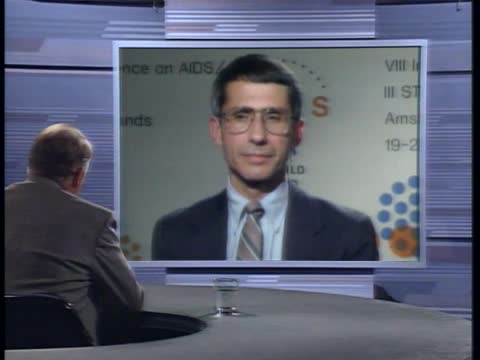
MR. MacNeil: This afternoon I discussed U.S. policy and the state of AIDS research with two Americans attending the Amsterdam conference. Dr. Anthony Fauci is director of AIDS research at the National Institutes of Health. Mark Harrington is a member of the Treatment Action Group, a prominent activist and scientific watchdog, and has served on government advisory panels on AIDS. Dr. Fauci, let me start by asking you about the story that broke in the last couple of days. How grave is the finding that ten -- twelve men have a disease like AIDS but without any sign of the AIDS virus?
DR. FAUCI: I don't think at this particular point that we can consider it a grave fighting. What has happened is that a group of individuals have been identified who have an AIDS-like illness who cannot have the virus identified in them or an antibody to the virus. There are a couple of possibilities that could explain that. The first -- and at this point probably the most likely -- is that the individuals had been infected previously with HIV, the virus had been responsible for the destruction of the immune system, and after a period of time either mutated so that it can't divide and be identified or, in fact, the body had sequestered it, for example, in the lymph nodes, in the peripheral parts of the immune system.
MR. MacNeil: Where it would --
DR. FAUCI: And the antibody responds --
MR. MacNeil: Where it wouldn't show up in the blood stream.
DR. FAUCI: Where you wouldn't detect it by a normal blood test.
MR. MacNeil: Right.
DR. FAUCI: And also when you don't have a replicating virus there anymore, the immune response or antibody to that would after a while peter out. That is certainly a major possibility for all this. The other possibility that we must keep an open mind about is that we may be dealing with another variant of HIV that's not picked up by the usual diagnostic techniques of culture and other types of ways that we look for the virus, but at this point in time to call it a grave finding, or to even call it that we're dealing with another new virus is certainly very premature. It's something we've got to follow and in a very methodical, systematic way prospectively investigate -- look for those individuals very carefully if there is any clue as to what we're dealing with -- and prospectively determine if there are a number of other people around that have that same finding.
MR. MacNeil: Some reports here there's been speculation that if it turned out to be a variant, or another virus, that all the blood supply in the United States which is now cleared for HIV 1 and 2 would have to be cleared for that new one, is that -- is that a correct supposition?
DR. FAUCI: Well, if it turns out -- again, that's a really big "if" that we have to underscore -- if it turns out that we're dealing with another microbe, then certainly it would be optimal to identify it and get an appropriate blood test. But we shouldn't lose sight of the fact that the vast amount of protection of the blood supply is due to voluntary screening out of individuals who have practiced high risk behavior. And if you look at these individuals who are among the group that have this unusual finding of an AIDS-like illness without any virus identified, virtually all of them belong to a risk group in the sense of their behavior very, very similar to what you see with HIV. So just on the basis of that kind of screening out, I don't think that we should look upon this as currently a major threat at all to the blood supply, because we're not even sure if we're dealing with another virus.
MR. MacNeil: Mr. Harrington, how do you view the stories of this new development?
MR. HARRINGTON: It's quite possible, as Dr. Fauci says, that there could be an undiscovered retro virus or other infectious agent that could be causing these symptoms, or that people could have had their immune system destroyed by an AIDS-like retro virus that resulted in these findings. Last year, there was a similar panic about people with kaposy sarcoma, an AIDS-related cancer, who did not have HIV, and the speculation based on that was that there was another infectious agent undiscovered that we still have to go out there and find, that we don't have money to go out there and find, that's causing these other unknown syndromes that are related to AIDS or AIDS-like or sometimes overlap with AIDS, but are not the same as HIV disease.
MR. MacNeil: Let's look on the occasion of this conference at where the research is. Mr. Harrington, your Treatment Action Group is releasing tomorrow a very thick report which, as I understand it, essentially suggests that AIDS research is stalled. Now, with some 5,000 papers being presented to this conference in Amsterdam, scientific papers, on all aspects of work on AIDS, how can you defend the thesis that research is stalled?
MR. HARRINGTON: Well, America accounts for about a quarter of the work that's being presented here and much of the most important American work is not available to be presented here because the National Institutes of Health are not able to send some of their most intensive investigators with their most recent reports about what's being done. But the most important point that we have in our report is that as a nation, the U.S. is abandoning its commitment to eradicate the disease, AIDS, whereas, the world 20 years ago made a commitment to eradicate small pox and did so 10 years ago. America, which is the flagship of the worldwide biomedical research establishment, is not committed to the eradication of AIDS. In the President's budget for this year, for example, AIDS research doesn't even keep up with inflation, and he sent it to Congress and Congress cut the NIH budget by $150 million, so whereas in the Reagan administration, Congress actually raised the President's AIDS budget request, now we have Congress cutting it; we have a government in gridlock, neither the President nor Congress able to coordinate a rational campaign against AIDS or any other serious disease, and the only solution that we're left with is calling for the doubling of the biomedical research budget not only for AIDS but for all diseases to $16 billion a year, because when you look at it, the U.S. spends but a pittance on biomedical research of all kinds, $8 billion for health-related research, compared to $50 billion for defense-related research, and the Cold War is over.
MR. MacNeil: Dr. Fauci, you've just heard what Mr. Harrington has said. Does NIH research suffer from a shortage of funds due to the causes he just said, the President proposing less and Congress lowering that money for basic research?
DR. FAUCI: Yeah. Well, I think we need to put things into perspective. First of all, the amount of activity in scientific research that's going on is extraordinary, really unparalleled compared to any other disease that we've dealt with. On the other hand, there will always be more scientific opportunities than there are resources to support those scientific opportunities, but we shouldn't get confused with the fact that we are making strides. We don't have the answers. We don't have an effective drug that would cure the virus or cure the infection from this virus, nor do we have a vaccine right now. But we certainly are making important strides in the direction of both of those ultimate goals.
MR. MacNeil: I'll come --
DR. FAUCI: But if --
MR. MacNeil: I'll give you an opportunity in a second to tell us what that progress is. I just want to know -- if the Congress and President collectively overcame the gridlock, if that's what it is, that Mr. Harrington charges, could basic research towards a vaccine or whatever be advanced more rapidly if you got more money for basic research?
DR. FAUCI: Again, it's -- I'm not trying to hedge on that, but it's a very difficult question to answer. Of course, you can make the statement if you put more money into something, the chances of advancing that field a little bit more or a lot more is substantial. To say that you're going to slow things down by the approach we're taking I don't think would necessarily be accurate, because science works in strange ways. You can never really predict where you're going to be able to make an important discovery. So for me to make a statement that something is being slowed as a direct result of something, I don't think it would be accurate or appropriate to say that.
MR. MacNeil: So how can you say that, Mr. Harrington, that this could move faster if the Congress and President were giving Dr. Fauci and his associates more money?
MR. HARRINGTON: Because in our report to be released tomorrow, we list example after example of areas that are being forced to compete with each other that are key target research areas with the AIDS epidemic. Adult research is being made to compete against pediatric clinical trials. Clinical trials for therapies for people infected with the virus are competing with vaccine trials to protect the uninfected. Immunology to shore up the immune system is being forced to compete with virology to understand how the virus works in people's bodies. Opportunistic infections that people with AIDS die of are being forced to compete with this new tuberculosis epidemic that we have in our cities all around the Eastern Seaboard of America and Congress says, you have to fund tuberculosis vaccines and pediatrics and you have to give it this much money, but it gives no more money to do that. So the existing programs are cannibalized and the new programs are smothered in their cradle because they never have a chance to reach the size and scope and coordination that they require. And the missing piece that I didn't get to mention before is that the NIH does not have a mechanism to coordinate the 18 institutes that conduct AIDS- related research for them, and that we feel that it's crucial that the President appoint an AIDS research czar to oversee the research of all the institutes and make sure that it's coordinated to fill the gaps and eliminate the overlaps of the current system.
MR. MacNeil: Well, Dr. Fauci, two points there to respond to. One is that different things are having to compete for funds. He mentioned tuberculosis vaccine as mandated by the Congress. Deal with that one.
DR. FAUCI: Again, yeah, well, let me first just reiterate what I said before so that there isn't any confusion. There clearly will be greater scientific opportunities and are greater scientific opportunities than there are resources available to fulfill those opportunities. The difficulty that we're dealing with is that we're dealing with a time of considerable fiscal constraint. Individuals would formally blame it on the President but, in fact, now what's happened is that it's clear that the blame is not at the President's feet because the Congress, recognizing the fiscal constraints that we have, have actually given to the AIDS this year and the previous year less money than the President asked for. Does that mean that the Congress doesn't care about AIDS? No. I think they do and you can deal with these individuals and see that they do care very deeply, but the reality of the fiscal constraints right now is that the money is not there. So from the standpoint of myself as a scientist, to say, are there opportunities that you can go after, and the answer is yes. But the reality of where we are fiscally is that the money is not there. The Appropriations Committee don't have the money to appropriate. That's something that goes beyond the scope of myself as a scientist, what I can do or what I can say about it, or when you ask them they will tell you that we just don't have the money.
MR. MacNeil: Okay. Now, with what money you have, how close -- how many possible vaccines are being worked on and how soon would the most promising of those go into trials with human beings?
DR. FAUCI: Well, we have now total worldwide approximately a dozen candidates which we call Phase 1 candidates. In other words, they are being looked at for their safety and for whether or not they induce an immune response. Over a period of time, we've learned a considerable amount about these so that we'll be able to narrow down within the next year or two, hopefully by 1994, the top couple of candidates which we can move into the next phase, which we call Phase 2 or 3, which directly addresses the question of efficacy, namely will these particular vaccines be able to protect individuals who are not infected with HIV, and who are at risk of being infected? And I would think that if we do start in 1994, that it probably would take several years from that point as to know whether or not we are going to be successful in having a safe and effective vaccine. So we're right now in the middle of a process which spans several years from the identification of a candidate to early testing, up through and including asking the question is it effective.
MR. MacNeil: And Mr. Harrington, you don't think that's fast enough, am I right?
MR. HARRINGTON: We feel that there are serious problems with the worldwide vaccine effort that are related to the U.S. policy onthe immigration and free travel rights of people with HIV infection or people who turn out to be sero positive because they joined a vaccine study. One of the very serious consequences of joining a vaccine study in the third world would be you would never be able to enter the U.S. because you would be sero positive. And under the policy of our current administration under Sec. Sullivan and President Bush, people with HIV can't enter the U.S., although the U.S. has the highest rate of HIV disease in the world. So as a result, the World Health Organization and the other organizations conducting the vaccine trials will not come to the U.S. to meet and plan the vaccine trials with Dr. Fauci and his organization. The Americans have to send their people overseas and the entire effort is being slowed down as a result. But I'd like to get back to the point I mentioned before. Vaccines are important. They're crucial. So are treatments for people that have the virus. Those two must be not made to compete with each other. It's just like people with AIDS must not have to compete with people with cancer, Alzheimer's Disease, or other disease for pieces of an inadequate pie. The entire biomedical research pie must be expanded. The Cold War is over.
MR. MacNeil: Okay. Dr. Fauci, the issue of U.S. immigration restrictions on people with HIV positive reactions, that is a very big issue there in Amsterdam, and many speakers have criticized - - including many American -- have criticized the U.S. government for this. Is it, in fact, inhibiting practical work, apart from whatever other questions there are on discrimination against AIDS people, which is suggested, is this immigration restriction inhibiting your work?
DR. FAUCI: The immigration restriction has a number of complex aspects about it that I'm not qualified to discuss because from my standpoint as a scientist it is not inhibiting my scientific work. But if you talk to the people who are involved in the other aspects, the sociological aspects of it, it is obviously a bone of great contention here. But to say that an immigration restriction is interfering with the basic clinical science that we do, I'd have to honestly say it's not, whether or not I agree or disagree with the policy. It's not interfering with our doing science.
MR. MacNeil: And Mr. Harrington, you think it's interfering when science reaches the point of wanting to do clinical trials on vaccines, then it would interfere, is that your point?
MR. HARRINGTON: Well, the ethical dangers of the vaccine studies have been seriously underestimated. It may be that the U.S. and other countries around the world will stop funding prevention initiatives and HIV prevention education programs in order to go and fund the vaccine studies. And if we do it wrong, what we're going to end up with is hundreds of thousands of people around the world infected with HIV because they thought the vaccine would work, but it was a Phase 1 vaccine. And unless we're working with the people in those countries, not just the health ministries, but the people in the communities affected by HIV, then we're not going to avoid those problems. And with the current administration's policy, we're not going to be able to work with the people in those countries that are most affected by this disease.
MR. MacNeil: What do you say about that, Dr. Fauci?
MR. HARRINGTON: And it's going to slow the whole effort down and it may ruin it.
MR. MacNeil: Dr. Fauci.
DR. FAUCI: Yeah. I think we're talking about apples and oranges right now. The immigration restriction, again, is an issue that is a different ballpark of what we're talking about, a cooperation among different countries. The immigration restriction would not allow people to permanently immigrate to the United States who are HIV-infected. Whether or not that is a correct or incorrect policy, we can just not address right now, but look at what the effect is. Collaboration and cooperation between countries and vaccine trials or what have you is something that is very important, that we need to further the collaboration and the cooperation, which we're trying to do. I don't think that directly relates to the immigration issue, again, saying, forgetting what my own personal opinion about that is, the science of a vaccine trial here or in another country, I think you're talking apples and oranges when you bring in the immigration issue.
MR. MacNeil: All right. Well, Dr. Fauci, and Mark Harrington, thank you very much for joining us.
MR. LEHRER: Still to come on the NewsHour tonight Weed and Seed and a conversation with the ambassador from Czechoslovakia. FOCUS - TAKING BACK THE STREETS
MR. LEHRER: Next, a look at something called "Weed and Seed." It's a key part of the Bush administration's drug program, so labeled by President Bush after the April riots in Los Angeles. The Justice Department has been testing the program in 20 cities. And additional funding for it was in the urban aid legislation passed recently by Congress. Tom Bearden reports now on one of the programs.
MR. BEARDEN: Trenton makes, the world takes, was an apt slogan when the city's mills provided steel and cable for bridges all over the world. But big industry abandoned Trenton over the last 60 years and now the main business here in New Jersey's capital is running the state's government. This town of 90,000 doesn't have a hotel, doesn't even have a movie theater. What Trenton does have is one of New Jersey's highest crime rates and a major drug problem. That's why the Justice Department selected Trenton to be one of the first two cities in its so-called "Weed and Seed" pilot program. Another reason was its location.
MICHAEL CHERTOFF, U.S. Attorney: We wanted to look at a city that was geographically removed from other cities so that we'd have more of a laboratory we could use in evaluating the program.
MR. BEARDEN: Michael Chertoff is the United States Attorney for New Jersey.
MICHAEL CHERTOFF: The conception was to take a kind of inter- disciplinary approach to the problem of law enforcement, bring together local, state and federal law enforcement with their various resources and various tools, operated in a coordinated fashion, and then follow up the traditional law enforcement techniques with the seeding process, an effort to reclaim the neighborhoods, and then once they're reclaimed, to help them grow and help them develop so that they are no longer hospitable to drug dealers or to gangs.
MR. BEARDEN: So far, the emphasis has been on weeding rather than seeding. Since the program began last fall, nearly 200 arrests have been made, almost all for drug dealing. "Weed and Seed" targets so- called "kingpins" under the more stringent federal statutes, which have no parole, tougher sentences and pre-trial detention. The goal is to make a maximum impact in clearing the streets. But "Weed and Seed" supporters say traditional crime statistics aren't the way to measure its success. Sgt. Marvin Johnson supervises the program for Trenton's police force.
SGT. MARVIN JOHNSON: To me, it's a large difference in that people are coming out. Their fear of crime issue is being addressed more rapidly than I thought. The word in the street is that, you know, "Weed and Seed" is here. The feedback from the community is that, you know, the people don't, some people don't mind walking at night because they know the program exists. I don't want to make you think that because "Weed and Seed" is here everything is clean, but the fact of the matter is there is improvement. And we're getting this feedback from the community. It's something the community just has to be involved in. the police just cannot do all this by themselves.
(POLICEMEN TALKING TO PEOPLE ON STREET)
MR. BEARDEN: That notion is a key element to "Weed and Seed's" law enforcement approach. Called community-based policing, it's a modern label for an old-fashioned concept. A pair of policemen walks a beat in each of the four "Weed and Seed" neighborhoods during the day. Instead of just responding to calls, they focus on building a rapport with residents and shopkeepers. The theory is that citizens are more likely to help police and call in tips if they know their officers.
OFFICER LUIS MEDINA: When I first came out here, people didn't want to talk to us, especially me, because they didn't know me. Now, they just walk right up to me, give me information. Sometimes they call me on the beeper.
MR. BEARDEN: This call concerned a suspect wanted for assaulting a policeman. Officers Maldinado and Medina had chased him the previous day.
OFFICER LUIS MEDINA: (on phone) We got information last night that they saw him at 9:30. Was he around at 9:30?
MR. BEARDEN: To the police, the program appears to be working because fewer citizens are calling for help.
SGT. MARVIN JOHNSON: After about three or four months, we saw a decrease in the service calls. That, in itself, is an improvement. Now, with a decreased amount of service calls, now the patrol units have more time to do motorized patrols. Therefore, when people call, they'll get the responses that they weren't getting in the past. To me, that's a big improvement.
MR. BEARDEN: But over on Sweets Avenue, these teen-agers don't see much of a change in drug dealing and they say it's unrealistic for the police to expect much support, even with anonymity on telephone calls.
TIESHA BUSH: Out here you got to mind your business -- I'm straight up -- you got to mind your business, because it's rough living down here, especially bein' a black teen-ager, as myself. You got to mind your business. You can't be trying to snitch on everybody because eventually that person will find out and they will try to hurt you or your family or something like that, so you got to mind your business.
MR. BEARDEN: And some longtime residents, such as James Champion, don't see that "Weed and Seed" is making much of a difference either.
JAMES CHAMPION: Well, it don't seem to me that it's really working because, like I say, I don't see any change, very little, so I don't think it's doing too much for this neighborhood as of yet.
MR. BEARDEN: One of the biggest problems on Champion's block and elsewhere in Trenton is the large number of boarded up houses. Besides being a psychological blight, these buildings are often used by criminals to hide in or sell drugs. Authorities have targeted a campaign on these houses as a way to weed and seed at the same time.
MICHAEL CHERTOFF: My belief is that one of the most significant seeding aspects of the program is turning what I consider to be problem housing into solution housing.
MR. BEARDEN: Drugs were dealt out of this once abandoned house on Tioga Street for years. Now the federal government has seized the home and turned it over to the state, which is renovating the building so it can be sold to a new family. These youths, who were sentenced to a juvenile program for their own crimes, are learning construction skills that may change their lives when they're released.
PEDRO PEREZ: I'm thinking about being an engineer, an electronic engineer, or a maintenance engineer, any kind of engineer.
MR. BEARDEN: This seeding effort tries to give kids a place to stay out of the streets and out of trouble after school and on summer weekends. It's called a "safe haven," and the program offers supervised activities where students can brush up on their homework, play games, such as bingo, and participate in sports, including swimming and tennis. Many of the younger kids are enthusiastic.
TIFFANY LAW: I like to write on the chalkboard and I like to go swimming and I like to do my homework here. It's not boring here.
MR. BEARDEN: And several teen-agers come to the Hollen School to practice with the drill team twice a week.
JOHNNY MEADOWS: It's making a big difference. It helped me a lot, kept me off the streets, and I used to get in a lot of trouble. It used to be every time you turned around cars getting stolen and kids get caught drivin' them. Most of these same kids that used to get caught are right here.
MR. BEARDEN: But for other young adults, the havens now offer little more than another place to play basketball. High school senior Shon McNeil finds the havens irrelevant without vocational offerings.
SHON McNEIL: The "Weed and Seed" program I guess is all right as far as you know, as far as I can see it, but where's the educational programs that -- you understand -- we're going to take our people off these drugs and everything, but first we got to educate 'em the right way.
MR. BEARDEN: Minister Shahid Watson is also disappointed in the program's offerings.
REV. SHAHID WATSON: There is no real social element to "Weed and Seed". Arts and craft, arts and craft what, play basketball? Every young black man don't play basketball and every young black man don't like arts and craft. What we need is treatment. There's no treatment facility here, so we're going to bring money into this city, or any black community or Latino community across America, then we need money that's going to provide to take people off drugs.
MR. BEARDEN: Health care clinics are planned for the safe havens, as well as courses that would be more appealing for adults. Substance abuse programs will take more time. But Alan Mallach, the city's housing director, says the federal government has much more work to do now. He's waiting to hear if the government will provide $2 million under a separate program to take over, renovate and sell 40 other buildings such as this one.
ALAN MALLACH, City Housing Director: Law enforcement can attack the symptoms, but it can't attack the real issues. The real issues in this area and other areas like it are housing opportunity, jobs, better education, a better environment for people. If we can't tackle those problems and change neighborhoods on a long-term basis, sooner or later, the quick fix, if you will, from a law enforcement initiative will peter out.
MR. BEARDEN: With "Weed and Seed" evolving, Mayor Douglas Palmer, a Democrat, urges that critics take a wider view.
MAYOR DOUGLAS PALMER, Trenton: I just don't think that people can look at "Weed and Seed" and say, well, it's not this and it's not this. Let's look at what "Weed and Seed" is, what its charge is, and look at how successful that is and also, on the other end, say, and we also need a, b, and c, which of course is drug treatment, which is economic revitalization and jobs, and targeted enterprise zones, or those things that will create jobs and opportunities in cities as well.
MR. BEARDEN: Vice President Quayle's recent visit to one of the safe havens underscored the program's importance to the Bush administration. Trenton's "Weed and Seed" effort was only allotted $1.1 million in its first year, but the administration appears to be responding to criticisms as it expands the program to a total of 19 cities. The President's new budget proposes $500 million to be split among them and only 30 million would be spent on Justice Department activities. The rest would go to seeding activities, such as the Jobs Corps, Head Start and drug prevention programs. U.S. Attorney Chertoff says the public has to understand the program is no quick fix.
MICHAEL CHERTOFF: The "Weed and Seed" program is not turn on the spigot and vast quantities of money come pouring into the cities. The greatest danger with a program like this is that people look at it after six months or a year, they say miracles haven't happened, therefore, let's try something new. Well, no serious problem gets solved in six months. It's taken years and years to have some of these problems develop, and if it takes years and years to remove the problems and eliminate them, we have to make the commitment to see it through.
MR. MacNeil: The Senate is expected to take up the bill containing the "Weed and Seed" funding later this month. CONVERSATION - PARTING OF THE WAYS
MR. LEHRER: Finally tonight, a conversation about a country coming apart, about the President who tried to keep it together and about the ambassador who represented those now failed aspirations in Washington. The country is Czechoslovakia, the union of the Czech lands and Slovakia created after the first world war, survived World War II and communism, but not the ethnic nationalism of post communist Eastern Europe. It is breaking up into two separate countries. The president is Vaclav Havel, the dissident and playwright who came to power after the so-called "Velvet Revolution" ended communist rule in 1989. Today, he officially resigned. And the ambassador is Rita Klimova. She lived in the United States during World War II, but returned to her native country immediately afterwards. She became a communist, but her opposition to the Russian invasion of 1968 cost her post as an economics professor. It led her to the dissident movement with Havel. She was named ambassador in 1990 and will be retiring and returning home in September. Madame Ambassador, welcome.
AMB. KLIMOVA: Thank you.
MR. LEHRER: A story in the Washington Post yesterday said your country was on the verge of a political nervous breakdown. Do you agree with that?
AMB. KLIMOVA: Well, things are tense and I think the Washington Post has been reporting very accurately, but I wouldn't say nervous breakdown. Things are tense and we seem to be headed towards a separation, yes.
MR. LEHRER: A clean separation?
AMB. KLIMOVA: Yes, absolutely clean, absolutely non-violent. That is what I'd like to stress right at the start, and hopefully even an amicable separation.
MR. LEHRER: Has this been inevitable since the fall of communism? Have you seen this coming? Could it be any other way?
AMB. KLIMOVA: Oh, absolutely, absolutely. This has been building for two and a half years and these are problems which existed before, certainly, for a long time. But, you know, I like to liken communist rule like to a big slab of concrete which was sort of on top of everything and many problems didn't get worked out. And this was one of them. And as soon as that lid came off, the problems appeared. In '68, we had a very brief respite before the Russian invasion when the so-called "Prague Spring," when there was an attempt to reform the communist system, and at that time, the problems appeared. But that was very short-lived.
MR. LEHRER: Define what the problems have been between the Czechs and the Slovaks.
AMB. KLIMOVA: That's difficult.
MR. LEHRER: I know.
AMB. KLIMOVA: The -- it seems that the country has developed into two separate countries. The languages are certainly distinct, even though they are very close. We completely understand each other. But our history is somewhat different and it seems that now the political culture is different. And what is most important is the outcome of the last election is very different, and it was a democratic election. It was our second democratic election. And so it's something that we just have to take into account; it has to be respected.
MR. LEHRER: Some people don't understand how the country could be together for 74 years and why it didn't grow closer together, rather than further apart, in this forced kind of situation?
AMB. KLIMOVA: Yeah. I would have thought that too many years ago, but things haven't worked out that way. That's all that can be said. The totalitarian system has given way to a whole set of options. I mean, democracy and a civic society don't automatically follow, although we sometimes wish they did. But it seems that the majority of the electorate in the Czech republic places the issues of a civic society and economic reform in first place, whereas, in Slovakia, national aspirations are put into first place.
MR. LEHRER: And these, these aspirations and these differences have been there all along. It was just the totalitarianism of communism that kept them suppressed.
AMB. KLIMOVA: Yes.
MR. LEHRER: Is that what you're saying?
AMB. KLIMOVA: Yes. That's exactly what I'm saying.
MR. LEHRER: And the slab went and boom, they have been there all along, now they're there and have to be dealt with.
AMB. KLIMOVA: That's right. That's right.
MR. LEHRER: Now, what do you understand to be President Havel's reason for stepping aside right now when the country is going through this trauma?
AMB. KLIMOVA: Yes. Well, he was not elected. Our president is elected by parliament, as you know. And last week, the week before that, we had elections, and the Slovak political representatives in parliament blocked his election. We had a system whereby one nation cannot outvote the other nation. There are twice as many Czechs as Slovaks and the Constitution was so designed that those Czechs cannot outvote the Slovaks.
MR. LEHRER: To protect the minority, in other words?
AMB. KLIMOVA: to protect the minority, that's right. And also it was not a very good system, to be frank, at least that is my opinion. The Constitution which was legislated in '68 when the tanks were already in Prague, the Constitution really works, if you have a Politburo which makes all the decisions. But if you have a parliament which is really expected to rule, well, then that Constitution is posing a lot of problems. So that's what happened. The Slovak part of the chamber of nations blocked the election of President Havel. Now, according to the Constitution, there would be repeated attempts to elect somebody, but if Havel was not electable, probably nobody was. And so he could have stayed in office through --
MR. LEHRER: No Czech could have, you mean?
AMB. KLIMOVA: No Czech, no, but probably no Slovak, because he would have been blocked by the Czechs.
MR. LEHRER: He wouldn't have gotten the Czech --
AMB. KLIMOVA: I assume. I don't know. I don't know.
MR. LEHRER: Sure.
AMB. KLIMOVA: But that's what I assume. So he would have -- probably somebody who might not have been acceptable to the Czech Party. This is theoretical. So there were -- according to the Constitution -- repeated attempts would have been made, and he would have been in office until October 5th. And by October 5th, he would have had to step down anyway. So he didn't want to be a lame duck, a lame duck president presiding over the dissolution, the legal dissolution of the federation and in this way, there has been some acceleration. That fact that he stepped down means that the two major political parties, the ODS with Mr. Klaus and the Czech republic and the Movement for a Democratic Slovakia with Mr. Meciar in Slovakia, these two parties agreed that they by the end of September, they would get together at least a timeframe for the dissolution and a method by which the action dissolution steps would be taken.
MR. LEHRER: So if Havel was an obstacle at all, he's removed himself?
AMB. KLIMOVA: That's right. That's right. He would have slowed down this process.
MR. LEHRER: Sure. You know, in this country, as you know, Vaclav Havel was considered a hero, still is, and Americans always, they - - remember after World War II when the Brits, the British turned out Winston Churchill nobody quite understood that. And I think America is having the same problem with Vaclav Havel. Here is this incredible guy who led the Velvet Revolution and now being kind of turned out and nobody seems to care. Can you explain that?
AMB. KLIMOVA: Yes. Well, I want to say that I think he's wonderful too. I think he's not only a friend, but I have great admiration for him, and he's really stuck to his guns. And he has tried to introduce a moment of morality and tolerance into politics which is not very usual. And I think he has a great political instinct also, strange as that may seem. But he was just unable to hold this together because I think this is the march of history. I hate to use words like that.
MR. LEHRER: It's all right.
AMB. KLIMOVA: But I think that this is what was meant to be and even a great intellectual who happens to be in power was capable of going against the tide.
MR. LEHRER: He was just unable to get the Slovaks to suppress, to continue to suppress their nationalist tendencies, correct?
AMB. KLIMOVA: That's right.
MR. LEHRER: Instincts, I should say.
AMB. KLIMOVA: Yes. They place higher priority on the values of building a nation state rather than on building a civic society. And I mean, they have every right to do that.
MR. LEHRER: Well, will Vaclav Havel be looked back upon as a truly important historical figure from the post communist world, and does he deserve that?
AMB. KLIMOVA: Oh, absolutely, absolutely, because I think his role -- the fact that in Czechoslovakia there was Vaclav Havel and those around him who were capable of negotiating a peaceful transition of power, I think history, even now many people criticize that because it's meant that purges and kicking out high level communists was a little slower than it otherwise might have been, but it was also non-violent, and I think the history will be kind to them, to the Velvet Revolution.
MR. LEHRER: Would it have happened without Havel?
AMB. KLIMOVA: Well, I don't know. I don't know, but Havel happened to be there and it happened the way it did. I don't know whether it -- it might have had different forms. Who knows. It might even had had the form it had in Romania, which was a lot of bloodshed. I don't know. I don't know. I think that's very tricky.
MR. LEHRER: Sure. I realize that. And from here on, this division that you think is inevitable that's going to happen now, is it going to -- you think it's going to be peaceful -- it's not --
AMB. KLIMOVA: Oh, absolutely.
MR. LEHRER: -- going to be Yugoslavia?
AMB. KLIMOVA: Oh, no, no. Under no circumstances can I envisage anything remotely remindful of Yugoslavia. The federal government has from the beginning said that of course it will never use violence to keep the country together and if one part of the country wants to secede or separate or whatever, then it has a right to do so. And the Czechs and the Slovaks are very peaceful people. It's twice in the last -- in the 20th century, in modern history, we probably should have fought and didn't. That was --
MR. LEHRER: In '68.
AMB. KLIMOVA: One was '68, when the Warsaw Pact came invading, and in 1938, during Munich. And those were two occasions when sort of keeping the peace or the realization that the odds were impossible led to the fact that we did not fight. And I cannot -- by no stretch of the imagination can I envisage any violence taking place.
MR. LEHRER: And I would think you have just said -- just to put a final key on it -- a cross on the "t" though, that Havel showed the way for peaceful transition.
AMB. KLIMOVA: Absolutely.
MR. LEHRER: In other words, part of his legacy is that this is now happening peacefully.
AMB. KLIMOVA: Yes, yes, and I'm sure he will continue in Czech politics. One of the reasons he's stepped down also is to make way for a Czech Constitution and the establishment of a Czech presidency, because we don't have that. And I mean the Slovaks are a little ahead in the fact that they have been preparing for this development.
MR. LEHRER: A separate nation, yeah.
AMB. KLIMOVA: And they have done a lot of work on constitution drafting, whereas the Czech republic hasn't. So I think they will now try to do their best to catch up on that and my hope is -- and that's what I gather from the press and from my friends in Prague - - that Havel will become the Czech president.
MR. LEHRER: Now, what about you? You're going back to Czechoslovakia, to a new, divided country, could be by September when you go back. What are you going to do?
AMB. KLIMOVA: Can I just make one note on the divided?
MR. LEHRER: Sure.
AMB. KLIMOVA: I don't think it will be that divided. I think if I want to go on vacation to Slovakia, to the beautiful mountains, or visit my friends in Bratislava, I'm sure I will be able to do that.
MR. LEHRER: Sure.
AMB. KLIMOVA: So that's --
MR. LEHRER: I used the word too harshly.
AMB. KLIMOVA: Yes. Yes. I mean, usually that's what people expect.
MR. LEHRER: Sure.
AMB. KLIMOVA: I hope we can do it really amicably. What I want to do, I really want to retire. I do not want an eight to five job. I'm over 60. I'd like to spend more time with my grandchildren. I'd like to teach. I'd like to write, try to write. I'm not sure I can do it.
MR. LEHRER: Are you going to stay in politics?
AMB. KLIMOVA: No. No. I have not joined any of the political parties. I have many friends in politics and I will try to do what I can.
MR. LEHRER: And you -- shortly after you came here -- you were diagnosed and treated for leukemia. And that is completely cured, is that right?
AMB. KLIMOVA: Yes, yes. My doctor in Baltimore tells me that it might come back, but I feel fine, and so I'm blessed with this remission. And I'm very grateful to the doctors and Johns Hopkins and to the United States for making this treatment possible for me.
MR. LEHRER: Well, thank you. Have a good life back home.
AMB. KLIMOVA: Thank you. RECAP
MR. MacNeil: Again, the main stories of this Monday, President Bush launched on a post-convention attack on Bill Clinton, calling his economic program "smoke and mirrors." Clinton pushed his plan to overhaul the nation's health care system as he continued his eight state bus tour. Sec. of State Baker held talks in Israel to encourage a quick resumption of the Mideast peace process. The latest cease-fire in the former Yugoslav republic of Bosnia was barely in place before it was shattered by renewed fighting. Experts at the International AIDS Conference in Amsterdam said women will be the primary victims of the disease by the end of the decade. Good night, Jim.
MR. LEHRER: Good night, Robin. We'll see you tomorrow night with a look at the new move toward peace in the Middle East. I'm Jim Lehrer. Thank you and good night.
- Series
- The MacNeil/Lehrer NewsHour
- Producing Organization
- NewsHour Productions
- Contributing Organization
- NewsHour Productions (Washington, District of Columbia)
- AAPB ID
- cpb-aacip/507-0k26970j83
If you have more information about this item than what is given here, or if you have concerns about this record, we want to know! Contact us, indicating the AAPB ID (cpb-aacip/507-0k26970j83).
- Description
- Episode Description
- This episode's headline: AIDS - Scourge of the Century; Taking Back the Streets; Conversation - Parting of the Ways. The guests include DR. ANTHONY FAUCI, National Institutes of Health; MARK HARRINGTON, AIDS Treatment Action Group; RITA KLIMOVA, Ambassador, Czech & Slovak Federal Republic CORRESPONDENT: TOM BEARDEN. Byline: In New York: ROBERT MacNeil; In Washington: JAMES LEHRER
- Date
- 1992-07-20
- Asset type
- Episode
- Rights
- Copyright NewsHour Productions, LLC. Licensed under a Creative Commons Attribution-NonCommercial-NoDerivatives 4.0 International Public License (https://creativecommons.org/licenses/by-nc-nd/4.0/legalcode)
- Media type
- Moving Image
- Duration
- 00:59:54
- Credits
-
-
Producing Organization:
NewsHour Productions
- AAPB Contributor Holdings
-
NewsHour Productions
Identifier: 4381 (Show Code)
Format: Betacam
Generation: Master
Duration: 1:00:00;00
If you have a copy of this asset and would like us to add it to our catalog, please contact us.
- Citations
- Chicago: “The MacNeil/Lehrer NewsHour,” 1992-07-20, NewsHour Productions, American Archive of Public Broadcasting (GBH and the Library of Congress), Boston, MA and Washington, DC, accessed May 15, 2026, http://americanarchive.org/catalog/cpb-aacip-507-0k26970j83.
- MLA: “The MacNeil/Lehrer NewsHour.” 1992-07-20. NewsHour Productions, American Archive of Public Broadcasting (GBH and the Library of Congress), Boston, MA and Washington, DC. Web. May 15, 2026. <http://americanarchive.org/catalog/cpb-aacip-507-0k26970j83>.
- APA: The MacNeil/Lehrer NewsHour. Boston, MA: NewsHour Productions, American Archive of Public Broadcasting (GBH and the Library of Congress), Boston, MA and Washington, DC. Retrieved from http://americanarchive.org/catalog/cpb-aacip-507-0k26970j83