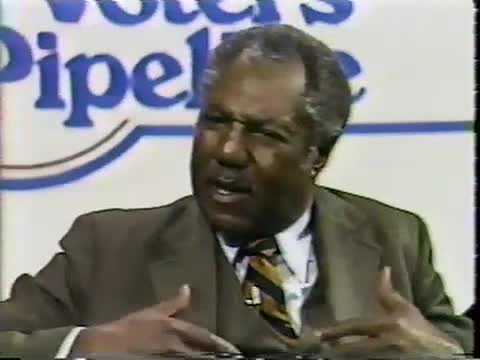
Voter's Pipeline; Sacramento Pipeline: Interview with Wilson Riles
- Transcript
Channel 15 now presents a voter's pipeline a program designed to keep voters in touch with the people they elect to office. The program alternates each week in dialogues with Orange County elected officials in Washington Sacramento county government and with personalities in Orange County discussing local issues. Today's program is entitled Sacramento Dateline and brings you an exclusive interview from Sacramento with State Superintendent of Public Instruction Wilson Ryan. Now here's your host Jim Cooper. No issues stemming from Proposition 13 has been more vigorously discussed than the future of education in California. And the man in charge of guiding a future of education in California is state superintendent for Public Instruction Wilson Riles. We're going to talk to him today about the rather tenuous future of education at this point in California. Wilson riles is serving his third term as California State Superintendent of Public Instruction. He
began his educational career as a teacher in a one room school on an Apache Indian Reservation near pistol Creek Arizona. He received school administration from Northern Arizona University joined the California State Department of Education in 1058. Superintendent Riley is a member of the National Council of educational research. In 1980 received the Robert M. HUTCHENS award for significant contributions in the field of education. I'd like to start with a question. Of. Where we are now after eight months of Proposition 13. And what do you see as the future of education in California and the reality of this Prop 13 world. We period of uncertainty. If it had not been for the. Bailout legislation. We would have had a disaster. We did take a significant cut in education I don't think many people realize that after. Proposition 13 passed. Two
point eight billion dollars was taken out of a roughly 8 billion dollar system which is slightly more than a third of a billion dollar business. That is really a California. And we were able to go to the legislature lay out a program that would. Permit us to survive. We were able to get about 1.9 billion dollars in the bailout. It's left us approximately eight hundred million dollars short about a 10 percent cut. Now the problem that I see ahead is one of great uncertainty. Because schools had already taken a cut sense and I did 73 and that's B 90 and so there were there's no fat in that it was taken out by a benign. That is correct and of course if we don't get a long range financing program this year this legislative session.
I think we're postponing doom and I stating the dilemma rather than overstating. Impending doom that's an ominous term that you've used. Yes it is it is very serious because because of the bailout you see many people feel the school doors open many people feel that business as usual and that is not the case. May I just suggest. Why it's important this year to get an attic with long range financing before you do that isn't it true we're going to get bailout number two right now. I want to call it that that is what is being suggested by many people in the state surplus about is from the state surplus. I am opposed to that I know. I think another temporary bailout is unwise. I thought you were going to develop your idea of the reason why I think it's unwise is that.
Let's take a look at it. Suppose we just get another bailout a temporary situation. There's the uncertainty. There's no way to manage a school system if you don't know what your revenues are going to be there's no way to plan. Secondly next year is an election year. They have the Senate in the state will be running for office. The governor I don't I'm not privy to any information I read the paper just like everyone else I don't know what he is going to do. We do know it's a presidential election. I think it's reasonable to expect that when they are running for office we'll turn their attention to the tough hard problems of dealing with this issue that throws it over to 1981. We don't know what will be the situation by then. And there's another reason Mr. Garr getting signatures to
limit state spend. We've already. Cut spending cut back severely by Prop 13 Prop 13. The only way students can finance themselves. We don't charge fees. I think probably taxes after the state general fund and you can see if you limit spending at the state level before you decide. What's your level of support is going to be for the schools the school could be out of business. So I think we should deal with this problem before we before we start talking about limiting state spending and bad as another day job crisis I have run. And there's a man by the name of Jack an attorney a professor at the University of California at Berkeley he's the one he missed to show the men are the ones that pushed Serrano versus priest decision. Yes. Now they have another scheme
and that's the aim is to set up a so-called voucher system. And that means that you just give the parents money and they go shopping for education. And to me that was an extreme just asked and if we have uncertainty you see going into nineteen eighty eight and someone comes up and says the public with ads and so on and people don't know about this. We could end up being the first state in the union that gave up on the public education about our youngsters and I again I would you assess that if that were to happen. I. It's an extreme action. But I can't imagine it but I often say that if I was superintendent in Kansas and Nebraska in the Midwest where things don't change and people get excited I wouldn't worry too much but California is a battle
state. We do some great and we do very well that's a crackpot thing. And if if we're not careful. Without the people knowing it we may drift into a situation where we could lose public education and add that means to the future of our young people and state. How many young children are we talking about and K-12 already have about four million three hundred thousand youngsters in the state. We have 300000 that population has no constituency at the polls and yet that's the other ones are going to be affected. If those four million three hundred thousand could vote we wouldn't have any worries. But that's what we're talking about. I'm thinking of the analogy of an eight billion dollar business of any kind of the private sector that has this uncertainty in your them and they're supposed to be guiding it. That has this terrible vacuum of
guidelines if you want to call their financial stability. Let me give you an example. Our laws require that if you are not going to hire a teacher you must do so prior to March 13 March 15. School districts don't know how much money they are going to have until June 30. If they did how in the world can you plan a program if you don't know the resources you're going to have one of the things that our state board did along with them. My department after 13 we decided that we would visit a number of representative districts and we spent a day in the district office with local boards with parents with the administrative staff with the superintendents and we asked what was the impact of 13. What did you do when your cutbacks.
What are your needs and so on. And it's interesting to note how responsible people tried to cope with the situation. Number one I already mentioned they couldn't lay off teachers and they knew that they had not been laid off. But I think more than that they tried to protect the classroom as much as possible. They did cut back on was. We call them classified people. They cut out in some places they cut out transportation completely off the bus drivers. They cut back on maintenance which as you know as any business person in the book because if you don't maintain your capital investment right you know you're going to pay more in the long run. They cut out on a story as custodians I visited some schools where they only swept the classroom every third of
fourth day and we found that the morale among the teaches in every instance was very low. They sap to the fact that there were cuts and I would be no salary increases and now because of their Supreme Court decision they're trying to get some adjustment and that that is correct. And of course I wary about this because if you don't have any money how are you going to comply with the contracts. I went into teaching years ago no one goes into teaching expecting to get rich unless you've had bad counseling. Yes teachers do because they want to have kids. It's a kind of missionary thing I know it was that way with me. But you did get some respect for you felt that you were doing something to help morally position in society where the function you're performing. That's right and I say that
if you are if you are going to get money you should get left out. So when you take live the way he was left and that is happening now we are losing our bet it teaches to industry. That's not going to say when you lose a teacher who grants to university training and had a credential and had a dedication and had maybe eight 10 12 years of experience and you lose him then you say wait a minute after while that was a mistake. How do you replace this person how do you get that kind of a family of a person very difficult because now I would have difficulty. Constantly urging my own youngsters to go into teaching that's a sad commentary and that is a place where I think young bright minds caring individuals should be. You have indicated that you'd rather not see a bailout number two. But as we said here today what is your best assessment do you think we're going to get a bailout number two and that the
so-called Band-Aid approach to fix education this year or are you optimistic that there will be a long range plan with this with these other requirements that you're going to get out of this. Well I am optimistic I guess because I'm an optimistic person. It's not because of the facts that I laid out there. I have taken on a personal crusade and along with the State Board of Education. To work diligently to get a long range financing program this year for the reasons that I told you. Now how do you get it. First place we've been working with two legislators one Senate dills who has a bill two three four that have the principles that we want. We have about seven hundred ninety six million dollars yet in addition to what we have this year right after the mint green who is chairman of the Education Committee is putting in a bill. Some of the
bill eight now we are supporting those measures because they have the principles that we want. But that is not enough. And I would like to make this point if you would permit me. Sometimes people forget that public schools belong to the public and they are going to be exactly what the public wants them to be. And so we are meeting with and we're urging and have indeed set up. Groups of parents coalition of citizens and 38 counties. And these are parents who are saying we want good education for our youngsters we're going to support it. And if this if we can get this kind of upsurge with people I'm not talking about educators if I go to that I just like it sounds self-serving but if people go that Kerry that is right. We are trying to involve businessmen
because as you know as a dynamic I'm amazed when I look at the statistics in that county. But I point out the businessman. The viability. The quality of life in your city is tied directly to the quality of your schools. If you have good schools people with children will move to that because they have heard that the schools are good. If the schools are poor they will move away. So we are all. In this commitment to two good schools and if we make it it's good for everyone. If we don't make it we will find deterioration in our state. And in the worst of all worlds this impending doom that you talk about. And I I I worry about I have sleepless nights about it to be honest.
Before Prop 13 40 46 percent of the money for local schools came from the local community property taxes. After Prop 13 72 percent is coming from the state. That is correct. Now if you have that kind of money coming from the state what does it do the old maxim that we all used to know about which was called local control by local school boards. What happens to a school system in the in the state of California when 72 percent of those dollars are coming from the state is is really in jeopardy. It depends upon the weather. We can make sure that even those 70 percent of the resources are coming from the state. Just 46 become even the state of Utah. Yes around 40. Well a little less than that. Yes be flat out already before 30 to 70. Seventy two percent that is right now. This means that we have to assure. That the legislature or the department do not take advantage of this
situation to try to run the system but our system where you have medical boards medical people making the determination. I am for that. As a matter of fact the program CCE early childhood education the school improvements might even go further. I want not only local control by the board but I want to see parents and school councils involved in some decision making in their schools and wherever this has happened. We have seen the excitement we have seen better learning going on for youngsters and I would just only say that because I know how the system is. I dont do not want the job of trying to have we have 200000 teachers in the state. I don't want the job to have to bargain with them and hire them. I really like the local control but it is in jeopardy. I guess that's my point yes
and I pretty well have 72 percent of our dollars going in the state. I as long as superintendent here and I've just been elected for four years. I'm going to work very hard to see that we maintain local control. Now if someone comes along and realizes that 70 percent of the money comes from the state and then decide that they are going to run the system we would better stop wearing the danger the danger is there the danger is there. You mention your own program the school improvement program and also the early childhood education. Let me read an indictment that was been that was given just a few weeks ago Senator Paul Carpenter introduced a bill to discontinue your system. He said there's no question that as IP and its predecessor early childhood education as implemented as implemented are costly in six years the state has spent four hundred sixty four million NSI s ip and the governor's budgeting one hundred fifteen million more for the coming
year. Is Senator Carpenter wrong or see Wright as completely off base. He doesn't have the data. I have often wondered why he introduced the bill. I believe we're going to defeat it hands down. Let me tell you exactly an objective of what the situation is so far as the quality of education in California. We measure. Reading and math. And language of course at the high school level. We test at the second grade the third grade the sixth grade and the 12th grade. Here are the facts. The second and third graders are reading California schools on an average up bar of the national average and their reading scores are growing up and they have grown for the last six years at the sixth grade level. We are slightly above average and the
reading scores are going up. These are the areas where we have had school improvement E C and people have been working together to reform the situation and it's paying off. At the 12th grade level we don't have any school improvement but we're just beginning this. The 12th grade. I have to say the national average and the averages are going down. I was there and maybe 65 in 1977 was to move some of these improvement programs up to the high school level. So I don't know what Mr. Kopp is talking about. It's a good way to grab headlines it's easy to be negative but I think it's terribly irresponsible what he's attempting to do and I think we're going to defeat them before we leave that subject you said in the 12th grade it's going down do you have any
reason for that why why should a state like California have this quality of education going down the 12th grade. I think it's because we haven't in 50 years. Really on a comprehensive basis than anything to reform the system. We have any kinds of impacts on on the situation. We a lot of people blame television the fact that youngsters see 15000 hours of television by the time they reach the 12th grade. That's more hours in all the hours that they've seen. That is right. The family situation is not as close as many reasons I don't want to point to one. But I also know that young people are just as bright. Just as anxious as some of the things that we plan to do. Ron is that you can't
Kloster young people in a situational situation for 12 years and then expecting many. So in our school improvement we are. Making it possible for youngsters to get out of the classroom in some learning experience too. If a youngster could visit and participate say in a newspaper office. I've seen them come alive. They learn that there are certain deadlines that you have to meet. They learn that it's a business. They learn how to relate what they learned to real life situations. These are the kinds of things that we ought to be attempting to give our youngsters a boost and some excitement and improve the quality of education. Governor Brown in his State of the state message and in his inaugural address. Was conspicuous in the opinion of many by what he did
not say about education. I'm going to ask you to answer very candidly. How is the governor extending leadership or not extending leadership these of these education. I am going to be candid. And please understand that I don't gain any points by being negative. To quote the governor he sits there with that blue pencil and I understand you talk about him out of the blue pencil. I have to say that I have been disappointed in its leadership I don't know whether it's a matter of style or what is it. For example his budget is totally inadequate for education. He had no opportunity to sit down with him personally as I did with Reagan on the budget. And I am extremely disappointed. I I don't know what his plans are but. The commonest is that he moves from issue to issue. And maybe that's the problem when he's
concentrating on one issue he concentrates on that. He's not concentrating on education. When we think of the leadership in any organization is the person. That gives us a massive blueprint a master blueprint who inspires us and says this is where we should be going. And whether you agree with where we should be going or not. Is one thing but not to have any plan at all is another thing. Is there really a master blueprint and now you know how often you meet with the governor. Weekly monthly or not at all. I think that's a fair question it's rather had and he will call when he is concerned with. Former governors had an education or administrative assistant and you could if you had a problem if you anticipated something on the road you could go to that the governor doesn't have that and and so he tries to stay on everything himself.
And it is and it isn't working I. See I guess. And I think I'm right that education is a high priority in the state and in this nation because we're talking about the future generations and how they are and whether they're going to be trained prepared and educated to manage this system when we moved off the scene and. An educated it goes to democracy itself. I remember reading something that Thomas Jefferson said that if you expect to have a democratic society. Without an educated voter. Then you expect what never has been and never will be. And that's what we're talking about. And so I think the best that we can do the best that society can do for our youngsters. We ought to be continually
probing to make it effective. And I must sadly say. That we are not getting that as I would expect we would be getting it. From the governor's office. Are we asking is cooperation to put the ideas out there to work them out and. One of the anguishing continuing problems in discussion particularly in southern California now after Judge Pauley Glee's decision in the Los Angeles school district about busing. But the suggestion that the busing should be expanded far beyond Los Angeles down to Orange County possibly in other counties. What is your view of that. MEMBER Well I'm very troubled I should say first that I went to segregated high school. I taught in a segregated school. Once I saw our integration. And B and not just from my point of view a
minority but of from a point of view of all of us that if we're going to live together and cut out the antagonisms we ought to learn together. Now having said that. We must be reasonable. And feasible. That's what the courts time you that. You are going to create problems dissension not only for whites but for blacks too. As far as I can determine the situation and Silas is not working and we'll have to find another approach. Thank you very much. And on the view of education in the future I hope that there is a good. Report the next time we meet. Thank you very much. Pleasure to be with. Our time is almost up now and I want to thank Superintendent Rials for being our special guest today. Next time we'll be bringing you the four congressmen from Orange
County from Capitol Hill and Washington D.C.. If you have any questions you'd like to ask the people that you have elected to public office simply write pipeline or see a TV channel 50 Huntington Beach California zip code 9 2 6 4 7. I'm Jim Cooper. Thanks for being with us.
- Series
- Voter's Pipeline
- Contributing Organization
- PBS SoCal (Costa Mesa, California)
- AAPB ID
- cpb-aacip/221-52w3rc88
If you have more information about this item than what is given here, or if you have concerns about this record, we want to know! Contact us, indicating the AAPB ID (cpb-aacip/221-52w3rc88).
- Description
- Episode Description
- In this episode of Voter's Pipeline Jim Cooper discusses the state of education in California with superintendent of schools Wilson Riles.
- Series Description
- Voter's Pipeline is a talk show hosted by Jim Cooper and featuring conversations with politicians and experts about local and state politics.
- Created Date
- 1979-00-00
- Asset type
- Episode
- Genres
- Talk Show
- Topics
- Politics and Government
- Rights
- Copyright 1979
- Media type
- Moving Image
- Duration
- 00:29:08
- Credits
-
-
Guest: Riles, Wilson
Host: Cooper, Jim
- AAPB Contributor Holdings
-
KOCE/PBS SoCal
Identifier: AACIP_1110 (AACIP 2011 Label #)
Format: VHS
Generation: Master
Duration: 00:30:00
If you have a copy of this asset and would like us to add it to our catalog, please contact us.
- Citations
- Chicago: “Voter's Pipeline; Sacramento Pipeline: Interview with Wilson Riles,” 1979-00-00, PBS SoCal, American Archive of Public Broadcasting (GBH and the Library of Congress), Boston, MA and Washington, DC, accessed April 5, 2026, http://americanarchive.org/catalog/cpb-aacip-221-52w3rc88.
- MLA: “Voter's Pipeline; Sacramento Pipeline: Interview with Wilson Riles.” 1979-00-00. PBS SoCal, American Archive of Public Broadcasting (GBH and the Library of Congress), Boston, MA and Washington, DC. Web. April 5, 2026. <http://americanarchive.org/catalog/cpb-aacip-221-52w3rc88>.
- APA: Voter's Pipeline; Sacramento Pipeline: Interview with Wilson Riles. Boston, MA: PBS SoCal, American Archive of Public Broadcasting (GBH and the Library of Congress), Boston, MA and Washington, DC. Retrieved from http://americanarchive.org/catalog/cpb-aacip-221-52w3rc88