Pyramids on the Prairie
- Transcript
ven rh ple viol fl fl Pak . . . . .. .. .. .. .. When it pegs exchange this comprises a 20 block area of turn of the century warehouse and commercial structures, located just north of portage and mean, and straddling both
sides of Main Street, this collection of masonry and terracotta buildings is considered unique in North America. Within 40 years of the city's founding, these veritable pyramids of the prairie sprang up. You can stand in its center, old market square park, and turn 360 degrees. Only a small angle of the circle would reveal buildings younger than 1900. For all you know, it could be 1882 or 1910. My name is George Simonas. Like many, I arrived as an immigrant at Winnipeg's CNR station. For the last 11 years, I've been involved in promoting Winnipeg's heritage buildings. Now I'd like to take you on a tour and show you people and places that make this area so exciting. We are at the center of what became the city of Winnipeg in 1873. These are the oldest remaining buildings on the western edge of where Winnipeg began to grow. One of those civic politicians that saw heritage buildings as a resource was Deputy Mayor
Bernie Wolf. Wolf's family were well-rooted in Manitoba, and he has served as the Chair of Canada's Transport Commission. Every flex, the greatest storehouse and legacy of heritage buildings anywhere in Canada, and it's unique because it reflects the importance of Winnipeg as the Transportation Hub that opened up Western Canada, attracted the investment of the banks and the manufacturers and the agricultural and implement dealers and everybody else. This is where the West really began, and it was forced into that situation by the fact both railways came through here like the thin end of a funnel. The old market square area reflected the marketing impact of every kind of goods and merchandise you can imagine. It was hardware and wholesale and manufacturing and clothing manufacturing. It just was endless and this is how Winnipeg grew. And a strange thing occurred is that because of the depression, things went on whole followed
by a war so that we had a 20-year respite where we were able to have nothing happen to this treasure, and that's why most of them are still here today. People don't realize those are two of the main factors that helped us preserve the heritage in the history of this city. Winnipeg soon came to be called the Chicago of the North, and Winnipeg shared not only the same distribution role based on being a railway hub, but also the prevailing architectural styles of Chicago. During the first period of Winnipeg's growth between the 1880s and 1903, most buildings were built in the Victorian style. Very simply, this means that they were embellished with intricate detail in their brick and stone work. The first grain exchange building built in 1892 is a good example of this ornamental style. The cornices which were fashioned to look as though they were made of stone were actually constructed of stamp metal pressed into intricate shapes. Architectural elements like these triangular pediments are frequently found in buildings
from this Victorian period. Just up the street is the first old building to see a new use, the Old Spaghetti Factory, located at the corner of Banditine in Princess Street. Originally part of Moz Garage, it once served as one of Winnipeg's first car dealerships. Doug Steven reflects on this innovative restaurant. Being in a historical property to begin with, we're in a heritage building, which carries a lot of history with it. We filled the building with artifacts both locally and from across North America and Europe so that we become a veritable museum as well as a dining experience. So to have a place where people can wander and whether it be to come back and see the artifacts or ask us a little bit about the history of the area, we'd actually take our staff on tours of our own building because we do offer tours to schools and daycares and to private groups if they so choose to talk about the trolley cars and their history and want to pay to talk about where some of the stained and wetted glass comes from to
talk about art at Canadian artifacts that are in the room. We think that whenever someone has a visitor to town and they want to take them out for a evening, we have all the theaters in this district and we have a lot of entertaining aspects, we have some nightlife in the exchange district. We know that people come to us or bring people from out of town to us because it shows them the exchange district and the historical buildings that are in the area. While Main Street is home to the banks and other elegant commercial buildings, most of the exchange district is comprised of warehouses. Most are constructed of yellow brick. The earliest of these are designed in the Richard Sonian Romanesque style with large cut limestone foundations and massive arched windows. As you look up their facades, you can see signs of the period of great growth during which many of these warehouses saw a series of additions. This required that the cornices be dismantled and reinstalled leaving behind ghostly signs
of their relocation. Dr. Emmanuel Finkelman has operated an optometrist in downtown Winnipeg for over 50 years and has seen a lot of changes in the exchange district. We've seen big improvements in the area which is referred to as the change district. I remember it as a wholesale district. It has been greatly improved, interesting sidewalks have been put in. New lighting has been introduced in the area. The buildings are still there, they recall golf, limited, RJ Whitlop, green shields, big dry goods, wholesales and their buildings still stand. They were elegant buildings and excellent for the purpose for which they were built and designed. Five and six story buildings, hall with elevators which was not that common in some of
the other buildings and when there were a lot of small merchants through Manitoba, Saskatchewan, Alberta, Winnipeg was the center for buying and these wholesales sent travelers through the west and when the owners of these businesses through the country came to Winnipeg, they went to these wholesales and that's where the merchant has purchased. You had a number of local people who established somewhat smaller of dry goods, wholesales. Some of those have remained, for instance, Kays limited, which is I guess probably the largest dry goods wholesale in the area now, was established by a Mr. K. Hymeke in about 1923. They took over what was the Maltese Cross Building, which is across the corner from Maltese Cross, was the company that sold rubber footwear.
You could go from one wholesale to the next without any problem. Well, the electric railway chambers was built by the Winnipeg Electric Company, which generated electrical power for the city of Winnipeg and for many years we had two electrical systems and Winnipeg Electric operated the electric street railway here, the street cars. They built this building as they're literally their head office and because it was an electrical building, they had all the arches that reached from the street to the top of the building. They were set with lights all the way up top. So when they turned those on, it was very bright, very attractive and could be seen from several directions because it weren't that many high buildings that were obliterating the light. As their original use is ended, a series of new owners have introduced light manufacturing.
Garment manufacturing in particular became a prominent use. In recent decades, many warehouses turn to furniture sales rooms and professional offices. But in large part, these structures with their strong floor loading capacities and a low occupancy cost, continuing various forms of light manufacturing, mingled with businesses requiring lots of low cost space. The combination of an old building and an auction room are made for one another and Dell Stevens operates a successful auction house from one of Winnipeg's earliest warehouses. We're in the Peck Building, which was built in 1896, all thereabouts. It's a multipurst unit, it's completely occupied by various things, there is the auction house in it, there's a store called the Antiguaire house in it, there's a clothing factory and there's a factory that produces car products, vinyl products for cars and there's also a warehouse that distributes comics all over North America.
There's the old posts and the old tin ceilings and the wood floors and it's very similar to what it would have been many, many years ago, except of course all the technology has changed so much, but I guess the area they're working in is very similar to what it was many years ago. If you were going to buy one, I think you'd have to really like all buildings because they do have their aggravations and their eccentricities and you'd have to really love them and feel for them. Sometimes the plumbing goes wonky and there's always sort of something to do in them and there's some kind of luckily minor problem, but you do have to face that, I think Winnipeg's tremendously lucky to have all these old buildings and I'm happy to see that people are really beginning to appreciate them and use them a lot and I want to be one of those people who sort of enhances that sort of system. Just around the corner and up our through street, another massive warehouse called the Whitlaw Building repeats the mix of light manufacturing and merchandising. For more than two decades, Merchant Ray England has operated toad hall toys from several
locations in the exchange district. Like many independent merchants, he finds the central location of the exchange district hard to beat. We jokingly say we're inconveniently located the same for everyone. There are approximately 40,000 people work with him, not that many blocks of this district and at lunch times and this sort of thing they like to get out of the office and go for a walk. So we get businessmen strolling through, we see them in their business suits during the weekend. On Saturdays, we see them in their jeans, their children in tow, working mothers, which are very prominent in our society these days. They need to pick up a birthday present or the child's going to someone, other child's birthday. They need to pick up something. It's a break again to get out of the office environment and they drop in and do their shopping. This building that toad hall is located is very characteristic of the wide range of buildings in this area.
It's a big old warehouse building, post and beam construction, elaborate tin ceilings. The floors will carry incredible weights. It was built as the rest were at the time when this was going to be the Chicago or the Canadian West, the big supply center. And it was the home for a major dry goods supplier, the warehouse here for distribution as the gateway to the west into Saskatchewan and Alberta, in fact even on into British Columbia. We've operated to toad hall toys in the exchange district area for going into our 17th year. The type of businesses that I think will thrive in this sort of a center is anything that is geared to specialized groups, specialized interests, is different than the norm. It's different than the discounter is going to handle, different than the major chain is going to handle. You've got to provide a specialized service or specialized choices. But to do that, you need access to the entire urban market. You can't survive as a neighborhood store.
You must be a city store. Remember, when you're in the exchange district, don't forget to look up. Winnipeg also had its share of newspapers.
And several of these clustered on McDermott Avenue. Don Aiken is a Winnipeg author who has worked for various news organizations, including the Winnipeg Tribune and who has lived through much of the city's history. Frontiers were all now. This was a term that was used to describe McDermott Avenue here. At one time, there were three newspapers, three daily papers, side by side on that street. The telegram, the free press, and the Winnipeg Tribune. My mother and father both came over here before the First World War, and we're married here in 1913. I was born in 1914. And I can remember one of my earliest recollections, in fact, is political. My father was very, very interested in politics. My father's colleagues were drawn from all over the city, and every ethnic group you could think of.
I can remember the general strike in 1919, because there were no streetcars running. The most divisive event ever to occur in Winnipeg was the General Strike, which took place during May and June of 1919. Thursday, May 15, 1919, is a date that will live long in the history of Winnipeg. They cleared the leaders of the Winnipeg General Strike. In less than two hours, the whole productive industry of an entire city was tied up. Not a wheel was turning in the big plants, not a streetcar was visible. Workers were convinced that their cause of improved wages, the right to bargain his large groups, and to organize politically were just causes. The whole country was watching Winnipeg and wondering, what was happening to the workers of Canada's third largest city? On June 1, 10,000 returning soldiers marched on the provincial legislature to express their support of the strike.
On June 9, the entire police forces dismissed. Raids were conducted on the strike leaders' homes and offices, and many were arrested. Finally, on June 26, the strike committee called off the strike and called on workers to send a large group of labor representatives to every level of government. All that was born, the beginning of a new political force, and a tradition of strong labor politics in Winnipeg. In the last 20 years, Winnipeg's exchange district is seeing a great new revival. There's now artists, series of restaurants, public events that are helping to bring the district to life. One of Winnipeg's early renovators is Tom Dixon. Today, his office is located in his most recent project, the Hammond building.
But his first, the Bain building, was also one of the exchange district's firsts. Tom Dixon combines his business interests with a love for old buildings. He is also active as a volunteer on the exchange district business improvement zone. My interest was sparked more than 30 years ago. The exchange district, per se, I used to come down and just wander around in as a kid. On a practical basis, we purchased our first property in this district approximately 20 years ago, a little over 20 years ago, on the east side of Main Street, quite close to Portage and Main. And that was the first conversion, I believe, of a downtown building in Winnipeg to office, a space of that type. I like to walk down Bannatine and see the Donald Bain building and know that we planted the trees that are now 30 to 40 feet high in front of it. And that building is still here. It gives me a feeling of tremendous satisfaction and maybe in my small way of something
I've contributed to society and that it'll be there for my children and their children's children to look at. Just down Alberstreet is another early renovator, Richard Walz. As a professional interior designer, he is characteristic of the handful of entrepreneurs who have found an old building, not only suitable for his needs, but also a satisfactory real estate investment. I've been in the exchange district for about 18 years. I was one of the first people that I guess discovered the on-tap potential here and have an act of trying to convince my business associates and other people in Winnipeg that it's a good place to do business. I guess being in the design business, I saw this as an opportunity after graduating from university to demonstrate that heritage restoration or renovation and contemporary design aren't compatible and don't necessarily have to be expensive.
So I looked for an opportunity where we could take an old building with a fairly small floor plate that most people would say can't work and demonstrate that particular niche markets, they can work very effectively. We've done that successfully in this building and as a consultant and a number of other smaller scale buildings in the district. Success stories in the exchange district, I think, have to be measured in unique terms. I don't think there are any businesses that are successful because they've speculated in real estate and found that they've made money. I think the success stories have been companies that their identity is a pleasant marriage between the architectural environment and the kind of thing they do. Things that have made me exceptionally happy about locating an exchange district and working here, I guess, are the good blend of people.
It's a neighborhood. You get to know everybody on a one-to-one basis, which often in a large contemporary office building doesn't happen. These are really your neighbors, most are your friends over the years. It's been very rewarding to see people that perhaps were a little bit skeptical about the area 15 years ago come on side, start to do things with their buildings. I think these kind of things are very, very important. The interesting fabric that we have in the exchange district, the mix of cultural, ethnic, wholesale, especially retailing, is a very sensitive one that we wouldn't want to see disturbed by any government program that suddenly encourages a particular sector to locate here. I think that mix is very healthy and it allows us to weather the storms of recession or boom times and probably is one of the reasons why this area is the gem it is today.
We haven't rushed into anything and while some of us get tired of waiting, sometimes waiting is worthwhile in the end, everybody benefits. The combination of rehabilitated structures in the exchange district and un-improved buildings is a boon for the diversity of people interested in finding space in the area. Not all buildings have seen rehabilitation and this is a good thing, while a professional firm may be able to afford relatively high rents of $15 per square foot in improved buildings, non-profit groups and artists are happy with less. Artist studios proliferate in structures like the Bay Building. On the fifth floor of this 1883 building that once served as a dry goods store, Darlene Toes, better known as Toots, is a graphic designer who enjoys economical space and a great view. I do graphic arts and illustrations, I also do whackle things out of paper mache and
recycled wood. I do a fair amount of work for the Winnipeg Folk Festival, I'm now working on projects for the Winnipeg Art Gallery for an Indian tribe, for a workout studio, so it's a wide range of sizes and budgets. I started taking violin lessons in the golf building, which is now the art space building, with Conrad music and I was maybe grade five or six then, so I've been always very comfortable in the area. I can't imagine working in another area because all the services I require, like type setting, printers, color separators are in the area and I can bike to them, so you get out of the office and have a good time doing your work. One of Winnipeg's most prolific architects at the turn of the century was John Atchison.
Atchison studied at the Chicago Art Institute and worked in the offices of William LaBarrin Jenny, who designed the first true steel frame skyscraper. He came to Winnipeg on business and by 1906 he had become the city's leading architect with as much work as he could handle. One of Atchison's first buildings was the Fairchild on Princess Street, built in 1907. It was a radical departure from the styles of other architects, reflecting Atchison's Chicago experience. This metal frame building looks quite modern and uses windows extensively to provide natural light and the entire rear facade features industrial glass, a technique which did not become common for another 20 years. Many of Winnipeg's most handsome buildings were designed by Atchison. The Maltese Cross Building at 66 King Street, built in 1909, was designed to be completely fireproof, no wood was used, and the floors are concrete and window frames are metal.
Atchison is also responsible for large scale commercial structures, including the Great West Life Building, the Union Trust Building, the Hamilton Bank, as well as numerous churches and residences. We're here in front of one of my favorite buildings at the corner of Portage and Main. This is Winnipeg's financial center now and also at the turn of the century. This is where all the funding came from that helped build this city and its various industries warehouses into a level of prosperity that was unequalled in Canada. Growing cities attract financial firms to help finance expansion. At one time, 27 different branches operated in Winnipeg and Main Street, their preferred location, was known as Bankers Row. Today, seven banks remain as witness to this exuberant period in Winnipeg's growth. Companies were the kind of client that architects killed for in Winnipeg's fabulous decade
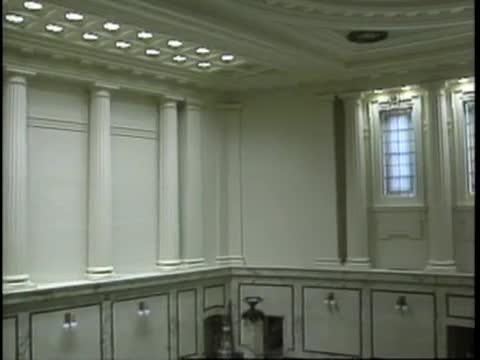
of bank construction between 1905 and 1916. The banks put a lot of money into their buildings to create the impact and impression on the investing public. I think it was to identify their stability, their strength, their image, and to create the impact on people that this was a good place to put their money, and it was a form of advertising. Just like you see today, the gasoline stations develop a logo. The bank's own logo was its building that said, we're here and we're strong. Often bearing strong resemblance to Greek and Roman temples, bank architecture featured columns, capitals, pediments, and lavish interiors finished in the best marble the world had to offer. Everything was first class. Inside, the banking hall made a second and equally impressive statement. Some halls felt like the interiors of cathedrals, so sacred is the space. So valued is its function in the community.
Palaces of commerce, the banks of left Winnipeg's exchange district, a legacy few cities can match. The Martin's family has been active in Winnipeg real estate for decades. Their introduction to historical buildings came not only from being moved by pictures of the architecture, but also from the conviction that they had the business sense to make old buildings work economically. We do have a lot of pride in redeveloping this type of facility. It would be a shame to see something like this torn down. This has so much value in terms of historic and heritage, the heritage of the city. And for anyone to allow something like this to be torn down and not redeveloped, I would say it would be a shame. We saw, I guess it's a two-fold purpose. One was we really recognized that new construction, there was a limit to the amount of new construction that could really be put on the market at this point in time.
The economy was a little slow and we felt that it was really not worth our effort to start dwelling on new projects. We looked at the older projects and then recognized real value in some of these historic buildings, the heritage buildings, and felt that they can be redeveloped and actually made to be substantially or fairly superior in terms of overall quality to what a new project could be developed into. To occupy this type of building, it's very important for people to look at the overall economics, but also to keep in mind that there is real potential, there's marketability in this type of a project. A tenant could move in here and an occupy superior space for virtually the same cost to that of occupying space and in a new project. The rehabilitation of these jams has necessitated craftsmen with special old-world skills
that were not readily locally available. Recent immigrant Alfred Widmer, who was brought to Winnipeg to manufacture the molds and statuary for a new project on a cinema avenue, possessed the masonry restoration skills that Winnipeg's ornate plaster ceilings required. His artistic touch has been honored by an award for excellence from heritage Winnipeg. Let's meet restore Alfred Widmer at work. I'm Stonewall from trade and restore from trade. Now I'm doing the walker theater and Winnipeg. My father was a sculptor and there's a kind of go-up with all these things with art and nice architectural things and statues and pictures. So it was no question to me to go into this business. He guided me to learn these things from a release stage, huh? And then later I am having wires going all the way across to come into a place like this
and to start doing the restoration work is kind of a detective has to walk into a case to find out who did what and how was it then and in order to compete the picture to convict the guy. Exterior restoration you would use. It's the ordinary painting of all the stenciling. It's the art painting. It's a mold construction, it's casting of new gyps and pieces, installing those pieces, doing all the steel anchors you need. So everything is done, it just with three people in here to keep the working sessions small because we have to leave the theater in the night because there's a performance and then we come back the next day and start working again. To me it's really nice to go in and then repair these things and bring them back.
It's a lot of fun, it's not the work, it's not the pride. I'm a tool, I'm just doing this. It's nice to know I did it, I brought it back to the original looks. Another building renovator who has been active in the exchange district is helmet sass. Inspired by his early upbringing in Germany, what drew him most was a love for their beauty. Initially people would appreciate about older buildings, there's a workmanship that goes into the quality of the materials used, for example, the marble, the brass, the workmanship that goes into woodwork, carvings and wood. I really appreciate it that, recognizing that these things could probably never be duplicated because costs would be enormous. So I really appreciate it that and then the cost at buying them was what appeared to me
to be ridiculously low. In hindsight now I look back and they recognize that I fell in love with the buildings without property considering the economics because they do require renovations upgrading to bring them up to current standards so that it could be marketable. We had a total of 17 at one point. We had, for example, out of this block, the National Bank building, the Chamber of Commerce have here old CIBC building next door, and the Bank of Hamilton building, then the 177 of which used to be the old gray West life building, and then across the street from that the grain exchange building. And then a number of buildings on the other side of the portage, which were demolished to make way for the TD Center, net and building the child's building, the Lindsey building, electric railroad chambers. In hindsight it was, we took on too many, took on too much debt, thinking that the real estate
boom would never end, and nothing that's forever, and it did end. In the 1960s and early 1970s old buildings were not as highly regarded and were demolished. An example of this was Winnipeg's old city hall of Victorian gingerbread landmark that was demolished in 1962 before there was a recognition of the value of preserving our past. Heritage buildings should not be a liability, but a resource. In the late 1970s, the Bank of Hamilton and the adjacent Bank of Commerce became the focus of a debate as to whether there should be preservation or not. If the banks would have had their way in 1979, this magnificent building would not be here today for you to see. Charles Bugeliskis is the city of Winnipeg's Heritage Buildings Officer. It is his task to administer the city of Winnipeg's Heritage Conservation bylaws.
Start buildings are a cultural artifact. They represent an investment in time in sort of the background of a city, and in Winnipeg we view Heritage Buildings as an asset that at least we should have a public forum about what gets demolished and what stands. Winnipeg is in a really unique situation that there's very little growth, there's very little pressure to demolish buildings to put up a new structure so that a number of 30 significant heritage buildings that said vacant and have sat vacant for 20-25 years. In Winnipeg this lack of growth, this lack of development pressure has allowed the city going back to the First World War to maintain many buildings and the whole warehouse district has managed to stay intact because of the lack of this development pressure and it's
not intentionally but inadvertently that we still have one of the best collections of heritage buildings in Canada. I guess the one of the big, the difficulty is is that there are so many and so many that need attention and so many that are important and yet the frustrating part of it is what do you do. There is once a former chair of these dark buildings committees said that Winnipeg has an overabundance of wealth and these heritage buildings and it's just you know how many and what's ones do you save and that determination is extremely complicated and very difficult and while the city hasn't lost that many important ones through demolition I believe that it's the slow deterioration and they're all aging at the same time and they're all the same vintage that the biggest loss could come.
Decisions about which buildings to save and how their renovation will be assisted will be made by civic politicians. Mayor Susan Thompson has firsthand experience about operating a family business, bird sadlery, out of an older main street location. It was very vibrant area, a lot of family entrepreneurs, family businesses, big manufacturing clothing buildings. I remember the big buildings, I remember them being older but the feeling I think is the thing I remember the most and it was a vibrant part of the city. Where our regional store used to be is now our centennial concert hall. So it was interesting because it was my grandfather's and father's decision that we not leave the area. I remember my grandfather and my father saying we didn't want to be a part of those new malls. We just became a clone out there.
We were special business and people would come to us. So we moved to blocks from our original location but continued to stay in the area. The area has changed in the sense that a lot of businesses have left the area, the businesses that are left are very special businesses though which gives a uniqueness to a city. I think our role today because the role is ever changing. So I think today our role is to make sure the priority buildings are protected. We have in our city a huge inventory of heritage historical buildings. What I'm afraid of is that we're not going to concentrate on the buildings that must be protected and I think that is our job and it has to be our priority is to make sure the most important buildings are protected and that we do a good job of that. Councillor Glenn Murray is a strong advocate on the need to protect and encourage the
rehabilitation of Winnipeg's heritage structures. As past chair of the city's planning committee, he spearheaded a task force on the kinds of incentives required to encourage their continued reuse. I'm an advocate of a number of things that we need to do and I think that we have to marry two ideas here. One is for cities to have a sense of soulfulness or a sense of place for people to live in. You have to preserve an essence of their past. I think that's really important in urban life today that there's a sense of continuity there. On the other hand, we're living in times where we're supposed to be committed to something called sustainable development, to preserving our environment. Our built buildings are often our most our largest throw away sometimes. If we can marry the idea of preserving built materials, preserving these buildings, not going back and using new steel and new stone but reusing our existing building materials, bringing them back to life, recycling them in a sense, with the idea of a sense of place.
Really, we need to also educate the real estate community, I mean I talked to, there's a few real estate agents that are great advocates of heritage buildings. Most of them advise people not to move into them. Based on prejudice and perceptions that most often aren't true, we still have a hangover from the 60s and 70s of sort of the bulldozer mentality of downtown development and we have to get past that. But while politicians of today must make difficult choices about which buildings to save and which to demolish, those that built Winnipeg at the turn of the century felt that the world was their oyster and their individual successes rivaled that of man in much larger cities. With only a third the population of Toronto in 1919, Winnipeg boasted that it had 19 million errors to Toronto's 21. They ran the legislature, city hall, education, medicine, the board of trade, the leaders were in the vanguard of all civic improvements.
And Winnipeg's public works mirrored the optimism shown by its private citizens, seeing great promise in Winnipeg's future, civic leaders dreamt and executed great public works. A major hydroelectric facility was being established on the Winnipeg River, a water supply system that would last for centuries and a high pressure pumping station for firefighting were built in 1907. One place few people get to see is the James Avenue pumping station. An example of Winnipeg's public enterprise at the turn of the century that facilitated the expansion of many of Winnipeg's warehouses. Located at the foot of the Red River, at the east end of Banditine Avenue, the Bain building was an example of the kind of structure that the pumping station was designed to protect. The wooden floor and post-and-beam structures comprising the interiors of these warehouse houses, as well as the variety of goods they stored resulted in fires and accompanying high insurance rates.
The increased capacity provided by the pumping station helped reduce the risks and costs of warehousing and distribution. Once a dry goods store, the Bain building was one of the earliest buildings to see renovation in the early 1970s, and the project succeeded in attracting a variety of professionals in the design field like Gary Helderman. The location is good, and it's well situated. And for us, the image was right. It was the kind of space where we could come in and without spending a great deal of money, it put walls into separate parts of the space. We can get large areas, and in our practice we have an open office concept, so very few of us are in private offices and sound travels around, and that's quite fine. If you don't need to break up an office space into a bunch of small offices, these buildings are terrific because they have large spans and they're open, and we're not slick in the
way we operate. So this building suited our image and our personalities, and we're comfortable here. I think it's important to have places within our sphere of access, no matter where we live, that are strong, that are strong in character, places that are easily accessible to the people who live in our city, who can experience an environment entirely different from the one in which they spend most of their time either at work or at home. And the richer we make our cities, or I should say, the more we do that by preserving and enhancing defining special places in our cities, the richer the cities will become. One of Winnipeg's early settlers was James Ashdown. A tin smith by trade, Ashdown became a prominent businessman and citizen. He served as mayor in 1907, 1908, a period in which he was truly merchant prince of Winnipeg.
Ashdown's hardware empire was the largest in the west, and his massive warehouse at 167 ban at time itself saw expansion reflecting Winnipeg's growth spurts as more and more capacity was increasingly needed to serve the growing west. Today this building has been completely rehabilitated into 100 upscale condominium residences. Its occupants include young, upwardly mobile professionals and empty nesters and those that like to live close to work in the theater and entertainment district. But the Ashdown's original occupants were workers. The railways contributed more to Winnipeg's growth than the business of transportation. Rail also brought hundreds of thousands of immigrants, swelling the city's population with every train headed west. And while most continued west, a large number stopped and found work in this growing settlements, immigrants that made up the bulk of the workforce for this expanding city.
Manly Silverman, owner of Silverman Jewelers, tells us the story of his father who moved to Winnipeg in 1908, a very expansive period in Winnipeg history. My father came to Winnipeg having emigrated from his native Lithuania about 1908 as a boy of 15. He came over to Escort, a sister who was engaged to be married, unlike many immigrants of the time he could speak the language. He had learned to speak English from a gentleman in his native hometown, who had subscribed to the London Times and together they taught my father to speak English. Like many immigrants, he went where he had relatives, as some of his kinfolk had preceded
him here. He also had a great liking for the wide-open spaces and he actually enjoyed the white snow and the beautiful blue skies of western Canada as compared to a great deal of rain and fog which you experienced in the maritime. So he was very content, not Winnipeg. My father never took a winter haul day in his whole life. He landed in Winnipeg on a Sunday and without a job, and he walked down Portage Avenue and he saw a jeweler through the window who had come down to wind up his watches in those days, a conscientious jeweler would have to come in on a Sunday and line up all his watches to see if they were keeping time and he tapped on the door and Mr. Andrews the name of the jeweler, he let him in.
And what can I do for you? And he said, I'm a watchmaker. Well, I guess Mr. Andrews liked my father's approach because he hired him. And as a little boy, I can recall how proud I was to tell my friends and my father had fixed the city hall clock. The focus of growth moved to the east side of Main Street after 1900. The grain exchange, originally on Princess, moved to much larger quarters on Lombard Avenue in 1907. A man who has spent his lifetime in the grain industry throughout North America and Europe and served as recent president of Winnipeg's commodity exchange is Dick Dawson. This is the only commodity exchange in Canada. The settlement of the West sprang out of here, agriculturally the land was strong and good and the climate was less harsh than Saskatchewan.
You can sort of see the tremendous impact that the first shipments of grain out of this country in 1876, 77, 78, and I think it went literally from 800 bushels one year to a million to five million within two or three years. The concept that you could come to Western Canada to Manitoba and settle and actually not just survive but actually prosper had a lot to do with the proven ability to move grain. And so I think that attracted not only settlers, but I think it attracted a lot of investment. I mean, it immediately was followed by the railway and then by grain elevators and so on. Then the main grain exchange building was built in 1908, right in the middle of the exchange district. And I find building architecturally and still contracted one and happily being renovated
and maintained. And the exchange moved out of there in 1981 or 2002 into this building here. And the main reason for the move was electronic. In order to electrify the boards, you would have had to rewire the oil grain exchange building. It wasn't possible. When it takes exchange district includes not only a lot of exterior beauty, but a wealth of interior features you won't want to miss. Thank you. Behind the old grain exchange is Winnipeg's theater district anchored by the Pantages Playhouse.
Doug Tiesen is the acting manager of the Pantages, which has been publicly owned for almost 60 years. Pantages began the construction of the theater in 1913. The theater was constructed over the period of six months and opened in February of 1914. Alexander Pantages was born Pericles Pantages, went to San Francisco, and then followed up the gold rush and actually was linked with Klondike Kate and took her money as the gold rush was winding down in open theater in Seattle at its height. In fact, he owned 30 theaters and managed another 20. He saw Winnipeg, I guess, as a lot of advertisers see it today, a good test market because of its isolation, et cetera.
So in fact, he used to build most of his vaudeville shows in Winnipeg and test acts in Winnipeg before taking in West and then south through the United States. Stan Laurel played the Pantages in, I believe it's 1921. Mr. Keaton performed with his mother and father, who were both vaudevilleans. And then in the later years, in the 30s, the three Stooges, a Basil Rathbone, in the 50s. The theaters used today is quite a wide spectrum. Certainly the backbone of its use is groups such as the Gilbert and Sullivan Society, the Winnipeg Music Competition Festival, and a great number of the local ethnic and commercial dance schools in terms of their recital. Certainly though, still the touring performers are the ones that perhaps the general public hears of most often.
The Exchange District has always been the place for entertainment, whether it's a theatrical performance, a night out on the town at a fine restaurant, or a public event in Old Market Square. And this is the place to be. Thank you! The dreams, the hopes of past and future generations have made all we have seen possible. The status of a heritage district is always a precarious one, subject to the whims and
fads of the day. It is each generation's responsibility to preserve a treasure so that it can be willed to the hands and eyes of our next set of dreamers. I'm George St. Mandis, thanks for joining me. Welcome to my channel. to order your VHS copy of
pyramids on the prairie call toll free one eight hundred three five nine seven seven eight eight operators are standing by. . . .
. . . . . . . . . . .
- Program
- Pyramids on the Prairie
- Contributing Organization
- WILL Illinois Public Media (Urbana, Illinois)
- AAPB ID
- cpb-aacip-16-78tb33d7
If you have more information about this item than what is given here, or if you have concerns about this record, we want to know! Contact us, indicating the AAPB ID (cpb-aacip-16-78tb33d7).
- Description
- Description
- No description available
- Asset type
- Program
- Topics
- Architecture
- History
- History
- Architecture
- Media type
- Moving Image
- Duration
- 00:57:19
- Credits
-
- AAPB Contributor Holdings
-
Illinois Public Media (WILL)
Identifier: cpb-aacip-acaaa473953 (Filename)
Format: U-matic
Generation: Master
Duration: 00:56:02
If you have a copy of this asset and would like us to add it to our catalog, please contact us.
- Citations
- Chicago: “Pyramids on the Prairie,” WILL Illinois Public Media, American Archive of Public Broadcasting (GBH and the Library of Congress), Boston, MA and Washington, DC, accessed April 3, 2026, http://americanarchive.org/catalog/cpb-aacip-16-78tb33d7.
- MLA: “Pyramids on the Prairie.” WILL Illinois Public Media, American Archive of Public Broadcasting (GBH and the Library of Congress), Boston, MA and Washington, DC. Web. April 3, 2026. <http://americanarchive.org/catalog/cpb-aacip-16-78tb33d7>.
- APA: Pyramids on the Prairie. Boston, MA: WILL Illinois Public Media, American Archive of Public Broadcasting (GBH and the Library of Congress), Boston, MA and Washington, DC. Retrieved from http://americanarchive.org/catalog/cpb-aacip-16-78tb33d7