Artisode; Pueblos Under Los Ranchos
- Transcript
Sometimes I'll have guests who are wonder if I have any ghosts, and I say no. The people who lived here obviously are very respectful of what Kit did. My name is Kit Sargent. In 1976, my husband and I purchased this old Adobe house which you see behind me. Under it lies a considerable archeological site. A series of Indian villages begun in 1300 AD and finally abandoned about 1650 AD. We began to test the area when we decided to put in a swimming pool in 1979. For an archeologist to buy a piece of property, the archeological site is a little bit unusual. This wall is fascinating.
It's made of turtle-back bricks which are round and molded and piled on top of one another. This is a remains of a turtle-back shell impression and actually several of these were recovered during the excavations and they were found attached on a vertical wall roughly like in this position. Right now it's already eroded, so it's hard to see what this actually was, but we can tell that this was actually the impression of a turtle-back shell and so it probably would have been a shell like this, so what the prehistory people did was that they removed the base of a shell like this, removed it and then used the upper portion as a scoop so that they could build the dobi wall. So they probably would have had a dobi mixed in pit, then scoop up the dobi into this turtle-back shell and then just attach it on the wall and then again and so this sort
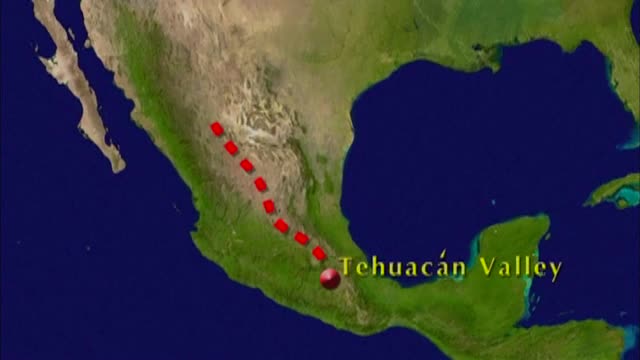
of would have been like an early masonry that the prehistory people were using. So again this is a pretty, pretty rare thing I'm not aware of where this would have been found at other pueblo and sites. I will take you back to the Coquetteland pace of development which was around 1,200, 1,100 BC taking place in Diwacán Valley of Mexico. This was the time when the corn was domesticated and the people found out that they could save the seeds, replant it and even carry it with them so they used it to migrate. They settled at a place called Crocanean and it is a place west of Cortez Corredo and lived there for several hundred years until the drought hit them around 980 by 1080 they began
to leave the area and by 1,300 they had pretty much settled along the Rio Grande where there was plenty of water didn't have to worry about drought anymore. What happened then, do you know? We don't know why but we know that based on the ceramics that we found at the site that they were here up to the time when the Spaniards came to the Albuquerque area. The years following the public revolt in 1681, many of the Tewa speakers who were talking about today left and went to the Hopi country as a place of refuge. They returned to the area and settled down to where they had been before. However, one priest decided that this area is very valuable for farming so he took many
of the refugees who had resettled at the area we were discussing and took them down to a sletta about 1230 miles south of where they used to live so that's how they arrived at a sletta pub. Only a small portion of the site has been excavated which leaves us only a small window to look at what may have happened out here but there's still a lot of questions unanswered because a vast majority of the site is still buried and unexcavated. If I or some other archaeologist would like to come back in future years to begin the excavation again, we would go on from these points.
We would find the plastic and the gravel and then move out around this excavated part of the site.
- Series
- Artisode
- Episode
- Pueblos Under Los Ranchos
- Producing Organization
- KNME-TV (Television station : Albuquerque, N.M.)
- Contributing Organization
- New Mexico PBS (Albuquerque, New Mexico)
- AAPB ID
- cpb-aacip-ff6b82695b8
If you have more information about this item than what is given here, or if you have concerns about this record, we want to know! Contact us, indicating the AAPB ID (cpb-aacip-ff6b82695b8).
- Description
- Episode Description
- The story of the Casita Chamisa Bed and Breakfast is discussed in this short program. The bed and breakfast was built on an archaeology site, a series of Indian villages that were occupied between 1300 A.D. to 1650 A.D. The owners excavated the site and share their stories with the viewers. Guest: Arnold Sargeant (Owner of Casita Chamisa Bed and Breakfast) and Alex Kurota (Archaeologist Publishing Report on Chamisal Site).
- Asset type
- Episode
- Genres
- Miniseries
- Media type
- Moving Image
- Duration
- 00:05:24.875
- Credits
-
-
Producer: Kelly, Lillian J.
Producing Organization: KNME-TV (Television station : Albuquerque, N.M.)
- AAPB Contributor Holdings
-
KNME
Identifier: cpb-aacip-b89fed78035 (Filename)
Format: XDCAM
If you have a copy of this asset and would like us to add it to our catalog, please contact us.
- Citations
- Chicago: “Artisode; Pueblos Under Los Ranchos,” New Mexico PBS, American Archive of Public Broadcasting (GBH and the Library of Congress), Boston, MA and Washington, DC, accessed March 11, 2026, http://americanarchive.org/catalog/cpb-aacip-ff6b82695b8.
- MLA: “Artisode; Pueblos Under Los Ranchos.” New Mexico PBS, American Archive of Public Broadcasting (GBH and the Library of Congress), Boston, MA and Washington, DC. Web. March 11, 2026. <http://americanarchive.org/catalog/cpb-aacip-ff6b82695b8>.
- APA: Artisode; Pueblos Under Los Ranchos. Boston, MA: New Mexico PBS, American Archive of Public Broadcasting (GBH and the Library of Congress), Boston, MA and Washington, DC. Retrieved from http://americanarchive.org/catalog/cpb-aacip-ff6b82695b8