¡Colores!; 301; Kirk Gittings, Clarissa Rizal, David Berkeley
- Transcript
Funding for COLORES was provided in part by: The Nellita E. Walker Fund KNME-TV Endowment Fund The Great Southwestern Arts & Education Endowment Fund ...and Viewers Like You >>THIS TIME, ON COLORES! ONE OF NEW MEXICO'S FINEST LANDSCAPE PHOTOGRAPHERS KIRK GITTINGS FINS THE GREATEST SENSE OF PRESENCE IN ABANDONED AND UNPOPULATED PLACES. >>You don't always know what you are looking for but when it happens you know that it just happened.>>ALASKAN TLINGIT ARTIST CLARISSA RIZAL CREATES CHILKAT WEAVINGS AND BUTTON BLANKETS HIGHLY REGARDED FOR THEIR UNIQUE BEAUTY AND THE STORIES THEY HOLD. >>When we tell our stories they are a guide from the past, through now, into the future. >>SANTA FE MUSICIAN AND AUTHOR OF 'THE FREE BRONTOSAURUS'
DAVID BERKELEY SHARES HOW STORIES CONNECT PEOPLE. >>Ultimately, what brings us together has to be something that hits us at more of an emotional core. >>IT'S ALL AHEAD ON COLORES! >>KIRK GITTINGS SHARES HOW WIDE OPEN SPACES INFORM HIS LANDSCAPE PHOTOGRAPHY. (guitarmusic plays) >>Gittings: My biggest
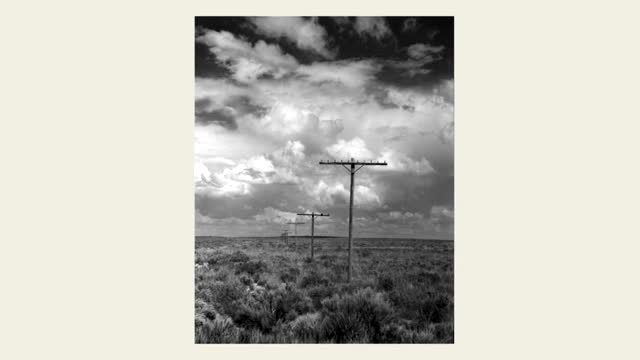
struggle, when I go out to photograph, is to become in the moment, so that I can see and feel what's happening around me. You don't always know what you're looking for, but when it happens you know that it just happened. It's less intellectual than it is physical. There's a relationships of landforms, and light, and shadow, and rivers and things. And, when you see them, you can feel it in your body. It kind of makes some kind of sense in a rectangle, a rectangle of a photograph. And then I set up a camera, and then I try to focus in on that. And then I wait,and I contemplate, and I think about the history that emits through this landscape, or the mythology that's
attached to that landform. (music plays) >>I care hugely about a composition. I often times photograph on the edges of storms, where there is rapidly changing light. And within the difference of a minute or two the whole composition can change because the light and shadows of the clouds and stuff can change. So sometimes I am making a series of images. One the one that has the magic in it. (music plays) >>One of the things I find most intriguing about the landscape is that it seems to be alive. Even things that are not life forms, like, a landform can be
alive. It kind of, has a personality to it. A good example is Jacona Cliffs. 25, 30 years ago, driving by there, it kind of spoke to me in a way. It had, it's like thisbackbone of some ancient dinosaur. And, I just, it has this kind of energy to it. And I thought, "I'd really love to get a great photograph of that and show how it really comes alive. So, I spent nearly 25 years pursuing that photograph. It took me a decade to figure out what the point of view was that I wanted. And, then another 15 years of bad transitional light, or whatever. It just didn'twork. Until one time I went there, powerful clouds, blowing through, on the edge of a storm, nothing was happening, I started to take the camera down, I turned around to the car, I turned
back and it was illuminated, this shaft of light had just come through and just illuminated that backbone of the Jacona Cliffs. And it just came alive. And, it came alive visually, the same way I had been feeling about it, for all these decades. (music plays) >>I grew up on the far west side of Albuquerque. Around us were all these massive, desolate spaces. The Sandias on one side and Mt. Taylor on the other side. That enormity of space kind of informed how I view the world. It was like being alone in this landscape, this huge, massive landscape, that I did not find intimidating, but I made friends with it. And, my friends and my brother and I, we would explore these landscapes and find things of interest, things to do. So now, when I'm in these landscapes, I still carry that interest with me, I carry that
affection for these broad spaces I'm comfortable in. But now what I'm looking for is imagery, imagery that reflects this relationship I have with these big wide spaces. (music plays) >>There's a lot that I've learned that I've experienced that I feel that I have a responsibility to share. At my heart, I'm probably as much an educator and a preservationist as I am an artist. I have seen in my lifetime, truly beautiful, extraordinary landscapes in New Mexico get ruined by a power line running through it, or a new highway running through it. And,
I would hope that my photography would help to educate people about the preservation of some of these beautiful, historic >>CLARISSA RIZAL CREATES CEREMONIAL REGALIA AS A WAY TO RECORD HISTORY. [Child 1] - I think we're reaching the moon and cutting from the - [Child 2] - OK! [Child 1] - How about we get their trail to lead here? [Clarissa Rizal] - The reason why I weave, it's like no other medium that I've ever
worked in. That connects me to the past and the present and the future. I take the fiber from an animal and a plant.And I weave them into these ceremonial robes and in so doing, it is the act of the weaving that puts me in touch with all that there all that power and energy. Our art was depicted
in everything. And that was a way to portray our identity, where we came from, since it was a matrilineal society. But also, it was our written language, we wore our history in our regalia. We still wear it. We didn't have a written language, it was all oral, on from generation to generation. But with the oral history, there was always an art object that went with every story, that went with every historical event. The stories come
from everyday life, whatever happens, whatever it is that you want to preserve for future generations. We want to tell a people wherethey're from, what happened, how did they come to be where they are. It's not just livelihood, it's piece "Resilience," and it's Resilience Chilkat Robe and what that is, it's like, it's a visual document of the ability of a people to adapt to outside forces that came into the culture. In that image, you'll see the foundation of our clan system, the eagle and the raven in the center
and then there's the outside influences. Within the eagle and the raven you will see the Alaska Native Brotherhood, the ANB and the ANF. These civil rights groups gave flight to therights of the indigenous people. And then at the bottom is the tail, and what that represents is that it's the Sealaska Heritage Institute logo and they are now the present day rudder as far as helping to retain and perpetuate the need of cultures in present day Western society. Resilience - the ability to adapt so that we continue to thrive. I keep stories alive because there's
always something to learn and even when the stories are repeated over and over and over again and you hear them twenty times in your life, or a hundred times in your life, at that stage in your life, you always get something else out of the story. [Clarissa Rizal, to child] - There they are! There's Louis! [Child 2] - Hi! [Clarissa Rizal to child] - Look, little socks, little socks, baby socks! [Clarissa Rizal] - When we tell our stories, they are a guide from the past through now, into the future, that's why we tell stories. >>DAVID BERKELEY'S SONGS
AND STORIES INVESTIGATE EMOTIONAL CONNECTION. father, I am coming home. Open up the gates, please let me in. Everybody needs some way on a road not always kind. Yes, it's been a long, hard you find your stories? [David
Berkeley] I wanted to write a book of interweaving stories, so all of the stories in this book, the characters meet each other and ultimately - some find love, some help each other in different ways. I was on a jog one morning and I came across a piece of lawn art in front of relatively attractive house. It was a stone brontosaurus and my initial reaction was -why would anyone want this dinosaur in their front lawn? I'm not sure why, but it stayed with me and as I was jogging further and running into other people on my run and thinking about people in my world, I realized I know a few people who would like that brontosaurus. Obviously the people who livethere and that was the spark. Then trying to investigate those people, people who maybe live at themargins a little more or people who find beauty
in bizarre places and instead of the initial judgments, trying to find what it is that they see in those things and see that that's actually a virtue and what makes them rich and beautiful instead of odd and alienated. [Reading] "What do you know about the legs of a brontosaurus?" the security guard cracked a curious smile and then, as he typically did with Russell, ignored the question and handed him a lollipop. "The legs," Russell repeated, unwrapping the dum-dum, "do they got any knees?" The guard shook his head slightly and then threw up his hands, "Man you are one crazy old fool, the hell do I know about a damn brontosaurus?" Russell adjusted his thick frames and held the guard's gaze a minute, as if to challenge him to think harder about the question. "Tell you what I do know, bank don't open for thirty more minutes," Russell was well aware of the credit union's hours. He was also well aware that a perfectly functioning ATM hummed idly only a few steps away. Russell didn't trust computers, nor did
he believe in the hidden hand of direct deposit. "What you can't see, you can't know," he'd like to say, "aw it doesn't matter anyway, not anymore, not with what I'm sitting on. Criminy, Jesse, wait until you get a load of what I stumbled upon a few days ago." [Hakim Bellamy] What inspires you about telling stories? [David Berkeley] I think that as a people, we're by nature storytellers. But I think, of late, maybe we find ourselves, not necessarily telling fewer stories, but telling different stories. Telling stories that maybe have a political agenda or telling stories that are maybe meant to alienate versus unite. Telling stories about struggle, but not with the goal of empathy. For me, stories are the best way to unite people. [Singing] Father, father, father, I am
coming home. Oh everybody needs a place to lean. [David Berkeley] For me, songs are mostly an emotional experience. [Singing] Have some would die to find. In a well in some forest, can turn more than some minds. No, not sure I believe it, I'm not sure that I do, but lately I have been grasping for something to pull me through. Where's the wishing
well? Where's the wishing well? And I feel like a travelling salesman going door to door. Though I don't like to say it,sometimes I want it more. [Hakim Bellamy] Why are stories important to us? [David Berkeley] The best power of a story is to make us look both outward and inward, to hopefully see a part of the world thatmaybe we're not used to looking at. Then to hopefully look back at ourselves and see a part of ourselves that we haven't seen before or haven't seen for awhile. I think a lot about why I write songs,because there's a lot of things you can do with your life, a lot
of things that are valuable. For me, trying to increase empathy is among the highest things of value. For me, songs can hit people at a level not a lot of things hit us. Because many message we get, many medium that we get divide us, they make us angry, they make us judge, and ultimately that's not gonna heal or help. Ultimately what brings us together has to be something that hits us at more of an emotional core. With a certain kind of emotional directness that allows us then to go into the world and see a new beauty and to seeeach other with kinder eyes. I think songs and stories ultimately make us more empathetic. [Singing] Oh I have found
my way back to you, please find your way back to me. Please find your way back to me. Please find your way back to me. Father, father,
- Series
- ¡Colores!
- Episode Number
- 301
- Producing Organization
- KNME-TV (Television station : Albuquerque, N.M.)
- Contributing Organization
- New Mexico PBS (Albuquerque, New Mexico)
- AAPB ID
- cpb-aacip-e45014b792a
If you have more information about this item than what is given here, or if you have concerns about this record, we want to know! Contact us, indicating the AAPB ID (cpb-aacip-e45014b792a).
- Description
- Episode Description
- One of New Mexico’s finest landscape photographers, Kirk Gittings finds the greatest sense of presence in abandoned and unpopulated places. “You don’t always know what you are looking for; but when it happens, you know that it just happened.” Alaskan Tlingit artist Clarissa Rizal creates Chilkat weavings and button blankets highly regarded for their unique beauty and the stories they hold. “When we tell our stories they are a guide from the past, through now, into the future.” Santa Fe musician and author of “The Free Brontosaurus,” David Berkeley shares how stories connect people. Berkeley is interviewed by Hakim Bellamy. “Ultimately, what brings us together has to be something that hits us at more of an emotional core.”
- Created Date
- 2016
- Asset type
- Episode
- Genres
- Magazine
- Media type
- Moving Image
- Duration
- 00:23:23.424
- Credits
-
-
Guest: Berkeley, David
Guest: Gittings, Kirk
Guest: Rizal, Clarissa
Host: Bellamy, Hakim
Producer: Walch, Tara
Producer: Kamins, Michael
Producing Organization: KNME-TV (Television station : Albuquerque, N.M.)
- AAPB Contributor Holdings
-
KNME
Identifier: cpb-aacip-aa125e118be (Filename)
Format: XDCAM
If you have a copy of this asset and would like us to add it to our catalog, please contact us.
- Citations
- Chicago: “¡Colores!; 301; Kirk Gittings, Clarissa Rizal, David Berkeley,” 2016, New Mexico PBS, American Archive of Public Broadcasting (GBH and the Library of Congress), Boston, MA and Washington, DC, accessed April 4, 2026, http://americanarchive.org/catalog/cpb-aacip-e45014b792a.
- MLA: “¡Colores!; 301; Kirk Gittings, Clarissa Rizal, David Berkeley.” 2016. New Mexico PBS, American Archive of Public Broadcasting (GBH and the Library of Congress), Boston, MA and Washington, DC. Web. April 4, 2026. <http://americanarchive.org/catalog/cpb-aacip-e45014b792a>.
- APA: ¡Colores!; 301; Kirk Gittings, Clarissa Rizal, David Berkeley. Boston, MA: New Mexico PBS, American Archive of Public Broadcasting (GBH and the Library of Congress), Boston, MA and Washington, DC. Retrieved from http://americanarchive.org/catalog/cpb-aacip-e45014b792a