Report from Santa Fe; Ian Hoffman
- Transcript
Two Three Two Three Two Three Three Two Three Two music Report from Santa Fe is made possible in part by grants from New Mexico Tech on the frontier of science and engineering education for bachelor's, master's, and PhD degrees. New Mexico Tech is the college you've
been looking for 1-800-428-TECH. I'm Ernie Mills. This is report from Santa Fe. I would guess today Ian Hoffman, a former journalist in the Mexico, who is also the co-author of a book book along with his friend, Dan Stover, called A Convenience Buy. And Ian, it's good seeing you here. Pleasure to be here. I got to start off this way because people never see the guests with a coffee cup over there. And since the book A Convenience Buy has just been published, you and Dan were out at book signings and you literally signed so many books you couldn't lift the coffee cup or a cup of water. I wasn't worried about that. The worry you have is when someone comes in after book signings and their hand doesn't hurt when signing the books. Fortunately, we haven't had that problem. New Mexico has treated us wonderfully. We're very thankful.
Can we go back just a little bit in time? You'd work with the Albuquerque Journal here for about five years covering the Los Alamos Laboratory. And then I know you went to the coast. You're freelancing now, I believe. And Dan Stover, who is your co-author, Dan works for a newspaper out there. For the San Jose Mercury News. San Jose Mercury. The newspaper of Silicon Valley. He's also, like me, a nuclear weapons reporter covered the sister laboratory to Los Alamos Lawrence Livermore. No, that's where Dan did his coverage out there with Lawrence Livermore primarily. How did you connect? Well, there's this rather small fraternity of us. They covered nuclear weapons. And so we were both familiar with each other's bylines, but it never met until this case. And so we began, you know, while we were kind of living in Albuquerque during the coverage of the case in hotels. So we would meet up after meeting our deadlines and talk
about all the things that had transpired in court. And I pitched him on doing this book. And then he was maybe on the edge somewhat until the last day of this case when when Holy pleaded guilty. And the judge, gentleman Jim Carker, down in Albuquerque, dressed down the government in an extraordinarily rare apology. It was almost an apology to win Holy, wasn't it? It was an apology to win Holy. And also, I think, a rebuke to the Clinton White House and the administration. And there was just so much emotion in that courtroom. People beaming through gala tears. And we looked at each other across the courtroom and knew that we had to do this book. Time for a book. How much of your coverage was done? I know you did quite a bit here during the trial here. And I know you probably went back home to California.
You know, again, you had to live a more out there in Los Alamos here. How much of it was done in Washington? Plenty. We did a couple of trips out to Washington and did a lot of interviews. Took weeks to transcribe all of our notes. And we actually had a horrifying moment while we were trying to catch a cab going from one interview to another and we get a call from a publisher who says, instead of the seven months that you have agreed to do this book in, you have three. And so it was a scary time. But it was gratifying. We had a number of intelligence officers and policy analysts and other folks who graciously gave us their time. I get a feeling that you and Dan get along very well. Quite, yeah. I've watched co-authors who are in each other's throat but you seem to have a very good rapport with each other. You know, we have this, you know,
momentary bouts of married couple syndrome. But beyond that, we have, we've had a great time. Now, objectively from your standpoint, I got a feeling the book was very objective. And that's not easy in a case like this because a very emotional case. Did you find a different feeling when you were doing your coverage in Washington and you did, for example, in Albuquerque? Well, sure. You know, Washington is, obviously, it's a strange and artificial environment where, you know, you can find a few points on any aspect of the compass and strongly held and also as equally wrong. But in any event, actually, one of the points of the book, and I hope it comes through, which is that, you know, I think the perception here in New Mexico was that this case was driven by these rather huge and impersonal monolithic forces in government,
often DC inside the beltway. And what you actually find when you wait into it is, you know, there isn't anything such as this monolithic government but you really have specific individuals with personal ideologies and ambitions who a critical junctures are driving this case and putting Wenholy in the bullseye of the FBI. It's very interesting how that happens and how it's perpetuated in part by partisan politics. I know that you were aware of this when you were reporting out of Albuquerque but it's always strange to me when the leaks and, you know, Los Alamos and their security if they had more leaks than a sieve. And when they leak it, they leak it to the Washington media because they're thinking in terms of, you know, not what's in the Albuquerque Journal though thinking in the Washington Post and then when they get creamed, they complain about the media
and there wouldn't be the media problem without the leaks. Can you, I know you can set out and prioritize some of what you consider to be the high points of the book and then I can get down to some questions. Sure, but just touching on this issue that you raised, my profession, journalism did not distinguish itself in this case. In fact, it was, you know, I think an embarrassing episode for our profession where that leak game that is the blood sport of Washington ended up, you know, having very real victims in this case. And, you know, it includes when Oli and his wife living up in Washington. And what you found among other things was every little bit of information that FBI agents here on the ground might find that might be subject to interpretation. Maybe you could look at it
in a very suspicious way but it also might be explained in an innocent fashion. They would report it to Washington and read about it cast in the most suspicious light in the pages of the New York Times within a week. And part of the reason was because official Washington had staked out rhetorical positions on this case. When Oli was the spy of the century, he was, you know, to quote, I guess it's a Senator Arlen Spector out of Pennsylvania. He had committed the grandest case of grand larceny in the history of the world. There are those of us who remember Rosenberg's, and I believe at one point in the book they had made a comparison from one official that this even dwarfed the, you know, the spy trial with the Ethel and Iver from Paul Redmond, who is
kind of with this renowned counterintelligence spy catcher with the CIA. And, well, he turns out to be wrong. But, you know, the other interesting thing about why this was a bit of an embarrassment for our profession was you had a very central figure in this case, Notre Troulac, who is a counterintelligence chief with the Department of the United States. One of these individuals that we were talking about earlier who, at very critical junctures, pushes this case along. Whenever it seems to be lagging or in some fashion, he, you know, either by testifying before, say, the Cox committee or by leaking something to the New York Times or pressing the case word with the FBI. He's always getting to go on track. And, in any event, you see that when the New York Times
actually breaks this story, they make a show of going out and trying to, quote, unquote, confirm what Troulac has been telling them. But, unfortunately, what they're actually doing is they're just talking to other people who have been talking to Troulac. The situation is just echoes of the same men. If, and it seems unfortunate, in a way, I don't believe the charges against the lab on security problems started with Wynn Holy. No, security has been a pretty persistent issue just as safety has and some other issues with the laboratory. I think, you know, there are some very real security issues. And the one that I think is most significant with us is a failure of the laboratory to really deal, you know, meaningful way with what's known
as the insider threat. And that's the, you know, the potential for somebody who's working in the laboratory who is cute-clear, who has a security clearance for handling nuclear weapons where to, uh, wittingly or unwittingly give up information. And the most salient manifestation of that is the total lack of real computer security. And it's very surprising that if anyone should be aware of it, be the laboratory. Yeah, I mean, and it goes all the way back to the Manhattan project. John Von Neumann was a digital age. I came up with the idea of, you know, computers capable of storing programs. And, uh, and, uh, for being able to, uh, vastly speed up, uh, calculations and make, make things far more efficient. And, uh, and so, uh,
Los Almos has always, uh, been on the cutting edge of computer technology, both hardware and software. as lags significantly when holey should never have been able to do what he did. Should never have been able to with a few keystrokes declassify, um, reams of, uh, of nuclear weapons design, software, and nuclear weapons designs, um, and, and put them on portable medium. Uh, so, but, uh, if I may, one, uh, other point, uh, we also find out that, uh, the federal government has shirked a very important responsibility with respect to security. And, uh, it has, um, a huge impact on, on the very culture of scientific security, not only Los Alamos, but, uh, uh, institutions that work with nuclear weapons all over the country. And, uh, and part of it is, nuclear weapons secrets are treated differently
than any other secret that this country has. It's a foreign secret. Any, any piece of information that has to do with the manufacturing design of nuclear weapons is, is, uh, by default, considered secret until it is actively declassified. And, uh, so, the result is that a vast amount of the basic science and engineering that goes into the design, uh, the research and development of nuclear weapons, uh, that probably ought to be classified, uh, probably ought to be classified, is. And, you can maybe see that over decades, uh, this breeds a certain degree of complacency among the scientists who work with that information day in and day out. A good, uh, a good spy type would have trouble looking at the classified information and finding out what really is classified and what isn't. Good ways to not a lot of his time. He's going through their material. Especially in the material that, uh, it's definition and exceedingly high volume of
unclassified material with a small amount of classified material sprinkled throughout. Yes. And I'm not looking at how you portrayed this in the book, but I did the feeling I got was that if they got after Lee on the basis, and I don't think anyone denies, that he certainly, someone referred to him as a security nightmare, I believe. That's right. That'd be the case, what you're looking at there is, first of all, the breaches of security, which certainly has to be against the rules of the lab. If they started at that level and then built up to anything else that would project onto whether he was a spy or not, it would seem, you seem more logical, but they sort of backed into it, and everyone was ignoring what were the normal security breaches. That's a feeling I got from the book. Well, you know, I don't mean to imply at all that there weren't rules that Los Alamos would suggest is that often there are ways around those rules,
and when only took those work arounds, and frustrated security in a number of different ways, both in terms of frustrating issues that should have brought question to his security clearance. Much earlier in the game. For example, he hides the fact of certain meetings that he has with Chinese scientists, and obscures other facts from the laboratory and the Department of Energy and the FBI. And personal feeling is he does this so because he's afraid. He thinks he may get in trouble. But what it does is it cheats the Department of Energy out of an opportunity to really look at his security clearance and judge whether he ought to have those kind of contacts. And at least in least in the case, you could have kept him out of a lot of trouble too. But I want to make
clear, regardless of the title of the book, we don't believe that Wenholy was a spy. That's you and me. Both of us. I, for all of its bumbling in this case, and there's plenty there. Had plenty of opportunities to really scrutinize his fellow's life. They photocopied his mail for a number of years off and on. They've gone through his garbage. They've gone through his computer system. They've gone through his phone records, his bank records. They've interviewed, they've done more than a thousand interviews. So of 100 agents assigned to the case at one point in time. This is one of the largest and most thorough investigations, at least towards the end that the FBI has ever conducted, especially in the area of computer forensics. They still did not find concrete evidence that the man was a spy or intended to be a spy. We had one picture in the book,
I find interesting, because it was near the end of the investigation. And they were trying to find a deep in the garbage up at the lab. And the picture, I think, shows a number of FBI agents dressed in white, raking through the... I have a lot of friends in the FBI. And I asked one of them, I said, how does it feel when you're youngster? He says, what does your dad do? And they say, well, he combs the garbage at Los Alamos National Lab. They looked a little bit in that picture and you're a Santa... You know, it's a sober they have. I think they call the little glumes that are dressed in white, dancing around the foot of this sober. And I immediately saw that in that picture. Now, the question, you made many references in the book. And this is where I thought started before when Holy, I believe the Cox report. That was represented in the Christopher Cox, wasn't it? So in California, yes. So in California.
The registry report is stunning. Now, if you ask about it... Including Bill Richardson, the secretary of energy at the time. That's right. And if you ask them, tell me, you know, tell me a little more about it. Now they'll say it was highly politicized. But I got the impression in the Cox report that there were people who were delving on the edge of providing secrets who knew that they were in conflict with State Department policy and that's business people primarily. That was somewhat scary because I never saw the government follow up with them. Well, there was some follow-up. At the time that the report was written, there was a contemplation within the Department of Justice of criminally going after some of those commercial entities that had shared technologies with China. But even when the interesting things about the Cox report is that really is all what he had was these allegations that Laurel and Hughes
and some other entities that deal with rocket technologies, missile technologies, rather and supercomputer technologies had, you know, either greased the wheels within the Clinton administration with campaign contributions to make these exports or perhaps inappropriately share these technologies to engineer the way, you know, scientists and engineers often work. And that was about as far as the Cox report would have gone. And then in the fall of 1998 and are no-trutrulok. And all of a sudden you end up with a rapidly rewritten report 80% of which now reflects his view that China is made off with the majority of US nuclear warhead designs. And to the timing here
is rather important because at that point the Cox committee I mean we have descriptions in the book. The committee members, their jaws, just drop open when they hear this from the head of intelligence and the Department of Energy. And he tells them, yes, and I have, you know, we have a spy actively under investigation in Los Alamos. He's been under investigation for three years now. I don't know what's the matter with the FBI and that they can't bring this manager just as he's still at work in the nuclear weapons design division of Los Alamos. Well, so the congressman who were on the panel become irate. personnel with the Department of Energy and beating on them and they include Ed Curran, who's chief of counterintelligence at the time. And they want to know why do you still have this quote unquote spy working in nuclear weapons, working with nuclear secrets and working on nuclear weapons
designs right there in Los Alamos National Laboratory. And he hasn't really got a very good answer for them. The answer, of course, is that the FBI demands a spy. Curran goes to Bill Richardson and again at this point in time and we're talking about the middle of December, 1998. There's frankly very little that's known that's really suspicious about Lee. A few things, not necessarily things that we think reasonable people we consider dismissable defenses. The word comes down from Bill Richardson from the Secretary of Energy to New Mexico, to the Albuquerque Operations Office and the Department of Energy to DOE offices at Los Alamos and to Los Alamos National Laboratory that the Secretary of Energy wants him fired. And so he's pushing both on the Department of Energy
and the FBI to make that happen. And it seems clearly to the impending release of the COX report more than anything else. And unfortunately, you know, I guess one is if you're a cabinet member, you're expected to do these things to protect your agency and your president. At the same time, had it actually occurred at that point in time, it would have also come a tremendous career cost for a man who at least had an influence here in the third congressional district. Interesting, but the COX report. You know, we're also living and you talk about the computerization and frequently when you ask anyone these days, can I got a copy of the report and they'll say, oh, it's on your computer and your website. And that's not quite the same as getting the copy of the report itself because once you get the copy of the report, if they make it, as you say, And when you get the copy of the report,
it's certainly pick up the phone and call you and say, better, you got the initial look for their revision. I had called the laboratory somewhat early on and asked if they had a copy of the COX report. People I talked to didn't know what I was talking about. That's a little scary. And then when I did, you know, finally got someone, he said, take it off the website and then, because we take our cheap shot that the Washington Post is using, the report seemed somewhat slick. But I got more concerned that what was in the report, and of itself, I'm sure there was an awful lot of material in there that had to shake you up, along with the congressman. But it seemed like something like when Holy being injected into this was a diversion from what they had admitted testimony that you get that feeling. There were some of the, I'm not sure whether it was Hughes as such, but they said,
we're going to do business with China. We're going to do business with these other countries. And so they were in operating under any kind of edict they felt from the Secretary of State, although, when Holy, they figured they had to. Yeah, I don't feel as though he was interjecting Lee and his role as a way of diverting attention from Luralin Hughes. I think that Luralin Hughes, and you have to keep in mind that the president of one of those companies was the top Democratic contributor to Bill Clinton's campaign years before in 1996. So he was obviously a chief target of the Select Committee, the Cox Committee, which had a kind of an informal charge of developing issues, attack issues for the 2000 campaign. In fact, the Cox report
was abridged down to a very glossy mailer, which it has a mushroom cloud rising up behind Al and Bill on the front and they're doing except wearing mal jackets. And this was mailed out to RNC contributors above a certain level as a way of kind of drumming up support. But I did want to make the point. If you don't mind, though, the claims about nuclear weapons espionage that are in the Cox report unfortunately, they were presented in a rather straightforward and they were bold statements. And you take a certain risk when you do that based upon intelligence. Intelligence is, you know, often spits and pieces
scraps vague gauzy kind of information. And that's what it was when I had this committee taking it as hard, fast facts and presenting to the American public that way. We actually realized that a lot of the claims in it are vastly inflated. Have you and Dan Stowers talked yet about doing a similar book on Enron? I'm sure that somewhere far more expert in Enron who will undertake that one. This book, it's a convenience by along with his co-author it is Dan Stober a book about the trial of Winholy and the tribulations of Winholy and the trial that ended in the Mexico. And we want to thank you Ian for taking the time to be with us. Thank you, Ernie. I'd like to thank you for being with us and report Report from Santa Fe is made possible in part by grants
of Mexico Tech on the frontier of science and engineering education. For bachelor's, master's and PhD degrees, New Mexico Tech is the college you've been looking for. 1-800-428-TECH. Music Music Music
Music
- Series
- Report from Santa Fe
- Episode
- Ian Hoffman
- Producing Organization
- KENW-TV, Eastern New Mexico University, Portales, New Mexico
- Contributing Organization
- KENW-TV (Portales, New Mexico)
- AAPB ID
- cpb-aacip-e44fd886cb0
If you have more information about this item than what is given here, or if you have concerns about this record, we want to know! Contact us, indicating the AAPB ID (cpb-aacip-e44fd886cb0).
- Description
- Episode Description
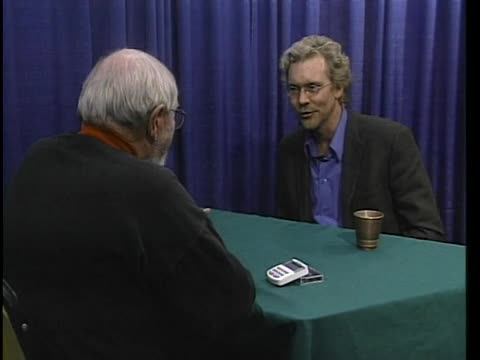
- Ian Hoffman, former journalist and co-author of " A Convenient Spy: Wen Ho Lee and the Politics of Nuclear Espionage," sits down with host Ernie Mills to talk about his new book, his previous work in Albuquerque as a journalist (often reporting on Los Alamos National Laboratory), and the “Cox Report.”
- Series Description
- Hosted by veteran journalist and interviewer, Ernie Mills, Report from Santa Fe brings the very best of the esteemed, beloved, controversial, famous, and emergent minds and voices of the day to a weekly audience that spans the state of New Mexico.
- Broadcast Date
- 2002-03-16
- Asset type
- Episode
- Genres
- Interview
- Media type
- Moving Image
- Duration
- 00:31:01.560
- Credits
-
-
Guest:
Hoffman, Ian
Host: Mills, Ernie
Producer: Ryan, Duane W.
Producing Organization: KENW-TV, Eastern New Mexico University, Portales, New Mexico
- AAPB Contributor Holdings
-
KENW-TV
Identifier: cpb-aacip-2c4b54ecaeb (Filename)
Format: Betacam: SP
Generation: Master
Duration: 00:28:11
If you have a copy of this asset and would like us to add it to our catalog, please contact us.
- Citations
- Chicago: “Report from Santa Fe; Ian Hoffman,” 2002-03-16, KENW-TV, American Archive of Public Broadcasting (GBH and the Library of Congress), Boston, MA and Washington, DC, accessed June 13, 2026, http://americanarchive.org/catalog/cpb-aacip-e44fd886cb0.
- MLA: “Report from Santa Fe; Ian Hoffman.” 2002-03-16. KENW-TV, American Archive of Public Broadcasting (GBH and the Library of Congress), Boston, MA and Washington, DC. Web. June 13, 2026. <http://americanarchive.org/catalog/cpb-aacip-e44fd886cb0>.
- APA: Report from Santa Fe; Ian Hoffman. Boston, MA: KENW-TV, American Archive of Public Broadcasting (GBH and the Library of Congress), Boston, MA and Washington, DC. Retrieved from http://americanarchive.org/catalog/cpb-aacip-e44fd886cb0