Report from Santa Fe; William "Bill" Fulginiti
- Transcript
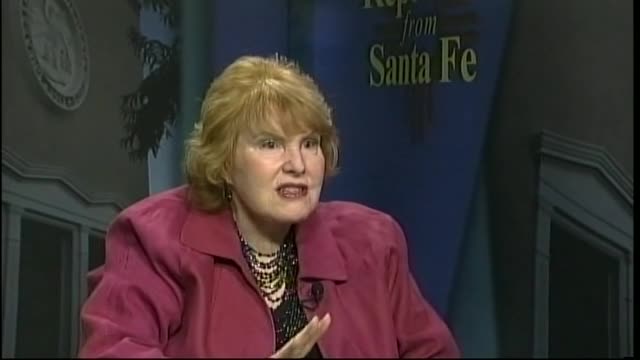
music Report from Santa Fe is made possible in part by grants from the members of the National Education Association of New Mexico, an organization of professionals who believe that investing in public education is an investment in our state's economic future and by a grant from the Healey Foundation, Taos, New Mexico Hello, I'm Lorraine Mills. Welcome to report from Santa Fe. Our guest today is Bill Fulgenetti, executive director of the New Mexico Municipal League. Hi Lorraine. Thank you for joining us. Oh my goodness, we have so much to talk about. I just want to tell people a little of your background. You've been with the Municipal League for 35 years. Twice you've been on the board of the National League of Cities. You're the vice chair of the New Mexico Finance Authority and the Water Trust Board. You've gotten the Governor's Distinguished Public Service Award, the New Mexico Distinguished Public Administration Award. You really do a lot and people really appreciate you.
Oh, thank you. That was really nice. You know, I was amazed that I've been able to serve in those capacities. It really helps us all across the state to serve on both those Water Trust Board and Finance Authority. Right, because it's so important to the cities. I'd like to start out by having your teller audience who and what is the Municipal League and why is it important? Thank you. My wife says that every time. Can I do it in 25 words or less? Probably not. The Municipal League is an association of all the municipalities of the state. Those that are incorporated under state law. And they banded together in 1927 when I incorporated to provide an opportunity to share and solve solutions together and work and represent themselves at the State House and in Washington. And from that, do a lot of service programs such as personnel consulting, inquiry surveys, insurance services. So it's grown from a zero staff to 25 staff over the last 30 or 50 years. Well, the old time was you should say, don't ever run for local office because for every dog that's barking in the neighborhood and every day the trash doesn't get picked up.
The local municipal official gets the call. That's right. So it's tough. And you represent also the chiefs of police, the fire chiefs, the librarians, the county clerks, all of the municipal officials. And I want our people to think about how important their city and what their city does in their daily life. It's really, really important. So I want to ask you now, we're in the middle of an economic downturn. And I've noticed that nationally our cities are really affected. We'll talk about that in a minute. But how has the economic downturn affected our cities in our state? Well, like nationally, we've experienced a significant downturn in our revenues we get in order to provide those basic municipal services. But our cities, being in the Mexico are traditionally conservative. So it's taking an opportunity to tighten their belt and do everything they could to cut through the budgets without laying people off.
Unfortunately, after three years of revenue downturns, we've had some layoffs. As a matter of fact, state and local government, including schools, over the last three years have decreased by 6,800 employees. So that's public sector employees. 6,800 people have lost their jobs. That's correct. That's a lot. It really is. And hopefully we've started to see a turnaround. But it's going to turn around in the public sector a lot slower than the private sector. We depend heavily on grocery seats tax here for cities. And in order for that economy to perk up and get that going again, the sales begin to pick up. Our revenue will be picked up. We're going to lag behind probably by a year or so, most everywhere. And hopefully we'll get back and we'll be able to put those necessary people, police officers, and back to work, so as we can. Well, one of the reasons I asked you here is that there are things happening nationally to some of our cities that I have found actually horrifying.
So nationally, some cities are going absolutely bankrupt. Stockton is the largest city to declare bankruptcy, Stockton, California. Harrisburg, the capital of Pennsylvania, Scranton, San Bernardino County, they have had to make draconian measures. Some of them have had to put all of their employees on minimum wage if they still had a job. They've cut retirement benefits, saved cut services. The most horrifying thing I think this was on 60 minutes was when the mayor of Stockton said, well, we can't collect trash anymore because we can't pay our own trash fees at the dump. Well, how quickly does a city go into chaos? Please tell me what's happening here and that we're not in danger of any of those things. I don't think we're in that state of affairs like Stockton is. And some of our towns, we won't have a bankruptcy that I know of. Well, we have a few that are pending serious decline in their revenues. A settlement part comes to mind. Columbus comes to mind.
Those two towns have serious financial issues. But all of our smaller towns have those financial issues as well. But I don't think they're in light of bankruptcy at all. I do think they've been conservative enough over the years. They know how to cut the budget. They know how to maintain. Can it happen? Sure. But I don't think it's going to happen. Well, I think it helps too that it's in the bigger structure of our state that can't do deficit spending. That's right. So we're really lucky there. That's right. I'm constitutionally we cannot. That's correct. Yes. But one of the things that had come up was a situation with Santa Rosa and the clawback of gross receipts taxes. Now, I don't want to lose our audience as we talk about taxes. But there is a big change in state policy from the tax and revenue department.
That is threatening in a way of some of the small communities, Hamas Springs. I know grants paid their back. If you can give us the very simple fun, exciting version of this clawback. Thank you, Lorraine. It has become a very serious problem within the last year. In our tax system, gross receipts are collected from businesses. Periodically, they'll report in a wrong location or they'll make an amended return and they'll do money back. But that money was already distributed as much as three years ago. So that was already spent. And all of a sudden the amended return comes in. The tax department approves it. Anyone back like in Santa Rosa's case, a million two. A million two is sway over their budget. And the policy that this second, this administration has is one I don't think conforms to state law. I've told her that as well.
You've told the governor that. That's the governor. We've told the secretary. We met with her three or four times. And what they've done is they zero out the first month that they're trying to collect back the money. So you're sitting in Santa Rosa expecting a check for $160,000. And you have payrolls. He gets zero. And you know, what do I do? My gosh. Now I have a loans against that money as well. I may have bond issues against it. We thought the policy was really clear that if that were to occur to occur, the secretary was to me with that local government and spread it out over an appropriate period of time and not zero it out. You've got to protect the intercepted loans. You've got to protect bond issues. And my gosh, you've got to have salaries pay the salaries of those workers. So you've got to come up with the structure that works. The one that they've been operating under for the last year or so really puts them under serious stress. Grants comes to mind. There was over 800,000 Santa Rosa million to Floyd. A little village of Floyd. $14,000 to them is more than a half a year's income. And cause he was 10,000 eight. And they want them to pay back 800 a month. But they only get 200 a month. Yeah.
I don't know how you do that. Yeah. So we have to meet with again with the state officials. And I talked to secretary Clifford yesterday. This is a matter of fact that we're going to meet along with the governor staff and see if we can come to some resolution of this. But if not, I'm prepared to on behalf of those towns to let the courts decide which statute works. Right. Because this was a law was it 78 that Artisia filed a lawsuit. And it was a certain structure was set up that ever since 1978 up until last year. The state would work out accommodations where municipality or city could pay back what it could afford. Right. And but to suddenly remove everyone's paycheck. I mean, it's very moralizing. It really was. I mean, the administrator in Santa Rosa was beside himself. I mean, he didn't know what to do. He talked about bankruptcy.
And thankfully, thank God it didn't have to do that. But they still don't they still do not have a resolve. So as I said, the statutes on the books, their interpretation of their statutes on the books, we may just have that court tell them which one works. And that is, you know, another function of the municipal league use help these municipalities in a crisis like this. This is certainly a crisis. So there's another crisis going on nationally. And that is, I think it was led by San Bernardino County who had more houses underwater. Oh, yes. Then any other county. And so this strange thing and wonderful thing has happened. And I think Matt Taiibi wrote about it in Rolling Stone. A serious challenge to Wall Street. What's been happening is that these counties and cities have been using eminent domain to condemn these houses, buy them and put them back at their market value. So again, this is way too financial for some people. But if you have a house, you bought it 300,000. Now it's worth 150,000.
It's still going to hold you responsible. The municipal or county government will buy up those houses that toxic, toxic debt and then let another agency through the government, this local government, loan out money so that real people can buy these houses at the real value. Or stay in them. Or stay in them. Or for the mortgage payments because you reduced it. Well, this is an incredible almost, it's a financial story, but a political story because it would be that regional self rule could really happen. And the beauty of it is that local officials don't have to go to Congress. They don't have to go to their state legislature. They have the power by eminent domain except in the state of New Mexico. For you remember well. Yes, I do. We don't have the right of eminent domain if it's in the context of what they call economic development. And I'm afraid us entering into the private market and buying properties through eminent domain will be considered economic benefit.
And at the state law would prevail and we wouldn't be able to do that. How disappointing that is because we could have initiated that in like around Bernalais, a city of Albuquerque, a number of large foreclosures. We could have handled that. And that was a very creative way to do it. Yeah. I know everybody gets upset when you say eminent domain and I want to take people's property. But you know, local governments do not take public property by eminent domain unless they absolutely have to. So if it's for a road or a water line or infrastructure. We can still do those. Okay, but for economic benefit to the entire community. We cannot. Because once these house, you know, these houses are for close on and they sit empty and then there goes their gross neighborhood. But do you think that there will be a movement to look at what's happening nationally with this and maybe change or modify our eminent domain laws?
No, but hope so. I know we intend to bring it up. But every time I bring up in a domain, at least at this legislature, we get the same kind of response. You can't take my proper property for economic benefit. Well, the courts have ruled that you could. The United States Supreme Court that started all this movement against them in a domain. The real ruling was you could do this. It was in favor of the city of Baltimore, or I'm sorry, New Haven, Connecticut. It was in favor of them. Everybody thinks it was against them. No. The Supreme Court said you may do this. Everybody got upset and said you can't take private property. So legislature is acted across the country. And major reforms happen and shut down the process in a lot of places. Well, we will watch and learn our guest today. I just want to tell our audience is Bill Fortunetti, who's the executive director of the New Mexico Municipal League and has fought many battles on behalf of you, the citizens. And let's talk about the food tax and the medical tax. We've got so much to talk about.
You want that in one sentence? No, no, no. You can go into the history of the food tax or maybe why we might need some tax restructuring. Yeah, the issue of taxing food is always a very emotional issue. And back in 2004, when Bill was introduced to repeal the tax on food, gross receipts taxes on food, that was obviously quite an appeal to do that. Oh, my gosh, you're taxing food, you're taxing misery, you're taxing most medical services. Oh, my gosh, how dare you do that? Well, you don't tax anything that's not a private sector business that's making money. We're not taxing misery, we're taxing a corporation that's making money off of those same things. And you go, whoa, so when they said, let's take it off of food. And we were against that. When you lower that, when you decrease that tax base and you lose $130 million to local governments, you really jeopardize those services that you talked about earlier about. Delivery of services to those citizens are in peril.
So we are able to convince the legislature to create what they call a whole harmless provision. They would get the money back just as it's a tax for a place. That would be funded out of a half percent tax increase that the state imposed at that time. Now, think of that, Larry. You don't have to pay tax on food anymore, but everything else you bought was a half percent. And there is a safety net for people that are really hungry. That's correct. There's low income supplements, there's food stamps, so that we hope no one is really going to starve. Over almost 400,000 people in New Mexico are on that program. They didn't pay tax on food anyway. Even before that bill were passed, they were not paying tax. And you could have changed the system to increase that number. And you could have changed the low income tax credit they get. And that wasn't, to me, a much more preferable way of dealing with those who needed assistance in purchasing a food. But no, we took it off of everything. So those who can afford it, well, don't pay it.
Or if you're coming in from out of state and you shop here and you're camping and everything, you don't pay tax anymore. And we think that's the wrong approach. Well, you remember under Bill Richardson, Bill, the Governor Richardson decreed that there should be this Blue Ribbon Tax Reform Committee tax force. And it was chaired by former lawmaker Jerry Sandal. And it had the most brilliant minds in our state, you are on it. Looking at this whole issue, let's look at the whole tax structure. Why do we have gross receipts tax, which taxes goods and services? Why do we have this and that? And you came up with some wonderful recommendations and proof. Yeah, they were not accepted. Yeah. Almost the entire Blue Ribbon Commission set up recommendations, which was the best commission I've ever served on dealing with tax structure. It was basically ignored. And there's pieces of it have been picked up lately, but not enough to do it in a comprehensive fashion.
Because when you press one button, trying to change the tax system, three more pop out. And you got to really deal with the whole thing. And we didn't do that. And what issue that came up in the last legislative session was the issue of tax peer-mitting. Yes. And was that an improvement? No. Well, yes and no. Tax peer-mitting is basically you pay tax on a number of items. When you're in manufacturing, you pay on the basic, you pay on the service, you pay on it. And it pyramids itself up to the end product. And that's not considered a really good policy. So the last session, they said, we should take the tax off the consumables, what do you use to manufacture and shouldn't be taxed. And also in construction services. And I think they went too far there, too. And I'll do the construction services really quick. They took the tax off pile-up, rubber filons.
They took the tax off of porta-potties. I don't exactly know how that makes a road. I know the company is building the road and I need those. But that ought to be a cost of doing business. And the manufacturing made a little bit of sense, but they underestimated dramatically. They said it would cost the state $25 million to do this. And we said it would cost local governments $50 million. They did not even include that in the rest of it. And what's the real cost? The real cost is closer to $120 million total. I mean, they were so far off as unbelievable. And they're starting to admit it now this year. And as it comes into effect, we're going to see more and more companies figure out how to take advantage of that. And it's going to probably sort to that 120 level. Well, our audience has gotten through M&M domain and whole harmless and taxpayer rating. Now there's something that really does affect us all. One is the problems that scandal they're calling it at the New Mexico Finance Authority.
You co-chair that. It's under investigation. There's a lot we cannot say. But could you briefly tell our people what happened and what the possible consequences could be? Because if we lose our good bond rating by the rating agencies, everything we do is going to cost more. Everything. And that is a really good way of getting a segue into what happened. The Finance Authority worked really hard over the last 10 years to get a AAA credit rating. And it's not for their benefit. It's for the benefit of people who borrow money from that agency. Local, small local governments who don't have a credit rating. Then they borrow money. They get the best interest rates possible. Now once happened here, it's alleged that one of the employees falsified an audit report that it really wasn't the real audit.
The external auditor never finished it. And what that did was we used that audit thinking it was okay to sell bonds. And that may place people in jeopardy. But what's worse than that, it shows that those internal controls need to be strengthened and that we need to pay a lot more attention to the process itself. And if you don't fix it, we're going to see a downgrade in that AAA rating. And we're put under watch already. So if that goes down, no matter how much it goes down, we're going to see higher interest costs in every one of those infrastructure projects that we've been doing in a state. And so far, we've done 600 million for local government. You can imagine if we were at a percent or two percent of the cost to the citizens would go really sky high. We really need to work quickly, restore the confidence in that agency, get that 2011 audit fixed, and get back in business. And so the state auditor and the SEC, SIC, will be investigating it.
So we have to leave it there. Well, I don't think I can talk about that part. No, no, you can't talk about that part. We're just going to leave it in there, capable hands. But Sunland Park. Oh my gosh. It doesn't even have a mayor now. And this is scandal on scandal on scandal. Yes. I don't know how many charges have been placed down there. On everybody. Yeah, on the mayor. Two people running for mayor. The manager has already been indicted. Five city employees. And then vote if, you know, they were voting for one candidate. One candidate hires a stripper to do a lap dance for the other candidate. Gets it on film. Skandalizes him. Both candidates are thrown out. The new guy. They appoint another mayor. And he can't, I mean, it's a mess. Yeah, it is. And it's not. It's under control of the Department of Finance and administration. They've sent an administrator down there to administer, take control of the finances. But it doesn't take the political situation off the hook.
Yeah. The way the state statute is set up. The council has to replace the mayor by appointment. And they can't hold a special election. At least under the statutory scheme of things the way it is. So there are three votes for one side and three votes for the other side. And they're hopelessly deadlocked at this point. So they're operating with a mayor pro-tem. And that's what the mayor pro-tem is there for. But that was supposed to be for short periods. Yeah, not. Yeah. I think that one of the resolutions would be to have a judge order an election. Yeah. Just like, okay, I understand it. I understand a state law. We're just going to have an election. This leads us naturally to ethics issues because this is the biggest breach of ethics. Probably the state's ever seen. But one of the things that you do, the municipal league, you have an annual conference. And you bring all the municipal officials together. And you have the best presentation I've ever seen in the workshop I've ever done on ethics. Was it one of your meetings?
And so you bring the issues of the day. And you educate everyone with the experts, the leading people. And so you have a meeting coming up at the end of August. I do. I August 29, 30, and 31. We have a conference coming up in Las Cruces, New Mexico. And Lorraine, I hope you'll be with us this year. I know. Thank you. And one of the workshops, one of the general sessions, will be on ethics. And we're pleased to have the former governor, Gary Carruthers, will be presenting that. He does an excellent job with the ethics training across the state. So we're looking forward to that presentation. We expect the room to be pretty full. Oh, absolutely. Absolutely. He's also dean of the School of Business. Yes. And there's something that he was a very popular governor. Yes. And has a wonderful way of speaking. Actually, I think I'll try to interview him about what he says. I love the title of this topic. Is something about the Wild West? No, the cowboy ethics.
The cowboy ethics. A man should be as good as his word. There you go. Pretty simple stuff. Yeah, but pretty lost on a lot of officials, you know. And the basic thing is so simple. And PR and government, if it looks bad, don't do it. It could be possibly interpreted. Don't do it. And yet these people get it all. They do. Yeah, they do. Well, I'd like to just do something with that. As much trouble we've had in Sonland Park in Columbus and some other cities. We have thousands of city officials who serve. And basically they don't serve, they don't get paid. And they do it every day for the benefit of their towns. I wanted the people to remember that the small percentage that Sonland Park represents, or Columbus represents, is so small in compared to the number of people who serve. And we have to remember that. Yeah, I'm glad you said that because the, you know, in all these small towns, and it's true, it can often be thankless because you can get an irate call in the middle of the night. And then you think, why am I doing this?
But the dedication that many of these mayors and fire chief, Lord knows, we love our fire chiefs. And the chiefs of police, but even the importance of a librarian or county clerks in these communities cannot be underestimated. It is like where the rubber hits the road in our democracy. It is. So do you have a final word for our New Mexican citizens, most of whom live in, how many people live in the municipality as opposed to rural? Two thirds of every New Mexico, and two thirds of the population of New Mexico, live in incorporated municipalities. Uh-huh. And it's growing. It actually was shrinking for a while. But night nationally there's a trend to go to the urban or incorporated centers that's happening here as well. So we have two thirds of New Mexicans live in our cities. Well, what word do you have for those? Well, the word I would have for you is go to city hall, go to the city council meeting, participate. You know, governance is not just those people sitting on that city council. Governance is the people working with them together to make it work for their cities.
We will close on that note. I agree with you. Our guest today is Bill Fulgenetti, the executive director of the New Mexico Municipal League. Thank you for joining us. Thank you, Dr. Ryan. I enjoyed it. And I'm Larry Mills. I'd like to thank you our audience for joining us this week and report from Santa Fe. I do want to encourage you to go out and get involved in your local government. You can really make a difference. Thank you. I'll see you next week. Past archival programs of report from Santa Fe are available at the website report from Santa Fe dot com. If you have questions or comments, please email info at report from Santa Fe dot com. Report from Santa Fe is made possible in part by grants from the members of the National Education Association of New Mexico, an organization of professionals who believe that investing in public education is an investment in our state's economic future. And by a grant from the Healey Foundation, Taos, New Mexico.
Thank you. Thank you. Thank you.
Thank you. Thank you. Thank you.
Thank you. Thank you. Thank you.
Thank you. Thank you. Thank you.
Thank you. Thank you. Thank you.
Thank you. Thank you. Thank you.
Thank you.
- Series
- Report from Santa Fe
- Episode
- William "Bill" Fulginiti
- Producing Organization
- KENW-TV, Eastern New Mexico University, Portales, New Mexico
- Contributing Organization
- KENW-TV (Portales, New Mexico)
- AAPB ID
- cpb-aacip-e2e2d655604
If you have more information about this item than what is given here, or if you have concerns about this record, we want to know! Contact us, indicating the AAPB ID (cpb-aacip-e2e2d655604).
- Description
- Episode Description
- This week's guest on "Report from Santa Fe" is Bill Fulginiti, Executive Director of the New Mexico Municipal League. Fulginiti serves as the Vice-Chair of the New Mexico Finance Authority and the Water Trust Board. Recipient of the Governor’s Distinguished Public Service Award and the New Mexico Distinguished Public Administration Award, Fulginiti's public service experience also extends nationally with his two terms on the Board of the powerful National League of Cities. The Municipal League is an association of all the municipalities in the state, representing mayors, councilors, chiefs of police, fire chiefs, librarians, the county clerks - all of the municipal officials. Municipal issues are important because two-thirds of the population in New Mexico live in incorporated municipalities! Fulginiti examines the effect the economic downturn has had on New Mexico's cities, revealing that public sector employment has decreased by 6800 jobs over the last 3 years. He discusses the national trend of bankruptcies among cities and explains what the gross receipts claw back by the New Mexico Taxation and Revenue Department are doing to communities like Santa Rosa, Jemez Springs, and Grants. Report from Santa Fe explores the history of the food tax in New Mexico and explains the recent legislative battle on tax pyramiding. Fulginiti discusses the use of eminent domain nationally to fight the toxic effect of foreclosures on cities, and also provides insight into the problems at the New Mexico Finance Authority, where he serves as Vice-Chair.
- Broadcast Date
- 2012-08-04
- Created Date
- 2012-08-04
- Asset type
- Episode
- Genres
- Interview
- Media type
- Moving Image
- Duration
- 00:38:13.625
- Credits
-
-
Producer:
Ryan, Duane W.
Producing Organization: KENW-TV, Eastern New Mexico University, Portales, New Mexico
- AAPB Contributor Holdings
-
KENW-TV
Identifier: cpb-aacip-79e09614070 (Filename)
Format: DVD
If you have a copy of this asset and would like us to add it to our catalog, please contact us.
- Citations
- Chicago: “Report from Santa Fe; William "Bill" Fulginiti,” 2012-08-04, KENW-TV, American Archive of Public Broadcasting (GBH and the Library of Congress), Boston, MA and Washington, DC, accessed October 14, 2026, http://americanarchive.org/catalog/cpb-aacip-e2e2d655604.
- MLA: “Report from Santa Fe; William "Bill" Fulginiti.” 2012-08-04. KENW-TV, American Archive of Public Broadcasting (GBH and the Library of Congress), Boston, MA and Washington, DC. Web. October 14, 2026. <http://americanarchive.org/catalog/cpb-aacip-e2e2d655604>.
- APA: Report from Santa Fe; William "Bill" Fulginiti. Boston, MA: KENW-TV, American Archive of Public Broadcasting (GBH and the Library of Congress), Boston, MA and Washington, DC. Retrieved from http://americanarchive.org/catalog/cpb-aacip-e2e2d655604