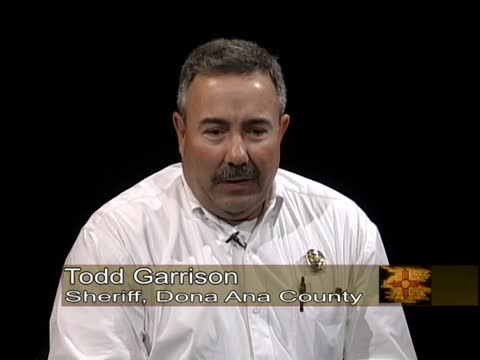
Minding Your Business; 352; Todd Garrison & Chuck Franco
- Transcript
Minding your business is provided by support from Seal Levitino of Emerick Realtors, proud to be associated with the quality programs and community service projects of PBS and K.R.W.G. TV. By Camino Real Builders, a committed partner with K.R.W.G. Broadcasting, providing educational, informative and entertaining programs to our region. And by the New Mexico Humanities Council, working with local groups to bring programs about culture and the human experience to all communities in New Mexico. K.R.W.G. TV presents Minding Your Business, a look at the people, places, events and issues that impact the business and economy of Southwest New Mexico with your host, Charles Comer.
Hello and welcome to Minding Your Business, the show where we explore business, politics and issues that impact our region. This week on Minding Your Business, they're two of the most respected lawmen in southern New Mexico and charged with policing a county that you could fit a couple of the smaller East Coast states in. Here to talk about the challenges and the achievements of the Doniana County Sheriff's Department, our Sheriff Todd Garrison and under Sheriff Chuck Franco. Gentlemen, thanks so much for being here. Yes, sir. I feel like I got to shake your hand. And we've known each other for a couple of years, so we've had a good time laughing here at the beginning. But you know one thing, all this time I've known you, I don't know much about you, the people. So Sheriff, we'll start with you. You've had a long and distinguished career, both of you. So let's find out a little more about where you grew up, where you went to school and share your history in law enforcement. It's, it's law, sure. Guy, I was born and raised here in, in Las Cruces. So actually I was
born in El Paso and, but lived here my whole life. I ran over to El Paso to get born and came right back close enough. Yeah, close enough. I grew up here and graduated from Las Cruces High School. I went to, uh, our Mosa Heights grade school and then I'm a sea of park. I went to Zia and then Cruces High, graduated from there. I got married to my high school suite heart. We've been married 26 years and we have six kids, four girls and two boys. Oh my gosh. So the county commission meeting when, uh, when you first got elected, I only saw two kids. Yeah, daughter and a son. Yeah, four more in there. I have, I have six total. So I guess, you know, managing your home life, managing the sheriff's department. Not a lot. It's not much different, but a summer size staff. Yeah, pretty close. And chuck your turn. Yes. Um, I was born and raised here in Las Cruces, um, went to Las Cruces High School and graduated from there. I went to New Mexico State University and graduated from there in criminal justice.
Currently working on my masters, uh, here at New Mexico State University. Really? And, um, I started with the Las Cruces Police Department in 1978. I was there for 17 years. Then I was appointed to a magistrate position, magistrate judge by Governor Johnson. And I was there for three years and then came back to law enforcement and that's where I'm currently at. Why so? Why do you, why do you leave the bench? Did you want to get out of the whole elected official thing? When I was initially appointed to that position, I was informed that that retirement would apply towards my law enforcement retirement. And while I was in there, there was some sort of legislative change that did not allow that any longer. So I had to come back to law enforcement to be able to retire. And that's why I left the bench. What do you like better? I enjoy law enforcement. I really do. That's in my blood and I enjoy serving the people and do what I can to make things safer for everybody.
So you both worked for, uh, for, uh, city PD under, uh, chief act style, right? Yes. And, uh, so let's fast forward. And, uh, as, as I, as I alluded, uh, I was there when the county commission first appointed you, um, to replace Sheriff Hernandez. Um, and then congratulations on your reelection. I actually don't think I've seen you, um, since then. But, um, but, uh, you know, you guys kind of inherited a mess. Um, and, uh, and Chuck and I were talking before the show, yet some great people, uh, some amazing personnel, some very dedicated individuals, but, but not a lot of happy deputies. Um, let's, uh, let's talk about, and, and either one of you, uh, jump in when you're ready. Let's talk about the situation when you both started with, with, uh, DASO as we call it in the industry. Sure. I think, you know, whenever, whenever you come into something new like that, it's, it's, uh, especially in a position as, as Sheriff, you're
gonna, there's gonna be changes made. There's gonna be things that that occur, uh, that, uh, everybody's lary about, you know, I mean, people used to live in a certain way or doing things a certain way. So, there's that fear. And I think there was just, there were some problems, internal problems that, uh, that were there that existed that, uh, we had to work through. And, and, you know, I think it's been a, it's been a rough road, but it's been a, a, a great ride. I mean, I think we've, we've got a lot of great people there. And, uh, the, the departments really come around and we're working together as a team and it's, uh, it's been a real experience. Chuck anything down to that? Yeah. Some of the, uh, areas of concern that we needed to address immediately was, first of all, the salaries that our deputies, uh, were receiving. It was inadequate and we needed to address that immediately because we were on the verge of losing quite a few officers, which would have really jeopardized the safety of our community. Secondly, their equipment, uh, their equipment needed to be brought up to par. Uh, we had to buy all new vests. Uh, we had to
buy a lot of weapons. We had to buy a lot of tasers. Uh, their vehicles needed to be replaced, on and on and on. And then thirdly, uh, also just as equally important was their morale. Their morale needed to be boosted and, and they needed to be shown that we are concerned about them. We are concerned about the community, but we had to address each one adequately and separately so that they could be addressed properly. Now, let's boil it down a little bit. When you guys started, what were your goals? You probably had to go back to fundamental goals. Would you share those with us? Sure. I think, you know, our goals when we first got in, I think we're first to identify the problems within the department and then to begin working on those. Of course, the morale and pay issues, those were all things that we were looking at the equipment issues. Um, and, and number one, you know, was to, to make sure that we continued the right kind of service for the public. I mean, we needed to make sure that, that, that trust is there that the public trust calling the department that, that we have the officers on the street that are
physically able to answer the calls, you know, equipped with the right kind of equipment and different things like that to best do the job that they, they can for the public. And I think that was, that was some of our biggest challenges. And, you know, I think we've, we've come a long ways in the last three years. I mean, the officers have a lot more equipment now. I can remember the first batch of cars we bought. It was, I think, 65. They were new to us, but used cars from Utah. And after replacing those 65 cars and taking 65 old cars out, we still had two or three that were over 400,000 miles. So yeah, I was going to say, um, if you guys know off the top of your head, how long does it take for, for an officer's unit, a deputy's unit to get just 100,000 miles? They put between what, 30 and 50,000 miles a year on a car. And so, which, which is three to four times the amount of mileage most people put on their car. What has helped tremendously is the officers have been allowed to take the units home with them, rather than having the same unit out in
the field 24 hours a day. That has helped reduce the amount of mileage on these vehicles and thus making them last longer. I've, I've understood because, because, uh, one of my very best friends worked with state police for, as a dispatcher for many, many years. Um, and he said, back in his time with him, he now works with Haida, but, but, uh, the, the state police officers had an advantage over the sheriff's deputies because they had their own units and they used their units like, like an office. They had every amenity that an office does. And, and so now your guys have been afforded that same thing. Oh, yeah. We're moving into guys and, and, and women. I'm, I'm sorry, I'm sure all of them. I mean, we're moving into, into the, uh, new age with all the, the new equipment coming out, we have, uh, we're moving into the track system, uh, which is something that we've been a pilot program for the state and it's a paperless citation. Uh, we're, you know, we're all computerized. We've, we've got the phone cards in the car with the computers and internet access to the reports.
And I mean, it just, it's, we've got hot spots throughout the county where they can hit certain spots and dump information down and different things like that. We've got, uh, new computers. I mean, new, uh, cameras now that, uh, we're recording digital, they're digital cameras and they're, they're able to record traffic stops and all that information and then they drive into the, uh, office and they push a button and download all that information wirelessly into the, uh, storage there at the office. So I mean, we've, it's, we've got a lot of stuff coming up. Because when you guys started, you know, any, in law enforcement, any traffic officer could be falsely accused of, of, of things by, by people they were citing. And so that's not the case anymore, is it? You know, not all of them have cameras yet, but we're working on that. And I think it's done a lot. We've had a number of people come in and follow complaints on an officer and when you can pull the tape out and you show the tape and it's, it's not there. They just, you know, turn around and leave or it is there and we take care of that. So probably a pretty obvious
answer, but what does that do for Marallo, the officers knowing they have that kind of backup? It's a, a tremendous boost for the Marall. Uh, and that, uh, reciprocates itself out in the field when the officer feels good about himself, uh, because of his equipment, because of his, uh, police car, because of, uh, his training. When he's out in the field, it reflects and the people see that they're dealing with a professional person out on the street and it, it's just a tremendous help to law enforcement all the way around. Now, you guys got a new home and now it's not, not, it's not super new anymore. You've been out there a while, but, uh, you guys were shoved in every corner that, that the county could come up with that was just barely enough to fit you guys in there. Tell us a little bit about, uh, about some of the features of your own, your very own department and, and your own space that was, that was designed for you guys.
What it's like and, and share some of those features. You know, I think it's neat. I can honestly say that the, the deputies, uh, for the most part have pretty much been satisfied wherever they've been. You know, I mean, they've got a good, they've got a good attitude that way. They, they make too. Yeah, they, they make do with what they've had and, and, and, you know, they have had some pretty rough places that, you know, but they've always had a good attitude. They always made it work. You know, there was always guys there that, that knew how to weld and they could build and they would do and add on to and, and that attitude is still there today and I admire that about them. But I think now that we do have a, a new department, we've been in there a little over a year. It's, it's a, uh, really nice facility. It's, it's a state of the art top of the line. We've got, most of the new computers. We got a lot of new furniture when we moved in. And you know, they're, they're making the best out of that now too. So it's, uh, you know, I think it's just a neat bunch of people to work with. I can, I can honestly say that because they take,
they take whatever comes at them and they, and they, they do the best with it. So it's, you know, that Chuck went a little too because he worked in some of the older buildings and of course we did the one on, on Motel Boulevard there until we cross the street. But it is nice and I, we're, we're out growing the one we got now. So are you guys? That's, oh my goodness. But, um, but Chuck show, you were telling me, um, before the show, some, some of the safety features. Yes, uh, we are very blessed to have those safety features incorporated into our new building. Just for example, when you enter our reception area of the building in the lobby, our receptionist is behind Bulletproof Glass and it extends all the way down to the floor, her Bulletproof protection. We have our museum right there as you enter our building. Very nice, very informative. And in order to access the rest of the Sheriff's Department, you need to have a slide card. Not anybody can just walk to the back and address certain issues. You have to be invited back and escorted by an officer or by a staff member. And if not, you are stopped in the
hall and you're questioned as to what you're doing in the back. Very nice. These were features we didn't have a lot of before. In the old, uh, Steve Lomen building there in the corner, uh, across from Wala Chevrolet. Well, it's not Wallace anymore. Bravo or something like that. But, uh, but to me, that looked like the most makeshift facility. But, uh, you, you guys, it's set the museum up kind of nice there in the front. Yes, it is very nice. Uh, what do, what do people think of that museum? Do, does the public have, is the public invited to come and see it? Oh, yes, definitely. Uh, it's open during working hours from eight to five. And, um, it's very nice. Uh, our deputy that handles that museum deputy, uh, Jim Beasley has done a very good job with that museum. Uh, he's just taken the ball and run with it totally. He's done a great job. Now, let's, uh, let's talk about some of the special things you, you guys have, have been doing
because I, I promise challenges and achievements. Let's talk about animal cruelty cases. If you're just reading the sun news, it seems like there's been a huge increase. But, uh, but someone I've known professionally for many years is Robin Gloucavitch. And, uh, and she was explaining to me that as far as animal and animal cruelty cases and how that's dealt with by, by SO is, is completely different now compared to, to three, four years ago. What has happened? What's changed? You know, I think one of the biggest changes is that, uh, animal control, uh, was needed by the county, but they didn't really have a home. And until they, they found a home with, uh, the sheriff's department, they were kind of floating around and just, you know, expected to do different things, uh, whoever their supervisor ended up being and it could change from, from week to week or whatever, but when they were placed in the sheriff's department, which I believe they should be because they are enforcement and, and, uh, that's the perfect place for them.
You know, we're trying to, uh, develop a sense of belonging and, and a team, uh, just a workplace. And I think that's, that's starting to come around. And, and in doing that, we're trying to get them training that's, uh, makes them better officers in the field, uh, teaches them how to do their job better. And I think it's just making better, more qualified officers for the county and, and we're finding more things because of it. And I think, you know, there's, a lot of these things have existed for a long time. We just didn't have the manpower, the, uh, knowledge you got and find them and they're, they're doing a real good job at doing that now. So, and from one, I understand animal cruelty cases is all Robin handles now. For the most part, she handles, well, she handles all of those, but she's still working on me. She's still a regular detective, she's still doing some of the other work. She works very hard. And she stays very busy. So, oh my gosh. Now, now she, um, she showed me a, a video of, uh, of the work that, that you guys have been doing along the animal cruelty case line. So many of them were pit bulls. Is there a dog fighting
in this area that, that you guys know of? And, and what are some of the challenges of, of, uh, of enforcing, you know, cracking down on that kind of thing? It's a dangerous crowd. Who does that? It's an issue that is being taken seriously right now. Um, we have recently become aware that there is a lot more dog fighting than what we thought there was. Um, we, as we speak, we're in the process of handling several cases that have been, uh, looked into where arrests have been made and there being adjudicated at this time. Uh, and there are several that are still pending that we are now addressing. As we speak today, there's two search warns going on, uh, where, we're addressing some animal hoarding, uh, that's, we've had a lot of those cases recently. So many, we, we've seen pop up in the last year, year and a half and, uh, and not easy cases to deal with as well. These people aren't, aren't necessarily cruel individuals, but it is animal cruelty.
Yes. And then what compounds the issue is that when we address these type of animal hoarding cases, uh, we have nowhere to put them. And it makes it very difficult because those animals that are confiscated now become evidence and cannot be, uh, handled as a normal animal who's taken in the custody by animal control is handled. So we're having to address all these issues and it's not just dogs and cats. We're dealing with horses. We're dealing with mules. We're dealing with any type of animal that is being abused and chickens earlier. I, I, I, I saw some, uh, some fighting roosters in, in that video was as well that, uh, that were injured and, and, or tat. Now, I think, if I could say something, please, please, to that. I think one of the, one of the things that's important to that too is a lot of times people see us take these animals away. And then they hear later on in the news that we had to euthanize them or put them to sleep. And, and I think that, that, you know, it's important to say that when animals are held in a house like
that and you have a hundred or 150 cats run around there oftentimes not very healthy. The cats are, they get sick and those kind of conditions and not only do they get sick but they can make the people that are living with them sick also. And when we get those cats or those kinds of things happen, uh, and the animals are not healthy. We have to put them, you know, they have to be euthanized and it's not that, that we want to do that. We're trying to do what's best for the animals and for the people involved, but a lot of times that's what happens. So now, on another unhappy subject, domestic violence. We're, uh, this, this show will air at the very end of December, right before New Year's. And so the holidays, tough time for domestic violence. I understand you guys have taken some measures since you, you came in command about addressing the domestic violence issues here in Doniana County. Share those with us. Yes. Uh, we've had to take that stance. Uh, what we've done, what Sheriff and Garrison and I have done is we've asked that each shift, uh, assign a certain deputy to address those issues while
they're out in the field. And so that he can kind of specialize in domestic violence and he would be the ones taking these officer or taking these complaints and taking them to the DA's office for prosecution. In conjunction with that, when there's a domestic violence situation that amounts to the felony, uh, stage, the felony level, uh, we have kind of, uh, brought on board, an investigator, Robert Nemaris, who has specialized in that area also. And he handles the felony cases and has done a tremendous job with that. And we've seen, uh, a great impact when we address it in this manner. Um, Sheriff and I have felt that it's very necessary to approach this properly and aggressively and make sure that the safety and, uh, welfare of everybody's, uh, address properly. Well, that makes a nice segue. We've, we've got, uh, just about a minute left to talk. Community outreach is huge with your department. The museum is, is, is one of the quiet or
things. Share with us in this last minute, some of the community outreach that your department does. I think one of the biggest ones, we're just talking about domestic violence. We have victims assistance coordinators on board now too, that we, we obtained through some grants and what do they do? Victim assistance coordinators and they actually, uh, reach out to victims of crimes, domestic violence, uh, walk them through the file of paperwork and different things that people just, a lot of times are left to take care of on their own and these people actually work for the department and actually go out in the community and help these people do all these things and they've been a real big success to the department and, and have done a lot towards reach now. We have, uh, we've created a animal reserve program. We've created, uh, the reserve, we're not created, but we have a reserve program with the patrol deputies where we have volunteers that come in and help and, and, uh, we're trying to get these going again and, and really pushing because we're finding out that they, there's a lot that they can help us do and accomplish. So I understand personnel like that can really take, take care of some of the office work, the leg work and the officers can spend a lot more time
outpacking law enforcement, right? Exactly. Transporting prisoners, doing things like that where we can leave the officer in the field to do more work and, and it has, have somebody else actually do the transport of the prisoners, which, that saves a lot of time. So, well, gentlemen, if you can believe it, how fast does that 22 minutes go? It goes fast. Sheriff Todd Gearson. Thank you very much. I'm sure of, thank you for having us. Thank you guys so much. Well, it's time again for our weekly piece here on my near business that showcases some of the hardworking entrepreneurs and business people in our area. We call it the Greater Los Cruces Chamber of Commerce, local business feature. We've opened up in March of this year, and probably to that we've been affiliated with the Fast Signs a year previous to that, and we've been trying to get the business up and running, and I want to say we as my wife Joyce and I, and we're the owners of the business, and just trying to make a go. Basically, I think our role is to provide a product for service that helps our
customer grow their business. And that's generally what we try to do day in and day out, and we try to listen to customer and create a product that meets their need. And we can do that through various products. That includes banners, exhibits, and displays like for trade shows, labels, and decals, vehicle graphics, like a full vehicle wrap, which is very popular now, even vehicle magnetics, window lettering, and graphics, site signs for construction sites, and things like that. Pointed purchase signage, illuminated signs, architectural signs, safety and ADA signs, and dimensional letter. And that's generally a snapshot of what we do, but generally we can do just about anything, depending on what the customer needs. As part of the Fast Signs network, we're part of a 522 store chain. It's locally owned and operated by Joyce and me, but we also have an extensive vendor network. So something that we can't physically manufacture here, we can go to our Fast Signs approved vendor network and pull a product out and provide it to the customer media's expectations. What we do here as part of the Fast Signs system is we recycle all of the
ink from the HP printer. So generally this is a waste bottle here. At some point it becomes full and then we store it in this container so that's environmentally sensitive to the area here and then that's taken out and recycled. So none of our ink waste or product is sent through the local trash system. We're really a customer manufacturer. Everything is done here. It is basically a custom made for that particular application. Well right here we've lived in Cleveland for the past 30 years and we wanted some places whether it was better. So that's one, but also lost cruises is a very good town. It has very nice people and it's also on the Fast Path for growing. It's fast paced and that's one of the reasons we relocated here. We did a lot of research prior to and lost cruises kept floating to the top as being one of the best communities to do business in and that's one of the reasons we're here and after we stayed here for a few months we decided that we liked the area and we liked the people and that's the primary reason that we settled here.
Something to keep in mind the greater lost cruises chamber of commerce is currently accepting applications for the 2008 leadership lost cruises program. The deadline to apply is February 2nd and for more information you can check out their website at lostcruises.org. Well that just about does it for this week. If you have a question or comment about the show you can call the mind in your business hotline at 6467350 or email me at Charles Comer at Yahoo.com. For an archive of past shows you can log on to www.krwgtv.org and follow the mind in your business links. Again I'd like to thank my guests Donana County Sheriff Todd Garrison and under Sheriff Chuck Franco for coming on the show and thank you so much for watching. I'm Charles Comer. Here's helping you have a great one.
- Series
- Minding Your Business
- Episode Number
- 352
- Episode
- Todd Garrison & Chuck Franco
- Producing Organization
- KRWG
- Contributing Organization
- KRWG (Las Cruces, New Mexico)
- AAPB ID
- cpb-aacip-db677bedfb6
If you have more information about this item than what is given here, or if you have concerns about this record, we want to know! Contact us, indicating the AAPB ID (cpb-aacip-db677bedfb6).
- Description
- Episode Description
- Doña Ana Sheriff Todd Garrison & Undersheriff Chuck Franco discuss changes in facilities and practices in law enforcement in the county. Animal cruelty cases are key topic.
- Series Description
- KRWG-TV's local informational program dealing with the people, events, issues, and politics that impact the businesses in southwest New Mexico and far west Texas. The program is intended to provide viewers with an understanding of current economic issues provided by the individuals who deal directly with those issues.
- Broadcast Date
- 2007-12-28
- Asset type
- Episode
- Genres
- Talk Show
- Media type
- Moving Image
- Duration
- 00:26:58.584
- Credits
-
-
Guest: Franco, Chuck
Guest: Garrison, Todd
Host: Comer, Charles
Producer: Comer, Charles
Producing Organization: KRWG
- AAPB Contributor Holdings
-
KRWG Public Media
Identifier: cpb-aacip-ebcf3830044 (Filename)
Format: DVCAM
Generation: Master
Duration: 00:30:00
If you have a copy of this asset and would like us to add it to our catalog, please contact us.
- Citations
- Chicago: “Minding Your Business; 352; Todd Garrison & Chuck Franco,” 2007-12-28, KRWG, American Archive of Public Broadcasting (GBH and the Library of Congress), Boston, MA and Washington, DC, accessed April 3, 2026, http://americanarchive.org/catalog/cpb-aacip-db677bedfb6.
- MLA: “Minding Your Business; 352; Todd Garrison & Chuck Franco.” 2007-12-28. KRWG, American Archive of Public Broadcasting (GBH and the Library of Congress), Boston, MA and Washington, DC. Web. April 3, 2026. <http://americanarchive.org/catalog/cpb-aacip-db677bedfb6>.
- APA: Minding Your Business; 352; Todd Garrison & Chuck Franco. Boston, MA: KRWG, American Archive of Public Broadcasting (GBH and the Library of Congress), Boston, MA and Washington, DC. Retrieved from http://americanarchive.org/catalog/cpb-aacip-db677bedfb6