Bill Moyers Journal: International Report; 110; Earthwatch from Nairobi
- Transcript
BILL MOYERS' JOURNAL: INTERNATIONAL REPORT
"Earthwatch From Nairobi"
March 20, 1975
copyright 1975, Educational Broadcasting Corporation
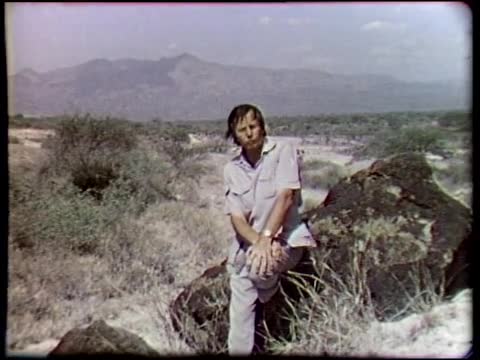
BILL MOYERS: Somewhere in this great Rift Valley in East Africa the story of the human race begins. Hundreds of thousands, millions of years ago, our kin first stood and felt the wind in their face and beheld the sun and stars. Among these ancient rocks, deep in this soil, are the roots of the mystery and miracle of existence.
It has been a long journey from the footprints first left on the floor of this valley by our ancestors to the footprints left recently on the moon by their descend- ants, and every step has been precarious. Through the ages this valley has been shaken time and time again by countless geological upheavals, and yet through it all, the human race has survived.
Now, 30,000 centuries later, our fate seems more precarious than ever. Now the pressing questions are not where and when did the human journey begin, but how and whether it will continue. Not far from here, not far from these origins of the past, the issue under international scrutiny is the shape of the future.
MOYERS: Thirty miles from the Rift Valley, where primitive peoples began their struggle with nature, the thriving young city of Nairobi. Seventy-five years ago, when the railroad snaked its way inland from the port of Mombasa, this was just a village. Now it is home for half a million people, and still growing.
It's also the home of a young organization commissioned to keep track of what all of us are doing to the world, the United Nations Environmental Program. Formed in 1972, UNEP, as it's called, monitors our relationship with the land, air and water essential to survival. The staff of earth-watchers, drawn from all over the world, is headed by an energetic Canadian, Maurice Strong. He's something of a world policeman, but he has to function without a big stick.
MAURICE STRONG: We have no armies at our disposal. We have no enforcement power in that sense, but we've found in the environmental field that mutual self-interest is a very powerful incentive to enforcement, and this is a positive sign.
I don't know that we'll make it. Maybe man does have the lemming instinct. Having lived in the Arctic, I often thought about the lesson of the lemming, you know, the little animal that grows in population and then suddenly makes a mad suicidal dash for the sea. I often wondered: Does man really have that instinct too? I hope not. I'm working on the basis that we don't have, or if we have, we can overcome it. But maybe we do have.
MOYERS: As a prelude to an extended interview with Maurice Strong about his work and about man's stewardship over the environment, I spent several days with him on a safari through central Kenya. It's an area rich in history and in beauty, but it's also a microcosm of environmental problems facing the developing world, and in many ways, it's an object lesson for the industrialized world. There's a lot to be learned out here.
Our first stop was the Rift Valley where archaeologists and anthropologists have pieced together so many elements of the human puzzle. We started at some digs where archaeologists have discovered some of our ancestors' first tools.
STRONG: This is really where technology all began, where primitive man first learned to use his intelligence to fashion tools and to fashion, in this case, axes and spearheads and little hammer-type instruments out of stone.
MOYERS: But it began to give him also control over the environment, didn't it?
STRONG: Absolutely. The technology began to give him that leverage that he's used to improve his lot and to improve what in those days was, of course, the struggle against nature.
Today, I mean technology has reached the point where modern man has got all the power which science and technology has accumulated in him over the years and given him a potential for impact on nature which is beyond the wildest dreams of primitive man.
Technology is neutral. Technology is beneficial. It's what man does with this technology. The same technology that can bring us benefits, that can build roads and beautiful homes and beautiful cities and can take man to the moon, that same technology can be used to destroy forests, to destroy the qualities of waters and of airs and destroy the very stuff of life.
If we take our own continent of North America, for example, and we look at the original inhabitants of North America, they cared for North America as we've never done. I recall very much what an Indian chief said to the representative of the white man's authority who had just beaten him in battle, and the Indian chief was surrendering and handing over the land, the land of his ancestors, and he said to the white man, "I would only ask you one thing. Please take care of the land. Through- out all of our history, we have cared for the land and the land has cared for us.
Well, that simple wisdom is the kind of thing that modern man, with his powerful technology, has got to learn.
MOYERS: What do you think about in terms of the world environment today when you stand on a place like this?
STRONG: Well, two things: One, the great resilience and the adaptability of man, because here, to have lived for something like two million, eight hundred thousand years in this valley, man has clearly had to be adaptable. He's also learned to live in harmony with his natural surroundings.
Modern man also has to adapt. And, of course, the rate at which we have to adapt today and the rate at which nature has to adapt to our increasing activities is accelerating vastly.
MOYERS: Do you think man's likely to be here three million years from now?
STRONG: Well, that's the crunch question. That's the reason we're here. We're trying to help this generation of man to find the answer to that question, and I believe the answer to that question will reside in what we do or fail to do in this generation.
MOYERS: What do we have to learn from our ancestors who lived here?
STRONG: Well, we've got to learn, I think, that nature and man are part of the same complex. Man and nature coexist. Man is part of nature. And yet today, man, with the power that science and technology has placed in his hand, is the most active and influential element in the processes of nature. Man has the power to impact on those processes that, you know, he's never had before, and this makes him both the central actor and also, in the final analysis, the repository of most of the consequences of his actions.
Some of the descendants of early man live in this area today not much different from the way in which their ancestors lived. They're highly intelligent people, but what they don't understand so much is how is this technology and this massive intensive activity of yours, how is it really improving your life?
What we really need is a blending of the wisdom that has come to man through the ages and which now we've almost forgotten, and where we have to go to primitive man, to people who are still following traditional ways of life. We have to go to him because he's the only man today who is the repository of this wisdom. We've shed it. Along with our, you know, civilized sophistication, we've shed the wisdom of the ages and we need to rediscover it, and we can discover it in real dialogue from them. Yes, they've got lots to learn from us, but we've got a lot more than we think to learn from them.
MOYERS; A journey north through the dusty roads of the Rift took us to Lake Nakuru, formed a million years ago by volcanic eruptions. The unique algae in the lake make it the habitat of more than a million flamingos, flamingos whose numbers are diminishing every year.
STRONG: There are over 400 individual species of birds in and around the bushes you see here. In fact, I am told that there is no place on earth where you can come to one place that's as compact as this is and see as many individual species of birds. Some of the birds that come here come from the Arctic Circle of North America.
If the deterioration of the lake continues at the rate it has the last few years, it hasn't got much of a chance. But because man has done more to it in the last 50 years than had occurred to destroy its prospects in the last -- in the previous million years. It clearly won't stand even another 50 years of this kind of activity on the part of man.
MOYERS: What are the threats to the conditions that exist here?
STRONG: Well, several, and all, in one way or another, related to man's activities. Of course, the town of Nakuru is growing. It's a thriving Kenya town. It has a population of something like 50,000 now. They say it will have a population of something like a quarter of a million in 20 years. And a fair amount of small industry in and around the town. All of this discharging its sewage and waste into a lake which has no outlet. And experts tell me that there is a very real risk that the lake will not very much longer support the unique birdlife that it now supports.
MOYERS: Well, the question arises: People say, "Well, it's nice to have flamingos; it's good if we can keep them, but human life and human needs are more imperative. So if the flamingo has to go to make way for man, it's a regrettable but not necessarily catastrophic loss.
STRONG: Well, of course, the loss of a flamingo alone would be a loss, but, as you say, not a loss that would necessarily mean that man himself was impaired particularly. But whatever temporary advantage he may have gained by the activities that have destroyed the flamingo at Lake Nakuru are obviously going to be balanced by the threat that he increasingly is going to be feeling himself, because every species has a habitat, like the flamingo, a habitat on which he depends for his life and his well-being, and man himself has this.
Man has to look at the whole cycle of cause and effect that he is triggering by his activities. The consequences for the flamingo may be extinction today, but the continuation of that cycle is going to threaten man's very life and well-being tomorrow.
If you just look around Lake Nakuru, you see a lot of the other evidence of man's activities that are reflected in the future prospects for the lake. Where they're burning on the hillsides. This is the good example, or a bad example, of the slash-and-burn tactics that are helping to destroy the agricultural potential.
MOYERS: How?
STRONG: Well, simply by exposing the earth to rainfall erosion, wind erosion. Right here, the other side of the lake, you see that great big dust cloud? Well, this is you know, this is wind shifting sand, shifting soil.
See that carcass over there and all the carcasses laying along the edge of the lake? They remind us that death is a part of this cycle, and, of course, it's part of the natural cycle. But today, what's happening, of course, is that the number of deaths of many of these species are vastly increasing over the number of births. And, you know, this is what causes a species to go extinct.
Now, with man it's the other way today. Death rates are much below birth rates. So it is this contradiction between the growing populations of man and the growing needs of man and the growing intensity of his activities as they impact on the natural habitats of many species around the world that is causing this increased death rate amongst the animal life.
MOYERS: Do we have anything to learn from this cycle and from this place?
STRONG: Yes. One of the big things we've got to learn is that we are not only on the cause end, we're on the effects end as well.
MOYERS: What do you mean?
STRONG: Well, what I simply mean is that we, man, may be the cause of many of the processes by which the flamingo and other species are extinguished, but at the other end of the cycle, those same causes are going to reverberate on man himself. Every single species that dies brings man himself a little closer to ultimate extinction.
MOYERS: One of the many people Maurice Strong introduced to me during our travels was Joy Adamson, the author of Born Free and numerous other books about Africa and its wildlife. And Austrian by birth, she has lived in Kenya for 37 years. We talked at her home on Lake Naivasha, about a hundred miles from where she raised Elsa, the orphan lion cub, until it was time for Elsa, born free, to return to the wild. It's a place of beauty and of harmony.
JOY ADAMSON: I may say that in these 50 acres out here, these are the only 50 acres that there's still some indigenous wildlife. And you see (unintelligible), and they all come here as they know that it's the only part where they can have a drink at the lake without being snared or shot.
I feel extremely humble living here and knowing that man is only a very small part and he should remain this part.
MOYERS: Why do you say that the wildlife here is important to every country? I live in New York. Very few people from New York will ever get to Lake Naivasha. Why is it important to the rest of us?
ADAMSON: Well, I can only answer that for myself and probably for the tourists who come here. It's difficult for a city dweller who has never seen anything but skyscrapers and petrol pumps and basements and air conditioned rooms to realize there is a world beyond this. You see, people are deprived today of the important values, the basic values because they never see them. They come here as a tourist, if they're lucky to come here, and they're charmed by these animals, but it is a holiday; it's not their real life. Then they go back again to their air conditioned prisons. And one has to bring it by education, mainly, home, you see. Wildlife is essential for everybody's survival, not only man. And to respect
MOYERS: You think that man has a stake in the survival of wildlife.
ADAMSON: He is responsible...
ADAMSON: That was a good one.
MOYERS: Yes, it was.
ADAMSON: Survival, yes. You're talking about survival.
MOYERS: Survival.
ADAMSON: But the question is: Is he out here only surface or the veneer of all these problems, but I feel nature is the answer for life in the widest, biggest meaning of its conception.
MOYERS: What do you think it will take to reverse the process of destruction?
ADAMSON: The complete reshuffling of all philosophy.
MOYERS: Philosophy?
ADAMSON: As well as our over-civilization. I mean it is not necessary that we have these enormous food quantities and the need of so much more clothing and transport and all these things which is partly status, partly over-civilization.
MOYERS: You're saying, then, a new concept of what is enough.
ADAMSON: Right. I mean I say I am 55 now 65 now, and I'm as fit and strong and healthy, never ill, never anything, and I live a very modest life. But I don't feel healthy when I eat so much. For me this famine problem…
MOYERS: The coexistence of human and wildlife in Africa is a fragile one. It's also fascinating. On the outskirts of Nairobi, at the very edge of the city, wild animals roam freely in a game park where they are not fenced in, but the city is.
STRONG: In many ways this is unique, in providing a habitat for species of animals which just don't exist elsewhere. But in another sense, it's a very good and dramatic example of the general problem we face throughout the world, the general problem of nature gradually having to bear more and more of the pressures of man's activities.
Animals, wild animals have to compete for the use of the land with other activities of man, and, of course, in this area, with the expansion of Nairobi city, with the airport just at the edge of the national park, we have the need for new agricultural land to be brought into production at the other extreme, so you have these competing uses of land, all for -- designed, of course, to serve man's benefit, to meet his economic needs. The amount of territory available for the animal population is shrinking about 50% in the last two or three decades.
One has to look at it in terms of the benefits to society as a whole, and not only to this generation, because, after all, we have inherited many of these benefits and we do have a responsibility to future generations, you know, to transmit these benefits to them, to permit them to enjoy these benefits too.
MOYERS: I've talked to Africans who say that the view you've expressed, which is held widely in the United States, for example, is really a white man, European, and industrialized view. "We've got ours; now you keep the animals for us to come see."
STRONG: Well, that's exactly what I meant when I said that the animals have to compete in economic terms with other possible uses of the land here in Africa. Of course, wildlife is a source of jobs for Africans; wildlife is a source of benefit to the economy.
Now, it's also true that to the extent that the rest of the world looks at African wildlife as a great resource for the world, and this is another proper way of looking at African wildlife, the rest of the world should pay something of the cost of maintaining it. And this is why we need international cooperation, this is why Africa needs and deserves international support for the maintenance of its wildlife reserves.
MOYERS: And it's not romance you're trying to preserve.
STRONG: No, but let's not entirely dismiss romance. You know, romance is part of man too. I don't like to feel that we must dismiss some of man's romantic notions as being of no significance, even in terms of Africa, even in terms of the animals. You know, let's preserve at least some of the romance.
MOYERS: This is more than preserving the Africa of Livingstone and Stanley and Tarzan.
STRONG: Well, of course. That Africa is gone. It's part of history. We've got the new Africa now, an Africa in which you see in Nairobi some of the best that modern civilization can offer, some of -- Nairobi has its highrises; we live in one of them. Right over there, as a matter of fact, on the horizon.
MOYERS: You get a good view of Nairobi as a microcosm up here.
STRONG: Yes, and that's a good word for it. It is a microcosm. Nairobi really exemplifies so many of the issues that man faces all around the world. Now here, of course, you have some of the best conditions of life. I live here and I enjoy it. It's one of the finest cities in the world to live in. Some of the best residential areas, some of the most beautiful and well-planned and well-cared-for streets you could see anywhere in the world. Some of the buildings have taste and character, the modern buildings. At the same time, Nairobi is experiencing all the pressures of growing urban life, all the pressures of population coming in, drawn in by this great magnet here. And it's difficult for any government to cope with these pressures.
MOYERS: So you have some of the worst here too.
STRONG: Indeed we have. You can see over here some of the parts of Nairobi where newcomers congregate from the rural areas.
You see, all around the world, what's happening to people is that they're gathering in cities. We've got an urban revolution on. In many of our countries that urban revolution has already reached the stage where most people live in urban areas. In the developing world most people continue to live in rural areas, but they're migrating at increasing rates to the cities.
Actually, the -- just to give you some idea, the cities of the world are growing at double the rate of the world population growth, and cities of over 500,000 are growing at double that rate again.
MOYERS: What are the consequences if that kind of growth continues unchecked?
STRONG: Well, of course, the consequences will be catastrophic. If we talk in terms of possible eco-catastrophes, I'm absolutely convinced that they're more likely to occur in the cities of the developing world than anywhere else.
MOYERS: What do you mean?
STRONG: Well, the cities of the developing world are growing beyond anything we have ever had to cope with in the industrialized world, and we know what trouble we're having coping with our urban problems. But in the developing world, countries at a very low with a very low economic base, with very few resources, are trying to cope with pressures that are just threatening to overwhelm many of them, the pressures of trying to provide decent water supply and health services, etcetera to populations that are expanding beyond anything any city has ever had to cope with.
The meaning is clear, I think, that with the right use of his resources and his talents and his creativity, man can cope with the problems of building better environments in human settlements, better urban environments, better rural environments. He can do this, but it takes the kind of commitment, the kind of priority that we give to warfare and other major societal priorities. We can do it, but right now we're being overcome by the problems. And some of the cities of the world are literally being threatened with being overwhelmed in the next decade or so with the kind of problems that we witness in microcosm here in Nairobi.
MOYERS: The headquarters of the United Nations Environmental Program, the ultramodern Kenyatta Conference Center, houses 300 employees. While they must work through the United Nations bureaucracy, with any bureaucracy's tendency to measure progress in terms of the number of participants at meetings, the proliferation of publications, and the frequency of international conferences, there are some deeply committed people here.
I talked with four of Strong's principal assistants about their work. Mostafa Tolba, Strong's deputy, is a microbiologist from Egypt. S. A. Evteev, a Russian, specializes in the outer limits of man's ecological conditions, climate changes and damage to the atmosphere in particular. Letitia Obeng's principal specialty is waterborne diseases. She's from Ghana. And Robert Frosch, an American, is concerned with man's relationship to the oceans. The environment is their work and their preoccupation.
ROBERT FROSCH: We're in a condition of worry. I suppose we're professional
worriers for the human race on this subject.
Some of these problems are extremely difficult even to define. We're worried about whether the combination of carbon dioxide and particulate matter and heat that we put into the atmosphere might sometime result in major climate change. Well, recently the climatologists are talking about the possibility of sudden changes, of abrupt changes in the climate. There is some possible geological-historical evidence that this has happened. That makes the problem very much more complicated.
S. A. EVTEEV: We don't know exactly, for the moment, how ecosystem function, and we have to rely heavily now on the scientific community to provide us with an answer, how much man can interfere without breaking this particular ecosystem.
LETITIA OBENG: As far as interfering with the environment goes, if you take our man-made lakes, for instance -- I can't get away from that subject; that's my work
we must have them, especially in countries where there's no oil, there's no coal, and people need energy, and this is the easiest quite often the easiest way of getting energy.
MOYERS: So you build dams and..
OBENG: Exactly. We build dams. But once you build a dam and you stop the river flow and you slow it down, you have your ecological change, you can bet anything that as long as you have human contact, you will get endemic diseases, and malaria is a typical example if it's in a tropical country, you see. And this is
STRONG: Well, some of it's happening through market forces. Look at the energy crisis, for example. Now, the energy crisis has set back the environmental movement in some respects. It's given rise to pressures for reducing, or at least deferring, some of the emission control regulations, etcetera. On the other hand, by increasing the cost of energy, it has increased immensely the incentives for conservation.
Conservation is now a serious economic issue and not only an environmental issue in the traditional sense, particularly in the developing countries, where the impact of high energy costs is falling very sharply indeed.
MOYERS: They're having to pay more now for the energy they use than they're getting in economic assistance.
SHARP: Oh, absolutely. As a matter of fact, the increased energy costs fall primarily on the poor of the world, the poor within our own societies and the poor in the developing world because the day of cheap petroleum, the day of cheap energy is over, and we've been able to build much of our wealth and much of our power on the cheap energy that we enjoyed in the past.
MOYERS: Let me be sure I understand you, then. Are you saying that we're about to enter an era of no growth, or are you saying that growth will be limited either by our own decision or because of forces beyond our control?
STRONG: Well, I am not a no-growth man. I don't believe no growth is a viable alternative for anyone, for societies any more than for people.
It does require very significant changes, however, in the whole system through which we motivate our economic life. It has to make it, in effect, economically attractive, profitable to do the good things, to do the environmentally sound things, the socially desirable things. And correspondingly, it has to make it economically unattractive to do the bad things.
MOYERS: Well, does that mean if you go to this concept, some people are going to get hurt?
STRONG: Absolutely. In any process of major change, the people who don't adjust or don't adjust in time, some of them are going to be hurt. When we moved from the horse-and-buggy stage to the automobile age, some people got hurt, but others had vastly expanded opportunity. The change to what I would call an eco-economy. Now, "eco" being ecologically sound and economically sound. This change to eco-growth or eco-development can be a very can unleash a tremendous amount of new dynamism in our economic system. We shouldn't be negative or defeatist about this.
The commitment to building a better and more beautiful nation, a better way of life, a better quality of life, better cities, better rural areas, better connections between rural and urban life, better recreational areas, improved access to natural beauty, improved opportunities for cultural growth, for educational growth, these things aren't negative; this is going to be job-creating, it's going to be stimulating to the economy.
Just you know, how can we accept the fact that a war, a destructive war is stimulating to the economy, but that something that improves the quality of life and increases the opportunities for human beings to express their aspirations, that something like this is going to be negative to the economy? We simply have to change.
Now, the real question, however, is: Will change come about through an anarchistic process of intensification of our competition for scarce land, for scarce resources for the oceans, for example an intensification of all these processes that have got us into the present predicament? Or will it come through a new era of enlightened cooperation; recognition that while competition is still very important, that cooperation is increasingly important?
MOYERS: What's the evidence, though, that that cooperation will become a fact?
STRONG: Well, you see, man has always been competitive, but let's not ignore the fact, too, that man has also had a very significant cooperative instinct. Now, detente, nuclear detente amongst great powers that have been, and still are in many ways, intensely competitive has come about because of the awareness on both sides that cooperation is the only way of avoiding nuclear disaster.
Now, equally, I think the nations of the world are beginning to realize, and the peoples of their societies have got to begin to realize, that cooperation on a scale beyond anything we've seen before is going to be absolutely essential.
For instance, security. Does it really make sense that we look at security in narrow military terms? Avoidance of war, avoidance of armed conflict. Should we not really see security as also tied up with security of the earth's resources, security of the environmental and resource base on which the continuance of human life depends, on which our well-being depends? This is the kind of incentive that we've got to see for change.
MOYERS: Take one practical question that arises as I listen to you: Can the security of the future be guaranteed unless there is a sharp reduction in the birthrate of the human population?
STRONG: No. No question about it. But on the issue of population, for example, it is true that population growth must be curtailed. It is not true, however, that this must be done on a universal, global basis. There are societies which need and deserve more opportunities for growth in their population. There are other societies, like the highly industrialized societies, which have got to really concentrate more on curtailing the growing appetites of their population.
See, the world is threatened by growing population, but it is also, even per- haps to a greater extent, threatened by the exploding appetites of the already rich. You know, it's well known that any infant born in our industrialized world imposes something like 40 to 50 times the demand on the earth's resources and on the earth's environment than a baby born in the developing world.
Now, however, I think what the main point is to see the interacting nature of the population issue with the resource issue, with the environment issue, with the whole growth issue. These can't be seen as issues separate and divorced from each other. They've got to be seen as elements in the total system of problems that we've got to deal with.
MOYERS: All right, my cynicism comes out again, and I'm back to the Rift Valley now. For as long as we have walked on this planet, we've competed for territory, we've competed for resources. And since the rise of the nation-state, our basic loyalties have been to our local countries and not to this earth. As you call upon us to Indonesians, Americans, Costa Ricans, Kenyans, Russians, Swiss, and others to see ourselves as well, as God sees us, aren't you flying in the face of human nature?
STRONG: Well, I have to be an optimist on this. I have to look at the positive evidence in our history that we can cooperate, though of course we compete.
Let's just look at the way man himself has developed. We've seen and talked about the Rift Valley. But as man has evolved over this approximately three million years that we know he's inhabited the earth, his loyalties have been gradually enlarged. His willingness to cooperate within larger and larger grameworks has been demonstrated by the fact that he has moved and his loyalties have moved from the family to the tribe to the village to the town to the city to the city-state and now to the nation-state. And each time this hasn't been because he's suddenly been struck with a wave of idealism; it's because his growing self-interest has required it.
As man has advanced technologically and industrially, the interdependencies of man on man have grown. And if he's going to take advantage of the technological civilization, he's got to enlarge the circle within which he cooperates with other people.
Now, the interesting point here, that as man's loyalties have grown, up to the point of the nation-state, for example, he hasn't had to completely shed his loyalty to his family. You're loyal to your home town. You're loyal to your state. You're loyal to the United States of America. There's no real conflict between this hierarchy of loyalties.
But now we've got to take the ultimate leap, all of us. We've now got to give our loyalty, as well, to planet earth. And this doesn't mean that we give up our loyalty to all the other groupings to which we owe our loyalty. It simply means that we have to modify them. We have to make room for that new dimension of loyalty to planet earth.
MOYERS: Maurice, there's blood being shed in Northern Ireland right now, in the Middle East right now. There are conflict-creating tension and animosities all over the earth that fly in the face of that leap, because we don't see ourselves as citizens of planet earth. What gives you any hope that this fine statement of a goal that you've set forth has any practical possibilities of realization?
STRONG: It has the practical possibility simply because it's the only guarantee of survival. We simply must make that leap. There is no alternative to making it, and man all through history has shown that when there is no alternative, he can rise above these petty jealousies.
You know, the changes in man's loyalties that I've described haven't come about easily. They haven't changed the basic nature of man. Man is still aggressive, he's competitive. But when his self-interest does force it, he is prepared to be cooperative. Now, we may not make it. Perhaps our petty greeds, our petty loyalties, our narrowness of vision, they may possibly consume us. We may not make it. But we certainly won't make it unless we act on the basis that when the chips are down, will have the guts, we will have the enlightenment, we will have the wisdom to do what is best and what is necessary for us.
MOYERS: Do you personally fear some remote threat of an ultimate doomsday?
STRONG: I think the beginning of wisdom, the beginning of the solution to the problem, the beginning of the long road to survival, to continued survival of man is the recognition that doomsday is possible. We've been on this earth for a very small period of time, and it may be that we will not be here much longer. That's the irony of it is that it's up to us.
If the Gods were to have devised the most ironical possible situation for man, it is surely that which this generation of man is confronting. The fact that for the first time in history we literally have the power to bring a better, a decent life to every human being on this earth, and at the same time that same power, that same knowledge gives us the capacity for total self-destruction.
MOYERS: If we do make it, will it take something new?
STRONG: It will take something new in a very special sense. It'll take a new sense of commitment to something very old: values that have been inculcated in the traditions of man, not in the physical traditions, but in the cultural, in the behavioral traditions of man from the very beginning, values that are common to most of the world's great religions and philosophies, values that call for caring, for caring for each other, for caring for the earth, stewardship, stewardship of our resources, of our power, sharing, sharing with our fellow man, being concerned about him, cooperating with him, not only for his good, but for our mutual good. These common values are values that we have to take seriously.
You know, up until now it's been fairly common for man to espouse these values but act in a practical way as though they were divorced from reality. Today, the evidence of the physical world has to bring us up face to face with the fact that these old values, which we have felt were divorced from reality have to be seen as the basis of the new reality, that it's only by living these values, by taking them seriously, by incorporating them into our social life, our economic life and our political life nationally and globally, it's only by this that we will continue to live for another three million years on this planet.
MOYERS: Well, I'd like to believe that those values will prevail, but I'm haunted, from the past, of other possibilities. And I wonder where you come out as you look out toward the future.
STRONG: Well, I come out simply on the basis that we can make it if we are prepared to take as the basis of these new realities some of the old values that we all have given lip service to. I believe we can make it.
And I'm often reminded of the lesson that all of us should learn from past civilizations and their demise. Most past civilizations have been destroyed by their own internal decay, their own actions; and if it happens to us, it will happen to us at our own hand. It will be self-inflicted destruction because it isn't absolutely essential.
I'm reminded particularly of Shelley's beautiful poem. He put it very, very well when he recalled the traveler traveling in the Middle Eastern land and finding in the desert a tablet of stone engraved to the honor and the glory of a great past king, Ozymandias. And he said something like this:
On that tablet of stone are written the words, "My name is Ozymandias, king of kings. Look on my works, ye mighty, and despair.' Nothing beside remains. Around the ruins of that colossal wreck, the lone and level sands stretch far away.
That need not be the requiem for this generation of man. It could be if we don't conduct ourselves well.
- Episode Number
- 110
- Episode
- Earthwatch from Nairobi
- Contributing Organization
- Public Affairs Television & Doctoroff Media Group (New York, New York)
- AAPB ID
- cpb-aacip-d89346fca3a
If you have more information about this item than what is given here, or if you have concerns about this record, we want to know! Contact us, indicating the AAPB ID (cpb-aacip-d89346fca3a).
- Description
- Episode Description
- A report on the United Nations Environmental Program, headquartered in Kenya, and a discussion with Maurice Strong, Executive Director of UNEP.
- Series Description
- BILL MOYERS JOURNAL: INTERNATIONAL REPORT looks at foreign affairs through a Washington lens. Interviews include: Secretary of State Henry Kissinger, Chancellor Helmut Schmidt of West Germany, World Bank President Robert McNamara, former Secretary of Defense Clark Clifford as well as journalists, European political advisors, academics and other experts on American foreign policy.
- Broadcast Date
- 1975-03-20
- Asset type
- Episode
- Genres
- Talk Show
- Rights
- Copyright Holder: WNET
- Media type
- Moving Image
- Duration
- 01:00:25:19
- Credits
-
-
: Green, Judith
: Rose, Charles
: Rubin, Ron
: Campbell, Marrie
Director: Clancy, Martin
Editor: York, Steve
Editor: Moyers, Bill
Executive Producer: Sameth, Jack
Producer: Clancy, Martin
- AAPB Contributor Holdings
-
Public Affairs Television & Doctoroff Media Group
Identifier: cpb-aacip-668e6724fd9 (Filename)
Format: LTO-5
-
Public Affairs Television
Identifier: cpb-aacip-235bf5b7e73 (Filename)
Format: U-matic
If you have a copy of this asset and would like us to add it to our catalog, please contact us.
- Citations
- Chicago: “Bill Moyers Journal: International Report; 110; Earthwatch from Nairobi,” 1975-03-20, Public Affairs Television & Doctoroff Media Group, American Archive of Public Broadcasting (GBH and the Library of Congress), Boston, MA and Washington, DC, accessed April 3, 2026, http://americanarchive.org/catalog/cpb-aacip-d89346fca3a.
- MLA: “Bill Moyers Journal: International Report; 110; Earthwatch from Nairobi.” 1975-03-20. Public Affairs Television & Doctoroff Media Group, American Archive of Public Broadcasting (GBH and the Library of Congress), Boston, MA and Washington, DC. Web. April 3, 2026. <http://americanarchive.org/catalog/cpb-aacip-d89346fca3a>.
- APA: Bill Moyers Journal: International Report; 110; Earthwatch from Nairobi. Boston, MA: Public Affairs Television & Doctoroff Media Group, American Archive of Public Broadcasting (GBH and the Library of Congress), Boston, MA and Washington, DC. Retrieved from http://americanarchive.org/catalog/cpb-aacip-d89346fca3a
- Supplemental Materials