Illustrated Daily; 3150; L.A.N.L. Director Kerr
- Transcript
In the late 60s, when anti-ballistic missile defenses were discussed, it was from the point of view of an umbrella, if you will, over the country. It was clear to everyone at that time and still is today that you can't have a leak-proof defense, at least in the foreseeable future. The thing that people have missed is whether, in fact, as we look ahead in time, there may be a role for increments of defense in lieu of further increments of offensive capability. All this was once one of America's best kept secrets. Today it is known throughout the world as one of the hubs of this nation's scientific
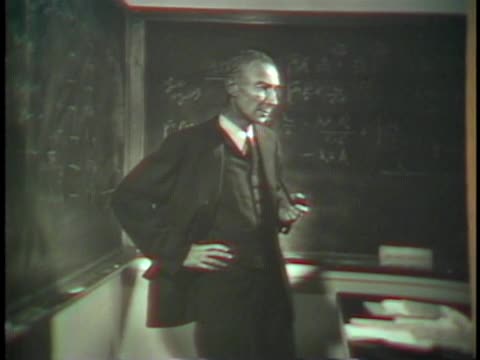
research into weapons development. Hello, I'm Hal Rhodes, and this is Los Alamos National Laboratories nestled in the hemispountance of Northern New Mexico, in whose seclusion the world's first nuclear device was developed. It is by now a famous story that began in the early months of 1943 when a former voice school was conscripted by the United States Army and made to be a scientific laboratory. This is inception Los Alamos has had four directors. Its first and its founding father, the legendary and in time controversial, Jay Robert Oppenheimer. Oppenheimer served as laboratory director at Los Alamos between 1943 and 1945. Oppenheimer's successor was Norris Bradbury for a quarter of a century between 1945 and 1970. Bradbury presided over the Los Alamos facility by far the longest tenure of any of the laboratory's directors.
1970 to 1979 Harold M. Agnew directed the Los Alamos laboratory. This during a period of dramatic expansion more than doubling the facility's budget and nearly doubling its staff in less than a decade. Today the Los Alamos National Laboratory is headed by its fourth director Donald M. Kerr. A physicist and an engineer, Kerr spent 10 years at Los Alamos before joining the Department of Energy in Washington DC in 1976. But by 1979 he was back at the laboratory and it has been a sometimes controversial four years since his return. Dr. Kerr, you know of course low these many years later that there is still an awful lot of mystery that surrounds this place, this Los Alamos laboratory. I think people generally have an idea or they think they have some vague idea of what goes on up here but otherwise it's a rather mysterious and some in some instances for a lot of people
that stay in New Mexico perhaps even threatening place. Well that of course a legacy as much as anything from the time that it was a closed community. We're working very hard today in fact to make it less mysterious and better understood. Although I must say even as director I don't know all that goes on here. The real point is that for a community such as ours and particularly a laboratory such as ours with its concentration on science and technology you have a mysterious aspect to begin with in the sense that most people aren't familiar with the words we use, the jargon we've developed, the kinds of things we've worked on. And so one of our major problems is communicating to those not trained in science and technology the things we do and why we do them. And there are those people out there just basically say I don't want to know. I just don't want to know what they're doing out there.
Well I suppose that's true. On the other hand today our laboratory works on some 600 different projects. From basic science to very applied engineering tasks range of the whole gamut from national security interest to medical technology to frontiers in theoretical physics and mathematics. And so we don't want to be mysterious and in fact we want people to know what we do they pay for it. You said the moment ago something that frankly surprises me even as director you say you're not sure that you know everything that goes on here does that make you nervous at all? No no it really just makes plain the fact that we're all limited in terms of our own experience in training. Mine as an engineer and physicist means that I'm a lay person when it comes to some of our work in the life sciences that's not my area of specialization. And so my understanding in detail of what's done there is less than those who are expert
in that area. Could we talk a little bit about the people who do work here? I mean I think we all in New Mexico know somebody who works at Los Alamos and have had some contact here. And I know that an awful lot of the top scientists work here in part because they really like this region it's a spectacular place to be. There is a lot of intellectual ferment and excitement in a place like this. It's an opportunity for a lot of scientists to work on projects they feel very deeply about as science and pursue their science as a consequence. But an awful lot of those very same people do not necessarily share sort of the major portion of the mission of this organization, I was thinking in terms of the period during the Vietnam War when some of the most strenuous anti-Vietnam War criticism was coming out of interestingly Los Alamos.
Is that built in ambiguity? Is that a tension here that has to be dealt with somehow? I don't think so in the following sense. There is no attempt at all to disguise the fact that our primary mission has been from the beginning support for the nation's defense posture. And people don't come here believing that it's any other kind of place. So to a degree we end up with people who do in a fundamental sense support that commitment to the nation's defense. At the same time we don't try to impose a corporate viewpoint relative to the specifics of how that's done and our employees like citizens everywhere are free to express their own opinions. I think important that they do so responsibly given where they work because they do working here in Los Alamos have access to a great deal of information about the nation's defense policies, the way in which our military departments arm themselves and plan to conduct themselves.
And so before people hear offer opinions they should, of course, inform themselves as they're able to. But there's no attempt at all that they should have views that are consistent, for example, with mine or some sort of overall laboratory view. That tension between personal values and some instances and corporate or professional values on the other. Has that ever been the occasion for management problems for you? I was not long ago here at Los Alamos talking to Dr. Edward Teller. We were talking about the larger world, the larger scientific community in this country. And he commented at that time that it has to be understood that there are a lot of very fine scientists working in the United States today who will and know why make a contribution to the kind of work that takes place here at Los Alamos.
That was not true in World War II when the institution was founded. Is Los Alamos as a consequence of personal values on the part of an awful lot of American scientists denied access to some of the nation's best talent? I don't think so. They're clearly in the scientific community as there is in any other identifiable community in the United States, a spectrum of opinions. We have, in fact, because of the laboratory's excellence in science, and, in fact, the excellence of those of our scientific staff today been able to attract over the years a continually increasing number of first-class people, whether we miss some because of personal preference or because they'd prefer to live elsewhere or for a variety of other reasons we don't know, always, but we have never really found that we've had a problem in recruiting and retaining people because of...
You've never had anybody look at you and say, I'm fascinated by the science you're talking about here, but I do not want to be made to be a party to this. I think that really is taken care of before we ever see the person. You ever get to that point? That's right. They wouldn't apply to work here, for example. Just not terribly long ago now, Los Alamos celebrated his 40th anniversary. On that occasion, Los Alamos Science Magazine published a number of articles, including one by yourself. I'd like... Could we talk a little bit about some of the ideas you've broached in that article? You said, among other things, you would like, on the occasion of the 40th anniversary of Los Alamos to look ahead to the next decade, at least, at a number of things which you would like scientists at this facility to contemplate as part of their mission. And one of those things involves arms controls. You want Los Alamos scientists to play a role in subduing the arms race and eliminating the fear that by accident or by design, nuclear war might destroy life on this earth. Right off the top of my head, it seems to me you're talking here largely a political problem
to the extent arms control is a political problem. How can scientists be instrumental in solving a political problem of that sort? What I'm really trying to do is make the point that while technology by itself will not solve a political problem as you have correctly put it, it may, in fact, ease the solutions or the approach to solutions by making available the techniques and the information processing that would allow, for example, for verification of an arms control agreement. I think you're aware each time we discuss in this country reaching an agreement with the Soviet Union and an arms control negotiation, the issue of verification always comes up. If, for example, as we did in salt, we negotiate the number of launchers, then our problem is counting launchers.
How do we do that? How are we sure of how many they have? If it's, as the president has now suggested, limitations on the number of warheads, you have a similar problem. How do we verify that, in fact, both sides verify that they're abiding by the agreement? This laboratory, in fact, in collaboration with Sandia in Albuquerque has been instrumental in providing that sort of technology in the past. We developed for the purpose of monitoring the limited test band of 1963, the Vila satellite systems, which detect atmospheric and space nuclear explosions if they were to occur. The treaty banned those, these monitoring capabilities verify adherence to the treaty. The technology, in this case, allows the political process to go forward, allows the treaty to be negotiated and signed and ratified, and the uncertainties that attend that political act are reduced considerably by the technology we provide for verification.
So your view on the role of the scientist, the Los Alamos elsewhere, livermore, sandate, sandian, this connection, is not necessarily to play a role in reducing what we have, but in augmenting our technology and our defensive capabilities as an instrumental to arms control, you added another dimension, of course, to the discussion. I guess what I'm asking you is, you arms control does not mean arms reduction. Not necessarily. In fact, while arms reduction, I think, is a legitimate and important aim in arms control stability and the elimination of the possibility of miscalculation or accident is an equally valid set of objectives, and in fact may come before reduction. Because what you really need to do is build confidence that you are negotiating with
a country you presently see as an adversary, yet the act of negotiating and signing a treaty implies that you do have some confidence that you have shared objectives. And you may share the objective of stability before you share the objective of reductions. Is stability as you use it, as you use the term synonymous with some kind of a freeze of arms, of the arms status at any given time? No. Stability, in my view, is the removal of any possibility for miscalculation or accident. So it's predictability? predictability is, I think, a way to elaborate on the word. For example, it may be better for the United States to develop and deploy new kinds of weapon systems, not necessarily larger numbers, but to incorporate the latest in safety, security,
and improved command and control, rather than freeze and leave in place systems which don't have those characteristics. And the point there is that if these are systems that are deployed in Europe, for example, exposed to some degree because they're outside of our own borders, it's far better in my view to have, first of all, no more than are needed to support our military posture and whatever commitments we've made to other governments, but secondly, that they incorporate the very best of the technology that makes them safe and secure in peacetime. All right. Let's go on to something else that you talked about in your article on the 40th anniversary of Los Alamos. So that has to do with your hope that, as I think you said, my second hope is that Los Alamos will be able to play a role in helping America solve its energy needs.
Now not too long ago, that was the focus at Los Alamos during the 70s, not the focus, but there was a rearrangement at least of priorities. And those priorities have been subsequently re-arranged, is defense activity now, the first priority, energy, the second priority? That's always been the case. I think to some degree, there was a change in perception during the 70s when the federal government decided that the energy crisis of 1973 should lead to increased federal spending funding in federal institutions to work on new energy supply technologies. There was a lot of publicity because that was growing, but in fact, it never grew and never was intended by the Department of Energy and its predecessors to be a higher priority
for the laboratory than the French mission. Though briefly wasn't the defense component of the Los Alamos budget under 50 percent? Not in total. Not in total. Now, what you have to distinguish there is our total national security program from the Nuclear Weapons Development Activity. Today, even the Nuclear Weapons Program is about 42 percent of the lab's activity, under 50 percent. Our total national security program includes, in addition, the verification technology, the satellite program, I mentioned earlier, the Nuclear Safe Guards Program, laser fusion, and direct support for the Department of Defense in areas of high explosives development. So, in total, that comes to something like 60 percent or so. Well, I knew it added up to date of 60 percent, but I had thought in the late 70s at least that it had fallen, but a lot of people went below 50 percent.
No, it never in total went below 50 percent. Again, Dr. Edward Teller recently on this program talked, and if I'd like to pick up on something that he talked about, President Reagan's request for a new defensive weapon, that particular time he was, Dr. Teller was talking about a debate that you, he and Hans Betta had just engaged in that particular day on the subject of that proposed weapon. Can you tell us something about the content, the nature of that debate? Yes, in fact, there was a fourth person involved as well, Dick Garland joined us in the discussion. The original intent had been to have a discussion broadly of arms control and nuclear weapons issues. Because of the President's March 23rd speech, or that part of it, at least, that called for a research and development plan for defensive weapons, most of the discussion focused on that.
The President in making his speech, of course, first asked the detention be paid to whether it would be feasible to develop weapons that were defensive in nature rather than continuing to add offensive capability. Many people have chosen to interpret the President's remarks as specifically advocating one or another approach. But if you read them, in fact, he didn't do so, what he did was make the general statement. He also indicated his commitment to seek further arms reductions, his commitment to maintaining our deterrent forces in whatever interim period there might be, and, in fact, correctly noted that any such defensive weapon deployment would raise ambiguities and questions in the arms control area. Unfortunately, it has become a political debate rather than a technical debate. The laboratory's role, as I see it, is to focus on the specific points where we can offer
information to policymakers. And that has to do with, first of all, is it conceivable? Is it feasible to direct radiation, particles, pellets, whatever, in a manner that could engage, for example, an ICBM, a reentry vehicle? If it's feasible, can it be done in an engineering sense? That is, there are lots of things that are scientifically feasible, but in an economic or engineering sense, impractical. And so we need to attend to those sorts of questions. The question of whether it's a good idea politically, or in an arms control sense, has to be taken up once one decides which, if any, of these ideas might work. Well, what did you post debate?
Did you debate the technical issues, or did you debate the political issues, or did they blend? Given the group of people, they were, in fact, inextricably intertwined, not surprisingly, given the group of people, Professor Beta, for example, and Dick Garwin, repeated many of the arguments that they had made in their scientific American article back in the late 60s. And to some degree, I think, missed a point that has changed in the intervening period. In the late 60s, when anti-ballistic missile defenses were discussed, it was from the point of view of an umbrella, if you will, over the country. It was clear to everyone at that time, and still is today, that you can't have a leak-proof defense, at least in the foreseeable future. The thing that people have missed is whether, in fact, as we look ahead in time, there
may be a role for increments of defense in lieu of further increments of offensive capability. For instance, if the approach the President has taken in the start talks to reduce the number of warheads succeeds, at the present time, with large stockpiles on both sides, small differences in the size of those stockpiles don't matter. It doesn't really make any military difference to the two nations. As you reduce numbers, at some point, small differences will begin to appear to be militarily significant. The concern about verification will then emerge, and once again will be in a debate, well, if the Soviets have 50 more than we agreed to, will that matter? At that point, a defensive system capable of coping, perhaps, with uncertainties of 50 or 100 or whatever, might become very important, because that would put a President at that
time in the position of saying, fine, we'll have a defense capable of dealing with this kind of attack or uncertainty, and thus preclude strong pressures building to have 50 more missiles of an offensive nature. So I think it's very important to think these things through and know what's feasible so that we can take up that point. That's the debate of which Dr. Teller spoke about which you are now reporting. That Dr. Teller, he said, frankly, surprised that the differences between the four of you are not greater than, in fact, were you equally surprised by that? I didn't know what to expect, I guess, to a degree I share his surprise that people were as close in their positions. On the other hand, Dick Garwin, who has been a consultant for the laboratory and, in fact, worked here in the 50s, Hans Betta, who was a division leader here and has continued
his association, Edward Teller, who, of course, worked here and at Livermore and has continued his association, we all start fundamentally with the same information. And so it's not surprising that in many areas we would tend to agree, because we share both the information and the approach to thinking about it. Something you said a moment ago is peaked by curiosity and I know it has been a case here for a very long period of time going back to the founding of this very facility. You say that very often a scientific idea is very attractive, but the engineering problems of making it somehow a reality can just make it prohibitively expensive or even unrealistic in any sense, engineering sense. I know that in the past there have been engineers who have come and left Los Alamos, who have always felt they did not get the kind of credit up here that they deserve for their contributions to the work of this facility. The glamour has always gone to the scientists, the great scientists, and the engineers have sort of been the tail that wagged the dog.
Is there any legitimacy to that feeling? That view is shared by people trained in the life sciences, by chemists, and others. The laboratory's early reputation or notice was, of course, due to some very prominent physicists and terribly prominent physicists. And they received, of course, a great deal of attention. Things still make up something like a third of our professional staff, interestingly enough, another third of our professional staff is engineers of all varieties. And, in fact, none of our programs would succeed were it not for our engineering capabilities, because what distinguishes us from many other institutions is that we don't just produce paper, no matter how it may appear to some. But in fact, our ideas are rendered into hardware, experiments are done, and they're tested in that sense.
And so we do have a cultural problem, a history, that we have to work very hard to overcome, because no one of the scientific or engineering disciplines is the most important at the laboratory. And in fact, we succeed because of our multidisciplinary nature and capability, and it's the teams that work together. And I hope that there are no-belt prize for engineering or some such thing to make the engineers feel that their contributions are understood. Well, I think it would. In fact, the National Academy of Sciences had to face this problem some years ago. Engineers weren't being recognized. It turned out the country couldn't solve the problem with the National Academy of Sciences, so we now have a National Academy of Engineering. Yes, well, that's always. Dr. Kerr, we're out of time. It's been an absolute pleasure talking to you. Thank you very much. Thank you. And thank you for joining us. I'm Hal Roach. Good night. Why don't you stick with me a minute? We'll talk while they roll credits over at you. Okay.
A young man born in Philadelphia, following in the footsteps of a guy like J. Robert Oppenheimer, do you remember ever a time in your life as a child thinking, gee, that's something I'd like to do? Honestly, not. I didn't really know about Los Alamos, of course, until I was, you know, in college. I came here, of course, right after I finished graduate school, and in fact, one of the people who pointed me this direction was Hans Beda, who was a student. Were you one of his students? I had courses from him. I was not one of his graduate students, specifically, but when it came time to be leaving Cornell.
- Series
- Illustrated Daily
- Episode Number
- 3150
- Episode
- L.A.N.L. Director Kerr
- Producing Organization
- KNME-TV (Television station : Albuquerque, N.M.)
- Contributing Organization
- New Mexico PBS (Albuquerque, New Mexico)
- AAPB ID
- cpb-aacip-d5d89a4e6da
If you have more information about this item than what is given here, or if you have concerns about this record, we want to know! Contact us, indicating the AAPB ID (cpb-aacip-d5d89a4e6da).
- Description
- Episode Description
- This episode of The Illustrated Daily with Hal Rhodes features an interview with Donald M. Kerr, the fourth director of the Los Alamos National Labs (LANL).
- Created Date
- 1983-06-08
- Asset type
- Episode
- Genres
- Talk Show
- Media type
- Moving Image
- Duration
- 00:29:40.834
- Credits
-
-
:
:
Guest: Kerr, Donald M.
Host: Rhodes, Hal
Producer: Trujillo, Ricardo
Producing Organization: KNME-TV (Television station : Albuquerque, N.M.)
- AAPB Contributor Holdings
-
KNME
Identifier: cpb-aacip-2bd6e26fbc1 (Filename)
Format: U-matic
If you have a copy of this asset and would like us to add it to our catalog, please contact us.
- Citations
- Chicago: “Illustrated Daily; 3150; L.A.N.L. Director Kerr,” 1983-06-08, New Mexico PBS, American Archive of Public Broadcasting (GBH and the Library of Congress), Boston, MA and Washington, DC, accessed April 3, 2026, http://americanarchive.org/catalog/cpb-aacip-d5d89a4e6da.
- MLA: “Illustrated Daily; 3150; L.A.N.L. Director Kerr.” 1983-06-08. New Mexico PBS, American Archive of Public Broadcasting (GBH and the Library of Congress), Boston, MA and Washington, DC. Web. April 3, 2026. <http://americanarchive.org/catalog/cpb-aacip-d5d89a4e6da>.
- APA: Illustrated Daily; 3150; L.A.N.L. Director Kerr. Boston, MA: New Mexico PBS, American Archive of Public Broadcasting (GBH and the Library of Congress), Boston, MA and Washington, DC. Retrieved from http://americanarchive.org/catalog/cpb-aacip-d5d89a4e6da