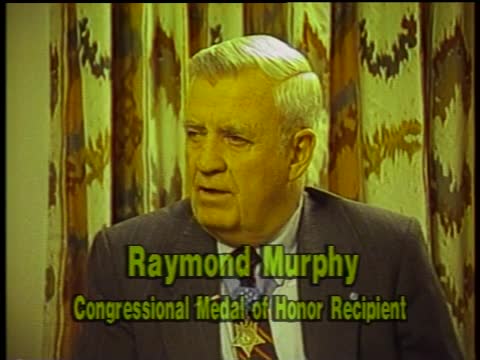
Report from Santa Fe; Medal of Honor Recipients: Raymond Murphy and Hiroshi Miyamura
- Transcript
Report from Santa Fe is made possible in part by grants from U.S. West, providing advanced telecommunication services to New Mexico homes and businesses, and by the best Western High Mesa Inn, your Santa Fe destination, where sources on the High Mesa serve Santa Fe style food at affordable prices. I'm Ernie Mills, this is Report from Santa Fe. Another extra special show, our guest two members of the Congressional Medal of Honor Society. We have four living recipients in New Mexico, Hiroshi Miyamura from Gallup, New Mexico, McKinley County, and Raymond Murphy from Santa Fe, New Mexico. It's going to be very hard for me to say Raymond, because I knew you in 1957, he said you got to go see Hiroshi, and then I left Gallup and came up from Gallup to Mexico and saw Murph. So with the show today is with Hiroshi and Murph, but two very dear friends over a long,
long time. First, Murph, let me start with you, if I may. In March, there is going to be another meeting, this is second major meeting from the National Society of the Congressional Medal of Honor recipients. It's going to be in New Mexico, and they're honoring one gentleman, and I want a little background on the affair itself, if you can. Well, it's called the Patriot's Dinner. Now, the Patriot's Award is the Medal of Honor Society's highest honor that they give to citizens who have contributed to our nation, to the community. Most of them have been on a national level, but this is more of a district, and we haven't had one of these for a long time, and in fact, we've only given about five on a district level. So we're given this to Mr. Kurs, because of the contributions that the Kurs family and the Kurs corporation has made, not just to the Medal of Honor Society, but to veterans in general, through scholarships and all kinds of, you find it hard to have a meeting of
veterans anywhere, state, local, national, without Kurs in there helping to make it a successful meeting. How many members do we have now in this society? Well, it's right at $199,200. We have a little trouble keeping track of some of our members. They're kind of nomad, and they move around, so now and then we get surprised and we'll lose one. But we believe the President Brady, who you've had on and I, that it's somewhere in $198 to 202. We had, and we did a previous show with General, it's Patrick Henry Brady, Major General, Army Retired, and he had been, in fact, he had the action he took that when he received the recipient of the Medal of Honor, which is about one month before I got into Vietnam, was January 6, 1968 when he was there. And of course, then I had Colonel Robert Scott, I would say, he is, I could say this without
fear of contradiction, Scott, he's getting more contankerous every year, and he's more fun every year. He really is just a marvelous, marvelous person who would receive his medal for efforts in the Second World War. And we had Richard Rocco, who is the co-chair with your Marf on this, putting this together, Richard had been in Vietnam. I want to, at this function in particular, it is open for anyone in the public who would like to attend. Yes. Yes. And so anybody can attend it, I understand there may even be an artist. They're going to have an artist show the night before, and they've got some of the top veteran artists in the whole area, not just from New Mexico, but around the area, so we're putting on the show the night, on the 11th of March. And the years I've known, I've had people say to me, do you know that if I say, yes, I've known him, I go back a long, long time.
You, both you and Marf look younger now to me than you did 15 years ago, what, well, it's like a lot. I was treating you well. I thought you were taking good care of yourself. I've had a couple of people ask me, in fact, one of the things I pointed out was that someone said, how do you get to be a congressional in the Medal of Honor winner? And I said, you're not a winner, you're recipient, and you could be all for lucky one thing. But a lot of people have asked me about it, and for a little background on yourself, this is one of the shows I consider a golden treasure show in a way where they can see the person who is the recipient. And it was during the Second World War, and that I received my medal, you were Korea, and Marf. Korea also. Both Korea and Korea. That's right. And Colonel Scott was for the World War II. And that was in, I believe his was in Japan at that time, and one of the islands. Right.
And then Richard was from the Vietnam War. Take us back a little bit. Do you remember what year it was? I was saying. Oh yes. This was the night of April the 24th, 1951. We were told to hold the perimeter, and we knew they were coming. And we were south to the M. Jen River. And when they crossed over, they let us know they were crossing and coming, because they just blew bugles and made all kinds of noise to get us on edge, I guess. And around midnight, they set off our flares. So we knew they were just down the bottom. We were stationed on a big high mountain, but our field of fire was to cover this draw like it. Once they tripped the flares, we knew they were down there. Just short time, we had a battle. And they surrounded my position, so I told the men to leave, and I'll just cover their
withdrawal. Luckily, they all made a back, a couple got wounded, but I got wounded in the action, and got captured, the boots on. And how long were you in the prisoner of war camp? 27 and a half months. You know, the furthest camp north to the 38th parallel. That's cold up there. Oh, very cold. I had, when some of the people I've talked to that have gone through the elsewhere in the country, you know, they forget the war record that our servicemen have in the Mexico. You know, marvelous. You know, we have people, I've mentioned names like Tommy Foy, who is served in the Batan Death March, and in Gallup, I remember Eddie Younger, and we all remember Cash Skarter, who had been a banker from Don Silver Cityway, and they were marvelous people
for Cash. He passed away now. Tommy is serving in the legislature, but the war record here just cannot be beat of the American citizens. What does the society mean to you, Harshan? What does society mean to me? Well, I'm just happy to be a part of, to be able to say that I am an American. To me, that's the all that matters. And I'm very grateful that I was born in this country. And I was never taught anything else. This was my country, and I had the participate in anything that had to do with defending the country. Murph, why don't you take us back a little bit to Korea when the date? It was February 3rd, 1953.
And it was in the kind of stagnant period when they were trying to get these truth talks taken care of, to try to get a no-fire. And it was very similar, I believe, to the World War I as kind of a trench warfare. And there wasn't much activity at daytime. Most of it was small units, squads, or very few even tuned at nighttime. And I guess the higher ups in the United Nations, the 8th Army, whichever, decided that we needed something to jog these truth talks loose. And they decided that they would have a heavily reinforced company raid on one of the strongest communist outposts over near the M.J. River where Harshan was, near Pandan John. My company was the $10 million winner. They were the ones selected to do the assault on this side of the outpost. And that's certainly the lottery you want to win. And the purpose was to try to shake up the talks, to try to naturally kill as many and
get some prisoners. And my opportunity was the exact evacuation of Wounded, the other two were the assault of Wounded. Well, by the time I got up the top of the hill, I knew there was something wrong because you couldn't find any officers or any sergeants, they were all wounded. So all of a sudden I became a company commander and it took most of the day to get the men back. We lost 90 some, about 18 K.I.'s and it was very fortunate to have given them the highest medal, but I've always felt that a group award because I had a tremendous number of great people that contributed to the disguise of the operation. In each passing year, I find that, for example, when they had the dedication of the women's memorial this year in 1993, actually. And there were people back there.
Some people said, well, I felt guilty because I didn't serve in combat as such and someone else said, you're heroes or the man who obeys the orders and you need for every man in combat. You look usually at about 8 to 10, and 68, I was mentioning to General Brady in 1968, it was 1 in 8, but except for New Mexico, it was 1 in 3 that served in combat. 1 in 3 in combat. And out of that 3, I think there was 1 out of the 3 that ended up a casualty during that period. But the thing that I find interesting now is people are sharing a lot more. For a long time, the Korean veteran was almost forgotten. The Indian veteran. And some people said, oh, you really need one memorial. And my mother used to say, there's room enough in the jar for everybody. And I think there's still an awful lot that has to be written about the Korean conflict.
Do you find this happening, Ergie? Yes. I belong to this Korean War Veterans Association. The majority of the members are finally beginning to voice their opinion, saying that we were the Fugurgaten soldiers. And it's time that we should let the public know something about us. And I think in time, you hear more stories about what happened in Korea. MR. You've been very involved in veterans and fares. And again, this is something where you can't differentiate. It's not a time to be treating one group almost as if it's a minority or such. You've got to recognize all of them. How much progress are we making to take care of our veterans? I think we're doing very good. Of course, I work for the Veterans Administration, but I believe that we're following the motto
of President Lincoln to take care of those who bore the run of the battle and their dependence. And I think we're considering every aspect of our government. I think we're doing good. We have the biggest hospital system in the world. It's 172 hospitals. We have what used to be the second and third biggest insurance business. We have about fourth or fifth now because of deaths and stuff. We have the biggest cemetery system in the world. The GI Bill, the famous GI Bill that we're having our 50th anniversary when it was signed in 1943, is one of the greatest social events that's ever happened in this country when you think of the people that have raised their standards through education that have been able to buy a home, the number one ambition of everybody that have their own home. And if it hadn't been for the GI Bill, so I think overall there's always room for improvement. You know, I remember talking to my father and my real father from this first world work.
And when they got out, I think you'd land like in Florida and you got your train fare back to your hometown and $50. And that was it. You get off the sun, the sun, I got off there and it still had the gas mask. I still remember scaring people with his gas mask in the basement. But that's a long way from there to what happened in the second world war and other changes as well. Most of the people I talk to, like yourselves, also are so dedicated. They're the ones who say, we don't want war. There is no one in my mind to my mind who feels stronger about staying out of war than the Congressional Medal of Honor when there's, for example, do you have any special message on that yourself? I think the goal of every recipient that I know and I know most of them very well is that there never be another Medal of Honor.
And that's not because we want to hoard it to ourselves because we know the suffering that goes with, usually with it. So that would be our ambition that it just fade out and never have that we would have peace among men. Harsh? I feel exactly the same way. Let's just hope there's never another award of combat awarded to anyone or have to be awarded. You know, we have the police actions again, like we have the desert storm, you know, and we want to get people to come back and say, in any way, you can get people all the way up the day. When they said police action, I thought I was going to go over there with them and given the Billy Club and actually become a policeman, but it's entirely different story when you get over there. And I'm sure these little fructoses that are going on right now are a lot worse than we realize.
Donald Scott told me, he said, he's lucky, he said, when I was there, he said, we just had to hand it. He said, he said, thank heaven, it wasn't as fancy as it got a little later on, but he's great that way. Yeah. What are you doing? You get together with this group. I mean, the fraternity has to be something else. It's tremendous. It's tremendous. There really is. Very closely. Yeah. We're a very diverse cross the board. We have presidents like General Brady, but we also have sergeants as president. There's no status in our society. Everybody's on the same level. A lot of disagreements, but still a bond that you can just kind of. Now this man here talks about being an American. He'll never talk about, there's only been two Nesey congressional metal runners. One was post-humanistly and Italy, and this man here. And this man here won't tell her, but his citation was kept top secret by the Pentagon for 27 months, because they knew are they felt if it was released, he'd be mistreated
in prison or work in. Yeah. That was a whole period or later on, when you look at that and say, how can we be sure these people will come back? We forget that bad treatment didn't just happen again in any specific conflict, or something that affected almost everyone. Right. What's the future hope for the organization? Well they're getting up there in the years. We would like to have as many as possible with this meeting in March, but some of them have problems, they're aging, and have a little trouble getting around. Eventually there'll be the last one, you know, I hope someday. I actually, I met the gentleman out here that had been one of those who went up to San Juan Hill with Teddy Roosevelt back about 25 or so, about 30 years ago. You got the medal on it.
Yeah. And as it was interesting, you know, this spread on, it's just incredible. And Marf Telles again, we have, I believe, and I haven't seen the final program yet. I think General Baca, Agenda General Baca is going to be the master of ceremonies at the banquet, and Mr. Curris is going to receive the Patriots award. And Phyllis and Lilmore, now that's the dates again. That's the 12th of March on a Saturday. The 11th of March on a Friday will be the Yacht show at the Ramada Classic in Albuquerque. And then, on Sunday, they're going to have a Matanza, it's going to have a pronounced right for the people who just take part in the ceremonies. So we're looking forward to a very enjoyable time, a very enjoyable reunion. What about the rest of the year and what other functions were you have outside of this meeting? The only ones we really can count on was we're always invited to the inauguration, and our
buy, we don't have an annual convention, we have a buy annual, and I think you remember we had the buy annual here in Albuquerque in 1849. Four years ago. Yeah, and it was one of our most successful ones. We had a tremendous committee of about 50 some Albuquerque's that just did a tremendous amount of work for two years on that. This weren't going to be a successful count. We're sure hope and counting, we're going to work on it. Okay. Hershey, you've lived as long as I've known, you know, in McKinley County, in Calabras. Born there in 1925, still there. Yeah, man. In all those years, I've known you. What was it like when you got back from Korea? Well, it was something that I didn't expect, the welcoming that I got, it was something out of this world. And I just didn't know how to really cope with it. I'm not the type of person to be making any speeches.
So I couldn't really express my gratitude and happiness for being able to come back to go up. Hershey, did you come right back to Santa Fe? Well, I'm originally from Pueblo, Colorado, but when I came back to the Korean War, I had a brother who was kind of deeply involved in the community here in Santa Fe. I wonder who that would be. And I decided I wanted to get another degree, so I went to graduate school and asked us and did that. And afterwards, my brother introduced me in coming in to business with him here in Santa Fe. So I've been here 40 years. I feel hopefully I'm a native. I think so. The brother is referring to, of course, is Leo Murphy, who reform a mayor of Santa Fe and a grand man, Leo again, is just one of our Santa Fe treasures, just a great, great person. I'm coming for the business because they show you how time flies. They're looking for an ice skating rink in Santa Fe now, and that's, you had the ice
game. We had one here one time. During those days. I went out there during that time. I almost killed myself. I want to check on a couple of items for you. Do you? Are you surprised in a sense that some of the materials we see this day? And for example, someone said to me they were talking about things like napalm and the ancient R and R and R and Shinsut, but I can remember it back to the first World War. And my father was telling me about the things like the gas attacks. They had mustard gas during that period. And those who had gone to France came back. And again, there was very little done for them during that period. And many didn't realize too much later what the effects of it have been worth. Because of your own background with the Veterans Administration, how has worked progressing on that to make sure that the health of the veterans is taken care of? I think we're doing some good things.
We've just opened up a push within the last year trying to find more involved in the mustard gas, not only in the First World War, but in some of the testing of mustard gas that was done during the Second World War. We're out doing outreach trying to find people that might be our entitled to benefits for some of the things that we've made some mistakes, you know, where we're human. And I think the VA is trying to go back and correct some of these by compensating people for some of the problems that they have. One of the people who works with vet help and you've traveled with them a couple of days before we did this show, Roger Fleming. I think it's a good example of a very dedicated person and we have an additional problem now I think. And we've had it before, people forget about the March on Washington when they camped, you know, camping it's after the First World War, when people camped outside the White House and such.
But we had the problem with the homeless these days among, first you have any feelings about that, what we can do, what people can do to help more? Oh, boy, I don't know, it's quite a problem, I'm not just going to take time to solve. There are people that are willing to work and then again, there's people that don't want to work. I've heard of instances where things that were donated to them, they would just throw them away in the trash can. So it's going to be hard to distinguish who really needs to help and wants to help versus the ones that are just trying to get what they can out of it, I think it's quite a problem there. Right? I think it's a very serious problem, Ernie, and to go back to my brother, as you mentioned, he was the first welfare director here in this state to have when they brought out food stamps. And he was a Democrat, I consider him a conservative businessman, and he told me after his four
years there that the corruption and the problems in that was less than 10 percent, but that small part, and I'm not questioning the media, it makes the front page. And I think as far as the homeless, the majority of them, there is a need. I know that you've always had, from where kids, you had hobos that followed the railroads and stuff. But now, I think with our modern, fast-paced society, there are some people that have fallen on Susan Crapp's cracks, and they need some help. You know, when you mention, and it is, someone just becomes a media problem, the person who drives up getting food stamps, for example, and a Cadillac, that's the isolated case, and not in as Leo would say, because he was very involved. He was, in many ways, President John F. Kennedy's man in northern New Mexico, and so I picked him, and I filed the other day, he came across it with Murph, and so he had that understanding and that feel for this kind of thing.
I think also that it would be interesting someday to get together with some of the people, the recipients, and discuss the difference in media coverage during conflicts. You know, there was completely, was completely different during Vietnam, and the intrusion of the media now, where they actually get involved, and I think I was one of those who fought. I angered a lot of people in my business about training media people, you know, making them go through a training period, so they didn't get someone else blown up, because they were out of shape. Sure. Very seldom do we talk about these things all the time. Yeah, I don't think I could have gone in person golf, because of the media problem. I had an example of my own when I was in Korea, just three months before the Medal of Honour Deal, I was awarded the Silver Star for an night operation out near Penn, when John. And before we went out on it, I was told by my company commander, I was to take a reporter from the Boston Globe, and I said, no, I'm not going to die. I get too busy watching to take care of my men, and he told me you don't have the choice. And it's from a book.
I said, well, I'd like to talk to up above. And they went to the Italian Command, and he said, that's right, you got it taken. Well, fortunately, we had one of the best commanders, and he was the top Marine in Vietnam later on Colonel Wald on regiment, and he got to him, and he said, Murphy's the boss. I don't think you could have done it during the Persian Gulf. I don't think you could have turned down the media. So times change, you know. We have to change this, I'd had a hard time. Has she found a word for today? Just glad to be here, and it's quite an honor that they recognize us, but Medal of Honour recipients, and we're looking forward to the Patriots Award. And we have our guest today, Leo Murthy, Leo Murthy, Leo, could always be the guest then. Raven Murphy, and Hiroshi Miyamura from McKinley County, and Ray Murphy from Santa Fe. And we have two other living recipients. One is Richard Rocco, and Richard will be with us later on, and we did have Colonel Scott, and Robert Scott on with us.
And of course, the Commander serves as National Commander, was on just about a week ago, and that is General Brady, General Patrick Henry Brady. Want to thank you for helping us today, to honor the recipients of the Conventional Medal of Honour, and don't forget the big convention in Albuquerque from March 11th through the 13th. Thank you for being with us on Report from Santa Fe. Report from Santa Fe is made possible in part by grants from U.S. West, providing advanced telecommunication services to New Mexico homes and businesses, and by the best Western High Mesa Inn, your Santa Fe destination, where sources on the High Mesa serve Santa Fe style food at affordable prices.
- Series
- Report from Santa Fe
- Producing Organization
- KENW-TV, Eastern New Mexico University, Portales, New Mexico
- Contributing Organization
- KENW-TV (Portales, New Mexico)
- AAPB ID
- cpb-aacip-d3419981631
If you have more information about this item than what is given here, or if you have concerns about this record, we want to know! Contact us, indicating the AAPB ID (cpb-aacip-d3419981631).
- Description
- Episode Description
- Congressional Medal of Honor Recipients Raymond Murphy and Hiroshi Miyamura join host Ernie Mills to discuss the National Society of the Congressional Medal of Honor Recipients in New Mexico's upcoming "Patriot's Dinner," the society, and what they do.
- Series Description
- Hosted by veteran journalist and interviewer, Ernie Mills, Report from Santa Fe brings the very best of the esteemed, beloved, controversial, famous, and emergent minds and voices of the day to a weekly audience that spans the state of New Mexico.
- Broadcast Date
- 1994-02-26
- Asset type
- Episode
- Genres
- Interview
- Media type
- Moving Image
- Duration
- 00:29:43.003
- Credits
-
-
Guest: Miyamura, Hiroshi
Guest: Murphy, Raymond
Host: Mills, Ernie
Producer: Ryan, Duane W.
Producing Organization: KENW-TV, Eastern New Mexico University, Portales, New Mexico
- AAPB Contributor Holdings
-
KENW-TV
Identifier: cpb-aacip-bb529c43450 (Filename)
Format: 1 inch videotape
Generation: Master
Duration: 00:28:17
If you have a copy of this asset and would like us to add it to our catalog, please contact us.
- Citations
- Chicago: “Report from Santa Fe; Medal of Honor Recipients: Raymond Murphy and Hiroshi Miyamura,” 1994-02-26, KENW-TV, American Archive of Public Broadcasting (GBH and the Library of Congress), Boston, MA and Washington, DC, accessed April 6, 2026, http://americanarchive.org/catalog/cpb-aacip-d3419981631.
- MLA: “Report from Santa Fe; Medal of Honor Recipients: Raymond Murphy and Hiroshi Miyamura.” 1994-02-26. KENW-TV, American Archive of Public Broadcasting (GBH and the Library of Congress), Boston, MA and Washington, DC. Web. April 6, 2026. <http://americanarchive.org/catalog/cpb-aacip-d3419981631>.
- APA: Report from Santa Fe; Medal of Honor Recipients: Raymond Murphy and Hiroshi Miyamura. Boston, MA: KENW-TV, American Archive of Public Broadcasting (GBH and the Library of Congress), Boston, MA and Washington, DC. Retrieved from http://americanarchive.org/catalog/cpb-aacip-d3419981631