Illustrated Daily; 209; 25 Years of Channel Five; Introductory Footage for 25 Years of Channel Five and Introductory Footage for Vietnam War
- Transcript
I feel like that these were the seeds, the early beginnings of certainly instructional television. Of course, public television has gone way beyond that into deep educational values and attainment values. And where's your reindeer? Where's Dasher and Dancer and Comet and Diner and Blisson and Sleepy and Dopey and Doc? I don't know about Sleepy and Dopey, but I sure could use a Doc. reindeer, reindeer, reindeer, reindeer, oh my god it's a running game! The Illustrated Daily, Managing Editor, How Roads.
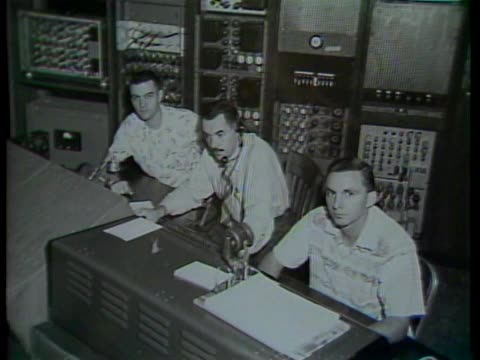
Hello, this is where it all began a quarter of a century ago. A converted sorority house which today head quarters the speech communications department at the University of New Mexico. But on May 1st 1958 at 6.35pm, from the world's highest transmitter atop Sandia Peak with one watt of audio and two watts of video it was here that KNME made its premiere broadcast. And educational television later to become public television came to New Mexico. The occasion of an anniversary is always time for reminiscing, but when the anniversary is silver, memories come rushing back. We had to try out so that we had to do so. My first impression was to absolute panic in a sense because I had never done any television work before and was requested to come down and among or along with about 15 other teachers to teach a lesson on television. And I came in with my little script, my mini script in my hand and I thought, gosh I don't think I really want to do this.
I don't know anything about television. I had been on television one time in my life and that was when they needed somebody to represent the student teachers or something. And I had been in front of a television camera one time. I knew absolutely nothing about camera technique, about scripting. Well, I thought I had nothing to lose and it sounded like fun and I went down there and tried out and I said, George, I think I'm going to go in and tell Virginia I don't want to do this. There was already somebody in there auditioning and he said, Kathleen and he really, you know, he talked to me the way George can talk to you quite seriously. He's a wonderful human being. What did you say? Wonderful human being. I heard that. Go on, say that again, you, Bob White. Wonderful human being. Oh, yes, we can do anything. A ball. And I went down there and tried out and lo and behold, they asked me if I would take this teaching position on television and you know that's what I did. Why?
You got an answer for that? There was a lot of fun in Channel 5 in the Comrade of a little tiny building, the building that's now 1801 Rome is a speech building now, I think. There was a lot of fun and comradeship there. Well, what did we learn there? Wonderful human being. No, no, no, no, no. The production that we went through and getting ready to set up and do a program was just wild. In those days, we had the black and white cameras. Everything was live. We stood all three of us started at the piano and then we walked down from one chart to the other. Why? At the beginning, we had no audio room and we had on recorder, a tape recorder on the set. And it was considered somewhat innovative. The day we rolled Maggie into the studio, Maggie being what we call the old real-to-real audio tape. With pre-recorded music on it so that we could have our own accompaniment without playing it always live on the piano and also have a voice track there so that you could sing with yourself and create harmony parts. And then we would have to punch the play and the stop before and after each song that we sang.
And we would sing like five or six songs. So as we progressed down the set, the further away we were from that tape recorder. And we would try to program into it a long introduction and a long conclusion to that audio music recording so that we could have time to run down and punch the button and run back up to get to the next chart. That tape recorder had its own little personality. And if you happen to punch the button, the play button, at the same time that you might gesture and touch somewhere close your microphone, it had a way of creating a circuit through your whole body that was most interesting. Except for the differences in size and shape the two are very much alike. Very much alike. And remember those were the days of live television. So you kept right on going no matter if you're a microphone cord wrapped itself around the piano legs or whatever you kept on going. And I'm sure you were able to tell.
I'm going to dog gun it. I'm hung up on this chair just a minute here. You know that's one thing about having a microphone on. If you get wound up in a chair, you're done. Now I'm back. Also I remember quite vividly the time that we first decided to put the audio tape into the booth and have it played from the booth. And the technician got the cuts mixed up at Monosoma School. And every time I would set up a particular song or particular activity to be used with that musical cut, it was the wrong one. Alright, let's see if you can do that with me and we'll keep the beat to a Hawaiian song. Here is your pitch ready thing. Thank you for doing that.
And if we could have Shalom Havardim, I'll sing it. We'll try to sing it as a round. Okay, you should hear the introduction first. Well, as you can tell, we're having our troubles. Shall we give it another try or shall I just go on? The Makah that we had borrowed from one of our local pet stores. Beautiful bird. And he was allowed to sit on my shoulder. What are you doing there? Okay. Up on my... Okay, Caesar. And he stayed. I guess I'm going to have to spend the rest of school today with a Makah on my shoulder. He stayed all during the program on my shoulder on it. He wouldn't get off. Well, always remember this day is the day Mrs. Marin taught school with a parent on her shoulder. Oh, it's not so bad. You're supposed to just put your finger up like this or a stick. I'd forgotten you had pretty heavy birds.
He wouldn't get off. He just stayed on my shoulder. I was afraid with the back of me was going to look like... Yes, we're going to have to decide how to get one Makah off Mrs. Marin's shoulder. Say, your claws are sharp. He was going to come over and take my nose. But the Makah just stayed there. I'm afraid now you always recognize me as I go down the street. I'm the teacher with the Makah on her shoulder. I guess it's better to have a Makah on your shoulder than a vulture or a hawk or something like that. Is this a fun program? It is to me. I'd dearly love birds. What a disgusting person. No, the runthroughs were the fun. We really fun. We'd have, with Kathleen and Nancy, the puppets would have to answer questions on the... Of course, the teachers were there to teach and we were there to help. But we weren't real helpful during the runthroughs.
Well now, hey, did you just make a pass at me sweetheart? She touched me Zelda. She touched my virgin body Zelda. Oh, she's always interrupting. Take her away Nancy if you've got a talk talk. Daniel's personal. Daniel's a little white puppy dog and he's definitely was adopted from the pound. Because he had no pedigrees here. And Daniel talks up high like this. And Daniel is, his hormone level is, let us say, is out of sight. I went little girl doggies coming to play. He saw this Daniel. You know what I mean? Now I have with me a young man. What's your name, sir? Ronald? That's a nice name. Yeah. Would you mind taking your shirt off, sir? Oh, this show is falling apart. Oh, that's nasty. This is a killer. You know you tell me about swing choirs and being mid school and high school.
Now can you teach me about puberty? Yeah, whiskey. The runthroughs for the game shows. I know probably weren't worth the effort they kept. They were sure fun. Dr. Bundy was such a helping counselor to me and to all of the television teachers. And from then on I have a fourth person who was very instrumental in that was Wayne Bundy, who gave me continued support. It was very nice to talk with Dr. Bundy at any time. But after a while you learned that if you had a live program coming on, say at three o'clock or nine o'clock, when mine could have been live, you didn't stop by and visit with Dr. Bundy before. When you had a schedule to meet, you'd stop by afterwards. And we call him and we met at Howard Johnson's for coffee at like eight thirty in the morning. At like quarter to twelve we were still drinking coffee. We've had more coffee than is humanly possible. And he talked about that.
Do you remember why we? No. But I remember we had a long, long, long morning of coffee with Bundy. But it was fun. He was wonderful. Dr. Bundy has a wonderful, it has a wonderful gift of talking. He can convince an elephant it's yellow. I'm convinced. And Daniel, now he would say one thing Zelda. He would say Dr. Bundy has been around almost as long as you have kids. You know, he dates back to the icon of scope. And very few of us know what that is. Oh, I sure know what that is. What would you say Zelda? Well, I'd just like to say that if Mr. Bundy, Dr. Bundy, Dr. Bundy, Dr. Bundy, if Dr. Bundy would like to have a little coffee with me, I'm always available. Ho, ho. Watch out.
Always available. Adios, moochachos, moochachas. Hagone, we'll see you soon. I'm Rod Gearing. This is you and him reports. Be back after the next of 1970. Be back after your 1970s. I'm Rod Gearing. I'm Rod Gearing. This is you and him reports. Be back after the next of 1970s. Be back after your 1973. Just be back. That was the wrong line. You could be on your way. Ow. I'm sleepy and dopey and duck. I don't know about dopey and duck, but I could use a sleazy. End of program. This is a KNME presentation.
This is a KNME presentation. This is a KNME presentation. From its inception to its end, Vietnam was perhaps America's most controversial war.
And when its veterans came home, they encountered a nation divided and anxious to forget. Not surprisingly, veterans of that war were soon heard to complain of a lack of appreciation and recognition for their efforts in Southeast Asia. And the bill of particulars was disturbing. Everything from something called the late stress syndrome to indifference on the part of existing veterans organizations, organizations dominated largely by veterans of World War II and Korea to the problems of those who served in Vietnam. Slowly, the pendulum has begun to swing in the opposite direction. That frustrations remain and very likely always will. Thank you for watching.
- Series
- Illustrated Daily
- Episode Number
- 209
- Episode
- 25 Years of Channel Five
- Raw Footage
- Introductory Footage for 25 Years of Channel Five and Introductory Footage for Vietnam War
- Producing Organization
- KNME-TV (Television station : Albuquerque, N.M.)
- Contributing Organization
- New Mexico PBS (Albuquerque, New Mexico)
- AAPB ID
- cpb-aacip-d13481b09f4
If you have more information about this item than what is given here, or if you have concerns about this record, we want to know! Contact us, indicating the AAPB ID (cpb-aacip-d13481b09f4).
- Description
- Episode Description
- This episode of The Illustrated Daily with Hal Rhodes explores the history of KNME-TV Channel 5. On May 1, 1958, the first show was broadcast from the studio that was once located at the University of New Mexico. This special episode features interviews with the early talent featured on Channel 5 and an interview with Dr. Wayne Bundy (former Program Director, KNME-TV) and Jon Cooper (General Manager, KNME-TV).
- Raw Footage Description
- This file contains raw Library Footage from The Illustrated Daily show called "Twenty-Five Years at Channel 5" (May 1958-1983) (incomplete) the old days 00:00-14:42; 209
- Raw Footage Description
- 14:50 to the end of the file is the introduction to an Illustrated Daily episode about the Vietnam War.
- Created Date
- 1983
- Asset type
- Raw Footage
- Genres
- Unedited
- Media type
- Moving Image
- Duration
- 00:16:26.574
- Credits
-
-
:
Producing Organization: KNME-TV (Television station : Albuquerque, N.M.)
- AAPB Contributor Holdings
-
KNME
Identifier: cpb-aacip-88280fdfe45 (Filename)
Format: U-matic
If you have a copy of this asset and would like us to add it to our catalog, please contact us.
- Citations
- Chicago: “Illustrated Daily; 209; 25 Years of Channel Five; Introductory Footage for 25 Years of Channel Five and Introductory Footage for Vietnam War ,” 1983, New Mexico PBS, American Archive of Public Broadcasting (GBH and the Library of Congress), Boston, MA and Washington, DC, accessed February 17, 2026, http://americanarchive.org/catalog/cpb-aacip-d13481b09f4.
- MLA: “Illustrated Daily; 209; 25 Years of Channel Five; Introductory Footage for 25 Years of Channel Five and Introductory Footage for Vietnam War .” 1983. New Mexico PBS, American Archive of Public Broadcasting (GBH and the Library of Congress), Boston, MA and Washington, DC. Web. February 17, 2026. <http://americanarchive.org/catalog/cpb-aacip-d13481b09f4>.
- APA: Illustrated Daily; 209; 25 Years of Channel Five; Introductory Footage for 25 Years of Channel Five and Introductory Footage for Vietnam War . Boston, MA: New Mexico PBS, American Archive of Public Broadcasting (GBH and the Library of Congress), Boston, MA and Washington, DC. Retrieved from http://americanarchive.org/catalog/cpb-aacip-d13481b09f4