Report from Santa Fe; Gabriella Coleman
- Transcript
The National Education Association of New Mexico, an organization of professionals who believe that investing in public education is an investment in our state's economic future. And by a grant from the Healey Foundation, Tows, New Mexico. Hello, I'm Lorraine Mills, and welcome to Report from Santa Fe. We have a cutting-edge show today, our guest is Gabriella Coleman. Thank you for joining us. Oh, my pleasure. Thanks for having me. Tell us a little about your background. What is your real job? And you're an author? I'm dying to talk with you about your books, but tell us where you live, what you do. Sure. So I'm here from Montreal, Quebec. I'm a professor at McGill University, and I teach in the meeting communications department, but I'm an anthropologist by training, and I study computer hackers.
All right. It's interesting that Cherry Holdet is scientific and technological literacy. We are dying from media and technological illiteracy. No, absolutely. We're saturated by technology, whether it's the fact that we have devices like cell phones or basically can't do anything today without technology. And there's so many political implications to technology. It's just so important to teach students and others about the implications of technological use in everyday life. You've written two extraordinary books. You do a lot of writing, thank you. Your book in 2012 was called Coding Freedom, the Ethics and Ethetics of Hacking. And that was very, very well received. Let's just take a minute and define hacking. Sure. I mean, hacking can mean different things to different people. There's one traditional definition, which is a kind of clever, non-obvious, innovative solution to a problem.
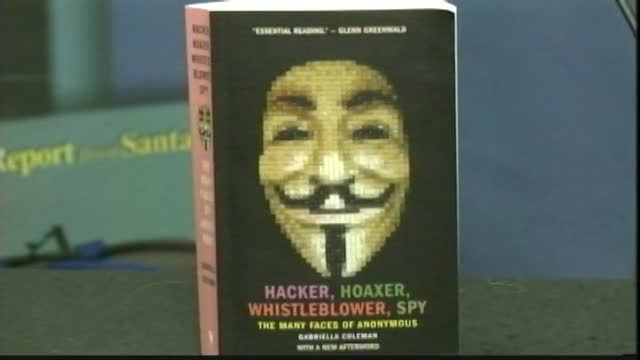
Like life hacks. Exactly. And with programming techniques, this is what hackers will refer to. They're stuck on a problem and boom, there's this little beautiful clever technical solution. So hacking can also mean breaking into a system as well. Now many, many hackers, and the hackers that I covered in my first book, did not break into systems. They actually liberated software because they didn't believe that software should be put under the lock and keep patents and copyrights. And so they use alternative methods to liberate it. Other hackers do break into systems, either for criminal or political purposes. Now your newer book, I just have to, this is so good. Hacker, Hoaxer, Whistleblower, Spy, the many faces of anonymous. So the reviews you have gotten for this, I think, Wired Magazine said that it's anthropology, because you're an anthropologist, that echoes a John LeCarré novel.
And Glenn Greenwald, one of my favorite journalists, who did the movie citizen for about Snowden, called it required essential reading. So we have a lot of definitions to do. So let's just talk about anonymous a little bit. And by the way, you're here as a guest of the School of Advanced Research in Santa Fe. And you did a lecture there called How Anonymous Dudge, the Cyberterrorism Frame, Masking Timing, and the Guy Falks icon. So I'm going to give you a bunch of definitions. Who and what is this and what does it represent? This is a, this is at least not quite his friendly version. So who is this and what does it have to do with a group called Anonymous? So that's Guy Falks. And Guy Falks was an actual historical figure from England. And he's most famous for trying to blow up Parliament in 1605. He was part of a kind of Catholic movement that was trying to allow kind of Catholicism
to be tolerated in the English context. He was caught, even though he was not the mastermind. He was the first one to be caught, tortured, and eventually killed. And so Guy Falks became the symbol for Anonymous somewhat accidentally, but maybe I'll explain what Anonymous is first. Now that we have Guy Falks out of the way, Anonymous is a name, and it's a name that anyone can take. You could take the name Anonymous, I could take the name Anonymous. And what has happened in the last seven or eight years is that many groups of people, some of them connected, some of them not connected, have used the name for forms of collective protests. And some of these forms of protests are street protests to showcase the human rights abuses done at the hands of the Church of Scientology.
They've done some computer hacking. They've brought attention to police brutality. So it's a general name that now is used for protest activity. But like the name suggests, you never can reveal who you are. You act anonymously. So they have taken the Guy Falks icon as their own. And for some people, they think the Guy Falks mask icon is anonymous, even though it has this longer history. One of the things that I learned from your book, and from my studies, Anonymous is so well named, for example, it's a multi-source name, anyone can use it. But they, well most organizations have a hierarchy, a power structure, and there's the boss, and there's the workers. Someone is equal, and taking credit, or grandstanding, or an egotrip is really discouraged. It's surrendering the private identity for the common good. That's absolutely right. And it was one of the most fascinating and really endearing aspects to Anonymous, which is precisely that.
There's a lot of activity that happens under the name. People make videos, posters, rally troops, and you're not allowed to kind of seek fame or recognition for your labor. You're supposed to do it for the collective good, for the collective name, Anonymous. And there were moments where individuals tried to kind of get a bit of fame and attention, and people would kind of smack them down, and line them, no, this is not what this is about. It was kind of refreshing to have that given, you know, I don't think there's anything wrong with getting recognition, but it can spiral out of control into kind of very narcissistic forms of celebrity seeking that are part of this political moment. So it's very refreshing to have a collective that refuses that sort of celebrity seeking behavior. So one of the wonderful approaches that you, and you really, I won't say, went undercover, you really got to know the people in Anonymous, and you got to understand what their roots and what their tools and techniques were.
I am delighted by the sense of trickster, or the coyote, or Loki, the Scandinavian trickster, and that it began early with simple pranking. These were not malicious. They were just fun, maybe a little off-color, perhaps, but there was no, there was no evil intent with these things, it was fun. Generally, so before Anonymous churned into this activist phenomena, precisely they were known for their pranking. And I think a lot of their pranks were kind of light-hearted and fun with some off-color elements. You know, there were some that were maybe a little bit kind of vicious, and other types of trolls could be very, very vicious as well, right? And so they came from this trolling tradition, which spans the spectrum from light-hearted, playful, to truly horrific. And I thought the trickster figure was a helpful frame, precisely because the trickster spans
from figures like Loki, who could be horrific, and sort of are on rampages, to playful figures like Puck and Shakespeare or Coyote, who is often making a lot of mistakes, but good things come from it. And so it was a very helpful frame to get at the different moral valences that emerged in early trolling. And then Anonymous, at a certain point, when they started to tack the church's Scientology, started to kind of troll less and less, and really engage in earnest activism, though the spirit of pranking and humor kind of is something that was still dear to them in many respects. I learned from your writing that there was a real reason for the masking when they were doing the Scientology work, because Scientology had these close-up, close-up cameras there were trying to figure out who these people were.
They, it was stronger than, you know, a dictatorial regime. Absolutely. And currently journalists and filmmakers and authors can write about Scientology openly. And there's all sorts of people who have done so, like Janet Wrightman and Alex Gibney. But prior to Anonymous, you, if you were an author or an ex-Scientologist who wrote about the church, and especially critically, wow, they would go after you. They're really known to be litigious, and they would harass you, sue you. And so when Anonymous decided to protest the Church of Scientology for the first time in February of 2008, they were like, well, you know, we should take some precautions and cover our face. And people were like, well, what should we use? And people were like, oh, the Guy Fox mask is very easy to buy off the internet at every Halloween store. And it was already part of our cultural sensibility because of the movie V for Vendetta, which was based on the graphic novel by Alan Moore.
I want to go back to the humor for a minute, and the trickster, tell us about Lolls and the line we came for the humor and stayed for the outreach. Right. Right. So Lolls is about- And that's L-U-L-Z. L-U-L-Z. And it's a bastardization of laugh out loud and a pluralization. And Lolls, again, just like trolling, especially historically, was on the spectrum from lighthearted to, like, horrific, Lolls is the form of humor that's generated when you engage in some sort of internet-based humor or pranking activity. And it could be something lighthearted, like sharing funny cat pictures to, again, something more vicious where you target some vulnerable person online. And Lolls was a kind of philosophy that was central to anonymous the trolls. And then as anonymous morphed into these activists, they retained that spirit, though, of course,
it had to be modulated to not be vicious anymore, but really stay on that kind of humorous side. And I can give you one example. So when anonymous was protesting the Church Scientology in New York City, there was a young man who wanted to kind of desecrate the church and do it in a Lolls-y funny way. So what he did was he got naked and was going to streak inside the church. But as a kind of more Lolls-y manifestation of that, he slathered himself in Vaseline and put pubic hair. His own pubic hair all over himself and streaked into the church. And I know, that's like super juvenile, but everyone laughs, right? And it got a lot of attention. And that's a perfect example of being silly, you know, pranking, but also seeking to get attention to then bring critical attention to the human rights abuses of the church. So and they went.
So they started with Scientology and they really had some historical events that they magnified and brought people's attention to. I know the Tunisia, the beginning of the Middle East rebirth, and Black Lives Matter. And I think even they even took an Albuquerque case of the homeless man who was killed by two policemen. That's right. And they got that video out everywhere and they, I think we're instrumental in getting the Department of Justice to look very closely at the Albuquerque Police Department. It was clearly an abusive power. Absolutely. I mean, because it's this multiple use name, and that's a term by another author called Marco Desarius, who's written a wonderful book that looks at everything from the use of similar symbols by the Luddites in the 1800s to anonymous, right? So basically a symbol that's polyvalent that many people can use, right? And because of that, people across the world have used it for very different kind of causes.
But what was very significant, I think, in the history of anonymous, is that in 2011, they stopped only supporting what you might think of as internet issues, fighting censorship, supporting piracy, supporting WikiLeaks, and started to aid social movements across the world. And so the Arab Spring was the first big one, but Occupy was central in Spain. The 15M movement was really important, and Black Lives Matters as well. And in fact, Erica Garner, who was the daughter of the choke, yes, exactly, of Erica Garner, who had, exactly, and she died a very young, I mean, she died at very young age. Very tragically, whoever was fielding her Twitter accounts kind of gave a shout out thanks to anonymous for bringing attention to Eric Garner in that issue.
And again, some of the teams working under the name anonymous were working in different places at the same time, or there were different groups working in different places at the same time. It was a very kind of difficult phenomenon to map because of the multiplicity of groups and individuals involved. We're speaking today with Gabriella Coleman about her book Hacker Hoaxer, Whistleblower Spy, and about anonymous, hacktivism, all these things. But in a way, we're now entering a field of information warfare. And can you, because it's gone from whistleblowers, to now nation states like North Korea with their Sony, or, I mean, now it's, and the way the alt-right has mastered this, can you talk a little about information warfare? Sure. So first, assuming hackers have always been a kind of privileged group of people who have been able to get information out there, either by hacking or simply because they had access
to information and an ability to build infrastructures like WikiLeaks did in order to host information. And they were kind of at the forefront in some ways of using technological tools in order to change the information game, right? And this has been going on for a couple of decades now. But what's so interesting about the last few years is that people who don't necessarily have deep technical skills have also started to master the use of propaganda and visual materials such as videos and images to change the conversation around certain issues. And I can give you an example around the alt-right and what they've done as a good example of kind of grassroots propaganda making. So I'll give a quick example and then maybe we'll go to nation states, which is the flip side.
So for example, what's referred to as the alt-right or sometimes as the far-rights, they also came from the same image boards that anonymous came from, but a different period of time, a number of years later. And they don't really engage in tactics of hacking, like anonymous, but what they're really good at is shifting the message around certain events. So for example, when Hillary Clinton got sick with pneumonia and fainted, an army of these propagandists were very clever in terms of creating good, intranet images of Hillary looking very sick, right? And then creating a hashtag, which was like, pound sick Hillary. And they bombarded Twitter with these images. And there was certain figures who were sort of saying, no, Hillary is very sick, she's not fit for office.
And so all of a sudden fear and uncertainty were seeded through these channels, right? So that's a really good example of a kind of information warfare coming from below. Now on the other hand, nation states, like Russia are probably, you know, all evidence kind of points to the fact that they're also really good at using these mediums for information warfare. So they might use bots to retweet those memes and images made by the alt-right. There's also evidence that they hacked into the Democratic National Convention party and got their emails and spread them through WikiLeaks to also spread not misinformation because the emails were true, but to seed doubts, right? So now everyone is doing this. And nation states would do this before, but they never necessarily released information. They just kind of kept information for intelligence.
And now there's this new game where people take information, spread it out there, or create propaganda. And in the past, propaganda tended to be in the hands of corporations and governments. And that's not the case anymore. So some of their techniques, I think of Steve Bannon and Breitbart repetition, and then the big lies back to Hitler again, you tell them the lie long enough and they'll start believing it. And that's what we've been just battered with. That's right. And if you do it in an emotional and compelling way, right, on top of it, that's what they're really good at, is tapping into fear and anxiety and giving people a sense that their path will provide a different path than you've got that perfect mix, right? Lies, emotions, compelling narrative, and it's a formula that works. And it's, as you noted, not necessarily new, right? Right, but now we're just saturated, saturated with it. So when you teach scientific and technological literacy, we need a media literacy aspect of
that too, starting with kids. And the whole thing, you know, that has hurt me the most is fake news because I'm a journalist. And that the word of the year by Miriam Webster dictionary last year was post-truth. And I'm not ready to enter a post-truth era, I happen to believe in truth. I believe it can be relative, I can believe it can be flexible. But there's a level of truth that I've experienced and that I still aspire to. How can we, is that, is it post-truth? I hope not, also, and as an, you know, academics and journalists, I think we're in the business of truth-making, right? But I think this is an interesting moment to think about, okay, if we can at least accept that the business of establishing truth is not easy, and it never was, actually. And I think that's something that a lot of, especially anthropologists, were very well
aware of. And actually, cognitive scientists as well have now done some very, very good work to look at really the cognitive reasons why it's so hard to establish truth. And I do recommend Brooke Gladstone's book. The name is escaping me, it'll come in a moment, but she looks at both some anthropological linguistic literature and cognitive science literature that really says, look, truth is a very difficult business. Because I'm not ready to let go of it, but I think we could think about what strategies can be used to make truth more compelling, right? Yeah. And of course, as a journalist, especially if you're working for New York Times or NPR, or ProPublica, you know, you can't use spectacle, let's put it that way, to get the message out. But activists can, right? And I do think that one of the great things about anonymous is that they worked the best when they were working with journalism.
So there'd be a good journalistic story that was out there. And then anonymous would create a compelling video, right? And call people to do something and grab their attention. And that, again, taps into emotional needs which people have, right? So I think that there is ways in which we could learn from the disaster that is the present moment where fake news is proliferating where it's so easy to get lies out. And think about how can we make truth telling a more compelling enterprise? And I think there's a lot of strategies activists can especially use for that. One of the other really difficult areas, if those of us who use social media, is trolling. And what's a good way, psychologically, to combat that, I've just seen people demoralize. People under the guise of being anonymous, not the group, but just not having to be who they really are can just really, they're so cruel.
They can be so cruel. They can also gang up with groups and really go after people, woman and other minorities are disproportionately attacked, which is a real problem because, you know, being online today is part of your career, right? And so if you are kind of forced to leave, that really can impact your possibilities for your career and kind of other activities. So it's a problem. I mean, I do think if the trolling is minimal, you do ignore the trolling, right? It does work, it can work. And then if there is a bigger mass of people, then I think if you're part of another network, having that network of people support you, right, and say we stand by you, screw you trolls, can at least provide some solace as you weather the storm, right? And then again, I think it's important for platforms like Twitter to think about what
they can do and they've done a few small things. You couldn't block users before, right? Now you can. But we're going to have to keep thinking about what strategies can be used to fight the trolls who can be quite vicious. Can you, we only have a couple of minutes left. What advice can you give us about cell phones, about the internet, about, to, yeah, everyone feels so vulnerable now? That's right. And there's, you know, there's a lot of things going on, right? I mean, it's amazing to have these technologies for the ability to connect with others and the amazing amount of information you can get. But I think it's, first of all, good to know that designers of social media are actually trying to addict us, right, and some of the developers, for example, the developer who helps make the like button on Facebook had a huge crisis and left Facebook and it doesn't even use social media because he realized that what he was doing was kind of helping to addict people, right?
And I think this is something I teach my students about, not just, not so that they all get off social media. I use it too. But I think you have to be aware of the kind of conditions that might be entraping you, right? I think that's really helpful. Another element is that these technologies can be used to track you, surveil you, you're willingly giving information that if it's the wrong bit of information can ruin your reputation, right? So you have to be judicious and smart about what you're putting out there, right? And I think it's really good to learn about the ways in which these technologies can track you so that you can start to use technologies that are now available to provide a layer of kind of encryption or anonymity. And so there's a lot of good tools out there. And so it's worth educating yourself about them to just be able to have a little bit more control than we might have today if you're just using social media. I am so sorry that we have to leave it there because I could talk to you for another hour.
But our guest today is Gabriella Coleman. I urge you all this book is, it's like a spine of hacker, hoaxer, whistleblower, spy. It's about anonymous, but it's about social media in our life and a thrilling anthropological study of a subset really fascinating subject you've done really good. Oh, thank you so much. And I'm so pleased that you joined us. I'll have to talk back to you next time you'll talk. I will, definitely. And I'm Lareen Mills. I'd like to thank your audience for being with us today on report from Santa Fe. We'll see you next week. Past archival programs of report from Santa Fe are available at the website, report from Santa Fe dot com. If you have questions or comments, please email info at report from Santa Fe dot com. Report from Santa Fe is made possible in part by grants from the members of the National Education Association of New Mexico, an organization of professionals who believe that investing in public education is an investment in our state's economic future.
And by a grant from the Healey Foundation, Tows, New Mexico.
- Series
- Report from Santa Fe
- Episode
- Gabriella Coleman
- Producing Organization
- KENW-TV, Eastern New Mexico University, Portales, New Mexico
- Contributing Organization
- KENW-TV (Portales, New Mexico)
- AAPB ID
- cpb-aacip-c772a1eba81
If you have more information about this item than what is given here, or if you have concerns about this record, we want to know! Contact us, indicating the AAPB ID (cpb-aacip-c772a1eba81).
- Description
- Episode Description
- This week's guest on "Report from Santa Fe" is Gabriella Coleman, anthropologist and author of " Hacker, Hoaxer, Whistleblower, Spy: The Many Faces of Anonymous," an intriguing exploration of the dark web that reads like a spy novel! Guests: Lorene Mills (Host), Gabriella Coleman.
- Broadcast Date
- 2018-02-17
- Asset type
- Episode
- Genres
- Talk Show
- Media type
- Moving Image
- Duration
- 00:27:58.978
- Credits
-
-
Producer:
Ryan, Duane W.
Producing Organization: KENW-TV, Eastern New Mexico University, Portales, New Mexico
- AAPB Contributor Holdings
-
KENW-TV
Identifier: cpb-aacip-1661c57537d (Filename)
Format: DVD
If you have a copy of this asset and would like us to add it to our catalog, please contact us.
- Citations
- Chicago: “Report from Santa Fe; Gabriella Coleman,” 2018-02-17, KENW-TV, American Archive of Public Broadcasting (GBH and the Library of Congress), Boston, MA and Washington, DC, accessed July 4, 2026, http://americanarchive.org/catalog/cpb-aacip-c772a1eba81.
- MLA: “Report from Santa Fe; Gabriella Coleman.” 2018-02-17. KENW-TV, American Archive of Public Broadcasting (GBH and the Library of Congress), Boston, MA and Washington, DC. Web. July 4, 2026. <http://americanarchive.org/catalog/cpb-aacip-c772a1eba81>.
- APA: Report from Santa Fe; Gabriella Coleman. Boston, MA: KENW-TV, American Archive of Public Broadcasting (GBH and the Library of Congress), Boston, MA and Washington, DC. Retrieved from http://americanarchive.org/catalog/cpb-aacip-c772a1eba81