¡Colores!; 2020; Patrick Nagatani, Two Shot, Audio
- Transcript
And as viewers, we get to see it all. Right. Yeah, that's the magic of it, huh? Right. Hey, hello. I can hear you very well. Tapes are rolling. It's good. Cool. Mm-hmm. Mm-hmm. Cool. Mm-hmm. Okay. We're getting close, Patrick. Okay. I just want to look at the camera, but I don't know. There he is. Oh, what do you think? Yeah. Cut.
And we're super close, Patrick. I thought I got some of my eye. Ooh. Okay. You got to make a person I didn't. Excuse me, are you? Look, they have to get my mug together. Do we already see the floor? Yes. In the Chlorist studio with Patrick Negatani. We're great to have you here today, Patrick. Great to be here. So we're going to jump into storytelling. And some of our viewers may know you as a photographer, because you have a very impressive career in photography. Your idea that photography is the telling of stories. Can you talk to me a little bit about why now you're using fiction and tell the truth? Certainly is a challenge. But I've always used fiction in a way.
I'm known as building a career in terms of being a directorial mode or a tablo photographer, i.e. like making films. And I construct my pictures in a studio for the most part. And those pictures, you know, my storytelling actually harkens from being an artist, from being a photographer, in arranging these sets and thinking about what the story is and then in the ultimate product with the layering, visual layering. I think that's always been an interest of mine. And the transition to writing and fiction and storytelling has been a challenge for certain. So why create fiction particularly? Well, I think that photography, and I come from photography, is an interesting medium in that it's always supposed as a truth. Even in a judicial system, photographs are used to depict the truth,
fact. But my sensibility in terms of approaching photography has always been that photographs actually lie. They tell stories and it all depends on how you construct the image. And throughout our cultural understanding, even in newspapers, it's interesting to analyze images the way they're taking and who they're taken by in that they're simply representations of the truth or fact. And create their own kind of narrative and their own kind of fiction that's re-figured out, reconstructed and looked at as the truth. And so I'm interested in those like shifts that photographs can have and how they're made and who makes them. And I think looking back in history, it's a good thing to do
in terms of understanding what's being said. And so coming from that school of thinking was, you know, photographs tell stories and in a way I think literature and writing do it even better. And so that's the challenge for me and that fiction has always existed but in quotes, fiction in terms of like representing the truth or coming from the truth. And the writing that I'm doing now comes from some type of factual narrative and then I fictionalize it. And then hopefully, like, bring the reader back to kind of a place like in theater where there's suspension of disbelief and you can get into the story and not kind of analyze it in terms of is it true, is it fact?
It's interesting because it's almost like insiduously, intentionally disarming because we couch it in fiction. And as you've just discussed with us that there's a lot of truth that can be found there and but we call it fiction so we don't, you know, necessarily take it too seriously. But I wanted to ask you, what is your fascination or your favorite part of fiction? And talk a little bit about the aesthetics of fiction, if you will. I'll get to that. I was just thinking about the idea of my favorite part of fiction is it's established from truth in a way or expectancy of truth and science does that a lot assumes. And so one of my favorite books is Visual Anthropology which is about scientists, anthropologists, photographing objects so that they don't feel fictionalized. So it's like flattening the object, don't create bend,
go kind of lighting, keep it flat. Keep it that it's truthful, not theater. And so there are these techniques in terms of even lighting. And I think about, so I'm an odd one to go light to the museum of natural history and look at displays and read what some anthropologists has said about like an Anastasi pot. And I'm kind of cracking up thinking that this is an example of the height of the Anastasi civilization when it might have been like the crappiest pot maker and it was thrown away. And that's why they found it intact. But this is like the highest art form. And so that kind of narrative, like it's always interesting to me. And then your question. Tell me a little bit more about the aesthetics of fiction, if you don't mind. The aesthetics of fiction, I've actually thought a lot of that
in terms of I believe that that's in skillful hands, like that is created. And I think in the skillful writers point of view, it's created in the poets writing that one can bring the reader to an understanding of a cultural position of interior feelings and do that with words. But yet it comes from kind of like a fictional narrative based upon some real thinking or event. And that's what interests me about it. And so the polarization of the word fiction is for me broader. It extends and has all these other connections. And I love the question. People ask me even about the photographs.
And if I share some of the writing that I'm doing, they'll ask me, well, was that true? You know, those ask me, was that true? And I say, I love the question because you're questioning it. You're wondering about it because it seems so factual that you wonder if it's the truth or not. But you might question that question in terms of, for me, everything is true. You know, everything you do, everything you make, it's all true. It's just about what is based upon. That kind of like is the outline of my aesthetics about what fiction is. Or like it's real because you made it. So it's real. It's kind of here. It's real. I once did this body of work where I had to talk about it. The Nagatani Excavation, Realichi Excavation work where I formulated a fictional archaeologist named Realichi, which happens to be my middle name.
And we, I was a photographer. And I went with this archaeological team from Japan and under luxury cars in sacred sites across the world. So it was all this fictional narrative storytelling but in pictures. Although I gravitated in that work to actually constructing in Japanese Realichi's journals and took pictures of pages of his journal which was then again like and the translation was important because it gave his thoughts in terms of an archaeologist in this fabulous adventure. And even questioned the paradigms of archaeology and taking objects and removing them from sites. So it was into that. But my point here is that it all became in my mind kind of like the truth, the scientific truth, to this wild event. And that, that's kind of like my,
I applied my aesthetic fiction into these photographs to tell the story. That's interesting because sometimes the real adventure is so outrageous that people don't believe it. And sometimes the main name is actually the fiction part. Like the most believable part. Let me ask you, in reference to your previous work, a lot of it was based in historical, as we talked before, before we cut the cameras on. So a lot of your work is based in kind of an historical framework. And then you just made the jump to fiction. Can you tell me about that shelf and why? History has informed a great deal of my work. I've done some bodies of work that are informed by literature where magical realism, for instance. But work like a nuclear enchantment, and my Polaroid collaboration work, was based upon historical sequences,
or like, for instance, a nuclear enchantment, was specific to real sites and real issues in the historical and contemporary aspect of New Mexico's marriage to the nuclear age, whether it be mining or weapons development, or a variety of aspects of New Mexico's involvement with nuclear issues clean up. And so that came from fact. And my representation of that fact is where the fiction came in, the layering. And I tried to, in that work, layer a lot of different cultural things that tied into that particular site or that narrative. And so it was like putting, it was like kind of doing a John Cage piece
where you take like six short stories, and you like use every other line and put them together. And it becomes one read, but it's a little bit confusing. But by the end, you have this overall feeling of the weave. And what I just said is kind of like an interesting way to maybe write a book. Just give myself an idea. There you go. Don't steal that at home, right? So this is a tough question, because it's almost like having two children and asking a parent which ones their favorite child. You know, they're not allowed to say. But I'm going to ask you now, between photography and fiction. You mean writing? Writing, fiction writing, yes, excuse me. Because the photography is fiction too. Yeah, can you, can you tell me the question? Because I think I was going to go off base. I have to make a choice between the two, maybe. Saying more, that's it. But could you say Patrick?
And it wouldn't be a choice. It would be, for me, it would be like a segue. Loving both. And in fact, just the other day, I was thinking about my need to make some pictures. So that never leaves the soul, the heart of me. And that the writing is such a challenge. Because, you know, I'm not a recognized writer. I'm attempting this. And I know what discipline, new discipline, it takes to do this. And it's almost like never complete. I just keep coming back and editing and changing words. It's such an interesting way to engage in a creative activity in thinking about what words mean and how they play and their juxtaposition together. You know, I'm into that and loving it. But it's like, yeah, maybe it is a hard decision to make between what you love more.
I love them both. And it's interesting that in my writing, in order to create a better visual sense of what the word sense, the word play is in development of my characters, I've actually made images first off. That hopefully will go with this novel in the beginning of each chapter. And so I approached it in a way from a visual point of view to get myself focused into what the story is from a visual image that I created. And so, you know, it's a segue in a way. And that's something we talked about actually in the beginning as a writer and a poet. I feel like we're always trying to illustrate with our words. And you're actually turning that process around. Right. Let me re-ask the question differently just to see what your answer is. Do you think that there's something you can say through fiction that maybe was left unsaid in photography or was harder to say through photography?
Definitely. That's what I think the challenge is for me. There's a lot that I believe in photography and what I've tried to create is an open-ended kind of line of thinking in terms of interpretation. And so, when I talk about layering the images, I like it when an audience comes in and doesn't necessarily go by a frontal layer but goes to an exterior layer and then formulates their interpretations. And it's oftentimes loose-ended. And there's a lot of ways you can look at the images and I analyze them and think about them from... In a way I rely a lot on my audience where they're coming from in terms of establishing interpretation and love that way of working. But it's a lot more open-ended. And I believe that writing is less.
That you still bring in an audience in terms of a suspension of disbelief and getting into the narrative in a story. But it's a lot more succinct. And I find that a great challenge and very interesting. I'm also interested in... I only can work with the English language. So I've read a lot of Haruki Murakami's work and I've talked to my Japanese friends and they've read Murakami... Japanese version. And they speak English and I've read the English versions. And they always laugh with me in saying that I'm not getting the full Murakami. And I say, well, what am I missing? And they say that in the Japanese language, that there are multiple ways where a word will work
in terms of establishing a feeling and idea and that Murakami's like a magician in terms of being able to use certain words in certain context of what he wants and having multiple meanings by those words, whereas an English word will be pretty decisive for the most part. But I like English words that have multiple meanings. So I'm thinking about that as I'm writing. Part of your process. So now I took you kind of away from... I took photography and fiction and put them way over here and I'm going to put them both together and say, in either medium, what drives you to tell stories? It might be escapism number one. It might be my desire for magic that I find a magical place in storytelling.
It might be the way I would love to lead my life in terms of constantly being, of seeing beyond what you're seeing and thinking about other meanings to it. My wife saw a dove yesterday that actually came up to the glass door and perched on a limb and they stared at each other. I told her that this is your animal spirit as I feel hawks are our mind. I think one brings in terms of magical realism and in terms of spirituality a lot to embracing fiction and embracing storytelling and having that in one's life. That's important for me. Does that answer your question? It's been important for me.
Why don't I go out with a camera? I'm terrible outside of the studio with a camera. Although when it comes to documenting, let's say, a nuclear site, I can do that fine. I actually did a body of work where I asked my audience not to the viewers of the work, to spend disbelief that these are the so-called truth. And I tried to, with my knowledge about how photographs I read, they were small, almost like snapshot images. And certainly my dealers could not commodify them. I refused to sell them. They were images of the 10 Japanese American relocation camps. And they were 50 years after what the landscapes were like. The body of work was, in a way, based upon an F. Scott Momendae, quote, that landscapes retained memory. And I tried to capture that memory in these straightforward, non-manipulated landscape images,
which I wanted, my audience, the only body of work that they ever did were no fiction, that these were like truthful documentary images, which I wanted me to do. That's beautiful. I want to go back so we can kind of find an ending, but thank you for that story. That was deep. I guess I want to go back to the question about which drives you to tell stories, but I'm going to ask it differently. And we're going to look for a tight landing here. Why do you keep creating? I used to tell my students that well after they get their degrees, or what they're going to do, that a lot of them will go do something important. Maybe that's making art become doctors, going to medicine. What have you? But I told them that, and a lot of you will understand I can't tell you what it is, but that it's in your heart. You know, I call it the soul of an artist. And it's why you want to live
and embrace the moment. And live with uncertainty. But the only certainty would be that you have a desire and hopefully an ability to understand the drive, the impetus for storytelling, or for making pictures, or for painting, making sculptures, writing poetry, that it's just like this kind of like thing that's in you. And you can retire from your vocational work. You can be on your deathbed, but you're thinking about this constantly. And it makes you happy. You know, it's kind of like that happy song. Rather than dancing, you know, you do your work. And I think that's what drives me. And I think that that's what's important. You don't make these demands on other people. You know, in a way it's a personal thing.
You just kind of like understand that. And even to speak about it is difficult. You know, because it's kind of like an internally based thing that isn't about work, challenges, commodification. But just about that's your life. That's something that you've got to do. And if you're lucky, you can share it. And people will like it. And that doesn't always have to be the case. That's perfect. Thank you. It's okay. Close that, okay? Wait. We're going to go back and ask another question. Okay. I'll take a previous question. The first question, because I kind of stumbled into it. Yes, stumbled into the first question. Mm-hmm. Green wine tape. I know, right? But that was a great, that ending right there was fantastic. Thank you. So what was the first question again, Tara? The first question, I think that's the first question. I don't know why. I don't know. Why.
The first question. The first question. Okay. I'm going to ask you about the spelling. Right. The first question, the first question, why is your answer a different thing? Okay. Okay. So I'm going to re-ass the question, Patrick. And you could take another stab at the answer. I don't know. I think your answer was fine, but my question was like. Okay. Yes, sure. Mm-hmm. Okay. Tara said, go ahead and try to answer again. Okay. What was the question again? The beginning part, just the beginning part. Photography. Thank you. That part. Okay. Patrick, you said your photography is about telling stories and now you are creating fiction. What is it about the fiction that you were creating? Mm-hmm. Um-hmm. Um-hmm. Um-hmm. Okay, just tell me verbatim how you want me to ask the question. Thanks.
Mm-hmm. Okay, just tell me verbatim how you want me to ask the question. Thanks. Mm-hmm. Um-hmm. Okay. Um-hmm. Give me the beginning again. The question that you want you to ask me. All right. I had to explain that to her. Right. Yeah. Because the difference in terms of that and the question is that photography for me is fiction. It is fiction. And, you know, and it's not separate. So there isn't photography and then there's fiction. Um-hmm. So there might be like photography and writing. And, and among, and, and fiction envelops all of that for me.
Um-hmm. There we go. Answering the question without the question. Without the question. Okay. Okay. Um-hmm. Patrick, you said photography is about telling stories. And you are creating fictions. Can you tell us more about the fiction you're creating? Sure. Um-hmm. You know, my basis, a lot of my, my foundation for, um- for my photography work in experience has been, um- in theater and film, in living Los Angeles. And, and, and so that idea of telling a story, um- for, cinematically, let's say, um- is all, is all about arranging, um- to tell that story. And it's often- and it's often, you know, both mixed primarily in fiction from a script and, um- developing that narrative.
And I think about that a lot in, um- in my photography work. And my photography work has always been studio-based. Tableau photography, directorial mode, it's been called in the past. And- and it's to establish my stories, much like a filmmaker would do. Um- rather than, um- shooting things that really exist in, in the outside world. Um- And so, I- I tell that story in my studios. In fact, I sit down and I think about, well, what story am I telling? And then start to construct a set to be photographed. Um- and I'm always- I'm always interested in the way photographs can come back in a way to be truthful. And so utilizing that, um- that ability about the medium, um- how it's read and understood, um- has been the way I've worked with, um- in a visual medium, um- specifically in creating photographs. Which is overlaid with, let's call it fictional photographs.
Um- based upon truthful events. Now, a challenge for me has been moving to writing. And, um- and of course, I'm not writing like an art historian. Uh- I'm- I'm- I'm removed from this kind of like fact. Um- I embrace it. But just fiction involved in that as well. Just storytelling and that, even more so, when you think about your approach, if I approach this in terms of like being a novel. So much of the novel that I'm writing is based upon fiction. About fact as well. And- and they're much like the photographs that I've made. And, um- I haven't seen that- in that respect it hasn't been a hard transition. It has been hard in terms of the discipline of being a writer and understanding how words are used, um- to establish a different kind of fictional narrative. Um- and we talked about words and-
and how they can do that. And certainly you as a poet understands that, you know, in terms of the way you use words and juxtapose them. And even apply them in a line and- and space them. You know, I love the way, um- and now I'm getting off of me, but it is me because I- I look at poetry and when I look at it, I look at how it's printed even, you know, the spacing and the division of sentences, um- in terms of that physical construct. That's really interesting to me because that's- that's really visual and, um- and yet, you know, it's like the voice- voice of the poet and how they want to say it. It impacts meaning. We talked a little earlier about how, um- there's a lot that could be said in the frame for a picture, but then it's also like what? Everything that exists outside that frame is- is part of the fact or the fiction, too. That's right. And I feel like as a reader, you- you particularly used to word earlier about how people read photographs. And I like that, that turn of phrase. Because I think whenever any of us look at a photograph,
we immediately start trying to tell a story. Like our brain starts to try to like create a story around it. And we start asking questions. Like, I wonder where they took this. And that person is looking at that person. I wonder what's going on. And our brain starts to struggle to find meaning within the picture as well. And I go beyond that in terms of- of, um- when I- what I call the fictional narrative, even in terms of documentary photography. Um- and I think of two cases where, um- I saw two examples of an event. I've taken in photographs. One was where, um- there- there were- there might have been only about 12 people attending this talk. And, um- and the photographer, um- then they all sit in one section. Otherwise, the auditorium was totally empty. And so the- one- one photographer went and took, you know, right and back of like the 12 people got in really close. So it seemed like a mob. And then the other photographer, like, moved the frame to the right side and just had the-
the speaker at the podium and showed all these empty seats. And it somehow, like, talked about the importance of that- of that narrator, of that- of that person speaking in about the audience, you know, being large or small, and the importance may be of what- was being said. And I- I always think about that in terms of, like, what the photograph tells. And the other is- is something that I read about the civil rights movement in how, um- all of the white photographers for the most part, um- during that- during the 60s, photographed, um- any event from, um- like behind the shoulders of the police. They- they're always part of- of, um- the military industrial complex, the- the- the police force. And- and the- and the blacks were always the other. It was never from their point of view. And so when the media showed those pictures, it was always like, you know, these guys are misbehaving.
This- this is- this is the righteous way from the police point of view, rather than showing it- the other way around. And so that was about just position of the frame, who's making the pictures, and what, you know, really what wants to be said. They're telling the story. Right. Who gets the privilege of telling the story? So it becomes all fiction for me. And it's just about how to read it, how to understand it, which is important. But- I just learned something. I just learned something. That was a lesson. Okay. Okay. We're- we're wrapped. We're done. That's fantastic. You should charge me for that lesson. That was good. I just learned something. I'd like to learn more. I'd like to learn more.
- Series
- ¡Colores!
- Episode Number
- 2020
- Raw Footage
- Patrick Nagatani, Two Shot, Audio
- Producing Organization
- KNME-TV (Television station : Albuquerque, N.M.)
- Contributing Organization
- New Mexico PBS (Albuquerque, New Mexico)
- AAPB ID
- cpb-aacip-bcf43fd096a
If you have more information about this item than what is given here, or if you have concerns about this record, we want to know! Contact us, indicating the AAPB ID (cpb-aacip-bcf43fd096a).
- Description
- Raw Footage Description
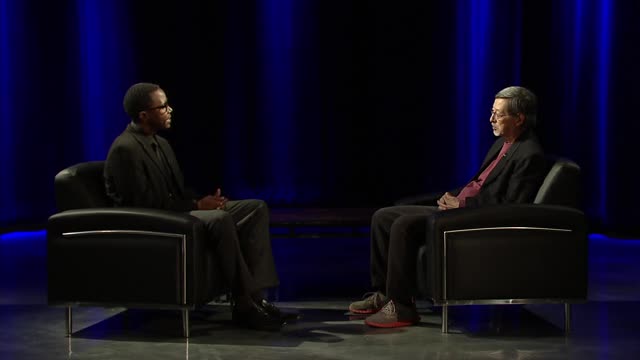
- This is raw fottage for ¡Colores! #2020 featuring an interview with Patrick Nagatani, professor of photography in the Department of Art and Art History at the University of New Mexico. Photography is the telling of stories, but he also writes fiction to tell stories. Photography is thought to be a medium that depicts the truth or facts, but photographs can lie depending on how the image is constructed. Discerning the truth in the stories that photographs tell is an interesting yet challenging task, which is necessary for understanding history. Host: Hakim Bellamy.
- Asset type
- Raw Footage
- Genres
- Unedited
- Media type
- Moving Image
- Duration
- 00:32:56.308
- Credits
-
-
Executive Producer:
Kamins, Michael
Guest: Nagatani, Patrick
Producer: Walch, Tara
Producing Organization: KNME-TV (Television station : Albuquerque, N.M.)
- AAPB Contributor Holdings
-
KNME
Identifier: cpb-aacip-af10a403489 (Filename)
Format: XDCAM
If you have a copy of this asset and would like us to add it to our catalog, please contact us.
- Citations
- Chicago: “¡Colores!; 2020; Patrick Nagatani, Two Shot, Audio,” New Mexico PBS, American Archive of Public Broadcasting (GBH and the Library of Congress), Boston, MA and Washington, DC, accessed May 2, 2026, http://americanarchive.org/catalog/cpb-aacip-bcf43fd096a.
- MLA: “¡Colores!; 2020; Patrick Nagatani, Two Shot, Audio.” New Mexico PBS, American Archive of Public Broadcasting (GBH and the Library of Congress), Boston, MA and Washington, DC. Web. May 2, 2026. <http://americanarchive.org/catalog/cpb-aacip-bcf43fd096a>.
- APA: ¡Colores!; 2020; Patrick Nagatani, Two Shot, Audio. Boston, MA: New Mexico PBS, American Archive of Public Broadcasting (GBH and the Library of Congress), Boston, MA and Washington, DC. Retrieved from http://americanarchive.org/catalog/cpb-aacip-bcf43fd096a