¡Colores!; 1801; Villa de Alburquerque; Interview with Joyce Begay-Foss
- Transcript
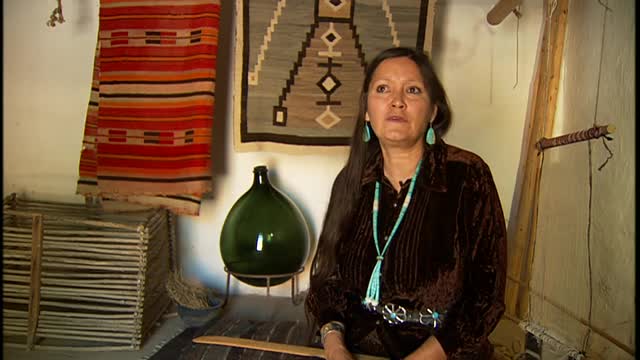
like, it just distracts you. You know, you're all like condom when you're... No, you're making me nervous. It'll be fine. Well, I'll sit there and you can talk to me. Okay, are you ready? Oh, I'm going to come sit here. That's right. Are you sure you want to try looking at camera first? Yeah. Why don't you do that? And then if it doesn't work, I'll come and sit there. I think you do. I think you do. Just pretend like it's a 12-year-old kid that. Are you ready? Are you ready? Are you ready? Okay, all right. Good morning. My name is Joyce Piguet-Fos, and I'm Navajo. My clan is Nakaitene, which is the Mexican clan. And I'm here today in a historic ranch, probably built around after 1710. And I'm in this room, which is identified as either a Navajo or a Native American weaving room.
Because at that time, the Spanish, when they arrived here and settled, they relied upon servants to maintain the ranches, and then also to do some of the other chores such as weaving. And weaving textiles are cotton cloth and different types of blankets. So they used also different types of looms. Probably they taught the native weavers at that time. They probably trained them on the Spanish treadle loom, which is a stand-up walking loom, and that's also called a horizontal loom. But historically, for the Native Americans, especially around the 1700s, is that they traditionally bulb on an upright loom, which is here in this room. And if we can look here, it actually is anchored on the floor,
and then it is tied up to the top vegas. And so this way, when they were doing the upright vertical loom, they were not really limited to size as in Spanish horizontal looms. Because with the Spanish looms, they're probably weaving about three feet. As you can see, there's a textile behind me, and it was woven in two pieces because it wasn't wide enough, and then they were sewn down the middle. And these had very different types of designs, and then they also used different yarns, and they also used different dyes. When the Spanish came, probably in the late 1500s, when Carnado came to this territory, they brought the most common breed of sheep at that time was the chiral. And the chiral is very well known for the very long fibers,
and it was very lustrous, and it came in a multitude of natural colors, sheep colors, of white, off-white, spages, browns, black browns, and black. So people at that time, traditionally, and this is both at the Spanish and the Native people, is that they would do all hand spun, warp and weft, foundation for the textile, and they would weave mostly garments to wear, and then maybe they would start weaving more of the blankets for household use or also for trade. So with the Native Americans, they will have different designs in their early blankets, and they all had specific meaning. And it's really hard for actually textile experts and people today to really pinpoint actual meanings for the designs.
Some of the early Navajo blankets, for example, do have symbolism of spider woman crosses, which is actually looks like a cross, and it has little design at each corner of each cross point, which would represent the spider legs. Also, they would have terrorist designs, which could mean relation to mountains or cardinal directions. But I think while they were here in this ranch, and they probably had influence from the Spanish people, here, to weave certain designs, and a certain style or type of textiles, because they were, you know, a servant, and they're servant, you know, in these quarters. I'm going to have to stop, because then... Okay, that was so good.
I'm already going to read this. Okay, well, you know, and it was great, and we'll just do it for the beginning. So we'll do one more take then. Are you ready? I'm ready, roll it. Okay. Yeah, good morning. My name is Joyce Bequefos. I'm Dene. I'm the Cuydene clan, which is the Mexican clan. And today I'm here in an historic ranch built, probably around 1710. And here, I'm in this room, which is referred to as a servant room, where possibly there were Native American servants weaving in this room. And, you know, there has been historical reports about the Navajo people being taken into captivity, possibly some of the members of the 19 Pueblos could be Comanche, also the Patches. But I'm assuming that, you know, probably,
it was probably the Pueblo or our Navajo Native Americans who were probably asked or, you know, being a servant here in this room, because of their already prior knowledge, the weaving history of these two people has been around for hundreds of years. And, predominantly, they weave on a vertical upright loom. And they already knew how to warp the looms, how to spin fibers. Probably the earliest fibers they spun were for Yaka, Yaka using animal furs and hides. So then later, when the Spanish came into this area in the late 1500s of the introduction of the sheep, you know, the tribes in at that time, probably, you know, migrated throughout the southwest, but also were raiding Spanish settlements,
and probably stole some of their sheep and horses, and, you know, and women. And it's probably vice versa for the Spanish people that settled here too, took servants. And then also, I think there was a common sharing of knowledge of the different plants here, and, of course, the animals. And so also with the weaving traditions coming from Spain and from Mexico, within, you know, also with the designs, you know, being held in captivity, they were probably advised to weave certain designs. And I know they were forced to weave on a different type of loom, on a Spanish horizontal loom, which is really different. But as far as for production, because, you know, they were probably weaving for the king of Spain,
weaving different types of cloth, especially cotton cloth, like Sabinea, also weaving blankets. This is a huge trade thing, you know, regardless of Native Americans being held in captivity, the trade. Can I just cut you there because you're doing great, and we'll just keep going. Just be sure to look at camera, and you're forgetting that. And then secondly, I think can we just pick it up from the point where you were talking about, that was great, that the different, the waves and the exchange, and then we talked about animals and the sharing of animals, and then you went right into the sharing of weaving culture. So we'll just pick it up from there. Be sure to look at camera. And then if you want, then we can end it on you referred to the textiles behind you, I think. Okay. So, you know, in the sharing of the knowledge of weaving and, you know, also different methods and processes, but every distinct group had their own way of doing these things, but, you know, it was a common thing,
like using indigo, the Spanish brought their own methods, but also when it got to even Hopi and into the Navajo people, they had their own ways of extracting the dyes. And these are very evident in very early textiles on both sides. And even today, with the more elaborate textiles, especially among the Navajo weavers, there is a tremendous influence of saltillo design, you know, the diamond design. And as you can see within some of the textiles back here that we have the different dyes, probably cochineal, matter root, and natural spun yarns, natural browns, and off whites. And then there's another natural textile here, you know, probably from the churro sheep, and they came in all these natural colors of greys, and browns, and whites, and blacks.
And one thing with the Navajo textiles is that they were able to weave them finer on the vertical upright loom, and they also had edge cords on the sides, versus the Spanish textiles, which were when they finished them, they had tied ends of overhand knots. Okay, great. Should we get you doing some weaving? Sure. I don't want to do any more thought. I don't know. Can we go ahead and start? Why don't you start with the weaving first? Whatever you can get accomplished there. I'm trying to get this thing tangled. And see, I do all this myself.
Great. I spin the yarn, and I do all the dyes. Every weaving my whole life. There are a lot of awards too. But we're not supposed to brag. So even with the native people, the weaving, today, they depend on it to survive. People don't think about that. We can say that. They think we live like in a modern, like everyone has TV. But blankets just pair out of nowhere. Yeah, but they still, even with the Spanish too. I mean, they're very strong weaving families, both the Spanish and Native American. Because that's part of the culture. That's part of the tradition.
All right, so are we going? Go ahead and start doing your thing. We're just getting close up to things. Okay. And if you want to talk, if you feel inspired, just talk to this. You can talk to the man or the camera though. Okay. Just go ahead. Okay. Well, this is a Navajo vertical upright loom. And usually the strings running up top and bottom are the vertical upright strings. This is their warp strings. And usually the Navajo weavers, they already have the design in mind. We don't draw on the warps. So we just separate groups of strings and we built, we start the design. And so the warp is usually, well, at that time, people used to hand spin all the warp. So it was very time-consuming.
It was a lot of work. And then also with the weft yarns, which is an example here of this yarn, they would have to card and hand spin this and wash it. And another thing about that time is that, you know, water was very scarce. So people had to go to the river or haul water. And it was very labor intensive to weave any of these textiles. Either in either like on the ranch here, or else, you know, even out on the reservations are in remote areas. So even the natural sticks here to separate the warp strings, these are called a pull shed and the stick shed. These were made out of natural hardwoods, of mountain mahogany, or... Oh, let me see. Well, mahogany cedar. So how do you do some weaving, yeah? And so now I'm going to put in this baton.
And I'm going to pull... This is a pull shed, because you see I'm pulling it. I'm going to open this shed up. And this baton, this long stick, opens up the shed so that you can put in the yarn to weave. And so you can lay in the yarn here and you can just pack it down with a weaving fork. And then so you just build up the design back and forth, alternating these two shits. And that's how the weaving is done. Can you do it? Can you do it? Can you do it? Yes. We're just going to put you to work now. Okay. This seems to stay. So with a Navajo loom, is that you have to go back and forth
and it's all using your hands. When they had the servants probably weaving in the posse end up, they probably are wrenched. They actually probably used a floor loom, which you could step your feet and then that would open the sheds. So that was more productive and a faster way of weaving. So even today, this type of weaving is done among the Navajo people. We have over 200,000 people on the Navajo tribe. I mean, that live on, that are registered members on the reservation, that actually have to live off the reservation. But this tradition still continues today. This is a very... Okay, I'm sorry, I'm sorry. I mean, I think we're doing what you're talking a lot and we're trying to pump the weaving.
Oh. We're not catching your face tough. So why don't we do one thing at a time? Okay. So that's partly my fault. Sorry. Why don't we just do some actual weaving? So Mr. cameraman can get some really cool shots of weaving. They'll look really neat. I'm going to have to get off the other side of that thing. Yeah. Okay. Okay. Okay. Okay.
Okay. Okay. Yeah. Oh, but see, it's just not holding this. Can you do it where she's holding? Just hold this up for her? Sure. Right there, yeah. I want you out of the shot, Sherry. So your head's going to be weird this way. You see the left hand. Yeah, come up from there. You see the other hand. There you go. Hold it like that. That's what you're going to do. That's okay. Now we've got some action in here.
But... All right, we're filming? No. You didn't need to probably want to see some weaving techniques. Okay. Okay. Okay. Okay.
Okay. Okay. Okay. Okay. Okay.
Okay. Okay. Okay. Okay. That was a great shot. Yeah, that was a good shot. Right there behind, so just be careful. Okay.
Okay. Okay. Okay. Okay.
Okay. Okay. Okay. Okay.
Okay. Okay. Okay. Okay. Okay.
Okay. Okay. Okay. Okay. Okay.
Okay. Okay. Okay. Okay.
Okay. Okay. Okay. Okay.
Okay. Okay. Okay. Okay.
Okay. Okay. Okay. Okay. Okay. Okay.
Okay. Okay.
- Series
- ¡Colores!
- Episode Number
- 1801
- Episode
- Villa de Alburquerque
- Raw Footage
- Interview with Joyce Begay-Foss
- Producing Organization
- KNME-TV (Television station : Albuquerque, N.M.)
- Contributing Organization
- New Mexico PBS (Albuquerque, New Mexico)
- AAPB ID
- cpb-aacip-b60dd55c8d9
If you have more information about this item than what is given here, or if you have concerns about this record, we want to know! Contact us, indicating the AAPB ID (cpb-aacip-b60dd55c8d9).
- Description
- Episode Description
- Footage shot for the ¡Colores! episode "Villa de Alburquerque." In honor of Albuquerque, New Mexico’s, celebration of its tricentennial, KNME proudly presents “Villa de Alburquerque.” This ¡Colores! production is a one-hour documentary that looks at the life and times of 18th century Albuquerque. The documentary covers the Spanish colonial period (1706 - 1821) and provides audiences with a sense of how people - settlers, soldiers, servants, nomadic tribes, and others – lived. It will also examine the cross-cultural influences of the time that help define what it means to be a New Mexican today. Avoiding a text book chronological map of the period and with the help of historians, musicians, re-enactors, and a DNA investigator, “Villa de Alburquerque” explores the historical roots of our mixed heritage, conveying the lives of the common people behind the big names and events of New Mexico’s Spanish colonial period. Funding for this program was provided by The Albuquerque Tricentennial and New Mexico Arts, a division of the Department of Cultural Affairs and the National Endowment for the Arts.
- Raw Footage Description
- This file contains raw footage of an interview with Joyce Begay-Foss, a Diné weaver, who discusses the history of weaving in New Mexico. Begay-Foss demonstrates the weaving process.
- Broadcast Date
- 2006-09-24
- Created Date
- 2006
- Asset type
- Raw Footage
- Genres
- Unedited
- Media type
- Moving Image
- Duration
- 00:33:43.428
- Credits
-
-
Interviewee:
Begay-Foss, Joyce
Producer: Kowalski, Kelly
Producing Organization: KNME-TV (Television station : Albuquerque, N.M.)
- AAPB Contributor Holdings
-
KNME
Identifier: cpb-aacip-7e692eb038a (Filename)
Format: DVCPRO
If you have a copy of this asset and would like us to add it to our catalog, please contact us.
- Citations
- Chicago: “¡Colores!; 1801; Villa de Alburquerque; Interview with Joyce Begay-Foss,” 2006-09-24, New Mexico PBS, American Archive of Public Broadcasting (GBH and the Library of Congress), Boston, MA and Washington, DC, accessed June 8, 2026, http://americanarchive.org/catalog/cpb-aacip-b60dd55c8d9.
- MLA: “¡Colores!; 1801; Villa de Alburquerque; Interview with Joyce Begay-Foss.” 2006-09-24. New Mexico PBS, American Archive of Public Broadcasting (GBH and the Library of Congress), Boston, MA and Washington, DC. Web. June 8, 2026. <http://americanarchive.org/catalog/cpb-aacip-b60dd55c8d9>.
- APA: ¡Colores!; 1801; Villa de Alburquerque; Interview with Joyce Begay-Foss. Boston, MA: New Mexico PBS, American Archive of Public Broadcasting (GBH and the Library of Congress), Boston, MA and Washington, DC. Retrieved from http://americanarchive.org/catalog/cpb-aacip-b60dd55c8d9