Illustrated Daily; 3067; Toney Anaya: State of the State and Raymond Sanchez: New House Speaker
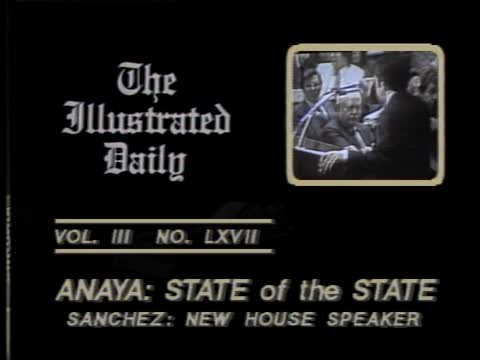
- Transcript
If these mountains die, where will I die? If these mountains die, where will our imaginations wander? If the far messes are leveled, what will sustain us in our quest to be larger than life? If the high valley is made mundane by self-seekers and careless users, where will we find another landscape so eager to nourish our love? And if the long-time people of this wonderful country are carelessly squandered by progress, who will guide us to a better world? Good evening, New Mexico's 36 legislature convened in Santa Fe at noon today.
Members of the State House of Representatives promptly settled in and in a surprise move avoided what many feared would be a bruising fight for the post of House Speaker. By acclimation, Representative Raymond Sanchez, the Democratic Caucus nominee for Speaker, was chosen to succeed former Speaker, C. Jean Samerson, who withdrew from the race. Thereupon, the two houses of the legislature convened in joint session to hear Governor Tony Anaya deliver his first state-of-the-state address to New Mexico lawmakers. Tonight, the state-of-the-state in difficult times, and we begin with these excerpts from the Governor's address to be followed by a conversation with the new House Speaker, Raymond Sanchez, and the House Minority Leader, Representative Hoyt Patterson. Mr. President, Mr. Speaker, distinguished members of the legislature, honored guests.
I welcome you to the first session of the 36th New Mexico legislature. We have many problems, several of crisis proportions. The list is long. We have many crucial concerns facing us, and I firmly believe that this is the time to speak the truth, to speak it clearly and frankly. First, let me talk about the truth as I see it, and speak clearly and frankly about the state government's revenue situation. In the 71st fiscal year, you're well aware of the impact of the recession on our state's revenue picture. The original projections for total revenues during the current fiscal year have been revised downward by more than $165 million. What originally was expected to be a $58 million surplus is now a prospective deficit of almost $115 million, and revenue projections for the next
fiscal year are below this year's appropriation level for the state's general fund. To make matters worse, federal funding for vital programs and services continues to decline. To meet the projected deficit for this fiscal year of almost $115 million, I proposed to you a plan to hold state spending within the actual anticipated revenue figures through a series of steps. The plan includes a reduction in spending of 4 percent during the next six month period. By all state agencies that public schools are higher education institutions, this measure will save about $25 million. Use of about $30 million of the state's $80 million in public school operating and other reserves. Replacement with seven tax bond issues of $55 million appropriated from the general fund for highway and prison construction and transfer of the balance needed of some $5 million from insurance reserves administered
by the risk management division of DFA. I urge you strong and immediate support for these measures. With respect to the 72nd fiscal year, I must say that Wally's solution for solving our fiscal problems in the current fiscal year is well at hand, it can be easily and expeditiously attained. The solution for next year's financial demands will not be so easy or painless, but a responsible solution is also well at hand. I stress the process that we followed in examining the details of the budget because I want each of you to know and understand that I personally reviewed the budgets of the departments of state government virtually line item by line item. My staff and I meet every effort to identify and eliminate those budget items not absolutely essential to state government operations. Thus I ask you to view the 72nd fiscal year executive budget not as a document that continues the
tradition of government growth year after year, but rather as a product of serious work to streamline government, eliminate waste, and reduce state spending while providing essential services in an efficient manner. Further, I ask you to give me as a state chief executive the authority and opportunity to effectively manage the executive branch by avoiding restrictive language in the appropriations bill that only serves to inhibit creative and innovative management. And these times have limited in diminishing revenues. I need flexibility to ensure that our departments and agencies can operate efficiently within minimal appropriations levels, which requires that the appropriations act not include restrictive language limiting intra-departmental transfers of funds. I also ask you to let me manage the executive branch by not cutting the requested appropriations further. I have attempted
to send your responsible budget already paired to the bone. And so doing, I have acknowledged the tradition of requesting more than is necessary to operate government efficiently and I have rejected that tradition. Now I ask you the legislature to reject the tradition of cutting the executive budget further simply for the sake of cutting, believing there is unnecessary fat hidden in the budget. Additional cuts will seriously inhibit our ability to provide essential services and significant layoffs and further economic disruptions would occur. This projected deficit I firmly believe is a short term phenomenon, which will be corrected for future years by an aggressive economic development program designed to stimulate the economy immediately. As we open this legislative session, we must choose between conflicting courses. Our changed economic circumstances dictate that our choices are limited. The wisest choice I am convinced requires that we eliminate all unnecessary spending and then find the
needed revenues to ensure as little disruption to the lives of our citizens as as possible. This course and my judgment clearly calls for and requires a temporary tax increase. The tax measures I recommend will provide $130 million in additional revenue by temporarily suspending in part the impact of the large tax cut measure that was enacted into law in 1981. Specifically, I recommend a two-year suspension in two portions of the large 1981 tax cuts to allow our state to meet its constitutional requirement for a balanced budget while providing an adequate level of essential public services. Despite my own preferences for a one-year delay only, I have been persuaded and convinced that a two-year delay is more responsible and advisable than a one-year suspension. If our economy has adequately recovered by next year at this time, we could then eliminate all our portions of the second year of the
two-year delay. If it hasn't, we don't have to face the same heart-wringing decision next year, and government, business, and our citizens respectively can be assured of some stability and government decisions that impact upon them. The specifics of my temporary tax proposal are as follows. First, a two-year delay in the 1981 individual tax cut combined with an adjustment and a withholding rates so that the adverse impact on individuals take home salaries would be negligible. This would generate $80 million during the 72nd fiscal year, and secondly, a two-year suspension in the 1981 property tax reduction for non-residential properties. This proposal would generate $48 million during the 72nd fiscal year. These two steps will thus provide a total of $128 million in additional revenues for the 72nd fiscal year. The tax consequences on our citizens and businesses would be minimal, especially
when compared to the benefits to be derived from the added revenues. I recommend and urge your favorable and expeditious consideration of this measure before you begin serious consideration of my spending proposals for this coming year. If we don't know what our revenue level will be, we obviously can't realistically determine priorities for expenditures. With respect to economic recovery and development, I have stated before numerous times that economic development would be the top priority of my administration, and I restate that pledge to you today. Indeed, the economic problems of our state have continued to grow more serious over the past months. I consider the creation of jobs for our citizens to be the most important task facing my administration and this legislature. Jobs and economic issues are uppermost in the minds of New Mexicans, but our state has lacked a comprehensive economic development
strategy. New Mexico has a potentially bright economic future, but unless and until, our state takes a stronger hand in dealing with the problems of our economy, our citizens will continue to share in New Mexico's high unemployment and low per capita income and they will not share in the benefits of our mineral and energy wealth and other inherent strengths. With local government, the problems facing state governments across the nation are shared by city and county governments. Indeed, local governments are increasingly confronted with more difficult and pressing needs than their counterparts and state capitals. Municipal sewer plants present serious public health problems, jails are inadequate, and equipment for basic services such as fire and police protection and ambulance services is often simply not affordable. State government in New Mexico has a responsibility to our partners at the city and county levels and I accept that responsibility. Clearly, we cannot do everything
that is needed, but we must do more than simply sit by while local services and infrastructure needs are ignored. With an eye toward a particular target day for results, we must review the need for and the viability of merging various regulatory activities in the public service commission and the state corporation commission. I compliment the current state corporation commissioners who have been making great strides in professionalizing their rate making capability and as we strengthen the public service commission, we may now want to consider how best to proceed and protect in the legislative interests of the legitimate interests of the regulated, the consumers, and more importantly, the taxpayers who are being asked to finance to sometimes duplicative regulatory agencies. Finally, I urge you to enact legislation to permanently prohibit utilities from diversifying into non-utility activities. On one item that has developed as one of the most crucial issues of our time, the nuclear
arms race, the threat of nuclear war concerns all of us, regardless of party or ideological differences. From bus cruises in silver city to Clayton and Farmington, New Mexicans are urging their government to join in a call for a verifiable bilateral nuclear weapons freeze. I strongly recommend that the state legislature adopt the freeze memorial. As to education, as Governor New Mexico, I plan to do everything in my power to provide the best possible quality education for our state's children. Fundamental to these efforts to improve New Mexico's public school system is the need to create a cabinet level department of education. I recommend that a proposed constitutional amendment be placed on a ballot at the earliest possible time, which, if adopted, would merge the public school
finance division and the state department of education into one cabinet level department of education under the governor with an appointed state board of education subject to Senate approval. Let me digress for a moment to discuss with you a serious problem as arisen as a result of a court ruling yesterday. I have consulted with Attorney General Paul Bartike and State Engineer Steve Reynolds. At this point, there's a consensus among the state officials directly involved that this decision must be appealed. All new legislation may be required. It would be premature today to address the questions of what amendments to New Mexico statutes or what federal statutes might be needed to overcome this decision. But whatever is required, I will be prepared to come back to you with recommendations, and I will be prepared to go to Washington, D.C. with your help and guidance and work for whatever federal legislative relief we need. I commend to you and the strongest of possible terms to enact a proposed constitutional amendment to delay the start of all legislative
sessions beginning with the 1985 session or at the latest, with the 1987 session to delay future sessions until late spring and to change the start of the state fiscal year to coincide with that of the federal fiscal year. I think it makes more sense. It doesn't dilute the power of any branch of government, and it will give taxpayers more efficient government. Governor Tony and Ion, the state of the state, has made in speech a chief executive delivered to lawmakers in Santa Fe earlier today. Now for the reaction of two state legislatures, both of whom figured prominently in other news coming out of the capital today, we go to the state library in Santa Fe, and the speaker of the New Mexico House of Representatives, Raymond Sanchez, the Democratic Caucus nominee from Bernal Leo County. Speaker Sanchez came
to his victory today by acclimation following former speakers, C. Jean Sanverson's decision to withdraw from the speaker's race. Also with this this evening in Santa Fe, the House Minority Leader, Representative Hoyt Patterson, the Republican from Curry, Lee, and Roosevelt counties. Gentlemen, good evening. Good evening. Speaker Sanchez, your selection as House Speaker very nearly upstaged, Governor Anaya's first address as chief executive to the state legislature. Congratulations to you. Thank you, Hal. Mr. President, you want to tell you it wasn't meant to do that? I suspect not. Mr. Speaker, the governor today proposed remedies for dealing with the financial difficulties of state government, the revenue shortfall, and he urged as well, that is within the present fiscal year, and he urged as well that the 1981 tax cuts be suspended in some part at least in for two years in order to deal with next year's anticipated deficit. There's a good deal of talk at the legislature
today about unity. Will these proposals by governor Anaya be the first test of that unity? Well, I don't know that there'll be a test of unity or that they can be explained that way. I think Governor Anaya's program is very ambitious. I think he said a very moderate course to try to remedy the problems that we have with the state. I think there's going to be some philosophical differences, especially with regard to the 1981 tax act. I'm not sure that any debate or dissension over that issue will show a lack of unity. I think you're going to see a lot of discussion on it, and I don't know how we'll come out with that. I think many of us have yet to look at that closely and evaluate it and make a decision. I'm not sure that that will be the test of unity. All right. Representative Paterson is leader of the Republican minority in the state house of representatives. What are your thoughts on Governor Anaya's proposed tax measures in order to deal with revenue shortfalls? Governor Anaya has to be commended on his decision
to make the present fiscal year of state government fit within the revenues, and I commend him for that. As for the next fiscal year, and his recommendations for an 8.2 percent tax increase in spending, and about a 12 percent tax increase to take care of that, I don't agree with. He says that we need to suspend, as he calls it, the income tax cut, for example, of 1981. There's no such thing as suspending it. It would take a brand new law to repeal that and reenact those income tax rates. Now, if we do that, and that law takes effect by the first of July, that means that the withholding for the people who are on wages and salaries now would be about four times what it is now, because by his own budget document, our present predicted take of income tax revenues is $76 million.
He says that this would raise $80 million, which it means that we would more than double the present state income tax rates. And to collect that much on 1983, you would have to double up in the last half or withhold four times what we are now. People are actually taking home more money now because of the 81 tax cuts. If we do, as the governor recommends, they will be taking home much less. Mr. Speaker, would you like to react to what representative Patterson has just had to say to us about a Republican reaction, or at least his reaction to the governor's tax proposals? Well, I wouldn't be as emphatic as representative Patterson is about the effects that the 1981 suspension will have of that 1981 tax act. I think the governor also talked about a situation that we have that's rather inequitable and that we ought to look at. And that goes to the middle levy that's charged against non-commercial,
I mean non-residential property taxes. That 1981 tax act took a significant sum of money out of the general fund because the benefit you gave to non-residential property, I think he's looking at that. In New Mexico, our personal income taxes are not that high to begin with. I guess the term a great deal, less now, is something that can be debated. It's kind of like aroses, aroses, aroses, aroses. And it's beauty is in the eye of the beholder. I'm not sure what that will come to when we talk about a whole lot less. I think we've got to see that in dollars and cents figures per capita, per individual. All right, Mr. Speaker, the governor also today called for a legislative memorial, endorsing the nuclear arms freeze proposal. How's that going to sail on the House of Representatives? I have no idea how that'll sail. I've seen them in moral. I have no objection to what I think we ought to look at that very seriously. Nuclear Holocaust is not something that we
want to face in the future. I think if it's a responsible memorial talking about a responsible end, that would be fine. We, of course, a memorial is a memorial. We're memorializing them to do something. We are not passing any type of legislation that will directly affect it. It will be the voice of the citizens of the state of New Mexico in a reaction to what is happening. All right, Representative Patterson, may I ask your reaction to the proposed memorial for a support of the nuclear arms freeze? If the Russians would agree to it 100% and we could trust them, which we cannot, I would be for it. In the light of the realities of the present-day situation in the world, I think that it would be a mistake. Is that the general sentiment amongst the Republicans in the State House of Representatives, or have you had an opportunity really to check this one out? That is my reaction. I have not visited with very many other Republicans on that regard. All right, Representative Sanchez might return to you. The governor also called for post-constitutional
amendment, which would delay until the spring, the regular sessions of the state legislature. His argument for the idea makes pretty good sense, I think, probably from the point of view of a governor taking office and trying to get a handle on his administration before the legislature comes into session, but if you serve in the legislature, what kind of advantages are there to this change? Well, I for one endorse that personally. I've been a proponent of that for years. I think that we ought to set off the beginning date of the legislature. Representative Patterson, I don't see eye on that. I'm not sure if it's for the same reason or not, but I think the governor, especially a governor-elect coming in and having the short period of time that he does have to work with a new set of a new structure, should have more time. I think we as legislators ought to have more time after he has gotten into office, and assumed office,
to be able to work with him. It's been very difficult. You look at the speaker's battle as a perfect example, and him moving into his administration. It was very difficult for us to organize. It was very difficult for us to get things together and work out some sort of a scheme and look at his programs and be able to evaluate him before we even get here. I like the idea. It may cause some inconveniences, but I like the idea, and I will push that. I do like that. All right. Although it was not in the governor's message, for some time in recent sessions of the legislature, there have been discussions about the merits of extending the length of legislative sessions beyond the present 60-day, 30-day arrangement. To what extent does that sentiment prevail today at the legislature? And is it likely to crop up if this amendment does get on the agenda to delay the legislative sessions in the future? I imagine there'll be some discussion about that. Extending the length of the session doesn't necessarily mean we'll get our work done in a better fashion. The longer we drag
out a session, I think the longer we're going to be debating matters anyway. I'd propose or like to see something such as being allowed to meet for say 180 days within a two-year period. That way you can break it up as you need it. I'm not sure I like the 30-day restriction that we have. I think that might be too short, but I'm not absolutely positive that you need to extend it past 60 days. All right, Representative Patterson, I'd like to ask you about the governor's proposal to delay the legislative sessions to spring. Representative Sanchez says he thinks you do not like the idea. The governor by President New Mexico law after the election can go to work in November and start learning about being governor. Governor and I did this. He had his transition team working and it is obvious from his knowledge of state government and the budgetary process is in the work he had put in in analyzing the various budgets
personally that he has spent a lot of time at this. So it's not from January the 1st to January the 18th. It is from sometime in November approximately a two-month period that he has had to work. Now if he needs or any new governor needs more funds to do this, the legislature should be willing to provide those. Delaying the start of the legislature would inconvenience a great many representatives because the spring and summer and fall months are the busy part of many people's year. If they're employed by someone in the motel hotel industry in New Mexico, they couldn't possibly serve in the legislature during the late spring and summer. If they're in business for themselves and cater to the tourist trade, they couldn't possibly serve in the legislature in the spring and summer. If they're farmers such as I am, they couldn't possibly serve in the legislature in the spring and summer. We would be eliminating a lot of people who presently serve in the legislature.
A lot of businesses, industries, wage earners and others who are represented by the present make-up of the legislature from ever-serving. All right, very quickly we will be out of time shortly. The governor's call for a proposed constitutional amendment which would merge the Public Service Commission and the State Corporation Commission. What's the thinking within the Republic of Minority in the State House of Representatives on this matter? Again, we have not caucused on that subject. My personal feeling is that I would be in favor of merging those if the resulting body was elected. All right, sir. Speaker Sanchez, could you give me very quickly the democratic reaction to this idea? All I can give you is my reaction to it. I like the idea back in 1971 or 72, I think Senator McBride carried a bill similar to that. I think that it ought to be an elected position whatever happens. So if the two parties agree on this, or at least the leaders of the two parties agree on this, the State House of Representatives, it seemed to have a leg up.
Would that be a safe inference, Mr. Speaker? I'm not sure they're going to listen to me that much, you know. Point carries a little more weight than I do on his side of the hill. Well, gentlemen, it was very kind of you to agree with me. You agreed on that. Gentlemen, it's very kind of you to conclude this long day and the first day of the 60-day session of the legislature, this 36 legislature, and I appreciate it very much and I'm sure our viewers do too. Thank you very much and good night. Thank you. Thank you. That's it for tonight. Join us tomorrow when State Attorney General Paul Bardicki and State Engineer Steve Reynolds visit the illustrated daily in the aftermath of New Mexico's disturbing setback in the El Paso Water Zoo. Thanks for joining us. I'm Hal Rhodes. Good night. You
- Series
- Illustrated Daily
- Episode Number
- 3067
- Producing Organization
- KNME-TV (Television station : Albuquerque, N.M.)
- Contributing Organization
- New Mexico PBS (Albuquerque, New Mexico)
- AAPB ID
- cpb-aacip-b551b860c8c
If you have more information about this item than what is given here, or if you have concerns about this record, we want to know! Contact us, indicating the AAPB ID (cpb-aacip-b551b860c8c).
- Description
- Episode Description
- This episode of The Illustrated Daily with Hal Rhodes discusses the new House Speaker, Democratic Caucus nominee, Raymond Sanchez. Governor Toney Anaya gives his first State of the State address. Guests: Raymond Sanchez (House Speaker, D), Representative Hoyt Pattison (House Minority Leader, R).
- Created Date
- 1982-01-18
- Asset type
- Episode
- Genres
- Talk Show
- Media type
- Moving Image
- Duration
- 00:30:52.351
- Credits
-
-
Guest: Pattison, Hoyt
Guest: Sanchez, Raymond
Producer: Barchus, Cindy
Producing Organization: KNME-TV (Television station : Albuquerque, N.M.)
- AAPB Contributor Holdings
-
KNME
Identifier: cpb-aacip-283056b5c6a (Filename)
Format: U-matic
If you have a copy of this asset and would like us to add it to our catalog, please contact us.
- Citations
- Chicago: “Illustrated Daily; 3067; Toney Anaya: State of the State and Raymond Sanchez: New House Speaker,” 1982-01-18, New Mexico PBS, American Archive of Public Broadcasting (GBH and the Library of Congress), Boston, MA and Washington, DC, accessed April 2, 2026, http://americanarchive.org/catalog/cpb-aacip-b551b860c8c.
- MLA: “Illustrated Daily; 3067; Toney Anaya: State of the State and Raymond Sanchez: New House Speaker.” 1982-01-18. New Mexico PBS, American Archive of Public Broadcasting (GBH and the Library of Congress), Boston, MA and Washington, DC. Web. April 2, 2026. <http://americanarchive.org/catalog/cpb-aacip-b551b860c8c>.
- APA: Illustrated Daily; 3067; Toney Anaya: State of the State and Raymond Sanchez: New House Speaker. Boston, MA: New Mexico PBS, American Archive of Public Broadcasting (GBH and the Library of Congress), Boston, MA and Washington, DC. Retrieved from http://americanarchive.org/catalog/cpb-aacip-b551b860c8c