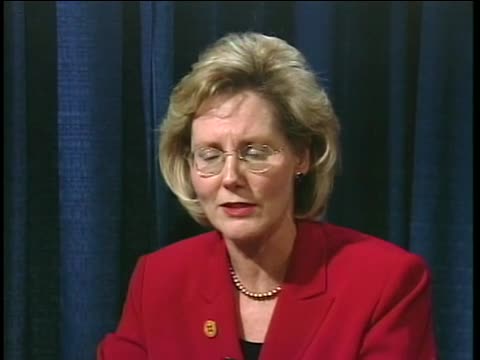
Report from Santa Fe; Janice Arnold-Jones and Hector Balderas
- Transcript
... ... ... ... Report from Santa Fe is made possible in part by a grant from the members of the National Education Association of New Mexico. An organization of professionals who believe that investing in public education is an investment in our state's economic future. I'm Lorraine Mills. I'd like to welcome you to report from Santa Fe. We're taping today in the state capital in Santa Fe during the special session. We have invited today two House of Representative Members, Janice Arnold Jones, a Republican from Albuquerque, and Hector Baldaris, a Democrat from Wagon Man representing five counties.
That's correct. Sam Miguel, Wadalupe County, Tows, Colfax and Moira County. Now, we just have to make very clear that we don't know how this is all going to turn out, but the main issues of the session is what I've brought you here to speak about. So, the impeachment of the state treasurer, the whole anti-price gouging legislation, the tax relief for the citizens, and how the size of the rebate and have many other issues. But we'll get started. I want to talk about the tax rebate. So, Janice, tell us how you feel about that and how it's coming along. Well, I think anytime we're able to give money back to the citizens, that's a good thing, because I believe that government does for the people what they cannot do for themselves, anything beyond that belongs to the people. And so, when the governor did announce that we were going to have a special session and that he had proposed $75.5 million as a rebate, I immediately said, why? And the reason I said that is that I know, I know from my interim committees, that we have more money than that in the bank. We have it today, and given that the gas prices are going up, and I know that heating bills are going to be terrible, that $20 extra per tank of gas, we're giving a $50 rebate to $128 for people who really needed. It was not enough.
And you know what? You need it. I need it. We would have appreciated it. That was okay. So, I am grateful that we're going to give something back, but we could have done much better. Well, we don't know how much it's going to be given back, because it's still going to be in flux. Well, I will lay money on right this minute, that the rebate is going to be right around $100 million, and since I worked on the low income energy assistance program conference committee, I'm relatively certain that will end up right around $37,500,000 in addition to the other rebate. And, Hector, what are your views on this tax rebate issue? You know, generally, I'm in favor of giving back to the Mexicans. The interesting dialogue and discussion, and he didn't even debate, centered more on how much do we give back.
I believe that everybody, both House Republicans and House Democrats, agreed that it was important enough reason to come to the session, have a special session and say we need to get money to the basically the homes of New Mexicans. But there has been extensive debate as to how much and to what cost. And so, generally, they're very supportive of what I liked about the bill, and we were all in agreement on this, is it needs to hit very quickly. This isn't something that we can do as a tax incentive and wait till January, February, where you can itemize a deduction. This is something that needs to go into the pockets of Mexicans right away. So, I was in favor of it. And so, here we have a Republican and a Democrat, both supporting this, and actually even supporting the fact that it could be more. How was the partisan interplay between the parties? Janice? That was a very interesting question, because I'm not really particularly sure that that was partisan. I think that was more legislative versus executive as near as I read it.
How about, I mean, is that how you read it, Hector? I kind of did. It's fascinating, first of all, just to see how the arguments evolve. We all started off in agreement that we are all here to give a rebate. And then, I think that there began to be a little bit of discussion as to, well, maybe we're giving too much too quickly. And, of course, then, several people said, well, I believe that we need to be giving more, and so that I think you could start to see divisions. I mean, not by party, but more by policy. Some people, I personally believe that we needed to be cautious in terms of just rather than saying whatever our surplus is, let's give it all back for home heating that maybe there was other things that we could invest in in January. And so, I thought you saw some differences there. And clearly, the investment portion, and you need to know, we have a tremendous amount of money coming into the state because of oil and gas.
And the problem for me, and thinking about the investment long-term, that is exactly what we need to be talking about, because we may never have another windfall like this, and there are things that we do need to do. But it was so interesting to sit in committee having been an interim committee, where our secretary's testify to amounts of money that we already had in our treasury that all of a sudden they don't know how much money we have. That was truly uncomfortable, and even when Senator Smith came over to testify in front of Tax and Revenue, he said, you know, a very conservative figure is $800 million. So that left us, and I mean, I do sit on Tax and Revenue, and that's what the discourse is. All of a sudden, we can't trust anything. And that was troubling. So you mean that the figures have a kind of gelatinous or mercurial quality, that someone will tell you there's 600, someone else will say 800, or? No, no. I mean, we have on record what we have through the interim committee. I mean, if you look on the website, you will see that we have reports that already report well over $350 million, but what was more remarkable was to have the Secretary of Tax and Revenue and the Secretary of DFA say, we're not sure how much money we have.
That's what was, you know, and I don't know how you all felt about it. I mean, it was, it was really very uncomfortable. And I think that's where Representative Arnold Jones is going with maybe the split between the legislative body and the executive. And so I do know that the legislature as a whole, both Democrat and Republican, is very protective of their constitutional obligation to appropriate. And so I, and I'm just new here, this is just me, my observation. But when you're not giving, or you're not forthright with figures, or maybe there's some laps and executive function like, hey, give us some accurate numbers and finance, we can't do our jobs effectively. And I think that that's maybe where there was a legitimate criticism that we can't appropriate money if you don't tell us exactly how much we're going to have.
And so I was sensitive to that concern as well. Now, I know that you, it was your bill, the anti-price gouging bill. For full disclosure, it was a majority leader's bill of Representative Kenny Martinez, who's a phenomenal legislator and leader. And, you know, these are kind of the urban legend stories that I think are around in the roundhouse, but this is actually true story that he came to me in a committee meeting, I think, and he said, look, I'm going to get really tied up with this impeachment. Any being the kind of leader that he is, he says that he cracks a joke like, it's not a big deal. Can you just co-sign, and I'll be around, don't worry, this is just in case you have to cover. And, of course, reality is said in that this is probably one of the most controversial bills of the session, and I carried all of it. I mean, it was, it's kind of an inside joke that he said, here it is, but I did appreciate the opportunity to carry this piece of legislation.
But it is a final tradition with freshman lawmakers, they would give them the co-fighting bill, which is throughout the ages of New Mexico politics, one of the most outrageous and controversial bills. And clearly he has a history in his county to do, I mean, it is just to do this. There's no doubt about that. So you graciously agreed to be the co-sponsor and to do the heavy lifting. I did, I did, and so it's been a phenomenal learning experience, and I thank Kenny for kind of, I think he has a lot of trust in the new representation that comes in, and he's willing to groom and mentor and teach. But in the same respect, I think he knows that I'm here to take chances, I'm here to learn, and so I welcomed him the opportunity to present that bill. Well, tell our people what he's in the bill on how it's doing. You know, it's passed the House of Representatives, I don't recall the exact vote, I think it was... There were only eight against. There was only eight House members of voted against, but to get that bill to even pass the House took a phenomenal effort among so many leaders.
And it was a bipartisan effort. One thing that the bill was suffering from in the beginning was it was somehow viewed as a bill that would just reduce gas prices. And so people, I was very worried about the expectations that New Mexicans are going to say, well, he's trying to lower prices at the pump. Another misperception somehow was that it unfairly singled out in industry. And so what I try to do is reframe it to its true intent, which is to protect consumers at the most vulnerable state when they're suffering from a natural disaster. And at that point, when the governor declares an emergency, at that point there was standards in which businesses couldn't gouge the most vulnerable citizens in the community. Some of the things that we worked closely with industry on to prevent or to stop what they viewed as harmful unintended consequences. What industry was worried about is somehow if you institute a price gouging bill that you're going to somehow stifle the market and end up hurting your community to begin with.
And that was never the intent of the bill. The bill is basically, it gives you benchmarks in which commercial entities cannot gouge. And it's only for those necessary goods and services to help the general welfare of the community. So among those would be gasoline water? Yes. The governor would have to specifically annotate, okay, I'm declaring a region, so he would be limited by even declaring a region. He'd have to notify the counties. He would also have to specify what products are deemed necessary for the livelihood of that community. And so a lot of people were like, well, you're going to affect barbershops and you're going to affect stores. And we tried to limit the scope of the bill to really just to those goods that are really necessary to the community. So you've had that experience of carrying one of the most significant bills in this specialization? Yes. Absolutely. And he was brilliant on the floor.
You know, it is a treat to watch somebody debate a bill and present it who is truly a statesman. And he did that. And while I did not ultimately vote for the bill, he made such changes that had it been a close vote, he would have had my vote. Because it was a good piece of legislation when he was finished and truly when it started, it was not. You don't have to answer this question, but why did you choose not to vote for the bill? Well, an easy one is that I had the luxury of it not being a critical vote. But my general philosophy is that we should not be setting prices into, you know, we have other pieces of legislation that already cover this. And so I really felt it was duplicative. But if I had to have a bill, I'm very pleased with this one. So we talked about Hector's shepherding, this significant bill, but you've also had some new experiences this session by being on the conference committee. Tell our viewers what the conference committee was about and what it was like.
You know, it was a remarkable experience and I expected it to be very contentious. It was not. And this was the conference committee for the low income energy assistance program that also affectionately known as LIHEAP. That is correct. And we added a number of pieces in there. For example, we the Senate wanted to make the appropriation $23 million. It was greater than what the House had recommended. And we also recognized later in the process that the school systems needed extra money for heating and extra money for transportation. So for K to 12, we divided those two particular line items so that we hopefully it would go where it's supposed to go. And the higher ed was really facing a tremendously high fuel bill. And so we put in $3.5 million for higher ed. And please don't think this is going to end here. And there was also need the volunteer fire departments needed gas. So we were the money part was very easy. And we kind of worked that out. We started at $36 million. The Senate wanted $44 million. We ended up with $37.5 million. Everybody was happy. But there was an amendment put on the Senate that would have required for two years. If during the winter a customer was unable to pay their bill for two years, the utility could not collect that or could not disconnect them.
And the general and it was a remarkable piece that was put on by Senator Soci. And we really worked through all of those issues. And so what we know now that quite frankly, the amendment was duplicative of the regulations and the statute. And so going through that process alone, I think made people more comfortable. And what we ultimately did was we took that amendment and said, okay, we have enough in statute. So we referenced the statute and said, dear utility company, if you have this problem, it is your obligation to also notify health and human services. And they must immediately do something to mitigate it because the worst thing you can do when you are short of funds is to get into debt because the debt would still be there. And that was worse. We thought sometimes even being cut off and truly the statutes prohibit anybody from being cut off who sick or during the winter months and no utility wants to cut somebody off in the middle of the winter.
But on the other side, you take places like Red River and Tows where people come in for the ski season. If we had opened it up, they would have been stuck with the bill. That's not good either. So it was a really remarkable thing to go in there and see that there really was great agreement. And there was a lot of care taken in crafting the amendment. And as we all know, none of it's ever perfect. I was pleased to do that in honor to serve. So the old line about processes you should never see are sausage making and law making. That was probably too many is the real nitty-gritty of lawmaking because you've got both sides, maneuver, negotiating. And you're really, it was a positive experience for you. I was so pleased to be able to serve with this gentleman and they were very serious and very thoughtful. That is what I expect. So I was delighted. Well, another thing I would like to speak with you both about because it's been history making is the impeachment issue. And constitutionally, it is the house's responsibility to we've never done it before.
So to set forth a procedure and a timetable for the impeachment of an elected or public official. In this case, it's our sitting state treasurer, Robert V. Hill. So I'd like to start with you, Hector. How is all this? How does this look to you? And how does it feel? From the gallery, I'm really impressed with the gravitas and the against ateliness, the state'smanship likeness that they're addressing this, but you're there on the floor. How does it look to you? It's a, it's something that was, it's very, was very surprising in terms of before we came to session, I'm sure we had all had personal experiences in our district. We had been affected by media. We had been inundated with phone calls. And then just as human beings, we were also dealing with the situation of the allegations in the state of New Mexico. But just as normal citizens to come here, though, and take the oath that we did and to be a part of a process, which is usually confrontational, usually it is partisan, usually there, there is a lot of indecision on behalf of representatives and senators.
It was surprising, and I shouldn't say surprising, but it was, it was humbling to come. And the, the representatives, the way they acted, it was unbelievable. There was no partisanship. Everybody was very down to earth in terms of, and I think everyone appreciated, I, I heard a representative early say, never mind what has happened out there in terms of the circumstances and the allegations and the indictment. This is something that we are almost on trial here. It's how we act as an institution. It's our institution that's going to be challenged. And that's what's really people are going to remember historically is not necessarily who that person was, what they went through, not even the allegations, I don't think it's going to be how did the House of Representative deliberate, how did they make history. And the other thing is we're not making a process that's reactive to just the allegation itself. We're creating a process that's going to be held as precedent for years and years to come.
It will be the template for future actions. It will. And, you know, and I have to say, as we went into this, I can assure you that we all have read and reread our constitutions probably more than probably since we were elected. And, and there were some tremendous questions that were asked when we, when we all walked on the floor and what was interesting is we all asked the same questions. You know, there, there is one thing about protecting the state against malfeasance. But the other issue is the protecting the presumption of innocence. And you need to understand that this is not a criminal proceeding for us. This is political. And so many people get confused as to why aren't you impeaching him now. You know, he's got, well, this is not criminal. This is about how someone does their job in office. And so watching how they have carefully looked through the evidence, and I'm sure you probably did the same thing. I kind of looked around and said, okay, there is a federal investigation going on. Well, that has nothing to do with this action. What they have been indicted for while serious truly is not going to necessarily play a part in our decision on malfeasance because the process says we are looking at specific qualities in office.
And so some of us actually went around and looked to see if we could find independent evidence. And it was very interesting because the issue of evidence, none of us are going to impeach someone without evidence. And I'm very pleased at the way that they've handled that question. And how I feel confident that when I have to cast that vote that I will do so knowing that it's not hearsay, that it's not out of the media, and it's not because somebody just wanted somebody's head. That's because there is foundation. And I think that's part of the process. You know, it was very interesting couple of just observations is, you know, a lot of times, I'm 32 years old. So I'm not that far out of school in terms of the theory that I learned in law school or the theories that you study in New Mexico history.
But, you know, rarely does there's a challenge like the issue of impeachment come in where all of a sudden the things that you learn aren't cliche anymore. And the reason that I express that is because, you know, my perception is somehow that the governor is very influential, very powerful. The attorney general, they have these authorities that they always use in the public and so people appreciate them and understand them and feel them a lot of times. And when this issue came before the public, the governor did try to exert his powers, his authority, his wisdom, same thing with the attorney general, they tried to exert solutions. But what is their solution? Well, and what's interesting is that constitutionally the solutions, the process, live within the House of Representatives. And so that was just an educating experience for us and for the public that even if they want to, even if they're responsive, even if they want to do the best job they can, even if the public wants them to, the Supreme Court said, no, this is a function of a House of Representatives. So that was extremely, even that takes a while to set in because you're assuming, well, it'll be resolved and it wouldn't until we came together and decided on the process.
And what was so interesting, our constitution almost has some conflict, we have a section under the judicial section with a little thing called Quo Warnto, which any person can take to the Supreme Court. And the Supreme Court said, you know, and I was worried about that because I think that would have been a terrible precedent had they said, okay, we'll do that. And that meant that anybody, the attorney general, could have removed anybody from office with a proponents of evidence as an impeachment. That's just not good process. And I'm very pleased with what we have established as the correct process. And just to update the viewers, I think the other surprise when you were realizing, hey, first of all, it's your baby or your puppy, so to speak. The second thing was how everybody had assumptions of how the speaker would act, everyone had assumptions, how the majority party would act, or that how the Republican party would act. And everybody broke those stereotypes immediately. They instituted a balanced committee, which is unheard of.
I believe that even if you study the other impeachment proceedings in the country, nobody chose to do the 555 approach. And so that was just even a message to the community that we want to be balanced here. We're not going to try to act reactive and we want everybody's input. And we don't want the appearance that this is something that is going to come down to history or the past, past relationships. We want a very deliberative body. So the, the, it was House Rules and Order of Business Committee appointed this 10 member committee, five Democrats, five Republicans, who in turn have hired Spatial Council of Paul County of Former Supreme Court Justice, who said right at the beginning, if he's innocent, you know, we're not deciding innocent or guilt right now that either one is possible. So we're going to give it absolutely the full process that is constitutionally decreed to us. Sure.
I would say and having Justice Kennedy on board. And, you know, I know we think that these things are partisan, but I know that Representative Martinez made that recommendation because he is looking for the best. Let me just tell you that Representative Martinez is a wonderful state's person. And I think he has led us all to that level. And we all hope to be state's people because we're here to serve the people. And when we get to that level, it's thrilling to serve. Well, it's been thrilling to watch. The House really rose, you know, to the highest level in taking on this challenge. And I think the next, there'll be a few interim dates, but the next big date is October 28th when you, the House and Senate will call themselves back into an extraordinary session. And is that when the final report will be delivered? No, but maybe we should back up. You should know that we for sure will call ourselves into an extraordinary session.
And I forget what the name of the rid is. We have all signed a document. Yes, the certificates. And they will be delivered to the governor. And so I want to assure the people we are coming back. We are not ignoring this. And it's because it's done. It's finished. And we will be here. And then from that, I'm not sure if they will have the full report at that time. I'm expecting to have basically a case presented to us for us to make decision. Do you understand something different? No, that is correct. What I've been briefed on is that Justice Kennedy will go and investigate and gather evidence. And this could be from documentation to, and he also was very clear that he wanted to provide. Mr. Vee Hill with any due process that he needs for his participation at his comfort level. The other thing is there has been a timeline instituted. So they are trying to meet be within that time frame. And at that point, we would basically read the report. And if we needed to see the evidence ourselves, we would be allowed to. So last, we've been operating under a limited timeline ourselves. And we've come to the end of our time. I want to thank you both so much for sharing your time and your thoughts with us today.
Our guests today are Janiss Arnold Jones, Republican from Albuquerque and Hector Belderas, Democrat from WagonMind. Thank you for joining us. Thank you so much. Thank you. And I'd like to thank you our viewers for being with us today on report from Santa Fe. We'll see you next week. Report from Santa Fe is made possible in part by a grant from the members of the National Education Association of New Mexico, an organization of professionals who believe that investing in public education is an investment in our state's economic future.
- Series
- Report from Santa Fe
- Producing Organization
- KENW-TV, Eastern New Mexico University, Portales, New Mexico
- Contributing Organization
- KENW-TV (Portales, New Mexico)
- AAPB ID
- cpb-aacip-b4414d57b15
If you have more information about this item than what is given here, or if you have concerns about this record, we want to know! Contact us, indicating the AAPB ID (cpb-aacip-b4414d57b15).
- Description
- Episode Description
- Representative Janice Arnold-Jones, Republican from Albuquerque, and Representative Hector Balderas, Democrat from Wagon Mound, sit down during this special session to discuss their thoughts on the main items under debate (including the citizen tax relief and rebate, the possible impeachment of the state treasurer, and the anti-price gouging legislation).
- Series Description
- Hosted by veteran journalist and interviewer, Lorene Mills, Report from Santa Fe brings the very best of the esteemed, beloved, controversial, famous, and emergent minds and voices of the day to a weekly audience that spans the state of New Mexico. During nearly 40 years on the air, Lorene Mills and Report from Santa Fe have given viewers a unique opportunity to become part of a series of remarkable conversations – always thoughtful and engaging, often surprising – held in a warm and civil atmosphere. Gifted with a quiet intelligence and genuine grace, Lorene Mills draws guests as diverse as Valerie Plame, Alan Arkin, and Stewart Udall into easy and open exchange, with plenty of room and welcome for wit, authenticity, and candor.
- Broadcast Date
- 2005-10-15
- Asset type
- Episode
- Genres
- Interview
- Media type
- Moving Image
- Duration
- 00:28:41.353
- Credits
-
-
Guest:
Arnold-Jones, Janice
Guest: Balderas, Hector
Host: Mills, Lorene
Producer: Ryan, Duane W.
Producing Organization: KENW-TV, Eastern New Mexico University, Portales, New Mexico
- AAPB Contributor Holdings
-
KENW-TV
Identifier: cpb-aacip-bc9f644ede7 (Filename)
Format: Betacam: SP
Generation: Master
Duration: 00:27:41
If you have a copy of this asset and would like us to add it to our catalog, please contact us.
- Citations
- Chicago: “Report from Santa Fe; Janice Arnold-Jones and Hector Balderas,” 2005-10-15, KENW-TV, American Archive of Public Broadcasting (GBH and the Library of Congress), Boston, MA and Washington, DC, accessed June 11, 2026, http://americanarchive.org/catalog/cpb-aacip-b4414d57b15.
- MLA: “Report from Santa Fe; Janice Arnold-Jones and Hector Balderas.” 2005-10-15. KENW-TV, American Archive of Public Broadcasting (GBH and the Library of Congress), Boston, MA and Washington, DC. Web. June 11, 2026. <http://americanarchive.org/catalog/cpb-aacip-b4414d57b15>.
- APA: Report from Santa Fe; Janice Arnold-Jones and Hector Balderas. Boston, MA: KENW-TV, American Archive of Public Broadcasting (GBH and the Library of Congress), Boston, MA and Washington, DC. Retrieved from http://americanarchive.org/catalog/cpb-aacip-b4414d57b15