Report from Santa Fe; John Counts
- Transcript
The National Education Association of New Mexico, an organization of professionals who believe that investing in public education is an investment in our state's economic future. And by a grant from the Healy Foundation, Tau's New Mexico. Hello, I'm Lorraine Mills and welcome to report from Santa Fe. Our guest today is Dr. John Cance. Thank you for joining us. Oh, thank you, Lorraine. Well, you are a soldier and a scholar. You are with the United States Army for 33 years. Your President of the Jewel of New Mexico, Western New Mexico, University in Silver City. Your President there for 18 years. The Harvard on the Healy. The Harvard on the Healy. Great. While you were there, you brought in a lot of really innovative programs.
You got the Zia Award for Quality. You started an economic development course, but that's not why you're here. You're here because you are an eyewitness to such an important part of history. In your Army career, you saw tours of duty in Vietnam. You received a Purple Heart. You were a Chief of Staff at the Army War College in Carlisle, Pennsylvania, but what we're talking about today, you were a Chief of Staff for the United States Command in Berlin when the wall came down. And why are we doing this show now? Because 25 years ago was when the wall came down. My How Times flies. Yes. But the whole world has celebrated this landmark event. So talk to me about you're an eyewitness to history, and I have to apologize because we are going to try to condense 40, 50 years of history into 26 minutes. So forgive us if we're skipping around a little bit. But talk about what it meant.
This was the end of the Cold War. What's the significance of the event that we're doing the show about? Well, I would tell you, it really marked the end of a war that really started in World War I. It was the culmination of a series of events that began with World War I and ended when that wall opened up. And when you look back at history, we could talk just about that period probably, as you've mentioned many times for three shows, but just the macro view of it, you know, the World War I occurs, the war to end all wars, which didn't. They had the rise of Hitler then in the 30s and Japan. And the next thing we know there's a thing called Pearl Harbor, and we're back at it again. And in 1943, at Stalingrad and LLMA, the course of that war in Europe and Africa changed in our favor. And from that time on, the Germans were having to move backward rather than forward. And in Yalta, in Tehran and Potsdam, before the war was over, the Allies met.
First Churchill and Staling, along with FDR, and determined what they would do at the end of hostilities. They would divide Germany into zones of occupation. They would divide Berlin into sectors. And they would try to keep a unified Germany in place. As the war wound down, they had yet another conference in 1947, the famous Potsdam conference, and the only thing they agreed on was that they couldn't agree on anything. Because at that time, it was pretty obvious there was going to be an eastern block of countries that were going to have Soviet administration. And there was not going to be one Germany, there was going to be two Germany's. So the Allies had all these conferences, and they were trying to figure out what to do. But in that period, again, condensing so much history, from about 1945 to 1961, you had once told me that a sixth of the population of East Germany had fled to Western Germany,
and talked to me a little about what was going on right before the war. Well, you have to contrast why the whole thing came about in the first place. We had different opinions on what democracy was, a pluralistic democracy, or a centrally-controlled democracy, i.e. socialism, extreme socialism, and communism. Those were the two forms of government that they called. It's not lost on me that in only four years, the Federal Republic of Germany had a constitution and became their own self-governed country and a member of NATO in 1949. And as you move from there on up until 1961, the one variable that dominates everything is this incredible flow of refugees, and they didn't just come from East Germany. They came from the Eastern bloc, and nobody even knows how many came, but they weren't buying the Soviet model by the tens of thousands a month.
And so by 1961, the situation was ripe for them to want to build the wall. They'd already built an iron curtain, but that wasn't working. So now the wall. Okay. What happened in 1961? Well, 1961, the wall was actually a surprise. Nobody saw it coming. Then on August 13, 1961, at two o'clock in the morning, all of a sudden they started building the first walls, which were really two fences. And then two walls, which were about 155 kilometers long, two walls separated by a desk strip, anywhere from 30 meters to 150 meters in some places wide, with guard dogs and tank ditches and everything, but guarded by 17,000 German and East German police. Wow. And that was a death zone in between— A death zone in between. Excuse me, Blurring. Yeah. That was a death zone in between.
It was. The history and film history is full of these Cold War movies where people are trying to get across in the ingenuity of their escapes, and that we don't know how many people were killed, some say 130, some say 200, we'll never really know. We never really will know, Blurring. But in 1963, our president, John Fitzgerald Kennedy, came to Berlin and he spoke, we're going to see this clip in just a minute. He said democracy is not perfect, but we've never had to put up a wall to keep our people in. And then he ends with that famous sentence, let's take it just a moment and look at it. Okay. Freedom has many difficulty, and democracy is not perfect, but we have never had to put a wall up to keep our people in to prevent them from leaving us. All free men, wherever they may live, are citizens of Berlin. And therefore, as a free man, I take pride in the words, it's been I'm feelin.
So the famous line, it's been I'm bear linear. So what was he expressing about Americans feeling about the wall? Very profoundly. Well, absolutely that what had been built was a prison, a prison that was going to hold people back from being free. And he was absolutely right. He also, I think in some ways, was a bit relieved because he said at one time, well, at least a wall is better than a war. Yeah, good. And I think that brought some comfort to him, but no, he, I think he hated it. And obviously, we'll never really know because a short time later, unfortunately, we lost him. Yeah. Well, a short time later, actually a long time later in 1987, the same year that you and your lovely wife Barbara arrived in the week, the same week, President Ronald Reagan came
to Berlin and he made another astonishing speech. We're going to, we're going to look at it, but everyone will remember this clip because he says it's a question of freedom. Let's take a moment and look at President Reagan in 1987. It is not the German question alone that remains open, but the question of freedom for all mankind. General Secretary Gorbachev, if you seek peace, if you seek prosperity for the Soviet Union and Eastern Europe, if you seek liberalization, come here to this gate. Mr. Gorbachev, tear down this wall. How many times has that sentence reverberated, Mr. Gorbachev, tear down this wall? And that was in 1987. Well, the Germans absolutely loved President Reagan. They also loved Gorbachev.
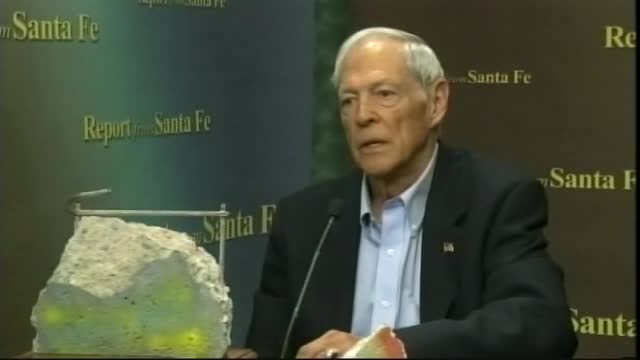
Yeah. And there was an interesting pair that they were because I think they really kind of felt that the same way about things, and of course Gorbachev, you know, really believed in transparency. He really believed in self-determination, perestroika, and he also did not believe in Eric Hanuker. Yes. He thought he was not equal to the task and as it turned out within a short time, Hanuker was ousted. Right. As what was his job? He was the prime minister. He was the prime minister. Okay. Let's take a minute and look at the wall. We've seated you behind two pieces of the wall. Show us the small one because there's a difference between the east side and the west side. Well, occasionally we'll talk to people and ask them, okay, what side is the west and what side is the east? And we'll let them look at the wall and then they'll tell us what we think and they'll normally get it right because on this side of the wall, you have graffiti, freedom of speech. Uh-huh.
On this side of the wall, it's white. I think. There isn't any graffiti. No freedom of speech. Yeah. Um, so suddenly in, on November 9th, 1989, the wall comes down, except for the Brandon Gerber gate. So we're going to look at some of the, some of the photographs that you yourself took that are just extraordinary. This was taken three days and this was November 12th and the wall was opened up on November 9th. You're in a helicopter. Tell us what you see here. Well, this is a very important photo because the wall opened up and it was so joyous. We had a, during that time from the night to the 12th, we had over two million visitors in West Berlin, not just from East Berlin, but all over East Germany. Unfortunately, the, the, the referee on top of the wall you saw there, which, which occurred on top that wall was replaced because the one place that the East Germans did not want to turn over was the Brandon Bird Gate. And that's an action. Unfortunately, it didn't happen for a little while later, probably on the 22nd of December.
That was the date that they actually then opened up the Brandon Bird Gate. And here's the Friedenbridge, also from your helicopter. It is. And so what's happening here? Well, again, the reason for the helicopter ride in those photos is that we were very concerned that this process was going to reverse itself, particularly when the East Germans got back on that wall and moved everybody back. And what you see there is kind of peaceful because those are East Germans just going back to, to East Germany for work. Yeah. Bobby's all lined up there in on the Friedenbridge, of course, which is quite famous. Well, this is just for fun. But this is you and your lovely wife, Barbara, looking through one of the holes in the wall. A hole that we made. Ah, excellent. My wife is very strong. Very strong. But one of the things that you see in news clips from the time is the, the exaltation, the jubilation. And we'll get back to that in a little bit, but just a million people went through in 36 hours.
There was so free at last to be able to go back and forth. Let's continue the historical process because six months later, June 22, 1990, checkpoint Charlie, we all know the phrase. It's really, this is a really important photo book. It's one of the things that most people don't realize is the wall opened and Germany started to reunite. But the Allies, led by the United States of America, did not trust these Germans. They still had over 90,000 Stasi, 180,000 informers back in the East. And so that ceremony really marked the official recognition by the United States and our allies that the wall was down. And what a vision though, you disappear a 2010 building. Well, the whole idea there was our, what we did with our colleagues with the East Germans and the Soviets, as we would tell them, look, there isn't such a thing as East Germany. There's only one Germany.
This is a very temporary situation. And to illustrate that, we started that ceremony with our Secretary of State, it was their James Baker and the other Secretary of State. And we went ahead and started it with the checkpoint there. We put the last people through the checkpoint, they made their speeches, we lifted it up, they marched into East Germany, we put it on a truck, hauled it away, and then had the great pleasure of saying we told you so, it was just temporary. Yes, yes. Now, we have a picture from that. This is from the retirement of checkpoint Charlie. We're speaking today with Dr. John Counts, who is Chief of Staff of the Americans, and there he is right there. These are the sort of Chief of Staff of the Allies. That's right, that's right, and saying, you know, we're done. This is, we're opening up now, this is really an open city. So there's one other issue, because that was in June, right? And then in October.
October was a busy month, because on the first of October, my last ceremonial sort of action was, as we had to retire the colors of the United States Command Berlin, which had been created in 1949, and the United States Command Berlin no longer existed. It was deactivated. It was deactivated, and then two days later, great joy, because we have German reunification. We won. Yeah. Thank you very much. We're so happy, and so our hearts were just filled with joy, and I would say this, my wife and I reflect many, many times on what a great privilege and honor it was to be able to serve there in Berlin during that critical time to really represent the incredible work that literally hundreds of thousands of people had done ever since 1945 to make that all possible. So it was, it was an extraordinary experience, Lorraine. Well, one thing we didn't show is you've got a small piece of the foundation of Checkpoint Charlie, and it's grand, and it's heavy, but it's just, to me, you don't want to chew
on it. No, no, I sure don't. But to me, the symbolism of not just decommissioning it, making it serve another function, you know, restrooms, I don't know what, but to actually remove it, all trace now, you know, people and the Brandenburg gates are open, people are free to come and go. Do we have time to talk about our retiring, our flag at Checkpoint Charlie? Yes, yes, so how please? I would mention to you that we also, right there and back of the Checkpoint, because that was the Checkpoint Charlie was in the American sector. We had an American flag that had flown at that Checkpoint ever since the war ended, and there was a Checkpoint Charlie. And afterwards, I went with my military police who were part of my staff, and we brought the colors down, the American flag down, folded it up, and I presented it back to these wonderful soldiers, our Marines, our military police, excuse me. There was a large crowd there, and some of the crowd was not happy. Back to one woman who was crying and came up and said, what have you done?
And I said, excuse me, ma'am, I'm so sorry, what's the problem? And she said, I live down the seat down the road there, I live on the second floor in that corner window. Can you see that? And I said, yes, ma'am, I most certainly can. I live there. And every morning, the first thing I do when I get up is I look out that window and see that flag there, and I know that we are all safe. Now the flag is not there, and I was kind of in a loss for words at the time, but the military police came to my rescue with another flag, and they said, no problem, that last flag we will keep, that's the last flag to fly over Checkpoint Charlie, and they put another flag up there on everybody cheered, and that was the end of the ceremony. So thank you very much. You know, there's so much, I want people to go on their computers and look, there's so much historical footage, and the people are just joyous and weeping from happiness, and they're almost going back and forth just because they can, the exaltation, and the
jubilation is just, I've never seen anything like it. And so you and your wife were among those very first people who came through the Brandenburg Gate, and that was on December 22nd, yes, and a little bit later we'll show a clip from Leonard Bernstein because he played the ode to joy three days later to celebrate this, but we're not quite there yet. Recently in Berlin, this, you know, because this is the month of the 25th anniversary, they had extraordinary celebrations, and Mikhail Gorbachev was here, he gave a very grim speech about where maybe we're back at a new Cold War because the wall coming down signified the end of the old Cold War, but Angela Merkel, who was Eastern, from Eastern Germany, who was the chancellor of Germany, said, you know, dreams can come true, this was her speech on the 25th anniversary, this is what I want Germans and the world to know that we don't
have to put up with stuff just because it is that way. We had a dream of freedom, and the dream came true, and all over the world, people have been looking at Berlin and celebrating. There was an art installation that was just beautiful, two German artists made a border of light. They had 8,000 beautiful spherical helium balloons that went 10 miles where the wall used to be, so you could feel that there was this border of light, and then at the very moment that the wall was opened up, they released the balloons. Oh, I wonder, but it was really wonderful because Barbara and I were able to go to Washington DC for a 25th anniversary celebration, and one of the things I'd be remiss if I didn't say it, when Barbara and I were in Berlin, we were part of an extraordinary team. My wife called our top team that we had there, the leadership in Berlin, the dream team, I think that's a little bit. Maybe over the top, but it's really great because the people that I work with on a daily basis were absolutely magnificent, and all those folks that have preceded us really assured
that someday that would come, you know, normally we were asking these many presentations we gave to dictatorships, when is the wall going to come down? And we had a bad answer, and that is it's going to come down. There is only one Germany, but probably not in our lifetime. Well, because of all those events and all those zillions of refugees that caused the wall to be created, and then finally, to come down because even with the walls up, they still couldn't keep their people in. We realized that dream, and we realized that on that evening of the night of November 1989. You know, were you surprised? I mean, it happens so quickly that going up, the wall was a surprise, but how did you find that about it coming down? Well, I got a phone call. I was, we had some dignitaries in being briefed, and my boss, General Hattick, was in giving a little presentation, and I was there with him as usual. I normally gave the presentations, but this was just a night that he'd done that. And I got a call down the hall, and there was a phone call, and I was talking to the military
police, and they basically told me, Colonel Counts, they're coming through the wall at all the six checkpoints that, you know, separate East and West Berlin by the thousands, and I said, by the thousands, that's something happened on German television, and they've all been told they can just come back and forth freely. So I went in and told me boss, right? I said, sir, apparently thousands of people are coming through the wall. He looked at me and said, you better check that out, John, so I went back out and didn't have to. And so immediately at the conclusion of that presentation, we piled in our vehicles and went out and joined in the celebration, which lasted basically without going to sleep until the following Monday. That was a Thursday when that occurred until the following Monday. We had to set up refugee camps for tens of thousands of refugees, because we didn't know if they were going to close it back up. I got a phone call from my colleague that asked, does anybody in your sector speak of
Vietnamese? And I said, no, but call my colleague over in the French sector, John Gennard, and they do, I'm sure, what's going on? Well, we've got all these Vietnamese here. I said, Vietnamese, and they've come over and ended up. There was 7,000 of them, and we had to set up a refugee camp for them, because they were guest workers, just our buyers over in the east. And it wasn't that they didn't want to go back to East Germany. They didn't want to go back to Vietnam, and it was a very interesting thing. So we had our work just really took off after that wall opened up. We had a whole new dimension. We had a much larger population all of a sudden in the west, at least temporarily. And like I say, as I mentioned before, the checkpoint, Charlie component of our little presentation here, the United States and the Allies were still, were very patient, because we were unsure about the permanence of that wall being opened. Due to the nature, it was sort of an accident in the first place, due to a way this German politician and East Berlin spoke on television.
And everybody heard it and ran with it a million times. They didn't give him a chance, and by the way, the East German government did try to correct it, but it was lost in the sea of thousands of people coming over, and we couldn't be happier. Yeah. Well, you know, the significance, people have written and written about this, but the triumph of democracy over tyranny and repression and liberty over repression, but now, you know, what is your takeaway? You were there. You were not only eyewitnessness to history, but you were a major factor. You were a major actor in this historical event. How do you hold it now 25 years later? You get freedom through strength, and this kind of a trite saying that has a lot of truth to it that I've shared with you, and that is, you know, those that forget history are condemned to repeat it.
And the world's changing. I mean, I take a look at the last 25 years, I take a look at where we are right now, and I couldn't be prouder of this country. God bless America. The one take away that I have is just that little saying, God bless the United States of America. Well, we're going to now look at that Linda Brinstein clip. So he was a director of the London, the Berlin Philharmonic, and in celebration, this is a clip of him. The first you see the Brandenburg Gate, and this is Linda Brinstein just at Christmas time talking about what a just that he never had in the experience like this. And he changed. Beethoven's ode to joy, to ode to freedom. Let's just take a look at the jubilance and the celebration that we see just a moment. He's laid by in the moment. He stars his moment. It's an historic moment. I've never experienced a Christmas like this before.
It's the most unforgettable moment in my long, long, long life. So that celebration, you know, I'll take you, I'll take you, I'll take you, I'll take you, I'll take you. So that celebration, you know, I'll take you, God bless America and freedom to strength. And when you look at those people and it is an ode to freedom and an ode to joy, our guest today is Dr. John Counts, former president in New Mexico, of Western New Mexico University, but chief of staff at the American Command in Berlin. And the witness, I witness to history of this extraordinary event.
Thank you. Thank you. And that we could hear your point of view and share your photographs and the wall and everything with us. Thank you, John. Thank you. And I'm Lorraine Mills. I'd like to thank you our audience for being with us today on Report from Santa Fe. We'll see you next week. Report from Santa Fe is made possible in part by grants from the members of the National Education Association of New Mexico, an organization of professionals who believe that investing in public education is an investment in our state's economic future. And by a grant from the Healey Foundation, Taos, New Mexico.
- Series
- Report from Santa Fe
- Episode
- John Counts
- Producing Organization
- KENW-TV, Eastern New Mexico University, Portales, New Mexico
- Contributing Organization
- KENW-TV (Portales, New Mexico)
- AAPB ID
- cpb-aacip-a93a795e0f9
If you have more information about this item than what is given here, or if you have concerns about this record, we want to know! Contact us, indicating the AAPB ID (cpb-aacip-a93a795e0f9).
- Description
- Episode Description
- This week's guest on "Report from Santa Fe" is Dr. John Counts, President Emeritus of Western New Mexico University and former Chief of Staff, United States Command, Berlin, Germany at the time the Berlin Wall came down. This month the world observed the 25th Anniversary of the Fall of the Berlin Wall and Dr. Counts was not only an eyewitness but also a major player in this important historical event that proved the triumph of freedom over tyranny and ended the Cold War. Dr. Counts is both a soldier and a scholar. For 18 years he was the President of Western New Mexico University in Silver City, New Mexico. He also served in the United States Army for 33 years and was awarded the Purple Heart. He served many combat tours in Vietnam, was the Chief of Staff at the Army War College in Carlisle, Pennsylvania, and was Chief of Staff, United States Command, in Berlin. He offers an eyewitness account of the events that led up to the fall of the Berlin Wall, the exciting events that surrounded this landmark event and explores the world-changing timeline of the historical markers that occurred after the wall came down. Counts also shares personal, rare historical photographs that he took at the time. From visits by U.S. Presidents Kennedy and Reagan, with clips of their famous remarks, to images of Checkpoint Charlie being lifted off its foundation and removed as a symbol of a divided Berlin, Counts provides a participant’s view of a pivotal moment in history -- one that changed our world forever. Guests: Lorene Mills (Host), John Courts.
- Broadcast Date
- 2014-11-22
- Asset type
- Episode
- Genres
- Talk Show
- Media type
- Moving Image
- Duration
- 00:27:08.810
- Credits
-
-
Producer:
Ryan, Duane W.
Producing Organization: KENW-TV, Eastern New Mexico University, Portales, New Mexico
- AAPB Contributor Holdings
-
KENW-TV
Identifier: cpb-aacip-67d0b899562 (Filename)
Format: DVD
If you have a copy of this asset and would like us to add it to our catalog, please contact us.
- Citations
- Chicago: “Report from Santa Fe; John Counts,” 2014-11-22, KENW-TV, American Archive of Public Broadcasting (GBH and the Library of Congress), Boston, MA and Washington, DC, accessed May 8, 2026, http://americanarchive.org/catalog/cpb-aacip-a93a795e0f9.
- MLA: “Report from Santa Fe; John Counts.” 2014-11-22. KENW-TV, American Archive of Public Broadcasting (GBH and the Library of Congress), Boston, MA and Washington, DC. Web. May 8, 2026. <http://americanarchive.org/catalog/cpb-aacip-a93a795e0f9>.
- APA: Report from Santa Fe; John Counts. Boston, MA: KENW-TV, American Archive of Public Broadcasting (GBH and the Library of Congress), Boston, MA and Washington, DC. Retrieved from http://americanarchive.org/catalog/cpb-aacip-a93a795e0f9