Bill Moyers Journal; 601; Campaign Report #1: Off and Running
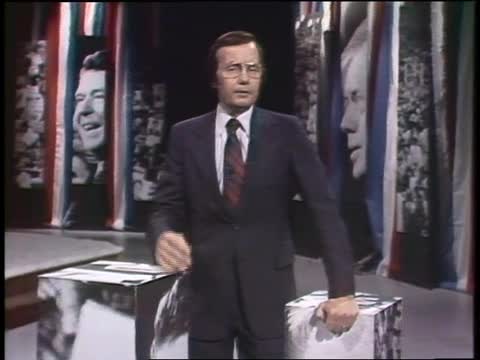
- Transcript
Bill Moyers' Journal
Campaign Report #1
September 12, 1980
BILL MOYERS: I'm Bill Moyers. Suppose an alien arrived here from Mars and, having been naturalized as a citizen, attempts to decide how to cast her note for president. Looking at the incumbent, she would see a man whose chief argument for himself is that from all the calamities over which he has presided he has learned wisdom, and that we should continue his education at public expense for another four years during which he can grow even more wise while the calamities continue. Turning to the chief challenger, she would discover a great simplifier whose essential vision, read from a three-by-five index card, assures us that we can end inflation, solve unemployment, cut government, discover new sources of energy, stand down the Russians, drive our cars as fast and far as we choose, and serve God all without sacrifice, burden, or pain. And finally, our newest voter from Mars would meet the third candidate, a man who having failed to convert the nation to theocracy, to win a single primary, or to persuade his wife that it's time to go home, renounces the party and principles of his lifetime and unilaterally declares himself fit to be the leader of the free world. Having learned further that the president running for re-election had once tried doing a state visit to convert the leader of Korea to Christianity, that the governor running for president began as a Hollywood actor who always played the nice guy but proclaimed his ambition to be cast as a louse, and that the congressman running for president had been endorsed by New York's Liberal Party despite a largely illiberal voting record well, who can blame our Martian friend for throwing up her three hands in despair, tearing up her citizenship papers, boarding her spaceship and returning to whence she came, shaking her two heads at the normal politics of American - Carter or Reagan or earthlings. Normal or not, those of us who live here can't get off so easily. We have to choose - Anderson, Clark, Commoner or another minority candidate or not to vote at all. We have less than two months to decide.
MOYERS: I don't know tonight how I'll vote on November 4th. But between now and then, personally, and on these weekly reports, I'll wrestle as you will with the candidates' conflicting claims, considering their rhetoric and their records, tugged by habit, buoyed by occasional ripples of hope, contending with cynical urges and finally with my fingers crossed, I'll decide. So, off we go, in this hour, to observe the candidates and to listen to people already persuaded who will tell us who they're for and why. In politics, the message is often the method. So how are Jimmy Carter and Ronald Reagan trying to get their stories across? Well, like every incumbent before him, the president is milking the office for all it's worth.
[Film of Carter commercial]
This is one of his new television commercials, shot on location at the White House. Notice it's start - a lonely executive leaves the office after a hard day's work. A voice proclaims Carter's record as he sees it. But the more important subliminal message is of a beleaguered but gritty president - America's chief workaholic — tackling a job so tough he has to bring it home with him, ‘—and he's not finished yet. President Carter.'
[Film of Carter giving speech]
It's a message Carter tested more explicitly this summer at the Democratic National Convention. Four years ago, he had traded on his lack of national experience the outsider, a voice in the wilderness. Perversely, that very appeal led to an administration noted for its ineptitude of innocence. Today, Carter is trying to disarm criticism of his first term by asking us to appreciate how much he's learned on the job.
[Interior, Democratic National Convention]
CARTER: I've learned that only the most complex and difficult tasks come before me in the Oval Office. No easy answers are found there because no easy questions come there. I've learned that for a president, experience is the best guide to the right decision. I'm wiser tonight than I was four years ago.
[Interior scene of Democratic National Convention of crowds]
MOYERS [voice-over]: That's the first stroke of Carter's campaign strategy - appealing to our sympathy for a hard-pressed man. The second stroke is more blunt. You may not like my last four years, goes the message, but consider what could happen if Reagan's in office the next four.
CARTER: I see despair — despair of millions that would struggle for equal opportunity and a better life and struggle alone. And I see surrender the surrender of our energy future to the merchants of oil, the surrender of our economic future to a bizarre program of massive tax cuts for the rich, service cuts for the poor and massive inflation for everyone. And I see risk the risk of international confrontation, the risk of an uncontrollable, unaffordable and unwinnable nuclear arms race.
[Exterior, montage of Carter in various campaign locations]
MOYERS [voice-over]: He's a master of retail politics, communicating to each group the feeling that he's one of them, hoisting the right symbols for the audience at hand. But if he wins in November, it will be with the not-so-subtle appeal to that confederation of interest groups united by their dependence on the federal government and by their fear about what would happen to them under the more laissez-faire policies of a Ronald Reagan. It's a conventional but not very uplifting appeal, nor does it carry the political dialogue beyond the status quo of interest group liberalism with which there is so much discontent. But it's the best thing the incumbent has going for him. Here's how Carter used it before the National Urban League.
[Interior, speaking before National Urban League]
CARTER: With your help in the three-and-a-half years since I became president, funding for teachers— for teaching basic skills, for instance, to the disadvantaged of our nation has more than doubled: Job Corps, over 157 percent; CETA programs, up 115 percent; Food Stamps, up 99 percent and we removed the requirement that poor people have to pay cash for food stamps; our funding for women and children's programs and for infants, is three times what it was in 1976. Despite our continuing effort to control inflation, we're protecting the programs that are most important to you, like Aid for Families with dependent children, Social Security, subsidized government housing and programs like Head Start.
[Interior, Bill in studio]
MOYERS: Jimmy Carter's been preaching those themes on occasional day trips to familiar constituents. But we may expect him to come out of the White House more as the campaign heats up, to amplify his carefully-designed appeals in a bid for another four years. Ronald Reagan, meanwhile, is already on the road. On the trail last week, he told me that the best thing going for him is Jimmy Carter's record. So for Reagan, there is for now only one technique
attack, attack, attack.
[Newark Airport, then Liberty State Park, Newark, New Jersey]
REAGAN: I'm here because it is the home of Democrats because I believe today that in this country, there are millions of Democrats who are just as unhappy with the way things are as all the rest of us are. That Carter record is a litany of despair, of broken promises, of sacred trusts abandoned and forgotten. Eight million-- eight million out of work through his inflation. He has raised taxes on the American people by 30 percent while their real income has risen only 20 percent. The lady standing there in the harbor has never betrayed us once. But this administration in Washington has betrayed the working men and women of this country. The president promised that he would not increase taxes for the low and middle-income people, the workers of America. Then he imposed on American families the largest single tax increase in our nation's history. Now, with two months to go until the election, he rides to the rescue with a crazy-quilt of obvious election year promises which he'll ask Congress for next year. I'm looking forward to meeting Mr. Carter in debate, confronting him with the whole sorry record of his administration -- the record he prefers not to mention if he ever finally agrees to the kind of first debate the American people want which I'm beginning to doubt — he'll answer to them and to me.
[Reagan leaves podium. Walks with wife Nancy and is stopped by police officer for an autograph.]
POLICE OFFICER: -for my son. [Reagan signs autograph.] Thank you. Good luck. [Then to Nancy Reagan] You're terrific too. [Back to Reagan] I've enjoyed every picture you've made. You're welcome to Jersey City anytime.
MOYERS: Reagan leaves New Jersey to carry his economic attack on Carter to Detroit where his advance men have arranged a barbecue in a worker's backyard.
[At a barbecue in a worker's backyard]
1st MAN: Governor, you want to give me a hand here for a minute?
[Reagan rolls up sleeves and cooks franks on grill]
2nd MAN: These are ball park franks
REAGAN: Hey. like they serve them at Tiger Stadium.
MAN: And while you're turning them over, have a nice Skoll's beer. Detroit-made beer.
REAGAN: Thank you very much. Well, I know a little about the Tigers. I used to be a sports announcer.
MAN: Oh, really?
REAGAN: Yep. As a matter of fact, I was broadcasting — it goes back a ways — I was broadcasting the Cubs and the Sox games out of Chicago. And then the Cubs, to win the pennant, had to win the last 21 games of the season. MAN: The last 21 games?
REAGAN: They had to have a mathematical— to win. And they did it.
MAN: I'll be darned.
REAGAN: And then they met Detroit at the World Series. And, of course, it was a little bit of a let down. They lost four straight.
MAN: Four straight games? What year was that, Governor?
REAGAN: That would go back to about 1934 or 5.
[Michigan State Fair]
WOMAN: And now, Ronald Reagan, we're stopping our show just for you. Everybody give him a nice round of applause. He might be your next president.
REAGAN: I'm happy to be here where you're dealing at first hand with the economic problems that have been committed and he's opening his campaign down in the city that gave birth to and is the parent body of the Ku Klux Klan. I think you and I have to recognize that much of this depression, our inflation, was created in Washington. And it can be cured in Washington. And it calls for letting each person keep a bigger percentage of his earnings, across-the-board tax cuts. Now the president has said that this is irresponsible and inflationary. Why is it more inflationary for you to keep your own money and spend it than it is for the government to take it away from you and spend it? And then we will begin putting people back to work in this country. But what's really going to save America and make it great again is having people in Congress and a man in the White House who believes in your greatness, in the greatness of the American people, and that you along with us can make America great again. And that's what we're going to do. Thank you very much.
WOMAN [on phone]: ‘—I'm up here where you are dealing at first hand with the economic problems which have been committed and he's down there in the city that gave birth to the Ku Klux Klan,' Reagan had said.
MAN [on phone]: ‘I intended no inference that Mr. Carter was in any way sympathetic to the Klan.' He goes on to say that it came up with a member of the audience where an entire mass attracted his attention and he made a joke, saying, 'I thought you were in Alabama.' And he goes on to say that he got the idea that the Ku Klux Klan headquarters was located in Tuscumbia because he had heard it on a network newscast the evening before.
[Film of Reagan's motorcade]
MOYERS: Still searching for the auto workers vote, Reagan pays a visit to Chrysler's new K-car plant.
[Interior, Chrysler K-car plant, Detroit]
REAGAN: I know the concern that you have with the imports from Japan. And may I say that I think that Japan is part of the problem. The other part of the problem is Washington, D.C. Now it's time to get the heavy load off the backs of government and American industry and that's just what I'd like to do. You know, I probably am the only fella that ever ran for this job who had a lifetime membership in a union. As a matter of fact, I think I'm the only candidate for president who was a president of his own union before he ran for the presidency of the United States.
Thank you very much.
MAN: What's your position on the bailout?
REAGAN: It is working and I'm happy about it and I think it was a proper answer.
MAN: But you opposed it originally.
REAGAN: I opposed the original idea. I said that I was reluctant to see the government get into the set the precedent of coming in to bail out business. But what everyone seems to have forgotten is that I also said that when government has been as responsible as it has been for the problems of the automobile industry, then maybe government's got an obligation to help out, to cure what they've caused and then at the same time, to eliminate the regulations and the things that brought this problem on in the first place.
[Reagan en route to Washington]
MOYERS: We're headed now to Washington where Reagan, still after Democratic voters, will speak to the B'nai Brith on the subject of Israel.
[Interior, B'nai Brith — Washington, D.C.]
REAGAN: The touchstone of our relationship with Israel is that a secure, strong Israel is in America's self-interest. Israel is a major strategic asset to America. In 1976, candidate Jimmy Carter came before this convention and said, ‘I have called for closer ties with our traditional allies, and stronger ties with the State of Israel.' Today, we have fewer real allies and among those we speak with, diminished authority. Our relations with Israel are marked by doubt and distrust. Israel today is in grave danger and so is freedom, itself. The man who asks, 'Trust me,' zigzags and flipflops in ever more rapid gyrations. Secretary of State Muskie condemned the U.N. resolution on Jerusalem in a long speech that was for the voters of this country. Minutes later, he abstained instead of vetoing the U.N. resolution. And that was for the PLO and their friends. This is the administration record in the Middle East. Arab leaders are persuaded that we don't say what we mean. Israel is persuaded that we don't mean what we say. President Carter refuses to brand the PLO as a terrorist organization. I have no hesitation in doing so. Let us hope during the holy days of Rosh Hoshanna and Yom Kipper that this next year will bring peace and justice to all the peoples of the Middle East and to all of you, I wish a happy and a healthy New Year. Shaalom.
[With audience at B'nai Brith]
MOYERS: How are you? How did you like the speech?
WOMAN: Well, I think he's a terrific speaker. He'd almost hypnotize you.
MOYERS: Well, what about the speech?
WOMAN: The speech— whoever wrote it— whoever wrote it wrote a beautiful speech.
MAN: Next president.
MOYERS: You think so?
MAN: Yes, sir.
MOYERS: How about you, Mr. Glazer? How did you like the speech?
GLAZER: Well, his speech was tremendously effective. It let us hear everything we wanted to hear. Whether he can implement it is a big question mark. To say things is one thing. To accomplish it is something else again. MAN: He's a man of his word as far as I believe and I think he will go far and I'm hoping he'll be elected.
MOYERS: You intend to vote for him?
MAN: I sure do.
MOYERS: What'd you think about the speech?
2nd MAN: I thought it was a fantastic speech and I think I'm gonna vote for him.
MOYERS: Your mind is not yet made up?
2nd MAN: Yeah.
MOYERS: It is.
2nd MAN: It has been made up tonight.
MOYERS: Have you made up your mind? And what did you think about the speech?
WOMAN: I haven't made up my mind yet. But I don't think that I have a tremendous choice for this Fall. I was impressed by the speech and that I think it was brilliantly acted and brilliantly delivered and I admire his ability to do so but it certainly didn't convince me in any solid way to vote for him in any election, especially this one.
MOYERS: You say we don't have a choice. Expound on that.
WOMAN: Well, I think that, first of all, with an audience like this, one comes and one says what the audience will like. One would hardly come here and say something exceptionally radical. But I think that everyone is saying basically the same thing, pandering each to a special interest group and I personally think that Reagan represents a daring leap back to the 1950's and represents also as very dangerous move for the Jewish community in that we have always seen our interests best represented with liberal candidates and we see with the Jewish move towards Reagan, if there is such a thing, a move towards conservatism which I view as very dangerous.
[Moyers with Richard V. Allen, Reagan foreign policy advisor]
-
MOYERS: When you prepare a speech like last night, are you now conscious in a way that Governor Reagan never had to be conscious, that there are many audiences out there - the audience in the hall, the audience of Israel, the audience in the Arab world, the audience in the State Department, the audience at the White House and the people watching?
ALLEN: I've been trying to talk- to reason with Governor Reagan for a— and we've had a friendly dialogue going on for a long time. I think that every speech speaks beyond the audience. And I think he does, too. But he likes to establish contact with his audience. And sometimes, he thinks that I don't care about establishing contact with the audience.
[Interior, with Jacksonville, Florida, businessmen]
REAGAN: This election concerns what has already been done to the American people and what would continue if we are given four more years of disaster. Because of the failures of this administration, we face an unprecedented situation. Our national security programs have been and continue to be systematically compromised by the Commander-In-Chief. He has repeatedly opposed congressional attempts to increase his defense spending; his argument is that increases in defense spending would lead to less, not more, defense and they could not be spent usefully, anyway. Now, I ask you how does that square with the facts? Are vulnerable strategic forces, a reduced Navy, an Army which is not combat-ready, planes that won't fly because they lack spare parts, and servicemen that are woefully underpaid but the most blatant example of the Carter Administration's efforts to obscure the truth has just occurred in the past two weeks. It is the story of the Carter Administration's willingness to actually compromise
our long-term national security for a two-day headline. A week ago, today, in sworn testimony before the House Armed Services Committee on Research and Development, the editor of the Armed Forces Journal, Benjamin F. Shimmer, revealed how the Carter Administration deliberately breached one of the most closely-held military secrets in the Pentagon. Mr. Shimmer told how the Defense Department called and gave him for publication purpose details of a super-secret project plans for the development of a technology called STEALTH which is said to enable our aircraft to evade radar detection.
The implication of the material he was given was that the technology of the project would make the plane invisible and that the deployment of this technology will change the military balance. Then, just four days after Mr. Shimmer was briefed by Carter's undersecretary, William Perry, on the program, and encouraged to publish it— an article, the secretary of defense, Harold Brown, called a press conference, to tell the American people that because of leaks to the press, it was no longer appropriate or credible to keep the program a secret. It is no wonder that the editor of the Armed Forces Journal described the Defense Department's action as irresponsible. Mr. Shimmer said the information was leaked for what he clearly recognized as political purposes. What the Defense Department deliberately leaked in order for Secretary Brown to justify calling his press conference four days later, was some of the most tightly classified, most highly secret weapons information since the Manhattan Project. Now, I understand the STEALTH Project was so secret that some of the civilians working on it had to agree to allow the government to tap their phones. Military officials who have served this nation in the very highest capacities tell me they cannot recall such a serious breach of national security secrets. The law provides severe penalties for anyone violating military weapons secrets of this magnitude. In this case, because the breach of secrecy was blessed and sanctioned by the Carter administration, itself, clearly for the sole political purpose of aiding Mr. Carter's troubled campaign, there will be no such penalty. But the fact remains, it has dealt the nation a grievous blow. Since the STEALTH aircraft would not have been ready for use until the 1990's, the Carter Administration's action has now given the Kremlin a ten-year head start on developing ways to counter this type of ultra-sophisticated weapon system. The KGB is, no doubt, gleefully celebrating this unearned triumph. The defense and the security of this nation is not a partisan issue. Mr. Brown owes Congress, the Committee and the nation, a full explanation of this whole sorry episode. Now, you usually won't find me quoting Senator Ted Kennedy. But in this next case, I'm willing to make an exception. Senator Kennedy has remarked that the chief characteristic of Jimmy Carter is that he's always being surprised. And the Senator's right. He's surprised to discover his policies have led to inflation, surprised that fighting inflation by unemploying millions is unpopular and destructive of family values. He was surprised by the Soviet invasion of Afghanistan. He was surprised to discover that canceling the B-1 bomber, postponing or delaying the MX missile, Cruise missile and the Trident submarine, and stopping production of the neutron weapon would be destructive to our military strength. Well, with your help and I need that help very much, and your support I'd like to thank you. I'd like to hand him one more surprise - Thank you very much.
[With audience of businessmen]
MOYERS: What's your impression of Reagan so far in the campaign?
MAN: Well, he's got some good ideas and I'm for him. I mean, I think he'll be better than President Carter 'cause he's got a little bit of backbone.
MOYERS: Better what?
MAN: Little bit of a backbone. Whereas Carter, he lets everybody push him around and make his decisions for him.
MOYERS: Does Reagan's inexperience in international affairs and economics trouble you at all?
MAN: No, not really. I'm— hadn't really looked into it that much, but—
MOYERS: Is it fair to say you are leaning toward Reagan or you made up your mind?
MAN: I'm leaning towards Reagan right now.
[Moyers walking alongside Reagan's entourage on the streets of Jacksonville, Florida]
MOYERS: This is Jacksonville, Florida - - northern Florida and it's truly Reagan country. He came down here in the Spring during the primary, drew an enormous crowd on a Friday night. They came out, cheered him, they're still cheering him. This is Reagan Come Home, even though it's 3,000 miles from California.
[Exterior, crowds cheering for Reagan]
REAGAN: It seems to me that Jimmy Carter would have us believe that that dream is over- or at least, in need of a change. Now, some people tell me that what Jimmy's doing is best. That's our problem--
[Exterior, Moyers in park observing Reagan]
MOYERS: Reagan is delivering a long speech here under the hot Florida sun, to this crowd in the park is listening. Florida, the South, is one of the real battlegrounds of the 1980 campaigns. Jimmy Carter won Florida in his primary fight with George Wallace in 1976, then went on to the White House. Reagan and his advisors know that if they can beat Carter in two or three states down here in November, he, too, might wind up in the White House.
[Shot of Reagan completing speech]
REAGAN: —give the Secretary of State the business anyway.
[Exterior, Reagan entourage on street with press]
REAGAN: Hi.
1st REPORTER: Governor, do you think the Civiletti case is another example of politicizing the White House?
REAGAN: I think it's pretty apparent that the whole administration is part of the campaign.
2nd REPORTER: Civiletti included?
REAGAN: You got me walking. I can't answer that. There are often
MOYERS [voice-over]: On the trail, they offered two battles being waged - the obvious battle between the candidates, Reagan versus Carter, and the not-so-obvious battle between the candidate and the press.
MOYERS: The candidate wants to get his message across. Ronald Reagan's message this week is an unrelenting indictment of Jimmy Carter's record on the economy and defense. He has to get it across in speeches reported by the press. The reporters have their eyes and ears open not only to Reagan's message, but to his mistakes, as well an off-the-cuff remark, an extemporaneous slip of the tongue and a campaign mistake becomes a campaign issue. After a rash of verbicide in which their candidate is seen on the evening news stumbling on the stamp, Reagan people have decided their man is making their own kind of news. So they're trying to limit his exposure to no extemporaneous remarks, no off-the-cuff interviews - just set speeches, please. But the best-laid plans go astray. And the battle over who shall determine what's news and what isn't, erupts again.
[Film of Reagan pushing a reporter out of the way]
[Interior, Reagan's airplane with Ed Meese, chief of staff for Reagan]
MOYERS: Are you frustrated campaigning this way? I mean, you have to get your message across through the media. The media wants to reduce it down, wants to make it brief, or it's always looking for mistakes such as the Ku Klux Klan or the two-China policy or Darwin or whatever— is it frustrating trying to get your message across?
MEESE: I won't say it's frustrating but it certainly is a challenge. And I think, you know, there's no sense griping about the game. You're in this to win. You play the game as best you can and you take advantage of every situation you can to get your message across. You have to know that everything you do, everything you say, is going to be looked at literally through a magnifying glass. And that's not all bad. I think that's important for the public to feel that they're getting a true picture of what kind of man this is that they're being asked to vote for.
[Exterior, next to ship — in New Orleans]
MOYERS: Ronald Reagan landed in New Orleans, the last stop of this week's trip, in the rain. And because of the rain, a rally that was scheduled outside has been moved indoors — indoors to a ship, a ship called, ‘President'. [Interior, ship]
REAGAN: He tries to tell us that we're only in a recession, not a depression, as if definitions - words would relieve our suffering. Well, let it show on the record, that when the American people cried out for help, Jimmy Carter answered them by taking refuge behind a dictionary. If it's a definition— if it's a definition he wants, I'll give him one. A recession is when your neighbor loses his job. A depression is when you lose yours. And recovery is when Jimmy Carter loses his. In 1976, Candidate Carter promised that he would bring unemployment and inflation both down to three percent. Unemployment is now nationwide around eight percent overall. Inflation is twelve-and-a-half percent and they were six percent and 4.8 percent when he started. In 1976, he ran as a candidate on the slogan, 'I'll never lie to you.' After hearing that line about 20 times, I was reminded of Ralph Waldo Emerson's line, "The louder he talked of his honor, the faster we counted our spoons.'
Thank you very much. Thank you.
MOYERS [to people in audience]: Let me ask you a question. Are you going to support Carter or Reagan in November?
WOMAN: I'm going to support Ronald Reagan.
MOYERS: Why?
WOMAN: Because. You were just hearing- didn't you hear what he said? I definitely think he knows what he's talking about.
MOYERS: They're all these women in here carrying these signs saying, 'Support Equal Rights' and saying that they won't vote for Reagan because of his stand on Equal Rights.
WOMAN: I'm against Equal Rights. I think women have got it made where they are right now and they don't need to push it any more.
MOYERS: Is the Equal Rights position enough to defeat Reagan in November?
WOMAN: I don't think so because I think that more and more women are realizing that they're being fooled by ERA and it's just a crutch. I think they're wasting their time.
MOYERS: Do you support Reagan?
WOMAN: Absolutely not. I don't support any party that rules the Equal Rights Amendment out of its plank.
MOYERS: Is the Equal Rights Amendment enough in Louisiana to defeat Ronald Reagan?
WOMAN: I hope so. Anybody but Reagan. That's the way I feel right now. And it's not just because of the ERA. It's because of virtually all of his positions his positions on taxation are ridiculous; he wants to increase defense spending but he still wants to lower taxes. He brushed over much of this without really explaining what he intends to do, if any of those decreases in taxes will have to come from the Social Security system, which is already failing. Now, whoever's fault that is, that's been going on in Republican and Democratic administrations.
MOYERS: Are you going to vote for Carter?
WOMAN: I really haven't made up my mind.
MOYERS: The rhetoric you hear on the trail is usually designed more to obscure than to reveal, making it virtually impossible to predict from speeches and television commercials what a candidate will do if elected. Ronald Reagan likes to quote Franklin Roosevelt's 1932 campaign speech, promising to reduce the size of government, which Roosevelt promptly abandoned, in office, under the force of circumstance. It's in how a candidate runs, rather than precisely what he says, that you get a sense of what he might become if he wins. Jimmy Carter, four years ago, campaigned as a liberal to Liberals, a moderate to Moderates and a conservative to Conservatives, foreshadowing an administration that has tried unsuccessfully to please everyone. With Reagan on the road, you get a sense that he would govern almost as he campaigns, contenting himself to articulate, personify and arbitrate a consensus of those factions out of power that want a piece of the action. In the end, it isn't the candidate telling us what he thinks that really determines our choice. It's each of us reading into the candidate our own values and prejudices of what we hope is possible through him. Which brings us to five partisans who will tell us who they're for and why. Elizabeth Janeway, you're a writer who's concerned with women's issues, government, and power. Your new book is called Powers of the Weak. You live in New York City. You're helping to raise money for the presidential candidate of your choice, John Anderson.
Tell me why you're for John Anderson.
ELIZABETH JANEWAY: I suppose the film clips that have been shown tell us one reason why I'm for John Anderson; we can sum that up by saying, 'Consider the alternative.' My own impressions of Anderson go back to the Nixon impeachment hearings. He seemed to me to come through then as a man of honor and dignity, but also as a person of great intelligence and of cogency. I certainly do appreciate his sense of reality, his response to social change, which is summed up in his strong support for what are called women's issues. I think I like also very much his approach to social problems, which is sensible and not empty: his idea of $4 billion annually redirected to revitalization of the cities; another $4 billion towards mass transit; the needs of ordinary people out there, how to save a volunteer army and navy by keeping wages, putting wages there to a level that will make them competitive and keep trained people in where we need them, rather than going back to the enormous bureaucracy of a draft. I'm for Anderson for a lot of those reasons, really pragmatic reasons.
MOYERS: I'll come back to that in a minute. Roy Childs, you're the editor of the Libertarian Review. You've spoken at anti-draft rallies from coast to coast, you've campaigned to abolish victimless crime laws in San Francisco, the city where you live. You were the keynote speaker at the presidential nominating convention of the Libertarian Party, and you are, of course, for Ed Clark for president. Tell me why.
ROY CHILDS: I'm for Ed Clark because he's the only candidate that I think is in favor of freeing up the system. You mentioned victimless crime areas— or victimless crime laws; that's only one area. Ed Clark has proposed massive tax and spending cuts, spending cuts on the order of $200 billion, tax cuts on the order of $80 billion. He's proposed to either drastically curtail or cut back entirely 168 different government agencies that he's gone over very carefully. He's in favor of abolishing all victimless crime laws, and crimes which we feel unjustly imprison people for following a different lifestyle that the majority of Americans may not share. But most important is the area of foreign policy, because on the horizon this year is the cloud of war. We've heard a great deal from Reagan, a great deal from Carter and from Anderson about the Russian threat, the need to spend more defending NATO, the need to get more involved in the Middle East. Ed Clark proposes a simple foreign policy of disengagement, of nonintervention. He's saying let's cut back that 70 percent of defense budget that goes toward the defense of and intervention in the affairs of other countries, and let's save that money and allow Western Europe and Japan to pay for their own defense and not get entangled in another war that could mean the death of this civilization.
MOYERS: Studs Turkel, you call yourself a disc jockey, for you do a daily radio program from Chicago; but you're a man of the world, a writer, an interviewer, and the best extemporaneous listener I've ever known. You've told us what it was like in your books to live through the Depression and how people feel about work, and your latest book is called American Dreams Lost and Found. You were the keynote speaker at the Citizens' Party convention nominating Barry Commoner. Why are you for Barry Commoner for president?
STUDS TURKEL: First of all, I'm delighted that John Anderson is running and that Ed Clark is running on the Libertarian ticket, because a myth must be shattered now, if ever, that the Republican and Democratic parties are the serious parties when in fact they're the two most frivolous parties. They're wholly irrelevant to the challenges facing humanity, and certainly us Americans, at this time. Barry Commoner and the Citizens' Party, to me, are the only group with a sense of vision of the challenges that must be met and the possibilities in these last 20 years of the 20th century.
MOYERS: Charles Wick, you've spent most of your life raising venture capital for business and real estate projects. Trained to be a lawyer, you live in Los Angeles, where you've been a long-time personal friend of Ronald Reagan. For the last year and a half, you and your wife have been full-time volunteers for Reagan, and you've helped to raise $3 million for his campaign. Why are you for Ronald Reagan?
CHARLES WICK: Bill, I'm for Ronald Reagan essentially because I'm a father who loves his children. I love my friends and I love their children. I see our country in a very perilous time probably unprecedented in its history. This is a time that requires a great man. A great man can only be judged by his track record. We've been fooled too many times by those with promises and with blandishments who, in practice, we find, are much less of what they purported to be. Right now, without a strong military posture, our peace is threatened. The average person, no matter what his political persuasion, can't pay his bills. He can't send his kids to school. There comes a time when one person must lead. I think Ronald Reagan inspires the people. He is a very sound man. I've known him for many years. I've seen him provoked by all kinds of circumstances that one finds in life. Never have I seen him react other than with a positive soundness, balanced intelligence. And that's why I'm for Ronald Reagan.
MOYERS: Congresswoman Cardiss Collins, you've represented Chicago's 7th District for seven years. Your constituents from the loop to the West Side voted 81 percent for Jimmy Carter in 1976. You're now the chairperson for the Congressional Black Caucus. You spoke to the Democratic National Convention here in New York urging delegates to unite behind President Carter. Why President Carter?
Rep. CARDISS COLLINS: Well, as you probably well know, when I went to the convention, I was there in support of Senator Kennedy. Since that time, however, I have pledged my support to President Carter for a number of reasons. I think the basic reason is because he has done some things that I have found to be very beneficial to the people that I represent, as the chairman of the Congressional Black Caucus and also in a congressional district which has a lot of minorities and women and so forth. We have a whole mix of people in that district. And I think that district reflects the makeup of the entire country, as a matter of fact. Now, among those things that he has done that I find very favorable is that he has appointed more women, blacks and Hispanics to federal judgeships than all the other presidents combined. In addition, he has, under his administration, minority businesses, procurement from federal government funds have tripled. Federal deposits in minority-owned banks have doubled since he's been in office. In addition to that, there've been real problems with the Social Security system. He's rescued that from bankruptcy. We have a real energy policy for the first time in this nation's history. He's been a man of peace. The Camp David accords are something that he, himself, worked out. He has completed negotiations on the SALT II. All of these things are extremely good things for our country, let alone and especially for minorities and women, etc. And that's why I'm for President Carter.
MOYERS: Are you persuaded, Studs?
TERKEL: No, I'm not. Because I know Congresswoman Collins. I respect her very much. I'm thinking of a recent gathering which— Robert Strauss- Robert Strauss, chairman of the party, speaking for Carter before a black group I forget, congresspeople and others and they said, 'Be specific.' He says, 'We can't be specific about these human issues.' But he's very specific about the MX missile project. So, no, I don't believe him. I did in 1976. I voted for the lesser of the two evils and what's the difference. Suppose Ford won. Suppose Ford had beaten Carter. How different would black people be, would everybody be the dispossessed and the possessed? I'd say, not the slightest difference. Nor is there a difference between Carter and Reagan.
COLLINS: Well, we have no way of knowing that. We can't look in the back of— and see what has happened. But we do know what has happened historically and in the past three-and-a-half years, these are the things that the president has done. Granted, he has not done all that I've wanted him to. As a matter of fact, I think everybody here is aware that I and the Congressional Black Caucus were the first to point out some of the things that we felt were shortcomings in his administration. But I'm convinced that he has heard our responses to his actions and that he's willing to make that kind of necessary change. We don't know what any of the other candidates are going to do. They're running on promises. He has to run on his own performance. And I think he realizes that. And I have stated to you what his performance has been in these past three-and-a-half years.
MOYERS: You're saying that you have to accept-you have to make a choice for a candidate even if that candidate does not represent your ideal.
COLLINS: Yes. and we've been friends for a long time -
MOYERS: When you were talking a minute ago, Elizabeth Janeway, you were making a case for Anderson and it occurred to me that on the most fundamental issues of nuclear power, labor rights, military spending and consumer protection, John Anderson has been anything but liberal. And yet, you seem willing to overlook that record in exchange for what he's saying now.
JANEWAY: Well, I don't think he's been anything but liberal. I think he has grown over the past two decades in his vision and in his understanding. I wouldn't give you two cents for somebody who never could change his mind. Anderson hasn't waffled. He's learned. All of us learn. All of us need to understand new things and change with changing circumstances. I think that he is somebody who does that and this is a very important part of the political process or it isn't going to be a process. We are going to have empty rhetoric plus adventurism. And I, too, voted for Jimmy Carter in 1976 with high hopes. And I have been very much distressed by the bad administration, the inattention to important questions which he, himself, raised them by the kind of adventurism in foreign policy is he really a man of peace? Aren't we forgetting that Bay of Pigs in the desert that happened last Spring, that misbegotten attempt to rescue the hostages that perhaps was bad enough as it was, but might have been even better if that military commando had got into Teheran. I don't know what would have happened. It seems to me that there's a great deal of not thinking through. Anderson is a man whose intelligence I respect very much and I can't see him doing that.
COLLINS: He is a man of great intelligence without any doubt. But I still have problems with the fact that over the past 20 years, he has never voted for a minimum wage. He has never voted for labor law reform. He's ignored common situs picketing altogether. He was against something I feel is very important, that's the Humphrey-Hawkins Act. So these things are things that I have real trouble with with John Anderson, whom I greatly admire. MOYERS: Roy Childs, I want to ask you. If I really wanted less government, when I cast my vote in November, why do you think I have a better chance with Ed Clark than with Ronald Reagan?
CHILDS: I think Ed Clark means what he says. When Ronald Reagan was governor of California, he doubled the budget, he doubled taxes, increased taxes on individual incomes, sales tax, business taxes, property taxes. He increased regulatory agencies across-the-board. Now, he's talking about cutting overall government by two percent which I think is ridiculous and miniscule, but massive increases in the defense budget, to intervene all over the world in the affairs of the Middle East and their areas. And I'd like to comment on one thing that Elizabeth said about Anderson because we're forgetting some of Anderson's recent record, here. Anderson was attacking President Carter as early as late as last January for backing away over the phony Soviet troops in Cuba. Now, that— and he's also in favor of spending more on our defense of NATO, considering the fact that directly and indirectly, we're spending $83 billion, now, on the defense of Western Europe, I think that's an outrage. And I think that the only new idea he's come up with is the 50-cent-a-gallon gasoline tax which would wreak havoc on American lives. I don't think Ronald Reagan is an apostle of small government. He wants more victimless crime laws. He's called marijuana the most dangerous drug in this country, which is simply simple-minded. In all these areas, I think he'd represent more government, just like he did when he was governor of California.
MOYERS: Charles Wick, is Ronald Reagan a simple-minded man?
WICK: I think that Ronald Reagan has a simple dedication to putting his finger on the crux of the solution to a complex problem. And that's what the times need today. With due respect to my very wonderful friend here whom I've had the pleasure of meeting today, the fact is that Ronald Reagan's incumbency in California, where Roy Childs talks about taxes doubling, actually the income level of the population in California doubled during the course of Ronald Reagan's incumbency. Regarding Jimmy Carter, my fundamental pieces, and I think that is the primacy of Ronald Reagan, that our severe malaise here is that families can't live. And you talk about minorities and black people. Whatever you articulate that has been positive for them, the point is that there are millions of people out of work, and the highest percentage of them are minorities. Jimmy Carter captured everybody's imagination by talking about Gerald Ford's misery index, and he said that he can't tolerate a 12 percent misery index, which is 6 percent inflation and 6 percent unemployment. Right now, in recent months the misery index under Jimmy Carter has been almost 25 percent. Eighteen to 20 percent inflation, 7 percent unemployment. Ronald Reagan appeared at the steel plant the other day, and there were Carter people picketing him— union people — and Ronald Reagan told him that he had been a Screen Actors Guild president labor union - for six years. What he neglected to tell them was that there were 19,000 steelworkers out of work under Jimmy Carter. MOYERS: That's a pretty strong indictment—
COLLINS: Yeah, that's a very strong indictment, and as in every case there is some truth and there is some non- some fiction, in everything that is being said. But before getting back to that point—
WICK: Please disregard the fiction.
COLLINS: I want to talk about some of the other things that Mr. Reagan did when he was the governor of California. And in addition to all the things that you talked about that he did I mean, he was violently opposed to the 1964 Civil Rights Act - that was number one. He has opposed the welfare reforms, saying that welfare for poor people was a handout to give poor people a vacation - can you imagine anything like that? Not only that, but talking about other things that he did — people things - he appointed 3,000 people when he was the governor of California, and only 9 of those 3,000 were black people. I mean, this is a miserable record when it comes down to minorities. I mean, in every sense of the word. I don't know how in the world-
WICK: Please-
MOYERS: Are you pleading guilty?
WICK: No, no, no, no. No, I'd like to—
COLLINS: -this man can represent everybody in this country with this kind of record.
WICK: I'd like to correct your facts, if I may. Number one, I don't know what Ronald Reagan- whether or not Ronald Reagan opposed the Civil Rights Act of 1964——
COLLINS: Oh, he did. I even have a poster on it—
WICK: Well, fine. I'll accept that, if that's what you say. But let me point this out. When Ronald Reagan appointed more minority people as governor of California than any prior previous governor in history, and any governor in the United States. Now that-
COLLINS: Now, that may have been minorities, but only nine of those were black, out of 3,000.
WICK: Well, I, I, I— when Ronald Reagan left office, 17.4 percent of all civil servants were minorities. And so I don't know where you're getting your facts and figures.
MOYERS: Well you put your finger on a problem. . .
WICK: One more thing—
MOYERS: Sure, go ahead.
WICK: Ronald Reagan had a welfare task reform— welfare reform task force, and what they did was they weeded out some fraud and some abuse, and they actually increased by 41 percent the welfare that went to recipients who had not outside income, while they carved down the welfare cases that they felt were not sufficiently need, you see?
MOYERS: This is the problem the poor, ordinary voter out there has—
TERKEL: You know, what occurs to me, as I listen to Mr. Wick and Congressman Collins talk about Reagan and Carter, or for that matter Roy talking about Ed Clark, it's a case and a metaphor at the same time. Black and white steelworkers, Youngstown, Ohio. The plant was mismanaged by U.S. Steel, they're closing the plant as many conglomerates do. They callously close a plant, the town is destroyed. Okay. The working people, the men and women of the steel plant, wanted to buy it. They could raise the dough, they also hired good managers who were there. But they need a government loan. And the steel company said no, and Jimmy Carter said no. And what would Reagan have done in this case- or Clark, for that matter. And when it came to Chrysler, they mismanaged. Quickly there was a loan. There's a double standard here that the ordinary working man knows is true. That's why more than 50 percent don't vote. They know both major parties are minor and bush league when it comes to the issues of the day for them. That's why Barry Commoner and the Citizens Party, indeed, speaks — when we use the phrase 'industrial democracy', it's nothing abstract, it's very specific. Saving jobs for people in which they have a chance to control their lives more than they do today.
COLLINS: Studs, I couldn't agree with you more about that, but I think we do have to be practical about the thing. The chances—I'm told that the Citizens Party expects to get, what, 5 percent of the vote this year, in November. I'm told that the Libertarian Party is planning to get something like- I think they're going to get about 3 or 4 percent-
CHILDS: Oh, we are at about 3 percent in the polls right now.
COLLINS: You're 3 percent right now and possibly you'll rise to 5, 10 percent.
CHILDS: Five, ten percent.
COLLINS: So, we're really talking about what's going to happen— you're talking about the Democratic Party and the Republican Party. And you're also talking about the 15 or 20 percent or whatever John Anderson is going to get.
JANEWAY: It goes a lot higher than that, Cardiss. When people— when you ask people whether would you vote for Anderson if you thought he really had a chance, and one of the things that has hung us up in our politics in this country is a sense that we have no other alternatives. I'm delighted this is a year when the Libertarian and the Citizens Party are there. Anderson got out there early and quick and made his point, but the—it is very, very necessary if we are going to get people into the process for them to understand that they don't have to put up with the kind of idiot pragmatism, so to speak. The sort of realism which says, 'we can't imagine anything better, so we'll sit with what we've got.'
COLLINS: I couldn't agree with you more. But I do feel that a vote for your candidate is a vote out of frustration, that isn't going to turn itself into a vote for the president of the United States who's going to run the country for the next four years or the next eight years as the case maybe.
MOYERS: Please, may I ask a question.
JANEWAY: A vote isn't a bet, let me say that right now. A vote isn't a bet. We don't have to be on the winner's-
COLLINS: Our whole country is based on winning the vote at the election for the president and every other elective office in the country. I mean, that is our nation–
JANEWAY: Our political process goes on longer than that.
MOYERS: Like elections, television programs have to come to an end. I want to thank all of you for being with me tonight. In the weeks following, I'll be on the trail with Jimmy Carter. I'll cover the debate of alternative ideas among candidates who are not Republican or Democratic, look at foreign policy issues, the Supreme Court and the presidency, and the importance of congressional elections which could determine the shape of government policies for the next four years more profoundly than the choice of president.
Thank you for joining me.
I'm Bill Moyers.
- Series
- Bill Moyers Journal
- Episode Number
- 601
- Contributing Organization
- Public Affairs Television & Doctoroff Media Group (New York, New York)
- AAPB ID
- cpb-aacip-a921538ab96
If you have more information about this item than what is given here, or if you have concerns about this record, we want to know! Contact us, indicating the AAPB ID (cpb-aacip-a921538ab96).
- Description
- Episode Description
- Bill Moyers moderates a round table discussion about “Who I'm For and Why" with guests Studs Turkel (Barry Commoner), Elizabeth Janeway (John Anderson), Roy Childs (Ed Clark), Charles Wick (Ronald Reagan), and Congresswoman Cardiss Collins (Jimmy Carter).
- Series Description
- BILL MOYERS JOURNAL, a weekly current affairs program that covers a diverse range of topic including economics, history, literature, religion, philosophy, science, and politics.
- Broadcast Date
- 1980-09-12
- Asset type
- Episode
- Genres
- Talk Show
- Rights
- Copyright Holder: WNET
- Media type
- Moving Image
- Duration
- 00:59:55;15
- Credits
-
-
Editor: Moyers, Bill
Executive Producer: Konner, Joan
Producer: Benjamin, Elisabeth Fink
Producer: Weinberg, Howard
Producer: Benjamin, Mark
- AAPB Contributor Holdings
-
Public Affairs Television & Doctoroff Media Group
Identifier: cpb-aacip-8d7230d0904 (Filename)
Format: LTO-5
If you have a copy of this asset and would like us to add it to our catalog, please contact us.
- Citations
- Chicago: “Bill Moyers Journal; 601; Campaign Report #1: Off and Running,” 1980-09-12, Public Affairs Television & Doctoroff Media Group, American Archive of Public Broadcasting (GBH and the Library of Congress), Boston, MA and Washington, DC, accessed January 6, 2026, http://americanarchive.org/catalog/cpb-aacip-a921538ab96.
- MLA: “Bill Moyers Journal; 601; Campaign Report #1: Off and Running.” 1980-09-12. Public Affairs Television & Doctoroff Media Group, American Archive of Public Broadcasting (GBH and the Library of Congress), Boston, MA and Washington, DC. Web. January 6, 2026. <http://americanarchive.org/catalog/cpb-aacip-a921538ab96>.
- APA: Bill Moyers Journal; 601; Campaign Report #1: Off and Running. Boston, MA: Public Affairs Television & Doctoroff Media Group, American Archive of Public Broadcasting (GBH and the Library of Congress), Boston, MA and Washington, DC. Retrieved from http://americanarchive.org/catalog/cpb-aacip-a921538ab96
- Supplemental Materials