¡Colores!; 501; Curator Andrew Connors, Scott Greene, Fremont Ellis
- Transcript
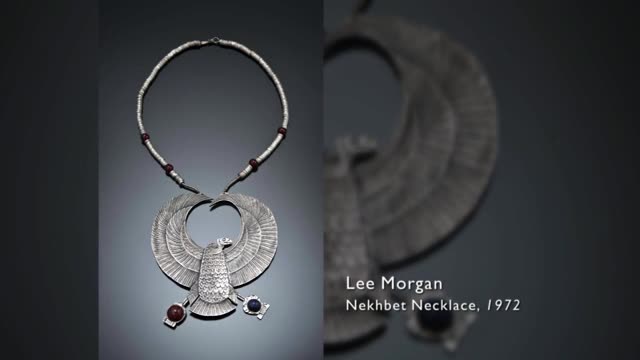
Funding for COLORES was Frederick Hammersley Foundation >>THIS FROM PREHISTORY TO THE LONG POSSESSED ALBUQUERQUE MUSEUM'S CONNORS SHARES HOW JEWELRY ALWAYS BEEN >>The jewelers in New best in the United States that they have been for years. >>IN HIS PROVACATIVE SCOTT GREENE HOLDS UP A >>There's a lot of artists the human element I kind of go the other >>I think ultimately he
painting something that perception of something directly but hadn't >>ARRIVING IN 1919, DEEPLY IN LOVE A MEMBER OF LOS CINCOS PASSION FOR PAINTING WAS FOUND IN THE LAND. >>It was a natural compulsion. >>IT'S ALL AHEAD CENTURIES OF JEWELRY REFLECT THE SPIRT ♪ ♪ >>Connors: I think it's
always remember that New long history of And I think in no other that there is basically that's unbroken, where materials transforming can decorate their body. I love that trajectory, jewelry. Every culture has some their heritage, but in New sort of, conglomeration of you can possibly imagine. So, every form of jewelry has been created in New the past, or certainly >>Kamerick: So, innovation scope of a tradition, but cultures. How is that
>>Connors: Well, I think we realize that human boxes. Human beings do not trajectory. Moving from my ancestry, all share ideas. We share community. We share neighborhoods. We share materials, and we share friendships. So, you can see that today living in New Mexico. They know each other. A Navajo jeweler might be Hispanic jeweler. An African-American close friends with a and they share ideas. And, they share They share tools and that beings exist. And, that's what's so that for thousands of been a land remote It's been a crossroads. It's been a place that It's been a place that
on their way somewhere constantly being New materials are Technologies are being this can be reflected in Mexico. >>Kamerick: What lineages have you found >>Connors: Well, certainly American lineages and one most looking forward to exhibition is some of 3,000 years old, there is material that does not was brought So, clearly, that maker of shell that had must have said, I've never seen anything I'm going to celebrate think of with traditional traditional cultures say, and reject it.
Human beings Human beings try things. The way that we eat foods. The way that we celebrate our own, is a perfect and materials through because things are often portable, can come across the Gulf Coast into New the visual heritage >>Kamerick: Isn't there a consider sort of the Mexico jewelry? >>Connors: There's a great that has two tabs of something that we would would use today from 400 old. And, flanking those two two pieces of abalone have come from So, at least 2,500 years this abalone shell as some
Pacific into New Mexico, community to community, in New Mexico said, "This to celebrate it. I want to use that never been used before." two pieces of turquoise, as so proto-typically strung on yucca fiber. So, what could be But it's all about new materials. >>Kamerick: How do share a story >>Connors: Well, I think that are absolutely the material, certainly material, and what we tend comes from New Mexico. It also comes It comes from Nevada, So, turquoise comes from but turquoise also Turquoise also went from
to the Mashika people founders of Mexico City. Long before the arrival trade routes, so that this be used in pre-Columbian So, that transmission of that is absolutely the You share precious things. You use them as a we see that with silver day. And, what could be more somebody to bring home jewelry? The stereotype of Well, 100 years ago, 120 wanted to bring home was silver filigree jewelry. That was the tourist That fell out of favor. The Hispanic-style of of favor and Native
place. Who knows, maybe in the jewelry from New Mexico tourists are If we're doing our exhibition, we'll be lot of those >>Kamerick: There's even one piece, made >>Connors: There are a composites? > There are a number of of plastic in the something that we tend certainly in the a number of jewelers Pueblo or Santa Domingo couldn't afford coral or expensive materials, so battery casings, or they discarded records, they used toothbrushes, toothbrushes and ground a precious stone. >>Kamerick: That's >>Connors: Well, It's problem-solving. You find these discarded new purpose for them.
You upcycle them, and ornament. There are other works from that were created by one engineers in the And, Armen Winfield was teach plastics technology Mexico and be an advisor and here he was on the working with his artists plastic jewelry while proof wind screens for the weekdays. So, there's this wonderful and functionality. >>Kamerick: How does a understanding of what >>Connors: Many of the the show are working with materials that they Pat Pruitt from Laguna computer-controlled so he's using very, very
space-age. And yet at exactly the Ousmane Macina, who came needs basically something some mud and some dung and can make the most woven silver and gold of centuries He comes from at least 10 silversmiths in West needs no equipment create this jewelry. He can make absolutely >>Kamerick: And he's >>Connors: And he's here and so we see this Some artists love that simply use their hands equipment. >>Kamerick: What about art by taking a look at >>Connors: Well, I think
about the nature of human exploring one medium, or being made throughout the So, when we look at 3000 New Mexico, we get to see step very far from the them to open up an opportunities and options. They just have to For instance, the into Native American realm of innovation and traditional materials that been using 100 years stone and shell, when entirely different The slightest introduction idea, can mean that the entirely different
exciting to me to see, the follow a slight hint and world. >>Kamerick: What do you from this exhibition? >>Connors: I hope that understanding that appreciating something viable is something that doing. We need to ask people of these objects look like okay it's a piece of but once you find out the story of the culture that it opens your appreciation allows us to realize that more interesting than And that, if we allow previously expected individuals are going
expectations. The jewelers in New Mexico the United States and the have been for at ♪ ♪ >>SCOTT GREENE CHALLENGES ♪ ♪ >>Bellamy: There's
Who or what is at the >>Greene: We are. We are at the And things have gotten to a lot more chaos ♪ ♪ >>Greene: There's a lot of eliminate the human landscapes. I kind of go I'm painting everything away and human activity It's a way to make a doing to the land. What we're doing It doesn't seem like a trying to live here, that
In "Deluge," the painting, insulation. I'm thinking about, well, Insulating us from We spent a lot of time the environment to protect all exposed. ♪ ♪ >>Bellamy: Could you tell decisions that led you to we're at with >>Greene: Well living and nearly 30 years has work. You really see the poverty and exploitation we bury the
We have the underground dry-cleaning that's going and we're trying to do it's, but it's very slow. I think it sticks out in you see it more. >>Bellamy: What obstacles to communicate to >>Greene: Some people objects in it: a mountain whatever, and it's not It's a beautiful sky, but I do try to make the as I can, so that is the of ways. ♪ ♪
>>Greene: There's times seem real. It's almost as if the reality and I think certain feeling that It's beyond what I can make that a real realistic interpretation not being real. ♪ ♪ >>Greene: There's a lot of hope that that comes makes people not turn away
it, or the more As a way to get more some distance on these we're all facing. ♪ ♪ >>SANTA FE PAINTER FREMONT PASSION FOR >>Bonnie: It was amazing
on a canvas and then it mountain, clouds, sky. And I think about his was coming home and the blue and these great big distance was just And there was one ♪ ♪ >>He was very serious he actually had no choice. It was a natural ♪ ♪ >>Narrator: It was a day I had never seen, very thunderhead cloud I thought, "My God, this Ellis) When 22-year-old
Santa Fe in 1919, >>Bonnie: He saw beauty simplest thing. >>Fremont Ellis II: In impressionistic verging on was very quick and down and do just the something just right. >>Narrator: For 67 lands' enchantment. His friend and fellow think I never met a man The physical act of He loved the very pigments onto his palette. He was deeply enamored painting, of the heft and touching in just the right
surface of the taut, The whole magic of the act hand and heart." ♪ ♪ Inspiration struck early with "The Rocky Mountains." >>Fremont took him to the Met, he could actually depict >>Bonnie: And, he told me, understand how Bierstadt >> Fremont Ellis II: He lived it and breathed it. It was in his bones >>Bonnie: He'd take a he memorized what was in home and he put Next day he'd go back He finished the painting,
experience for a >>From that moment on he I can do something like represent the majesty splendor of Mother Nature throughout his entire >>Bonnie: Painting, That was his life, and he painting. He never hesitated and he his pocket. >> Fremont Ellis II: He very quickly, cursorily. I think ultimately he
painting something that perception of something directly, but hadn't seen light. >>Bonnie: And, in the It was so special. He said, "You "I said, "Oh heavens, through the trees and I through the Aspen. And every time I see He made beauty come to
grateful that he Until Next week, thank you for
- Series
- ¡Colores!
- Episode Number
- 501
- Producing Organization
- KNME-TV (Television station : Albuquerque, N.M.)
- Contributing Organization
- New Mexico PBS (Albuquerque, New Mexico)
- AAPB ID
- cpb-aacip-a7c16875e8e
If you have more information about this item than what is given here, or if you have concerns about this record, we want to know! Contact us, indicating the AAPB ID (cpb-aacip-a7c16875e8e).
- Description
- Episode Description
- From prehistory to the present, New Mexico has long possessed cultures of adornment. Albuquerque Museum’s curator of art, Andrew Connors (curator, Albuquerque Museum), shares how jewelry-making in New Mexico has always been about innovation. “The jewelers in New Mexico are some of the best in the United States and the wonderful thing is that they have been for at least three thousand years.” In his provocative paintings, Bernalillo’s Scott Greene holds up a mirror to our society. "There's a lot of artists that will try to eliminate the human element in their landscapes. I kind of go the other way; I'm painting everything people do or throw away and human activity as part of the landscape." Arriving in 1919, painter Fremont Ellis fell deeply in love with Santa Fe, New Mexico. A member of Los Cincos Pintores, his lifelong passion for painting was matched by the beauty he found in the land. “I think ultimately he was really concerned with painting something that would give other people a perception of something they’d experienced directly but hadn’t seen in that way.” “Painting, painting, painting, that was his life.”
- Created Date
- 2019-01-26
- Asset type
- Episode
- Genres
- Magazine
- Media type
- Moving Image
- Duration
- 00:26:51.498
- Credits
-
-
Guest: Connors, Andrew
Guest: Greene, Scott
Guest: Ellis, Fremont
Host: Bellamy, Hakim
Producer: Kamins, Michael
Producer: Walch, Tara
Producing Organization: KNME-TV (Television station : Albuquerque, N.M.)
- AAPB Contributor Holdings
-
KNME
Identifier: cpb-aacip-5fef264d08b (Filename)
Format: XDCAM
If you have a copy of this asset and would like us to add it to our catalog, please contact us.
- Citations
- Chicago: “¡Colores!; 501; Curator Andrew Connors, Scott Greene, Fremont Ellis,” 2019-01-26, New Mexico PBS, American Archive of Public Broadcasting (GBH and the Library of Congress), Boston, MA and Washington, DC, accessed April 4, 2026, http://americanarchive.org/catalog/cpb-aacip-a7c16875e8e.
- MLA: “¡Colores!; 501; Curator Andrew Connors, Scott Greene, Fremont Ellis.” 2019-01-26. New Mexico PBS, American Archive of Public Broadcasting (GBH and the Library of Congress), Boston, MA and Washington, DC. Web. April 4, 2026. <http://americanarchive.org/catalog/cpb-aacip-a7c16875e8e>.
- APA: ¡Colores!; 501; Curator Andrew Connors, Scott Greene, Fremont Ellis. Boston, MA: New Mexico PBS, American Archive of Public Broadcasting (GBH and the Library of Congress), Boston, MA and Washington, DC. Retrieved from http://americanarchive.org/catalog/cpb-aacip-a7c16875e8e