¡Colores!; 304; Common Ground I, Common Ground II, Common Ground III
- Transcript
Funding for COLORES was provided in part by: The Nellita E. Walker Fund KNME-TV Endowment Fund The Great Southwestern Arts & Education Endowment Fund ...and Viewers Like You >>THIS TIME, ON COLORES! BRINGING A PROVOCATIVE NEW VISION TO NEW MEXICO'S ART HISTORY, ALBUQUERQUE MUSEUM CURATOR ANDREW CONNORS ASKS "WHO IS A REAL NEW MEXICAN AND WHAT IS THE REAL NEW MEXICO". >>The more broad provocative our vantage point can be, told through hundreds of different artistic voices, the more we are going to come close to understanding this place we call the Common Ground of New Mexico.
>>IT'S ALL AHEAD ON COLORES! (piano music) >>The more stories that we get to experience in our lives the more rich our understanding of the world becomes, and each artist tells us a different story using their own vocabulary, using using their own sense of priorities. When we look at different landscapes created by different artists we can learn a great deal, not just about the New Mexican landscape, but moreso of the artists themselves. So, artists don't just depict straightforwardlywhat they see. Artists filter what they see, very complexly. This becomes very complicated when we want to know what the real New Mexico is all about, because there isn't one real New Mexico, there are thousands or millions of real our New Mexico based on the common ground
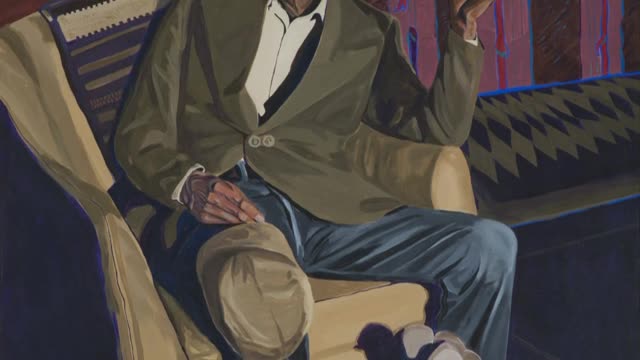
of the state, of the reality of this place, filtered around us. (piano) One of the first galleries in the exhibition asks the question "Real New Mexicans?" Who are real NewMexicans? Individuals can be portrayed in so many different ways and when you have different artists looking at the same culture each artist will respond in their own way. For instance, Edward Gonzalez has created a spectacular portrait of Patracinio Barela, the great wood carver from Taos. Gonzalez's portrait shows the nobility, the strength, the wisdom, the thoughtfulness of an artist who was one to be shown in museums in New York City. And Edward Gonzalez said we need to know this man. portrait of him. (piano)
>>There's a portrait of Julian Duran, a young shepherd from Taos and he was painted by Buck Dunton in 1926. Julian Duran probably listened to the radio and probably drove around in a car every once ina while, but Buck Dunton decided to portray him as a goatherd, as a shepherd in the spectacular landscapes a romanticized painting and it's a painting that basically does not celebrate Julian Duran's modernity. It celebrates the past. It celebrates his fitting into an ancestry of generations. So many Mexicans were aimed for an outside audience to show people not from New Mexico what New Mexicans look like. We have a couple of astoundingly important
examples of portraits that are representative of Hispanic New Mexicans, for Hispanic New Mexicans, and those works of art really tell complex stories and important stories of modernity of modernism andcontemporary life. One individual here in Albuquerque, Juan Jose Baca, said I want to be photographed. I want to be portrayed in the most modern media possible. In the eighteen eighties there Mexico to create a photographic portrait on this scale and so Mrs. Albright made a drawing in charcoal that looked like a photograph, and the same was true in 1906 when the Armijos commissioned a portrait from an itinerant painter that shows them as up to date as modern as any couple in Philadelphia and Boston in New York in Charleston and as Hispanics they were leading Albuquerque and therefore New Mexico
looking back to their past and on their heritage. In this exhibition we see broad range of ways that artists found the voice that they needed to tell the story that they wanted to tell. In artist self-portraits we get one of the wonderful opportunities where artists don't have to worry about flattering other a variety of different techniques. Raymond Jonson explored a technique called pointillism. And, then we bring that up to the present and see Fritz Scholder being incredibly expressive with his brush stroke. (piano) Sheldon Harvey, Navajo painter, created a self-portrait that just rips your heart out because he's looking at himself through the guise he have to do to make himself
look Indian? Many artists came to New Mexico because they had heard of the spectacular interesting is how many artists interpreted other things as well as the stereotypical landscape. Raymond Johnson came to New Mexico a few years before even Georgia O'Keeffe arrived and looked at the landscape and was inspired to paint the landscape in very unusual ways. This spectacular way that he presented Carlsbad Caverns is so theatrical. Sometimes contemporary artists are very much moved by the entropy of the loss of the change of culture and heritage through time. Tim Prithrow created a model of Starkey's trading post. It was the American Dream it was this man's ideal to create
a trading post and raise his family, and create a good income for himself, but when route 66 was passed over in favor of the interstate Starky's Trading Post and multiple other businesses, thousands of other businesses throughout the West lost their vitality and Starkey's tradingpost shows the loss of the American Dream on behalf of this one family. (piano) So, what is the real New Mexico? (piano) If we're willing to enter
into a new world of each artist we really shed a lot of our preconceived notions. We shed a lot of our expectations for what the truth is, and we may be open to new truths and to new of seeing things. The more broad our vantage point can be told through hundreds of different artistic voices, the more we are going to come close to understanding thisplace that we call the common ground of New >>We always ask in New Mexico whose culture is truly New Mexican? All of our cultures are truly New Mexican. It's
not just a landscape that's static. It's a landscape that has existed over time and human beings have created new culture within that With every great creative tradition that's come to New Mexico, it's been transformed in a way that's completely unexpected and completely unique to the North American continent. One of the important parts of New Mexican aesthetic heritage is the remoteness, and so most religious objects era weremade at home. Some of them came up on the Camino Real, but many of them were made right here in NewMexico. They could never be confused for coming from Mexico then, was passed on generation to generation. By the 19-teens Jose Dolores
Lopez in Cordova, New Mexico was creating commercially milled lumber window frames and picture frames and furniture but he was carving them to decorate the functional objects and then he painted them in addition to the chip carbon. It was a later generation of Anglo visitors that really admired his chip carving and admired his aesthetics but encouraged him to stop painting his work. By leaving it plain, leaving it unpainted, became a modernist aesthetic object. object or is it a modernist object? And that push and pull has been consistent throughout the modern era here in New Mexico. The challenge that we have with the maintenance of tradition is just how much and how much of it can exist in contemporary life,
and there are great santeros in the nineteen sixties and nineteen seventies who were reviving the tradition of making saints and Horacio Valdez is perhaps the most famous of those artists and Horacio Valdez went to the art store of and bought commercial paint, and there were a number of people that said, "That's not traditional. You can't use that." And Horacio Valdez very much said, "I'm going to use things of my time period, to keep myancient heritage alive and to keep it relevant." In the same way Luis Tapia says that he is the tradition. No matter where he goes making traditional art, because he is of that heritage. Nicholas Herrera from El Rito decided that he was going to create a death
cart, but we don't drive around in carts very often any longer, so he made a death truck from Los Alamos. So, is this tradition or is it not tradition? And Nicholas a maintainer of tradition, because he's constantly saying our contemporary life is much more full and much more rich when we know what came before. That sort of relevance and updating of stories keeps New Mexico alive and interesting. You don't live in the past. We live in the present and we look forward to the future, so when traditional artists can do that as well it means that the life and the art is going and viable. The wonderful thing as human beings, creative human beings, is that we're allowed to be influenced by other people. We're allowed to see the world through somebody else's filter
or through somebody else's stories and that's when things get very interesting and engaging, but it's also where things get a little difficult because who has the authority to tell the Pueblo story? Similarly, can a Nativeartist respond to an art form that is an Anglo art form? Jason Garcia is a perfect example of that.A traditional potter from Santa Clara Pueblo creates a cartoon superhero using contemporary language, contemporary idiom, as a way of saying this is my heritage and I want it to remain active. I wantit to remain powerful and communicative. Diego Romero is telling the story of the Pueblo Revolt andhe's using traditional ceramic vessels, but he's using gold leaf on the vessels and the style that he is painting in is much more classical Greek figure
painting than it is Native American. So, does Diego Romero have the authority or permission to use Greek-style painting to tell the Pueblo Revolt story? I don't think he needs So, he's bringing from the world. He is a man of the world and celebrating all of those stories and telling them using the visual language that he feels most appropriate for his message. somebody else's culture usually gets a very bad rap because we want to be true to ourselves. We don't want to be seen as stealing somebody else's heritage or their culture but we do that all the time as human beings. Sometimes we explore that is so meaningful to us, that we want to make it ours. When an artist comes in and says I really likethe
way your culture does that. I want to try it too, that's a slippery slope. Sometimes that becomes a little bit dangerous. There's a wonderful in an absolutely non-harmful way, a way that says I love your work so much I'm going to use it in maybe an unexpected manner. We have a wonderful painting of Jesus and the Sagrado Corazon, the sacred heart of Jesus and the man who made it decided, "I need a frame headlight and put his painting in theheadlight with the lens in front of it, so the idea of appropriation in some cases simply means responding to the things, the new things respond to outside stimuli. We allrespond to cultures and aspects of culture that are not our own.
It's very important that in our contemporary society we allow for a variety of different voices and languages and cultures and heritages. Good artists bring all of those different voices together and the more times that we're told a story in a different language, using a different aesthetic system, of coming from a different something more about ourselves and about the place in which we live. The more voices we can hear in more languages, the more we can celebrate humanity and celebrate that incredible creativity that is the human being. Human beings have this capacity to see so many different ways, to speak in so many different ways, to create paintings, to create sculpture, to create photography, all from different vantage points, and the more we expose ourselves to those different vantage points the greater the understanding we will have and how we, as an individual, fit into the larger context
that is the diversity >>Our daily existence becomes very interesting when we are challenged with new ideas, and challengedto come up with our own thoughts. The world is very mundane if we live in the same day. If we think the same things day after day after day. It's when we get provoked. It's when we don't know what the right answer is and we have to make that to answerthat question that we really learn more about ourselves and the world becomes that much more expansive and interesting. Modern Art creates a real
challenge for us because a lot of people will go up to an abstract work of art and expect it to tell them something as opposed to allow something out of them. And, for most artists, most good contemporary artists, art is not supposed to be something And that challenges us because contemporary artists always expect that the viewer is going to participate in the interpretation. They don't tell us what to think but they challenge us to think. So, New Mexico, while it didn't necessarily provide abstract subject matter, the openness of the space, to experiment and try new things, I think allowed things to happen here in New Mexico that happened nowhere else
in the United States. Raymond Jonson is a perfect example of one of those experimenters. Raymond Jonson, when he came to New Mexico, was a figurative painter, a landscape painter. But, shortly after arriving in New Mexico, he began to reduce the outside influence, to pure abstraction. And, he with a group of other artists founded a group called the Transcendental Painting Group that basically implied that good painting, good works of art, can transcendthe here on the planet and take us somewhere different. It can take us to a world of open interpretation and open possibility. In Albuquerque, unlike in Santa Fe or Taos, there was no perceived traditional culture. There was no heritage that you had to respond to. The world was of the railroad in 1880, Albuquerque was a place that
was looking forward constantly. It was a place of commerce and business and when the University arrived it wasthen a place of Commerce Business and new cutting-edge ideas, and the artist responded to that verypowerfully. Juane Quick-to-See Smith, coming from a Native American background moved to New Mexico, an entirely different cultural area for her, and pulls things from her ancestry, from her heritage in Montana and Idaho area, and interprets
that through the realities absolutely modern images. One of the youngest voices, now, to burst on the scene is Sheldon Harvey, who paints from his Navajo heritage and tells stories. He does root his paintings in subject matter that is meaningfulfor him and his community, but if we don't know those stories we can still get so much from those works of art if we're willing to invent our own. To come up with our own solutions to the challenges that he proposes to us. So, when when they find their language in which to express themselves, they can push it towards abstraction, towards the ethereal, towards the unclear or the unrepresentative, or they can pull it back and tell very specific stories that work
for them and work for their heritage. With the revival of the Santero tradition, which was in many ways spearheaded by a number of dynamicartists including Horacio Valdez, we see an anti-modern response to the new and to experimentation and a return to a past subject matter, from heritage, from their ancestors. But what Horacio Valdez does with his death cart is streamline it. He minimizes the details and he reducesit to the pure communicative form of modernism. Ramona Sakiestewa, a weaver of Hopi heritage has been working in a medium that's not traditional for women. In the Hopi culture, the men do the weavingso she's
breaking new grounds that way, but she's also weaving in a way that is very avant-garde and is very contemporary and it's completely abstract. Certainly the colors would never give us any indication that she is looking at stone work from New Mexico. The fact that she's rooting it in pre -conquest heritage is really profound. see the world through lenses of wonder and the best artists are so enthused with their constant daily interaction with the unknown that they want to share that with many ofus and contemporary artists, abstract artists in particular, love to share the unknown with us, because they've just gotten their themselves and they want
to pull us there so that we can see it as well. When you walk through the portrait section of the exhibition I hope nobody will say that's a typicalNew Mexican or this is what a typical New Mexican is, because all of those portraits are New Mexicans. All of those landscapes are New Mexican places. All either made in, or are a reaction to New Mexico, and I think it's important that all of these different voices are engaged in this communication and all of these works of art basically push towards an understanding ofwho we are as a state and who we are as a community through all of our diversity >>Funding for COLORES was
provided in part by: The Nellita E. Walker Fund KNME-TV Endowment Fund, The Great Southwestern Arts & Education Endowment Fund...
- Series
- ¡Colores!
- Episode Number
- 304
- Producing Organization
- KNME-TV (Television station : Albuquerque, N.M.)
- Contributing Organization
- New Mexico PBS (Albuquerque, New Mexico)
- AAPB ID
- cpb-aacip-a58c6fa79e1
If you have more information about this item than what is given here, or if you have concerns about this record, we want to know! Contact us, indicating the AAPB ID (cpb-aacip-a58c6fa79e1).
- Description
- Episode Description
- Who is a Real New Mexican, and What is the Real New Mexico? - Bringing a provocative new vision to New Mexico’s art history, Albuquerque Museum curator Andrew Connors asks, “Who is a real New Mexican, and what is the real New Mexico?” “The more broad our vantage point can be, told through hundreds of different artistic voices, the more we are going to come close to understanding this place we call the ‘Common Ground of New Mexico.’” Appropriation and Allowing New Voices to Emerge - In our second of a three part series, Albuquerque Museum’s Curator of Art, Andrew Connors, shares more insights into his provocative Common Ground exhibition. In this segment he discusses the dangers of appropriation and the inevitability of cultural evolution. “It’s very important that in our contemporary society we allow for a variety of different voices and languages and cultures and heritages.” New ideas - In the last of a three part series, Albuquerque Museum curator Andrew Connors discusses new approaches to art in his Common Ground exhibition. “Modern art creates a real challenge for us because a lot of people will go up to an abstract work of art and expect it to tell them something as opposed to allow the work of art to draw something out of them.”
- Asset type
- Episode
- Genres
- Magazine
- Media type
- Moving Image
- Duration
- 00:27:37.544
- Credits
-
-
Executive Producer:
Kamins, Michael
Producer: Walch, Tara
Producing Organization: KNME-TV (Television station : Albuquerque, N.M.)
- AAPB Contributor Holdings
-
KNME
Identifier: cpb-aacip-572b6980083 (Filename)
Format: XDCAM
If you have a copy of this asset and would like us to add it to our catalog, please contact us.
- Citations
- Chicago: “¡Colores!; 304; Common Ground I, Common Ground II, Common Ground III,” New Mexico PBS, American Archive of Public Broadcasting (GBH and the Library of Congress), Boston, MA and Washington, DC, accessed September 23, 2026, http://americanarchive.org/catalog/cpb-aacip-a58c6fa79e1.
- MLA: “¡Colores!; 304; Common Ground I, Common Ground II, Common Ground III.” New Mexico PBS, American Archive of Public Broadcasting (GBH and the Library of Congress), Boston, MA and Washington, DC. Web. September 23, 2026. <http://americanarchive.org/catalog/cpb-aacip-a58c6fa79e1>.
- APA: ¡Colores!; 304; Common Ground I, Common Ground II, Common Ground III. Boston, MA: New Mexico PBS, American Archive of Public Broadcasting (GBH and the Library of Congress), Boston, MA and Washington, DC. Retrieved from http://americanarchive.org/catalog/cpb-aacip-a58c6fa79e1