Report from Santa Fe; Hampton Sides
- Transcript
The National Education Association of New Mexico, an organization of professionals who believe that investing in public education is an investment in our state's economic future. And by a grant from the Healey Foundation, Taos, New Mexico. Hello, I'm Lorraine Mills and welcome to report from San Fe. Our guest today is Distinguished New Mexico author Hampton Sides. Thank you for joining us. It's good to be back with you. It's wonderful having you back. We're here to celebrate the paperback release of your latest book in the Kingdom of Ice. Now this caused quite an ice storm, quite a flurry of words and good reviews. Tell us a little about this book. Well, it's a it's a book about an early American attempt on the North Pole, one of the one of the first official ones and it's
going back to the early days of polar fever and this nagging, annoying need that we need to know that we had back then for what is at the top of the world. We didn't know if there were holes up there that led down into the earth. That was one of the leading theories. One of the other theories that this expedition was designed to test was whether there was there was a belief that there was an open polar sea, a warm body of water up there that was fed by the Gulf Stream and other oceanic currents. So in the summer of 1879, the captain George Long and his 32 men and their 40 dogs left the United States went past Alaska, which we had fairly recently purchased from the Russians and looked for this open polar sea. They didn't find the open polar sea what they what they found was ice, lots and lots of ice. Well, they were trapped in ice for two years. Two years. That's what makes it such a wonderful summer read. Yeah. There's a lot of
ice. It's literary air conditioning. It'll cool you off. That period of when they're stuck in the ice, certainly they start to go crazy. They they're not actually suffering though. They got plenty of food. They're just waiting for something to happen. When finally in two years later in the summer of 1881, the ship is crushed by the enormous pressure of the of the pack and it's thanks to the bottom of the Arctic Ocean. And so these men and their dogs and three open boats and very few belongings are are stranded out on the ice pack and the plan is is to use that summer and a limited amount of time to reach the nearest landmass, which is the central Arctic coast of Siberia, about a thousand miles away. So it's really one of these great survival stories, a story of you know comradeship and friendship and leadership as they try to hold this thing together during that summer and make it to open water where they can sail the rest of the way to Siberia. Now you make this tale when reading it is an
absolute page shunner. It's riveting. It's like you are there even the dialogue. You almost feel like you're eavesdropping. And then it's gotten so many wonderful reviews. You have a way of making this adventure and this challenge a metaphor for the travails we all face and we wonder what would I have done? Well, I wouldn't ever. Yeah. Well, some of you are always asking yourself what these Arctic stories, you know, invariably things go wrong. They go north, everything goes south, you know. And so you ask yourself, how would I survive this? What combination of qualities would I try to summon? Whether there's a sense of humor or religious faith or physical stamina? And it's also a study and leadership, you know, you're constantly asking, did the long make the right decision here there in the next place? And it does become a metaphor for all of our travails that we experience. One example in the book, there is a place where they're having a great success. They think they're
marching to the south and making great strides when they take a positional reading after two weeks and realize that the ice over which they're struggling is actually drifting faster to the north than they're moving south. So they've been going exactly backwards for two weeks. And it was a demoralizing needless to say, period of that, but they, but they do hold it together along as proofs in an amazing leader. And I mean, I was drawn to this story mainly because of him and because of the fact that I had never heard of this expedition. Almost no one has. I mean, it's even though very, very important expedition in his day, subject of bestselling books and inquiries and parades and monuments, it was almost completely forgotten. And so I love to resurrect these kinds of stories and and bring them to the place where I think they belong. Well, speaking of monuments, one of the most chilling photographs you have in the book is that the icy cross in the US Naval Academy, they've monument to them. And it's a cross, but part of the sculpture is this ice dripping from it makes you
cold. Just looking at it. Yeah. And apparently there's a ritual at the Naval Academy where, you know, they take the midshipmen have kind of a hazing ritual and midnight they have to go and count the number of icicles on the Jeanette cross. And report back, you know, your tax dollars will work evidently. But yeah, I mean, it is the one place where the Jeanette is celebrated and known is in the Navy circles because it was a US Naval expedition commanded by a Navy captain. So the Navy people know about it. But after the book came out, though, I mean, it was the bestseller. It has been option to be a mini series. Now there's now a group of scientists, both Russian and American that want to stage an expedition to go find the rec, which is way off way off in Arctic waters and Russian waters. And which I'll be a part of if that actually happens. So there's been a lot of new interest in the Jeanette because of the book. I mean, there's also a pattern
of ship will get stranded in the Arctic than a rescue ship goes to rescue it, but the rescue ship gets stranded. Yes. And then someone goes to rescue them. This is a very bad domino effect. A bad bad then. Now we hope with the, you know, these Russian icebreakers are pretty indestructible and with GPS and with all the tools that we have now, we won't we won't suffer the same fate. We won't get stuck in the ice. But it is true that this expedition, the Jeanette, no one had heard from them for two years is like they went off the face of the tragic letters from his wife. Oh, yeah. So his wife writes all these letters to him and the hope that he did the captain. The captain will receive them by way of some Arctic wailers. Oh, they're tragic letters. They're beautiful letters. And I found them sort of by accident by cold calling all the delong people in the phone book in New England. Because I'd heard there were some survivors and found this woman and she had a trunk literally one of these classic scenarios, a trunk in the attic full of letters. And she let me
and they were from when she wrote in duplicates. So this is from Mrs. Delong to her husband, the captain during the summers of 1879, 80 and 81. She called them her letters to nowhere. They never reached him. But she had made copies and in some cases the letters had returned back to her. So that forms actually a pretty important part of the book. I want to talk with you about your background. I want you to tell us about your background because a lot of the things you did in researching this 1870s story were modern journalistic techniques. Now you have a degree in in history. But is history changing? What is narrative nonfiction? You're known as a bestselling author of narrative nonfiction. These gripping epics that you write about, but they're rooted firmly in history. Yeah. Well, you know, I think there's a question of nomenclature for the kind of work that I do. It always bothers me, for
example, that what I do has a non has a negative in front of it. Like nonfiction. Why is it shouldn't be the other way around? It should be truth versus non- truth. And there's also question even more narrowly in the profession of like, do we call it literary history, literary nonfiction, literary journalism, creative nonfiction? I hate all those terms. They're not quite right. It should be called history. But unfortunately in the last hundred years or so, academic historians and the profession of history has gravitated in a different direction. You know, most academic history I'm afraid is deadly dull. You know, chlorform and print. It's put you to sleep. It is aiming increasingly for a very narrow audience of other scholars. And so about the early historians like Herodotus and Thucydides and Tacitus and so forth. I mean, they certainly understood that they wanted an audience. They
knew how to hold an audience. They knew how to tell a story. And that's what narrative history strives to do is tell a story. Rather than argue a very narrow case for a very obscure esoteric topic. So I'm looking for a general audience. I'm looking for great tales that have great characters. And most of the kinds of attributes that I guess you now more commonly associate with with a novel. For shadowing, suspense, dialogue, dialogue when you can find it, point of view, shifting points of view, multiple narrative lines that intersect and are braided. So those are the kinds of things that, you know, a narrative historian I think he's looking for. And really, you know, the history that's being read and is being reviewed and taken seriously in popular circles is generally being written by narrative historians. Most of them are really journalists who got into the history game a little later. And a golden age for that. I mean, you know, they would McCullough and Nathaniel Philbrick and
SC Gwen. And I mean, I could go on and on. There's a lot of great people out there doing what I do. And so, but it's an interesting time to be practicing this this craft. Well, you practice it well. I want to look at one of your best selling books. This is the old hardbound that the paperback has a cover with Kit Carson. It's called Blood and Thunder. And I know someone who gives away buys them 20 at a time and gives them to everyone he knows. It's called an epic of the American West. It's the best thing that's been written about Kit Carson. Tell me and what you had to work with as a historian, you said, do you looked at his papers? There were two papers. Yeah. Well, Kit Carson was a literate. And so he didn't produce many papers and created a challenge for me as a historian to go around the country finding places, archives where there were there was stuff written about him. But I wanted to use Kit Carson. You know, it's not a biography of Kit Carson, but I use Kit Carson as a it's kind of a through line, almost like force gump, you know, he's a guy who had this
curious knack for intersecting with history and with major figures all over the American West. Whenever something was up, he was in the center of it. And yet here he was, this illiterate backwoodsman from originally from Missouri who who wandered out here and through his own wit and through his sort of hard weren't hard one experience as a mountain man as a scout as a as a what I call a pre-Westerner because this was before Westerns. This is you know, there's no barbed wire. There's no cowboy hats. There's there's there's most of the white guys are speaking French or Spanish and they're on the backs of fuels, not horses and they're usually chasing sheep, not cattle. It's a very different West, but he was this proto pre-Westerner. He was this great character to follow to try to understand the larger story of manifest destiny and how the whole Western third of the continent was captured and and and conquered and subdued in one generation, his generation, the 1820s, 30s, 40s, and
finally he died in the 1860s. Now although he was illiterate, he spoke seven or eight Indian languages and recently in Towson we talked about this on the airwants. They came in, they were going to rename everything that had Cate Carson's name on it like Cate Carson Park, Cate Carson's house, Carson National Forest, and actually people were raised about the effort to kind of sanitize or revise history. Right, it's still controversial and on, you know, people are always trying to find safe history, but you know, history is not for sisters, you know, I mean it's, you know, Thomas Jefferson was a great man, you know, there's no question about it. He also, it's had slaves, as did Washington. So, but are we going to sanitize them from our history as well? No, I think, you know, the better course is to sort of recognize who these men were and all their complexity, they're good and they're bad and to try to understand
the times that they lived in and not to judge them by present-day standards of equality or women's rights or racial, racial equality or whatever standard we might have now. I thank God we've evolved as a society from the days of Cate Carson because they were very, very violent times and he's the kind of guy that if you had to go back in time and live in those times, you'd want him on your side. He was a great fighter. He was someone who was really calm and poised in tense situations. He knew the West extremely well, he knew all the river systems, he had been everywhere and really knew everybody and was very close friends with many Indian tribes. He mentioned, he spoke multiple native tongues, he married an Arapaho woman, his first wife was Arapaho. He was not an Indian hater in any sense of the word, but he is known for his best known perhaps for his conquest of the Navajo people. They are long walk, they are of course a very important tribe,
one of the largest living on the largest reservation now. So, of course, their enemy is quite well known as now, as an enemy of much of Indian America, but that's a very simplistic view. Right. Now, you have said that you're one of the things you're fascinated in your books, as you work on them is character, you're attracted to strong characters. Kate Carson was certainly a strong character. You have written an intriguing book about the man who killed Martin Luther King, he's called Hellhound on His Trail, the stocking of Martin Luther King and the international hunt for his assassin. Now this, you swam in danger of seas when you did this. Can you tell us about this? Well, I grew up in Memphis, born and raised there, and it's the biggest thing that ever happened to my hometown, the assassination of Martin Luther King. I wanted to write about the event, I wanted to try to piece it together and deconstruct it, but then I became intrigued by this character, James Rollray. Who was he exactly? I became convinced that he in fact
did kill King. I leave a lot of doors open about conspiracies because I think he did have some help, but I do believe he fired the shot. And once I kind of reached that position in the research, I decided to really follow him and read what he read and go to all the places where he went both before and after the assassination. It's not very well known that it took 65 days before he was captured in Heathrow Airport in London on his way to Rhodesia where he, if he had made it, and he just, he almost got on this airplane, he probably would have alluded capture, would have gone to Rhodesia where there was no extradition treaty, and he would have gotten away with this crime. So it's a fascinating kind of international detective story about how the FBI and Scotland Yard and a lot of other agencies finally caught this creepy guy. I mean, he's fascinatingly creepy. You can't invent a character like James Rollray and kept me busy for number of years. And I really, I really enjoyed this that project a lot is
fascinating. We're speaking today with Hampton Signs. We're celebrating his the paperback release of In the Kingdom of Ice. We're talking about Hellhound on this trail and the man who killed Martin Luther King. You, you, you make me as interested as you clearly were. This guy was an escape artist. Well, he did escape from two maximum security prisons. With the oldest trick in the book. The bread box kind of thing was a big bread crate that he got into from the bakery of the prison. And he, you know, he was one of these guys that was both brilliant and stupid at the same time. He would do these brilliant things that involved a lot of planning and scheming, and then he would, he would do one stupid thing like leaving the rifle near the science, the scene of the crime in Memphis, and a bundle full of stuff that ultimately got him caught. So, you know, he, he's just, he's an interesting cat. And I love in my histories to try to find these kinds of
characters and follow them. And sometimes they're heroic and sometimes they're in, like in Ray's case, very, very dark and very complex. And kind of a vessel of the zeitgeist. I mean, he was a real creature of the 1960s in many, many ways. And I had had a lot of fun kind of trying to understand the complexities of his personality. You don't only write gripping books narrative, nonfiction. You do, you're an editor at large for outside magazine. Outside magazine, too. I do a lot of journalism magazine articles. You had the cover story on June's National Geographic about marijuana. Yeah, yeah. So, that was certainly an article that caused my teenage son to smirk and some of his friends. But I that was a great story. And it was really about the science of cannabis. It's about where we're at now in terms of our knowledge of the plant itself and the
compounds that are in it. The medical uses, there's a geneticist in there who's literally literally doing the genome for cannabis. And kind of what's happening in the front lines of cannabis research now that people are starting to recognize and they're sort of a critical mass of people who understand that this plant has a lot to offer. Besides just being intoxicating, it's a it's a powerful mullage of all these compounds that have all these potential uses. I'm always impressed by your research and this is very well research in terms of the scientific literature. You also point out that no one has ever died of an overdose of marijuana. Yeah, it is it can be for certain people a dangerous drug. It's not a it's certainly not an innocuous drug. But at the same time it has never caused a known case of overdose. And that's partly because it is not toxic. It does not kill cells. It is you know like alcohol kills
liver cells and bad for your brain and it's bad for your kidneys and it's toxic. Marijuana is not toxic. It's not saying it's good for you in every case. And the article is very clear on the research particularly in terms of the developing brain, the young brain. It can alter the way the young brain grows and develops. So it's the article is very clear and it's in its parameters. It's not urging people to go out and get high all the time. But it focuses particularly on this one compound called CBD Cannabidiol which has no psychoactive effect. But this is the compound that helps clearly helps with tremors and epilepsy, seizures, these children up in Colorado that you've heard about. So I you know I zero in a lot on that one compound. And I go to Israel to interview this kind of the chemist, the patriarch of cannabis science. And how do you say his name
because I read it? You have to kind of cough up a lugi to say it correctly. It's his name is Machulum. That's Machulum. And he's been studying cannabis since the 1960s. He identified THC. He played a big role in identifying CBD and almost all this other research that's happened has happened really because of his pioneering work. But what's interesting is a lot of this research has not happened here in the United States. And that's because it's been scheduled a schedule one drug which means it's a federal government position on it is that it's highly addictive, highly dangerous and has no medical value. But in the same category as heroin, which is extraordinary for anyone who has any kind of actual experience with this plant. That seems to be changing. There's a little bit of a sea change away from that position, perhaps to call it a schedule two drug. In which case then,
scientists around the country won't be risking their reputations or their financial status with their universities to begin to seriously study and do human clinical trials on this plant. Now, each one of these books is an investment of years of your life. So how do you choose like four years for in the Kingdom of Ice? It's about four. And how long for? And for not done with it after you finish it. Because you go out to promote it and talk about it and and I've been all over the country for the hard back and now the paperback version of the book. So it's really an investment of really in some senses the rest of your life. It's like having a child. So how do I pick the topics? It's kind of a mystery to me how or the precise criteria. It has a rational side which is good characters. The existence of really good primary documents. A good arc, a story arc that has a beginning, middle, and that is satisfying.
A story that has been written about Lincoln has been written about perhaps too much you might say. So those are the rational components, the little boxes that I check. But then the irrational side of it is just something that grabs me. It really, you know, that feel that sort of the goose bumps on my neck and I feel that, you know, this is something that for reasons I can't fully explain is something I want to sick my teeth in for all these years. And the new book that I'm working on now is about a a storied, very harrowing, a very heroic battle in the Korean War. In 1950 the Battle of Chosen Reservoir. So it's a battle narrative. I've written around war and and and and ghost soldiers I certainly kind of get get into some some battle scenes. But this is the first time where I've really focused entirely on one battle. I neglected to mention ghost soldiers which is about was made into a movie called. It was the movie was called The Great
Raid. It's about the baton death march in the Philippines. And an amazing rescue. And a rescue that happens late in the war of some of the survivors. So I'm I'm this is a getting back into a battle a forgotten kind of battle. And in this case the Korean War and the entire wars is practically a forgotten war. And these veterans are near the end of their lives. Many of them many of them have already died unfortunately. So I'm now traveling around the country interviewing veterans and getting ready to write this next book. What was it that grabbed you about this battle or do we have to wait and read the book? Well it has a lot of these components. I mean a lot of my books are about you know men in very extreme environments in which they have to summon every every ounce of energy and and wit and stamina to get through it. And this was a battle in which the Chinese had entered the war without our really fully knowing it. And 100,000 Chinese surrounded 10,000 Marines in the mountains of North Korea in 20 below
weather. And the the Marines have to fight their way out of this of this entrapment. It's really a fighting surrender. It's a I want to say surrender. It is a fighting retreat. They do not surrender. They fight their way to the coast. They get out of this situation and everyone who knows anything about military maneuvers knows that a retreat. An organized systematic withdrawal is the hardest maneuver there is in combat. So it's celebrated among the Marines is one of the great accomplishments. It's certainly in modern marine history and that's the focus of the book. Well I'm looking forward to reading it. I want to remind our audience this is in the Kingdom of Ice paperback perfect summer read but really riveting reading and for anyone who loves the west. They have to read Blood and Thunder which is named after those penny dreadfuls those little throwaway novels about life in the west but this you go so deep and so rich it's a wonderful book. Well thank you. And so our
guest today is Hampton Sides author extraordinaire. Thank you for joining us. My pleasure. And I'm Lorraine Mills. I'd like to thank you our audience for being with us today on report from Santa Fe. We'll see you next week. Past archival programs of report from Santa Fe are available at the website report from Santa Fe dot com. If you have questions or comments please email info at report from Santa Fe dot com. Report from Santa Fe is made possible in part by grants from the members of the National Education Association of New Mexico, an organization of professionals who believe that investing in public education is an investment in our state's economic future. And by a grant from the Healey Foundation, Taos, New Mexico.
- Series
- Report from Santa Fe
- Episode
- Hampton Sides
- Producing Organization
- KENW-TV, Eastern New Mexico University, Portales, New Mexico
- Contributing Organization
- KENW-TV (Portales, New Mexico)
- AAPB ID
- cpb-aacip-9d22d392246
If you have more information about this item than what is given here, or if you have concerns about this record, we want to know! Contact us, indicating the AAPB ID (cpb-aacip-9d22d392246).
- Description
- Episode Description
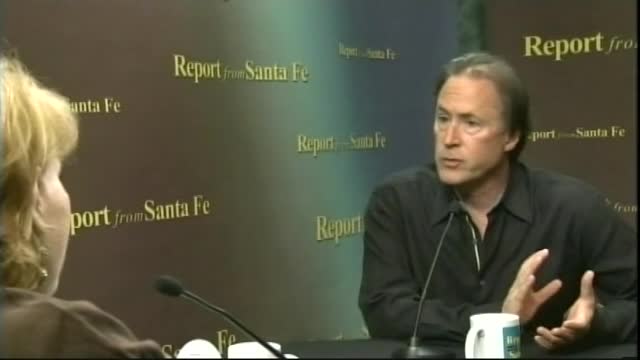
- This week's guest on " Report from Santa Fe" is Hampton Sides, award-winning author of the acclaimed best-selling histories "Blood and Thunder," "Ghost Soldiers," "Hellhound on His Trail," and "In the Kingdom of Ice." Sides is also an editor at Outside magazine and is a frequent contributor to National Geographic magazine. Sides wrote the cover article on “Weed: The New Science of Marijuana” for the June 2015 edition of National Geographic. He describes the transformative work being done in medical research on the healing powers of the drug. The article evaluates the latest research on using marijuana and its derivatives to treat glaucoma, multiple sclerosis, cancer, and AIDS and describes new directions for the scientific study of the drug. Guests: Lorene Mills (Host), Hampton Sides.
- Broadcast Date
- 2015-08-29
- Asset type
- Episode
- Genres
- Talk Show
- Media type
- Moving Image
- Duration
- 00:27:15.735
- Credits
-
-
Producer: Ryan, Duane W.
Producing Organization: KENW-TV, Eastern New Mexico University, Portales, New Mexico
- AAPB Contributor Holdings
-
KENW-TV
Identifier: cpb-aacip-3eaf1d26773 (Filename)
Format: DVD
If you have a copy of this asset and would like us to add it to our catalog, please contact us.
- Citations
- Chicago: “Report from Santa Fe; Hampton Sides,” 2015-08-29, KENW-TV, American Archive of Public Broadcasting (GBH and the Library of Congress), Boston, MA and Washington, DC, accessed April 1, 2026, http://americanarchive.org/catalog/cpb-aacip-9d22d392246.
- MLA: “Report from Santa Fe; Hampton Sides.” 2015-08-29. KENW-TV, American Archive of Public Broadcasting (GBH and the Library of Congress), Boston, MA and Washington, DC. Web. April 1, 2026. <http://americanarchive.org/catalog/cpb-aacip-9d22d392246>.
- APA: Report from Santa Fe; Hampton Sides. Boston, MA: KENW-TV, American Archive of Public Broadcasting (GBH and the Library of Congress), Boston, MA and Washington, DC. Retrieved from http://americanarchive.org/catalog/cpb-aacip-9d22d392246