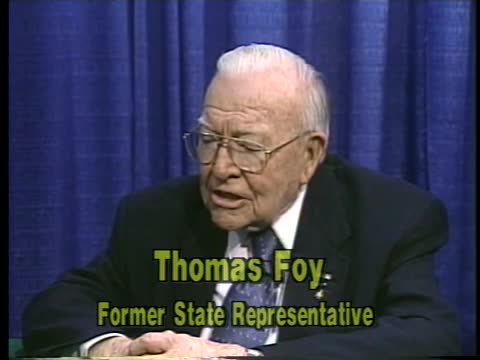
Report from Santa Fe; Thomas Foy
- Transcript
... Report from Santa Fe is made possible in part by grants from the members of the National Education Association of New Mexico. An organization of professionals who believe that investing in public education is an investment in our state's economic future. I'm Ernie Mills, this is report from Santa Fe. Our guest today from the Murray Roundhouse to be called a capital, former state representative Thomas P. Foey from Silver City from Grant County. Actually, you're down there, a little south of. In Beard. In Beard, right. This was a marvelous day to be here for this. Several of the lobbyists had gotten together. Marie Eaves was one of them and heading it up. I think Joe Minna-Pace. And they decided to honor former members of the legislature. I think Tommy, they got surprised because they didn't expect 450 to show up, but that's how many you're here.
What was your reaction to the day itself? I was really happy that they thought of the idea to get everyone together. Because now this is the first time in my memory that I've been invited up to the Roundhouse. And we received invitations and we also received places to park. We couldn't park downstairs, you know. But we received parking spaces and it's just been great. We got here yesterday afternoon and came over and had a little social last evening from 530 to 730, which was grand. I saw some men and women there that I hadn't seen in 40 years. People that I knew way back when I used to come up to the legislature when my law partner, Vincent Vesley, was the senator from Grant County. And he, Vincent passed away while he was in.
He passed away on the floor of the Senate two days before the session ended in 1965. And Mrs. Vesley? Mrs. Vesley took over. He was named to Phil and vacancy. And then her son ran for the, who's now a judge, ran for the office. But he was defeated by Benny Altvarano. And he's now a district judge and a six judicial district. That's about 30 years ago. That's right. That's correct. Six to 65 to 35 years ago. 35 years ago. You know, I looked at some of the names. Like you know, the bumped into Lydia Renaldi that I knew from Gallup. And there were a whole bunch they called Caloups, who were there. And who didn't know, the others were there, Willis Smith, who was here in 1958. There was Vernon Kurt, Republican from Los Alamos. He was from Gallup.
And I'd been out there in 1957 as editor of the Gallup Independent. You know, one other person I met that was gone by the time I come up here. But he looks like a million dollars. That's Ray Hughes. He's from over in Deming, isn't he? Yes. And Ray served up here in the 1950s. Yes. That's right. You know, one thing lawmakers told me at the reception, and then at the breakfast, because there was a reception in Capitol North, we call it now, where the old state library was. But that's been all dressed up. And then there was a breakfast in the morning at the Capitol Rotunda. But lawmaker after lawmaker said to me, how can we return some of the dignity and gentleman behavior, gentleman behavior, to the legislature that we had in the so-called good old days? Do you have any feeling about that? Yes. We have a different breed of people coming up to the legislature today. It's like in the law profession now, they're making a state two hours of professionalism.
Now, I learned professionalism when I was in Notre Dame in law school. But I don't know what they're doing anymore, because so many lawyers do not respect their fellow lawyers. They think that they, in order to make a name for themselves, they have to be femboint, flamboyant. They have to take care of everything in the way they think it's to be done, not the way the opponent thinks it's going to be done. And there's no getting together on those things anymore. You know, when I've often said this with media people, for example, if you come up to cover a legislative session with a chip on your shoulder, somebody's going to knock it off. And I've always felt that if we taught the respect for the system, it's that part of the system is that if a governor walks in, you may not like him, but you still stand up. And that doesn't mean you can't criticize him. And I found up here that if you have legitimate criticism of a legislator, they accept it.
If they know you haven't got that chip on your shoulder, if you respect the system itself. I've asked the talk to people, you know, when you have that chair in the house, and you were there for, you would have been seeing your member this year, that House of Representatives. And you don't sit in the chair of one of the representatives or senators. And someone asked me they said, that doesn't seem very, it's part of the system. And you set the rules down there. I want to go back to a period. This is after you started serving though. When you first came up, I don't think you were named to the judiciary committee. And I knew that was your love, you know, getting on to judiciary. Did you have to wait a couple of years before you got on to your judiciary? It was two years. I served as chairman of bank, money and banking, they called it, in those days. I was chairman of that committee for four years. And then I served as my second year, second term, I served on the judiciary.
And I stayed on the judiciary committee either as a member or as chairman for the next 28 years. There was a time up here when everybody admitted that they had to review, had to revise, the judicial system as such. And that's rewriting, that's a recodification of the laws in the Mexico. And they wanted, they had what they were looking, I think, with some darn fool who would take on that load. But they said, we're going to give it to Tom Foy. That was one of the most arduous jobs that I ever saw to legislate your handle. And yet you came through that with flying colors, didn't you? Here's a little background on that. Where did you start on it? How do you start, like, building a bridge? It is, but you also have a background of other jurisdictions that have revised their system, or not their system, but the laws that they operate under.
Like, we had the lot of trouble with the judiciary trying to fit it in. And a lot of people wanted the judiciary at that time to be in a point of deal rather than being an elective job. And so we compromised on it. We said, well, we elected the first couple of years and then they'll run for retention. Which has worked out fairly well over the years. The retention system is still working very well. It's still working very well. And that's given a lot of dignity also to the judiciary. The judiciary does not have to get out and subject themselves to criticism or how they handled their cases or how their decisions came down. Now, before that, you know, they criticized the judge and the judge had to go out and run for re-election. And then when he ran for re-election or he'd get into trouble, and we had that lowered the dignity of the judicial system at that time. Correct me if I'm wrong.
As I remember, there was hardly any debate on the, you know, and you had a lot. It was a massive pile of legislation. It had to be introduced that time. But when you proposed that and it started in the house, it got through almost without dissent, didn't it? Yes it did. All but one bill that we had that one of the legislators on the committee said that he would not allow his wife to use the same facilities that they had marked for men. And that was the only bill that didn't go through. You know, I was thinking today because, you know, our old friend Fabian Chavez is going to be honored very shortly. 40 years ago, he was one of those responsible for helping on the legislation for the UNM Hospital, the Medical School. And they decided to, you know, to single him out. We were going through. He wants to find out how many people were serving with him in the Senate at that time.
And I was thinking, you mentioned the bills, I call them Joker bills, like, you know, can a woman go into the men's room? And we were talking about Palomone Martinez, who had been in the Senate. And Palomone wanted to, it was a five cent toilet bill because he was upset at what they were charging people to use a restroom. So he insisted they, they, five, five cents. That was one of the most exciting bills back in the other, in the other chambers. We've had, you've seen a lot of those, haven't you? Yes, yes, we've seen a lot of them over the years. Now, you, you serve it, see, 30 years up here. I served for 28 years. 28 years. Mary served 30. It's Marie Ryan. And, uh, Mr. Speaker served 30. 30, that's sort of Raymond Sanchez. And, uh, we still have one man in there that will get 32 years. And, uh, that's K-Luna.
Fred Luna. Right, he's from down in the Valencia County. That's right. There were five of us that came in with that class in 1971. And there were five of us that lasted all the way through. And we're just getting knocked off now. You know, this is interesting. Well, the class with Fred Luna is still serving now. He's still serving. He looks like he got another good 10 years. He does. He does. I got back, when I, when I got back from Vietnam, that's when I found a Tommy Foy up here. And, uh, so I'm talking about one kind of war stories. But I wanted to look at your other career because you had served, you had been on the Batan Death March. And, uh, take us back a little bit on that because those were the greatest heroes you want to find anyway. Great guys, uh, very closely knit, great bonding with them. And, uh, we had, we had a lot from that sober city area, didn't we? Yes, we did. We did.
You know that, that group, I feel, were the finest young men that we ever had in New Mexico. That were called to duty. And the 200th was federalized. That was the 200th Coast Artillery. And we had a lot of good college men, boys that were just out of high school. We had a lot of college graduates in that outfit. And that was the cream of the crop. And it was just sad that so many of them did not return. That they were lost either on the battlefield and the Philippines at Batan. And we were trying to protect the, uh, the peninsula or the, the, uh, boys that were lost in the death march. There were about 10,000 that died in the death march. That's including the Filipino Scouts and the Philippine Army. And, uh, the, it was just too bad. We had 1,800 men in the 200th Coast Artillery that went to the Philippines in September, August and September of 1941. And we were at war.
Think of this. We were at war on the seventh day of desaith. They have desimbr. 1941. That came that close. And, you know, it's always I, I'm chided, uh, like General Baca, Ed Baca, who had been head of our National Guard here for a couple of years ago. And I said, it's funny that they had the 200th Coast Artillery and said to give a Coast Artillery to a state where there's no Coast really. I said, I knew that they were in trouble. The minute they, the minute they did that, you followed also very closely on legislation for the veterans. And you know, if you go, if you're following the Mexico back through every conflict we've ever had, the state itself doesn't like federal intrusion. But when the state is threatened, or the nation is threatened, the Mexicans are the first to show up. We saw it in Vietnam, saw it in the Second World War, saw it in Korea. It's amazing the loyalty of these people.
It said that the 200th was the first to fire and the last to lay down their arms. That slogan came when the Japs hit the Clark Field on December the 8th. Of course, it was December the 7th in white, but the state line in there, you know, it changed the date. So we were the 8th and a lot of people think that we were hit the day after Pearl, but we weren't. It was the same day. It was just a few hours later that the Japs came over with 54 bombers and dropped them on Clark Field and knocked out all the two P-49s, knocked out all of the B-17s that were on the ground. This was at noon, at 12 o'clock when they flew over. And it was just too bad that we had been sabotaged. All the wires were cut out to our positions. And we didn't know what the 54 planes were. Some of the boys looked up and said, oh boy, the Americans are coming to help us. What happened there?
Wrong. Wrong. About that time we heard the swish of the bombers coming down and that was it. You know, I've talked to a number, Manuel Armillo, for example, and I'd been in Washington. And when Ed Bakker got back there, he turned the office of the National Guard Bureau into, it was like an adjunct of New Mexico. But I remember they brought out a small piece of artwork. And Manuel was there when he looked at it and he said, that's me. And he looked and it was on the death march. When I think some of the Japanese would hit you on the back of the head with the better they're right for if you didn't take off your hat, how did you get through that? Oh, Ernie, I had my bumps and hits and knockdowns and so forth. But I think I was just lucky that I was able to overcome a lot of that. I had a lot of faith. I just graduated from Notre Dame Law School. I just returned home to start practicing law and I was going to be drafted.
So I always wanted me to join the Guard. So I joined the Guard. But I always had that faith that I was going to get home. I was working for a Mr. Woodbury. I was a clerk for him in Silver City in his law office. And I wouldn't have asked him if I would have a job. And he says, yes, Tommy. But he says, you're not going to come home until there's a war fought. And Calden, great for not just laugh. He said, oh, no, we're just going over to the train. We went to the train. We didn't know at that time we were getting a trip. We went to Fort Bliss to train. And that was remarkable. And I think something that people forget too. When you look at the age and the members, you know, if I'm correct, back around 1941, used to go down and with friends. And I remember they virtually held hands to make sure no one split them off during the draft. And you would go in and say, we all want to get into the Army or we all want to get into the Navy. And then they realized that after the 200th got over to the Philippines,
that we had whole families and cities. And when the ones who did not come back, there was a period there where there was no, there was no age group. They had all been over in the Far East. And I think it was after that they made the decision that you'd go down with a group of four in that stamp at Army, Navy, Marines, Air Force. And just to break it up, to make sure you didn't risk a whole community. I know how close you were with the legend up here. And I talked to some of the people like when the young fellas came back from the Vietnam War. And I said, you know, initially, you get a feeling you're being left out. But I said, I think you'll find the bonding will be tremendous between the ones who returned from there. And they got different treatment from the treatment was accorded back when you got back from, you know, during the Second World War. They came back as heroes and the Vietnam guys took their lumps and took it big.
I think that that was due to the fact that the American people were apathetic. They didn't care. They wanted to get the war over with and they didn't care how it was that over with. They just wanted to get over with. Now, in our World War II, that was not the attitude of the people. The people wanted to get us home. They wanted us to win the war. And that's why the Americans went all out and gave their all to carry on and get as many of us home as possible. Now, I don't think happened to a fullest extent in the Vietnam War, which it's too bad. As you said, I'm sorry that it happened. And they hadn't really, I think the public didn't, and certainly the country didn't make up its mind that they wanted to win it. And that's always painful to come out and say, well, we're not sure whether we won or won or lost. But I look at your career. And again, and I've seen this happen with military people that, for example, I knew some young men who were studying for law school over in Vietnam.
And they would work six days a week to take their day off and go on medical medcap trips, we call it. And then they'd go back and crack their law books. But what would get into a mind, mind of a man to go through, first of all, Notre Dame Law School, that's tough enough. And then when the military, before you got your feet on the ground with the law school and the law practice, and then come up to the legislature, what got you first to come up here? Well, that was, that's a long story. Of course, I was DA for eight years down there. Then when I was defeated for the third term because of the strikes that we had down there during my term of office, well, I called Judge Hodges, he was elected to DA at that time. And I thanked him very much because it gave me an opportunity to get out and earn some money so I could send my children to school. That was the best thing that happened. And then I worked until 1965 when Dundt Svesley died as a lawyer in my law office, private law practice.
And then when we, I was just really doing very well in my law practice, when Bob Martin called me one morning, and he says, Tommy, I am not going to run for re-election. He said, and I'd like to have you take my place. I said, oh Bob, I said, this is so sudden, I said, what did I do? It's like being anointed. I don't know what's going to happen. So Bob, as well, I said, I'll think it over and ask my family. I had to go and confer with Joan. So I went home and conferred with Joan and Joan says, well, I was me. I could confer with my dad and my mom. They said, well, if that's what you want to do, go ahead. And so Bob said, I'm not telling anybody until I hear from you, because I'm not going to run. So about noon the next day, I called the radio station, about 10 o'clock I called the radio station, and told them that I had an announcement to make.
And then I called Bob Martin and told them, yes, that I would run. And then I went over to the office and I had Dankford Keith, the voice from Roswell, in my office at that time. I said, Laney, do you think you can handle the office while I go to the legislature? Oh, he says, sure. He says, that would be great. So I walked out the door and told Laney says, Tommy, you're missing something. Did you call the great white father and ask him if you could run? I said, no, no. So finally, I bought quarter of 12, where I went to radio station. I called John Binghamon. I said, John, I'm going to run for, first I said, John, what do you think of my running for state legislature in Bob Martin's place? He said, oh, you can't do that. I have a man in the office here. Now it's going to run. I said, well, you better get him going, because I'm going to the radio station and announce noon.
I did. Nobody ran against me that. We would forget that John Binghamon was a powerhouse with former U.S. Senator Clint Anderson, and he was a great fundraiser around the state, but he actually, coming from Sober City, as he did, he almost, he brought a lot of universityality to the Sober City area, because he was a man of many good taste. And he was. He was a good man. John Binghamon was a good man. Now, that's Jeff Binghamon's uncle. Yes, right. And his, his, Jeff Binghamon's dad, Jeff Binghamon, taught me in high school. When I went to New Mexico State Teachers College, high school in Sober City, he taught me chemistry and physics. And he was our sponsor, class sponsor for the senior class, but he's, that's when he gave it up. He said, with the senior class foil like you had, I wouldn't take about again for life. Some of the, some of the, I would love to share with you, but you've been through some very exciting periods up here in the legislature.
What do you tell me some of the highlights that you remember that you had, when people say we want to know about what went on, what made the biggest impression on you? The biggest thing that I feel that our legislature has done is in uniform laws. I know I've been on that commission, I think, for 12 years. And I was reappointed, even though I'm not in the legislature, I was reappointed as a citizen member. And I'm still on that committee. And we have some bills in the legislature now that are going through in uniform laws. Uniform laws means that we pass the law in the state of New Mexico, Arizona passes the same law, California the same law. So if you travel or do business in all those states that have uniform laws, they're all the same. And they represent a very broad expansion of laws that we look at. We see there's now people forgot, like with the Secretary of State, how many actual laws affect that agency. And there was one of the ones where it just didn't seem to collaborate with any of the other secretaries of state at all. That was a major step, wasn't it?
It was. It's something that's a big help to the citizens of New Mexico. You know, when I look at you know, people have always said these such a gentlemen. And I went back to another friend of yours and he had been on the Batan Death March and cash scarter. And the cash was a little guy. And I remember once someone went in to see cash scarter and the man told me he said, you know, that little Randy said, he does want to give me a loan, but I'll teach him a trick or two. And I remember telling him at the time, I said, I'd be cautious and cash. Good must've been about five foot five. He was president of the bank down in Silver City. And he picked this fellow up who was six two and bodily through him out of the bank. And I said, you know, I said, he said, you didn't tell me how tough he was. I said, don't tell a guy who is in a prisoner of war camp what he has to do. They don't take kindly to that. You were that way yourself. You're tough. But you still come back. A lot of the fellows that I've talked to, they may come up to something like the reception that we had this week.
But you have come back frequently to observe what's going on. You're still very interested in the legislative process, aren't you? I'm saying, I'm interested in all that they do. And any help that I can give, I just happy to do it. I have a lot of friends left in this legislature. Do you have any suggestions for improvement of the legislature? Not at this time. I don't. I mean, I think they're going along okay. We won't go into politics. We say that every year. We think we've seen every time before. I want to thank you for being with us today. You're a great man. And to us, you represent really all of those former lawmakers who came back here and who were honored. That includes your colleagues like Murray Ryan. We haven't got the big bear. Mike Smalley here. He passed away. But good men. And we hope to see when you can spare his time from the Notre Dame football games. We'll see you back here again.
Thank you. I'm Ernie Mills. Our guest today, Thomas P. Foy, former state representative for 28 years and in the Mexico House of Representatives. Thank you for being with us and report from Santa Fe. The report from Santa Fe is made possible in part by a grant from the members of the National Education Association of New Mexico. The organization of professionals who believe that investing in public education is an investment in our state's economic future. Thank you very much.
- Series
- Report from Santa Fe
- Episode
- Thomas Foy
- Producing Organization
- KENW-TV, Eastern New Mexico University, Portales, New Mexico
- Contributing Organization
- KENW-TV (Portales, New Mexico)
- AAPB ID
- cpb-aacip-9826409bbcf
If you have more information about this item than what is given here, or if you have concerns about this record, we want to know! Contact us, indicating the AAPB ID (cpb-aacip-9826409bbcf).
- Description
- Episode Description
- Thomas Foy, former state representative from Grant County, sits down with host Ernie Mills to discuss the recent gathering of lobbyists honoring former members of the legislature, his background, and some of his experiences in legislature.
- Series Description
- Hosted by veteran journalist and interviewer, Ernie Mills, Report from Santa Fe brings the very best of the esteemed, beloved, controversial, famous, and emergent minds and voices of the day to a weekly audience that spans the state of New Mexico.
- Broadcast Date
- 2001-02-24
- Asset type
- Episode
- Genres
- Interview
- Media type
- Moving Image
- Duration
- 00:30:00.787
- Credits
-
-
Guest: Foy, Thomas P.
Host: Mills, Ernie
Producer: Ryan, Duane W.
Producing Organization: KENW-TV, Eastern New Mexico University, Portales, New Mexico
- AAPB Contributor Holdings
-
KENW-TV
Identifier: cpb-aacip-91affdb2dae (Filename)
Format: Betacam: SP
Generation: Master
Duration: 00:28:36
If you have a copy of this asset and would like us to add it to our catalog, please contact us.
- Citations
- Chicago: “Report from Santa Fe; Thomas Foy,” 2001-02-24, KENW-TV, American Archive of Public Broadcasting (GBH and the Library of Congress), Boston, MA and Washington, DC, accessed April 4, 2026, http://americanarchive.org/catalog/cpb-aacip-9826409bbcf.
- MLA: “Report from Santa Fe; Thomas Foy.” 2001-02-24. KENW-TV, American Archive of Public Broadcasting (GBH and the Library of Congress), Boston, MA and Washington, DC. Web. April 4, 2026. <http://americanarchive.org/catalog/cpb-aacip-9826409bbcf>.
- APA: Report from Santa Fe; Thomas Foy. Boston, MA: KENW-TV, American Archive of Public Broadcasting (GBH and the Library of Congress), Boston, MA and Washington, DC. Retrieved from http://americanarchive.org/catalog/cpb-aacip-9826409bbcf