Black Journal; No. 307; Black St. Louis
- Transcript
The following program is from WNET 13. The following program is from WNET 13. Black Journal is an on-the-air magazine reporting on the personalities, ideas and issues that affect Black America. It attempts to achieve balance by reporting from a Black perspective.
This season we're offering you free. This Black Journal magazine, filled with articles about our programming and philosophy, ideas of leading blacks and many more interesting features. For a souvenir copy, send your name and address and 50 cents in post-each stamps. Do not send cash to Black Journal, department M, 10 Columbus Circle, New York, New York. Black Journal, 10 Columbus Circle, New York. And here in St. Louis, we have a division, 95 percent of South St. Louis's white, yes. And if I were to send North St. Louis's black, in this ruling class, plays us now in the middle against each other. How old are you? 17. What's it like to live in St. Louis? Do you like living here? It's alright. I guess. I don't know. I never live in a place like that. There's definitely a boycott against Kroger. There's definitely a boycott against Kroger for support over white racism. There's definitely a boycott against Kroger for tying up the Metropolitan Police Department.
What I taxed dollars to watch them and their white races and their local towns and their other people that go in there. In my opinion, Mrs. Walker is really a symbol, a symbol of the critical conditions that exist in terms of housing for poor people in the city of St. Louis. St. Louis, Missouri, is often called the Gateway to the West. The city extends almost 20 miles along the Mississippi Riverbank. From its very beginning, blacks have lived and worked here. Today, over two centuries since it was founded, St. Louis is a city marked by the paradoxes that often define black people's lives in America. Although at least 40% of the total population is black, blacks hold only one of the elected positions in St. Louis's city government. Only 6% of the city's businesses are owned by blacks. The problems of daily existence for black people have been around as long as the city has. And because black history is so deeply entrenched in the roots of St. Louis, the city is also rich in many aspects of black culture.
St. Louis Blues has quite a detailed story. Of course, everybody knows that W.C. Handy is a man who did the St. Louis Blues and is responsible for it. But as a matter of fact and record, he did not compose the St. Louis Blues. He compiled it. He had a guitar player who lived here in St. Louis by the name of Guy Williams and they were lifelong friends. And Guy Williams brought out of Mississippi a little tune known as a Joe Gold Blues. And from this Mississippi tune, Mr. Hand, they put him to his St. Louis Blues. St. Louis Blues is a man who is responsible for the St. Louis Blues. He is a man who is responsible for the St. Louis Blues.
St. Louis Blues is a man who is responsible for the St. Louis Blues. He is responsible for the St. Louis Blues. He is responsible for the St. Louis Blues. St. Louis is in any different. We have the basic problems that every major city has. We have the problems of the minorities. We have the problems of a contracting tax base. We have the problems of delivering health service. We have the problems of dilapidated and houses that has to be rebuilt. So we have the same problems that every other city has to a greater or lesser degree.
We have the problems that are based on the racial mentality of the majority of people who live in the area. When I say majority, I speak of the white community and the community with the influence and power to make the decisions that affect the lives of black people. There seems to be a general attitude in this country among whites now that blacks have made too much progress. So we find ourselves fighting a holding kind of fight where we seem to feel as if we have been victorious, if we can just keep them from taking back the rights that we have gained over the past 10 or 12 years. The quality of black life in St. Louis today is a partial reflection of the history of blacks in that city. Black Enterprise Magazine says, quote,
St. Louis is an enigma, a 20th century city with a mentality still rooted in the Missouri Compromise. Still standing is the old courthouse once an auctioning house for black slaves and sight of the Dred Scott decision and act making the free black man Dred Scott a slave once he entered Missouri territory. Frankie and Johnny to semi legendary characters about whom much music has been written were real people black people who lived in St. Louis in the early 1900s. Judge Nathan Young who testified in a court case for the woman, Frankie has done volumes of research on the history and culture of black St. Louis. St. Louis is one of the old cities of this country. It is now 208 years old goes back to 1764 and I think if we do some digging in the early history of St. Louis. There's a legend that says that St. Louis was founded by 30 men and a boat and a 14 year old boy by the name of Show Toe. They landed on the 15th day of February in 1764.
These 30 men they were black men. Well, that's my point. Nobody has told who these men were and I claim that some of them were black men. Why? Because this was French territory and out of Haiti sandals of mango at that time. There had been a revolution and many of the people had come into Louisiana, New Orleans and some came up the river. So the early history of St. Louis is mangle with black people and it has been sadly neglected and almost forgotten. I would like to claim for St. Louis and New Orleans as the number one city to study civil rights in America. Why do you say that?
Well, because we go back so deep into history and the very beginning of the Great Louisiana Territory Purchase and St. Louis was a capital of Louisiana Territory. In 1803, this vast number of states that 18 states laid on with this vast territory was bought from France for $15 million. And St. Louis will see up a capital. And here we had a large number of free black citizens in New Orleans and in St. Louis. And the treaty that changed Louisiana Territory to American Territory provided that all citizens thereof should be treated with equality. But when the Americans took over, they did not want to treat the black free citizens. They wanted them to be ousted. And as a matter of fact, the first law they made that all free blacks and the user would, Malatas and blacks, shall be driven out of the territory.
So the key to our whole civil rights history is the free Negroes who appreciated freedom and did something about it. And the first demonstration in civil rights was right here in St. Louis in 1819 when a small group of whites and the free Negroes demonstrated against the new law of Missouri to drive them out or either reduce them to slaves. Now that is the beginning of your civil rights fight in America. At that time, Chicago was a car pastor. So the Missouri Compromise has never been correctly taught. Things have been hidden about it that should be told. Missouri Compromise was to get rid of these free Negroes. St. Louis has a history also of black mythology. What about the legend of staggerly and the devil?
St. Louis is a half mythological character and he is half man. He was the first black man in America. He came along with Jesse James and the younger brothers. St. Louis was a bad man and he loved to gamble. And in his gambling, he didn't always win. So one night after a big loss down on Market Street in St. Louis, he went out in the wet night and he was so downcast and he didn't know what to do. He got the old German cemetery, a German cemetery, a Pica cemetery. And as he wanted out there and his court was up around his neck and he didn't know what to do, up jump the devil. And he had a conversation with St. Louis. He said, St. Louis, what's your trouble? I said, I lose all the time. You want to win? They made a deal.
And the deal was that as long as St. Louis would wear a special brand of Stutsson hat, he would always be looking and he would win. On the hand, St. Louis to give his life when he died, pawned his life and pawned to the devil. Things went well for bad staggerly for 10 long years until the devil got into a man named Billy Lions and made him steal the Lucky Stutsson hat. Staggerly took a gun and shot him down. They had a trial here in St. Louis and they sent a stack to 75 years, sent him up to Jeff City. Now I want to point out two things to you. First thing is, the devil was defeated because Stacks shot a black man, killed a black man. If he had killed a white man, he would have been hanged. But if he killed a black man, they simply gave him some time.
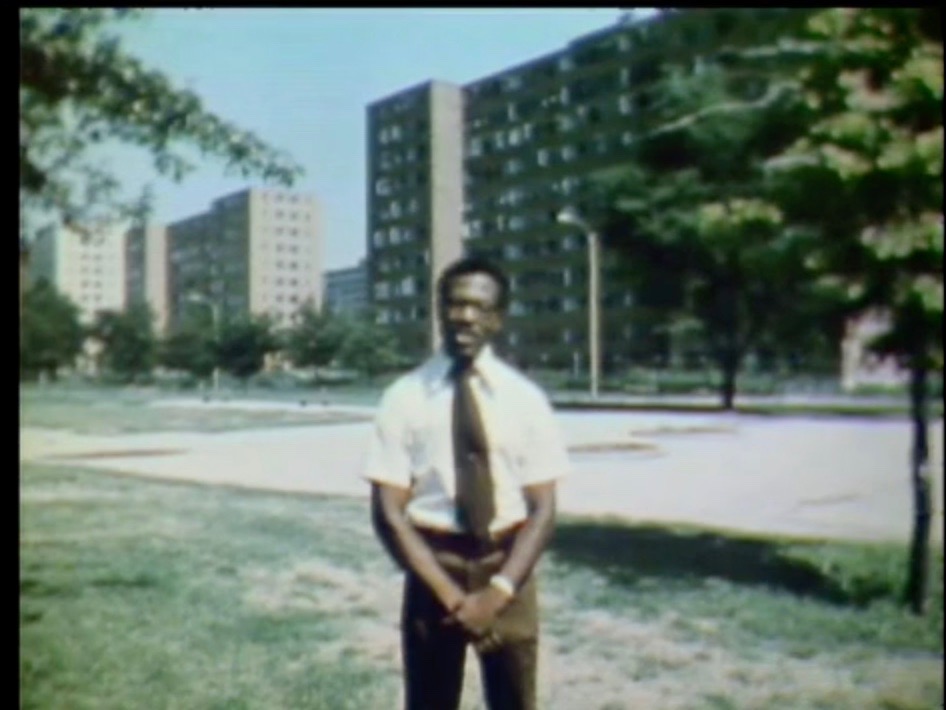
Sprawled across 57 acres on the predominantly black north side of St. Louis, are the remains of a public housing complex known as Pruitt Igo, which was built at a cost of $33 million in federal funds in 1956. Since then, most of Pruitt Igo's tenants, the majority of whom were black, have left because of high rent, high crime rates, and the overwhelming density of population, compacted into the area. Although the cost of building Pruitt Igo has not been fully paid as yet, today, 16 years after its completion, the area resembles a small ghost town. Pruitt Igo, which is less than 15 years old, when it was built, had some 10,000 people. Today, it has less than 500 families.
There were some people who said that when Pruitt Igo was built, other cities should do likewise. But I think what we have here is an example of what should not be done when it comes to housing pool people. In 1969, when we had 10,000 people living in Pruitt Igo, there was a rent strike because people were saying that we can no longer pay 70% of our income for rent. Reverend Buck Jones heads a self-help housing organization known as Operation Live. Many of the people who lived here would move, but they did. And I think what happened was, many of the families accumulated their escrow money, and they simply moved into other slums. And therefore, what we see now is a place where people want to live. Well, I think that Pruitt Igo is perhaps the most tragic mistake that this country has ever made in terms of public housing. And my position from the beginning has been that Pruitt Igo should be level to the ground that it should be destroyed.
Today, we have a plan that we've been working with Secretary Romney in demolishing a portion of the area and de-compacting the area to bring in high-rise only for the elderly citizens and the low-rise for families with children to open up recreational areas, to open up playground areas, to bring back commercial establishments, to bring back a department so that they could control themselves and that it would become safe and habitable. And I think that Pruitt Igo will again be an outstanding place in this community. I think it's impossible to rehabilitate Pruitt Igo. Now, they're in the process now of tearing down some of the buildings and spending another $50 million in taxpayers' money in an effort to rehabilitate or to refurbish Pruitt Igo, which, in my opinion, will not work. I think that if Pruitt Igo is ever going to be successful, that we're going to have to change the name of it, and I recommend that we change the name to Richard M. Nixon.
And then I think that the federal government will come in and do something about the dastardly problems that exist at Pruitt Igo. Reverend Jones and Operation Live members have helped many St. Louis residents secure housing, including Mrs. Laverne Walker, who was twice arrested for changing apartments within a housing complex. In this case, they call this up. They have cleaned it up. There's a lot of broken windows shot through, and I cannot go back there. Personally, about two weeks ago, three weeks ago, I went to bed about eight o'clock at night. I was waking up about five minutes to five. My air conditioner and television was missing out of the house. They had taken the air conditioner out of my kitchen window, and a small television set off my refrigerator. I called the police. They regard to this. I have never heard anything else. This place, I found open. I told Reverend Jones, if I found a place open, I would move into it. This place, the back door,
when it was broke out, stuck my hand in and I locked the door and kept putting all my stuff in here. And each time they come and move me back out, and I move me back here. The average black person who lives in this area really believes in their heart that the reason that they're not making repairs and filling the vacant apartments is that they're just trying to squeeze blacks out of the inner city. And I, for opinion, Mrs. Walker is really a symbol, a symbol of the critical conditions that exist in terms of housing for poor people in the city of St. Louis. Yeah. That's going to be for any homeless. Some of St. Louis's poor blacks have taken another route to secure better housing. McClure Shepherd heads the Jeff Vanderloo organization, which has coordinated the necessary financing to rehabilitate some homes and build new ones. We formed Jeff Vanderloo three years after we had the citizen group in 1966 in October. Jeff Vanderloo is the cooperation.
And we named it simply from the third phase, not a person's name, it's names of streets by which the downtown floor traffic goes and come. As of now, we have completed 138 units. And we're under the process of what you see here. During another 54 remalign units, which is in the stage of being feasibility study issued very shortly. And we're doing these 74 units here, which will also be a rental type of thing. As has happened in other cities across the nation, the prison population here has become increasingly vocal. And the black community increasingly aware of the regressive effects of jail.
St. Louis recently experienced a jail disturbance. And afterwards, relatives of inmates and concerned citizens demonstrated for inmate rights. The disturbance in the jail was about the prisoners had grievances about the cold food, about not having a towel and a face rag to wash with. And about their visiting, about how the law is working here, about the judges over in the court, and about the warden in the city jail. I was inside the city jail for four months. Since I've been out, I've been fighting for the prisoners up in the jail, I sit up under this tree out here for six days and six nights protesting for the prisoners just still in the jail. John Bass supervises the city jail.
Well, the population at the city jail here, we have a range of, I'd say, about 85% of the population are minority group members. The population of the city of St. Louis, we think it's something like about a 50-50 population. So it's a disproportionate number of blacks in the institution compared to our total population. I would have to concur that the inmate population here is typical of populations in ghettos throughout America that feel that we have the same responsibility to this population as the population is in open community that got out in a commercial bond. What we're doing right now is we're doing a reconnaissance searching for some wonder bread, our hostess trucks in a neighborhood. And what we plan to do is to let them lead us to the stores that they are still putting the bread in. And boycotting all wonder bread and hostess product for fair and equal employment for blacks. We plan to visit a couple of other stores that we know that is still carrying the product.
And we will go in and ask the merchant once again to withdraw the product. And upon him failing to do so, a picket line will be thrown up around his store. You're all still stocking and wondering for you. You don't feel the need to support our company policy. Because the company's policy is to put white races. The company is at 60-50 Northland but county problems suggest you talk to them. I don't really know what it is. I just do what they tell me. Well, I just do what they tell me. And there at Kroger Supermarket was to sensitize that particular store, making them aware of the fact that as far as we're concerned, we're holding them just as much as responsible for stocking this bread, knowing that we are boycotting the product.
There's definitely boycotting this Kroger. There's definitely a boycotting this Kroger for support over white racism. There's definitely boycotting this Kroger for tying up the metropolitan police. Wunderbred officials say that of 650 employees in St. Louis, 200 or 30% are black. They claim minority employment covers all job categories. The plant's program of hiring, training and upgrading of minority workers they argue, has been underway for more than 10 years. It is equally important for whites to have their share of the menial jobs as it is for blacks to have their share of the better paying jobs. I think the rate of unemployment for blacks is even higher than one out of four.
And I know in terms of youth unemployment, it's somewhere in the neighborhood of 42%. There's a great deal of reluctance on the part of the people in Washington to make the employers in the St. Louis area comply with the laws of this land. And until we get that kind of enforcement, I don't think that blacks are going to be able to get equal employment or even jobs in any measurable amounts. In 1960s, in reviewing all of the federal programs and the condition of the black community, it was obvious that we were not solving the problems that took place in the 60s. We were winding up with unemployment. After a number of years of working with various different programs, we were winding up still with a poor school system with poor housing and so on. So the question is, we had to think in terms of how does the community develop its own resources.
Because when we say economic development, we're really talking about bringing all of the funds and all of the resources that we can't enter the community to be able to supply all of the needs for that community. That means hospital, schools, housing, day care centers and everything that the community needs. What is the picture for blacks in the media in St. Louis? From St. Louis, we wouldn't receive any gold and boss merit badges. The picture is frankly bleak. There are a few people in media who stand out. The picture is bleak. It really doesn't mean that much of you stand out. You see, there are messages to be given. There are things to be said. Many times, black people in media are not either allowed to give the messages or won't. Let me give an example of what I mean. St. Louis is the fifth most segregated city in America.
In the next 10 years, we will be more black than white. During that same period of time, the city fathers and the city plan to spend $97.8 million for crime control. Many black people think that means them. During the same period, they will spend $1 million for civil rights. That's a very scary thing in the city of St. Louis that affects black people. And yet to get black reporters and black people in media to talk about this is almost impossible. So I say we are either not allowed to do our jobs in St. Louis or there's a great amount of empathy. Although the first black civil rights demonstration was held in this city over 150 years ago, blacks have been unable to make significant gains since then. Some black St. Louis residents feel the best way of affecting a change for the better is through the creation of alternatives to existing institutions. One important area where this is happening is an education.
The St. Louis African Free School, based on the alternative free school idea, operates out of a small one-room basement in St. Peter's AME Church. 20 students attend five classes a week in Swahili, history, science, and mathematics. Everything taught at the African Free School is based on the premise that in youth lies the future of black people. Our brothers and sisters this morning were going through a lesson in Swahili. And you recall that Swahili is one word from an African language that means coast. So Swahili means coast, let me hear you say that. Swahili means coast. Now does anybody know what the coast is? Sister Tanya? The land between the water and the land. The land between the water and the land. Alright, let's say that together. Coast means the land between the water and the land.
Red? It's for the flood. For the flood. Which is not a new ship? In vain. Black. It's for our faces. Black. Green. Green. Green. For you. And for you. CCY2WAndZ. CCY2WAndZ. White 2WandZ. White 2WandZ. PaMOD. PaMOD. Too tashing. PaMOD. Too tashing. We are black. We are black. Beautiful people. Beautiful people. two again together, we win. two again, together, we win. One, two. Three, four. One, two. Three. Sugar, three, four. One, two, three.
Sugar, three. Sugar, three. Sugar, three, four. Sugar, three, five. Sugar, three. Sugar, three, four. Four, five. Sugar, three, four. Then one, six. Ginger, a ransom money. Wonder if you can slash this. Okay. Three, four, five. . . . . . .
- Series
- Black Journal
- Episode Number
- No. 307
- Episode
- Black St. Louis
- Producing Organization
- WNET (Television station : New York, N.Y.)
- Contributing Organization
- Library of Congress (Washington, District of Columbia)
- AAPB ID
- cpb-aacip-972cd988b7b
If you have more information about this item than what is given here, or if you have concerns about this record, we want to know! Contact us, indicating the AAPB ID (cpb-aacip-972cd988b7b).
- Description
- Series Description
- Black Journal began as a monthly series produced for, about, and – to a large extent – by black Americans, which used the magazine format to report on relevant issues to black Americans. Starting with the October 5, 1971 broadcast, the show switched to a half-hour weekly format that focused on one issue per week, with a brief segment on black news called “Grapevine.” Beginning in 1973, the series changed back into a hour long show and experimented with various formats, including a call-in portion. From its initial broadcast on June 12, 1968 through November 7, 1972, Black Journal was produced under the National Educational Television name. Starting on November 14, 1972, the series was produced solely by WNET/13. Only the episodes produced under the NET name are included in the NET Collection. For the first part of Black Journal, episodes are numbered sequential spanning broadcast seasons. After the 1971-72 season, which ended with episode #68, the series started using season specific episode numbers, beginning with #301. The 1972-73 season spans #301 - 332, and then the 1973-74 season starts with #401. This new numbering pattern continues through the end of the series.
- Broadcast Date
- 1972-11-21
- Created Date
- 1972-10-11
- Asset type
- Episode
- Genres
- Magazine
- Topics
- Race and Ethnicity
- Media type
- Moving Image
- Duration
- 00:30:17.494
- Credits
-
-
Host:
Brown, Tony
Producing Organization: WNET (Television station : New York, N.Y.)
Speaker: Walker, LaVerne
Speaker: Green, Percy
Speaker: Jones, Buck
Speaker: Fields, Bill
- AAPB Contributor Holdings
-
Library of Congress
Identifier: cpb-aacip-f6a38a9f1a6 (Filename)
Format: 2 inch videotape
If you have a copy of this asset and would like us to add it to our catalog, please contact us.
- Citations
- Chicago: “Black Journal; No. 307; Black St. Louis,” 1972-11-21, Library of Congress, American Archive of Public Broadcasting (GBH and the Library of Congress), Boston, MA and Washington, DC, accessed October 10, 2026, http://americanarchive.org/catalog/cpb-aacip-972cd988b7b.
- MLA: “Black Journal; No. 307; Black St. Louis.” 1972-11-21. Library of Congress, American Archive of Public Broadcasting (GBH and the Library of Congress), Boston, MA and Washington, DC. Web. October 10, 2026. <http://americanarchive.org/catalog/cpb-aacip-972cd988b7b>.
- APA: Black Journal; No. 307; Black St. Louis. Boston, MA: Library of Congress, American Archive of Public Broadcasting (GBH and the Library of Congress), Boston, MA and Washington, DC. Retrieved from http://americanarchive.org/catalog/cpb-aacip-972cd988b7b