Illustrated Daily; 5036; Mrs. Rossin Remembers
- Transcript
Carl Sandberg was probably one of the closest friends we all had. I adored him, and his family lived on the other side of the lake. And so he was in Chicago alone a great deal, so he spent a lot of time with us. And he always played games with me, and his router bag of stories were written for children. And I was claimed to erupt him from me, but he did have some other children he rupt him for, too. The Illustrated Daylight, Managing Editor Hal Rhodes. Hello, Alice Oliver Henderson Rosson is a veritable treasure trove of knowledge about the cultural history of this region, and the people who have shaped that history for at least the past seven decades.
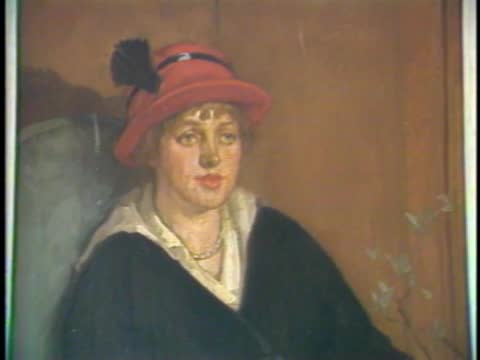
And why shouldn't she be? Just the branches of the family tree tell a good deal of the story. Father, William Penn Hallow Henderson, distinguished artist and architect, mother, Alice Corbin Henderson, poet, and early 20th century doyen of Santa Fe's literary circles. Her first husband, John Evans, poet and novelist, her second husband, Edgar Rosson, mining magnet, daughters Natalie, a poet, Nancy, and Latisha, an artist and dancer, and assorted in-laws, mother-in-law, the legendary Mabel Dodge-Louhan, son-in-law, Pulitzer Prize-winning political cartoonist, Bill Maldon. William Henderson was a well-known Chicago portraitist and art teacher who had also designed costumes and sets for stage productions, illustrated books, and created murals for Frank Lloyd Wright's ill-fated Midway Gardens before moving to Santa Fe in 1916 with his alien wife and nine-year-old
daughter. Henderson responded to the New Mexican landscape and to the Pueblo and Hispanic cultures with bold, colorful forms and prolific energy. It was with these subjects and in this light that he found and perfected his mature style. The design and construction of his studio turned Henderson's interest to architecture and he became a leading southwest architect and contractor. Noted for his landmark restoration and expansion of St. Clauza in Santa Fe and for his design of the elegant white estate, Henderson's best-known work is the Museum of Navajo ceremonial arts, now the Wheelwright Museum of American Indian Art, which received an award from the Architectural League of New York in 1938. Alice Corbin Henderson generally credited with having discovered Carl Sandberg, established her reputation in Chicago as a poet and co-editor of Poetry
magazine. Upon moving to New Mexico she combined poetry with a new interest in the region's cultural history. Her book, The Brothers of Light, about the penitenties of New Mexico, reveals the sensitive understanding of other cultures and religion that won her the friendship of both Hispanic and Indian leaders and the devotion of many American poets of the day. A collector of Native American art, she was also committed to preserving the cultural heritage of Santa Fe and helped revitalize such traditions as the Fiesta. The daughter of these two remarkable people, Alice Rosson, inherited the family trade of wide-ranging interest and talents. Growing up in Santa Fe and accompanying her father on horseback to Pueblo ceremonies, Alice absorbed two culture symbol tangiously, finding she says that in New Mexico,
theater becomes real life. After the birth of her three daughters, Alice found her own creative outlet as the designer of denim and bandana fashions, long before it was fashionable. And like her parents, Alice Rosson has become a committed collector, preserving the art and artifacts both of her family and the region. And rightly so, for the creative family tree continues to grow. One thing that's really great of course is working in the studio. People say they feel as spirit in here and I can I can sort of feel that. One connection I see between Alice and Henderson that's that she lives for a color. I mean, I love taking people into her house and there's flowers here and flowers there and she's wearing orange and the upholstery's turquoise and the walls are pink. If there was and I suppose we should
start with your father, if there was a Renaissance man in New Mexico between basically statehood and world war two, it surely was William Henderson. Is it possible somehow briefly to give us some sense of the man's character? Warren would be the first term you would use. He liked people, he was nice with people, he went out of his way to do things for people. But he was a person who worked very much alone in his painting and designing and when he was doing architecture and furniture, he worked at night by himself when he didn't get interruptions because he'd drop anything he was doing to help somebody, whether it was a human being or an animal. The public Indians had an iron clad rule, no photographing, no sketching of their ceremonial. There were some out of fringes that people got away with it but it was supposed to be general. But your father didn't. I'll never.
And the point is that each public did it separately so some amount have not been as stern about it but father never sketched in the public. A ceremony, he'd do the picture of the villages later. Yet his paintings of the ceremonial are almost definitive. It would seem to me he must have either had a very keen sense of observation and or a keen sense of recall. He did have a keen sense of observation and he didn't talk to you during the ceremony. He was always leaning against us and the doby wall by himself registering obviously his and in his memory what he was seeing. But he didn't want to you know people sat around and made him social events, not father. He was busy and he and I would go and do a pebble and I might go off with somebody and he'd say I'd see it later and I'd see him when the ceremony was over. And then when you'd see his painting, what would you think? Well I knew they were going to be good. And I think they're beautiful. Unfortunately we don't own any of the pastels of the dances that he did of the actual ceremonies. Half of them longed to a
private collection, the other half belonged to the Art Institute of Chicago. And there are some on exhibition in Phoenix at the moment which will go up to Denver in February. But those two that whole thing was taken. He did about 23. You just curated the show here. Yes. That must have been quite an experience for the daughter to do that. But I've done them before. The first one I did was his retrospective in 1963. That was 20 years after he died. And I had sort of been the manager of Wenzhou and New York in the late 20s. So I wasn't exactly naive and I also used to help him when he was getting his pictures ready to go for exhibition purposes. So I knew some of the techniques. And then since his death I've tried to get all of his things and properly recorded, which isn't easy. 10% I don't know where they are or who owns them. They may not even be still in captivity because you know different generations don't like the same
thing. They may have destroyed them. Alice Corbin was an extraordinarily fine poet. But beyond all that I had I have a suspicion having read what I have read about her. She must have had something of a magnetic personality. She did. She had a very great personality in charm. And she climbed birds off trees as far as I was concerned. And she was the one who really started the literary part of Santa Fe. And she had been an editor of Poetry Magazine, helped start it and remained an editor really all her life. And so what she was doing was getting people together to do things for themselves. And she started the Cowboys Roundup they called it, the Poetry reading. One of the houses and gardens here in Santa Fe where they raised money for nurses on the Indian reservation. Everybody had to come, all the people who were reading had to come dressed as Cowboys. And they would refer to them as coming out of the shoot just the way they were in the Cowboy rodeo. And those were very successful. And it put people out in the public eye that wouldn't have
been there. Mother could persuade them. That was the part of it. How came it to be that both Carl Sandberg and Robert Frost felt compelled to pay court to Alice Corbin in Santa Fe? Well Carl Sandberg was probably one of the closest friends we all had. I adored him. And his family lived. I can't remember them. They didn't live in Chicago properly. They were out. I think on one other state but on the other side of the lake. And so he was in Chicago alone a great deal. So he spent a lot of time with us. And he always played games with me. And his rutabaga stories were written for children. I was claimed he wrote them for me. But he did have some other children. He wrote them for me. I didn't admit it. Well I don't blame you. I wouldn't use it if I could lay claim. But he was a particular fund. What was it like bouncing around at these people you bounced around as a child? I just took it for granted. In retrospect, do you still take it for granted? Certainly. Well I either had to feed them or do something for them. I had to feed them a lot of the time. So I was responsible for, so I had to share in it. What was the cost like? Well he was
not nearly as warm as Sandberg nor as warm as some of his poems. Yes, of course he has that that is the reputation. Yes, he was much more austere I think you would say. What's he as nasty as some of his critics of course? Not in my presence or not around my parents. No, but that wasn't the kind of thing that happened to my parents. I think they didn't let it happen to a great extent. I was never conscious of it. And you see what happened is all these people would stop on their lecture tours of the United States, which I always thought was such fun. And because they wanted to come see mother, they would come to reduce rate. What a remark. Isn't that wonderful? What's the story about Camino Del Monte Soul? Well there are lots of stories about the Camino Del Monte Soul you could do of whole volume on that. Because when we came here, we were the first angles on the Camino. We were surrounded by our Hispanic neighbors. We're all our close friends. And there was a telephone line that went up to Sunmount, which was you know that our sanitarium that was such a fine one here. And your mother came here actually? Yes, because
of it. And the point was the idea of calling a telephone road didn't appeal to mother. So in talking to her friends, she found out that the old name of the telephone road was Camino Del Monte Soul, which means a road to Sunmount, which was the mountain behind Sunmount. Sunmount hospital was named after the mountain, you see. So mother went down and appeared before the city council and said she would buy the sign. If they give her permission to put it back and change the name to Camino Del Monte Soul. So they said fine. So mother went down, got the sign, printed, brought it to them. And then we went back mother and nine from our horses and nailed it on the telephone pole. So bless her heart. She saved a piece of Santa Fe history for us. I'll say. And all these people who have been there since, there was nothing between the little house we lived in. One little log cabin, all the way to Sunmount. Now it's solid houses all the way. You wouldn't believe it. What led your father back to your father from art to architecture? Yes. Well, the point was that when he was studying in Boston, he had taken civil engineering.
And on his trip, when he took his scholarship in England and France and Spain and Italy and and all those Belgium, all those countries, he was terribly interested in the architecture of them. I think more particularly at Alhambra in Spain than he. So, so that occasion happened and actually was his first son-in-law who got into some kind of building here and he needed help. And it certainly went from there. And he took a young partner and they did build a famous white estate, which is School of American Research. And he built the St. Applaza, which was a fallen down for sided building. And it's very known now. And he built the Navajo Museum. Well, I'm curious. He did houses in between that. Well, I'm curious is, you know, but he went on painting. Really fine artists. To balance all of this, it would seem to me truly to make him a Renaissance man. I suppose that that's as good a term as any. I think terms of generalities are often hard to come by,
but I suppose that's as good. That would fit. And you know they have in the exhibition in Phoenix that they've just found. They call him the Santa Fe Colorist. Oh, yeah. That's the title of a non-made catalog. The jungle meme thought highly of your father's architecture, didn't they? He came here as a young man and started out. He was just to see him all the time. He was another patient at Son Mountain. Many of the best people came that way, including the writers and artists. Well, many of the most distinguished of New Mexicans of the century came here for reasons of health, including Clinton P. Anderson. He went to Albuquerque, but we always accepted that. Albuquerque used to like to come up here to cool off in the summer because it got to a hot down there. Well, we still do. And there used to be out here in Tassouki because I lived out here for nearly 60 years. And there used to be people who had little houses here for the summer. There aren't any more. They've sold them to now there are other people living there. When your mother came here for reasons of her health, she was in critical condition.
She was. She was given a year to live. She made it 39. So that serves her good deal for the climate, doesn't it? But and a lot of people came. And for instance, Monson Cutting, when he came out here, his mother couldn't imagine. He's coming to a place that didn't have a lovely luxurious hotel and things like that. So they built his house. What was he like? Well, he was a very learned gentleman, but he was very, well, he wasn't outgoing at all. He was really very, basically very shy. And so when he was here, he kept very much to himself. He had people visiting him. He had a staff that his mother set out from New York and the proper white, I touched uniforms that used to fascinate me. And no woman was allowed to go there without being a certain age. So I went there because one of his secretaries used to take me there to lunch. And I was under age so I could go. So anyway, it was very funny because in that thing, you know, somehow you didn't know whether he
was here. And I think he was a terrific surprise when he died in that accident because it was such publicity. I don't know why I find it surprising. You know, he was a controversialist, to say the least. And yet he was shy. That seemed somehow to me ironic. But he did things that mother approved. Well, they could talk to him about what is it when they try and take the books apart that come in, coming through customs and being forbidden. Sensor? Sensor, and mother talked to him about things like that. And he was, he did things about her because he understood what she meant. Perhaps it's a touchy subject. But I think it could be argued that Frank Lloyd Wright did your father dirt. Well, I don't think that's very difficult. Because I think, you see, he was a man of such enormous vanity. Did you find that? How much about that whole story? Yes, and he told me that story. I don't know how that worked. But you see, he came to see us later.
He came to see the house I built in Buffalo. This is after. See, this is after he made up your father's mural. The Midway Gardens were in Chicago and they were on the ocean. I mean, on the lake, and they were going to be a great center. And then came the World War. You see, that, of course, was what really slowed it down. But when father, who finished his murals, I think Mr. Wright was just plainly too jealous of them. They were, they were painted out. And he never paid my father a nickel. I was going to say your father got a dime for you. And somebody has... His chief was Frank Lloyd Wright. No, he wasn't. But then why wouldn't he pay your father? Because he resented what he'd done. I think it was basically just mean. And he mentions it in his bio, because I carefully read it to find out what it was anything. And I would give anything if we could get hold of them. I only have a few photographs. And one, I think we have two figures that he did that were done in Watercolour. I think it's some of the pictures I've seen, some of your father's greatest words.
Friendly. There is one, there is one that he did of the Hopi dance, when he was in Chicago, that we're like, it's something that he got out of his trip in 1944, when he went to Nanooka. And when I'm mistaken, don't you have that hanging just down the hall here in your house? Yes, I have the one that he did in Chicago of what I think we were talking about it earlier today. I think it is them, Neymon, Kinchina. But I had never seen it. My grandson said he thought it was, because he's seen it. Would you do me a favor, give me some of the word portrait, word portrait to some of the people who crossed your paths, who's acquaintances, have left their mark, not only on your life, but on the life of this. Well, what had been it was certainly one of the people that did that. He came here on one of his lecture tours, so he would see mother, and he had been teaching out in Berkeley, and he was extremely tired, and so mother asked Dr. Merron to put him up, because we didn't have a hotel at Saint-Main. Well, he stayed there on a rescuer, and then he never left. And he was a delightful person, and he added much to Santa Fe, and he brought very charming people
here, so that I think he was one of the things. And there were some lovely people. He stopped bombing. Gustav Bowman was a came here from Chicago, and you know he was a print man, and he'd done a lot of illustrations, those were before color photograph, and he did photographs, and he did a color pictures of hams for Swift and company and armor, and things like that. That had been what he made his living on. Then he came out here to paint seriously, and of course you know he's famous for his very fine woodblocks. I think probably he's one of the best ever, and he was a very taciton, kind of very Germanic, and a very kind person, but he wasn't warm. Wasn't your father, and he weren't they close friends? Yes, they became so, because of course, but Mr. Bowman could assume that he was your friend, whether you knew it or not, he had that quality, you know, he would just make up your mind. Did they talk art, or did they tell you? Well, that wasn't always present.
I was preparing lunch or dinner or something about that from time to time, but he was one of my borders, I used to say. I had several of them. All right, what about Tony Lohan? Well, Tony Lohan and I were very close friends. Right. I was extremely fond of him, and he used to come down quite often and visit me, and he also used to come down from my fiesta parties, which we used to have in the garden in those days, and he would come bringing Towsingerus for me, which was very nice, and help entertain all the out of town people. That's when we used to have the very wonderful fiestas for three or four days, and took the whole town in, and he really made a great difference for me. Was he as handsome as a counselor? Very. Of course, he was a big man, and one of the things is that for some times he got heavier than he should have, but he was handsome. He had wonderful posture. Mabel Dodge, Lohan. Yes. What do you want me to tell you about her? Well, I just don't know for her to ask you to begin. What's on the top of your head when the word comes out? Because she was a quite an extraordinary lady, very much of a worldly person,
and of a very dominating personality, and yet extraordinarily warm. If you got past the one she was trying to measure her weight in demand and things like that, and of course, it's a little difficult for me to explain about Mabel, because Mabel was my mother-in-law. Yes. And she was the grandmother of my three daughters, right? So that I had quite a bit to do with her always, because I insisted that the children should see their grandmother and so forth. Was she a good grandmother? No. That isn't the kind of thing that she had time for. She would have been a good grandmother to somebody else's grandchildren, but her own. Not her own. She expected everybody to do just the things that she wanted. I understand that you told somebody one time that up in the mountains of Tows there are many a ghost. No. In the big mountain of Tows, there is a big ghost. Not a ghost. There's something that sleeps in that mountain that makes Tows have a strange atmosphere. Here are you idea of what that is?
No. I haven't defined it. I'm not the only person that feels it. I don't know whether it's Indian or whether it's something that came from another country and wishes it could get back, but I think it creates an aura in Tows. Tows isn't the comfortable place for me and some other people, I know, to live in for long periods. It's a guy has a restlessness. It does, doesn't it? It does to us, anyway. The churns. That's it. It's a low grinding noise. You don't hear. Why don't you just see it? You just feel it. That's all. It's in the aura. Why did you stop designing yourself? I didn't. You didn't. I've been designed always, but I've stopped having a shop and having a little factory, but I did start in the thirties. I started the denim and bandana fashions and made quite a success of it. I had two shops in Arizona and the one here in Towsuki, the factory was here, and I sold my things in New York or wherever and bought New York to bring
back to my shops here in Phoenix, I mean in Tucson and Chandler. They went terribly well. Of course, now I really don't care about denim anymore. There's a little too much of it. I suppose when you were working in the fabric and you were manufacturing and designing these clothes, it was quite unusual. Well, it was, when people like Stanley Marcus, who was one of the persons who claims he found me, discovered me, and of course that wasn't bad to sell to Neiman Marcus. They sent their people around to find things like that. Then he decided he'd better come up. We've been friends ever since and see what was going on in this because I had Hispanics and Indians working for me in my workroom and times I had as many as 30 people. I sold more of it out of state than in. Of course, because there had to be a substantial price for a thing that was handmade and hand done like that, all my friends said, we'll make our own. And then when I went on buying trips,
they would come and order a suit for themselves. I was talking to your grandson, Andy, Maldon, the moment ago, Bill Maldon's son, William Henderson's great grandson. I mean, those jeans must be just loaded with artistic instincts. I think they are. And you know the youngest one is doing television, consulting out in California, and so that it does come naturally. They all were in things after that. Do you think creativity is transmitted genetically? I've never thought about it that way. I've just taken it for granted that some people have it and some don't. You know what I mean? I know what you mean. I haven't really been serious. I'm serious about reading about genetic things that relate to illnesses like diabetes or something like that. The advances we make. But I never think of the genetic part in our family for some reason. I take it for granted. What a luxury that you can do there. It is naughty, isn't it?
But I expect enough of them, you know? They can do nothing less. I think not. And I think they I think they're often do things that are significant and they're all living for lives. And that's very thrilling to me. The three of them have moved back to New Mexico from the east, from New York and Connecticut. What's the best book you've read lately? I read constantly and I reread too. Because some things that you have to, for instance, I like to reread Tony Hellman's story about the bank hold up in the house. And these short stories, you've read that haven't you? Yes, I have. You read it a lot. It's the most wonderful story. Only Tows would do that. And so I make people read things. I've had a reading awful lot to do with my, the things I've been doing the last eight months because you see we've run into problems with the restoration and care of paintings with all this troubled acid proof things. And I have spent a lot of time on that. It's just beginning to be
recognized as a serious problem. And it is a serious issue. And there are not many or sources to get your information. In the way I think I could write one after what we've gone through here. Because you see the pastels are on paper. But pastels father always did them on French paper. And it's the American paper that has the unfortunate lack of acid proof. But perhaps that's the next thing you should do is write the book. I'll come back and talk to you when you find the solution. Here I'll place you to talk to you. I'm too nice. It's delightful to have you here. I hope you come whether you read Dr. Mirnot. Well, I'll always come. On TV. All right. Thanks so much. Thank you for joining us. I'm Hal Rhodes. Good night. She is such a firecracker and gets people so excited that when she starts and her enthusiasm for her father's work is so genuine and so infectious because of her personality that I pity the poor art dealer or museum director who comes under her, under her clutches because they won't be able to leave until they're two singing Henderson's praises. All artists should have an Alice in the
background. That's right. It would change things. I think probably continue to make mischief with a lot of stories. My problem is to remember where I should stop. I hope I didn't make any mistakes.
- Series
- Illustrated Daily
- Episode Number
- 5036
- Episode
- Mrs. Rossin Remembers
- Producing Organization
- KNME-TV (Television station : Albuquerque, N.M.)
- Contributing Organization
- New Mexico PBS (Albuquerque, New Mexico)
- AAPB ID
- cpb-aacip-95562171327
If you have more information about this item than what is given here, or if you have concerns about this record, we want to know! Contact us, indicating the AAPB ID (cpb-aacip-95562171327).
- Description
- Episode Description
- This episode of The Illustrated Daily with Hal Rhodes features an interview with Alice Oliver Henderson Rossin, who is a veritable treasure trove of knowledge about the cultural history of New Mexico and the people who shaped it for the past seventy years. Her father, William Penhallow Henderson, was an artist and architect and her mother, Alice Corbin Henderson, a leading poet in Santa Fe. Henderon Rossin's first husband was poet John Evans (son of Mabel Dodge Luhan) and her second husband was mining magnate Edgar L. Rossin.
- Created Date
- 1984-11-29
- Asset type
- Episode
- Genres
- Talk Show
- Media type
- Moving Image
- Duration
- 00:28:56.190
- Credits
-
-
Guest:
Rossin, Alice Oliver Henderson
Host: Rhodes, Hal
Producer: Maffitt, Louise
Producing Organization: KNME-TV (Television station : Albuquerque, N.M.)
- AAPB Contributor Holdings
-
KNME
Identifier: cpb-aacip-563aec3fc59 (Filename)
Format: U-matic
If you have a copy of this asset and would like us to add it to our catalog, please contact us.
- Citations
- Chicago: “Illustrated Daily; 5036; Mrs. Rossin Remembers,” 1984-11-29, New Mexico PBS, American Archive of Public Broadcasting (GBH and the Library of Congress), Boston, MA and Washington, DC, accessed May 16, 2026, http://americanarchive.org/catalog/cpb-aacip-95562171327.
- MLA: “Illustrated Daily; 5036; Mrs. Rossin Remembers.” 1984-11-29. New Mexico PBS, American Archive of Public Broadcasting (GBH and the Library of Congress), Boston, MA and Washington, DC. Web. May 16, 2026. <http://americanarchive.org/catalog/cpb-aacip-95562171327>.
- APA: Illustrated Daily; 5036; Mrs. Rossin Remembers. Boston, MA: New Mexico PBS, American Archive of Public Broadcasting (GBH and the Library of Congress), Boston, MA and Washington, DC. Retrieved from http://americanarchive.org/catalog/cpb-aacip-95562171327