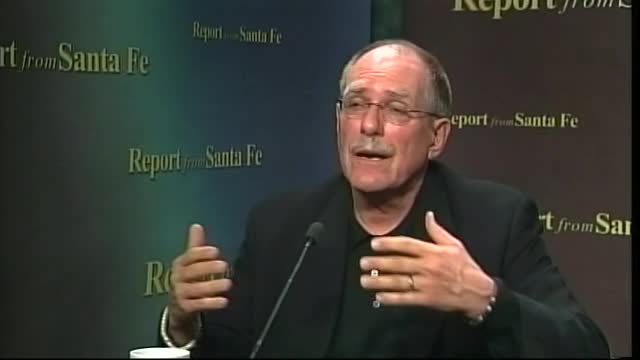
Report from Santa Fe; David Houle
- Transcript
The National Education Association of New Mexico, an organization of professionals who believe that investing in public education is an investment in our state's economic future. And by a grant from the Healey Foundation, Tau's New Mexico. Hello, I'm Lorraine Mills and welcome to Report from Santa Fe. Today we have futurist David Hool. Thank you for joining us. Mark Pleiser. Well, I've heard you speak recently. I'm just fascinated you are an author. One of the recent books is called Entering the Shift Age. And I tell you, you've really blown my mind with some of your things. On the background a little bit, you have a BA in art history and a matter of what Obama says about our history degrees.
And you have been in TV and media for 20 years, gotten two Emmys, gotten the Peabody Award. And tell us about some of the programs that you helped launch. Well, people always say how do you become a futurist. And I go to that Lorraine because I worked at NBC and CBS and then I took a huge pay cut when cable was only 10% of the country and became part of the team that created and launched TMTV, Nickelodeon, VH1, and CNN Headline News. So that was the early 80s. Then in the early 90s I worked with a gentleman named Bill Curtis and I created some series for the Arts and Entertainment Network Investigative Reports and American Justice. I won my two Emmys by doing a nationally syndicated children's program called Energy Express with a woman named Marilyn Preston who's a resident of Santa Fe. And then I got nominated for the Academy Award and won the Peabody Award for a documentary called Hank Aaron Chasing the Dream that I did with, parted with Denzel Washington on. Ah, ah.
Well, you know, having studied art history and then created some programs that now we really can't imagine what TV we've was like before. Right. So, especially thinks Nickelodeon, MTV, my goodness, you've branded whole generations with this and Headline News, you know, it's the only place we can go at any time to find it what's going on. But I was struggling with the definition of what really is a future. Yes. Yeah, I always get the, gee, you're the first futurist I've ever met. I define what I do and in the moment I had the revelation that put me on this path, this was the revelation. And as you heard me speak on stage the other day, this is how I describe what I do. I am a catalyst to get people, companies, governments, and the world to think about the future and then to facilitate a conversation about it. So I'm a catalyst to get people to think about the future because most people don't. And then have a conversation about it. Well, you're called the futurist to CEOs, and I was fascinated in that you've been given 300 speeches in ten countries, at six continents, but there's something about the time frame
that a CEO is most interested in. So you're not interested in the year, 3,000. What is your focus that the CEOs are so desperate to understand? It's funny you asked that question now because on my, on my website, David Hool.com, I have a page called Forecasts because when I started talking as a futurist 2007, what have you said that's come true? And I could point to all the stuff that I've done that came true, I can TV. So I started making forecasts and they're all up there. And I realized that my gift, my strength, my level of accuracy was great from six months to fifth, five years. And then when I started speaking as CEOs, of course, that's their limit. So what I did at the beginning of 2014 this year, I went back and I looked at every single one of my forecasts, the ones that would have come true by 2014 and the ones that in this decade and I said, did they come true and if so, why and if not, why not? And I've been incredibly accurate, but when I wrote that column, I said most of the world
is and certainly leaders are looking at six months to five years out. So all that conversation about here's the great new things that are going to happen in 2030, I called futurist locker room talk because oh, it's kind of nice, but doesn't mean anything to me as a human being right now. And the other thing, learning is that between now and 2030, the speed of change is so accelerated and there's so many major variables that to have anybody tell you that they know a 2030 is going to be like, except in the general contextual way, it's not accurate. Just can't be. So I can be accurate to 2020. So I go out that far. Well, I urge people to go to your website and look at some of the predictions you predicted the great increase in the cost of oil, the death of your homework, of media, the death of newspapers and the media changes that is really, really fascinating. This book entering the shift age, what is the shift age? That's the question.
So I am known as the person who said we've left the information age and we've entered the shift age. Can we go back because there were a couple more ages before then? Sure. Yes. So this is something. One of my great conceptual ancestors is Dr. Alvin Toffler. He wrote the third wave and he wrote future shock. And he and others have identified the ages of humanity. There was the agriculture rates that began 10,000 years ago where man literally put down roots, stopped being nomadic, used tools to create roots and therefore created culture. And that was 10,000 years ago. Then roughly 300 years ago with the invention of the steam engine, the industrial age began. And then back in our lifetime, loosely early seven days, the information age began. So in the early part of this century, around 2004, 2005, as somebody who has always been fascinated about the future and what's next, I sense that something big and new was about to happen. And I went back and read all the grates and they weren't very specific and I said something new.
So I then came up with the name, the shift age, all the other ages around product. They came up with shift age because I felt that humanity, and this is 2005, 2006, 2007, when I formalized this thinking, we're going to undergo dramatic shift, all areas of humanity, different rates of shift, different magnitude of shift. And the interesting thing, when I put out my first book, The Shift Age, published with Amazon, it was one of the first books on Kindle because I had forecast something like Kindle happening for it up for free. I said, oh, thank you. That was the end of 2007. If you went to type in the shift in nonfiction books, I was the only book. You go to nonfiction books under Amazon type in shift, nonfiction, there must be a hundred books. So I obviously was right in using that name. Yeah. Well, and we see it all around this. We see how fast the media is changing, how fast health is changing, science, physics, social media, social interactions, cultural changes. So you focus even a little more, we're in the shift age, but you say this decade that
we're in now, the transition decade, transformation, transformation decade between 2010 and 2020, what's happening now? Right. So 2010 to 2020, I called it the transformation decade, and I wrote a blog on 01010, interesting digital date, January 1, 2010, and it blew up on the bloggers for all around the world who calls it this. The dictionary definition of transformation is a change in nature, shape, character, and form. So 2010 to 2020 is the decade where most of humanity's institutions and much of our thinking will change their nature, shape, character, and form. And when I came up with that, I thought that was pretty profound, but it has been an incredibly good metaphor when I do corporate retreats, where I say to corporations or all these CEOs that I've spoken to. If you're not changing the nature, shape, character, and form of your business, you may not have one by 2020.
Change your diet. Right. Literally. Well, you take this inflection point in history that we're at right now, and you define three of the main forces that are driving the future. Right. So when I came up with the shaping the concept of the shift age, as a student of history about ages, all ages have their distinct defining characteristics. So I tried to say the one, what are the characteristics or forces? And I got it down to three. The three forces of the shift age is this floated global. Of course, it's the global economy, but we're living in a global construct. So we have entered the global stage of human evolution. Simultaneously, this is what I call the floated the individual. We as individuals are more powerful than we've ever been before. Over the last 40 years, we've experienced an explosion of choice. More ways to watch television, more ways to listen to music, more brands of toothpaste, and when there's an explosion of choice, the power motion, the producer, to the consumer,
the institution, to the individual. So at the same time, we're getting organized around all of us, each of us has more power. And both of those two forces are amplified by the third force, which is the single greatest force that play in the planet today, and one of maybe the three or four greatest in the history of humanity is the accelerating electronic connectedness of the planet. We're getting ever more connected across the board. So those are the three forces. You threw out some amazing statistics, 4.2 billion people alive now, and how many cell phones are there? There are seven point two. I'm sorry, seven point two. The seven point two billion people live today in the early part of 2014. And six point one billion have cell phones. So you take away all the people who are really young, all the people in the Himalayas in the Andes. You have cell phone. You pick with it. So as you heard me talk, what I have to say, because this brings the point home, you know, we are three feet away. If I called you cell phone to cell phone, it would take five seconds, you know, one one thousand, two one thousand, three one thousand.
Your phone would ring. If I were to call China 12, 15,000 miles away, it would take another two seconds. So the difference between three feet, 12,000 miles is two seconds. So there's no time or distance limiting human communication for the place, because when you get on the cell phone, it's got, where are you at, or where are you? So there's no time distance or place limiting human communication. That could not be said five years ago, let alone tenor for three. That is a totally transformative state that will change our consciousness. When you say in this broadband world, there's a tension between the physical reality and the screen reality. Talk about that a little bit. Sure. When I grew up, when you grew up, we grew up in the physical reality. Go outside and play and come back for dinner. So those, and our parents spent their entire lives in the physical reality. Now there is this screen reality that depending on who you are and how old you are, is compelling. If you're a kid who goes to high school, how you show up on Facebook and the screen reality is every business importance how you show up in high school the next day.
And I've been talking about this, as I said since 2007, and now there is distinct evidence of the difference. So the physical reality, of course, is based on atoms and the screen reality is based on digits. And therefore, the screen reality can evolve more quickly. So in the physical reality, why did borders go out of business? Why are big box stores closing because of something on the screen reality called Amazon.com? So now the screen reality, due to its power, its connectedness, its universality, is changing our physical reality. Yes. You call what the boomers have, legacy thinking. Legacy thinking. What about just boomers? Yeah, the thought that's brought us here. And you're discussing that the new modality is more networking and nodes as opposed to the hierarchy that the legacy thinking represents, boss, sub bosses, worker bees, all the way down nodes, nodes.
And that the communication between the network is so fast, whereas a hierarchical structure takes a very long time to change and to adapt to the changes. Yeah, exactly. So to break that down into two answers, I call the transformation decade is going to be the decade of transformation because legacy thinking is going to collapse. The definition of legacy thinking is thought from the past. So for example, anybody who is watching this television show, who's over the age of 40, has spent the majority of their lives in the 20th century, formative years. So most of their thought has been shaped by 20th century thinking. And now we're in 2014. So if you thought something was accurate in 1990, you had better check it, see if it's still accurate now. So that's legacy thinking. But part that you're talking about is the legacy thinking about how people run organizations. Back when the industrial age began, there was no business model. So the thing was, oh, let's just imitate the military hierarchy now. So people always are in too many meetings and they pass information, it goes up and down.
So the metaphor for the 20th century is the skyscraper, the metaphor for the 21st is the net, the internet. So what I say is you inferred is I say if you have management structures, you can't get rid of them. But instead of thinking of your departments and your hierarchies as entities, think of them as nodes of a net, because information moves much more quickly across a net. So if you're having a meeting, if you're the CEO, instead of seeing what level should this be, say what are the nodalities that need to be in this meeting? Oh, I think it's marketing and sales. Or I think it's finance and R&D and think nodalities. And whereas that's impossible to immediately implement, I know because I've worked with many CEOs that they're starting to think that way and they tell me that's a transformative way for me to look at my organization, make it flat, make it faster, and think of nodes. Yes. We have so much to cover. I just want to talk. You are very, very popular when you did a lot of writing for Oprah. Right.
And one of the articles that really struck me was your kids are different and it's okay. So would you talk about the various generations, particularly the Millenniums and what you call the digital natives? Who are they? Yeah, real quickly. The Millennials, I say, were birth years, 1981 to 1997. So they're going to be the leaders of the shift age, meaning they're the people loosely in their 20s today and 24, too, roughly a little. And they are the leaders and they are different from boomers, particularly the ones born since 1991 because they grow up with a computer in the home, with parents having cell phones, with double income families. So the Millennials see gender equality because that's what mom and dad was. They both worked. The digital natives, to me, is a future, is much more fascinating because they represent the future. So they're born since 1997. Digital native, they are the first generation born into the digital landscape. You and I, and anybody older than them, are digital immigrants because we were adults
when we got our first cell phone. We were adults when we got our first computer. These kids were born into households, mom and dad, cell phones, computer in the home, internet. And if they were born since 2009, their entire media experience is a touch screen. Damn it. So how different? What is a three-year-old who's on an iPad in 2014 going to be as a 20-year-old? Yes, it blows your mind to think about that. And it also blows my mind that there's two million more of those two generations. I just thought of somebody told me last week, I always get these great anecdotes appear to tell me other kids. So last week, a parent told me of her one-year-old who is not yet learning to talk. But when Siri comes on the iPhone, she pushes the button to get Siri, Siri says, how can I help? The kid makes noises. I'm going to go, go, go. That is the first time they've ever heard their child make noises in reaction to something.
Think about that. Well, some of the changes are so interesting. There's always a lot of hand-ringing about some of the changes in excitement. Sure. But you had something about when people are saying, oh my god, these kids are just looking at the screens all the time. What about the difference between books and the video games? Oh, okay, yes. So that, because you heard me use that metaphor. So the quick context is, you know, my 27-year-old son grew up as gaming grew up. And so my conversation with my fellow parents was, boy, is this an anti-social or what? And then I had a conversation with somebody who said, just flip it upside down. Here you have a son sitting in a dark room admittedly, playing games against people in China and people across town. What if the video game had been invented first? And then the book was invented. And all of a sudden, your son was taking this inanimate object and walking over to a corner and relating to an inanimate object. Which would you consider more anti-social, right? Yeah.
So that's that legacy thing. Well, if they're reading a book, it's good. If they're playing video games, it's bad. No, that's so much. No, that's so much. And another thing, you know, we all have experiences with our own children when you say, I really want to talk with you now. Right. And they take out their ear buds. Oh, yeah, right, right. They mute the TV. They close their laptop and say, yeah. Right. So they can function. We say multitasking. It doesn't work. But they've grown up being able to synthesize all that information. When I speak to audiences that are largely boomers and even gen-exers, one of the most frequently asked questions I've given, like, 600 speeches now, is how do you deal with information overload? And these digital natives have three to six percent more synaptic activity going on in the brains because they've been born into this world for so for them it's reality. So I, parents come to me all the time and go, they were exactly right. My child does homework, the TV on, listening to music, texting, doing Facebook. And I say, are they getting straight today?
So go, yeah, I said, yeah. So what you're seeing is something that you couldn't do, but that they do. They are different. And it's okay. I've had, I literally have parents come up to me in tears saying, you've given me a way to understand my kids. Now I'm a future, so I'm talking about this. I wasn't prepared for that. Yeah. Yeah. We're speaking today with David Hool, who is called entering the shift age. One fascinating thing about the shift age is that it's all about attention. The information age was about information, but now context is king. Talk to me about that. In the new media, why is context? We live in an ever more contextual world. The low level example I'll give within media. You know, if Barack Obama is having something with the House Republicans and there's a finite metrics to that story, if you watch that story in Fox News, you versus watching an MSNBC, you have totally different stories. Same story, entirely different context. So the context in which you receive the information is as significant as the information itself. So context is king and the information is content was king.
Well, and because we're more connected, you know, that information now has a backdrop through social media and the cross-platform and our attention now is what, at the beginning when you were there in the cable expansion, they were desperate for content. But now, the only way to succeed is if you win someone's attention, you may have 180 channels, but why are people watching what they're watching? So there's this competition for attention. Well, the environment, the context is, we are now trained to watch or consume what we want, when we want it, where we want it, and on what device. So it's the flow to the individual. The individual decides, I want to watch a whole season of House of Cards this weekend. Well, they couldn't do that when the institutions were in control. Or I want to watch YouTube on my phone while I'm writing to work on a bus.
So the multiplicity, the infinite number of channels, when you consider the internet connected globally, we get to choose what we watch and how and when we watch it. That's the liberation of the shiftage. Now, we're aware that there's a downside to this and there are some huge topics that I'm going to have to have you come back to talk about. I'd like you to talk about privacy because in this new, interconnected world, we don't have the old kind of privacy. Other issues that we won't have time to do more than touch on is how is this affecting health care and how is it affecting education? And New Mexico. And New Mexico. Okay. So I first with the privacy. Okay. Real quickly privacy. I have spoken, that's been always one of the great questions, because within the context of social media, right, privacy. So in Snowden, made all his revelations last summer. It made me go back and rethink privacy. So I wrote a mini ebook, is privacy dead, the future privacy in the digital age.
It's like $2.99, there's a short one. And in the research, I realized that the definition of privacy was a physical definition, privacy of one's own home. It started in the 1400s and as we've talked about the two realities, it was all within the physical reality. So the deterioration or the decrease in privacy in our lives occurred with the telephone and television and computers. And now we live in a world that is functionally without privacy. So to have a conversation about, well, what's the private individual versus national security? It's not the issue. Except the fact that we largely live in a world of no privacy. How do we redefine privacy and what are the new social contracts that we have to come up with? If the NSA spies on all my stuff, on my communications, is that reason to put me into jail? No, it's a reason to maybe, to track me, to do something. So my privacy is violated, but my rights are not.
And that's where we have to have a new conversation. As the future, I want to lead the conversation, what is the new definition and a new way to think about privacy in a world of no privacy, as it has formally been defined in past centuries? The two biggest issues of our time, certainly, health care and education, a sentence or two. I wrote a book on each, because in 2008, when we were in collapse from Lehman Brothers, we're going to remain a great nation. And I said, if we don't better educate our young, if we don't become a healthier populist, and we don't rebuild the infrastructure of this country, it doesn't matter what else we do. Education is undergoing the greatest transformation it has gone through in the last hundred years at all level, pre-K, K through 12, and higher ed. Higher ed is a bubble right now. K through 12, I wrote that book, it's dynamic school superintendents around this country are transforming. So it's all changing, it's an nature-shaped character in form. Health care, the Affordable Care Act was an imperfect bill, but was directionally correct. And the simple way to talk about health care is all of the stuff that we've been talking
about in this brief time together, connectivity, transparency, price competition is now just coming to the part of the GDP that's health care. It is the only part of the American economy where you have something done that you don't know how much it's going to cost, or you buy something you don't know how much it's cost. So, it is, the Obama Administration did an abominable job of launching that website, of course. They did it all wrong, but again, it was a bureaucracy, legacy thinking. But, health care, it is most transformative decade of health care, medicine, 2010 to 2020. Human history. I say to people, if you're certainly over the age of 13, definitely over the age of 40, do whatever you can to reach the age of 20, 25, because we may be able to live decades longer. It's so exciting. Ah, ah. Now, you're in New Mexico, you're coming off, and I've got a question that is in the mind of New Mexico. And what is the most important thing that New Mexico can do to bring ourselves in this time of transition where we want to go?
What would be a game changer for New Mexico? Well, I'm working on something we can talk about in the future thing, yeah, next time. But I came here to get a series of talks in 2010, and then in 2014, I key noted the governor's conference on tourism, and my sense is, you know, the loss of jobs we know, the lack of, you know, the depressed real estate. I think New Mexico needs to rebrand itself with all the qualities it has for the 21st century. You have Spaceport America, Spaceport 2.0 starting two hours south of Albuquerque. You may have some, you know, Elon Musk may be bringing a factory here. You've got Sandia, you've got Los Alamos, you've got the best weather, if you like sunshine in the United States, and you've got a sense of freedom and openness. So I think over the last 20 years, people, if you said to boomers, New Mexico, they would go, oh, experience Santa Fe.
I think the state needs to rebrand itself, and that's why I'm here, and I want to be here, and I'll perhaps become a part-time resident of the state because I love it. This is the state for the future, and here's why. Space, technology, wonderful weather, great universities. So I think that's what it needs to do. It can no longer just be the land of enchantment and come experience Santa Fe. That's my, again, I was involved in launching brands, so I think that one. Yeah. Now, for people who want to know more, tell us your website and your blogs. Sure. This way to find me is my name, David Hool, d-a-v-i-d-h-o-u-l-e, dot com, davidhool.com. My blog is evolutionshift.com, and my new blog, which is me curating a visual look to the future. It's real simple. Remember, futurewow, dot com, futurewow, dot com, evolutionshift.com, and davidhool.com. Thank you for asking. And I do urge you to get David Hool's book, Entering the Shift Age, and I want to thank you, David Hool, for being with us today.
It was really interesting. My honor and pleasure. Please have me back. I will. We just scratched the surface. Thank you. Thank you. And I'm Lorraine Mills. I'd like to thank you our audience for being with us today on report from Santa Fe. We'll see you next week. Past archival programs of report from Santa Fe are available at the website, report from Santa Fe dot com. Report from Santa Fe is made possible in part by grants from the members of the National Education Association of New Mexico, an organization of professionals who believe that investing in public education is an investment in our state's economic future. Read by a grant from the Healey Foundation, Tau's New Mexico.
- Series
- Report from Santa Fe
- Episode
- David Houle
- Producing Organization
- KENW-TV, Eastern New Mexico University, Portales, New Mexico
- Contributing Organization
- KENW-TV (Portales, New Mexico)
- AAPB ID
- cpb-aacip-884593bfc4d
If you have more information about this item than what is given here, or if you have concerns about this record, we want to know! Contact us, indicating the AAPB ID (cpb-aacip-884593bfc4d).
- Description
- Episode Description
- This week's guest on "Report from Santa Fe" is David Houle, futurist, strategist, speaker, and author of "The Shift Age." He coined the phrase "The Shift Age" in 2007 and identified this new age as the successor to the Information Age. He has been called “the CEOs futurist” and is regarded as the “emerging global futurist today.” He spent 20 years in media and was part of the executive team that launched MTV, Nickelodeon, VH1, and CNN Headline News. He has won two Emmys, a Peabody and was nominated for an Academy Award.
- Broadcast Date
- 2014-05-10
- Created Date
- 2014-05-10
- Asset type
- Episode
- Genres
- Interview
- Media type
- Moving Image
- Duration
- 00:28:28.898
- Credits
-
-
Producer:
Ryan, Duane W.
Producing Organization: KENW-TV, Eastern New Mexico University, Portales, New Mexico
- AAPB Contributor Holdings
-
KENW-TV
Identifier: cpb-aacip-6aed61adfd0 (Filename)
Format: DVD
If you have a copy of this asset and would like us to add it to our catalog, please contact us.
- Citations
- Chicago: “Report from Santa Fe; David Houle,” 2014-05-10, KENW-TV, American Archive of Public Broadcasting (GBH and the Library of Congress), Boston, MA and Washington, DC, accessed June 8, 2026, http://americanarchive.org/catalog/cpb-aacip-884593bfc4d.
- MLA: “Report from Santa Fe; David Houle.” 2014-05-10. KENW-TV, American Archive of Public Broadcasting (GBH and the Library of Congress), Boston, MA and Washington, DC. Web. June 8, 2026. <http://americanarchive.org/catalog/cpb-aacip-884593bfc4d>.
- APA: Report from Santa Fe; David Houle. Boston, MA: KENW-TV, American Archive of Public Broadcasting (GBH and the Library of Congress), Boston, MA and Washington, DC. Retrieved from http://americanarchive.org/catalog/cpb-aacip-884593bfc4d