Taming New Mexico; Judge Bruce D. Black Interview
- Transcript
Okay, let's just start, just say your name, spell it, and then give us your title. All right. My name is Bruce. And I'm sorry, you'll be looking at me as well. Oh, yeah. Okay, sorry. My name is Bruce D. Black. I'm a senior United States judge in the District of New Mexico. And your name's easy, but please spell it out for our editor. B-L-A-C-K. Okay. All right. Okay. Let's go ahead and start with the stuff in the script. And we'll get those. And then we'll get to some of the more fun questions here. So let's talk a little bit about how this building itself, how long it took this building to get finished and why. Once New Mexico became a territory in 1851, we started to build a capital. Our capital was this building. It was started in 1853. It was to impress the Easterners that we didn't all live in mudhuts. And therefore, we built a substantial edifice designed by our first Chief Justice, Joab Houghton.
And it was built on a limestone up here in the, from a quarry up on Fort Mercy Drive. And we're going to have to put it over all this so that's fine. All right. So the stone walls built up about two stories after two years. And we ran out of money. The original budget was $20,000 and that was not enough. And we asked for more. We got two more appropriations. The last one in 1857 was suspended by Abe Lincoln. We were given the choice of paying civil war taxes or getting the money to finish the building. Since most of our citizens had been Mexican citizens and knew nothing about direct taxes, they voted to give up the building. The building was finished in 1887. It then was one story and had rooms for the executive offices, the court and the legislature. But by then, the court had found another home and this became the court of land claims.
Just on a second, Tony. Yeah. Can you run out? And there's a, on that table, there's like head findings. I'm sorry. Did I have the date wrong? 1887 is the component role. Okay, I'm sorry. So let's start over and start the same way you did with the, you know, how to become a territory. And this was, they wanted to get the capital building up to sort of establish, you know, the system here. And, you know, and then talk about how far got in the first year or two before they stopped. And pick up again after that, but just get that part of that. After the treaty with Mexico ending the Mexican war, New Mexico was declared to be a federal territory in 1851. Two years later, they started this building to impress the Easterners that we would become a state. We wanted to build a substantial stone building that would impress them, that we did not all live in brown huts. And therefore, this building was to be built in three stories.
Have the executive offices on the bottom floor in the basement now. The middle floor was the judiciary and the upper floor. This room would to be the legislature. It got up a story and a half and we ran out of money. The original appropriation was $20,000. We got two more appropriations. The last one in 1857 was suspended by President Lincoln during the Civil War. He gave the territory the choice of paying taxes or getting the building money to complete, or getting the money to complete the building. And we chose not to pay the taxes. Okay, go on. So if you're going to have the paper, be very careful with it. I'm not saying you can't. All right. All right. I just want to look through here and make sure. So I want you to.
At the conclusion of the Mexican War, New Mexico became a federal territory. The inhabitants who had all been Mexican citizens wanted to impress the Easterners that we were not all living in mud huts. And therefore decided to build a substantial stone building as our capital. This building was to be our capital. The executive floor was to be on the bottom or the basement. The middle floor would be the judiciary and this room would be the legislature. It was completed about a story and a half by 1857. We'd had two more appropriations. The initial appropriation was $20,000. The 1857 appropriation was suspended by President Lincoln. Who gave us our choice whether we wanted to pay direct taxes for the Civil War or get the money to complete the building. We chose to skip the taxes. Okay. I'm a little confused by that. I think it taxes to get the money for the building. Yes.
That was a choice. Pay the taxes or forfeit the money for the building. Okay. If you could just say that part worded that way, it was confusing. The choice sounded funny to me. Okay. The way you explained it makes sense. I think you started with the last payment or the last whatever started at that point. The 1857 appropriation was suspended as President Lincoln gave us the choice whether to forfeit that payment or to pay direct payment to the Civil War effort and have direct taxation. We chose to forfeit the money for the courthouse. Okay. Now we'll pick it up and how fast forward to 1889 about how it got. It finally got built but it turned into something besides the Capitol building at that point. Going back again to when they stopped working in 1857, did you tell me at some point that people came and just started hauling off blocks.
We came to town dump basically. We came to town dump. There's a picture of all the rubble people used to deposit. Okay. Well let's do a quick bite on that that after construction was suspended in 1857. When construction was suspended in 1857, the area basically became the town dump. People brought rubble here and deposited all kinds of garbage. The Fort Marcy led right up to the corner of this building and they deposited all their rubbish here. When the building was finally finished in 1887, they had to clear all that away and then finished the upper two stories of the building. And at that time, the State Supreme Court or territorial Supreme Court, excuse me, had already found a place to have their meetings as had the legislature of course and the executive had quarters elsewhere. This became the federal court of private length.
Okay. We'll go that again. Yeah, we'll do it. We'll do it a couple of times. Yeah, we can sort of do it shorter. So what I want you to do is tussulate the part about becoming a town dump and that there. And then we're going to pick up and say, and how did it, where did the money come from in 1889 to finish this? Same place money always comes from the feds. Okay, so I'm going to break it up that way. So just talk about after it was abandoned, it turned into the town dump and then we'll stop and then we'll fast forward to 1889. All right, they got the money, they cleaned it up, the pick kind of thing, so two parts. So let's just do the first part first about it, become the town dump. Once construction was suspended, the area basically became the town dump. It was adjacent to Fort Mercy, where the military compound was. And the local villagers just brought their garbage and put it here. In 1887, we got another appropriation to finish the building. It was finished and became a state or federal court of private land claims. Start with, and now is again, is it 87 or 89?
So let's just start with the, we got the appropriation. The appropriation was 87. Okay, so how about we'll start there. They got an appropriation in 87. When it was finished, 89 became the court. And then the federal court later on, I mean, so let's just do that a little bit. In 1887, Congress appropriated the money to finish the courthouse and it was completed in 1889. By then, the territorial Supreme Court had already found other quarters and it became the court of private land claims. Eventually, it became the territorial Supreme Court, but that was several decades later. 1907, actually. That'll do it for that section. Let's go, we're going to skip the next one and then go, we'll go to Kirby Benedict. So again, this is how we have it written. If we do something sort of like this, and then we can add some detail in as we go.
It's, you know, we want to get to Lincoln's quote, obviously, as well. So Kirby Benedict was probably one of, if not the most colorful, territorial judge we ever had. Red the law in New Orleans, they re-learn Spanish and then practiced in southern Illinois where he meant soon to be president Abraham Lincoln and Stephen A Douglas. He wished to be a territorial judge and tried to get a position in Minnesota in Washington. He eventually was appointed through Stephen Douglas for the territory of New Mexico. He was very smart, but he had what you would call a substantial problem with alcohol. I would say he was a drinking buddy of Douglas and Lincoln except that Lincoln didn't drink. So I think maybe Benedict drank his share as well. Once he was installed in New Mexico, he was a very controversial part because of his personal habits and the general in charge of the fort then General Carlton asked President Lincoln to remove him during the Civil War. Lincoln replied, I've known Benedict for almost 30 years. He, me, imbibed to excess, but he knows more law of drunk than anyone else in the territory knows sober.
Great. Okay, I want to do one more take of that. One of the most colorful judge in the territorial period was Kirby Benedict. Kirby practiced law in southern Illinois and there became acquainted with young Abraham Lincoln and Stephen Douglas. Through their auspices, he was appointed to be a territorial judge on the territorial Supreme Court in New Mexico. Judge Benedict had something of a drinking problem. He and Abe and Stephen Douglas, I would say, tried several cases together and I would call them drinking friends except that Abe Lincoln was a tea toddler and I think perhaps Kirby drank his share. When he came to New Mexico, that behavior along with his lack of manners and rude behavior caused substantial problems. The post commander during the Civil War General Carlton asked Abraham Lincoln to have Benedict removed. Lincoln's response was classic.
He said, I've known Benedict for almost 30 years and he knows more law of drunk than anyone else in the New Mexico territory knows sober. Great, great. Oh, okay, and then did you have like any specific examples? Any specific examples of him in his courtroom behavior? Well, his courtroom behavior called a jury to investigate gambling in Las Vegas and they indicted him. He said he heard there was substantial gambling going on in Las Vegas and indeed there was and it was mostly the lawyers and Judge Benedict.
An example of Judge Benedict's behavior that was inappropriate for the bench occurred in Las Vegas where he had called a grand jury to investigate the gambling allegedly going on there. They did indeed find out there are substantial gambling and involved mostly the lawyers who came to town and Judge Benedict. Judge Benedict duly find each lawyer who pled guilty when his name came up. He stood up, pled guilty, find himself and then borrowed the $50 from one of the lawyers. Again, we'll start out saying he had a checkered career, he did render these important decisions but he also ended up getting disbarred.
Well, President Lincoln was correct on both counts. He did him vibe to excess and he also knew a lot of law. He was a fine jurist and indeed rendered the first land claim decision in New Mexico territory and also settled a decades long dispute between two of the poor blows involving water. He was eventually disbarred for his conduct and his inability to recognize his own faults. President Lincoln's judgment of Judge Benedict was correct. He did indeed imbibe to excess and he also knew a substantial amount of law, likely more than anyone in the territory. He was the first to write a substantial land claim decision. He also settled a decades long dispute between Laguna and Akima involving a water rights case. Unfortunately, his conduct also led him to be the only federal judge to be disbarred.
Perfect. Our first United States Attorney, WWE, Davis wrote a book recounting his adventures in the Wild West as the U.S. Attorney. He, of course, rode circuit with each of the judges when they were holding court around the territory which then included most of Arizona in a portion of what's now Colorado. So it was an enormous territory. In writing the circuit, the judges either rode by carriage or on horseback and they had to encounter not only hostile territory but hostile inhabitants. The natives, particularly the Apaches, were very zealous in protecting their territory. They had to ride down to Las Cruces, probably the most perilous journey across the Hornado de Morte and that was a very dangerous segment of property. They also had to stay in boarding houses where the last one usually slept on the table with a tablecloth and frequently were served unique delicacies including stew that had puppy meat.
Okay, let's just do another take of that. That was fine. I think we, you know, we got the idea of the large, the territory, the type of truck. Our first United States Attorney, WWE Davis wrote a book called El Gringo which contains very clear stereotypes of the locals based on his Eastern upbringing. And he also did a good job of recapturing all of the trials and tribulations of being a judge in this territory during that time. It was an enormous expanse of land, it concluded most of what's now in Arizona and a chunk of what's now Colorado. And they had to ride it on horseback or by buggy as a part of that journey they had to encounter the Hornado de Morte which was the long trip between Sacoro and Las Cruces or La Macea where the court was. The last person to arrive at a boarding house frequently had to sleep on the table and use the tablecloth as a cover and was served according to Davis stew that sometimes included puppy meat.
Okay. All right. That's good stuff. Talk that type of journey. The entourage, the judge including the United States Attorney and several other attorneys to represent defendants had to travel across vast stretches of desert over mountains and across very hostile territory. And the hostility came not just from the hot and cold of the terrain but also the Apaches who are very zealous in protecting territory they viewed as belonging to them. Okay. Great. That's just that. Even eating became an adventure. Attorney Davis recounts a situation where they stopped at Chimita and were served a stew that was represented as containing puppy meat. Okay. Good. You said that was a straight face too. That's good. So, okay.
New Mexico has always been sort of a step child frontier in the Mexican Empire. It was the northernmost part of the Mexican Empire and received very little attention from Spain. Yeah. Start that over. Right. In the Spanish Empire, New Mexico was a step child, the northernmost frontier and very much ignored that became also the case when Mexico declared independence in 1821. Again, Santa Fe was a remote province of no value to anyone in Mexico City. When the United States took over the territory, they were very concerned about California which obviously had the gold fields and they wanted to build a railroad across New Mexico. When they viewed the territory, there was really not much there of value. There were some silver city mines that had silver, of course. And some other areas that had potential promise but otherwise it was poor ranching land.
The people for the most part spoke little English and they were not very concerned about us becoming a part of the United States. Therefore, we received very little in the way of sustenance from the federal government. Okay. Well, it seems to me we talked something you'd related it to the Civil War too. That it was why New Mexico was important. Well, we had the war crowns that was a hero of it as was saw. So I was big at Gloria, that was Gettysburg of the West. But was that, I mean, I know it's 1840s but was it, was New Mexico seen as potentially a part of it? Yeah, what the plan was was they were going to come up from Texas right through New Mexico, claim the Colorado gold fields and then right over to San Francisco and get an ocean port. The South was blockaded and had no way to get their goods out or ends. So if they could have pulled this off, they'd had all the wealth of the Colorado gold mines as well as had a port in San Francisco. That was the goal of the whole campaign into New Mexico.
This was Cerny's campaign or this? No, no, this was Slough came down. It's one of the Colorado volunteers to fight over so we're talking about civil war periods. Yes, yes, yes, yes, yes, the Texas. So, if you could, yeah, start that out and explaining who's, I guess we're up to decide on the pronunciation slower, slower. Yeah, I mean, you put Slough, I don't care. Doesn't matter to me. I don't know. What do you know it as? I've heard it as Slough, but I don't know. Let's do it that way. If anybody mentions it again, we'll make sure it's that simple. So explain that in the context of pre-civil war, civil war, what where we were status was. During the Civil War, New Mexico became very important because the Texas volunteers under General Sibley decided that the only way to break the Northern blockade was to come up through New Mexico, Colorado, and then over to San Francisco to obtain an ocean port along the way they would seize the Colorado gold fields. The Union sent down General Sibley along with several other Colorado regiments, and they fought a substantial battle at Gloria edda, which determined the outcome of that portion of the Western war.
Okay. All right. Let's see here. Talk a little bit about, you know, we all know about Kerney coming in and his quote, bloodless kind quest and all that good stuff. Big dispute about what Armillo was on the take and whether he disappeared. Well, that's a whole other story. But what I want to ask you is just what was the, what was it like for the folks living here? You know, what was the reaction when Kerney comes in and says, hey, you're the US territory now. Ready when you are. So, yeah, so set the scene from the viewpoint of the folks already living here. What it must have been like when Kerney comes in and declares your US territory. And they, you know, I understand I mean, half these people didn't even know what was going on.
So talk about what that reaction would have been like. After General Kerney came in, they took over. Sorry, over and say his whole name. Oh, yeah, Stephen Watts County. When General Stephen Watts County wrote in with his Missouri volunteers, the locals were totally confused by what was happening. General Armillo or then Governor Armillo had thought to protect the territory, but wrote off to Albuquerque without firing a shot. Kerney came in and put up the flag, then everything in their lives changed before that time. The Spanish and then Mexican civil law had applied. And basically all the Sputes have been settled either by a local priest or the Ocaldi mayor. Then they became aware that there was a jury system. There was an entirely different federal procedure for determining cases. And that did not set well with most of the locals who did have their choice to remain Mexican citizens or become United States citizens. Within 10 years there was a revolt and the governor bent was killed.
And that was a part of the reaction to the territory being taken over by the United States federal forces. There was actually a lot less than that because they tried to romero and say they're old guys named on the basis of treason. And they said they couldn't be guilty of treason because they were not US citizens. You said within 10 years? Within two years, exactly. So within a year there was a revolution being whispered about the plaza and the revolution actually took place in Taos. Where they killed Governor Bent and Kit Carson's brother-in-law and wife. Okay. Start over again. Within a year there was whispers of rebellion on the plaza. That rebellion took place in Taos and Governor Bent was killed along with Kit Carson's sister-in-law. Harsh retaliation was inflicted on the rebels and the Taos Pueblo was the last remaining bastion of that revolt.
It was bombarded for a better part of a day and several of the revolutionaries were killed. Those that remained several were hung. One of the leaders was tried for treason. The military, which tried to be rebels, found that he could not be guilty of treason because he was not a US citizen, but rather a partisan fighting for his own country at that time, Mexico. Okay. That will do it. You found that in your course of your research? In reviewing the district court records in New Mexico, it turns out that the two most prominent claims by number were land claims, which of course arose from the United States taking over the territory and adultery. And I have been puzzled ever since about why adultery was a substantial claim and why we had dozens of not hundreds of adultery claims filed in the territory. Perhaps a plea for child support or protection of honor.
I don't know what it was about, but we had a lot of adultery claims. Okay. Let's do that again and just mention specifically that we're talking about the territorial period in review of. During the territorial period, a review of the court records indicates the two most prominent types of litigation were land claims over, who had titled it, where it came from, the County of Spain or the United States, and adultery. Now, I don't know why adultery ends up being a substantial number of cases, but it is a close second to land claims. Perhaps people wanted child support. I don't know what drove that, but there were a lot of adultery claims. Okay. Thank you. Yeah, I never figured out why the hell we had so many adultery claims, but we certainly had a substantial number. Perfect. Okay. The three capital crimes in New Mexico were murder, of course, first degree, and helping to escape or lead to the escape of a murder and bank robbery and train robbery. Train robbery became a problem because of Blackjack Ketchum and his gang.
He robbed several trains coming through the territory, and when he was caught, they erected a gallows. There were very few trees to hang people, despite of the image of the Old Westerns. So they erected a gallows. Unfortunately, nobody in Raton had any practice in hanging people, so they overweighted his feet when he was hung. His head popped off, and it was quite a gruesome seat. Got his attention. We still had the issue of train robbery and hanging, you know. We're rolling. We still had a substantial crime problem in the 1890s, just before statehood, train robbery became a major crime. The death penalty was passed for that, and the most substantial train robber was Blackjack Ketchum. The erected a gallows, he was to be hung in Raton, drew a huge crowd. Unfortunately, no one had any experience in hanging someone from a gallows, and they overweighted his feet when they dropped the trap door.
His head popped off, and it was quite a gruesome seat. That's great. That story. My friend in Charleston says your docket is determined by geography, and that is absolutely correct. He does abnormality cases and things we never hear of here. But we do manslaughter cases and murder cases on the reservation under state law, and those are never heard in cases outside of the four corners and the Dakotas. New Mexico has a unique blend of federal jurisprudence. The border, of course, is a huge contributor. We have a lot of problems coming from the border with illegal undocumented immigrants coming in, and also with a lot of substances, of course. We also have a lot of crimes on the reservation. The Navajo Reservation is roughly the size of West Virginia. It generates a lot of problems.
We have 19 poblos, we have two Apache tribes. So between all of those jurisdictions, we have all of their major crimes act cases come to federal court. That determines a large part of our docket. Okay, great. And what maybe are things that could be better? I think we have done a great job at trying to be all inclusive. We have put all three of the major groups, the Anglos, the Hispanics, the Esponos, and the natives on juries. We have had a translator on the federal payrolls and Navajo translator. We've got a half a dozen Spanish translators, and increasingly we're getting translators that can speak indigenous dialects from Central America. But we have encouraged jurors to participate from all walks of life. We have done a good job, I think, in making people feel as though they're represented. And their stories can be heard in federal court.
We have a problem because the state's so big, and it's hard to try cases from the four corners area. They have to come to Albuquerque. Raton has to come to Albuquerque. The whole southern part of the state basically goes to Los Cruces once in a while, Roswell. But it's a difficult jurisdictional problem because of the size of the state. And it's also a problem, I think, because of the nature of the location of the state. We're right on the Mexican border, and therefore we get a lot of problems off of that. And we have problems that have held over from the territorial days. A lot of the natives don't understand why we are trying their cases in federal court with a group of people from the northeast heights, several whom have never been to any of the reservations, and maybe a couple of the pueblos. And indeed, those yours frequently ask me, why am I deciding this? I don't know anything about what happens out on the reservation. All right. Okay. I think we've done a good job involving all of the major cultures in New Mexico. We have a Navajo translator on the federal payroll. We have several Spanish translators.
We've brought in translators from all the indigenous dialects of Central America. And we get jurors from across the state, even though it's not very convenient to bring them to Albuquerque or Santa Fe or Las Cruces. They come and serve willingly, and I think most of them find it very educational and enlighten. Okay. For the federal court and administering justice fairly and consistently for everybody. And we can break that down. That's a lot of question. Give me the first part again. So the first part is about how New Mexico is sort of unique in its history and its cultural diversity, and how that's something going to the question of taming New Mexico. How do you kind of get a handle on all that? I mean, there's a lot of stuff to deal with there. I think we still have some of the problems we had in territorial days. There's a vast expanse of territory, and it's hard to regulate in terms of law and order and the rule of law.
You have banks in very rural areas that are easy to hit. We have a lot of drug crimes. We have domestic violence on the reservation. It ends up coming to federal court because of its nature and the Major Crime Act. And I think those crimes have not changed in large measures since our territorial days. We have done a good job, and of course the state courts have contributed. And the tribal courts have made a substantial contribution to bringing the rule of law to the state. Okay. I think the biggest challenge is going to be to make our new tech knowledge. You said the biggest challenge for the federal court. I think the biggest challenge for the federal courts in the future will be to employ technology to benefit the court and the judicial system. Bringing the people closer together through electronic means and not having to travel so far as they did when they were writing the, or now that they weren't there. Okay.
But the other question with that, so getting back to the title of this piece, Taming New Mexico, you know, is it about breaking bad? That's all I heard in Europe. I have a curvy. I had friends too. They're walking over the higherland or something. Yeah, exactly. You've got this in France. Yeah, exactly. They want to know, but I really like that. We want to know what's the news. Yeah, so how, so that I guess my question is, how do you, you know, is it, is it possible to tame New Mexico or has New Mexico been tamed? Is there, have we, have we brought, you know, a sufficient degree of law and order? Or is it still kind of the wild west out here from your standpoint is a federal judge? I mean, you see this stuff. I think we're unique in some of the cases we see, as I said, we have a very different docket than judges in anywhere else in the country. We have huge numbers, and we also have cases of a substantial nature that they don't see in most of the country. I think we are unique, and I think that's one of our positives and one of our negatives.
I think we are a land of enchantment, which is very different than anywhere else in the country with the possible exception of one or two of our near neighbors. Okay, and, you know, is it, would you say we've tamed New Mexico or not? Is it still, how much of that legacy of the territorial period is, I guess that's the question behind, is it still, is that still there? Is there still an undercurrent of that, or have we reached a pretty stable situation of law and order in this state? Compared to what in New Jersey, Chicago? Well, I'll let you move on. Well, I grew up in Detroit, and I think there's a good deal more crime or was at that time in the city. I think that's changed some with the demographic changes of less population. I think we have some of the carryover from our earlier days, but we also have, of course, a much better infrastructure for law enforcement. I think we could use more money and more technology for air transport and helicopters that type of thing to monitor.
I'm sure drones are coming. We'll have a lot more in the future to regulate areas that have been hard to monitor in the past. Okay. All right. One last thing, I don't know if we're going to use it, but tell me to call a Neblet story. One of my favorite 20th century judges is Colin Neblet. He was from the South, and therefore a favorite of Woodrow Wilson. He was a young state judge at the time in Silver City. And Judge Neb, or President Wilson, then sent out two people from Washington to find out about Judge Neblet. They interviewed everyone in Silver City in probably Grant County, and came to Judge Neblet and said, we need to ask you a few questions. This is before they had the ABA and all the kind of betting that judges now have to go through. But they said, Judge Neblet, we understand that you gamble a bit.
And he said, well, you know, I play poker with my buddies, at least once a week. And then this is during probation. And they say, we understand you and Bob Spirit is alcohol. And he said, well, you really can't play poker without drinking whiskey. And they said, and it's also been noted that you have more than a passing interest in the fairer sex. He said, gentlemen, if you're looking for a gilding, I'm not your man. Great. That's perfect. Is your average view? I think probably the most difficult thing is the numbers, particularly from the board we have to make. It's a story I just have the most difficult thing about either sitting on the federal bank. I think the most difficult thing about being a federal judge is the numbers, particularly with regard to the board. We have to send people back on a repeated basis. We have done as many as 60 sentencing in a day where they just turn folks around and send them back to New Mexico or Central America. And therefore, I think that's difficult to do with any degree of deliberation and sense of being conscious about what you're doing.
We also have occasional cases where the jury does something different than we might do. But two cases have gone along with the jury. I think they are conscientious for the most part and spend a lot of time deliberating and their consensus is usually better wisdom than mine. What kind of thing weighs most on your conscience? What's the most important thing you have to take into consideration in handling a case? I think the federal system is difficult because of the sentencing. The sentencing guidelines are unwieldy. I think they're sometimes unjust. Indeed, when I started, they were draconian. They have done a good deal to make them somewhat more flexible. But it's hard to send somebody to a mandatory minimum of five years or ten years when you don't think that's an appropriate sentence. And I don't want to get too personal about how much judicial about this will ask the similar question.
Is this something you take home with you? I mean, I'm trying to get across the way you guys have. I think we take some of these cases home with us. It's difficult to send somebody to what you think is an unfair sentence and know that you will not ever have a chance to see them again. They will have to be in prison for ten years. And there's no attempt at rehabilitation in the current system. So they will come out ten years older but no wiser and likely no better, probably sicker. And therefore, I think it's hard to impose those sentences. Great. Okay. The polygamy is probably a link between the past and the future. The polygamy, now what's it? Yeah. He tried a Native American for polygamy. Start, just tell us, just start, just mention his name first and then. One of Judge Neblet's other more famous cases was his polygamy case. We've had those cases when I was on the state court, I'd see them. But he had the Navajo translator, the gentleman on trial as a defendant, did not speak English. He spent a good deal of time listening to testimony and finally he came to a decision and said, you're going to have to go home until one of your wives to leave under our law. You cannot have two wives.
The translator spent a good deal of time talking to the defendant who then spent a good deal of time talking back to the translator and they went back and forth and back and forth. And finally Judge Neblet said, well, what does he say? He said, he'll choose, Judge, you go tell him. Alright, that's a wrap.
- Series
- Taming New Mexico
- Raw Footage
- Judge Bruce D. Black Interview
- Producing Organization
- KNME-TV (Television station : Albuquerque, N.M.)
- Contributing Organization
- New Mexico PBS (Albuquerque, New Mexico)
- AAPB ID
- cpb-aacip-80e368b4633
If you have more information about this item than what is given here, or if you have concerns about this record, we want to know! Contact us, indicating the AAPB ID (cpb-aacip-80e368b4633).
- Description
- Raw Footage Description
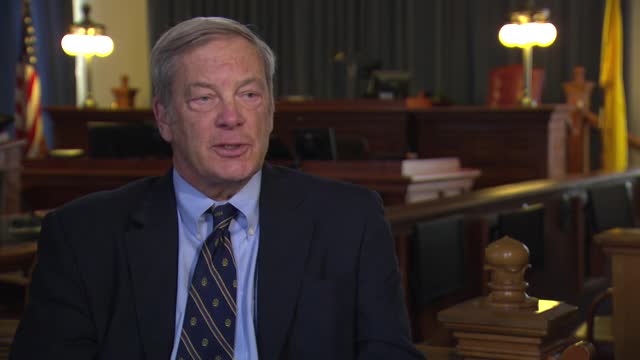
- This is raw footage for the documentary "Taming New Mexico." This is an interview with Bruce D. Black, Senior U.S. Judge with the District of New Mexico. In this footage, Judge Black discusses the history of New Mexico’s judicial system and its evolution.
- Created Date
- 2016-10-20
- Asset type
- Raw Footage
- Genres
- Unedited
- Media type
- Moving Image
- Duration
- 00:40:51.252
- Credits
-
-
Executive Producer: Kamins, Michael
Interviewee: Black, Bruce D.
Producer: DellaFlora, Anthony
Producing Organization: KNME-TV (Television station : Albuquerque, N.M.)
- AAPB Contributor Holdings
-
KNME
Identifier: cpb-aacip-19a40053556 (Filename)
Format: XDCAM
If you have a copy of this asset and would like us to add it to our catalog, please contact us.
- Citations
- Chicago: “Taming New Mexico; Judge Bruce D. Black Interview,” 2016-10-20, New Mexico PBS, American Archive of Public Broadcasting (GBH and the Library of Congress), Boston, MA and Washington, DC, accessed April 4, 2026, http://americanarchive.org/catalog/cpb-aacip-80e368b4633.
- MLA: “Taming New Mexico; Judge Bruce D. Black Interview.” 2016-10-20. New Mexico PBS, American Archive of Public Broadcasting (GBH and the Library of Congress), Boston, MA and Washington, DC. Web. April 4, 2026. <http://americanarchive.org/catalog/cpb-aacip-80e368b4633>.
- APA: Taming New Mexico; Judge Bruce D. Black Interview. Boston, MA: New Mexico PBS, American Archive of Public Broadcasting (GBH and the Library of Congress), Boston, MA and Washington, DC. Retrieved from http://americanarchive.org/catalog/cpb-aacip-80e368b4633