Heritage: Civilization and the Jews #108; No. 108; Out Of the Ashes
- Transcript
<v Narrator 1>Major funding for this program has been provided by the Charles H. <v Narrator 1>Revson Foundation, Petrie Stores Corporation and the National <v Narrator 1>Endowment for the Humanities. Additional funding has been provided by the following <v Narrator 1>contributors. <v Narrator 1>A complete donor list is available at WNET. <v Abba Eban>[ominous music] Who could these men be?
<v Abba Eban>What authority did they represent? <v Abba Eban>K lived in a country with a legal constitution. <v Abba Eban>There was universal peace. <v Abba Eban>All the laws were enforced. <v Abba Eban>Who dared to seize him in his own dwelling? <v Abba Eban>Where was the judge he had never seen? <v Abba Eban>Where was the high court? <v Abba Eban>He raised his hands, but the hands of one of the partners were already <v Abba Eban>at Kay's throat while the other thrust the knife into his heart and turned it <v Abba Eban>there twice. <v Abba Eban>Joseph K, the hero of Franz Kafka's novel The Trial, <v Abba Eban>goes to his death without ever knowing what his offense might have been. <v Abba Eban>His enemy is the unbridled, irrational, emotionless power of a modern <v Abba Eban>totalitarian state. <v Abba Eban>We have in this century, uh too often seen this legalized nightmare occur in reality, <v Abba Eban>a nightmare that we now call Kafkaesque with its street policeman, <v Abba Eban>street thugs and concentration camps where death can become an industry <v Abba Eban>of the state.
<v Abba Eban>It is fitting that Kafka, the prophet of this horror, should have been born a Jew. <v Abba Eban>For the Jews of Europe were to experience the first half of the twentieth century as <v Abba Eban>a Kafkaesque ordeal. <v Abba Eban>A time which promised them freedom and equality, but which brought them to the brink <v Abba Eban>of annihilation. [erruption sounds] <v Abba Eban>[cork pops] [jazz music plays] At first in the 1920s, the mood was optimistic. <v Abba Eban>19th century stuffiness was dispelled. <v Abba Eban>There was dance of liberty and even of excess. <v Abba Eban>Profound changes in how we thought of ourselves, of the world, even if the universe
<v Abba Eban>were working down into popular consciousness. <v Abba Eban>In 1921, Albert Einstein was awarded the Nobel laureate. <v Abba Eban>He came to symbolize not [audio cuts] ?only? <v Abba Eban>intellectual order, but also the final and complete emancipation <v Abba Eban>of West European Jewry. <v Abba Eban>Like Freud, he became one of the Jewish patriarchs of the modern world. <v Abba Eban>The numbers of Jews in scientific, artistic and public life increased as formal <v Abba Eban>barriers against them fell away. <v Abba Eban>The sting of modernism in art and its roaring sophistication is symbolized <v Abba Eban>general license and decadence to those who needed stability and certainty in their lives. <v Abba Eban>[aggressive music] They found the modern world confused, tense, frenzied. <v Abba Eban>Appeals to order and traditional morality were in vogue.
<v Abba Eban>In Italy, the journalist Mussolini seized power. <v Abba Eban>Hundreds of political opponents were murdered. <v Abba Eban>Believing in the disciplines of a vanished past, he adopted the sticks and axes <v Abba Eban>of ancient Roman authority as the symbol of his regime. <v Abba Eban>The fasces, fascists, fascism. <v Abba Eban>It was an age without consensus, an age of extremes, individualism <v Abba Eban>versus conformity, liberty versus subservience to the state. <v Abba Eban>And for the Jews inevitably caught up in this conflict, the consequences <v Abba Eban>were to be tragic. <v Speaker>The vast majority of Jews lived in Eastern Europe, far from the world of the few <v Speaker>privileged Jewish artists, scientists and businessmen of the West. <v Speaker>Visitors taking home movies in the 20s would notice few signs of modern times
<v Speaker>in the shtetl the market town. <v Speaker>But the appearance of tradition was, to a certain extent, deceptive. <v Speaker>By the early thirties, there were nine and a half million Jews in Europe, mostly Yiddish <v Speaker>speaking, they were increasingly secular and increasingly urban, living <v Speaker>in the cities of Poland, Lithuania, Romania and Hungary. <v Speaker>Communities poor in worldly goods, but rich in vitality and diversity. <v Speaker>Some support it to traditional religious life.
<v Speaker>Others denied it. <v Speaker>Some stressed Jewish difference. <v Speaker>Others sought assimilation. <v Speaker>Whatever road they took, the Jews paid for the freedom, creativity and prominant, <v Speaker>which some are very few of them achieved. <v Speaker>This limited success fueled traditional hatred of the Jews as aliens <v Speaker>and competitors. <v Speaker>Nevertheless, Jewish cultural life of all kinds flourished. <v Speaker>Oslo Yiddish produced a popular literature, <v Speaker>a tradition of stage plays and now a small movie industry. <v Speaker>Oy, oy, oy vey. <v Speaker>Yay! Yay! This one
<v Speaker>again in Hebrew and Polish as well as in Yiddish. <v Speaker>The Jewish press thrived. <v Speaker>There was a vigorous debate about what being Jewish meant from the traditionalists <v Speaker>to the socialists to the Zionists. <v Speaker>Scientism was taken up by minority who felt increasingly the constraints <v Speaker>of anti-Semitism all around the. <v Speaker>I did not see any prospects for a future after I finished school in this <v Speaker>terrible situation, I took to Zionism. <v Speaker>Like a drowning person to a board, the one aim <v Speaker>is to go to Palestine. <v Speaker>These Polish youngsters were smitten by a dream Jewish resettlement of Palestine <v Speaker>had begun. It was progressing slowly, but it was underway. <v Speaker>Another road into the modern world. <v Speaker>A road away from the centuries old traditions of European Jewry. <v Speaker>Traditional Jewish life, face to challenge, is everywhere in Russia
<v Speaker>after the revolution. Jews who had little enough reason to support the old order <v Speaker>were found among the communist leaders. <v Speaker>The revolution reached into every corner of life. <v Speaker>And although it broke the walls of czarist oppression, it also directly threatened <v Speaker>Jewish traditions. <v Speaker>But the central threat to traditional Jewish life in Europe developed in the West, <v Speaker>in the states with the most modern, most assimilated Jewish community, Germany <v Speaker>in the 1840s. <v Speaker>The Jewish poet Hiner had called this land a modern Palestine, <v Speaker>the home of philosophy, the mother soil of prophecy and the citadel of pure <v Speaker>spirituality. <v Speaker>Defeated in the World War, Germany was now embodied in a faltering democracy.
<v Speaker>The Weimar Republic. <v Speaker>Inflation and then depression destroyed the value of people's savings and wages. <v Speaker>The bread lines lengthened as jobs vanished. <v Speaker>I got to say. <v Speaker>Famer's politics constantly slipped into extremism. <v Speaker>On the far right, the National Socialists, the Nazis made a bid to <v Speaker>turn all of Germany's discontents to their advantage. <v Speaker>Although the Nazi platform might have been deranged, it was as coherent in its way <v Speaker>as any other political program of the day. <v Speaker>It promised bread and work and was seen by many as a clear alternative <v Speaker>to the chaos of Famer. <v Speaker>Big, big.
<v Speaker>Nuremberg, a symbol of the glories of Germany's past. <v Speaker>The Nazis were to turn this vision into a dark romance of blood, soil, <v Speaker>race and honor. <v Speaker>By appropriating and distorting all of German history, they mounted a successful <v Speaker>appeal across the deep divisions of fine ofsociety. <v Speaker>The Nazi Party began as a revolutionary gang, terrorizing all opponents, <v Speaker>but by the late twenties, Hitler himself was leaving these tactics behind to seek <v Speaker>office through the ballot. <v Speaker>The party became so popular that one out of every three Germans without compulsion <v Speaker>was regularly voting Nazi. <v Speaker>After the election of January 1933, Hitler became famous last
<v Speaker>chancellor. His contempt for the democracy he had manipulated was total. <v Speaker>He rapidly silenced all opposition within six months of the <v Speaker>election. <v Speaker>Gestures of protest such as this became impossible. <v Speaker>Democracy was banned. Hitler was dictator. <v Speaker>Mussolini said fascism is a religion. <v Speaker>The 20th century will be known in history as the century of fascism. <v Speaker>Hitler was proclaimed the father of the nation, the son of the race. <v Speaker>The spirit of the folk. <v Speaker>A fantasy of total conformity and subjugation fed to the Nazis doctrine, <v Speaker>all the liberal ideals of the modern world were to be cauterise, burned out, <v Speaker>put to the flame. <v Speaker>Sigmund Freud, who had in 1924 received the Gerta Prize not for
<v Speaker>his science, but for the purity and elegance of his German prose, wrote <v Speaker>what progress we are making in the Middle Ages. <v Speaker>They would have burned me. Nowadays they are content with burning my books. <v Speaker>But Freud was wrong. <v Speaker>The Nazis were not to be content with the burning of books. <v Speaker>That's right. <v Speaker>I just gave a fifth judicial intellectualise move to end <v Speaker>the ideas in the books were to be destroyed and all who persisted in believing <v Speaker>those ideas were to be destroyed as well. <v Speaker>I meant that by. <v Speaker>Dufault. <v Speaker>A quiet community a few miles from Eunick noted only for the ferocity
<v Speaker>of its local brownshirts. <v Speaker>It was here that the Nazis set up their first concentration camp to test the <v Speaker>limits of their new power. <v Speaker>They rounded up communists and churchmen, liberals and Social Democrats, all who <v Speaker>opposed them. German society and the German courts turned <v Speaker>a blind eye. <v Speaker>The Nazis. A small band of determined extremists had successfully overturned <v Speaker>the central balance of government. <v Speaker>At first, most Jews bystanders in fine arts, extremist politics <v Speaker>were not subjected to the concentration camp unless they were politically active <v Speaker>against the regime. But this was not long to remain the case on <v Speaker>the street. The Nazis presented the Jew as the enemy who moved on other enemies. <v Speaker>They used the radicalism of a few Jews and the wealth of a few more <v Speaker>as sticks with which to beat the whole community. <v Speaker>Nazi hatred had no rational basis.
<v Speaker>It was, in essence, an amalgam of racial hysteria and prejudice, a dangerous <v Speaker>paranoia. <v Speaker>The early phase of Nazi rule was one of humiliation and public vilification, <v Speaker>intermittent street violence, boycotts and of signs saying Jews <v Speaker>not wanted. <v Speaker>Did she? <v Speaker>I had walked the streets in Berlin and so many <v Speaker>crowds in front of various stores with Jewish names. <v Speaker>I felt completely lost. I didn't know what it's all about until I came <v Speaker>to the back on this. <v Speaker>And I saw a very large crowd standing in front yelling on top <v Speaker>of their voices. McCaul's shooting out and suddenly my <v Speaker>blood boiled over and I made my way through.
<v Speaker>This crowd went into the shop. <v Speaker>I felt this overwhelming anger at being considered <v Speaker>by these people as a Jewish voters. <v Speaker>I myself considered myself a German. <v Speaker>I was as German as they were. <v Speaker>As I left the shop, the crowd outside had made for me a very narrow <v Speaker>lead. I could barely walk through. <v Speaker>I remember I kept on thinking in my head, Just show dignity. <v Speaker>Just don't be afraid. Just show dignity. <v Speaker>And they were yelling, Go to Palestine. <v Speaker>Youdon zo, get out. <v Speaker>This haphazard persecution was not to be the shape that Nazi repression would <v Speaker>take. <v Speaker>Right. Right. <v Speaker>What you did back to the.
<v Speaker>Throughout the years, when Hitler ruled in peace and Germany prospered, the Jewish <v Speaker>community was devastated by law after law. <v Speaker>Legislation denied the Jews all those rights, which normally only the <v Speaker>law can guarantee. The Nazis twisted every institution of government <v Speaker>regarded then and still seen today as vital to the protection of the citizen. <v Speaker>It happened in three phases. <v Speaker>First, from 1933, <v Speaker>Jews excluded from the practice of law. <v Speaker>No Jews allowed to work as civil servants, including teachers, professors <v Speaker>and doctors in public practice.
<v Speaker>No Jewish newspaper editors in schools and universities. <v Speaker>A quota system for Jewish students. <v Speaker>Then in 1935, the Nuremberg decrees Jews are declared <v Speaker>second class citizens with virtually no rights. <v Speaker>All further, social and sexual contact with their neighbors is prohibited. <v Speaker>Then a third wave by 1939, Jews would be totally <v Speaker>excluded from any economic activity. <v Speaker>Special identity cards would be required and passports stamped with a J. <v Speaker>Jews would be excluded completely from universities, beaches, sleeping <v Speaker>cars and dining cars on trains. <v Speaker>Forbidden to drive private vehicles. <v Speaker>Subject to arbitrary eviction by landlords or divorce by non-Jewish partners <v Speaker>restricted to certain shopping hours, gradually the
<v Speaker>modern totalitarian state was taking shape and within it the Jew was <v Speaker>becoming the ultimate outcast. <v Speaker>All this was for less than one in 100 of the population. <v Speaker>There were only some five hundred and twenty thousand Jews in a race of sixty <v Speaker>million. <v Speaker>Yet for most of the others, life for the first time since the First World War was good. <v Speaker>There were jobs again. Not least because Germany was rearming and Germany <v Speaker>was once more respected in the world. <v Speaker>In 1936, as a mark of this renewed stature as she hosted the Olympic <v Speaker>Games. <v Speaker>The country was cleaned up for the occasion.
<v Speaker>The Jewish athletes were allowed to attend. <v Speaker>Jana Falana wrote in The New Yorker for Germany, <v Speaker>1936 has been an Olympian season only. <v Speaker>A determined, deaf and blind visitor to any corner of this land could fail <v Speaker>to see and hear the sight and the sound of Germany's forward march. <v Speaker>It was a forward march. That's within five years was to engulf the whole of Europe. <v Speaker>In every state bordering the RIF lived ancient German speaking communities.
<v Speaker>Each one now became a pretext for Nazi intervention. <v Speaker>Austria was first. <v Speaker>But as the greater RIF grew to contain more Germans, it also expanded <v Speaker>to absorb more Jews. <v Speaker>They were dealt with swiftly. The process of humiliation, expropriation <v Speaker>and terror, which had taken five years to develop in Germany, was unleashed <v Speaker>in days and weeks. <v Speaker>There were protests, as there had been from the very beginning, Mayor <v Speaker>LaGuardia had proclaimed. <v Speaker>I am here this evening to join <v Speaker>the five fellow New Yorkers in a great <v Speaker>growth path. Not again. <v Speaker>The German people, but again, the present German government. <v Speaker>But all the voices of protest were buried. <v Speaker>The 30s were a time of depression, political violence and outright
<v Speaker>armed conflict. <v Speaker>Far from being the most civilized of centuries, the 20th had begun <v Speaker>to reveal the terrifying effects of new technologies. <v Speaker>Wars raged around the globe from China and Ethiopia to Spain. <v Speaker>To contain the flood of war, Germany's neighbors developed a policy of appeasement. <v Speaker>After Austria, Germany wanted and was given the German speaking area <v Speaker>of Czechoslovakia. <v Speaker>Czechoslovakia was dismembered. <v Speaker>In such a world, it is not surprising that the Jews were being left to their fate. <v Speaker>In the courts and on the street, the Jews were constantly threatened. <v Speaker>On November the 9th, 1938, gerbils turned out the brownshirts for
<v Speaker>an orgy of burning and looting Kristallnacht the night of breaking <v Speaker>glass, every synagogue in Germany was attacked by the Nazis. <v Speaker>Ninety one Jews died. <v Speaker>I stood there for probably half an hour. <v Speaker>There was not one attempt to put out the fire in the synagogue. <v Speaker>My father was not there. He came back late that morning. <v Speaker>He was in bad shape. <v Speaker>We talk together. What's going to happen now? <v Speaker>And one thing he did and he's just he says, we got to get you out. <v Speaker>The truth was unambiguously clear after Kristallnacht. <v Speaker>The Nazis had legally written the Jews out of society. <v Speaker>Now they would physically expel them from the Reich. <v Speaker>But where were the Jews to go
<v Speaker>in 1938? <v Speaker>The world was still suffering from depression and high unemployment. <v Speaker>It was a world of visas, immigration quotas and affidavits. <v Speaker>There was a family, non-Jewish family living in Wilmington, Delaware, <v Speaker>who had offered an affidavit for myself to get out. <v Speaker>That affidavit unfortunately had a number next to it. <v Speaker>That number was somewhere 18000. <v Speaker>And when we went to the American consulate to try to find out when I would be able to <v Speaker>leave the to leave Germany to emigrate to the United States, I <v Speaker>was told that the year was 1942. <v Speaker>Yet some doors were ajar, Palestine was there as a haven. <v Speaker>The Zionist dream was still alive, a virtual British colony <v Speaker>since 1918. <v Speaker>Palestine presented a most un-European face.
<v Speaker>It was an undeveloped, multi-ethnic Middle Eastern land. <v Speaker>And for most immigrants, it offered a vivid contrast to the Europe that they had fled. <v Speaker>Above all, it was so completely different to anything I had known back home. <v Speaker>The sharpness of the colors, the sense, the smells and the variety of the people. <v Speaker>Outside the cities, there were no trees, no woods, no rivers, no brooks. <v Speaker>Just here and there, oasis of dazzling flowers and citrus groves <v Speaker>and then unremitting sand. <v Speaker>Well, I mean, have. <v Speaker>Despite hardships, the dream was being closed in reality. <v Speaker>The Jewish community was more than 200000 strong. <v Speaker>It had begun to remake the land. <v Speaker>And with an effort every bit as hard, it had reestablished Hebrew as an everyday
<v Speaker>language. <v Speaker>A whole new Jewish city, Tel Aviv, was being built, <v Speaker>a new society, a new culture was being fashioned. <v Speaker>That's the Hebrew University was founded, <v Speaker>a national symphony orchestra was established at Toscanini, conducted it <v Speaker>as a protest against the European fascists. <v Speaker>As more Jews arrived, relations with the Arab majority worsened. <v Speaker>In 1939, the British responded to Arab unrest by limiting <v Speaker>Jewish immigration to a total of seventy five thousand over five years and <v Speaker>then no more Jews at all. <v Speaker>The door was to be slammed. <v Speaker>The community protested, but the policy remained unchanged.
<v Speaker>It was a policy to be repeated by nation after nation nearly everywhere. <v Speaker>The refugees were to be refused entry. <v Speaker>This was a time of an exodus by every available route. <v Speaker>A time of a wandering. As tragic as any ever suffered by the Jews. <v Speaker>907 German Jews boarded the steamship, the St.. <v Speaker>Lewis heading for Cuba. <v Speaker>They came within feet of safety but were turned away. <v Speaker>Pleading was useless. <v Speaker>Next, they approached Miami, but the US Coast Guard denied them entry. <v Abba Eban>Unable to land in the new world, they were forced to return to the old. <v Abba Eban>The escape had failed. The opportunities for further escape attempts <v Abba Eban>were fast disappearing. <v Abba Eban>Throughout Europe, tensions were mounting.
<v Abba Eban>Once more, the world was on the brink. <v Abba Eban>The Reich wanted western Poland. <v Abba Eban>September 1939, the Nazis crossed the Polish border <v Abba Eban>and the world was at war. [explosions] The world lightning, <v Abba Eban>in German blitz, acquired for all the peoples who lived between the North <v Abba Eban>Sea and the Urals, a frightful new meaning. <v Abba Eban>The Nazis waged lightning war, Blitzkrieg, across an entire continent. <v Abba Eban>Nation after nation was struck down. <v Abba Eban>Total war involved people, ordinary people in unprecedented numbers. <v Abba Eban>[sobbing] [emotional music] Millions of families were split up under the Nazi guns.
<v Abba Eban>Many would never see each other again. <v Speaker>Each conquest, and for three years there was little else, each conquest, <v Speaker>especially in the east of Europe, added to the number of Jews within the Reich. <v Speaker>For every Jew within his grasp, in 1933, Hitler had nearly <v Speaker>20 in 1941.
<v Speaker>So to contain and control them in all the cities of the east, the Nazis <v Speaker>confined the Jews to what they termed ghettos. <v Speaker>From kazimir, a suburb of the Polish city of Krakow, the Jews were <v Speaker>herded together across the river into the poorer sections of the town. <v Speaker>Facing the all encompassing power of the Nazis, the Jews were doubly imprisoned, <v Speaker>held in the ghettos and surrounded by occupying armies. <v Speaker>Physical resistance was futile, but moral resistance was everywhere. <v Speaker>Forbidden public prayer. They prayed in secret. <v Speaker>In back rooms, on drunk benches near a table, little schoolchildren sat and
<v Speaker>learned in secret. <v Speaker>Jews worked, the Jews believed needed to believe that if the work was <v Speaker>required, then so was the worker. <v Speaker>Above all, there was a sense of foreboding. <v Speaker>However hellish, the ghetto families were still intact. <v Speaker>There was a semblance of order. <v Speaker>But the Jews feared that worst was yet to come. <v Speaker>God, please let us stay here. <v Speaker>Show us you are merciful. <v Speaker>If my census are accurate, this is the last paradise we will <v Speaker>ever know. <v Speaker>Please let us stay in this heavenly hell forever. <v Speaker>We are tightly packed in the ghetto, but that must be a fine way to
<v Speaker>live in comparison to deportation. <v Speaker>They got the leave of his senses. <v Speaker>Something terrible is coming. <v Speaker>There are seven of us in nine feet of space. <v Speaker>Let them put 14 together. <v Speaker>Twenty eight. <v Speaker>We will sleep on top of each other. <v Speaker>We will get up at 3 a.m., not four. <v Speaker>Stand in line for 10 hours. <v Speaker>Anything. <v Speaker>Anything just let our family stay together. <v Speaker>5000 a month were dying of starvation and disease in Warsaw Ghetto. <v Speaker>But this was not enough for the Germans. <v Speaker>And now the Nazis made their unique contribution to the annals of European
<v Speaker>anti-Semitism. <v Speaker>They no longer said has had their medieval forebears. <v Speaker>You cannot live amongst us as Jews. <v Speaker>They no longer said, as they themselves had for nearly a decade, you cannot live <v Speaker>amongst us. <v Speaker>Now, they said something new. They said you cannot live. <v Speaker>As the Germans swept into the heart of the Jewish communities of western Russia in <v Speaker>1941, close behind the frontlines came the mobile <v Speaker>killing squads of the SS. <v Speaker>In the 16 months to the autumn of 1942, they and other members <v Speaker>of the German army, as well as Ukrainian and Baltic pro Nazis, shot <v Speaker>nearly one and a half million Jews. <v Speaker>Human beings a minute for every hour of every day. <v Speaker>For nearly 500 days. <v Speaker>About the problem, as the Nazis termed it, persisted.
<v Speaker>Early in 1942, here at a villa in Van, say, outside <v Speaker>Berlin, the leaders of the German government met in order to refine <v Speaker>the plan already underway in the east of systematically murdering <v Speaker>every last two in its control. <v Speaker>By spring, the logistics of death were in place. <v Speaker>Bureaucratic processes down to the last in my new detail of costing <v Speaker>supplies and scheduling were put to the service of murder. <v Speaker>We drag ourselves to the railroad station. <v Speaker>The sun is mercilessly hot. <v Speaker>People are fainting, babies screaming. <v Speaker>We, the young and healthy teenagers are totally spent. <v Speaker>What must the old the sick feel? <v Speaker>Totally stripped of our dignity.
<v Speaker>Leaving the town we were born in grew up in. <v Speaker>What happens after this long wait? <v Speaker>Where are we off to? <v Speaker>Seventy five to a car, no toilets, no <v Speaker>doctors, no medication. <v Speaker>Rescreen my mother into a sitting position on the backpack. <v Speaker>Her face has an otherworldly look. <v Speaker>She knows she will not laugh, but she wants us <v Speaker>to live desperately. <v Speaker>All these years, I have carried with me her face of resignation <v Speaker>and hope and love. <v Speaker>Stay alive, my darlings.
<v Speaker>All six of you. <v Speaker>We started the journey of ugliness on May 29. <v Speaker>We headed for Auschwitz. <v Speaker>We arrived on May 30 first. <v Speaker>Our line moved slowly forward until we came face <v Speaker>to face with an elegant Essman <v Speaker>leather coat, gloves. <v Speaker>Young man and the thumb went up and the sun went down. <v Speaker>Up you lift down your died. <v Speaker>You didn't know what it meant. We had an idea. <v Speaker>The scent of spring wasn't delicious.
<v Speaker>The earth didn't smile. <v Speaker>It shriek in pain. <v Speaker>The air was filled with the stench of death. <v Speaker>Unnatural that the smoke was thick. <v Speaker>The sun couldn't crack through. <v Speaker>The scent was the smell of burning flesh. <v Speaker>The burning flesh. <v Speaker>Was your mother. <v Speaker>I am condemned to walk the earth for all my these <v Speaker>with the stench of burning flesh in my nostrils. <v Speaker>My nostrils are damned. <v Speaker>Maise, theymade may should be abolished. <v Speaker>Me. It's. <v Speaker>There should be only eleven months in a year. <v Speaker>Me should be set aside for this. <v Speaker>For six million years to cleanse
<v Speaker>the earth. <v Speaker>Millions died, but contrary to the records made by the Nazis, <v Speaker>they did not all die without protest before, despite the starvation <v Speaker>and brutality and the unbridled power of their gods, some rebelled <v Speaker>in Auschwitz in the lowest circle of hell. <v Speaker>The special squads charged with the disposal of the dead attempted a revolt <v Speaker>in Treblinka. The underground blew up the arsenal and 200 inmates <v Speaker>escaped in Sobibor. <v Speaker>The entire surviving population rebelled. <v Speaker>Conrads forward? <v Speaker>I shouted. The cries echoed through the camp as six 600 of <v Speaker>us, pain wracked and tormented, surged forward to life and freedom.
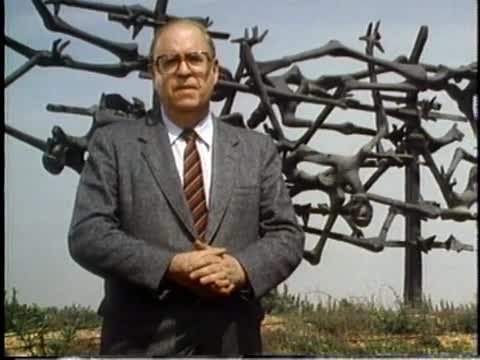
<v Speaker>The grass has grown over many concentration camps, outfits. <v Speaker>My Dansk Treblinka, Tracy interestand Bergen-Belsen. <v Speaker>Perhaps the word monument is the best way of describing their significance today. <v Speaker>There are across the world monuments to man's gift of beauty. <v Speaker>There are monuments to man's creativity. <v Speaker>There are monuments to man's wealth. <v Speaker>Here, scattered over Europe, there are these monuments, monuments to human <v Speaker>cruelty, suffering, anguish and resistance. <v Speaker>The ghettos are not preserved.
<v Speaker>Nevertheless, they offer witness to the strength of the human spirit for here to <v Speaker>resistance when weapons could be found and preparations made, but came the <v Speaker>rebellion in Bialystok, in Vilna, in 105 ghettos, <v Speaker>and there was armed resistance. <v Speaker>In Warsaw, the young Jews, the under-20s, the radicals ambushed the Nazis. <v Speaker>We were young boys and girls. <v Speaker>We had no military training before. <v Speaker>We prepared quite a big mine to do it. <v Speaker>Well, the Germans marched in and we switched <v Speaker>on and the mine exploded. <v Speaker>This was the the first time I saw dead Germans. <v Speaker>The Germans, of course, were astonished when they <v Speaker>came near to us. <v Speaker>We swarns them and made grenade. <v Speaker>We had a lot of bottles.
<v Speaker>And then again, we thought our gentlemans burning like <v Speaker>a torch. <v Speaker>We just wanted to die with dignity. <v Speaker>Therefore, what we wanted and to take revenge. <v Speaker>After weeks of fighting, the Germans retook the ghetto building by building <v Speaker>elsewhere. <v Speaker>Resistance continued. <v Speaker>Do you know where <v Speaker>the endless forests were in reach of the ghettos? <v Speaker>Thousands escaped to join the Soviet partisans, harassing the Nazis behind <v Speaker>the lines. <v Speaker>From the ghetto of Minsk alone, 10000 fled to reinforce the fighters <v Speaker>in the forests. <v Speaker>All in all, one estimate says as many as 40000 Jews were under <v Speaker>arms in the east. <v Speaker>Although these episodes had limited strategic significance for the Jews, they
<v Speaker>were a crucial step away from their traditional behavior. <v Speaker>The responses of European Jewry to this persecution had been to no avail. <v Speaker>Obedience to every last whim of their persecutors had brought them no respite. <v Speaker>They faced the ultimate barbarity. <v Speaker>It understood only power. <v Speaker>So Jewish communities, however few, however futile their resistance, <v Speaker>rose in arms against their oppressors. <v Speaker>Beyond heroism, beyond the search for dignity in death, Jews <v Speaker>came to understand the necessity of power. <v Speaker>This was a crucial lesson. <v Speaker>There is a lesson also in remembering the righteousness of ordinary people in every <v Speaker>European nation. <v Speaker>Denmark until the fall of 1943, the quietest of Nazi <v Speaker>occupations. <v Speaker>The seven thousand five hundred Danish Jews lived in peace under the Nazis. <v Speaker>Unmarked hand and enslaved orders were drawn up to begin
<v Speaker>deportations. <v Speaker>The Danes refused to cooperate. <v Speaker>Among the protests, a pastor cried from the pulpit. <v Speaker>I would rather die with the Jews than live with the Nazis. <v Speaker>The Nazis planned the roundup for the Jewish New Year. <v Speaker>September 1943, the Danes hid all but <v Speaker>477 Jews in factories, in hospitals, in private homes. <v Speaker>Over the next several nights, the Jews were placed in boats. <v Speaker>Any boats and ferried over the narrow waters to safe and neutral Sweden <v Speaker>and the Danish Jews were blessed with neighbors who abhorred persecution of any <v Speaker>kind. Others across Europe also found ways of protecting <v Speaker>their Jewish neighbors. <v Speaker>There were public demonstrations in Bulgaria, Swiss and Swedish visas
<v Speaker>were issued in Budapest. <v Speaker>Everywhere at great risk, single Jews or more often Jewish children <v Speaker>were hidden. <v Speaker>Very few were saved. But each life is a testament to what might be called <v Speaker>the Danish spirit. <v Speaker>In contrast, the governments of the UN enslaved world witnessed the genocide <v Speaker>of the Jews almost in silence. <v Speaker>And they did witness it. <v Speaker>By the spring of 1944, the allies knew the exact nature <v Speaker>of the camps from Auschwitz escapees. <v Speaker>But although allied bombers flew over rail lines to the camp, the death trains were <v Speaker>never disrupted. <v Speaker>The Jews were not alone in their agony in the camps, the Nazis murdered millions <v Speaker>of Russians, Serbs, Poles, one out of three of Europe's Romani gypsies,
<v Speaker>all opposition the mentally ill and the chronically sick. <v Speaker>Jehovah's Witnesses, homosexuals. <v Speaker>Elsewhere, the innocent were also dying, sometimes in atrocities as bad as the camps. <v Speaker>Here in order doored in central France on the morning of the 10th of June, 1944, <v Speaker>the Nazis murdered the entire population. <v Speaker>They shot the men and then killed 500 children and women in the village church. <v Speaker>Be specific reason for the massacre was not announced and has never been discovered. <v Speaker>Or outdoor sewer glan has never been rebuilt. <v Speaker>The Nazis were fighting two wars, one without rules against the Jews
<v Speaker>and the other a general war, but the two wars were in fact one <v Speaker>believing that one group of human beings, the Jews were vermin, led the Nazis <v Speaker>to treat all their fellows as such. <v Speaker>It became one war against the value of individual life. <v Speaker>For all free people, the war became something more a crusade against <v Speaker>a terrible evil. <v Speaker>Beyond the usual claims of justice and right the allies. <v Speaker>Roosevelt and Churchill argued that the Nazis were an uncommon breed of evil, <v Speaker>anti humanistic, the very antithesis of civilization. <v Speaker>The costs of the conflict was enormous. <v Speaker>More than 30 million dead. <v Speaker>The majority civilians, the allies ruthlessly pursued
<v Speaker>victory in response to the Nazis total war. <v Speaker>The Reich was to be destroyed as effectively as it had devastated its <v Speaker>neighbors. <v Speaker>Summer, 1944. <v Speaker>D-Day. <v Speaker>Germany careened into defeat, invaded from east and west, <v Speaker>and the RIF that was to have lasted a thousand years, drowned in a sea <v Speaker>of blood. <v Speaker>And so finally it was over. <v Speaker>The particular plague that had tormented the world for 12 years passed away <v Speaker>and was still. <v Speaker>For the millions of soldiers amongthem hundreds of thousands of Jews in the allied
<v Speaker>armies, the time had come to go home. <v Speaker>But in Europe, in the summer of 1945, eleven million prisoners of war <v Speaker>and displaced people were uncertain where home might be. <v Speaker>None more so than the remnant of the death camps. <v Speaker>One hundred thousand Jewish survivors fled into the British and American occupied <v Speaker>areas of Germany from the East. <v Speaker>Some Jews tried returning to the Polish cities, but within a year there was <v Speaker>another pogrom overreach. <v Speaker>Centuries of Jewish life in Poland virtually came to an end. <v Speaker>If this is Krakow, Poland, today, the Jewish community
<v Speaker>still has a warden, but now it numbers a scant seven hundred. <v Speaker>Once it was nearly sixty thousand strong. <v Speaker>The juries of Central Europe were, as the Nazis had desired, very nearly wiped <v Speaker>from the face of the Earth. <v Speaker>And the secular Yiddish culture that flourished here has disappeared forever. <v Speaker>The Jewish presence, which had contributed to the history of these lands for more
<v Speaker>than eight centuries was savagely cut off. <v Speaker>But the Nazis attacked far more than the communities of one small European <v Speaker>ethnic minority. And the significance of the destruction of those communities <v Speaker>is of a moment greater than the limits of Jewish history. <v Speaker>The Nazis challenged the values of civilization. <v Speaker>They offered a grim plan for the future. <v Speaker>A world in which doubt. was forbidden. <v Speaker>A world of absolute truths. <v Speaker>A world of obsessive order and rigid conformity. <v Speaker>A world without human diversity. <v Speaker>And they were willing to go to any lengths to achieve their purpose. <v Speaker>But in the end, at a cost almost too great to bear. <v Speaker>They were defeated. <v Speaker>None can know the meaning of that narrow victory so well as those who witnessed the very <v Speaker>eye of the storm.
<v Elie Wiesel>There is nothing else my generation could do but bear witness and therefore <v Elie Wiesel>bear witness for humanity. <v Elie Wiesel>They thought they could kill six million Jews and and go on as though <v Elie Wiesel>the six million Jews didn't die. <v Elie Wiesel>Well together with the Jew, the image of man <v Elie Wiesel>was destroyed. <v Elie Wiesel>We have all the reasons in the world to despair and to give up on man <v Elie Wiesel>and to give up on culture on civilization or language and even on God. <v Elie Wiesel>We aren't permitted to have. <v Elie Wiesel>We have the reasons to do so, but we will not invoke them. <v Elie Wiesel>And in spite of everything, we shall go on believing. <v Abba Eban>[hopeful music] Out of these ashes comes the understanding that no one's life can be <v Abba Eban>guaranteed without constant struggle. <v Abba Eban>Belief in the ultimate ability of humankind to overcome the darkest, most <v Abba Eban>brutal of forces is the light which must carry us forward. <v Narrator 1>Major funding for this program has been provided by the Charles H.
<v Narrator 1>Revson Foundation, Petrie Stores Corporation, and the National <v Narrator 1>Endowment for the Humanities. Additional funding has been provided by the following <v Narrator 1>contributors. <v Narrator 1>A complete donor list is available at WNET. <v Narrator 1>Abba Eban has written a companion book to this series, which is published by Summit <v Narrator 1>Books and is available in bookstores and libraries. <v Narrator 1>[PBS theme plays]
- Episode Number
- No. 108
- Episode
- Out Of the Ashes
- Contributing Organization
- The Walter J. Brown Media Archives & Peabody Awards Collection at the University of Georgia (Athens, Georgia)
- Thirteen WNET (New York, New York)
- AAPB ID
- cpb-aacip-75-644qrt6c
If you have more information about this item than what is given here, or if you have concerns about this record, we want to know! Contact us, indicating the AAPB ID (cpb-aacip-75-644qrt6c).
- Description
- Description
- The Holocaust. The Nazi party arises from the unstable world of Germany in the 1920s. Hitler subverts civil rights, silences his opponents and intimidates citizens through mob violence. German armies overrun Europe, and an unspeakable mission begins - the extermination of the Jews. From memoirs of those who suffered to tales of resistance and bravery to the nightmare of death camps, this hour ends with the liberation of Europe in 1945 and with refugees huddling in camps, separated forever from those they loved.
- Asset type
- Episode
- Media type
- Moving Image
- Duration
- 00:59:44.481
- Credits
-
-
Executive Producer:
Labaton, Arnold
Executive Producer: Siegel, Marc
Host: Eban, Abba
Producer: Fox, John
- AAPB Contributor Holdings
-
The Walter J. Brown Media Archives & Peabody Awards Collection at the
University of Georgia
Identifier: cpb-aacip-c81c0a94afe (Filename)
Format: U-matic
Duration: 1:00:00
-
Thirteen - New York Public Media (WNET)
Identifier: cpb-aacip-3e087bb6e6f (Filename)
Format: 1 inch videotape
Generation: Master
-
The Walter J. Brown Media Archives & Peabody Awards Collection at the
University of Georgia
Identifier: cpb-aacip-2d41367d529 (Filename)
Format: U-matic
Duration: 1:00:00
-
Thirteen - New York Public Media (WNET)
Identifier: cpb-aacip-c6f7c095314 (Filename)
Format: 1 inch videotape
Generation: Master
If you have a copy of this asset and would like us to add it to our catalog, please contact us.
- Citations
- Chicago: “Heritage: Civilization and the Jews #108; No. 108; Out Of the Ashes,” The Walter J. Brown Media Archives & Peabody Awards Collection at the University of Georgia, Thirteen WNET, American Archive of Public Broadcasting (GBH and the Library of Congress), Boston, MA and Washington, DC, accessed October 2, 2026, http://americanarchive.org/catalog/cpb-aacip-75-644qrt6c.
- MLA: “Heritage: Civilization and the Jews #108; No. 108; Out Of the Ashes.” The Walter J. Brown Media Archives & Peabody Awards Collection at the University of Georgia, Thirteen WNET, American Archive of Public Broadcasting (GBH and the Library of Congress), Boston, MA and Washington, DC. Web. October 2, 2026. <http://americanarchive.org/catalog/cpb-aacip-75-644qrt6c>.
- APA: Heritage: Civilization and the Jews #108; No. 108; Out Of the Ashes. Boston, MA: The Walter J. Brown Media Archives & Peabody Awards Collection at the University of Georgia, Thirteen WNET, American Archive of Public Broadcasting (GBH and the Library of Congress), Boston, MA and Washington, DC. Retrieved from http://americanarchive.org/catalog/cpb-aacip-75-644qrt6c