Heritage: Civilization and the Jews #109; No. 109; Into the Future
- Transcript
<v Narrator>Major funding for this program has been provided by the Charles H. <v Narrator>Revson Foundation, Petrie Stores Corporation and the National <v Narrator>Endowment for the Humanities. Additional funding has been provided by the following <v Narrator>contributors. <v Narrator>A complete donor list is available at WNET. <v Narrator>[theme music plays] [audio cuts out multiple times] <v Narrator 2>These Jews were survivors of the Holocaust, refugees, displaced
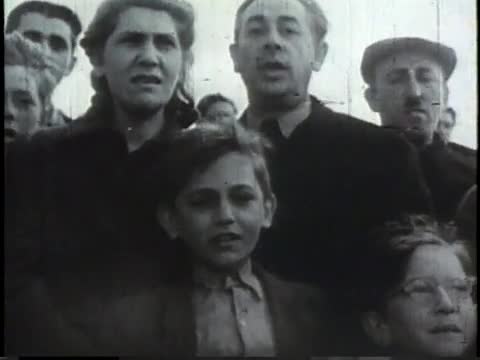
<v Narrator 2>persons. Behind them lay the smoking and blood soaked ruins <v Narrator 2>of Europe and the devastation of their lives. <v Narrator 2>Behind them lay 6 million of their relatives and family, their friends and neighbors <v Narrator 2>murdered. <v Narrator 2>For over a century, they had assimilated and adapted. <v Narrator 2>They had struggled for their traditions. <v Narrator 2>For the right to be different. <v Narrator 2>They had believed in the possibilities of the brotherhood of man. <v Narrator 2>But now, after the Second World [audio cuts] ?War?, the remnant of European juries <v Narrator 2>and other threatened Jewish communities. <v Narrator 2>The overwhelming hope was for a place of safety, a secure home. <v Narrator 2>[singing] They hoped to live normal lives, <v Narrator 2>to raise families and to live in peace. <v Narrator 2>Some had found refuge in the Americas and in Australia, but most looked <v Narrator 2>elsewhere to a small land with great meaning in their history.
<v Narrator 2>To Palestine, the ancient homeland of their people. <v Narrator 2>Palestine. For centuries, this had been a remote and desolate corner <v Narrator 2>of the Ottoman Turkish Empire with only a small Jewish community. <v Narrator 2>Then in the late 19th and early 20th century, this land saw <v Narrator 2>the arrival of a new breed of Jewish settler. <v Narrator 2>They were young and idealistic from Russia and the country [audio cuts out] <v Narrator 2>in Europe. They came to [audio cuts] agrarian settlements <v Narrator 2>to start what they dreamed would become a new Jewish nation.
<v Narrator 2>They called themselves Zionists. <v Narrator 2>They numbered more than 80,000 by 1914 when the First World War broke <v Narrator 2>out in [audio cuts] Europe. [explosions] <v Narrator 2>The Turkish empire, an ally of Germany, ?came? <v Narrator 2>under attack from allied forces. <v Narrator 2>It collapsed, and British and French troops moved into the Middle East, promising <v Narrator 2>independence to its various region. <v Narrator 2>Palestine fell under [audio cuts] ?British? rule, while its Arab and Jewish populations <v Narrator 2>each waited to be given control of the land. <v Narrator 2>In 1917, Britain had a document, the Balfour Declaration, <v Narrator 2>promising support for a national home in Palestine for the Jewish people. <v Narrator 2>[singing] This promise raised the hopes of Zionists everywhere. <v Narrator 2>In the 1920s, Jewish emigration increased in part because of the new
<v Narrator 2>opportunities in Palestine, in part because of the worsening conditions for Jews <v Narrator 2>in Eastern Europe. <v Narrator 2>On a greater scale than ever before, the Jewish community remade the land <v Narrator 2>clearing fields, draining swamps, building cities. <v Narrator 2>By 1929, the Jewish community had reached 160000. <v Narrator 2>Twenty percent of the total population of Palestine. <v Narrator 2>In the 1930s, Jewish towns were growing steadily. <v Narrator 2>Tel Aviv was already a metropolis. <v Narrator 2>And Jewish emigration was fast increasing as tens of thousands arrived <v Narrator 2>each year, fleeing Nazi power in Europe. <v Narrator 2>In the Middle East, France and Britain had recently created new Arab
<v Narrator 2>states: Iraq, Lebanon, Syria. <v Narrator 2>The Arabs of Palestine were now growing restless, frustrated <v Narrator 2>by continuing British rule, angered by continuing Jewish emigration. <v Narrator 2>In the 30s, there were riots and sporadic outbreaks of violence <v Narrator 2>against both the Jews and the British authorities. <v Narrator 2>But the conflict in Palestine was about to be engulfed by a coming <v Narrator 2>universal conflagration. [explosions] <v Narrator 2>The Second World War brought a half decade of horror and devastation. <v Narrator 2>[mournful music] <v Narrator 2>In Europe, millions were homeless.
<v Narrator 2>Three quarters of the Jews in Nazi occupied Europe had been massacred. <v Narrator 2>For the Jews of Germany, Austria and Poland in particular, home now seemed <v Narrator 2>the abode of murderers. <v Narrator 2>At ?inaudible? in Poland in 1946, there was a further anti-Semitic <v Narrator 2>outbreak. 43 Jews were killed by a mob. <v Speaker>In Palestine, Jews demanded that a safe haven be made there for <v Speaker>the survivors of the Holocaust. <v Speaker>But the British refused. <v Speaker>They continued to limit immigration, severely, hoping to achieve good <v Speaker>relations with the Arab world and protect their influence in the Middle East. <v Speaker>The Jews, however, were determined to increase immigration in defiance of British <v Speaker>authority.
<v Speaker>In secret, often in the dark of night, displaced and homeless <v Speaker>Jews were brought to small ports all over the Mediterranean, crammed onto <v Speaker>boats old and barely seaworthy to sail for the forbidden shore of <v Speaker>Palestine. <v Speaker>There were two thousand dollars on a boat built for 400. <v Speaker>Many of us were sick of the crowded conditions. <v Speaker>As storms. <v Speaker>Secrecy was vital as British planes flew overhead. <v Speaker>As we neared the shore, a warship appeared on the horizon. <v Speaker>We had been discovered the hiding was useless, so we came <v Speaker>on deck to. <v Speaker>We knew the British would try to stop us reaching the shore, <v Speaker>but we wanted them to know they could not break our spirit.
<v Speaker>Some of the refugees eluded the British blockade. <v Speaker>Most were captured, their fate once more uncertain. <v Speaker>She told them, you're going to be taken on board the ship, <v Speaker>which will take us to Cyprus. <v Speaker>When we finally sighted that ship into <v Speaker>the port of Haifa, it was the greatest feeling of letdown, <v Speaker>a feeling of trauma and of of uncertainty. <v Speaker>And to some extent, a fear for many of us <v Speaker>came out of concentration camps. <v Speaker>The ship looked like it was fasion camp because the decks were <v Speaker>all why I didn't caged in. <v Speaker>And those of us who are still as sure and <v Speaker>watched others walk into these cages, these were moments of
<v Speaker>dread and difficulty for us. <v Speaker>While over 50000 Jews were interned in camps in Cyprus, <v Speaker>Jewish negotiations with the British led nowhere. <v Speaker>International pressure mounted for Britain to change its policy, but to no <v Speaker>avail. <v Speaker>In Palestine, the Jews now fought the British by all available means. <v Speaker>In 1946, the King David Hotel British headquarters in Jerusalem <v Speaker>was bombed throughout the land. <v Speaker>Bridges were blown up. Soldiers were attacked. <v Speaker>The continuing British response was imprisonments, armed searches, harsh <v Speaker>penalties, an apparatus of repression and control was clamped down, <v Speaker>unable to find a solution. <v Speaker>In February 1947, the British government requested that the United <v Speaker>Nations to intervene.
<v Speaker>After months of inquiry and debate, the United Nations General Assembly <v Speaker>voted whether to partition Palestine into two states. <v Speaker>One Jewish, one Arab. <v Speaker>Yeah, the Soviet Union. <v Speaker>Yes, the United Kingdom abstained. <v Speaker>The United States? <v Speaker>Yes. Approval of the new plan came from countries <v Speaker>both east and West. <v Speaker>The resolution of the Committee for <v Speaker>Palestine was adopted by Surtees to reboot <v Speaker>again in upstate. <v Speaker>There were to be two states occupying the area of Palestine with <v Speaker>Jerusalem and international city. <v Speaker>Once more, 19th centuries after the destruction of Judea by Roman
<v Speaker>legions, the Jews were to have a land of their own. <v Speaker>On May 14th, 1948, ending an occupation of 30 years <v Speaker>and refusing to implement the United Nations partition plan, the British <v Speaker>withdrew from Palestine. <v Speaker>That afternoon in Tel Aviv, David Ben-Gurion, leader of the National <v Speaker>Jewish Council, proclaimed the establishment of a Jewish state in Palestine <v Speaker>to be called Israel. <v Speaker>It was exactly three years, almost to the day since the end of the war in <v Speaker>Europe and the overthrow of the greatest tyranny that had ever oppressed the Jewish <v Speaker>people. For the Jews, it was a miraculous transition <v Speaker>from the deepest valley of despair to the fulfillment of their highest hopes.
<v Speaker>But the Arabs viewed the U.N. <v Speaker>decision as a defeat. <v Speaker>Arab irregulars from Syria and Lebanon, the armies of Egypt and Transjordan <v Speaker>and other Arab forces crossed Palestine's border in arms, <v Speaker>rushing to occupy the vacuum created by the British withdrawal. <v Speaker>The Jews now have to take up arms to defend their lives, along with a <v Speaker>life of their new state with few weapons or supplies, <v Speaker>but with determination and discipline, they created a civilian army. <v Speaker>War raged the length and breadth of the land. <v Speaker>Nowhere more fiercely than in besieged Jerusalem. <v Speaker>It took a year of intense and hard fought conflicts.
<v Speaker>The United Nations plan was destroyed in the flow of battle. <v Speaker>Access to the old city of Jerusalem was lost. <v Speaker>The city was split its holiest places in the hands of Arab forces. <v Speaker>By 1949, Israel emerged victorious, but at great <v Speaker>cost. Six thousand dead, one percent of the Jewish <v Speaker>population. <v Speaker>For the first time in almost two thousand years, there was a Jewish <v Speaker>state. <v Speaker>And in May nineteen forty nine, Israel took her place as a member of <v Speaker>the United Nations. <v Speaker>By some miracle, it had been successful. <v Speaker>The Jews had been landless, united by the ties of their common history. <v Speaker>Their shared faith and the ever recurring cycles of their religious calendar. <v Speaker>But now a great community had been created into place, which had
<v Speaker>dominated Jewish history. <v Speaker>These Jews were bound together, not just in time, but also in space. <v Speaker>In the space of this new state and the ancient prayer next <v Speaker>year in Jerusalem took on a new meaning, a new significance. <v Speaker>Jerusalem was now within reach. <v Speaker>There was a welcoming door, a place of their own. <v Speaker>A state whose fundamental law gave every Jew in the world the right <v Speaker>to enter. <v Speaker>And they came more than five hundred thousand in the first <v Speaker>three years alone. <v Speaker>By 1951, the Jewish population of Israel had doubled <v Speaker>to more than a million. <v Speaker>They came from 42 countries, many like these Yemenite
<v Speaker>from the Arab lands. <v Speaker>For the Yemen nights, it seems a biblical promise fulfilled <v Speaker>to be returned to Israel on the wings of an eagle, though the eagle turned out <v Speaker>to be a battered DC 6 plane after played laboriously <v Speaker>brought out the entire Jewish community of Yemen. <v Speaker>One hundred and twenty thousand more were flown in from Iraq. <v Speaker>For centuries, many Jews had lived scattered throughout Arab lands. <v Speaker>Their customs and culture very different from that of their European brethren. <v Speaker>But in Israel, all these Jews were to share a common destiny and a common <v Speaker>purpose. <v Speaker>From Morocco, Jews brought the celebration of the Moonah, <v Speaker>a festival unique to that community marking the end of Passover, <v Speaker>variety of customs that have developed among the Jews during and two
<v Speaker>thousand years of dispersal was now brought together for the first time <v Speaker>within the borders of a single land. <v Speaker>For most of those who came, Israel meant more than a refuge they hope <v Speaker>to find in it a place of rebirth for the Jewish people. <v Speaker>The site of a new Jewish culture. <v Speaker>It was the deepest conviction of David Ben-Gurion, Israel's first <v Speaker>prime minister, that his people would create a new and vital <v Speaker>culture as they worked to transform the land. <v Speaker>He made a point of working on the land himself, demonstrating by <v Speaker>his labor his belief in a society without privilege.
<v Speaker>He wrote. One could hardly find a revolution that goes deeper than what Zionism <v Speaker>wants to do to the life of the Hebrew people. <v Speaker>It is to be a homeland for every Jew who returns their <v Speaker>homeland that provides equally for all children. <v Speaker>Ben Gurion and his wife lie buried here at the edge of the <v Speaker>desert, which was at the heart of his vision near the kibbutz, stable <v Speaker>care. His last hope. <v Speaker>Inspired by the Zionist dream, Israelis took a neglected countryside <v Speaker>and remade it. <v Speaker>The kibbutz, a new kind of collective settlement, was one engine <v Speaker>of this progress. <v Speaker>A small number of Jews left behind their professions and their experiences <v Speaker>of urban life to join in the kibbutzim and other pioneering
<v Speaker>villages to follow a new ideal. <v Speaker>While working the land to participate equally in decisions made <v Speaker>for the good of the community and the country as a whole, <v Speaker>we go into a new place. <v Speaker>We were going to build not just the settlement, not just the village, <v Speaker>but in the new world life. <v Speaker>Something different, something better place based on equality <v Speaker>and mutual help. <v Speaker>Another society. <v Speaker>But the challenge that brought me to Israel was the simple challenge, the new country, <v Speaker>the Jewish culture, the idea of building <v Speaker>something from nothing. <v Speaker>The togetherness of the kibbutz appealed to me. <v Speaker>But the hardship of the kibbutz appealed to me. <v Speaker>I was like what we did then to the opening up of the West in the United States. <v Speaker>The kibbutz, with its altruistic ideals and its all embracing social
<v Speaker>concern, has been a principal source of leaders for the whole of Israeli <v Speaker>society. <v Speaker>It has been an abiding symbol of one aspect of the scientists dream. <v Speaker>The establishment of Israel had a profound effect on Jews everywhere. <v Speaker>It gave them new inspiration, a new source of pride in Great <v Speaker>Britain, in France, in North and South America, around the world, <v Speaker>Jewish communities found strength and inner meaning in the existence of a Jewish <v Speaker>state. Nowhere were these effects more apparent than in the <v Speaker>world's largest Jewish community. <v Speaker>Among the Jews of the United States. <v Speaker>The Jewish population of this land has grown to 6 million since
<v Speaker>the days when many Jews first arrived to settle these streets and tenements <v Speaker>on New York's Lower East Side. <v Speaker>The Jews who came from Eastern Europe in the late 19th and early 20th <v Speaker>centuries saw America as the golden door to their future. <v Speaker>They brought with them a rich mix of responses to the modern world. <v Speaker>The ambition that moved them all, however, was to become Americans. <v Speaker>As they made their way into American society, they were transformed, <v Speaker>shaped by the culture of this land. <v Speaker>They were Americans that's closely tied to a Jewish world. <v Speaker>Their loyalties and their sentiments flowed in both directions.
<v Speaker>By the 30s, the East European Jews were finding a place of distinction <v Speaker>in American life. <v Speaker>My way. <v Speaker>No deal for the American people. <v Speaker>The administration of Franklin Delano Roosevelt involved Jews in government. <v Speaker>Never before. <v Speaker>While many became at home in the streets and the neighborhoods of this country, <v Speaker>they continued to feel a part of an extended Jewish community. <v Speaker>More and more, they participated in international affairs through support <v Speaker>for scientists in Palestine. <v Speaker>As Hitler's power grew in Europe, the scientism became a rallying point <v Speaker>for the American Jewish community in the wake of <v Speaker>the Second World War. <v Speaker>All of America celebrated the overthrow of Nazi Germany.
<v Speaker>For the Jews of America, the victory was a poignant one, but incomplete. <v Speaker>They now threw their support behind the Jews of Palestine. <v Speaker>In the successful effort to found a haven for the European refugees. <v Speaker>By the 1950s, Jews were joining in all walks of American life <v Speaker>in every way they gave themselves to and were welcomed by the American world. <v Speaker>In these years, the Jewish community was changing rapidly <v Speaker>before the war. <v Speaker>Most Jews had lived in places like the Lower East Side of New York or <v Speaker>other urban Jewish neighborhoods. <v Speaker>Now many were leaving those places behind. <v Speaker>Their experiences of urban life were receding into memory, into <v Speaker>nostalgia.
<v Speaker>Even so, you had a little Middle Eastern enclave here. <v Speaker>It was also a street that the Romanians dominate. <v Speaker>You can't see it now, but most of the cafes or many of the cafes were long. <v Speaker>Here on allergy. <v Speaker>The old way of life has become a memory. <v Speaker>For decades, Jews have been moving to the suburbs, moving to communities <v Speaker>which are mixed and integrated. <v Speaker>The sense of an immediate Jewish world is gone. <v Speaker>They have become part of a larger American community. <v Speaker>These Jews and their children are freer to pursue their individual lives <v Speaker>than Jews have ever been in the history of the Diaspora. <v Speaker>But in America, Judaism has become in many ways a faith <v Speaker>like the other religions of the land. <v Speaker>For Jews and non-Jews alike, worship is a voluntary part of life.
<v Speaker>Yo, yo, yo, yo. <v Speaker>On that score. <v Speaker>For thousands of years, the Jews have been more than just the followers of a religion. <v Speaker>They have been a people. <v Speaker>So in America, a question arises whether <v Speaker>they could remain a community and if so, how? <v Speaker>For there is a danger, the temptation of assimilation. <v Speaker>In America, less than half belong to a synagogue and more than one <v Speaker>of every three marries someone who is not a Jew.
<v Speaker>But the Jews of America retain a sense of communal concern <v Speaker>that continually seeks expression. <v Speaker>There are a wealth of Jewish organizations and services, local community <v Speaker>centers, federations of Jewish philanthropy, national associations. <v Speaker>This network of activities helps maintain the community. <v Speaker>And within this network, support for Israel has come to play a vital <v Speaker>role more than just a reason to march down New York's Fifth Avenue <v Speaker>in an annual parade. <v Speaker>In recent years, a concern for Israel has cut across all the <v Speaker>distinctions that separate American Jews, whether religious or nonreligious, <v Speaker>whether traditionalist or reform.
<v Speaker>Although few desire to settle there for many, Israel has become <v Speaker>an important factor in the way they define themselves as Jews. <v Speaker>The concern for Israel is real and heartfelt. <v Speaker>Not the least because Israel is a land beset by enemies and the peaceful <v Speaker>haven has remained an elusive dream. <v Speaker>The Jews of the diaspora, remembering the Holocaust, have feared that the Israeli <v Speaker>community would be engulfed and destroyed. <v Speaker>In 1967, the nightmare once more threatened. <v Speaker>In May of that year, Egypt demanded that U.N. <v Speaker>forces be withdrawn from Sinai. <v Speaker>It moved to cut off the Israeli port of a lot and massed a thousand <v Speaker>tanks and 100000 troops in Sinai for two weeks. <v Speaker>Israel sought international assistance, but in vain.
<v Speaker>Israel's response when it came was swift and unexpectedly devastating. <v Speaker>In less than a week, Israel was victorious. <v Speaker>The Sinai Peninsula, the Golan Heights, the West Bank of Jordan <v Speaker>under Israeli control. <v Speaker>On June the 7th, Israeli soldiers took possession of the old city <v Speaker>of Jerusalem, to which they had been denied access for 19 years. <v Speaker>Now, Jews were again able to reach the Western Wall, the ancient temple <v Speaker>site, to pray before the deeply moving symbol of their origins as <v Speaker>a people. <v Narrator 2>Around the world, Jews were intensely proud of Israel's victory.
<v Narrator 2>For most communities, the effect was profound. <v Narrator 2>Nowhere more so than among the 2 million Jews of the Soviet Union. <v Narrator 2>One who remembers that moment vividly is ?Allah Rousinek? <v Narrator 2>who was a high school student in Moscow at the time. <v ?Allah Rousinek?>In uh 1967, it was for the first time that <v ?Allah Rousinek?>on the 5th of June that I heard that there was a Jewish state. <v ?Allah Rousinek?>It was for the first time that the word Jewish had some <v ?Allah Rousinek?>positive connection. There was a Jewish state. <v ?Allah Rousinek?>It meant that uh it's not that I'm kind of <v ?Allah Rousinek?>an outcast, that I belong to a state. <v ?Allah Rousinek?>And after that, it didn't take me long to learn that there is a Jewish people <v ?Allah Rousinek?>that live in a Jewish state, that they have a Jewish history and religion <v ?Allah Rousinek?>and uh the language.
<v ?Allah Rousinek?>And it is not that I don't belong anywhere. <v ?Allah Rousinek?>I, I do belong. I have a people and uh I have a <v ?Allah Rousinek?>country. <v Narrator 2>Red Square Moscow in the 1930s. <v Narrator 2>The communist revolution had brought an end to the Sardis, pogroms, and persecutions <v Narrator 2>of the Jews. <v Narrator 2>The Jews became prominent in Soviet life in politics, science and <v Narrator 2>in the arts. <v Narrator 2>The Soviets also encouraged all the cultures of their multinational state, <v Narrator 2>including a secular Yiddish culture. <v Narrator 2>?Shlomo Mithoyles?, one of the greatest actors of his generation, <v Narrator 2>was one of many who benefited from government support. <v Narrator 2>He was lionized as the director of the Moscow Yiddish Theater in the thirties, <v Narrator 2>where many classics of the Yiddish stage were presented as authentic expressions <v Narrator 2>of proletarian culture. <v Narrator 2>Yiddish literature of all kinds flourished.
<v Narrator 2>One hundred and fifty thousand Jewish children studied in Yiddish at state <v Narrator 2>sponsored schools. <v Narrator 2>In the course of the 1930s, however, Joseph Stalin turned his government <v Narrator 2>into a system of absolute rule. <v Narrator 2>He liquidated old allies, even friends. <v Narrator 2>Among them, Trotsky, a true and founder of the Red Army. <v Narrator 2>The Jews, like others, lost many of their leaders in the purges. <v Speaker>But the war years that followed brought a reconciliation of sorts <v Speaker>Stalin back to the formation of a Jewish anti-fascist league, <v Speaker>including me, Hoyle's and important Jewish writers and intellectuals. <v Speaker>The war over, however, Stalin, fearful of disloyalty on all sides, <v Speaker>selected the Jews as a major target of his paranoia among <v Speaker>the first to be liquidated. <v Speaker>Shlomo Hoyle's, as in Sari's times, official <v Speaker>anti-Semitism again became state policy.
<v Speaker>No one was safe. The leaders of the anti-Fascist League, the legions <v Speaker>of Yiddish culture. The poet Perez Marx murdered. <v Speaker>The novelist David Bergersen murdered. <v Speaker>Dozens were liquidated, all on fabricated charges. <v Speaker>The Soviet state set about crushing the identity of its Jews. <v Speaker>Tbilisi, Soviet Georgia, the Jewish Quarter <v Speaker>in 1980. <v Speaker>These pictures taken by a Soviet Jew, no doubt ginger hash vely <v Speaker>documented the remains of Soviet Jewish life. <v Speaker>It was becoming harder and harder to practice or feel as a <v Speaker>Jew. And everything to do with the past and tradition was <v Speaker>vanishing. <v Speaker>I knew if I didn't record of sin, no, it would soon be too <v Speaker>late.
<v Speaker>It would all be gone in Burbidge if <v Speaker>the synagogue had become a stocking factory in Kiev <v Speaker>and movie house in neurosis. <v Speaker>It was a sewing shop in Tbilisi, a club house <v Speaker>in Lithuania and office building told the <v Speaker>meeting house official hostility <v Speaker>to Jewish identity has remained a part of government policy <v Speaker>within the Soviet empire. <v Speaker>Jews are considered a people, but a people whose culture the Soviets <v Speaker>are seeking to repress. <v Speaker>Jewish education, even in private, is forbidden. <v Speaker>Hebrew is banned, as are all expressions of Jewish culture. <v Speaker>Since the 1960s, unofficial quotas have excluded Jews <v Speaker>from many posts in government, in the army, in medical and scientific institutes. <v Speaker>University admission is restricted after
<v Speaker>the Six Day War. Many Jews sought exit visas for Israel. <v Speaker>No Soviet citizen is free to leave the country, but the Kremlin <v Speaker>to further detente gradually allowed two hundred and fifty thousand <v Speaker>Jews to emigrate. <v Speaker>An exodus without precedent in Soviet annals. <v Speaker>But two million remain. <v Speaker>And the Jews of other lands watched with concern as many Soviet Jews, <v Speaker>having asked to leave, suffer the floor wage of Soviet oppression. <v Speaker>The plight of Soviet Jews. <v Speaker>The periodic threats to the security of Israel. <v Speaker>These and the dangers Jewish communities have faced from Argentina to <v Speaker>Ethiopia have brought the worlds of Jews together in a common cause. <v Speaker>Since 1967, there has been a new sense of solidarity
<v Speaker>in Britain, in France, as here in America, in public demonstrations <v Speaker>of protests and support, unifying the community and give hope <v Speaker>to the imprisoned and the persecuted. <v Speaker>So that Anatoly her husband. <v Speaker>So let the free world and others can hear our voices. <v Speaker>Yes, Reale. Hi. <v Speaker>I present to you. Tell Sharansky. <v Speaker>He tells Sharansky, wife of an imprisoned Soviet scientist. <v Speaker>Shalom, friends, again, <v Speaker>we gather together to call for the immediate, immediate release of Prisoner <v Speaker>of Zion, Anatoly Sharansky and other prisoners <v Speaker>from Christobel Prison. My husband Anatoly has written me <v Speaker>of his faith. <v Speaker>She has faith in the indivisible unity of the people of Israel <v Speaker>and his faith in the dignity of men.
<v Speaker>And I thought he has. <v Speaker>The Jews are particularly sensitive to questions of human dignity in the light <v Speaker>of their history and its traumas of this century. <v Speaker>These are Holocaust survivors gathered in Israel in 1982 <v Speaker>to remember and to remind they are <v Speaker>a remnant of the remnant. <v Speaker>At the Warsaw Ghetto Memorial in Jerusalem, they honor their dead <v Speaker>and especially the bravery of those who resisted in the camps, in the ghettos, <v Speaker>in the Warsaw uprising. <v Speaker>And among the partisans. <v Speaker>They remember the past, but they look to the future determined <v Speaker>to preserve an identity for which millions lost their lives.
<v Speaker>There is ample reason to mistrust the progress humankind is deemed to have made, <v Speaker>especially in this century. <v Speaker>The experience, which these few survived has raised profound <v Speaker>and unanswerable questions. <v Speaker>In the words of the Jewish philosopher. <v Speaker>Bouba, how is a life with God still possible in a <v Speaker>time in which there is an hour schvitz? <v Speaker>One can still believe in the God who allowed these things to happen. <v Speaker>But can one still speak to him? <v Speaker>Can one still hear his word? <v Speaker>The experience of the Holocaust has helped to redefine the relationship <v Speaker>of Christians and Jews. <v Speaker>The Reverend Bruce Bramblett.
<v Speaker>I'd grown up with Jewish kids, had gone to schools with Jewish kids, <v Speaker>but really never learned about the Holocaust. <v Speaker>So I went to the Holocaust Museum in Jerusalem <v Speaker>without any of that background whatsoever. <v Speaker>And I was already a clergyman at that point, had already gone through my seminary <v Speaker>training. And in the middle of that museum found myself <v Speaker>reading the story and weeping. <v Speaker>You can't build trust after that kind of relationship of two thousand years very <v Speaker>easily. I think it's also somebody once said that the great burden of <v Speaker>of Jewish of Jewish life is is suffering, <v Speaker>but the great burden of Christianity is guilt. <v Speaker>And I think while individual Christians cannot. <v Speaker>Cannot individually take responsibility for the whole history of Christianity. <v Speaker>I think to the extent that Christians. <v Speaker>Change their attitudes and revise their thinking about Judaism to
<v Speaker>the extent that they can act in metanoia repentance for those <v Speaker>attitudes of the past and assure that something like the Holocaust never can <v Speaker>happen again. <v Speaker>From the earliest days of Christianity, many had held Judaism <v Speaker>and all Jews in all generations responsible for the crucifixion of Jesus. <v Speaker>In 1965, during the Second Vatican Council, the Roman <v Speaker>Catholic Church declared this charge groundless and reaffirmed the common <v Speaker>spiritual foundations of Judaism and Christianity. <v Speaker>This is Prague for a thousand years, in part a Jewish city. <v Speaker>The Nazis massacred Czechoslovakia's Jews and gathered <v Speaker>here in Prague, tapestries tore our covers, rabbinical commentaries, <v Speaker>ritual ornaments, all that they had pillaged and looted from every jury
<v Speaker>in Europe. They intended to create a museum of a vanished <v Speaker>people. <v Speaker>The artifacts are now in the care of the Czech state archives. <v Speaker>In 1983, the exhibit was prepared for shipment to America <v Speaker>and the Nazis unique museum became instead a precious legacy <v Speaker>of centuries of Jewish piety and artistic expression. <v Speaker>For the Jews of today, these objects donated to synagogues <v Speaker>in memory of departed loved ones are themselves a moving link to the past, <v Speaker>to a world that is no more. <v Speaker>But aspects of that world are still remembered and preserved its language, <v Speaker>its attitudes, its music. <v Speaker>On a street corner in New York City, klezmer, the tradition
<v Speaker>of popular shtetl music is celebrated. <v Speaker>The klezmer was the performer whose joyous music accompanied <v Speaker>weddings, bar mitzvahs and other celebrations of ordinary life. <v Speaker>Many of the cultural traditions of the Jews have moved through time and space <v Speaker>to be rediscovered and treasured by new generations in different <v Speaker>worlds. <v Speaker>For some, such as these, Hasidim, tradition shapes and defines <v Speaker>the very details of life, preserving the style of dress, of <v Speaker>speech, of religious practice common in Eastern Europe two centuries <v Speaker>ago banafsha Mental Snelson The Lubavitcher Ebbe <v Speaker>The Seventh trippier that title meets the members of his community. <v Speaker>These Hasidim are a small minority, less than 1 percent of the world's Jews,
<v Speaker>but they actively seek to reach the larger Jewish community with their message <v Speaker>of a binding tradition and their influence extends beyond their numbers. <v Speaker>The traditions of Jewish life are taken up in different forms by <v Speaker>others. <v Speaker>In this backyard in an American suburb, a group of conservative <v Speaker>Jews share in an intimate and informal kind of service. <v Speaker>This is a rock group, one of many throughout America. <v Speaker>In small gatherings reform, a conservative and sometimes orthodox <v Speaker>Jews reaffirm their belonging to a world of Jewish life, <v Speaker>culture and worship. <v Speaker>It is an American phenomenon, reflecting the patterns and ideals
<v Speaker>of American society in many groups. <v Speaker>Women share with men the responsibilities of ritual, but the importance <v Speaker>of ancient Jewish tradition is everywhere. <v Speaker>Parents <v Speaker>say they have RA <v Speaker>is but one small aspect of the great variety with which Judaism has <v Speaker>responded to a free environment. <v Speaker>More representative of orthos within the mainstream. <v Speaker>The vast majority of America's Jews as we have Richard Shabbat <v Speaker>in our home. <v Speaker>So do we receive it at this family's service in the extended <v Speaker>home of the Jew, the synagogue, whether in the synagogue <v Speaker>or in life outside of the Jewish community? <v Speaker>These Americans have found that their Jewishness is an integral part of America <v Speaker>woven into the fabric of the nation state.
<v Speaker>We would choose a new time. <v Speaker>There is virtually no realm of American life that is closed to them. <v Speaker>There is no aspect of American society that has not in some way <v Speaker>benefited from their contributions. <v Speaker>In this more tolerant, more integrated world, Jews everywhere <v Speaker>have been seeking new and diverse expressions of their Jewish identity <v Speaker>in the great community of America, in the populace jurys of France, <v Speaker>where more than half a million Jews live in Great Britain with 400000 <v Speaker>in countries from Australia to Brazil.
<v Speaker>Jewish life and experience continue in rich and creative variety. <v Speaker>In Israel, citizenship itself is part of Jewish identity. <v Speaker>Over the years, Israeli society has continued to grow and mature <v Speaker>in less than four decades since the founding of the state. <v Speaker>The image of the land and the tempo of its life has been transformed. <v Speaker>Its Jewish population has swelled from 600000 in <v Speaker>1948 to over 3 million today. <v Speaker>In the last 20 years, Israel has progressed well beyond its agricultural <v Speaker>beginnings to develop successful industries based on science <v Speaker>and technology. <v Speaker>Israel possesses one of the few genuine democracies in the Middle East. <v Speaker>The variety of its lifestyles is unique among the world's juries.
<v Speaker>These Sephardim, the Jews who immigrated from Islamic lands, <v Speaker>make up 60 percent of its population. <v Speaker>It is their style and their enthusiasms which now tend to color the culture <v Speaker>rather than that of the European Jews who are Israel's founders. <v Speaker>Among Israel's most unique and remarkable achievements is the revival <v Speaker>of Hebrew. And its transformation from a mainly liturgical language <v Speaker>into a language for everyday life. <v Speaker>The ancient tongue gives the eloquent testimony to the fact that Israel <v Speaker>is the land, both old and new. <v Speaker>But Israel's success, its triumphs and achievements are linked to a dilemma. <v Speaker>The fate and future of the Palestinian and in the upheavals <v Speaker>that created Israel, many lost their homes. <v Speaker>Some fled to Syria and Lebanon.
<v Speaker>Others to the West Bank. <v Speaker>This is a refugee camp near Jericho built after the war of 1948. <v Speaker>For a while, it housed the homeless till it was abandoned in 1967. <v Speaker>Syria, Egypt and Jordan have repeatedly cast the die of war <v Speaker>in the name of the Palestinian Arabs. <v Speaker>Each time they have lost. <v Speaker>More than 17 percent of Israel's citizens are Arabs, both Muslim <v Speaker>and Christian, who did not flee the country in the war of 1948. <v Speaker>They have full civil rights. <v Speaker>They are represented by Arab members of parliament. <v Speaker>Some are judges, mayors, officials. <v Speaker>But there are still unresolved problems and tensions. <v Speaker>These Arabs are citizens of a Jewish state, but members of
<v Speaker>an Arab nation, as one has said, my nation is at war with <v Speaker>my state. Therein lies the dilemma. <v Speaker>In Israel, for the first time in millennia, Jews have had to come to <v Speaker>terms with the exercise of state power and the use of military <v Speaker>force. Given the embattled and isolated circumstances <v Speaker>in which it has always found itself, Israel has in a sense become <v Speaker>like other nations. <v Speaker>Its actions controversial, its population divided <v Speaker>now at the end of four decades. <v Speaker>Israel is confronting the limitations and dangers of military power. <v Speaker>The difficult lesson that while arms may protect, they cannot always <v Speaker>make peace. <v Speaker>Israel pays the price. Other nations pay.
<v Speaker>It has its cemetaries of war dead. <v Speaker>Its day of remembrance. <v Speaker>It has had already many wars, too many wars. <v Speaker>You know, she is. <v Speaker>Guess the symbolic symbol. <v Speaker>But Israelis cling to the hope of peace. <v Speaker>And there has been one significant and poignant breach in the wall <v Speaker>of isolation in 1979 with American <v Speaker>mediation. Israel signed a peace treaty with Egypt, and at last <v Speaker>Israel was able to say, with its largest and most powerful Arab neighbor, <v Speaker>no more war.
<v Speaker>No more war and the opportunity to grow and to prosper, <v Speaker>to build and to plant, to live out their lives in peace. <v Speaker>To secure a safe future. <v Speaker>In the north of Israel, members of a kibbutz celebrate Shafron, <v Speaker>a double celebration marking the giving of the law at Mount Sinai <v Speaker>and the harvesting of the season's first fruits. <v Speaker>The realities of life are often painful and difficult. <v Speaker>But a new generation of Israelis is striving to overcome the problems <v Speaker>that have beset this small land and in their striving. <v Speaker>They will create through the examples of their lives. <v Speaker>A new expression of Jewishness. <v Speaker>The Jews of Israel will always draw strength and inspiration from the memory
<v Speaker>of their past. <v Speaker>They share with Jews everywhere a sense of history, a set of ideals <v Speaker>for a sanctified memory is what holds the Jewish people together. <v Speaker>They remember at this Festival of Tabernacles events lost in <v Speaker>the mists of time, the wandering through the deserts of Sinai <v Speaker>and the first and greatest Jewish contribution, the idea of the one <v Speaker>God. <v Speaker>They remember at this the Western Wall of Herod's Temple. <v Speaker>All the history of their part in the ancient world and their sense of <v Speaker>themselves as a nation. <v Speaker>They remember the millennium of the European sojourn, the persecutions <v Speaker>and golden times of their ongoing dispersion and the fulfillment <v Speaker>of the Zionist dream. <v Speaker>Throughout their complex history, they have continued to evolve as a unique <v Speaker>and remarkable civilization.
<v Speaker>They have borrowed from and contributed to the many cultures with which they have <v Speaker>been in contact. <v Speaker>In the rich variety of their lives, they reflect the variety <v Speaker>of Lall civilization. <v Narrator 2>The story of the Jews has an astonishing resonance, their strange destiny, <v Narrator 2>their achievements, their suffering and their vision are an enduring part of <v Narrator 2>civilization, for civilization is the bringing together of the memories <v Narrator 2>and the experiences of all peoples. <v Narrator 2>We are, all of us, the children of history. <v Narrator 2>And for the enrichment of our world, we must try. <v Narrator 2>Each of us, to understand our heritage, to judge it in the light of its highest <v Narrator 2>values, and to pass it on as a treasure for all mankind. <v Narrator 2>This is the message of the Jews to the world. <v Narrator 2>[music playing] <v Narrator>Major funding for this program has been provided by the Charles H.
<v Narrator>Revson Foundation, Petrie Stores Corporation and the National <v Narrator>Endowment for the Humanities. <v Narrator>Additional funding has been provided by the following contributors. <v Narrator>A complete donor list is available at WNET. <v Narrator>Abba Eban has written a companion book to this series, which is published by Summit <v Narrator>Books and is available in bookstores and libraries. <v Narrator>[PBS theme plays]
- Episode Number
- No. 109
- Episode
- Into the Future
- Contributing Organization
- Thirteen WNET (New York, New York)
- The Walter J. Brown Media Archives & Peabody Awards Collection at the University of Georgia (Athens, Georgia)
- AAPB ID
- cpb-aacip-75-08v9sc5h
If you have more information about this item than what is given here, or if you have concerns about this record, we want to know! Contact us, indicating the AAPB ID (cpb-aacip-75-08v9sc5h).
- Description
- Description
- The story of Israel begins with Zionist immigrants from Russia at the end of the 19th century and their dream to create a Jewish homeland. By World War II, Jews are already a sizable minority in British-controlled Palestine, and relations with the local Arab population are tense. Jewish refugees from Europe struggle to enter Palestine, and the United Nations calls for two states: one Arab and one Jewish. Israel is founded on May 14, 1948, and Arab countries vow its destruction. Warfare and terrorism continue for almost two decades until Israel wins a decisive victory in 1967. But Israeli military control of a large Arab population brings bitter divisions in Israeli society. In America, the Jewish community struggles with a different set of problems - intermarriage and indifference - and tries to formulate guiding principles for the coming decades.
- Asset type
- Episode
- Media type
- Moving Image
- Duration
- 00:59:58.868
- Credits
-
-
Executive Producer:
Labaton, Arnold
Executive Producer: Siegel, Marc
Host: Eban, Abba
Producer: Fox, John
- AAPB Contributor Holdings
-
Thirteen - New York Public Media (WNET)
Identifier: cpb-aacip-1debfb5602e (Filename)
Format: 1 inch videotape
Generation: Master
-
The Walter J. Brown Media Archives & Peabody Awards Collection at the
University of Georgia
Identifier: cpb-aacip-f9ee5b788ac (Filename)
Format: U-matic
Duration: 1:00:00
-
Thirteen - New York Public Media (WNET)
Identifier: cpb-aacip-4bea6a3e483 (Filename)
Format: 1 inch videotape
Generation: Master
-
The Walter J. Brown Media Archives & Peabody Awards Collection at the
University of Georgia
Identifier: cpb-aacip-551a1ea166d (Filename)
Format: U-matic
Duration: 1:00:00
If you have a copy of this asset and would like us to add it to our catalog, please contact us.
- Citations
- Chicago: “Heritage: Civilization and the Jews #109; No. 109; Into the Future,” Thirteen WNET, The Walter J. Brown Media Archives & Peabody Awards Collection at the University of Georgia, American Archive of Public Broadcasting (GBH and the Library of Congress), Boston, MA and Washington, DC, accessed September 25, 2026, http://americanarchive.org/catalog/cpb-aacip-75-08v9sc5h.
- MLA: “Heritage: Civilization and the Jews #109; No. 109; Into the Future.” Thirteen WNET, The Walter J. Brown Media Archives & Peabody Awards Collection at the University of Georgia, American Archive of Public Broadcasting (GBH and the Library of Congress), Boston, MA and Washington, DC. Web. September 25, 2026. <http://americanarchive.org/catalog/cpb-aacip-75-08v9sc5h>.
- APA: Heritage: Civilization and the Jews #109; No. 109; Into the Future. Boston, MA: Thirteen WNET, The Walter J. Brown Media Archives & Peabody Awards Collection at the University of Georgia, American Archive of Public Broadcasting (GBH and the Library of Congress), Boston, MA and Washington, DC. Retrieved from http://americanarchive.org/catalog/cpb-aacip-75-08v9sc5h