Heritage: Civilization and the Jews #101; No. 101; A People Is Born
- Transcript
<v Announcer>Major funding for this program has been provided by the Charles H. <v Announcer>Revson Foundation, Petrie Stores Corp., and the National <v Announcer>Endowment for the Humanities. <v Announcer>Additional funding has been provided by the following contributors. <v Announcer>A complete donor list is available at WNET. <v Music>[Intro music]. <v Narrator>The story of civilization is the story of our origins,
<v Narrator>of how we came to be the way we are. <v Narrator>It is a family tree of lost nations, <v Narrator>ruined empires, buried <v Narrator>couches, <v Narrator>and a surviving strain of ideas that inspired our ancestors. <v Narrator>Values that ruled our history and shaped the modern world. <v Narrator>In this 5000 year genealogy, there are many great traditions <v Narrator>intertwined.
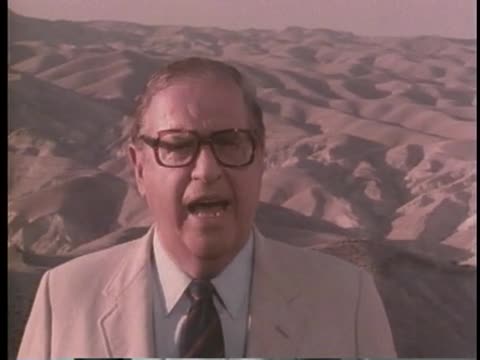
<v Narrator>1 of them old enough to carry memories off the mystious beginnings runs <v Narrator>unbroken to the present day. <v Narrator>Follow that single thread, and you follow a course of ideas that <v Narrator>gave meaning to the experience of civilization. <v Narrator>It is the tradition, the story of the Jews. <v Narrator>I'm Abba Eban, a Jew, a citizen of Israel, educated <v Narrator>in England. By training a scholar of history and language. <v Narrator>In recent decades, a diplomat and member of my country's parliament. <v Narrator>In the 9 1-hour episodes of this series, we are going to show you history <v Narrator>through a microscope, focusing on the experience of a single small
<v Narrator>people, small in size and space and power. <v Narrator>We tell their story not just because of its constant drama, but because <v Narrator>their ideas have played a central and influential role in human affairs, <v Narrator>because their history is a link between our origins and our present. <v Narrator>You cannot recount the story of civilization without coming face to face <v Narrator>with what the Jews have thought and felt and written and performed. <v Narrator>Who are the Jews? <v Narrator>Not a race. <v Narrator>They are much too varied in physical type. <v Narrator>Not only a religion. <v Narrator>They include believers, nonbelievers, disbelievers. <v Narrator>No, the Jews are a people. <v Narrator>No more than 14 million, a fraction of 1 percent of the world's population. <v Narrator>About six million of them living in the United States.
<v Narrator>Over 3 million in Israel. <v Narrator>A few million more scattered throughout the world, but acknowledging <v Narrator>a common heritage, a common history that spans time and place. <v Narrator>Where does their unique story fit into the larger epic of mankind? <v Narrator>Into the history of empires and civilizations? <v Narrator>When and how did they conceive the idea that has been their greatest and most lasting <v Narrator>contribution as a people? <v Narrator>The idea of God that most of the world's great religions have come to share. <v Narrator>That idea is one of the great reaches of the human mind.
<v Narrator>It encompasses our view of our fellow human beings, of the universe of <v Narrator>life itself. But it did not arrive at the world full blown. <v Narrator>It evolved like the Jewish people themselves. <v Narrator>Over the course of many centuries, the development of that idea, <v Narrator>this people, the civilization in which they originated. <v Narrator>That is our subject in the first episode of Heritage, The Story of <v Narrator>Civilization and the Jews. <v Narrator>The search for the human past. <v Narrator>The fascination is probably as old as the human race itself. <v Narrator>The science is new.
<v Archaeologist>Divided, one room from here. ?inaudible? <v Narrator>It was only in the early 19th century that archeologists began systematically <v Narrator>sorting the ruins of ancient cultures and deciphering their lost languages. <v Narrator>Before archeology, our main source of information about the ancient world <v Narrator>was the Bible. <v Rabbi>[Speaking Hebrew] <v Narrator>But the Bible is a relatively modern document. <v Narrator>An anthology started only about 2500 years ago <v Narrator>by a group of Jewish scholars exiled from their home land in a foreign <v Narrator>capital called Babylon. <v Narrator>It was a collection of a people's memories. <v Narrator>Some written, some only told about events that were already receding <v Narrator>into the distant past.
<v Bible reader>Moses did not know that the skin of his face shown <v Bible reader>because he had been talking with God. <v Bible readers>[People reading the Bible in several different languages] <v Narrator>The first 5 books of the Bible, which Jews call the Torah, the teaching <v Narrator>traced to the genealogy of their people traced it back to a line of godly <v Narrator>men. Abraham, Isaac, Jacob and Joseph, and before <v Narrator>them to an ancient place, which was the starting place of all their memories. <v Narrator>The Torah calls it Eden.
<v Narrator>A garden watered by the rivers, Tigris and Euphrates. <v Narrator>Eden, the legendary site of mankind's origins. <v Narrator>The birthplace of our common ancestor, Adam. <v Narrator>The name Adam is simply the Hebrew word for human being <v Narrator>from the word for earth, adamah, the red clay from <v Narrator>which he was said to have been created. <v Narrator>The time, according to the Torah about 5,800 years <v Narrator>ago as Jewish traditionalists would count it, <v Narrator>3800 years BCE before the common or Christian era. <v Narrator>Archeologists tracing the human past have arrived back at the <v Narrator>same place at about the same time. <v Narrator>It is the place known to history as Mesopotamia, the land between
<v Narrator>the rivers, the part of the Middle East now called Iraq. <v Narrator>Scholars identify it as the starting point not of creation, but <v Narrator>of civilization. <v Narrator>Civilization developed out of agriculture, <v Narrator>out of irrigation, which earlier people had devised <v Narrator>as a way to temper the droughts and floods of the rivers to turn chance <v Narrator>vegetation into crops they could depend on. <v Narrator>Turn barren clay into Eden. <v Narrator>Irrigation was a social undertaking. <v Narrator>More people to share the hard work, the increased flow of water, <v Narrator>the increased products of the soil.
<v Narrator>Irrigation led to communities and communities became cities. <v Narrator>The great process called civilization was underway. <v Narrator>Civilization, literally the culture of cities. <v Narrator>Cities first arose in Mesopotamia between 4000 and 3000 <v Narrator>BCE. <v Narrator>This restored temple is a fragment of one of the earliest cities. <v Narrator>A place called Ur, which is mentioned in the Bible as Abraham's ancestral <v Narrator>home. It was built long before the Jews as a people entered the <v Narrator>story of civilization. <v Narrator>Built by a Mesopotamian people called the Sumerians. <v Narrator>In outward appearance, those earliest cities probably resembled this one <v Narrator>called ?inaudible? In North Africa. <v Narrator>They were mud brick complexes.
<v Narrator>Their walls enclosing a nucleus of public buildings, the temple and the palace, <v Narrator>and housing for a population of thousands. <v Narrator>Mud brick construction doomed these places to crumble into <v Narrator>ruins. Doomed the Sumerians to be forgotten. <v Narrator>Their very identity buried beneath the ruins of peoples who followed them. <v Narrator>But the Sumerians were, in one historian's phrase, the true inventors <v Narrator>of civilization. <v Narrator>In the marketplaces of their cities, skills developed into trades. <v Narrator>The potter's wheel was a crucial development <v Narrator>and early means of mass production. <v Narrator>Ancient man was no longer a mere hunter, no longer just a farmer. <v Narrator>He was also a merchant and a craftsman. <v Narrator>In the cities of Mesopotamia, there were weavers and wool merchants, brewers
<v Narrator>and bakers, metalworkers, dyers, tanners. <v Narrator>The wheel was a basic device of civilization, and the Sumerians <v Narrator>were the first to make use of it. <v Narrator>They moved their products in carts pulled by donkeys, vehicles of commerce <v Narrator>that soon evolved into a vehicle of war. <v Narrator>The military chariot. <v Narrator>The Sumerians were the first people known to field an organized army. <v Narrator>They also developed the arts of peace. <v Narrator>Lives eased by the civilized division of labor found the time to <v Narrator>develop music and poetry and painting. <v Narrator>On this inlaid panel found in the ruins of Ur, a Sumerian <v Narrator>artist portrayed the life of the third millennium BCE. <v Narrator>You are looking at one of civilization's milestones. <v Narrator>The picture like symbols on this tablet are one of the most remarkable of all human <v Narrator>inventions, writing.
<v Narrator>Devised by the Sumerians, about 3100 BCE before <v Narrator>Egyptian hieroglyphics, before Chinese ideograms. <v Narrator>After various transformations, it emerged as a system of weird <v Narrator>shaped symbols called cuneiform. <v Narrator>With writing, human knowledge could be preserved and transmitted. <v Narrator>Writing promoted political development. <v Narrator>The rights of citizens were established in legal codes. <v Narrator>This early code engraved in stone <v Narrator>was formulated by a Mesopotamian king named Hammurabi around <v Narrator>the year 1750. <v Narrator>The office of King was a significant development. <v Narrator>The earliest leaders had been chosen just for the course of some civic emergency. <v Narrator>Now, they ruled permanently and handed on their power to their heirs. <v Narrator>The Kings ruled as caretakers of the gods.
<v Narrator>These votive figures evoke a world dominated by special deities, <v Narrator>gods of various cities, a god of Ur, a god of ?inaudible? <v Narrator>the rival gods of Babylon, Assur, Nineveh, Nippur. <v Narrator>Gods that could be seen and felt in the forces of nature. <v Narrator>Abstract powers like chaos and creation. <v Myth speaker>He created man. He created the beasts of the field. <v Myth speaker>He created the Tigris and Euphrates. <v Myth speaker>And he set them in their place. <v Narrator>This is the story of creation as told in a Mesopotamian myth. <v Myth speaker>Tear down this house. Build yourself a boat. <v Myth speaker>Aboard this boat, take the seed of all living things. <v Narrator>This is the story of a great flood in which all of mankind is destroyed <v Narrator>except for one deserving family. <v Narrator>A story handed down through the generations in Mesopotamia centuries <v Narrator>before the story of Noah and his ark would be written into the Bible.
<v Narrator>All of life, in the ancient view, was at the mercy of the gods. <v Narrator>Their all too human whims and rages. <v Narrator>Their perpetual conflicts with each other. <v Narrator>The god who appeared as wind fighting the god of vegetation. <v Narrator>Storm god fighting sea god. <v Narrator>Human beings could appeal to the gods through the priests with their ritual magic. <v Narrator>They could try to learn the mystery of their fate from omens. <v Narrator>The entrails of sacrificed animals, the patterns of birds in flight. <v Narrator>They might learn, their fate might even be deflect it. <v Narrator>But in the ways of the gods, they could see no moral pattern. <v Narrator>Nothing to count on or live up to. <v Narrator>That rather chaotic view of the human condition was one that dominated the life <v Narrator>and thought of early civilizations. <v Narrator>It would begin to change dramatically, permanently, only with the emergence <v Narrator>of a Jewish people onto the scene.
<v Narrator>According to the best evidence of archeology, that would not begin to happen until <v Narrator>sometime after 1500 BCE. <v Narrator>By 1500, the cities of Mesopotamia have developed into a thriving <v Narrator>city states, rich and potent nations ship their surplus grain <v Narrator>and wool and hides across overland trade routes that pass across <v Narrator>the countryside of Canaan towards cities along the Mediterranean coast. <v Narrator>Ugarit, Bybos, Sidon, Tyre and Gaza. <v Narrator>Those were the names of great city states off the Canaanite coast, ports <v Narrator>that maintained contact with other Mediterranean cities like Troy and with Mediterranean <v Narrator>islands like Cyprus and Crete. <v Narrator>Inland, beyond the coastal plain, there were walled citadels guarding <v Narrator>the trade routes that stretched east to Mesopotamia. <v Narrator>Along those routes, Canaan exported minerals, textiles and dyes
<v Narrator>and timber from the cedar forests of Lebanon. <v Narrator>The architecture of these cities was indigenous to Canaan. <v Narrator>Instead of mud bricks, there was plenty of durable stone. <v Narrator>But the culture of the Canaanite cities was in many respects an extension <v Narrator>of Mesopotamia in their art, their legal codes, their religious <v Narrator>outlook. <v Narrator>This huge stone platform may have been an altar used for animal <v Narrator>sacrifices in the worship of nature gods, deities identified <v Narrator>with the cycles of planting and harvest, death and renewal. <v Narrator>The chief of the Canaanite deities was Ba'al, revered as the source <v Narrator>of bounty of fertility. <v Narrator>He dominated a pantheon of lesser gods. <v Narrator>Ba'al's female counterpart, the fertility goddess called Ashtoreth or Astarte.
<v Speaker>This symbol of political power, a bronze scepter, was found along <v Speaker>with a crown in a cave near the Dead Sea. <v Speaker>In the Canaanite city states, power was concentrated at the top of a feudal structure. <v Speaker>The king, the royal family, the class of warrior knights, they owned most <v Speaker>of the farmland beyond the city walls. <v Speaker>The civilization of Canaan produced the alphabet, which became the basis <v Speaker>of all Western written languages. <v Speaker>It was an advance beyond the system of cuneiform symbols which the Canaanites <v Speaker>had learned from the Mesopotamians. <v Speaker>It was over caravan routes that Mesopotamian influence arrived in Canaan, <v Speaker>arrived with the goods carried by itinerant and traders, much like the Bedouin of today. <v Speaker>Like these Bedouin, like all peoples, they brought as part of their culture,
<v Speaker>their own lore, their memories handed down from generation to generation. <v Speaker>Songs, stories, myths rooted somewhere in experience, <v Speaker>in fantasy or belief. <v Music>[man singing a song] <v Announcer>By the year 1500, generations of travelers had arrived from Mesopotamia. <v Narrator>Whole families, tribes, clans, had settled in their way among the peoples <v Narrator>of Canaan in a land that was still inhabited by lions, its coastal <v Narrator>marshes by the hippopotamus. <v Narrator>Further centuries would pass before any of the peoples of Canaan could be identified
<v Narrator>as Hebrews or Israelites or Jews. <v Narrator>But that would only happen as the consequence of another significant traffic that <v Narrator>connected Canaan with a society to the south, a civilization <v Narrator>almost as old as Mesopotamia and equally powerful. <v Narrator>Egypt, a stable ?inaudible? <v Narrator>society, quick to flourish and slow to change <v Narrator>through dynasty after dynasty of absolute rulers. <v Narrator>The pharaohs. <v Narrator>The pharaohs reigned as incarnations of the gods, the many complex deities
<v Narrator>of Egypt, the pharaohs spent their lives preparing to join <v Narrator>the gods after death. <v Narrator>Building tombs like fortresses to preserve their bodies for the journey <v Narrator>into eternity. <v Narrator>The skill of Egypt's architects and engineers kept pace with the ambitions of <v Narrator>the pharaohs, what supported their immense projects was a flourishing <v Narrator>economy. <v Narrator>It was based on agriculture and a way of life still found along the Nile
<v Narrator>more than 3000 years later. <v Narrator>In ancient times, the dependable harvests of this delta were newer
<v Narrator>to immigration. <v Narrator>Tribes from Canaan came across the border when their own lands were parched by <v Narrator>drought. As Jacob's family did in the Bible story. <v Narrator>Many of the foreigners stayed to enjoy the rich life of this society. <v Narrator>Some rose to positions of authority, as in the story of Joseph. <v Narrator>Rich, creative Egypt. <v Narrator>Egypt's astronomers were the first to plot the stars. <v Narrator>Its mathematicians first to chart the earth. <v Narrator>Its artists wrote and painted with a zest for daily life. <v Narrator>The complexity of all ancient religious systems with their remote and of multiple
<v Narrator>gods was hard for the individual to comprehend. <v Narrator>There were efforts to simplify. <v Narrator>In the 1300s a pharaoh tried to combine many guards in a single <v Narrator>divine image, the Life-Giving disc of the sun called Aten. <v Narrator>But the reform was put down as heresy, Aten expunged <v Narrator>from the heavenly hierarchy, the old system of belief restored. <v Narrator>A few decades later, in the reign of a pharaoh called Ramesses the second, <v Narrator>the pace of Egyptian history seems to quicken. <v Narrator>With shipments of granite from the quarries of the Upper Nile, a vast new <v Narrator>building program is undertaken. <v Narrator>The pharaoh orders additions to the great temple of Karnak, the religious capital
<v Narrator>of the country. <v Narrator>A temple to prepare for his own death. <v Narrator>Ramesses' major project is a cluster of new cities in the Nile Delta, <v Narrator>a scheme requiring vast new sources of manpower. <v Narrator>Foreign workers are pressed into service as forced labor. <v Narrator>Egypt's records are vague, but scholars guess that among them were the foreigners <v Narrator>from Canaan. <v Narrator>Under Ramses and his successors, Egypt launches a series of military adventures <v Narrator>in Canaan. Egypt meets resistance not from its traditional rival <v Narrator>Mesopotamia, but from a newer empire. <v Narrator>The Hittites of Asia Minor. <v Narrator>It is in connection with this series of military campaigns that an arresting
<v Narrator>entry suddenly appears in the annals of Egypt. <v Narrator>A single, terse, remarkably, unprophetic line on a commemorative <v Narrator>column erected by a pharaoh named Merneptah. <v Narrator>Israel, it says, is laid waste. <v Narrator>His seed is destroyed. <v Narrator>The data's around 12 20 BCE. <v Narrator>This is the first known written record of a people we might identify <v Narrator>as Jews. <v Narrator>Who are the people who call themselves Israel? <v Narrator>The name is made up of 2 ancient words, one meaning God, the other to strive. <v Narrator>The Torah, written down centuries after the time of the events, describes <v Narrator>a group of Canaanite refugees fleeing slavery in Egypt. <v Narrator>The date probably about twelve fifty BCE, <v Narrator>one of the oldest passages of the Torah, celebrates their deliverance by their
<v Narrator>God, a God whose name modern scholars reconstruct as Yahweh <v Narrator>and many Christians pronounce Jehovah. <v Narrator>Very Orthodox Jews traditionally never pronounce the holy name at all. <v Narrator>They call him the Lord. <v Torah reader>Then Moses and the children of Israel sang this song to the Lord, saying, I shall <v Torah reader>seem to the Lord. He has triumphed gloriously, horse <v Torah reader>and rider, he has hurled into the sea. <v Torah reader>The Lord is my strength and my protection. <v Torah reader>He has become my salvation. <v Torah reader>The chariots of Pharaoh and his army, he cast into the sea. <v Torah reader>The abyss in Gulf. <v Narrator>The charismatic leader called Moses, the escape route, the chronology of the <v Narrator>exodus, these are matters for which the Bible is our only source, but the fact of the exodus and its impact are
<v Narrator>hard to dispute. <v Narrator>In the story of mankind, the emergence from Egypt into this wilderness sanctuary <v Narrator>would become a universal metaphor and everlasting symbol of the human <v Narrator>need and right to be free. <v Narrator>In Jewish tradition, it would be celebrated by generation after generation <v Narrator>in the springtime holiday of the Passover. <v Narrator>A festival of liberation as fervent as any nation's Independence Day. <v Narrator>It evokes the feelings of the liberated tribes, leaving the labor camps of the Nile <v Narrator>Delta behind them. To them, the exodus must have seemed nothing less than a miracle, <v Narrator>a deliverance so implausible, so incredibly dramatic that it could <v Narrator>only be a divine act. <v Narrator>It was evidence of the power of their own special god, not a universal God. <v Narrator>There was no single power ruling over human affairs, but the gods of this <v Narrator>one little group had triumphed over the mighty pharaohs and their gods.
<v Torah reader>Who is like you among the gods, oh Lord? <v Torah reader>Who is like you? <v Torah reader>Majestic in holiness, awesome in fame, worker of miracles. <v Narrator>Some events stand outside history. <v Narrator>Beyond the challenge of science. <v Narrator>What happened to the people of the exodus may never be established by scholars, <v Narrator>but what the Bible says about this awesome place has resonated through <v Narrator>the centuries of human experience. <v Torah reader>And Moses brought forth the people to meet with God, and they stood <v Torah reader>at the base of the mountain. <v Narrator>Tradition calls this towering peak the Mount Sinai of Exodus, <v Narrator>the landmark of the whole Western religious heritage and its base. <v Narrator>For the last 12 centuries, a Greek monastery has sat in humble attendance. <v Narrator>The meaning of this place is commemorated in the words of the Torah.
<v Narrator>For this is the place tradition identifies with the covenant, the <v Narrator>agreement by which the people calling themselves Israel accepted God's <v Narrator>law and God promised his blessings. <v Torah reader>I am the lord, your God, who brought you out of the land of Egypt, out of the <v Torah reader>house of bondage. You shall have no other gods before me. <v Torah reader>You shall not make for yourself a graven image. <v Narrator>There were laws governing the relationship between man and God. <v Torah reader>You shall not take the name of the Lord, your God in vain. <v Torah reader>Remember the Sabbath day to keep it holy. <v Narrator>Laws of behavior between men and women, between members of the family.
<v Torah reader>Honor your father and your mother. <v Narrator>Laws governing the relationships of individuals and society. <v Torah reader>You shall not kill. <v Torah reader>You shall not commit adultery. <v Torah reader>You shall not steal. <v Torah reader>You shall not bear false witness against your neighbor. <v Narrator>By the act of the covenant the people of Israel had committed themselves <v Narrator>to the rule of law as a holy principle.The <v Narrator>God of Moses is not without connections to earlier religions. <v Narrator>He visits a kind of spell on Israel's enemies in the form of plagues. <v Narrator>His worship includes a prescribed ritual of animal sacrifices, but Yahweh, <v Narrator>however, the Hebrew God is without precedent in ancient belief, if not <v Narrator>the only God in the universe, then he is the only God of this particular people. <v Narrator>And there is no mystery to be defined by omens or averted by ritual magic. <v Narrator>Yahweh promises to deal with his people not on the basis of divine whim
<v Narrator>or passion, but of law, open and explicit. <v Narrator>Other peoples have elevated their king s to the status of duties, but in this <v Narrator>covenant, Israel has accepted God as their king. <v Narrator>Mankind's view of the human condition has begun to undergo a remarkable change. <v Narrator>The God driven people who entered the sanctuary of Canaan with a vivid <v Narrator>memory of the Sinai experience merged into the established Canaanite <v Narrator>population. <v Narrator>Most of them, after all, were originally Canaanite by language and culture. <v Narrator>It was around this nucleus that a new people would be formed and <v Narrator>out of that people a nation.
<v Narrator>Canaan in the 1200s was vulnerable to new forces.
<v Narrator>The currents of history were converging on this small land. <v Narrator>A sequence of landings by warriors from the Aegean, the area that would later be <v Narrator>known as Greece. The sea peoples, so they were called. <v Narrator>They arrived as mercenaries of the Egyptians and Hittites. <v Narrator>They stayed as free ?inaudible? <v Narrator>pursuing their own violent cause. <v Narrator>The siege of Troy described by Homer. <v Narrator>That was 1 of their acts. <v Narrator>Their pattern of pillage soon spread south. <v Narrator>1 group known as Philistines occupied the coastal cities <v Narrator>of Canaan. Later, the country would bear their name, Palestine. <v Narrator>The social structure of Canaan was in flux.
<v Narrator>The poor were fleeing the cities. <v Narrator>The tenant farmers who worked the nobles' land, the nomads who sometimes <v Narrator>settled among them, were driven by hardship, by repression, and <v Narrator>the turbulence of the times. <v Narrator>Many of these people became refugees, are hapiru in the <v Narrator>ancient term. <v Narrator>They fled to the back country where they joined with another group of refugees. <v Narrator>Those God enlightened people of the exodus from Egypt. <v Narrator>2 groups of hapiru which may be the source of the word <v Narrator>Hebrew. <v Narrator>At Beersheba in the northern Negev region of modern Israel, <v Narrator>lie the ruins of an ancient Canaanite town. <v Narrator>It became a Hebrew settlement sometime in the 1100s.
<v Narrator>The typical house was built around a courtyard in which most of the family <v Narrator>life took place. It was surrounded by 3 or 4 small <v Narrator>rooms. <v Narrator>Stone pillars supported some sort of roofing which sheltered the family members <v Narrator>and sometimes the animals. <v Narrator>Life in those places was simple and egalitarian, like <v Narrator>the character of Israel's belief in which the only authority was God's <v Narrator>and everyone had equal access to his law. <v Narrator>Today in the nearby countryside, you could find small Arab villages <v Narrator>in which the atmosphere of those early settlements still survives. <v Narrator>The inscription on this wall is in ancient Hebrew.
<v Narrator>It bears witness to the Israelite God. <v Narrator>In the course of 2 centuries, the belief in Yahweh and his law <v Narrator>spread through the hill country and wilderness of Canaan by conversion and by <v Narrator>conquest as it spread, its adherents formed a league, <v Narrator>a federation of little communities. <v Narrator>Their only authority was a temporary leader they called a shofet <v Narrator>or judge. Men like Gideon and Samuel, a woman <v Narrator>named Deborah. <v Narrator>The only thing that linked the communities was the Covenant of Sinai. <v Narrator>They carried tablets inscribed with God's laws into battle when they fought with <v Narrator>neighboring peoples for control of the countryside.
<v Narrator>Their greatest adversaries proved to be the Philistines. <v Narrator>Those descendants of the formidable sea people with a newly discovered source <v Narrator>of power, iron, it gave them a critical edge <v Narrator>in warfare. <v Narrator>Their burial cases may look benign, but their iron weapons <v Narrator>made the Philistines the scourge of Canaan. <v Narrator>About the year 1020, faced with a losing war against this enemy, <v Narrator>the Israelites adopted a course often taken by ancient peoples in <v Narrator>times of crisis. They chose a king. <v Narrator>His name was Saul. <v Narrator>This decision transformed the federation of believers into a unified <v Narrator>people. The League of Villages into a nation. <v Narrator>But it would have a drastic impact on their simple form of society.
<v Narrator>It was contrary to the spirit of a religion in which God was, in effect, <v Narrator>the only legitimate sovereign. <v Narrator>This is where their transformation took place. <v Narrator>I'm standing on the site that became the very center of Israelite nationhood. <v Narrator>Its capital, in fact, and in sentiment over the centuries. <v Narrator>This ancient place now being uncovered outside the southern walls of Jerusalem <v Narrator>is the city of David, the citadel built by Israel's second king. <v Narrator>Here, the modern nation of Israel seeks out its origins, assembles the <v Narrator>buried fragments of ancient Israel's brief golden age. <v Narrator>That era of fateful and dramatic change of rise and decline <v Narrator>ushered in by the reign of King David. <v Narrator>David, a popular hero who staved off the Philistine
<v Narrator>threat and unified the scattered communities of Israel.. <v Narrator>In the city of Jerusalem, he installed his government and provided a <v Narrator>permanent home for the tablets of the law. <v Narrator>The powerful symbol of his people's belief. <v Narrator>David himself was one of the voices of that faith, a poet <v Narrator>credited with some of the loveliest psalms in Hebrew literature. <v Psalm reader>Oh, Lord, our Lord, how great is your name in all <v Psalm reader>the Earth? <v Psalm reader>When I consider your heaven, the work of your fingers, the moon and the stars. <v Psalm reader>What is man that you are mindful of him? <v Psalm reader>You have made him a little lower than the angels and crowned him with honor <v Psalm reader>and glory. <v Psalm reader>You gave him dominion over all the works of your hands, all sheep and <v Psalm reader>oxen. Yes, and the beasts of the field, the fowl of the earth,
<v Psalm reader>and whatever passes through the paths of the sea. <v Narrator>David's legacy was an empire. <v Narrator>With the great powers in Egypt and Mesopotamia both in temporary decline, <v Narrator>Israel expanded to fill the vacuum. <v Narrator>Israel's dominion extended north to the Euphrates, south <v Narrator>to the borders of Sinai. <v Narrator>The nation of refugees was now a ruler of subject peoples. <v Narrator>Canaanites, Edomites, Moabites. <v Narrator>David's son and heir, Solomon, consolidated Israel's new power <v Narrator>and exploited it in trade with the corners of the empire.
<v Narrator>Luxury goods of all sorts were imported. <v Narrator>They found a market among a new class of urban rich. <v Narrator>Like the pharaohs of Egypt. <v Narrator>Solomon launched an ambitious building program, it's keystone, <v Narrator>the splendid temple in Jerusalem. <v Narrator>The Bible account says he was 7 years building the House of <v Narrator>the Lord with its doors of olive wood, its planks of cedar <v Narrator>covering every inch of wall so that no mere stone could be seen. <v Narrator>Its carvings of palm trees and blossoms. <v Narrator>Winged beasts called Cherubim, their wings spreading from wall to wall. <v Narrator>The figures overlaid with gold. <v Narrator>But in the city of the Lord, Solomon permitted the worship of Ba'al <v Narrator>and foreign cults.
<v Narrator>And there were other building projects. <v Narrator>Solomon refortified Canaanite cities, Hazor, Megiddo, Gezer. <v Narrator>Gezer was the dowry of a foreign princess, 1 of Solomon's wives. <v Narrator>Israel was now tied to a system of foreign alliances, bound <v Narrator>to an imperial style that was undermining the old communal way of life. <v Narrator>This is all that is left of Fortress Gezer. <v Narrator>You can find it just off a busy highway a half hour's drive from modern Jerusalem <v Narrator>and archeologists dig a tourist site. <v Narrator>These stones behind me were the foundation of Solomon's massive gates. <v Narrator>To build these fortifications, the whole network of Citadel's guarding the <v Narrator>capital and the major trade routes, he resorted to a divisive, bitter memory. <v Narrator>Forced labor. To man these garrisons, he fell back on another <v Narrator>drastic measure. Military conscription. <v Narrator>The imperial style could be supported only by a heavy burden of new taxes.
<v Narrator>This fell crushingly on the ordinary people, the small farmers and tradesmen. <v Narrator>Around the year 920, after Solomon's death, rival claims to the <v Narrator>throne erupted, the empire fell apart and the kingdom split in two. <v Narrator>Israel in the north with a capital of its own. <v Narrator>Judah in the south, holding on to Jerusalem and the Holy Temple. <v Narrator>Two states going their separate ways. <v Narrator>The Israelites have come a long way from their simple beginnings, <v Narrator>the egalitarian life of the early settlements had been corrupted by <v Narrator>power and affluence. <v Narrator>In a society ruled by rank and privilege, who would speak for the ordinary people? <v Amos the shepherd>You trample upon the poor and take from them exactions of wheat, you have built houses <v Amos the shepherd>of human stone. But you shall not live in them. <v Narrator>These were the words of a shepherd named Amos. <v Narrator>Amos, spelling out the symptoms of Israel's plight.
<v Narrator>Farmers and tradesmen forced into debt. <v Narrator>A rising class of rich landowners collaborating with corrupt judges <v Narrator>exploiting their neighbor's distress. <v Unidentified text>Listen to this, you who would devour the needy, annihilating the poor of the land, <v Unidentified text>tilting a dishonest scale and selling grain refuse as grain. <v Unidentified text>The Lord swears by the pride of Jacob. <v Unidentified text>I will never forget any of that doings. <v Narrator>In the 8th century as inequities worsened and society disintegrated. <v Narrator>The cry for social justice was taken up by other inspired dissidents. <v Narrator>Hosea, Micah, Isaiah. <v Narrator>The men we have come to know as the prophets. <v Narrator>Some were imprisoned for their dissent. <v Narrator>They preached against foreign alliances, against the spread of foreign cults. <v Narrator>The prophets spoke as caretakers of the religion. <v Narrator>Recalling the Israelites to their origins. <v Narrator>Recalling them to God's law.
<v Prophet reader>Take away from me the noise of your songs to the melody of your harps. <v Prophet reader>I will not listen. But let justice roll down like waters and <v Prophet reader>righteousness like an ever flowing stream. <v Narrator>Justice and righteousness, the absence of justice was nothing less than a violation <v Narrator>of the covenant that was Israel's foundation, the heritage of Sinai. <v Narrator>A terrible retribution was promised. <v Prophet reader>You princes at the house of Israel who hate the good and love the <v Prophet reader>evil because of you, shall Zion be plowed as a field and Jerusalem <v Prophet reader>become rubble? <v Narrator>In fact, the danger was not far off Egypt and Mesopotamia <v Narrator>was stirring again the empire of the pharaohs being challenged <v Narrator>by a dynamic military force from Assyria. <v Narrator>In the course of this conflict, the northern kingdom of Israel was reduced <v Narrator>to a vassal state, surviving only by paying tribute to the Assyrians. <v Narrator>Then it was simply swept up into the empire.
<v Narrator>A century later, the armies of Babylon came marching west and in 605, <v Narrator>defeated the Egyptians. <v Narrator>Judah was occupied by the Babylonians under King Nebuchadnezzar. <v Narrator>Jerusalem was pillaged, at least 10,000 <v Narrator>families were sent into exile. <v Narrator>The temple was destroyed by fire. <v Prophet reader>How the city to set solitarily that was full of people. <v Prophet reader>She, that was great among the nations. <v Prophet reader>How she has become a vassal. <v Prophet reader>Judah has gone into exile. <v Prophet reader>She dwells among the heathen, she finds no rest. <v Narrator>The year was 586 before the common era. <v Narrator>One of the bitterest years in Jewish memory. <v Narrator>The life of the independent nation was ended. <v Narrator>Its unifying symbol, the temple, was in ruins.
<v Narrator>The leadership in exile in Babylon. <v Narrator>In this majestic city of perhaps a million people more than 500 <v Narrator>miles from ruined Jerusalem, a group of Hebrew scribes set <v Narrator>about organizing and assimilating their people's history. <v Narrator>This is where they assembled the lore, written and spoken, the writings and <v Narrator>sayings of their leaders, poets and prophets, assembled it into the <v Narrator>first books of the Bible, into their great national work, <v Narrator>the Torah. <v Narrator>What emerged in this book, these books, what had been emerging over
<v Narrator>the centuries from the exodus to the exile was a new and <v Narrator>larger vision of life in the tragedy that had overtaken them. <v Narrator>The exiles saw the hand of a universal God, had not the prophets <v Narrator>warned them that violating the covenant would bring on a terrible punishment? <v Narrator>Was it not that God Yahweh, who had sent the mightiest empires of the world <v Narrator>to punish the Israelites? <v Narrator>So Israel and the enemies that had brought about its downfall were <v Narrator>all the instruments of a single God and his universal law, <v Narrator>a law in which goodness was required and in which wrongdoing was doomed to failure. <v Narrator>All the world's nations were linked in a common destiny, bound together <v Narrator>by a moral law with inescapable consequences. <v Narrator>At the center of this vision was no mere guard of nature, but the <v Narrator>God of all history, no mere national God but the God of all <v Narrator>mankind.
<v Narrator>The exiled people who wrote that vision into their history were called <v Narrator>Yehudim, people of Judah. <v Narrator>The word became Jews. <v Narrator>In the experience of exile, the vision of the early Israelites was transformed <v Narrator>and the Jewish people was born. <v Narrator>Born, they believed to a chosen mission, to carry the word of <v Narrator>the single God of justice and mercy from this place, Jerusalem, <v Narrator>to carry the word through history. <v Music>[outtro music] <v Announcer>Major funding for this program has been provided by the Charles H.
<v Announcer>Revson Foundation, Petrie Stores Corporation, and the National <v Announcer>Endowment for the Humanities. Additional funding has been provided by the following <v Announcer>contributors. <v Announcer>A complete donor list is available at WNET. <v Announcer>Abba Eban has written a companion book to this series, which is published by Summit <v Announcer>Books and is available in bookstores and libraries.
- Episode Number
- No. 101
- Episode
- A People Is Born
- Contributing Organization
- Thirteen WNET (New York, New York)
- The Walter J. Brown Media Archives & Peabody Awards Collection at the University of Georgia (Athens, Georgia)
- AAPB ID
- cpb-aacip-75-03qv9zkt
If you have more information about this item than what is given here, or if you have concerns about this record, we want to know! Contact us, indicating the AAPB ID (cpb-aacip-75-03qv9zkt).
- Description
- Description
- This episode begins with humankind's earliest history - the beginnings of civilization in the ancient near East - and recounts the transformation of an early people into the biblical Israelites. It examines the birth of monotheism and explains how the Israelite kingdoms were destroyed and Jews sent into exile in Babylonia, where they compiled the literary legacy of their people into the Torah, the first five books of the Bible.
- Asset type
- Episode
- Media type
- Moving Image
- Duration
- 01:03:59.602
- Credits
-
-
Executive Producer:
Labaton, Arnold
Executive Producer: Siegel, Marc
Host: Eban, Abba
Producer: Fox, John
- AAPB Contributor Holdings
-
Thirteen - New York Public Media (WNET)
Identifier: cpb-aacip-c3013229bb0 (Filename)
Format: 1 inch videotape
Generation: Master
-
The Walter J. Brown Media Archives & Peabody Awards Collection at the
University of Georgia
Identifier: cpb-aacip-92720373017 (Filename)
Format: U-matic
Duration: 1:00:00
-
Thirteen - New York Public Media (WNET)
Identifier: cpb-aacip-f6f09e36131 (Filename)
Format: 1 inch videotape
Generation: Master
-
The Walter J. Brown Media Archives & Peabody Awards Collection at the
University of Georgia
Identifier: cpb-aacip-5e211d6bd56 (Filename)
Format: U-matic
Duration: 1:00:00
If you have a copy of this asset and would like us to add it to our catalog, please contact us.
- Citations
- Chicago: “Heritage: Civilization and the Jews #101; No. 101; A People Is Born,” Thirteen WNET, The Walter J. Brown Media Archives & Peabody Awards Collection at the University of Georgia, American Archive of Public Broadcasting (GBH and the Library of Congress), Boston, MA and Washington, DC, accessed September 25, 2026, http://americanarchive.org/catalog/cpb-aacip-75-03qv9zkt.
- MLA: “Heritage: Civilization and the Jews #101; No. 101; A People Is Born.” Thirteen WNET, The Walter J. Brown Media Archives & Peabody Awards Collection at the University of Georgia, American Archive of Public Broadcasting (GBH and the Library of Congress), Boston, MA and Washington, DC. Web. September 25, 2026. <http://americanarchive.org/catalog/cpb-aacip-75-03qv9zkt>.
- APA: Heritage: Civilization and the Jews #101; No. 101; A People Is Born. Boston, MA: Thirteen WNET, The Walter J. Brown Media Archives & Peabody Awards Collection at the University of Georgia, American Archive of Public Broadcasting (GBH and the Library of Congress), Boston, MA and Washington, DC. Retrieved from http://americanarchive.org/catalog/cpb-aacip-75-03qv9zkt