Report from Santa Fe; Clyde Tombaugh
- Transcript
You You You Report from Santa Fe is made possible in part by grants from U.S. West
providing advanced telecommunication services to New Mexico homes and businesses and By the members of the National Education Association of New Mexico and organization of professionals who believe that Investing in public education is an investment in our state's economic future I'm Ernie Mills and this is report from Santa Fe today from Las Cruces, New Mexico The home of Patsy and Clyde Tumba professor Tumba. I've been waiting a long time to do this show with you Thank you. I I have talked to a lot of people they all have their own stories about you. I have my own we'll talk about a couple of them But what I'd really like to talk about today is if we can go back to that period when the Kansas Farm Boy Came to New Mexico. Why don't you pick it up from there and tell us about yourself Well, of course. I was born in Illinois 1906 and my father was a former corn farmer and then the family moved to Western Kansas in 1922 when I was 16 and I lived there and I could help I could cut share with house makers a week my younger days
and then I made these telescopes and So I made drawings of Mars and Jupiter through my nanny. She went it's out there And the micens on them sent them to the little observatory To see what they'd think of them. Well, they were impressed apparently because they could compare them Actually with their current photographs on those dates So after a couple of letters. He asked what he asked some questions on me And after a couple letters He invited me to come to Flagstaff when Vima's trial to operate a new photographic telescope They were installing and what year was that? Can you read that? I was 1928 the letters that I went there and I went to the observatory in 1929 January middle of January 1929 Now what what was it that got you interested in in the stars in the in space? Well when I when I was in the lower grades I had a very strong interest in geography as a hobby Geography Then the one day and about the sixth grade the idea occurred to me. What would the geography be like on the other planets?
Well, now your wife Patsy mentioned to me that she had talked to a lady one time And the lady said I don't think God wants us messing around in space And Patsy sort of indicated to that maybe God does want it to know what's going on in these other planets But that basically wanted to know what was going on there is what inspired you And when I talk to people and say well, they'll tell me Clyde you know They'll say it let me tell you my Clyde tumbo story The one thing that's impressed me Is that you talk to me once almost as you would a child explaining something to me But it's your relationship you know when you talk to youngsters and children on the way to your home We passed the Clyde W. Tamba Elementary School Children come to see you on your 90th birthday. Mm-hmm. You receive letters and email From all over the world You know if if you were talking to youngsters today
What would you want them to know about the future? Well, I think they should Uh Work at it be industries don't waste your time in gangs and stuff like that at crime because that only gets them in trouble If they have something to one that don't have everything to do go to the library and read something learn something The person gets the good jobs with people who will learn and know something And if they don't do it, you're going to take the lesser jobs Now they should be I understand that When I have never been able to understand there was one book that you wrote yourself And working also with a with an English author That the English writer and that's out of print That book itself I couldn't imagine why he wouldn't have printed an extra 50,000 copies or so, but It explains in detail Exactly how it was done how you explored that can you can you tell us Well, I was the planet to do that later because I
They were beginning to get some of the probes out there the planets and so on and they were also making us some discoveries with others But some Pluto and learn more about so I thought I'd wait a few years and bring it up to date But that but that came and so fast it overloaded. I just gave up Now this is 1930 Well, yeah, but the uh I was thinking about the things that were being learned in the 40s and 50s. Not a great deal, but some So as it's a ten thing went on Well, of course, I wrote this book at The darkness in 1980 I tried to write it several years before that But my schoolwork was so heavy that I could not I'd forget what I'd left off and it was just too much interruption So only after I retired from teaching That I find time to write this book in a way that was really coordinated Now that's when the book itself that explains what it was like at that time You when you came to in the mexico uh, this was
This was about one year after a white sands. That's right. That's right. Now. I don't think most people realize that you You worked for several years at white sands before you nine years. Yeah before you came down to to you I went to the pioneers. I had to The civil service of course is about half the crew half military and the head of the personnel office Said to me he said that later. I wish you would Write up the job descriptions of your man different jazz because we don't have any person before we have the least idea how to write it So I did that I was out of the pioneers And also I was one of the co-designers of the small missile range That's out here white. Yes At that time, what was the different you I'm sure you you go out there now In fact, I think you're planning on going out there the week after we do this show. Yeah, that's right again for more honor General forward is going to receive the award this year He well deserves it. He's a very good general now I want you to go back if you will to 19
19 30 I guess the the discovery of Pluto was February 18th. Yes, 1930. Yes. Let's lead up to that a little bit if you can because Some of the material you throw to me is almost mind boggling the one point there I think you estimated you had looked at 90 million stars over a period of time 14 years You also said that after the first year you've seen one star you've you've seen them all but Catch catch that back for me if you will. Let's go back there What kind of a telescope were you using it? Telescope was a wide angle photographic telescope With a low and low magnification in order to take it large by the sky For example, the moon's image on those plates that about the size of a dime So taking large area, but when you have to cover a lot of sky area So you have to have a telescope that is short focal length Takes it a wide area to sky in the plate otherwise you can't cover the area fast enough That's what we called that an astrograph
And the one that they had there was one of the finest of in the world now this telescope was where Isn't that the Franks after the 13 years? That was that flex. Yeah, there's a 13 inch On the material you have in the book that is out of print now and I'd love to you know It's almost someone's just got to pick that up and say we're going to bring it back to print because you can see The distance in just how small it is that you had to work with the spot Pluto You know to the spot at that time How long after you felt that you had discovered it? Did it take to get the kind of recognition that was needed to was almost immediately after it's announced at 13th of March Because they director and he said on the cablegram and the telegram and not to do the headquarters at Harvard And just happily He told exactly where it was in the sky and anybody wanted to take photo got to look for themselves. They didn't need a convincing They can see it was what it was what we said it was right there
Yeah, this was a factor. Yes short focal length a better wide angle camera and it was a big 14 by 70 plates. There's something to handle And I made a couple thousand of those now people had to ask you how did you come up with the name? Oh, yes Well Pluto is the god of the lower world And where it's more dimly late and Pluto was out there for the sun, but it was dimly late So we thought that was the appropriate name and then of course when they found the satellite of Pluto By James Christie He called it after somebody after his wife's name Charlene called it sharan sharan now sharan was the name of the butman who You wrote who took big souls of the Souls across from every sticks to eighties. So they was well put together So it's a very appropriate name Now I I found one thing interesting. I'm going back now In my memory, but you remember it as well
It's a very as a young man. I felt I was a young man a lot of other people didn't but back in the early 60s I came to Las Cruces and there was a move made to bring in a new newspaper was the Las Cruces American And since I had worked with the ulcer brothers in Washington DC We picked up their column And in the early 60s the Russians Launched a sputnik that's what they called it the sputnik And the ulcers came out with a column which we ran in the paper right here And it indicated that it was not really a sputnik that they were using reflectors to deceive people I got a call from this gentleman and he said this is Clyde Tombaugh and I sure would like to talk to you And you came down and sat down with me and got chapter and verse And where the Russians were correct on this and the column was wrong and you said I'd sure like you to To correct that do you remember that period? I somehow had to ask
I'd ever forget the morning of the thrill when I saw it visually in the sky before dawn I haven't long asked how long after the first launch did you sput the sputnik? About one one day or so on that night Because since we learned about it we went out to watch to see if you can see it sure enough it came across what they said it would Exactly where they said it was pretty much so you recognized at that time that they weren't there. There was no deceit involved in this There was none I don't see how anyone could cook up anything false on that the way it behaved Well the interesting thing was and I give a credit to the ulcers because they corrected it also and I said The gentleman I've talked to is somewhat of an authority on this matter and he'll back up what he has to say So they made the proper Corrections. I think everyone was was fairly happy all around on it We're we went we've gone from like 1930 Discovery Pluto took it up like to the the sputnik itself You have been acted at in the mexico state universe. I don't know how your wife reacted and trying to find room for all
The honors and awards that you've had Yeah, you have quite a few of them and from from all over the world too What what I would like to check is in this period I would say like between 1960 and now, you know, we've had the We we've really launched another step into into space A professor of English once named G. Stewart Demarest made the comment. He says poets make the best astronomers He said because they they have creativity they have vision and they can make these quantum leaps Did you have to make to understand space? I asked Patsy. I said is Did any chance his professor Tamba poet she said he's a punster. We know for sure but
How do you develop the kind of creativity today to understand in your terms? What geography is like in the rest of this space? I was interested in my environment I wanted to know what was on the other side of the mountain And I just love geography and I love maps and I could at one time and then about the fifth sixth grade I could bound every country in the world for memory. I knew it that well And so then I had why to have one some new world was the conqueror so it went astronomy And of course that provided a good outlet for further study and I got a great kick out of it and so Been learning ever since do you have do you have other worlds that you want to conquer now? You know you you still you're as alert as you were 35 years. I wish I was as alert Well, I think I Side to let their younger men do it now, but I feel quite satisfied with what I did in my lifetime Do you think do you think you'd like to take a space trip?
If you ever when you watch some of the people you know We've known some of these fellows right from New Mexico that have gone up and space. Have you? I realized I'd like to do that but I realized I was told But the thought of if they came to you and said Professor Tombo would like you to make this pastry. You wouldn't have turned them down It wouldn't have to go over to turn them down because I wouldn't be able to take it That's a bit of a strange incident And I wouldn't be able to take it at my age What do you think we're going to look at now for the future? We're Education, you know, we we the priorities that people talk about An edgy we always say education is our top priority Yet after elections and things it tends to sink to the bottom of the barrel. There are other priorities in there Where do you think we're headed and the kind of education we have we need to explore together sided this mountain as you put it Well, of course as you know They have two space probes Being designed to send the Pluto you know that
And that I wouldn't have to see the outcome of that because I don't take 10 12 years to get there But that'll give us more information about Pluto And it's also a Strong endeavor being made to detect planets around other stars You mean if you were heard of that from the gravitation to pull along they visible remember Uh, this isn't seen them directly, but it didn't infer that exists there because of the gravitational influence That is going to be pushed now considerably and also the Perhaps the top of all is how did the universe begin? How do I lean? Cosmology that there are several hypotheses and uh, we I don't think I've satisfied any of them I don't think yeah, and I don't know that if he did know what it was I'm not sure we could understand it It's just too big for example is the universe finite Well, uh, that's hard to imagine because of these space cruders out that what's outside of that
So you had a loss I said definitely goes on forever forever. That's hard to visualize too So I am an uncutable dilemma on what to think about it. I don't know Are you it's interesting to say that you're uncomfortable with what they're telling you is and uh, well the big bang I don't longer believe and for some time because The distribution that you would expect from a big bang like that did not match the way I saw the galaxies distributing my plates It did not no did not I couldn't reconcile with the way they were distributed on the plates with the with several big bang I I've seen stories this very month that we're during the show you know again They're mentioning the big bang as such as the the creation creation of the world uh, if we lock ourselves into a theory like that too much is that the reason we might not be able to There were our own minds are too restricted that we can yeah, I think it does I think tends to do that now I would say at the present time
Probably about two-thirds of astronomers believe in the big bang Well, I uh discarded several years ago to realize it in pride things that I could not reconcile with what I had seen And so I think eventually the time will come when they will abandon the big bang idea We simply do not know Now when we I chuckled the when we were getting directions to come to the house again, and uh, uh, I love to go patsy Well, you can't miss it. Here's the address got good instruction, but there's a big telescope in the yard When you say there's a telescope in the yard, that is a sizable telescope. Yes, you put that entire thing together yourself. Yes Granting around the mirror and the power to put the parabolic figure on it It's an F10 ratio about 15 feet long and Bolard all the steel with bolts and bolted To form the friend is about a ton of steel in that And it works beautifully this superb, they will I can use powers on with sharp images on good nights. It's high 700 diameters
Do you ever wonder when you know there we always think I went to a Father-daughter camp and we were watching the you know sort of a The showers up there in the skies and lying down and and feeling every arthritic rock in my back And uh, but I wondered about the the poor people that live in some of the urban areas that probably never see stars Yeah, you know, they never get on now. I had another question because Am I wrong that when you first spotted Pluto It was in the afternoon. Yes now people ordinarily would say how can you it's not dark to see well You see they have the idea that I discovered at night. Look at their telescope It is impossible to find a plant like Pluto that way Because you would have to watch each star for two hours before it had moved presently to be visible You can't do that for a hundred thousand stars So it has to be photographic you see take them to different dates And then you have a third plate table on third date because you will get several
faults and suspects and one time another and you think man here seven So you have to have a third plate to see if the image of the right place that fits the other If it doesn't it throw it out But in case of Pluto it was confirmed And it was confirmed, but it was spotted at four I had to confirm within the within about half hour Half an hour and then in the afternoon right When I played off at the old one on another one on and there it was Is exactly the right place it's supposed to be so that meant it to all the other it was real You know we recently I believe On top of all your other honors The Board of Regents in the Mexico State University Uh Issued a proclamation just on your behalf. It was a marvelous Marvelous recognition, but going back through all those years on your lectures To when you first came down from from Kansas down here You as that did you establish the Department of Astronomy I had a big hand in it. Yes, and the Mexico State and not entirely mine
Had a paid a big hand in it and uh, you you had stayed uh, do you still maintain the Emeritus Uh, I still have the rank of Emeritus professor at the at the University How have they developed over the years friend had beautifully they've expanded to have a large And graduate school of astronomy we are we've now given out 24 PhD degrees over the years we've been in existence And about a dozen master degrees and all our candidates doing all of them have gotten very good jobs elsewhere And they were treated well. They were in demand And we have a fine faculty and so we're doing very well. And now that uh Jack Burns was ahead of the year. He then we got the big tusk up up at the The mountains there You know the patchy point and that's a big telescope So they uh, they they've got he has different people there who specialize in different areas of astronomy And it makes a mom's coverage of the whole thing
You can't know everything you never know astronomy because it's it's like medicine. You have to specialize Can anyone whose interested in space really Carry that interest forward today without The knowledge of astronomy is such and space programs is such Without really having a good knowledge of astronomy. I think you need a good knowledge astronomy What about computerization now, you know, wouldn't you? Well, you know, you just could be if you use computers of course to get the It's itself results and analyze But you just that you have to have a Mental picture of what you're working with in a sense of space and time Otherwise, it's unintelligible to you So you have to have that in order to have the imagination to see where you go next. I think that's the imagination We talked about earlier when the poets imagination Did you know in your mind? Did you know at the time that you were first looking? Were you looking for Pluto? Oh, yes. That was my job It turns out that
Pressful law had made a prediction that Pluto would be in the sky and he changed the position drastically And finally put it in these contours about where would be Pluto but now now They had been trying early years to find it but it's not in success and they weren't doing too thorough job of it either they So they started early 195 and of course with the bigger telescope is a leisure But it could have been found on 1915 and it plays And the Pluto was recorded on two of those places 19 to take 1915 and they missed it They couldn't there it was on the plate, but they didn't see it or they didn't miss it Well, when you do the scattered place we have to have a very strong mental Concentration otherwise you get you can't let your mind wander you've got to be conscious of seeing every star. I may just see if it shifts And that's very demanding and so When I did the place I got the place that I made that examiner We're taking I took them in January in 1930 and the following month I got I'd take the do the examining during full moon period
Because of that telescope you cannot take place from the moons of the sky because it fogged the plates So You you would have to take it you say during the full moon period no There's no moon it's not all no moon the sky even the question moon fog the plates just that light in the sky Because I was pressure to the limit you see when our exposure Can you know even I've someone said to me no certainly this is not fancy You're persistent Where's the difference between being persistent you got to be pretty stubborn to do that persevering persevere That's probably the word will stick with persevering also I was somewhat of a perfectionist And that's what you need to refine the technique the procedures so does to be successful I had that in my temperament you You've got to feel very good about yourself. Don't you? Yes And the way you've conducted your life and I had worked out the geometry
And this all myself education. I hadn't been to college yet I had worked out the geometry metal and geometry. In fact, I studied trigonometry as a hobby as a school in the farm Because I didn't couldn't get high school. I studied trigonometry how many people do that today To entertain themselves not very many well. I was interested in knowledge And so of course I was fascinated by that so in the sky Can can I was there something from your family from the The parents has such that you know, that's not of course There were a lot of things that kids have today that distract them You know between TV and and computers and such they didn't have those distractions as a farm boy back there in Illinois and later in Kansas Can you attribute that thirst for knowledge to any particular person or yes? I had an uncle name He lived in nearest in Illinois And my uncle Lee and he had a small telescope and he was cut aside of an amateur and so I He helped me and of course I was the thing just appealed to me for some reason and so I read everything
I could get on a library zone on astronomy to learn more about it And so that's the way I started on all my strutting. I knew when I went to Lowell was what I taught myself You know, it's interesting Gerald Thomas from her president the university down here once checked with a number of people and said could you tell us you know, can you Tell us who the people were that They really made a big difference in your life the same way you say my uncle Lee who had a telescope There are children Young people all over this world who thank Clyde Tumba for their interest in it I want to thank you for taking the time today to open your home to us and they're very welcome with all your good friends in New Mexico I'm Ernie Mills with the person we consider a golden treasure for in New Mexico Clyde W. Tumba Want to thank his bride Patsy for letting us into their home on this report from Santa Fe Report from Santa Fe is made possible in part by grants from
U.S. West providing advanced telecommunication services to New Mexico homes and businesses And by the members of the National Education Association of New Mexico and organization of professionals who believe that investing in public education is an investment in our state's economic future
- Series
- Report from Santa Fe
- Episode
- Clyde Tombaugh
- Producing Organization
- KENW-TV, Eastern New Mexico University, Portales, New Mexico
- Contributing Organization
- KENW-TV (Portales, New Mexico)
- AAPB ID
- cpb-aacip-6d78727dc05
If you have more information about this item than what is given here, or if you have concerns about this record, we want to know! Contact us, indicating the AAPB ID (cpb-aacip-6d78727dc05).
- Description
- Episode Description
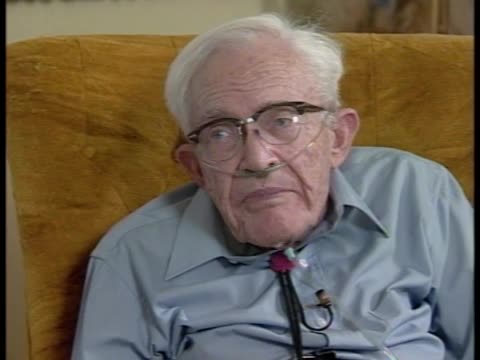
- This episode is dedicated in memoriam to Clyde Tombaugh (1906-1997). Host Ernie Mills sits down with professor Clyde Tombaugh to discuss his background, some of his career highlights, and his work at New Mexico State University.
- Series Description
- Hosted by veteran journalist and interviewer, Ernie Mills, Report from Santa Fe brings the very best of the esteemed, beloved, controversial, famous, and emergent minds and voices of the day to a weekly audience that spans the state of New Mexico.
- Broadcast Date
- 1996-07-13
- Asset type
- Episode
- Genres
- Interview
- Media type
- Moving Image
- Duration
- 00:28:33.000
- Credits
-
-
Guest:
Tombaugh, Clyde William, 1906-1997
Host: Mills, Ernie
Producer: Ryan, Duane W.
Producing Organization: KENW-TV, Eastern New Mexico University, Portales, New Mexico
- AAPB Contributor Holdings
-
KENW-TV
Identifier: cpb-aacip-2e881bfdfd4 (Filename)
Format: 1 inch videotape
Generation: Master
Duration: 00:27:06
If you have a copy of this asset and would like us to add it to our catalog, please contact us.
- Citations
- Chicago: “Report from Santa Fe; Clyde Tombaugh,” 1996-07-13, KENW-TV, American Archive of Public Broadcasting (GBH and the Library of Congress), Boston, MA and Washington, DC, accessed May 12, 2026, http://americanarchive.org/catalog/cpb-aacip-6d78727dc05.
- MLA: “Report from Santa Fe; Clyde Tombaugh.” 1996-07-13. KENW-TV, American Archive of Public Broadcasting (GBH and the Library of Congress), Boston, MA and Washington, DC. Web. May 12, 2026. <http://americanarchive.org/catalog/cpb-aacip-6d78727dc05>.
- APA: Report from Santa Fe; Clyde Tombaugh. Boston, MA: KENW-TV, American Archive of Public Broadcasting (GBH and the Library of Congress), Boston, MA and Washington, DC. Retrieved from http://americanarchive.org/catalog/cpb-aacip-6d78727dc05