Moments in Time: Stories of New Mexico's History; 100 Years Ago: New Mexico's Early Film History
- Transcript
>>Narrator: On the 100th anniversary of New Mexico's statehood it is fascinating to journey back tosee what New Mexico was like a century ago. Filmmaking came here at the same time as Statehood andearly films provide an opportunity to travel back to 1912 when the Land of Enchantment became the 47th state. Perhaps these movies are the closest thing we have to a time machine. >>Thanks to the railroad and the introduction of the automobile, at the beginning of the 20th century, New Mexico was no longer remote beyond compare. The state was being promoted and as some might say exploited as an exotic land and place of opportunity. Promoters saw our distinct history, diversecultures, and dramatic landscape as a tremendous lure. Unfortunately, these complex elements were often distilled
into a single, easy to grasp message. >>From today's perspective it is indeed intriguing to see the New Mexico of the early 20th century. It's equally revealing to see the obvious naivete and cultural insensitivity of the time. >>Today we like to talk of all the great movies made in New Mexico. It was in 1912 however Hollywood's elite first arrived. Legendary filmmaker D.W. Griffith produced New Mexico's first two-reeler motion picture A Pueblo Legend starring of all people Mary Pickford. The other star of the film was thelocation. The great director Griffith said "Isleta Pueblo offered some of the finest scenic opportunities ever put into a picture." >>The story takes place
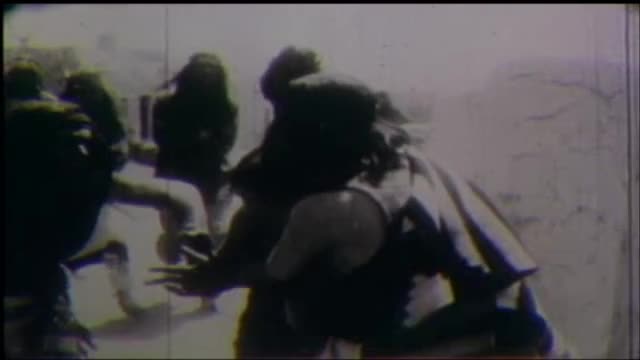
in what the film describes as a mystical and primeval setting before the coming of the Spaniards. A handsome war captain Great Brother is sent on a quest to find the Sky Stone of Happiness. A Hopi Maiden, played by Pickford falls in love with Great Brother. >>On his quest Great Brother encounters enemy Apaches and a dramatic battle ensues. >>Eventually it is our heroine Mary Pickford who saves Great Brother and finds the stone of happiness. >>The overt theatricality and the way Native Americans were portrayed in the film offended Isleta residents and Griffith was actually detained at the Pueblo for a few hours.
>>At the end she and Great Brother are finally united, wrapped together in a wedding blanket. >>Albuquerque's sensational trackside Alvarado Hotel was a huge draw for railroad travelers and filmmakers. In 1912 Mack Sennett soon to be of Keystone Kops fame and one of early Hollywood's most prolific filmmakers stopped in Albuquerque to make The Tourists - a short comedy of errors. With the Alvarado and Old Town as backdrops, a party of tourists, take advantage of the short stop to admire the work of Indian sellers. Distracted with buying, Trixie, played by Mabel Normand, and her friends miss their train and Trixie wanders off to do some sight-seeing. >>She asks a local chief to give her a tour. >>Much to the displeasure of his wife.
>>Trixie is in hot water and the chase is on. >>But, it all ends well. She hops onboard the eastbound train waving fair-well to Albuquerque. >>For sheer bravado, no early New Mexico film compares to the 1913 classic The Rattlesnake. The writer, producer, director, and star was the then famous and now forgotten Romaine Fielding. In 1913 fans voted the flamboyant Fielding to be Hollywood's most popular actor. In 1914 a disastrous fire at the Lubin film company incinerated the majority
of Fielding's films and along with them his place infilm history. He made The Rattlesnake in Las Vegas, New Mexico after making films in Silver City. The Las Vegas Optic newspaper reported Fielding left Silver City saying there was nothing left to blow up. >>The Rattlesnake is a tale of obsession. A critic of the time said Fielding's performance personified the venom of jealousy. In the film, Fielding plays Tony, whose former love, the beautiful Inez, marries a surveyor and has a family. Tony goes from being a carefree Vaquero to a man insane with jealously. To seek revenge he takes up with an unusual conspirator - a rattlesnake. At the climax of the film, Fielding places the rattlesnake in the surveyor's bed. Unexpectedly the surveyor's child gets into the bed. Seeing his plan has gone
tragically wrong, Fielding rushes in and saves the child. Killing the snake, his sanity returns. >>That same year Romaine Fielding outdid himself. In the hills above Las Vegas he produced his futuristic blockbuster The Golden God. Set in the 1950's, labor and the consolidated wealth of the world controlled by the Golden God are at war. He recruited thousands of locals for extras and brought thefirst airplanes to NM to take part in the battle scenes. Unfortunately, no copy of this film has been found. The Rattlesnake is one of the very few remaining examples of Fielding's work. >>Shifting gears, the theme of the 1917 Adventures in Kit Carson Land is discovering
northern New Mexico through something that was quite novel and adventurous at the time an automobile trip. Hopingto capitalize on the national craze for automobile touring, this was the first film produced by theNew Mexico Tourist Promotion Bureau. Which notes the Greatest Scouts and Indians fighters blazed a trail for tourist and home builder of today. >>Although a tourist film, it gives us a remarkable look at turn-of-the-century northern NM. Careening through rugged mountain roads, negotiating the Rio Grande gorge, truly gives us a sense of the difficulty of these early trips north. >>It is fascinating to actually drive into Taos plaza, dodging carriages and covered wagons. It is astep back in time. >>Promoting New Mexico was
the goal of the ambitious 1915 Panama- California Exposition film that documented communities across the state as modern places with abundant resources. >>Around New Mexico parades were the rage, like this one where proud Albuquerqueans show off their finest, including the latest in modern living such as electricity. To wow the crowds, the fire department charges down Central Avenue in a dramatic exhibition run. >>In the Mimbres Valley near Deming, a procession of farming equipment travels into the fields. Gigantic combustion engine tractors look like bizarre mechanical beasts towering above the following work horses and mules. >>Electric pumps drew 2000 gallons of water per minute from the ground to feed new fields of alfalfa, beans,
cotton, and other crops. It was important to show that New Mexico was no longer a desert and with use of with modern technology water was plentiful. Indeed farming was now possible on an unprecedented scale and one could prosper. No wonder why the folks in the film are happily dancing between rows of crops in their well irrigated fields. >>And to end this journey back in time, we see New Mexico was indeed a place of the future. In 1902 Tucumcari was little more than a railroad camp made up of tents. In this 1917 film we meet schoolchildren in front of their new school. Dressed in bright, new clothes, they are cheerfully
waving handkerchiefs, heralding great beginnings and a bright future.
- Producing Organization
- KNME-TV (Television station : Albuquerque, N.M.)
- Contributing Organization
- New Mexico PBS (Albuquerque, New Mexico)
- AAPB ID
- cpb-aacip-682178e24a3
If you have more information about this item than what is given here, or if you have concerns about this record, we want to know! Contact us, indicating the AAPB ID (cpb-aacip-682178e24a3).
- Description
- Episode Description
- Moments in Time: Stories of New Mexico’s History looks back at New Mexico’s early film history on its 100th anniversary as a state. New Mexico’s evolution and its growth are shown through films, photographs, and maps.
- Created Date
- 2011
- Asset type
- Episode
- Genres
- Miniseries
- Topics
- Education
- Media type
- Moving Image
- Duration
- 00:11:06.066
- Credits
-
-
Producer:
Kamins, Michael
Producing Organization: KNME-TV (Television station : Albuquerque, N.M.)
- AAPB Contributor Holdings
-
KNME
Identifier: cpb-aacip-7b1c0090e6f (Filename)
Format: XDCAM
If you have a copy of this asset and would like us to add it to our catalog, please contact us.
- Citations
- Chicago: “Moments in Time: Stories of New Mexico's History; 100 Years Ago: New Mexico's Early Film History,” 2011, New Mexico PBS, American Archive of Public Broadcasting (GBH and the Library of Congress), Boston, MA and Washington, DC, accessed September 29, 2026, http://americanarchive.org/catalog/cpb-aacip-682178e24a3.
- MLA: “Moments in Time: Stories of New Mexico's History; 100 Years Ago: New Mexico's Early Film History.” 2011. New Mexico PBS, American Archive of Public Broadcasting (GBH and the Library of Congress), Boston, MA and Washington, DC. Web. September 29, 2026. <http://americanarchive.org/catalog/cpb-aacip-682178e24a3>.
- APA: Moments in Time: Stories of New Mexico's History; 100 Years Ago: New Mexico's Early Film History. Boston, MA: New Mexico PBS, American Archive of Public Broadcasting (GBH and the Library of Congress), Boston, MA and Washington, DC. Retrieved from http://americanarchive.org/catalog/cpb-aacip-682178e24a3